
InspectAPedia® FREE Encyclopedia of Building & Environmental Construction, Diagnosis, Maintenance & Repair |
Question? Just ask us! InspectAPedia
|
 Indoor Mold Contamination
Home Page & Index to Articles
- POST a QUESTION or COMMENT about how to find, test for, remove, clean up and prevent mold contamination in buildings
The building mold contamination articles at this website answer just about anything you want to know about mold contamination in buildings: how to find, test, remove, clean-up or prevent indoor mold contamination.
These mold-action & indoor environment investigation & cleanup articles provide expert, unbiased information for owners, occupants, inspectors.
InspectAPedia tolerates no conflicts of interest. We have no relationship with advertisers, products, or services discussed at this website.
How to Find, Test, Inspect For, Remove, & Prevent Indoor Mold Contamination: what to do about mold in buildings
 This complete guide to building mold contamination discusses the following in depth:
- How to recognize mold
- How to test for unsafe mold
- How to clean up or remove mold
- How to prevent mold contamination in buildings
- What mold related illnesses and symptoms have been reported
- How to deal with mold related illness
- What to do about black mold and other indoor air quality (IAQ) contaminants
We give detailed and authoritative information and procedures for finding, testing, cleaning and preventing indoor mold, toxic black mold, green mold, testing building indoor air quality, and other sick house / sick building investigations.
[Click to enlarge any image]
We also provide research articles on mold hazards and on the accuracy and reliability of various mold testing methods. We suggest the most effective building inspection and testing procedures for mold and similar indoor contaminants, and we provide a directory for expert services.
We give in-depth information about mold and other indoor air quality problems: causes of respiratory illness, asthma, or other symptoms such as neurological or psychological problems, air quality investigation methods, and remediation procedures such as mold cleanup, handling toxic mold contamination, and building or mechanical system repairs.
We offer advice on mold prevention and mold-resistant construction resistant to indoor problem molds such as the Aspergillus sp., Penicillium sp. and Stachybotrys chartarum groups.
To find what you need quickly, if you don't want to scroll through this index you are welcome to use the page top or bottom SEARCH BOX to search InspectApedia for specific articles and information.
Article Series Contents
- MOLD CONTAMINATION IN BUILDINGS - home - how to find, test for, remove, clean up and prevent mold contamination in buildings
- SIX BASIC APPROACHES - for Cleaning Up Indoor Air
- DETAILED ADVICE - articles on how to find, test, clean up, remove, & prevent indoor mold contamination
- DO YOU NEED TO HIRE AN EXPERT - bring in a mold remediator, hire a handyman, or clean up for yourself?
- MOLD RELATED ILLNESS - asthma, allergies, lung, neurological, IAQ complaints?
- HOW TO PREVENT MOLD GROWTH - & avoid mold problems in buildings
- MOLD CONTAMINATION DETECTION - & mold identification photos & tips
- MOLD TEST PROCEDURES - valid and in-valid mold testing methods & protocols. Are some mold test kits junk science?
- MOLD CONTAMINATION in BUILDINGS, FAQs - questions & answers about mold contamination in buildings and when should we test, clean-up, or move
- MOLD DOCTORS - ENVIRONMENTAL MEDICINE - how to find a physician who's expert in mold-related illness
- MOLD / ENVIRONMENTAL EXPERT, HIRE? - when should you hire someone, and how to be sure you hire someone with the right expertise.
Don't rely on "mold tests" alone without an expert visual inspection that produces a report telling you if there is a mold problem, if so where it is, how big it is, and what cleanup is needed, and finally what steps should be taken to prevent future mold growth in the same building.
Six Basic Approaches for Cleaning Up Indoor Air, Mold Contamination, or Similar Indoor Air Quality Problems
The US EPA lists six basic strategies for reducing the level of indoor air pollutants.[5]
These six approaches
- source management (removal, substitution, encapsulation)
- local exhaust
- ventilation
- exposure control
- air cleaning/filtration
- education
We list and describe these approaches just below, followed by descriptions of key indoor mold contamination articles.
1. Source Management of indoor air contaminants such as mold and MVOCs
The US EPA describes three indoor air pollutant source management approaches:
- [Mold] Source removal:
For mold contamination, cleanup or removal is the most effective method.
See MOLD CLEANUP GUIDE- HOW TO GET RID OF MOLD
But if you don't yet have a mold problem, or even after cleaning up a mold problem, preventing mold problems in the first place is still better.
See MOLD PREVENTION GUIDE
For toxic, allergenic, or pathogenic mold contamination in buildings, this step is by far the most important.
The location of both visible and hidden mold reservoirs must be found, and problematic (non-cosmetic) mold cleaned-up or in essence "removed".
Any step other than cleaning off or removing mold, such as use of mold sprays, air cleaners, ozone generators, will be comparatively ineffective, and worse, by making you think the mold problem has been handled, you may be fooled into leaving harmful mold in the building.
See warnings at OZONE TREATMENT WARNINGS
If you suspect or know that there is a mold problem in a building, you need to know the extent of cleanup needed, whether mold is cosmetic (inexpensive to clean), allergenic, or toxic (requiring special care).
For small areas of mold contamination, generally where less than 30 square feet of contiguous mold is present, simple building cleaning and renovation procedures are all that's needed and testing is usually not appropriate. Most building mold contamination falls in this category.
At DO IT YOURSELF MOLD CLEANUP we provide suggestions for a do-it-yourself cleanup of small areas of mold.
Also see ACTION GUIDE - WHAT TO DO ABOUT INDOOR MOLD
and MOLD CLEANUP GUIDE- HOW TO GET RID OF MOLD
You need to know whether or not to hire a professional to inspect, test, find the mold, and write a cleanup plan, whether or not to hire a mold cleaning company, how to clean up mold, how to test to be sure the cleanup was successful, and how to prevent mold in the future.
At MOLD / ENVIRONMENTAL EXPERT, HIRE? we provide guidelines to help decide when it is probably justified to bring in a mold expert to perform mold inspection and testing in a building. - [Mold] Source substitution:
This approach to IAQ contaminants refers to selecting a less toxic material, such as low-VOC paints. IAQ problem source substitution may pertain to mold remediation in selection of encapsulants but otherwise it is less significant than source removal. - [Mold] Source encapsulation:
This approach to IAQ pollutant management, where the contaminant is mold, might include the use of encapsulant sprays or coatings to immobilize mold or dust particles that remain on surfaces after cleaning.
Encapsulation is not usually a good substitute for mold removal. More subtle is the question of the priority of removing toxic or allergenic or pathogenic mold contamination suspected to be inside of a building cavity such as an enclosed wall or ceiling.
Self-encapsulated mold contamination, a term we invent for this discussion, refers to a building mold reservoir that appears to be enclosed in a wall, ceiling, or floor cavity such that one might suspect that the mold is not affecting building occupants.
Watch out: these apparently "self-encapsulated" mold problems in building cavities are often not as benign as we might wish.
As the building environment varies in temperature, moisture, light, and air movement, a presumed "self-encapsulated" mold reservoir may indeed release problematic levels of mold spores or MVOCs into building air.
However, in our opinion, while self-encapsulated mold reservoirs in a building should be removed and the cause of the mold growth should be found and corrected, if the self-encapsulated mold reservoir does not appear to be affecting the rest of the building, the remediation might be handled as a non-emergency.
But don't wait to find and fix building leaks that may not only be causing hidden mold contamination but also building rot or other problems.
2. Local Exhaust of contaminated or moldy indoor air or of other indoor air pollutants
Local exhaust during mold cleanup is also a critical step in controlling the movement of moldy dust during a mold cleanup project in a building.
By using air handlers that in essence blow indoor air from the mold remediation work-space outdoors, we assure that air pressure inside the mold-contaminated area is lower than air pressure in nearby building areas.
This pressure difference can prevent cross-contamination of moldy dust and debris from the mold area into other building areas.
Emergency local exhaust in a mold contaminated building can be installed promptly on the discovery of a large problem mold reservoir using fans to blow indoor air from the moldy area and moldy odors outdoors. This step is not, however, a substitute for cleaning and removing the problem mold.
Also see MVOC TESTING
Watch Out: local exhaust is not an effective remedy for indoor mold contamination - the mold must be removed. And local exhaust can interfere with the safe operation of heating appliances by creating backdrafting
See BACKDRAFTING HEATING EQUIPMENT
that in turn can cause dangerous, even fatal carbon monoxide hazards
See CARBON MONOXIDE - CO EXPOSURE
Local exhaust can also cause unanticipated movement of other remote indoor air pollutants (mold, gases, or other problems) through various building areas.
Local exhaust is effective in removing "point sources" of indoor air pollutants such as temporary VOC contamination from indoor painting or odors from kitchens and bathrooms.
or
In other cases it is important to identify and fix the source of building odors
see ODORS GASES SMELLS, DIAGNOSIS & CURE
especially if potentially toxic or explosive gases are present including
HYDROGEN SULFIDE GAS
Also see TOXIC GAS TEST PROCEDURES.
3. Ventilation of the building to dilute contaminated indoor air
Ventilation uses fresh outdoor air to dilute polluted indoor air in buildings. While national and local building codes provide specifications for the amount of fresh air needed or recommended in buildings, ASHRAE and EPA standards typically give 15 cmf of fresh air per person as a benchmark.
Increased building fresh air ventilation is needed for special situations such as during painting or floor refinishing.
At VENTILATION in BUILDINGS we provide in depth information about building intake, balanced, and exhaust fresh air ventilation systems.
4. Exposure Control to reduce the impact of moldy or contaminated indoor air
Exposure control as a means of controlling the impact on people of contaminated indoor air refers to limiting the amount of time that people spend in suspect or known contaminated areas. Actually all of the indoor air pollutant and mold contamination control strategies impact the level of exposure of building occupants.
Watch out: individual sensitivity to mold, MVOCs or other indoor pollutants varies widely, so even if some building occupants appear not to be bothered by indoor mold contamination, that same indoor mold level could be very serious for others.
At an audiology clinic we investigated, the staff had no indoor mold complaint, even though they knew that extensive mold growth was visible over a suspended ceiling in the offices. But when an asthmatic client entered for a hearing test, he experienced a very serious reaction to the indoor mold levels.
5. Air Cleaning / Filtration to reduce the impact of indoor mold or other air pollutants
Air cleaning or indoor air filtration is a useful strategy in general in buildings where it is desirable to reduce the level of indoor dust and in some cases with specialized filters, odors as well.
See details at AIR FILTERS for HVAC SYSTEMS
and at CONTINUOUS BLOWER FAN OPERATION
Watch out: air cleaners or purifiers are not a substitute for removing a problematic indoor mold reservoir, and portable air cleaners in general are not capable of effectively cleaning and making safe the air supply in a building.
Details are at AIR CLEANER PURIFIER TYPES
6. Education of building owners and occupants to control indoor mold problems or other indoor air pollutants
Where a building has or might have a significant indoor mold contamination problem, building owners and managers as well as occupants benefit from knowing
- How to set priorities of attention - what tasks should be addressed first. Mold test results may be of assistance to physicians if mold related illness or other illnesses are involved.
See MOLD or INDOOR AIR EMERGENCY RESPONSE - When a mold problem is serious enough to merit hiring a professional versus when it is appropriate for building owners or occupants to simply clean up the mold themselves.
See MOLD / ENVIRONMENTAL EXPERT, HIRE? - When mold testing is useful and when it is unnecessary.
At MOLD TEST REASONS we discuss medical and other more basic reasons to test for mold in buildings.
Watch out: mold "tests" may be inaccurate and without an expert building inspection mold tests alone are not a reliable means of characterizing mold risk at a building.
The "MOLD ACTION GUIDE" contains sufficient information to address these questions. This website offers more in-depth articles on these and related environmental and indoor air quality topics.
Helpful Articles Offering Detailed Advice on How to Find, Test, Clean up, Remove, & Prevent Indoor Mold Contamination
For advice concerning all other indoor and building-related environmental and health hazards
see ENVIRONMENTAL HAZARDS - INSPECT, TEST, REMEDY.
Mold Contamination Articles:
- MILDEW in BUILDINGS ? - does mildew grow in buildings or on building surfaces?
What to do about mildew: mildew cleanup, mildew cure, mildew prevention, mildew in buildings vs. mildew on plants. - MOLD AGE DETERMINATION - how old is the mold in a building?
Also see MOLD ACTIVITY in BUILDINGS - is it active mold growth? - MOLD ACTION GUIDE: follow this easy step by step outline of what to do about mold.
We emphasize that for small areas of mold contamination, generally where less than 30 square feet of contiguous mold is present, simple building cleaning and renovation procedures are all that's needed and testing is usually not appropriate.
Most building mold contamination falls in this category.
At DO IT YOURSELF MOLD CLEANUP we provide suggestions for a do-it-yourself cleanup of small areas of mold. - MOLD CLEANUP GUIDE - how to clean up mold or remove mold in buildings.
- MOLD CLEANUP COMPANIES - companies offering mold remediation services.
- MOLD DETECTION - articles on mold identification photos and tips - how to find and recognize mold in a building - articles describing how to find problem mold. Also
see MOLD APPEARANCE - WHAT MOLD LOOKS LIKE
- MOLD / ENVIRONMENTAL EXPERT, HIRE ? - decide when it is probably justified to bring in a mold expert to perform mold inspection and testing in a building.
MOLD TEST REASONS - when it is appropriate to test for mold. - MOLD GROWTH on SURFACES - index to photographs and names of mold genera/species are frequently found on various building surfaces and materials
- MOLD TEST KITS - how to collect and send your own mold sample to our mold testing lab.
Watch out: in most situations you do not need to test to identify mold: knowing the mold genera/species won't change the cleanup needed one bit. - MOLD RESISTANT CONSTRUCTION - how to prevent mold growth in buildings.
- FREQUENTLY ASKED QUESTIONS ABOUT MOLD - this detailed list answers most questions about mold.
- MOLD ACTION GUIDE after a FLOOD - how to minimize mold damage after a building flood
- MOLD ODORS, MUSTY SMELLS - what causes moldy smells in buildings?
Also see SMELL PATCH TEST to FIND ODOR SOURCE - ODORS, ODOR DETECTION, SMELLS, & GASES - how to find and identify sources of noxious or toxic odors and gases.
- ONLINE ATLAS of INDOOR MOLD - CLINICAL ATLAS - of Indoor clinical mold, pathogens, allergens and other indoor particles
- RENTERS & TENANTS - how can a tenant deal with a moldy rental apartment or rental home.
- SALVAGE BUILDING CONTENTS - how to sort & clean wet or moldy building contents.
- SERVICE: FIELD INSPECTION & TESTING for MOLD
- SERVICE - IN-HOUSE MOLD TEST LAB
- WHEN TO STOP LOOKING FOR MOLD - how do we know when enough mold remediation or mold cleanup has been done? Also see these related articles:
HIRE AN EXPERT - Do you need to hire a mold expert, bring in a mold remediator, hire a handyman, or clean up for yourself?
Readers should see WHEN TO HIRE A MOLD EXPERT for details about how to decide when hiring a mold expert is justified and appropriate.
See MOLD INSPECTORS & MOLD TESTERS for a list of mold investigators whose work is familiar to us. Other mold investigators and test consultants may also be competent and qualified.
- WHEN to HIRE a PROFESSIONAL - to inspect, test, write a cleanup plan
- FIND a MOLD INSPECTOR - a directory of well qualified mold/IAQ service providers
- ASSOCIATIONS, ENVIRONMENT & IAQ - sick house, sick building, SBS - air quality, government, private associations and information resources.
- MOLD CLEARANCE INSPECTIONS - when & how to perform a mold remediation clearance inspection
- MOLD LEVEL REPORTS - reporting the results of mold and IAQ investigations & clearance inspections: what should be included.
- OUR FIELD INVESTIGATION SERVICE - We are NOT available for hire, but sometimes can provide limited pro-bono consulting - our senior expert goes (or actually went before he retired) where no one else wanted to look, uses non-invasive tools and sophisticated testing equipment for mold, gases, moisture, air quality, contaminants, building problem diagnosis.
- AIHA MOLD RESOURCE CENTER [website - this link leaves InspectApedia.com] American Industrial Hygiene Association - lists agencies in North America
Web page excerpt: A number of agencies have guidelines that include protective measures for mold remediation and cleaning. However, when significant mold or other sewage contamination has occurred, it is recommended that business and homeowners seek professional guidance before attempting to clean large amounts of contaminated materials. Industrial hygienists and other safety and health professionals can anticipate health and safety concerns and design solutions to prevent exposures using guidelines established by governmental agencies and institutions such as the Institute of Inspection Cleaning and Restoration Certification.
MOLD RELATED ILLNESS - Asthma, Allergies, Lung, Neurological, Other Complaints?
The following articles provide detailed information about mold-related illnesses.
- ALLERGEN TESTS in BUILDINGS - advice about how to test and what to look for in evaluating the level of dog, cat, or other animal allergens in a building
- ANIMAL ALLERGENS - dog, cat, and other animal dander - cleanup & prevention information for asthmatics and regarding indoor air quality.
- ASBESTOS IDENTIFICATION IN BUILDINGS - provides a detailed guide to recognizing asbestos-containing materials in buildings and links to in depth articles about individual asbestos-containing building materials
- ATLAS of MOLD RELATED ILLNESS SYMPTOMS & COMPLAINTS - incredibly long list
- CAT DANDER - how to inspect and test a building for past or current presence of cats, cat hair, cat dander, and cat allergens
- CLINICAL ATLAS of MOLD TOXICITY - an online description of toxic, pathogenic, allergenic fungi, fungal diseases
- FIBERGLASS INSULATION, MOLDY © 2005 - comments about a field study in process, & more about health hazards from fiberglass insulation - DJF
- Legionella BACTERIA & HVAC EQUIPMENT - Legionnaires' disease hazards from bacterial growth in HVAC systems and in hot water heating systems, tanks, geysers & cylinders
- MOLD CLINICAL REFERENCE TEXTS - texts on mold related illness, mold identification, mold pathology and toxicology
- ODORS, ODOR DETECTION, SMELLS, & GASES - how to find and identify sources of noxious or toxic odors and gases
- OTHER ENVIRONMENTAL RISKS - our much longer list: asbestos, carbon monoxide, electromagnetic fields, etc.
- POLLEN ALLERGENS - identification, photographs of pollen under the microscope and on plants
- PRODUCTS to REDUCE MOLD & ALLERGY PROBLEMS - to reduce indoor mold or allergen levels: air cleaners, air purifiers, dust mite covers, vacuum cleaners, crawl space vents
- RECOGNIZING ALLERGENS - what various indoor allergens look like - identification photos to help identify pollen, dust mites, animal dander, toxic or allergenic mold - common mold and other allergens, irritants, remedies & advice
- Rodent control issues, including dander, fecal, and urine contamination of buildings and building insulation are discussed at
our MOLD ACTION PLAN page
and
at CRAWL SPACE CLEAN UP where we discuss use of rodenticides, mouse or rat infestations, etc. - SEWAGE & SEPTIC BACKUP CONTAMINATION in BUILDINGS - inspection, testing, remediation, & references to expert sources
PREVENT MOLD - How to Prevent Mold Growth and Avoid Mold Problems in Buildings
The following articles provide detailed information about how to prevent mold growth in buildings and in their mechanical systems:
- BUILDING FLOODS - quick steps after a building flood or plumbing leak can prevent costly mold contamination
- MOLD ACTION GUIDE AFTER a FLOOD - how to minimize mold damage after a building flood
- HOW TO PREVENT MOLD - how to avoid mold growth in buildings: priorities, repairs, products
- HUMIDITY CONTROL to AVOID MOLD - how low should you keep indoor humidity to avoid a mold problem
- MOLD-RESISTANT BUILDING PRACTICES - some detailed suggestions from an expert on preventing mold growth indoors
- OZONE WARNINGS - use of ozone as a "mold" remedy is ineffective and may be dangerous
- MERULIPORIA INCRASSATA - "Poria" the house eating fungus Meruliporia incrassata or perhaps a different mold, Serpula lacrymans - which one is the "house eating fungus" - what is house rotting mold like in a building and under the microscope
MOLD DETECTION - Mold Identification Photos and Tips
These articles explain how to find and recognize mold in a building. The articles include mold recognition photos, methods of visual inspection for mold, and explanation of how to cut your mold investigation cost and trouble by learning to recognize stuff that is not mold at all. We also explain that not all black mold is harmful. Some is cosmetic only. Visual inspection can answer some of these questions without mold testing.
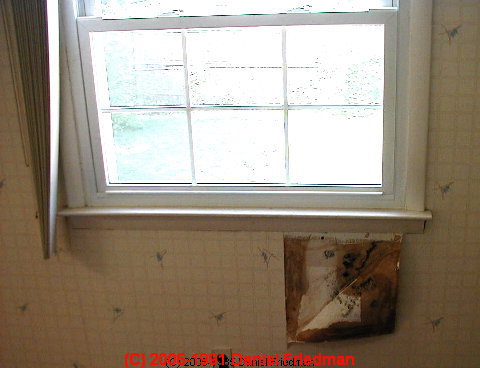
- HOW to FIND & TEST for MOLD IN BUILDINGS - looking for mold - a "how to" photo and text primer on finding and testing for mold in buildings
- CHOOSING a MOLD TEST SAMPLE POINT - to conduct a mold test
- SAMPLING DRYWALL - for mold
- MOLD TESTING & SAMPLING MISTAKES - when conducting a mold test
- ATTIC MOLD - how to recognize mold in an attic, when is it a problem?
- BASEMENT MOLD - how to recognize mold in a basement, is it a problem?
- BASKETBALL MOLD SYNDROME - BBMS - sudden attention to old clues in buildings makes them seem brand new to some observers
- CRAWLSPACE MOLD - how to recognize mold in a crawl space, where will it be, is it a problem?
- DO-IT-YOURSELF MOLD CLEANUP WARNINGS - for people inspecting and testing for toxic mold
- MOLD ON DIRT FLOORS - in basements and crawl spaces
- MOLD on or in CARPETS - where to look for mold on and under carpeting
- MOLD GROWTH on SURFACES, TABLE OF - table of common molds found on building surfaces
- MOLD GROWTH in/on BUILDING INSULATION - possible hidden reservoirs of mold in fiberglass or on other insulating products that have been wet or damp
- HIDDEN MOLD LIST - a list and photos of other places to look for hidden or hard to spot mold contamination in buildings
- HIDDEN MOLD PHOTO GUIDE - shows how to find hidden toxic or even simply cosmetic mold in buildings
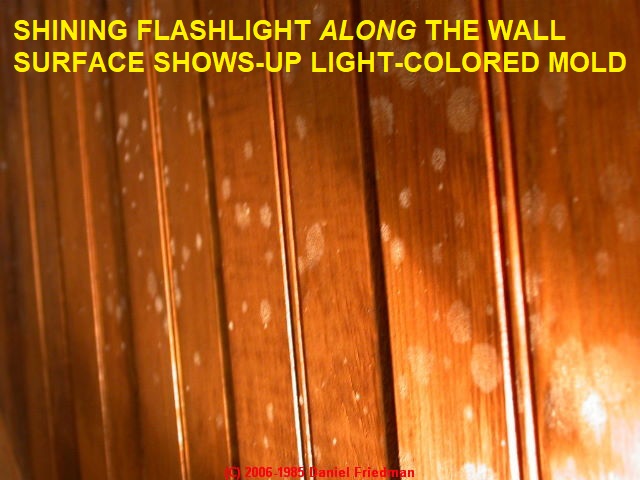
- WHAT DOES MOLD LOOK LIKE? - mold spores in the home - a photo ID library for detection and identification of mold allergens
- STUFF THAT is NOT MOLD - but is often mistaken for it - things you may not want to test. Not all "black mold" is toxic or harmful.
- TRAPPED MOLD BETWEEN WOOD SURFACES - do we need to look for, find, remove, or try to kill mold on mating wood surfaces such as between floor joist tops and subfloor underside, or between a wall sill plate and the subfloor surface?
What about between layers of wood flooring and subflooring? - LIGHTING, PROPER USE of - discloses hard to see but toxic light or white mold colonies on building surfaces - read this if you're doing your own tape sampling for mold.
- LIGHT, PROPER AIM to FIND MOLD - proper use of a flashlight can help spot mold on paneling and other building surfaces
- MOLD INVESTIGATION TIPS - for Home Inspectors & Mold Inspectors on how to find mold, where to look, what is likely to be important
Advice to Building Inspectors intending to inspect or test for toxic or problematic mold indoors, mold inspection methods, and mold test methods which are valid or invalid - MOST COMMON INDOOR MOLDS - a table of the mold genera/species most often found in buildings
- MERULIPORIA INCRASSATA - the house eating fungus or "poria" may be mistaken for wood rot
MOLD TEST PROCEDURES - Valid and invalid mold testing methods & protocols. Are some mold test kits junk science?
Please see MOLD SAMPLING METHODS in the INDOOR ENVIRONMENT and in addition, the mold test critique articles listed just below.

HOW to SEND a MOLD SAMPLE to A Lab: 6 Easy Steps - for a mold test:
How to collect mold samples using adhesive tape and plastic bags - a low-cost high-quality and very easy method to send a mold sample to a mold laboratory for analysis Use this simple, economical mold test kit by following our instructions on how to collect and mail mold samples to a lab.
At MOLD TEST REASONS we discuss when it is appropriate to test for mold.- VALIDITY of COMMON MOLD SAMPLING or TESTING TECHNIQUES
- TAPE MOLD TESTS: DUST or MOLD SAMPLES on TAPE - "bulk" or "tape" samples of dusty or moldy surfaces & their interpretation - a brief tutorial
- TAPE SAMPLES: HOW to REPORT MOLD CONTAMINATION LEVELS - in tape samples of surfaces in buildings
- AIR SAMPLES: MOLD TESTING - samples & their interpretation
- a brief tutorial on indoor air sampling for mold - are spore counts per cubic meter of air accurate and valid? Using air sampling to determine if a mold problem is "present" or "absent" and the role of cultures for "viable spore sampling" are criticized.
Air sampling used alone is an unreliable way to look for mold and is highly questionable as a means of characterizing a precise mold exposure level indoors. - CARPET MOLD CONTAMINATION TEST GUIDE - suggestions for alternative methods to test carpeting for mold
- CULTURE TESTS for MOLD CONTAMINATION - & "Home Test Kits for Mold" - validity of settlement plates or swabs to test for toxic mold in buildings - a brief tutorial
- MOLD SAMPLING METHODS IN THE INDOOR ENVIRONMENT - a critique of popular mold testing methods - Is your "expert" using valid methods? Is your mold test kit worth the bother? (Technical Paper.)
- Also see QUESTIONING the VALIDITY OF CERTAIN INDOOR MOLD SAMPLING TECHNIQUES, [Power Point Presentation] Daniel Friedman, (Illustrated Power Point Presentation) 15th Annual North Carolina/South Carolina Environmental Association Technical Conference
- TOXIC MOLD TESTING METHODS COMPARED - also toxic gas testing methods and MVOC's - valid vs. invalid methods, recommendations compares air sampling for mold, surface or tape sampling for mold, culture or swab sampling for mold, and gas MVOC sampling methods for mold or other toxins, and organizes links to papers on each of these topics
- A Comparison of Some Indoor Air Sampling Devices - simultaneous application of popular sampling cassettes and slide samplers allows comparison of typical particle collection variation by device in actual field use. A field study by DJF, 2008 - 2005 (Technical Paper)
See MOLD TEST PROCEDURES and
MOLD CULTURE SAMPLING METHOD
SWAB & PCR SAMPLING & TESTS for MOLD
TAPE & BULK SAMPLING & TESTS for MOLD
- Burkard personal air sampler used by many residential investigators (we use multiple units simultaneously in some investigations).
We also employ other residential building sampling equipment for surface, air, vacuum, and bulk sample collection methods as well as for gases. - Alternative, low-cost air sampling equipment and methods such as the mini-vacuum pump and Zefon Air-o-Cell or Allergenco-d cassettes or MCE filter cassettes for viable, non-viable or other forensic particle identification in buildings. A field study by DJF, 2005 - 2006 (Technical Paper)
See AIRBORNE PARTICLE TEST SAMPLING CASSETTE STUDY
Also see TECHNICAL & LAB PROCEDURES.
- Allergenco Mk-III time-lapse impaction air sampling equipment - study changes in particle dispersion under varying conditions (furnace on/off) - Field study by DJF, 2004 - 2010 (Technical Paper)
See
AIRBORNE PARTICLE COUNT VARIATION CAUSES
AIRBORNE PARTICLE COUNT VARIATION EXTENT
AIRBORNE PARTICLE COUNTS vs SAMPLER HEIGHT
AIRBORNE PARTICLE COUNTS vs WINDOWS, DOORS
AIRBORNE PARTICLE COUNTS in DUCTWORK
MOLD CULTURES - Validity and Usefulness of Mold Cultures & Culture-Based Home Test Kits for mold
For a quick to understand overview of the validity and usefulness or perhaps not-usefulness of culture tests for mold, see
VALIDITY of MOLD CULTURE TESTS - (settlement plates or swabs) used to find toxic mold in buildings which is an overview and critique of using mold cultures, settlement plates, petri
dishes, and cultured swab samples, and air sample testing limitations for determining what's in a building, and which tests are useful in different situations.
For more thorough detail see
SHORTCOMINGS of MOLD CULTURE TESTS which lists a number of detailed concerns about viable spore traps and culture media for Building problem detection.
MOLD CLASSES, LEVELS - Mold Hazard levels, Mold Spore Count Validity, Interpreting Mold Counts, and Classes of Mold
Please see MOLD CLASSES, LEVELS for the full text article on this topic.
- AIRBORNE MOLD SPORE COUNTS - air tests for mold - airborne mold spore counts - are indoor fungal spore counts valid?
- MOLD EXPOSURE STANDARDS - exposure standards for mold, levels of severity of indoor mold contamination - various published standards of permissible mold exposure limits: at what level is toxic or allergenic mold a problem? - What does your "spores per cubic meter of air" or "spore count" really mean - if anything?
- MOLD EXPOSURE RISK LEVELS - how to determine mold contamination probability or mold exposure risk levels in buildings based on visual inspection
- MOLD LEVEL IN AIR, VALIDITY - mold spore counts - are indoor fungal spore counts valid?
- MOLD HAZARD LEVELS - mold classes, levels of what types of cosmetic, allergenic, or toxic mold are a problem? Can mold be cleaned-up successfully?
- MOLD REPORTING - how to report mold levels in mold test samples of surfaces in buildings
- MOLD SPORE COUNT PER CUBIC METER - airborne density counts of mold spores per cubic meter of air - how to interpret low mold spore trap count results
MOLD REPORTS - Mold and IAQ Investigation Reports
- INDOOR AIR / TOXIC MOLD FIELD INVESTIGATION & LAB REPORTS - what to look for in a toxic mold field investigation report and mold test laboratory report ©
- INDOOR AIR / TOXIC MOLD TEST LAB REPORTS - what to look for in a toxic mold test laboratory report ©
- HOW TO REPORT MOLD LEVEL - in mold test samples of surfaces in buildings - suggested non-quantitative definitions
- SICK HOUSE INVESTIGATION QUESTIONNAIRE - used to collect occupant and building information that may aid the investigator ©
Robigus, Lord of Fungus - a brief history of the Legend of Wheat Rust Fungus
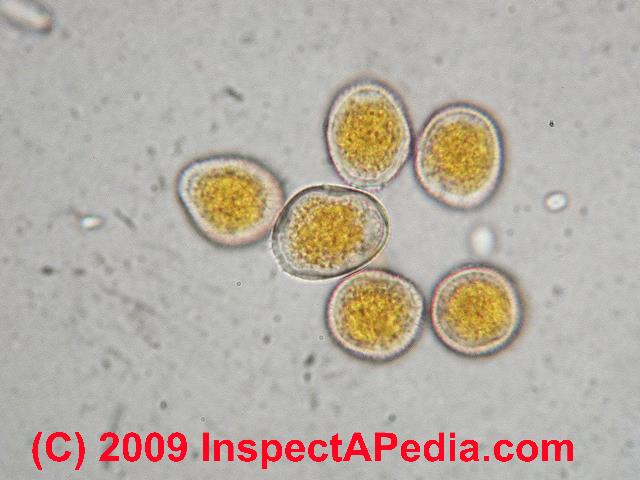 Robigus, the Roman God and Lord of Crop Fungi, is by legend the power who arranged that wheat rust, a crop destroying fungus, would plague humanity.
This punishment was in retribution for the cruelty of a boy who set fire to straw he had tied to a fox's tail. Indeed, wheat rust leaves crops looking burned, and leaves as much as 40% of the crop destroyed. Robigus, a fertility god, protected crops against diseases.
At the Robigalia festival each April 25th, red-colored offerings (wine) were made to appease this god of the rust-red colored wheat rust fungus or wheat leaf rust a parasitic fungus, Puccinia recondita.
Rusts, or Uredinales, include Puccinia rusts that invade corn, cotton, mint, sugar cane, and wheat, also Melampsora - flax, Hemileia - coffee, Cronartium - pine, Uromyces - chickpea, bean, and many others. There are about 5000 species in this group.
Our lab photo (left) shows typical Urediniospores from an air sample where rust spores were frequent. (These are not wheat rust spores).
Wheat leaf rust causes small (1/32") reddish-brown pustules or blisters to appear on the surface of plant leaves.
The wheat leaf rust Puccinia recondita spores may also produce a reddish brown dust (mold spore powder).
Mature wheat leaf rust fungus pustules and their fungal spores may be dark brown or even black. Wheat leaf rust spores live only on live leaves but survive the winter on leaf fragments, periodically reaching epidemic proportions in the wheat crop.
Interestingly, the location of wheat rust on the plant can indicate its source: rust on upper plant leaves suggests that spores blew into the wheat field from a more distant location, while wheat rust pustules found on lower plant leaves indicate that the rust fungus over-wintered on leaves in the local field.
In addition to application of systemic wheat foliar fungicides such as Tilt, Quadris, and Mancozeb, some varieties of wheat are bred to resist this fungus, and experts note that resistant species are the best way to control wheat rust epidemics. More information about wheat leaf rust is at the Kansas State University Website.
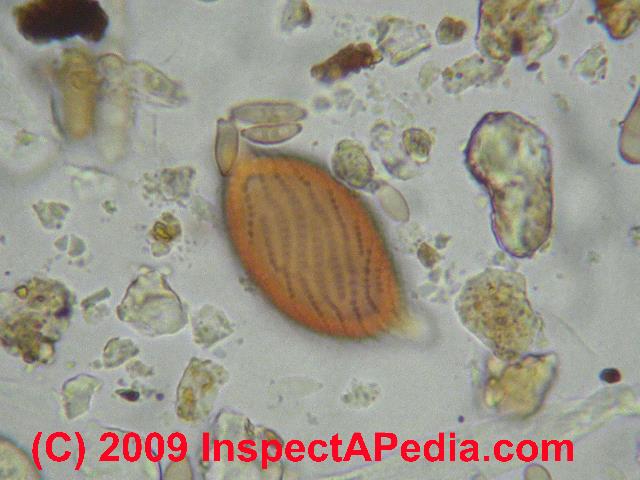 Rust spores can be quite beautiful, belying the crop damage they may cause, as our lab photo of Pileolaria brevipes (a rust spore found in an air sample we collected in San Diego, CA) shows at left.
While InspectAPedia.com focuses attention on building and indoor environmental concerns, the history and forensic work on Puccinia recondita is so important to the world's wheat crop and serves so well as an example of good investigative work that we have included this expanding topical section.
TECHNICAL PROCEDURES - Technical & Laboratory Procedures
Good laboratory and microscope procedures are critical in making sense of field samples. Competent, trained, experienced aerobiologists, mycologists, and microbiologists can identify sample contents with good accuracy.
Depending on the experience of the laboratory, it is also possible to interpret the meaning of the sample for the building and its occupants.
Laboratory professionals who have also performed the field inspection can make useful extrapolations from lab results. Hasty work by disinterested parties may be less useful for building occupants and owners.
Please see TECHNICAL & LAB PROCEDURES for the full text article on this topic.
OTHER IAQ CONCERNS - Other Indoor Air Quality Concerns
See ENVIRONMENTAL HAZARD MAIN WEB PAGE - environmental hazard detection, testing, repair, illness, symptoms, & prevention in buildings - research and "how to" articles
Mold Testing: Examining the Validity of Current Indoor Mold Sampling Techniques
The complete and most current version of this paper is found at MOLD TESTING METHOD VALIDITY. Excerpts are below.
This paper presents a summary and critique of some popular methods used to examine indoor air quality to test for presence or absence of problematic levels of toxic or allergenic mold or other bioaerosols. we will describe and critique specific "testing" or "sampling" methods used to "test" buildings for mold in the course of a building investigation.
The appropriateness of testing at all is discussed on this and other pages at our website. our website InspectAPedia.com/sickhouse.htm includes more broad discussions of the overall approach to building investigation, as do many expert references cited at that web. For a more comprehensive collection information about mold test methods see
INDOOR AIR QUALITY TESTS COMPARED
The full-text version of this presentation is
at MOLD TEST METHOD VALIDITY - © 2017 - 2005 Daniel Friedman.
An illustrated power-point version of this document is
at MOLD TEST VALIDITY CLASS - © 2017 - 2005 Daniel Friedman, but involves larger files of images and data - if you are viewing this document from a low-speed line, you should stick with the text version.
Watch out: interpret all quantitative data with great caution. Individual samples of particles in air show tremendous variation from minute to minute, making "ok" test results a thing to view with care. In situations of particular risk, additional or periodic testing should be considered.
If you think you need to hire someone, see WHEN to HIRE a PROFESSIONAL for more detailed help in deciding when and how to proceed.
Also see CAN MOLD MAKE YOU SICK?
Reader Comments, Questions & Answers About The Article Above
Below you will find questions and answers previously posted on this page at its page bottom reader comment box.
Reader Q&A - also see RECOMMENDED ARTICLES & FAQs
On 2023-11-06 by Anonymous - (multiple questions posted by the same reader)
@InspectApedia Publisher, a bit too complicated, can you just tell me can hepa filter filter out asbestos fibers when the fibers are going directly to the filter at a higher efficiency? it has charcoal filter too
did you mean the design of the device and the tolerance, other variation like use condition and care? I just want to know if the filter itself is good at filtering out asbestos or not.
can you at least tell me is it the hepa filter that fits standard filter out asbestos fibers?
the research is quit complicated.
On 2023-11-06 by InspectApedia Publisher
@Anonymous,
What you name is one of many variables that prevent a simple and accurate answer. I listed a number of these. Please review what we said earlier and if you are still curious take a look at the research that we cited.
I don't think there's more that I can add.
On 2023-11-05 by Anonymous - (multiple questions posted by the same reader)
@InspectApedia Publisher, quit complicated, but I see that you mean the HEPA filter itself is fully capable of filtering out asbestos, but there might be other condition like air leaks, which makes a bypass for air that doesn't go through the filter, so you can't make a specific answer.
right?
so the variable is there could be other leaks which the air can go around the filter thus air leaks. Is my understanding correct?
On 2023-11-05 by InspectApedia Publisher - can HEPA-rated air filters filter out very small particles, including airborne asbestos
@Anonymous,
Yes and no.
HEPA-rated air filters are capable of filtering out very small particles, including airborne asbestos (not that I agree that there is any reasonable probability of an asbestos hazard inside your car's interior from brakes and brake dust when driving).
However tests of a collection of HEPA vacuum cleaners performed by my Cambridge MA friend Jeff May many years ago found that even when the HEPA filter itself is quite capable of filtering as it should, that doesn't tell us how leaky might be the device, system, or appliance into which the HEPA filter has been inserted.
Air leaks in a device form or at least can form a bypass of air that simply doesn't go through the filter. No one, therefore, can promise a truly reliable answer to your question without performing tests or having data on the air leakiness of the vehicle system, such as an automobile's ventilation air system not only in the original design, but also taking into account manufacturing tolerances and variation and variations in the care and use conditions that affect the ventilation system leakiness on a specific vehicle.
So while all of this is technically an interesting question about the filtering capacities of automotive ventilation air capabilities, without a review of scholarly research to see how it pertains to your very specific vehicle in my OPINION the topic and question
1. don't address a meaningful asbestos hazard risk
2. cannot be answered in general and then applied to your specific vehicle
see
Chan, Tak W., Marie Lee, Gary Mallach, and David Buote. "Efficiency of the vehicle cabin air filters for removing black carbon particles and BTEX from the air intake." Applied Sciences 11, no. 19 (2021): 9048.
Abstract:
A laboratory study was conducted to evaluate 11 vehicular cabin filters (including electrostatic filters) in removing fine particles. Two filters with charcoal were also evaluated to understand their usefulness in removing five common volatile organic compounds, including benzene, toluene, ethylbenzene, and xylene isomers (BTEX). Filters were found to show considerably different particle filtration efficiencies (FE). Electrostatic filters were found to provide 20–60% better FE across all particle diameters (6–520 nm). For 6 nm particles, FE from 78 to 94% were observed (from the worst to the best filters), while at 520 nm, FE varied from 35 to 60%. The best group of filters provided 44–46% FE for capturing the most penetrating particles (100–300 nm), while the worst group of filters provided only 10–11% FE. The filtration behavior of nominal filters was typically stable (with respect to particle number, black carbon, and particulate matter mass) over the course of 1–2 years of usage. The benefits of the electrostatic filters were significant, but such advantages were observed to gradually dissipate over the course of about 1 year; by then, the electrostatic filter becomes no different compared to a nominal filter in terms of filtration behavior. Charcoal filters showed variabilities in removing BTEX, and removal efficiencies varied from 11 to 41%.
Heo, Ki Joon, Jung Woo Noh, Byung Uk Lee, Yeonsang Kim, and Jae Hee Jung. "Comparison of filtration performance of commercially available automotive cabin air filters against various airborne pollutants." Building and Environment 161 (2019): 106272.
Abstract:
Controlling air pollutants in the automobile cabin environment has become increasingly important owing to the health risks of exposure to high concentrations of harmful air pollutants. To protect daily commuters and drivers against the harmful effects of air pollution, modern automobiles are commonly equipped with automotive cabin air filters (ACAFs). Thus, understanding the filtration performance of ACAFs is essential for assessing cabin indoor air quality. In this study, six original equipment manufacturer (OEM) and nine after-market ACAFs were selected and their particulate matter (PM) filtration performance against standard particle (ISO 12103-1 A2 dust), filter pressure drop under various airflow velocities, and gas removal performance against standard test gases (n-butane and toluene) were estimated. In the PM filtration test, the lowest filtration performance occurred at a particle size range of 0.3–0.5 μm, with a filtration efficiency of 50–90%, and the filtration performance increased with increasing particle size. The PM filtration performance of OEM ACAFs (72.3 ± 13.81%) was higher than that of after-market ACAFs (56.4 ± 23.72%). All test OEM ACAFs satisfied the Korea Air Cleaning Association standard filtration performance guidelines for 0.3–0.5-μm particles (>50%), but four of the nine after-market ACAFs did not satisfy the standard guidelines. In addition, only one of the six OEM ACAFs simultaneously satisfied the standard removal performance guidelines for n-butane (>70% after 1 min and >45% after 5 min) and toluene (>80% after 1 min and >70% after 5 min). This study provides valuable baseline information on ACAFs for understanding and improving cabin indoor air quality.
Kalatoor, Suresh, Pierre Legare, and Simon Smith. Filtration Efficiency of Automotive Cabin Air Filter Media Subjected to Different Aerosols under Various Environmental Conditions. No. 970669. SAE Technical Paper, 1997.
Abstract:
Increased awareness of health effects caused by airborne contaminants that include natural and industrial aerosols, bioaerosols and gases, has led to increased usage of various kinds of filters. This trend is reflected in the automotive industry, where cabin air filters are increasingly offered as a means to reduce the likelihood of inhaling these contaminants while driving. Pleated filters, typically employing charge enhanced, thermoplastic base non woven media, have most commonly been applied in order to achieve the requisite level of particle capture, at minimum expense of additional burden to the vehicle HVAC system.
The reliability of these filters, however, has been under scrutiny. This is particularly true for those derived from depth electrostatic media. In this study we have evaluated a newly developed depth media, as well as a split fiber electret media, under various simulated environmental and loading conditions. Loading evaluations were made on a filter test system with a vertically configured test duct section measuring 61 cm square. Filters were evaluated following loading with SAE fine dust, and following cyclic environmental exposure over the range -40°C to 90°C and relative humidity ranging from 0 - 98%. The test aerosol employed for efficiency determinations was SAE class Ultrafine.
The introduction of fine meltblown fibers within a depth media appears to significantly moderate the decay characteristic on aging often associated with depth solutions. The particle penetration for an automotive cabin air filter was compared between laboratory filter test as observed with optical counter, and in vehicle testing with sampling by means of aerodynamic particle sizer.
Lee, Eon S., and Yifang Zhu. "Application of a high-efficiency cabin air filter for simultaneous mitigation of ultrafine particle and carbon dioxide exposures inside passenger vehicles." Environmental science & technology 48, no. 4 (2014): 2328-2335.
Pui, David YH, Chaolong Qi, Nick Stanley, Günter Oberdörster, and Andrew Maynard. "Recirculating air filtration significantly reduces exposure to airborne nanoparticles." Environmental Health Perspectives 116, no. 7 (2008): 863-866.
On 2023-11-05 by Anonymous
@InspectApedia Publisher, i am worrying about asbestos in brakes, so i bought a hepa cabin filter, does it work? been digging up some reserach most said it does work. does it work?
On 2023-11-03 by InspectApedia Publisher
@Anonymous,
AC or A/C is a common abbreviation that frequently is used to refer to air conditioning or to alternating current.
On 2023-11-03 by Anonymous
i saw this when trying to replace the cabin filter in my car, this AC stands for air condition not asbesots containing right? the car ia brand new 2024 model
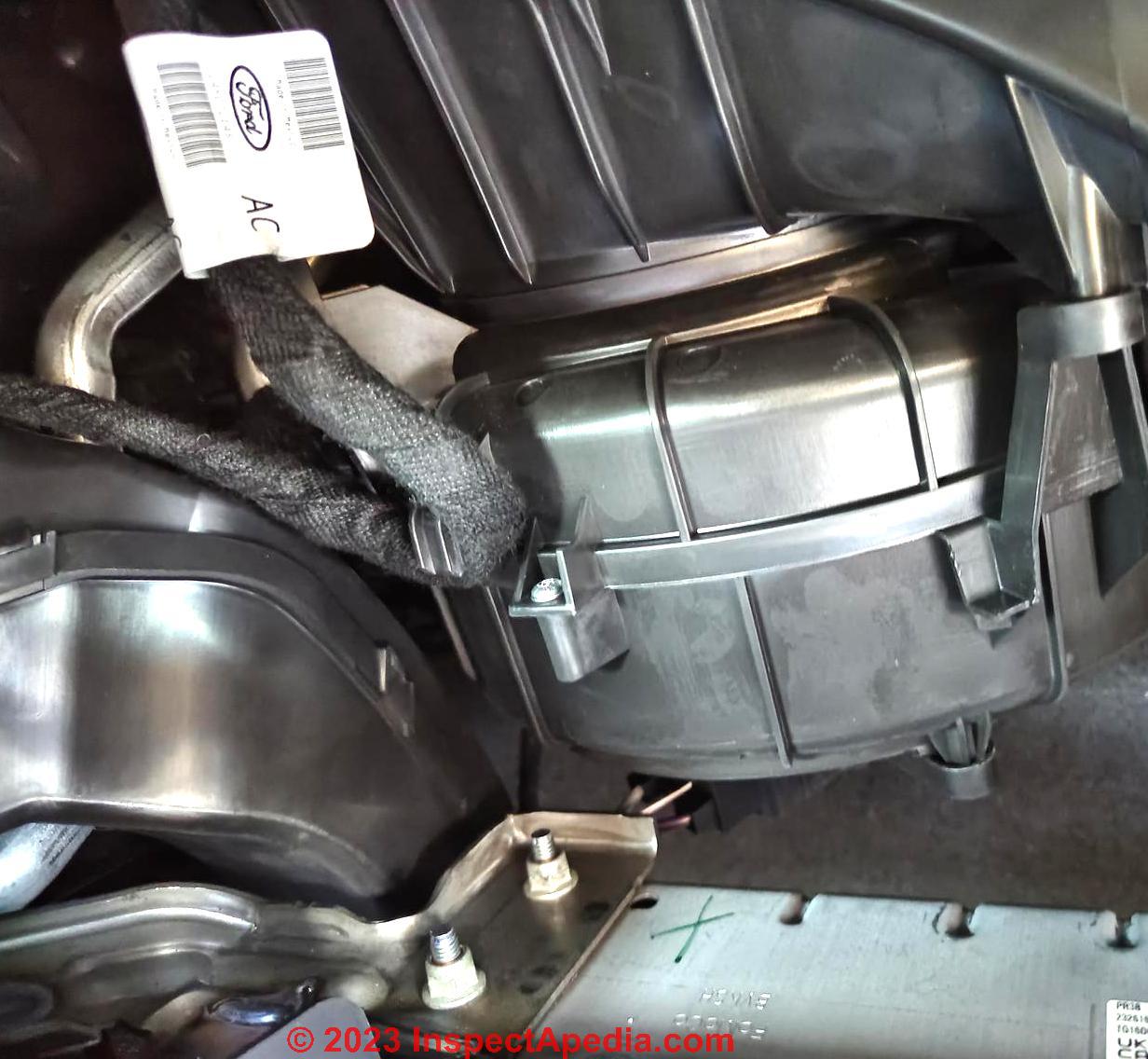
On 2023-10-28 by InspectApedia DF (mod)
@Anonymous,
Please find your original question, our discussion, and our detailed reply now at
BOAT & CAR SMELLS & ODORS
inspectapedia.com/odor_diagnosis/Odor_Diagnosis_Cars_Boats_RVs.php
On 2023-10-26 by Anonymous
do i have to worry about formaldehyde and other voc in a new car today?
On 2023-09-19 by InspectApedia DF (mod) - need help finding a qualified individual to do mold cleanup in my house
@Yung Scrawberry,
Please see our Experts Directory, specifically for mold remediation in Texas at
MOLD REMEDIATION COMPANIES
https://inspectapedia.com/mold/Mold_Remediator_Directory.php#TX
where you'll find the name and contact information for someone in Lewisville, TX - only about 30 minutes away from Dallas.
Additionally, if you're experiencing health issues and believe it's from mold exposure, it's important to discuss this with your doctor and follow his/her advice.
On 2023-09-19 by Yung Scrawberry
I think I need help finding a qualified individual to do mold cleanup in my house but I don’t know who to trust I live in Dallas Texas
The job isn’t huge but I’m really sick from it-I have terrible asthma and sometimes if I get too much of an allergen on my skin I’ll have seizures. It’s either live with this or go back to my abusive ex.
Everyone I’ve contacted has been terrible, wanting to test the air and other stupid stuff. Does anyone know someone worth trusting to help me out? I was just gonna die trying but I shouldn’t be dumb about it xD
On 2023-06-24 by InspectApedia Publisher - do the shared walls & roof between different townhouse properties increase risk of exposure?
@Anonymous by private email,
Interesting question and I think you've already got an idea of the possible problem: you could have a townhouse with a common wall whose neighbor is not johnny-on-the-spot at repairing leaks or removing mold contamination.
First concern is the condition of the building you buy and its prior leak or water entry or moisture history.
Buying a one family home that by construction methods, materials, maintenance history, etc. is at higher risk for mold contamination could be its own worry.
Ask your home inspector to report very carefully on the building's leak history, signs of moisture or water entry, and for construction conditions that make leaks or trapped moisture more- or less- likely, as those are helpful (though incomplete) mold risk indicators.
Take a look also at
MOLD EXPOSURE RISK LEVELS https://inspectapedia.com/mold/Mold_Exposure_Risk_Assessment.php
how to assess the risk that a building has or is likely to have or have had in the past a serious mold contamination problem
On 2023-06-23 by Anonymous by private email
I have been looking to buy a townhouse for about 3 years. I have an extreme sensitivity to mold (have had to leave 3 other residences). I plan to have an inspection & remediations of the new property.
Is purchasing a townhouse as opposed to a single family home an unwise choice?
Given the shared walls & roof between different townhouse properties?
On 2023-05-30 by InspectApedia Publisher - mold tests, without an expert visual inspection on-site and a careful review of the building's leak history, construction materials, etc. is not enough to understand what action is needed
@James Liu,
Those molds are associated with there having been a water leak or wet condition during construction.
But you're giving just percentages in a test result. That gives no clue at all of the severity of the problem. Is there one square foot of moldy material or is there a large mold reservoir - more than 30 sq.ft. or 10 meters?
Equally important: what got wet, when, why, and what cleaning was done?
Is this only a moldy roof sheathing or is there mold contaminated insulation, drywall ceilings? Did water run into finished wall cavities or what?
Just mold tests, without an expert visual inspection on-site and a careful review of the building's leak history, construction materials, etc. is just not enough to understand what action is needed.
Let's get an experienced on-site inspector there to track down the leak history and to get a reasonably-confident opinion of the extent of mold cleanup needed.
Your inspector should consider the condition of the insulation in the attic and at the very least, the condition of the attic side of ceiling drywall.
If there's more than 10m of moldy material, professional cleaning is appropriate. When your mold includes Aspegillus, a mold that can cause serious illness, I'd not ignore it, even if it's only in the attic space.
If the mold came into the building on lumber/plywood left outdoors, that's encouraging in that at least we're less worried that there was a leak or flooding event that sent water down through building cavities.
Still, a large attic mold reservoir on roof sheathing can contaminate the insulation below, and, in a few situations, send mold down into the occupied space below. So you'd want it cleaned, perhaps followed by a fungicidal sealant, and you may want the insulation replaced.
On 2023-05-25 by James Liu
@InspectApedia DF, Thank you for your response, mold assessment was carried out by ABM Environmental Inc , home inspection discovered mold like spots in the attic sheathings buy builder denied it was mold
which is why I called in this mold specialist company to verify and do the remediation and since my two grand children aged one and three will be moving in with me I am at a lost if I should go ahead with the house purchase also .
assessment report suspect lumber material was left outside in the weather or moisture from dry wall compound drying during construction
On 2023-05-25 by InspectApedia DF (mod) - what is the acceptable level of mold in buildings
@James Liu,
Building tests taken by themselves (without an expert inspection) are not very reliable for several reasons: the mold detected by some tests (such as cultures) may not be the most significant or dangerous mold present, and a test that does not detect certain molds does not assure that there is no problem mold present in a building.
To learn more about what is the acceptable level of mold in buildings, it would be useful for you to read
AIRBORNE MOLD SPORE COUNT NUMBER GUIDE
As you’ll see there, the information you’ve provided us is inadequate in assessing the levels of molds present let alone the risk.
And the validity of various types of mold testing is discussed here
A GUIDE TO GOOD PRACTICES IN MOLD "TESTING"
Watch out: mold "tests" may be inaccurate and without an expert building inspection, mold tests alone are not a reliable means of characterizing mold risk at a building.
Watch out: in most situations you do not need to test to identify mold: knowing the mold genera/species won't change the cleanup needed one bit.
You need to:
1. Find the mold
2. Clean up the mold
3. Fix the cause of the mold
If the total square footage is under 30 sqft., normal cleaning by a homeowner or handyman is usually adequate. But it sounds like you may need help from a home inspector to be sure you found and fixed the mold cause.
After reviewing those articles, please let us know if you have additional questions.
On 2023-05-25 by James Liu
Found 60% Cladosporium herbarum and 40% Aspergillus fumigatus mold in the attic of a brand new house ,tape lift samples were taken of the attic sheathings, please advice how concern should I be , I am in Vancouver BC
On 2023-05-13 by InspectApedia Publisher - interpreting mold counts specific to your building requires knowledge of the expert who inspected the home
@Manny H,
I hope you read the long note that I left you before where I gave you my best and most carefully thought out advice.
Beyond that and the articles that I highly recommended for you,
interpreting mold counts specific to your building, given that such counts are questionable in the first place and doubly questionable in your case, requires knowledge of the expert who has carefully inspected the home.
I certainly hope that for the rather steep cost that you quoted for me someone actually did the proper job. Charging that amount for simply collecting a few unreliable mold test samples would be further argument for demanding your money back.
For someone a thousand or two miles away to say more is so speculative as to be so unreliable as to not be helpful.
On 2023-05-13 by Manny H
@InspectApedia DF, this is what the results look like. We don’t know what we’re looking at. They did air samples and swabs. They said that the air samples were not able to be accurate because there is a lot of debris from the demolition done last 2 weeks.
Workers demo the house and didn’t catch the black mold that my wife found. We want to know levels of mold but we don’t know how to read the results.
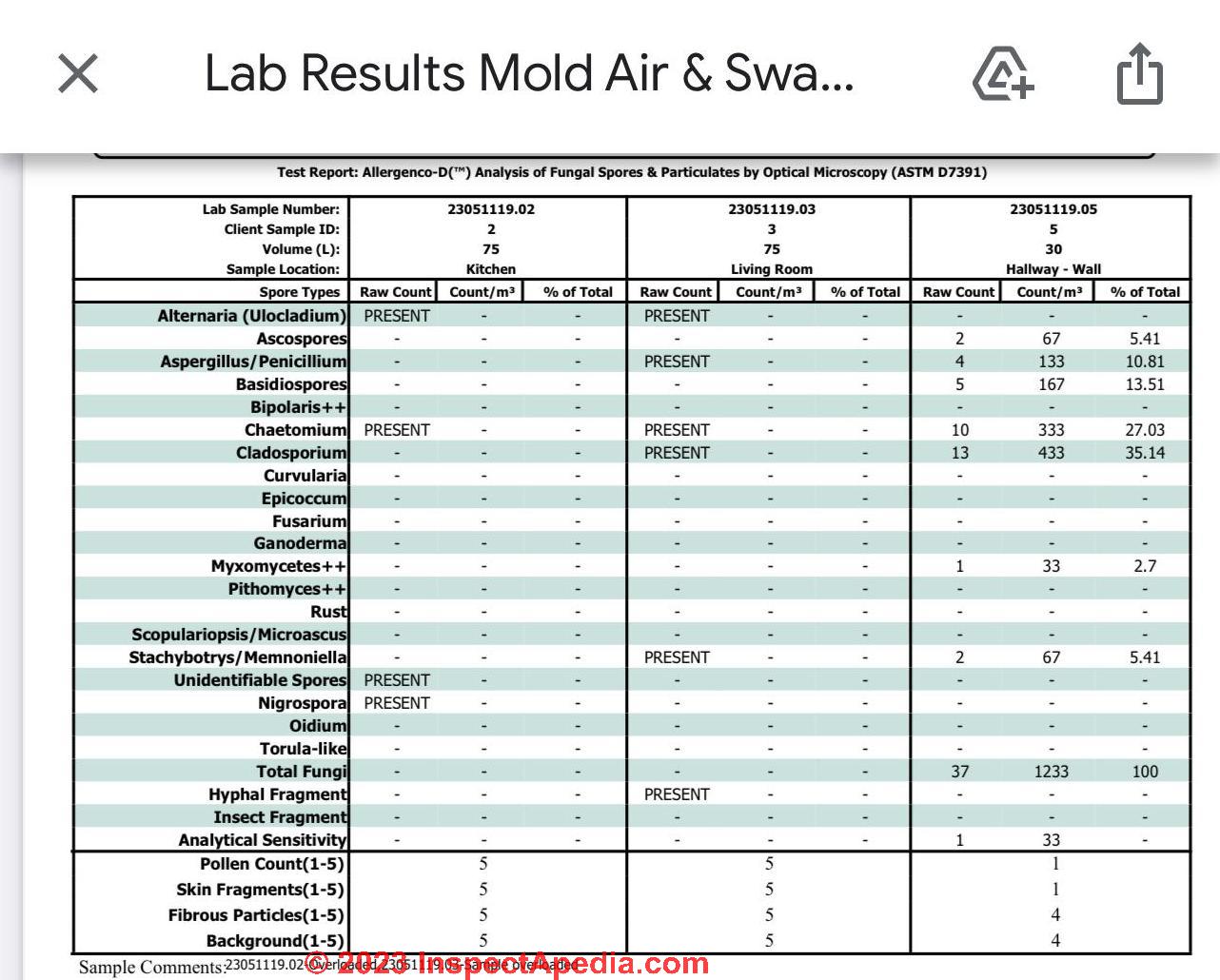
On 2023-05-13 by InspectApedia DF (mod)
@Manny H,
First: I hope you will demand your money back.
1. if the consultant whom you paid a stunning fee can't be bothered to help you understand the mold test results they should refund your money.
2. Mold "tests" (we don't know what sort of "test" you had performed" ) without a thorough expert inspection, occupant interview, building leak history notation and similar investigation, are singularly unreliable.
So if you paid the fee you cite simply for some "air tests" for mold (unreliable) or culture tests for mold (even less reliable), then without an inspection and explanation the service you used was not reliable and can't be used to take any remedial action IF such is actually needed.
The "number" you're given, if it was an airborne spore level, could be different from the actual site conditions at that time by four orders of magnitude depending on small variations in just how a test was conducted. In culture tests it's worth understanding that of the million or so mold genera species, only a small percent of them will grow (show up) in any mold culture whatsoever.
That said, if a large area of mold was seen or very high indoor spore counts were found and differ from an outdoor baseline, then there's probably something needing attention. The inaccuracy of mold tests is one of magnitude and there is mostly a risk of false negative results.
3. It is normal to find some mold in building air. There is always some airborne mold, everywhere.
But IF there is a large mold reservoir in your home - one that's not simply a cosmetic problem - it needs to be found and removed. Don't panic - doing so risks increasing costs to you unnecessarily.
4. It is normal, if a building has an actionable mold contamination reservoir, for there to be multiple mold genera/species present in the building. It would be very odd indeed for mold-conducive conditions inside a building to produce only one mold species.
I recommend reading through MOLD TESTING METHOD VALIDITY inspectapedia.com/mold/Mold_Test_Method_Validity.php
MOLD / ENVIRONMENTAL EXPERT, HIRE ? inspectapedia.com/sickhouse/IAQ_Investigation.php offers some opinion on how to decide when hiring an expert is appropriate
AIRBORNE MOLD COUNT NUMBER GUIDE inspectapedia.com/mold/Airborne_Mold_Count_Number_Guide.php gives some perspective on the rough meaning of airborne spore counts as generally accepted among experts - keeping in mind the high variability I have already cited.
If in fact your home has a large mold reservoir - more than 30 sqft. - that merits professional remediation. To do that properly will require the sort of inspection I described earlier: find the mold, remove it, clean the exposed surfaces, and fix the cause of mold growth.
We don't know any details of your mold test but I hope you and your family can get help that reduces the anxiety you describe. That itself is a health worry.
On 2023-05-13 by Manny H
@InspectApedia Editor , we just received our mold tests results and its worse then we could’ve ever have imagined. There’s about 10 different molds throughout the whole house.
It’s so frustrating because we don’t understand the lab results and company is not helpful at all even though we paid $2,200 for these services.
When we asked them to please explain results they said it’s pretty explanatory. We are so overwhelmed and don’t know what to do.
On 2023-05-10 by InspectApedia Editor - focusing just on "black" mold leads to potentially harmful errors
@Manny h
Please read the Cosmetic Mold article I recommended before thinking about "testing"
and also FYI "toxic black mold" is an unfortunate disservice to the public that resulted from early news coverage about harmful molds.
Molds may be allergenic, pathogenic, "toxic" in any color - depending on the genera/species and on what the mold grows on. So focusing just on "black" mold leads to potentially harmful errors.
On 2023-05-10 by Manny H
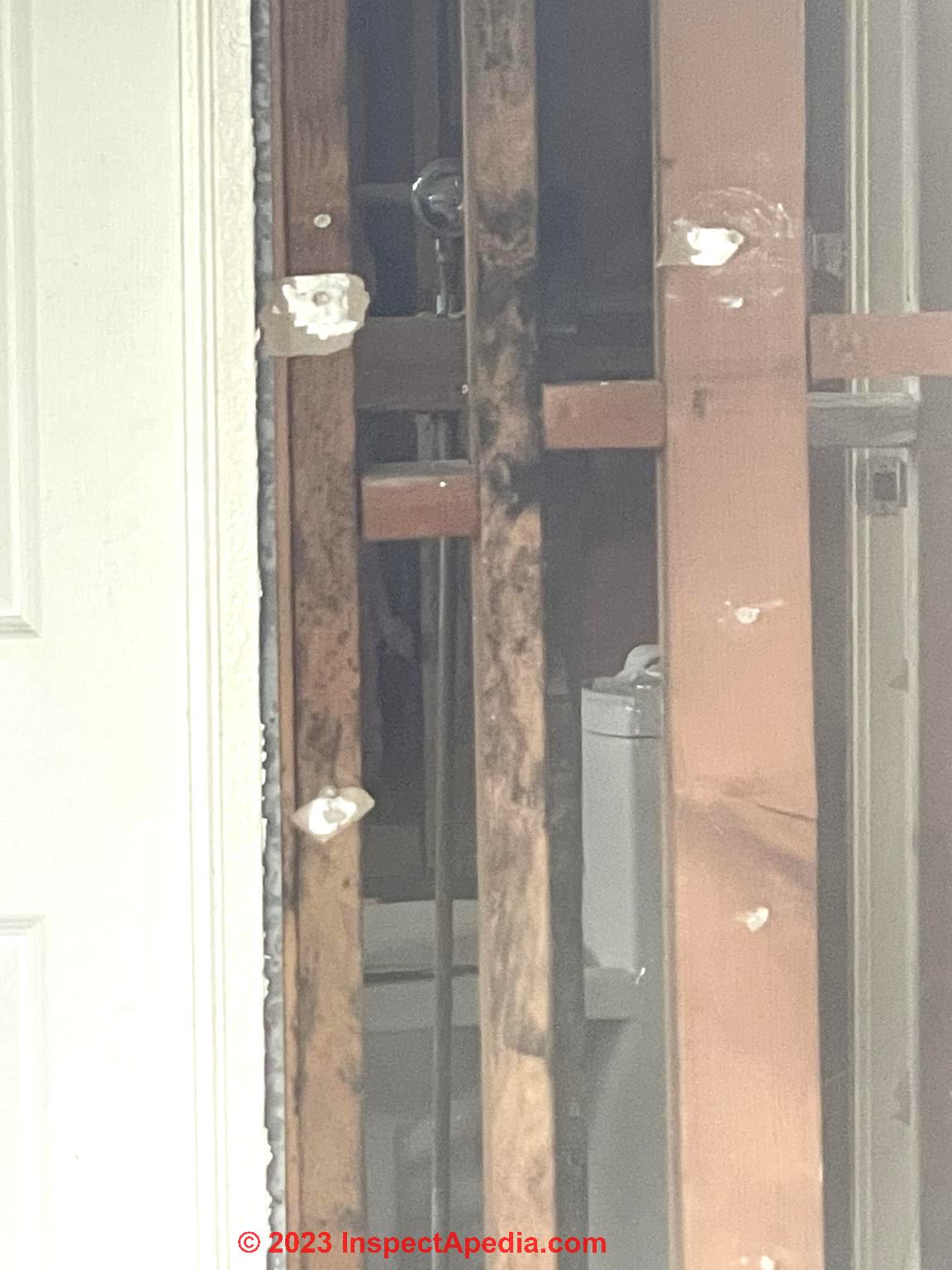
@InspectApedia Publisher, it’s actually a stud but the picture flipped. It’s weird because it’s on a lot of the studs in all 3 bedrooms and 2 bathrooms. It’s on like every other stud. And also on some joists.
It’s just in random spots doesn’t really cover a whole area. We’ve lived here 27 years and we’ve never had any leaks so we’re baffled on why there’s mold. Should we get it tested to see if it’s the toxic black mold?
On 2023-05-09 by InspectApedia Publisher - black stuff on joists after remodel
@Manny H,
That does look like mold on the bottom edge of what - a joist?
But it's significant that it hasn't spread to abutting lumber.
Read through COSMETIC MOLD, RECOGNIZE
and let me know if what you're seeing seems to be explained by that page.
On 2023-05-09 by Manny H
Hi. Thank you for such helpful information. We are remodeling our house and my wife noticed a lot of this black stuff mostly in the bedrooms and bathrooms. We gutted out the house that’s only reason we are able to see it.
I’m wondering if it’s black mold? My wife thinks it is and she’s freaking out.
On 2023-05-01 by InspectApedia Editor
@Sarah,
Thank you too for the generous comments. We work hard on this material so we're grateful when readers find it useful and trusted. Working together helps us both.
About central humidifiers: my personal OPINION is that for typical residential comfort in dry weather, I prefer to use a "point of use" portable room unit that's easier to clean, probably only in occupied bedrooms. That avoids the concerns about blowing water into the air handler. But any humidifier needs to be kept clean.
On 2023-05-01 by Sarah
@InspectApedia Editor , Thank you so much for your detailed reply and links to relevant pages which I reviewed quickly and will look at in more detail later. One of the links raised an issue related to another HVAC challenge we've had for years and which I've posted about. I will post in the A/C section later so as not to muddle the focus on the topic of this page.
Yes, you are correct, the (mysteriously posted as sideways) image, it's a central humidifier in our HVAC system. In theory, I would prefer not having something that introduces moisture in my HVAC system for all the obvious reasons, but the winter air is so exceedingly dry it impacts our health negatively and free-standing humidifiers aren't sufficient to battle the low humidity where we live.
We do carry out regular inspections of the entire humidification unit, both ourselves and via routine twice yearly HVAC service. So far, everything has been extremely clean and many service techs have commented about that. We also have an IAQ consultant who we hire from time to time around issues of concern.
Needless to say, yes, we threw out the nasty tubing after we saw it yesterday and replaced it with clean tubing. But, also as you say, this will be an ongoing issue to monitor and replace. I appreciate your reminder about slope and think the set up could be improved. Thank you for that tip and we will address this today and discuss w/our HVAC service tech when they're here in a couple of weeks, as well. We will also discuss the "trap" you mentioned with them to develop a better design. Are you referring to a "J trap" or something else?
As always, thank you for the amazing generosity of sharing your expertise and providing a resource to people for guidance on all manner of topics related to health and home. It is amazing.
On 2023-05-01 by InspectApedia Editor - black sludge on the inside humidifier tubing needs inspection and cleaning
@Sarah,
Thank you for a helpful moldy humidifier drain line question.
First let's be sure we're on the same topic. Your comment and photo are of a central humidifier used in an HVAC system - equipment intended to ADD moisture to building air, usually during the heating season.
Now about that humidifier that I can see just partly in your photo,
1. you need a regular program of inspection and cleaning not just of that moldy tubing that drains excess water from the humidifier but of the whole humidifier interior - these devices easily become mold gardens that can harbor a mold reservoir that then feeds directly into the building's HVAC system air supply.
2. That moldy drain tubing in your photo: I'd throw it out and replace it with clean tubing, but I recognize that it'll grow mold again and need to be cleaned or replaced from time to time.
My OPINION (and this is speculation since certainly I've not tested your humidifier drain tubing) is that the water-loving molds growing in the tubing, even if they produce some spores, are nowhere as likely to be a serious health hazard as other mold genera/species or of other pathogens that may grow in the humidifier itself - both in volume and in genera/species what's in the tubing is tiny.
But do be sure that the tubing is pitched to drain well with no low slope or flat areas enroute.
Then consider adding, at the humidifier drain connection itself, the same sort of trap that's used on central air conditioner condensate drains - a device that lets water out but that prevents any negative air pressure in the air handler from drawing contaminated air back up the condensate drain line and into the air handler unit.
3. Cleaning the humidifier also needs to address other pathogens, not just mold, such as Legionella.
So be sure to read also
Legionella BACTERIA & HVAC EQUIPMENT
4. Be sure you've read
CENTRAL HUMIDIFIERS in BUILDINGS
See also our warnings at CENTRAL HUMIDIFIER LEAKS into DUCTWORK
On 2023-05-01 by Sarah
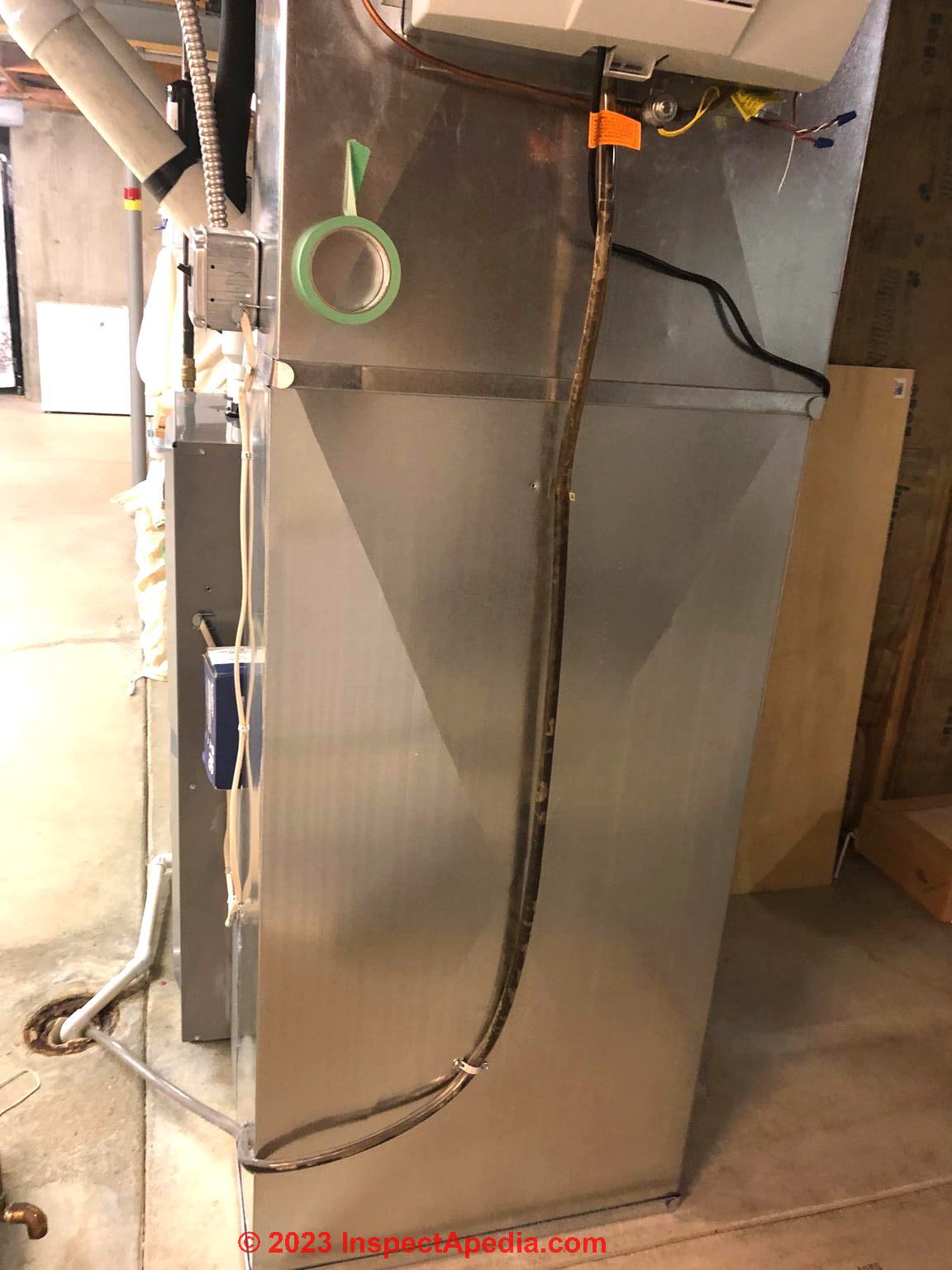
When I was in the basement today I noticed the drain line from the inline humidification system on our HVAC had a coating of what looked like black sludge on the inside. Very gross and concerning. Last year we had the system switched from the intake side to the return side.
When it was on the intake side, the tubing was relatively short and went into PVC that my husband kept clean w/Clorox. But now that it’s on the return side, the soft plastic tubing runs from the humidification unit into the drain in the floor.
I’m very concerned because when the unit isn’t running and water draining through the tubing, the top of the tubing is open, essentially, to our HVAC system (via the humidification unit, but still, it’s open). What would you propose we do at this point to make sure we haven’t introduced a boatload of mold spores into our HVAC system, assuming the sludge-like coating was mold, which I assume it was.
I’m attaching photos. Needless to say, we changed the line today, but my concern is what we’ve introduced into our system. Thank you, in advance, for your time and guidance.
On 2023-04-28 by InspectApedia Publisher - high levels of Chaetomium sp. is a clear indication that there has been a leak and mold growth somewhere
@Chris,
That added information is helpful.
Keep in mind that we don't normally find Chaetomium sp. at high levels (usually C. globosum) indoors - so when we do it's a clear indication that there has been a leak and mold growth somewhere.
It sounds as if you followed water stains on the exposed surfaces indoors - but that you've never explored building cavities.
I would go to the most-suspect spots and cut modest test openings, typically 2" x 4" - easy to patch - to inspect wall and ceiling cavities for hidden mold.
Else you're likely to "sign off" on this job and later have to do it over again properly to remove a mold colony.
On 2023-04-28 by Chris
@InspectApedia Editor, thank you for your helpful reply. Chaetomium was the only mold detected at high levels. No moisture has been found anywhere in the house (a pronged meter was used throughout). Everything appears to be dry now and there is no visible wood rot.
We looked for additional water stains in the ceiling where the leak started and pulled up all the flooring beneath the leak. We visually followed any water stains as far as we could and they appear to just be in a contained area. We removed some questionable (moldy?) insulation.
Remediation has started today (HEPA vac and scrubbing with anti-microbial cleaner by mold professionals). Another air quality test will be done again in a few days. I know you said we shouldn't rely on that alone. I hope we have covered all the bases. I have read many of the articles here. Thank you for this wonderful website!
On 2023-04-27 by InspectApedia Editor - water-indicating mold indicates need for remediation process
@Chris -
Chaetomium sp. mold not itself "toxic" though some of its species are probably allergenic. That's not the question.
Chaetomium is a water-indicating mold.
That means that there are certainly other mold genera/species present building, some of which may be may be more harmful.
What's needed is to find the mold (follow the water, see what got wet), remove drywall or insulation that were wet or that are visibly moldy, clean the exposed surfaces, then complete the repairs.
Never rely on "air tests" for mold alone - the "count" provided by an air test varies by at least 4 orders of magnitude based on very small changes in test conditions.
But if the cleanup is done properly in scope (all the infected materials removed, surfaces cleaned, cause fixed), then IF there is a new mold problem in the building, it's new, from a new leak or wetting event.
So everything in your ability to be confident that this mold problem was properly handled depends on the thoroughness of the investigation and cleaning in the first place.
Use an independent expert who has no economic nor any other relationship with the experts who are performing the cleanup remediation job.
Who does the remediation? For less than 30 sq.ft. of contiguous mold, you don't need a mold remediation professional. Larger areas: you do.
Read through the Recommended Articles above on this page and you'll be well equipped to talk with and understand the people involved in this mold remediation job.
Don't hesitate to post follow-up questions. - DF
On 2023-04-27 by Chris
- re-posted by mod after DF accidentally deleted question (mod)
AUTHOR: Chris (no email)
COMMENT: Chaetomium has been found in our home. Spore count in one area is 7790. Is this considered a toxic level? We believe the mold developed following a water pipe break 18 months ago while the home was under construction. The builder is taking financial responsibility for the air quality tests and remediation (to take place soon).
Is it safe for us to be in the home in the meantime? Once remediation is complete, can the chaetomium problem return? We are concerned about the builder walking away after remediation and us being stuck with a possible ongoing or returning problem. I appreciate any advice you can provide.
On 2023-01-26 by InspectApedia Publisher
@Mary Ross,
That doesn't look like mold to me. Possibly on the upper board a paint residue? Possibly a soft white remnant of an insect web or egg sac between the two boards>?
Lower board? A hard paint or wax material?
On 2023-01-25 by Mary Ross
Is this mold ? Old window from cabin remodel that I put a mirror in the back.
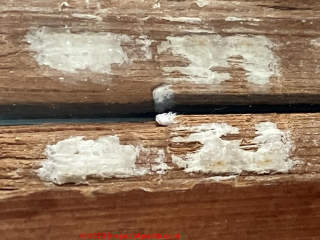
On 2022-12-26 by InspectApedia (Editor) - mold can grow on the organic residue left in sinks, tubs, toilets
@Jordan,
That looks to me like a dirty bath tub.
Indeed sometimes we find several species of mold growing on the organic residue left in sinks, tubs, toilets, often water-loving molds and not likely to be a direct cause of lung issues.
But it would certainly make sense to clean the but surfaces and to be sure that the tub isn't a slip-fall hazard.
On 2022-12-26 by Jordan
This is a my inlaws bathtub/shower. On the otherside of the wall is where my mother in law sleeps. She has gone to doctor after doctor seeking answers and cures for all her health and lung issues . But refuses to even consider the source of her problems is staring at her right in front of her when she takes a shower.
I'm not here asking for health advice. however could you tell me what you see in this picture and is it a cause for concern. Should it be investigated further. Who knows maybe they will listen to a guy on the internet . Thank you
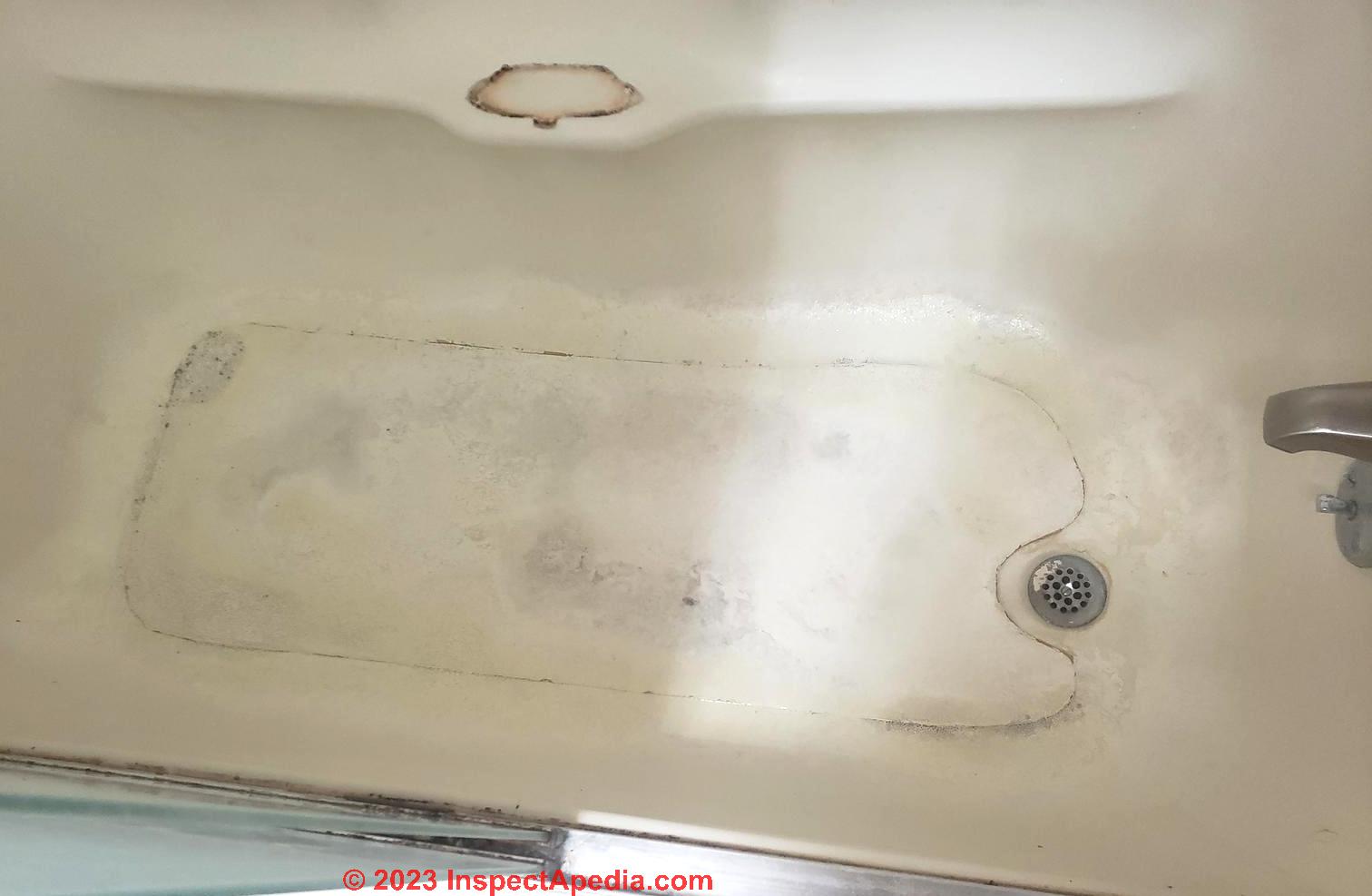
On 2022-12-05 by InspectApedia (Editor)
@Sandra McKenzie,
I'm sorry I can't be more helpful but I can't make out enough sharp detail in your photo to know what we're looking-at.
I do see what looks like white paint over wall surfaces that are so uneven that there may have been prior damage, painted-over. On what I take to be a floor (the brown and tan area) I see what looks like staining and soiling but I can't make it out.
Take a look at our photos of what mold looks like on various building surfaces, at
MOLD APPEARANCE - WHAT MOLD LOOKS LIKE
On 2022-12-05 by Sandra McKenzie
Is this mold? It is in an upstairs bedroom mainly in corners but also under radiator and in closet?
Thank you

On 2022-08-09 by InspectApedia-911 (mod) - mold test numbers alone are very unreliable and inaccurate
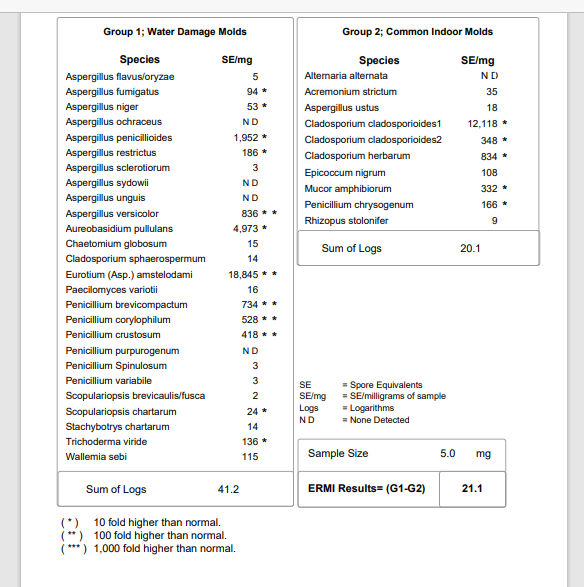
@Aliah,
While the actual mold test numbers are very unreliable and inaccurate, overall it looks as if there's a mold problem in the building. If the people you hired to inspect for mold are not helping you understand their report you should insist on a complete refund of any fees paid.
After all, those onsite people surely have seen the building, inspected all of it, interviewed occupants, and ought to offer advice on what to do next. All we have is a report.
On 2022-08-09 by Aliah
Our ERMI dust test (Swiffer type collection) results seem bad, but should we really be alarmed? Not sure what steps to take after this. Thanks.
On 2022-06-27 by InspectApedia-911 (mod)
@Kat,
In the photo you posted of the pipe in your bedroom floor I see an a iron pipe that has been sawn-off at floor level and stuffed in and around with pink fiberglass insulation. Perhaps this is an abandoned steam heating pipe or water pipe.
Where is the building - country and city - and how old is it?
Did it previously have steam radiators?
In any event there's no meaningful hazard from the fiberglass in your photo but certainly if it's troubling you, for peace of mind you could spray it with clear shellac or you could stable down a bit of vinyl or plastic or even wide masking tape over the opening.
On 2022-06-27 by Kat
Here is the pipe that’s on my bedroom floor. It’s actually positioned so that it’s under the bed, but that doesn’t help much when it comes to keeping the fibers in place.

On 2022-06-27 by InspectApedia-911 (mod)
@Kat,
Apologies but we can't identify the particles from your description and photos. Sorry I can't make out anything in some of these photos.
Try HEPA vacuuming, damp wiping, and then if necessary, seal over cracks or gaps from which these are entering your occupied space.
On 2022-06-27 by Kat
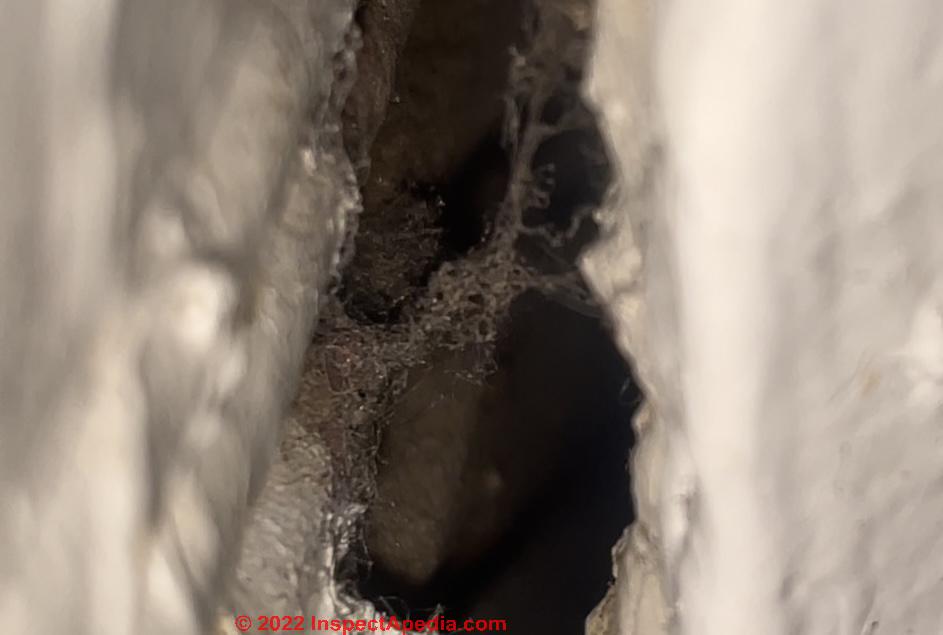
Hi! I moved into an apartment in an old Victorian house this past September. By January, I’d begun to notice long, fluffy, white “furs” all over my home. They’re incredibly light (just moving my hand towards one is enough to send it flying into the air) but they’re also sticky. They stick to each other in clumps, to my clothing, my eyelashes, etc. I also began to have issues with my eyes in January, and constantly felt like I had something in them. It’s now June, and the doctors have been unable to diagnose an underlying reason for my eye problems.
Also of note, I now notice darker, denser, curly fibers, in addition to the initial white. I find that both the gray , and white, are frequently inside of my eyes, and I have to pull them out from the corners. I actually have chronic Dacryocystitis at this point (tear duct blockage,) which I’m assuming is because of the sticky fibers that frequently clog them.
Im also currently experiencing a blistering leg rash with sharp, straight fibers inside of the blisters. In addition to that, my eyes also seem to frequently expel sharp bits of “glitter” and it stings to walk barefoot through the home. I know that this is most likely due to fiberglass, which is exposed on the floor of my bedroom in a sawed off pipe. But I found another location in the bathroom recently which looks like the other fibers could be coming from. I’m just hoping you can tell me if this is moldy fiberglass, or rockwool, or just straight up mold.
Any advice would be a huge help in figuring out what steps to take! I couldn’t figure out how to upload any additional photos, but for reference, those are chopsticks in the picture, which I was using to try and get a sample.
Thank you!
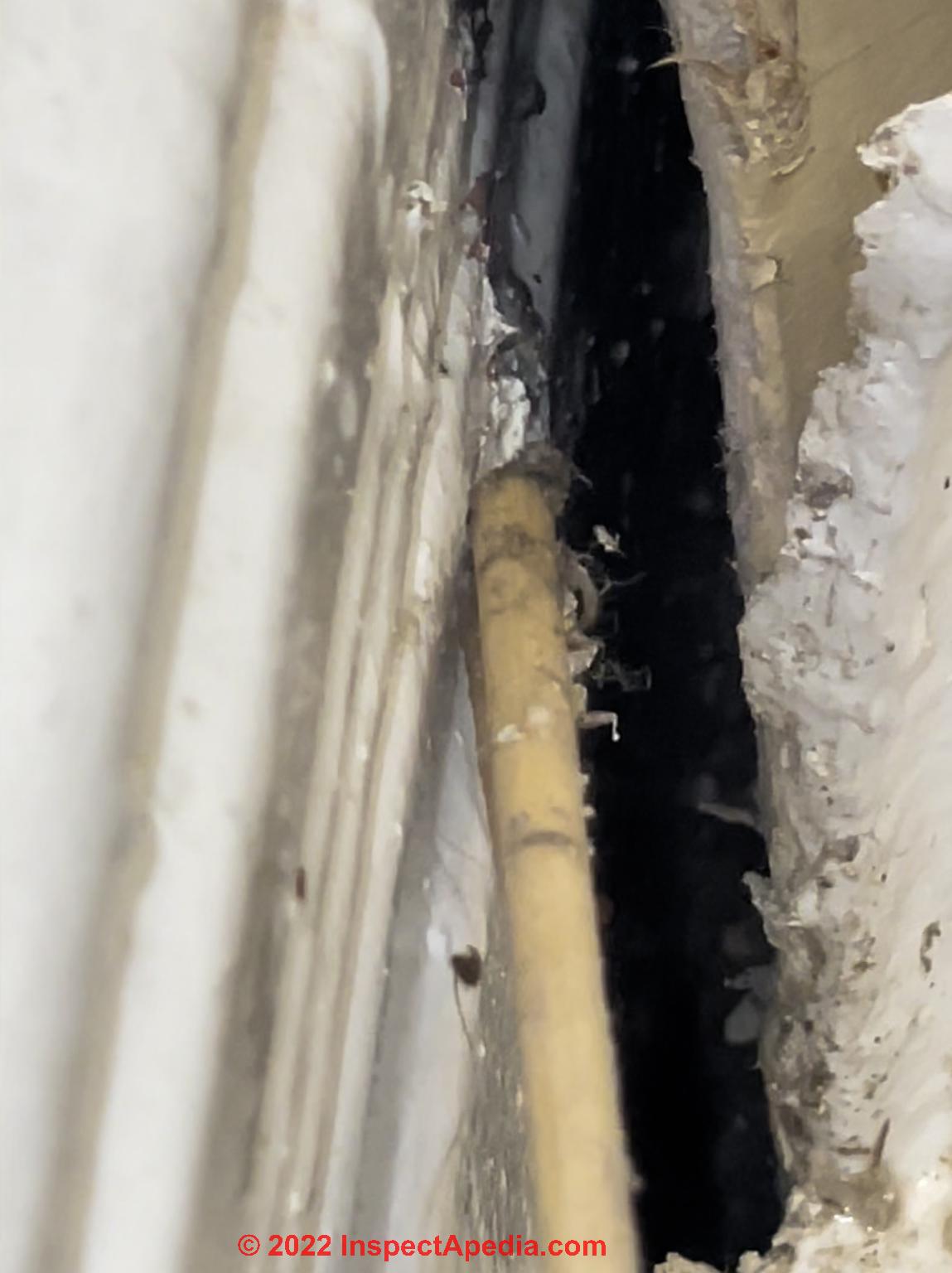 ...
...  ...
... 
On 2022-06-06 by InspectApedia-911 (mod) - humming noise detection
@Lawrence,
I'm a bit confused about just what "turn off" you mean: electrical, plumbing, or something else.
If the city flushed lines, were they flushing water supply or sewer lines?
If the water lines were being treated and sediment was stirred up it might enter a pressure regulator and you might be getting noise there.
See details of diagnostic steps for humming noises
at HUMMING NOISES in BUILDINGS
On 2022-06-06 by Lawrence
The last couple of weeks we had had a constant humming noise and it seems to be coming from the main turn off inside a door in our basement wall. What would cause. this. It seemed to start just after the city flushed all the main lines.
On 2022-05-30 by InspectApedia (mod) - test for mycotoxins, beta glucans, and vocs
@Donna,
You can contact a lab to do the testing you request but
Watch out: you need to discuss your needs and be sure that they'll do what you need and not just assume that you’re already properly diagnosed nor just give you some standard boiler plate report that doesn’t really help your situation.
Bottom line: find an environmental doctor whom you trust and follow her advice.
I did a google search for a lab near Medford, NY and came up with these, albeit not real close:
https://yorklab.com/
https://www.airmd.com/areas-served/new-york/new-york/voc-testing/
A quick read of their websites 'seems' to cover at least some of what you are asking for.
On 2022-05-30 by Donna
How do i find someone to test for myctoxins, beta glucans, and vocs. I am in metford ny and i cant find someone who is willing or able
On 2022-05-12 by Inspectapedia Com Moderator
@Desmond,
I'm sorry that you've had so much aggravation. I can't say what your local health department will do, as I find that the practice varies enormously depending on the country and city where you live.
But it's certainly worth giving them a call to ask for help. There may be other legal or housing aid available as well depending on your location.
On 2022-05-12 by Desmond
I'm in the middle of being evicted, however, there are numerous violations that I've been exposed to over 8 years. This includes no certificate of occupancy, visible black mold, faulty ventilation system, and no heat. If I call the health department would they place me temporarily?
On 2022-05-22 by InspectApedia-911 (mod) - need more information to assess mold risks
@jodie,
I don't want to even slightly appear to be able to second-guess your on-site expert.
Some points to keep in mind:
1. "dry mold" is by no means harmless. For example when some species of Apergillus sp. dry out, they release tremendous numbers of spores specifically due to the drop in humidity, and some may cause serious lung infections such as Aspergillosis.
2. We'd be more confident if we knew the extent of the mold, what caused it, and where water went in the building. That'd address the question of whether or not there is a substantial hidden mold reservoir.
3. Small amounts of mold contamination, under 30 sq.ft. are, for most people, a normal homeowner cleanup job.
On 2022-05-22 by jodie
@InspectApedia, the environmental specialist checked it out and said that the wood was bone dry and that the fungus was dormant. He suggested that I could clean it off if I wanted, or to just keep it vented with the dehumidifier running as it is now.
On 2022-05-10 by Inspectapedia Com Moderator
@jodie,
Please let us know the results that you find. That will help other readers as well.
On 2022-05-10 by jodie
@Inspectapedia Com Moderator, thank you for your response. I've retained the services of a water damage & mold remediation specialist.
On 2022-05-03 by Inspectapedia Com Moderator - need more information from home inspector
@jodie,
Frankly I'm dismayed that the home inspector, who doubtless got a fee for her or his inspection, couldn't answer your question, as that person has seen a lot more of the home than I can in a single photo.
What's significant that we see in the photos is
- what looks like framing in an older home
- evidence of a large or protracted or recurrent leakage
- cause of the leak?
- has a proper repair been made?
- where did water go?
- what got wet? What materials, in what areas?
- how mold-friendly are those materials (e.g. drywall)
- is further investigation appropriate, probably involving some removal of some building materials to properly assess the condition.
On 2022-05-03 by jodie
Home inspector found this brown-yellow fuzzy substance on the floor joists inside a plumbing access under the kitchen sink, behind the laundry equipment. There's a dehumidifier running and the opening is covered by a metal grate. Obvious sings of past leakage, but continues to appear dry after a month of using the kitchen sink. I can't reach to get a sample. Does it look like I need a professional?
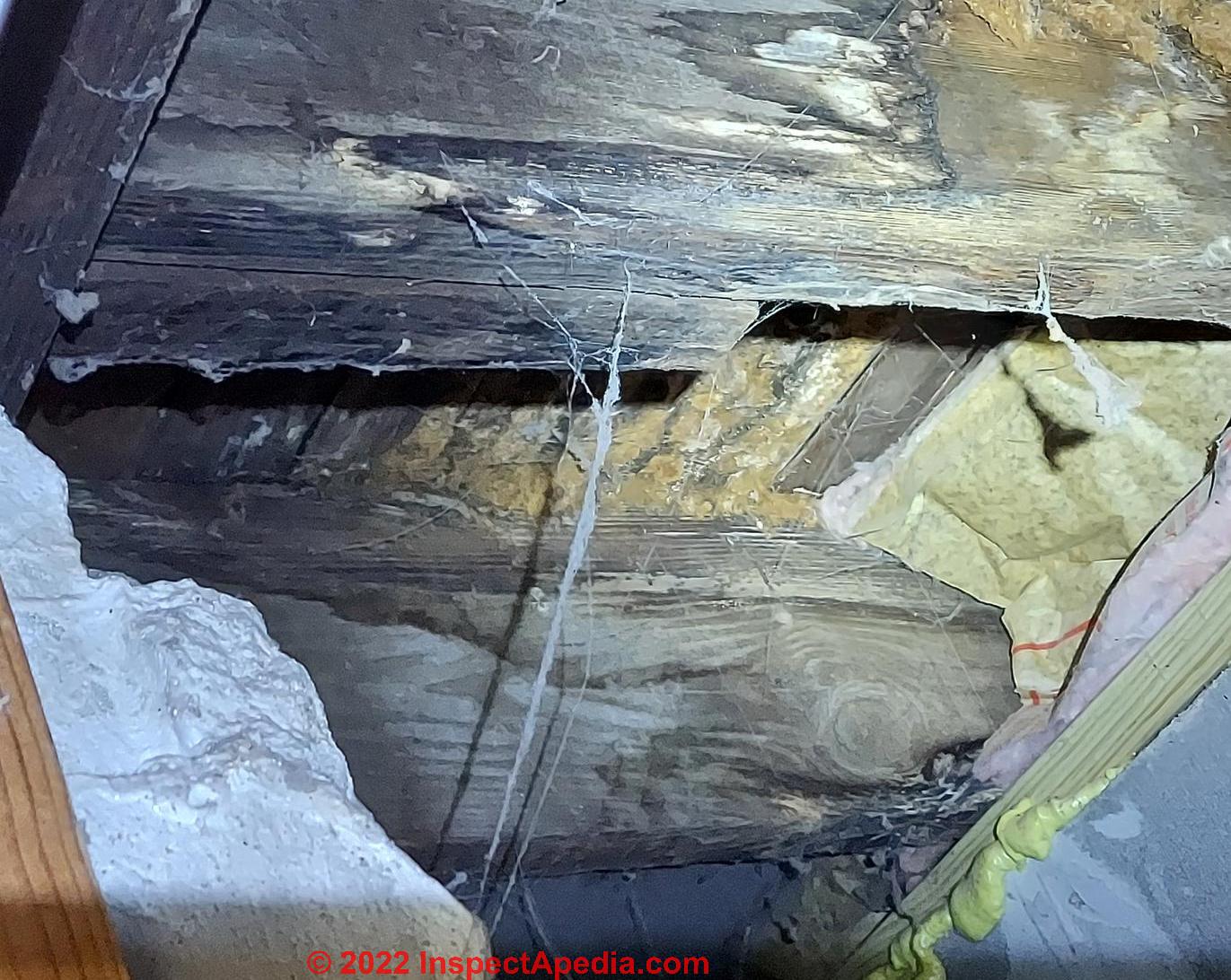
...
Continue reading at ACCEPTABLE MOLD LEVEL or select a topic from the closely-related articles below, or see the complete ARTICLE INDEX.
Or see MOLD CONTAMINATION in BUILDINGS, FAQs - older mold contamination questions & answers posted here.
Or see these
Recommended Articles
- MOLD CONTAMINATION IN BUILDINGS - home building mold contamination guide: how to find, test, inspect for, remove, & prevent indoor mold contamination what to do about harmful indoor mold.
- SIX BASIC APPROACHES - for cleaning up indoor air
- DETAILED ADVICE - how to find, test, clean up, remove, & prevent indoor mold contamination
- DO YOU NEED TO HIRE AN EXPERT - bring in a mold remediator, hire a handyman, or clean up for yourself?
- MOLD RELATED ILLNESS - asthma, allergies, lung, neurological, IAQ complaints?
- HOW TO PREVENT MOLD GROWTH - & avoid mold problems in buildings
- MOLD CONTAMINATION DETECTION - & mold identification photos & tips
- MOLD TEST PROCEDURES - valid and in-valid mold testing methods & protocols. Are some mold test kits junk science?
- MOLD DOCTORS - ENVIRONMENTAL MEDICINE
- MOLD / ENVIRONMENTAL EXPERT, HIRE ?
- MOLD TESTING METHOD VALIDITY
- RENTERS & TENANTS ADVICE for UNSAFE or UNHEALTHY HOME
- WHEN to HIRE a PROFESSIONAL
Suggested citation for this web page
MOLD CONTAMINATION IN BUILDINGS at InspectApedia.com - online encyclopedia of building & environmental inspection, testing, diagnosis, repair, & problem prevention advice.
Or see this
INDEX to RELATED ARTICLES: ARTICLE INDEX to MOLD CONTAMINATION & REMEDIATION
Or use the SEARCH BOX found below to Ask a Question or Search InspectApedia
Ask a Question or Search InspectApedia
Questions & answers or comments about how to find, test for, remove, clean up and prevent mold contamination in buildings
Try the search box just below, or if you prefer, post a question or comment in the Comments box below and we will respond promptly.
Search the InspectApedia website
Note: appearance of your Comment below may be delayed: if your comment contains an image, photograph, web link, or text that looks to the software as if it might be a web link, your posting will appear after it has been approved by a moderator. Apologies for the delay.
Only one image can be added per comment but you can post as many comments, and therefore images, as you like.
You will not receive a notification when a response to your question has been posted.
Please bookmark this page to make it easy for you to check back for our response.
Our Comment Box is provided by Countable Web Productions countable.ca
Citations & References
In addition to any citations in the article above, a full list is available on request.
- Atlas of Clinical Fungi, 2nd Ed., GS deHoog, J Guarro, J Gene, & MJ Figueras, Centraalbureau voor Schimmelcultures, Universitat Rovira I Virgili, 2000, ISBN 90-70351-43-9
- [5] US EPA - Mold Remediation in Schools and Commercial Building [ copy on file as /sickhouse/EPA_Mold_Remediation_in_Schools.pdf ] - US EPA
- Kansas State University, department of plant pathology, extension plant pathology web page on wheat rust fungus: see http://www.oznet.ksu.edu/path-ext/factSheets/Wheat/Wheat%20Leaf%20Rust.asp
- A BRIEF GUIDE to MOLD, MOISTURE, and YOUR HOME, [PDF] U.S. Environmental Protection Agency US EPA - includes basic advice for building owners, occupants, and mold cleanup operations. See http://www.epa.gov/mold/moldguide.htmA
- US EPA - UNA BREVA GUIA a MOHO / HONGO - en Espanol
- "Indoor Air Quality (IAQ) ASHRAE Standard", Ranish Joshi, Arctic India Sales, reviews the basics of IAQ, emphasizes the importance of both source control and removal of contaminants when improving indoor air quality, warns about bringing inside contaminants from outdoors, and reviews the pertinent ASHRAE IAQ standards for buildings.
- "ASHRAE Fresh Air Ventilation System", Jie Chen et als, describes a fresh air ventilation system designed to meet ASHRAE 62.2P Standard.
- "IgG Food Allergy Testing by ELISA/EIA, What do they really tell us?" Sheryl B. Miller, MT (ASCP), PhD, Clinical Laboratory Director, Bastyr University Natural Health Clinic - ELISA testing accuracy: Here is an example of Miller's critique of ELISA - www.betterhealthusa.com/public/282.cfm - Townsend Letter for Doctors and Patients
The critique included in that article raises compelling questions about IgG testing assays, which prompts our interest in actually screening for the presence of high levels of particles that could carry allergens - dog dander or cat dander in the case at hand.
- www.tldp.com/issue/174/IgG%20Food%20Allergy.html - contains similar criticism in another venue but interestingly by the same author, Sheryl Miller. Sheryl Miller, MT (ASCP), PhD, is an Immunologist and Associate Professor of Basic and Medical Sciences at Bastyr University in Bothell, Washington. She is also the Laboratory Director of the Bastyr Natural Health Clinic Laboratory. - Allergens: Testing for the level of exposure to animal allergens is discussed at http://www.animalhealthchannel.com/animalallergy/diagnosis.shtml (lab animal exposure study is interesting because it involves a higher exposure level in some cases
- Allergens: WebMD discusses allergy tests for humans at webmd.com/allergies/allergy-tests
- Fifth Kingdom, Bryce Kendrick, ISBN13: 9781585100224, - we recommend the CD-ROM version of this book. This 3rd/edition is a compact but comprehensive encyclopedia of all things mycological. Every aspect of the fungi, from aflatoxin to zppspores, with an accessible blend of verve and wit. The 24 chapters are filled with up-to-date information of classification, yeast, lichens, spore dispersal, allergies, ecology, genetics, plant pathology, predatory fungi, biological control, mutualistic symbioses with animals and plants, fungi as food, food spoilage and mycotoxins.
- Fungi, Identifying Filamentous, A Clinical Laboratory Handbook, Guy St-Germain, Richard Summerbell, Star Publishing, 1996, ISBN 0-89863-177-7 (English)
- ENVIRONMENTAL HEALTH & INVESTIGATION BIBLIOGRAPHY - our technical library on indoor air quality inspection, testing, laboratory procedures, forensic microscopy, etc.
- Adkins and Adkins Dictionary of Roman Religion discusses Robigus, the Roman god of crop protection and the legendary progenitor of wheat rust fungus.
- "Disease Prevention Program for Certain Vegetable Crops," David B. Langston, Jr., Extension Plant Pathologist - Vegetables, University of Georgia (PDF document) original source: www.reeis.usda.gov/web/crisprojectpages/209797.html
- Disease Prevention in Home Vegetable Gardens [PDF], Patricia Donald,Department of Plant Microbiology and Pathology,
Lewis Jett
Department of Horticulture, University of Missouri Extension - extension.missouri.edu/publications/DisplayPub.aspx?P=G6202 - "Management of Powdery Mildew, Leveillula taurica, in Greenhouse Peppers," Ministry of Agriculture and Lands, British Columbia - Original source: www.agf.gov.bc.ca/cropprot/peppermildew.htm
- Mycology, Fundamentals of Diagnostic, Fran Fisher, Norma B. Cook, W.B. Saunders Co. 1998, ISBN 0-7216-5006-6
- US EPA: Mold Remediation in Schools and Commercial Building [ copy on file as /sickhouse/EPA_Mold_Remediation_in_Schools.pdf ] - US EPA
- US EPA: Una Breva Guia a Moho - Hongo [on file as /sickhouse/EPA_Moho_Guia_sp.pdf - - en Espanol
- In addition to citations & references found in this article, see the research citations given at the end of the related articles found at our suggested
CONTINUE READING or RECOMMENDED ARTICLES.
- Carson, Dunlop & Associates Ltd., 120 Carlton Street Suite 407, Toronto ON M5A 4K2. Tel: (416) 964-9415 1-800-268-7070 Email: info@carsondunlop.com. Alan Carson is a past president of ASHI, the American Society of Home Inspectors.
Thanks to Alan Carson and Bob Dunlop, for permission for InspectAPedia to use text excerpts from The HOME REFERENCE BOOK - the Encyclopedia of Homes and to use illustrations from The ILLUSTRATED HOME .
Carson Dunlop Associates provides extensive home inspection education and report writing material. In gratitude we provide links to tsome Carson Dunlop Associates products and services.
 | HOME | ABOUT | ASK a QUESTION | CONTACT | CONTENT USE POLICY | DESCRIPTION | POLICIES | PRIVACY | |
| © 2024 - 1985 Publisher InspectApedia.com - Daniel Friedman | |||||||||