
InspectAPedia® FREE Encyclopedia of Building & Environmental Construction, Diagnosis, Maintenance & Repair |
Question? Just ask us! InspectAPedia
|
 Water in Oil Storage Tanks
An owner's guide to preventing, or measuring & removing oil tank water contamination

- POST a QUESTION or COMMENT about how water gets into oil storage tanks and what problems it causes in oil fired heating equipment
Water accumulation in an oil tank from flooding or from leaks into the oil storage tank:
Why is water in an oil tank a problem? How water gets into an oil storage tank - assessing the level of water in an oil tank: water finder paste, instruments, visual inspection .
This article series explains the problems caused by water accumulation in oil tanks, how water gets into the oil tank, how to measure water in the oil tank, how to remove water from oil storage tanks regardless of whether the oil tank is indoors, outdoors above ground, or buried, and how to prevent water from getting into an oil storage tank.
We explain how to test for or visually check for water in a buried or above-ground oil storage tank, and how to get water out of an oil tank. Extensive free un-biased oil storage tank inspection and testing advice for property buyers and owners is provided at this website.
InspectAPedia tolerates no conflicts of interest. We have no relationship with advertisers, products, or services discussed at this website.
Testing for and Removing Water Contamination from Oil Storage Tanks
What problems are caused by the presence of water in heating oil or heating oil tanks?
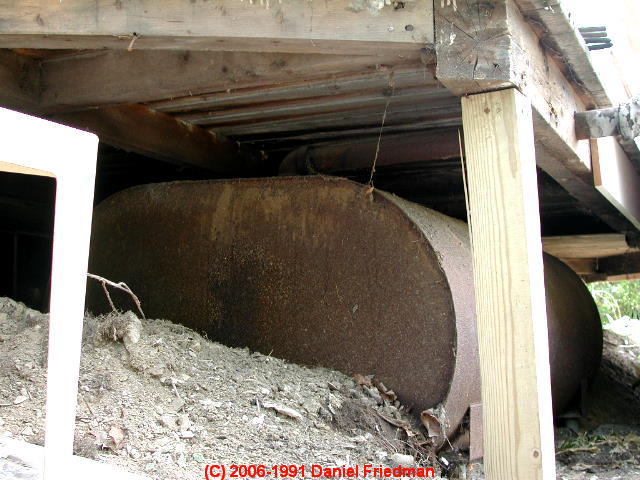 According to R.W. Beckett, a major manufacturer of heating oil burners and related equipment, water in the heating oil tank or piping system causes the following "nuisance service problems" problems [edited, paraphrased, amplified - Ed.]:
- Rust inside the oil storage tank leading to heating oil fuel pump damage
- Freezing and blocking the heating oil supply line in some outside oil storage tank installations
- Permitting bacterial growth and sludge formation inside the oil storage tank or heating oil piping (or filter canister)
- Contributing to heating oil filter blockage, erratic oil burner operation, oil burner nozzle clogging, and safety lockout of the oil burner, leading to loss of heat and related building damage such as frozen pipes, water damage, mold contamination damage
- Beckett did not include but we add: oil storage tank corrosion, perforation, and leakage, potentially leading to costly oil tank replacement and environmental damage cleanup costs.
Testing an oil tank for for water contamination in an oil tank (above ground oil tanks whether inside or outdoors, or buried oil tanks) is simple and can be done by any service person or even a homeowner.
Oil Tank testing methods for oil leaks vary in risk to the tank, cost, invasiveness, length of time to complete, and more.
Since water in a heating oil tank can lead to loss of heat and related building damage we want to know if in-tank water is a problem at a given property. There are several steps and test methods for finding water in an oil tank and for determining how much of a problem it is.
How Does Water Get Inside a Buried Heating Oil Storage Tank
Details about how water leaks into or condenses in buried oil tanks are at BURIED OIL TANK WATER ENTRY. Excerpts are below.
- Water enters a buried or above ground tank by condensation: as temperatures vary moisture-containing air may be drawn into and then out
of an oil tank.
Air leaves the tank as oil is consumed; air enters and leaves the oil tank through the oil tank vent. Moist air entering the tank from outside can bring water which, on entering the cooler tank interior, condenses out of vapor form into water droplets which can, over time accumulate. - Water enters a tank filler pipe: from roof spillage onto the tank or filler top (particularly and obviously if the filler cap is left off), or from ground or surface runoff entering the oil storage tank (particularly and obviously if the filler cap is near, at, or below ground surface level).
- Leaving off an outside oil tank filler cap for a few days is not itself a likely source of a problem unless the filler was exposed to heavy rain, roof runoff spillage onto the open filler pipe, or surface runoff entering the tank (such as for a filler pipe flush with the ground).
- Water leaks into a buried oil tank from an actual tank perforation that admits ground water, or from a bad plumbing fitting on the tank. When oil levels in the tank is below an oil tank perforation or a leak in oil tank piping, it is possible for ground water to leak into a buried oil tank just heating oil may leak out of the oil tank when it is filled above the perforation or leak point.
- Water leaks into the buried oil tank from a faulty filler cap gasket around the oil tank filler pipe plug, especially at installations whose oil tank filler pipe is located in a box whose top is flush with the ground surface. Rainwater or snow-melt water then enter the oil storage tank.
- Water leaks into the buried oil tank from an oil tank vent pipe that is missing a cap to protect against rainwater or roof runoff spillage into the tank, especially if the vent (or filler pipe) are located under the roof's drip-line.
- Water leaks into a buried oil storage tank from leaky oil piping fittings. R.W. Beckett recommends that [Quoting]
All pipe fittings must be tightened securely and have the threads sealed with a resilient compound that can endure the environmental variables in temperature. Any loose or poorly sealed [oil tank fuel piping, fill, or vent piping] joints can permit ground water to infiltrate the [oil] storage tank. - Water is delivered to the oil tank along with the heating oil fuel: This is not common, but it is possible to get a delivery of "bad" heating oil that is water contaminated,
especially if the oil truck happens to fill-up at the oil storage depot when an oil barge is
unloading oil since during that operation water which is normally kept in the bottom of oil depot
storage tanks may be stirred-up.
Most oil companies know to avoid this problem and some also have water filters installed at their oil trucks. No oil company is going to admit that they picked up and delivered water-contaminated oil to your home so don't waste time asking them if they are guilty of this crime.
R.W. Beckett referred to this [quoting] "possible but rare contributor due to storage and maintenance practices in the [heating oil] distribution system. Large bulk [oil storage] tanks must be checked for condensation accumulation and bled periodically.
If this is not done conscientiously, then it is possible for water to be drawn out with the oil when the stocks are extremely low or when the bulk storage is filled and the water is forced into temporary suspension. Fortunately, our industry has implemented effective maintenance measures and this has been virtually eliminated.
However, if water and sludge are found in a tank that does not have a leak, then it must be thoroughly pumped out, cleaned, and treated with a chemical additive that disperses water, sludge and neutralizes bacterial growth."
How Does Water Enter an Above-Ground Oil Storage Tank
Details about how water leaks into or condenses in above-ground oil tanks are at ABOVE GROUND OIL TANK WATER ENTRY. Excerpts are below.
Sources of water entry into above ground oil storage tanks are similar to the underground oil tank water leak sources listed just above.[Paraphrased, edited, and expanded from R.W. Beckett]:
- Water may enter an above-ground oil storage tank from a fill pipe that is not properly capped, sealed, and located out of the roof edge drip line.
Our photo (left) of an outdoor oil storage tank shows that the oil tank vent is not protected against water entry, and worse, though you can't see it in this closeup photo), this outdoor oil tank was located close to the building (the usual practice) placing it right under the drip line of the roof.
Whenever gutters overflowed (which is common), water splashing on the oil tank to was at risk of entering the tank through this vent pipe. - Water may enter an above-ground oil storage tank from a vent pipe that is not capped, shielded from water entry, and located away from roof edges. Note that water spilling on to the top of an outdoor oil storage tank can splash-up and enter the oil tank through the vent pipe even if the pipe has a rain cap installed.
- Outdoor above-ground oil storage tank water condensation occurs when a partially-filled oil tank is exposed to variations in outdoor temperature. Oil in the tank and the tank steel itself are warmed by sunlight and higher daytime temperatures.
At higher temperatures both air inside the free area in the oil storage tank and the oil itself expand in volume, pushing air out of the oil storage tank.
As temperatures fall after sundown or in night time temperatures, both air and oil volume in the oil tank are reduced in volume. This volume reduction of air and oil inside the oil tank will draw night-time air into the oil tank through the oil tank vent pipe opening. When that incoming air is high in moisture, moisture will condense on the oil tank interior walls, accumulating on the oil tank bottom (water is heavier than oil).
When the quantity of water on the oil tank bottom is great enough to reach the oil supply piping (for oil tanks whose piping is attached through the oil tank top), or when it reaches an oil supply line outlet at the tank bottom (for oil tanks piped off of the tank bottom), water enters the heating system oil burner, leading to lockout or loss of heat.
Steps to Reduce the Chances of Water Entering an Outdoor Above-Ground Oil Storage Tank
Details about how we keep water out of oil storage tanks are found at OIL TANK WATER PREVENTION. Excerpts are below.
[Paraphrased, edited, and expanded from R.W. Beckett and other sources]:
- Install properly sealed fill and vent pipes on the oil storage tank, and avoid locating the tank where roof runoff spills onto the tank or its piping.
- Paint the above-ground outdoor oil storage tank silver (aluminum paint) to reflect sunlight (and heat), or locate the tank in a shaded area if possible.
If you consider that in freezing climates we recommend constructing a heated enclosure around an outside oil storage tank to avoid oil tank waxing or water freezing and loss of heat, that step will also reduce the problem of oil tank water accumulation due to condensation. - Install the oil tank so that the oil tank fill pipe end is sloped downwards.
This will cause water entering at the fill pipe to pool right below the filler cap where it can be observed and pumped out. - For oil tanks drawing oil from the oil tank bottom, install a 3" vertical riser (soldering a 3" x 1/2" O.D. copper tube) onto the oil tank side of the oil tank bottom fitting so that oil is always drawn off from 3" above the tank bottom, thus above water that may be accumulated on the oil tank bottom (as long as the water has accumulated to a level less than 3" this works).
- Install a water tank drain port on the lower end of the above-ground oil storage tank.
[Properly installed a aboveground oil tank is installed with a few inches of slope away from the tank bottom outlet fitting so that water and sludge accumulate first away from the oil supply piping connection point. Even if the oil piping is installed through the tank top fittings (a better, more water and sludge-resistant approach), an oil tank bottom drain can still be used to check for and remove water accumulated on the oil tank bottom. - Install the oil supply and return piping through oil tank top fittings rather than at the oil tank bottom fittings.
A 3/8" or 1/2" diameter compression fitting is installed in a special dual-port oil tank top fitting that permits the copper oil supply and return piping to be routed through the tank top fitting, extending continuously (without potentially leaky joints) to 3" above the oil tank bottom.
R.W. Beckett's illustration shows that the oil pickup and return tubing are also bent at an angle away from one another so that the oil pick-up line does not pick up sludge or air bubbles that are caused by excess oil returning to the oil tank through the oil return line. - Keep the heating oil tank filled during warm weather. By minimizing the air space above oil in the oil storage tank you will reduce the oil tank air "exhale" as the oil tank warms, and "inhale" as the oil tank cools, thus reducing outside air and moisture being drawn into the oil tank.
How to Measure the Level of Water Contamination in an Oil Tank
Oil storage tanks would ideally be tested for water accumulation at every oil delivery, but as that simply is not going to happen, you should ask your oil company to assess the amount of water in the oil tank at least once a year by using one of the methods discussed
at OIL TANK WATER DETECTION where we provide details about measuring the level of water contamination in heating oil tanks. Excerpts are below.
A simple method that can be used on oil storage tanks whose fill pipe is located directly above the tank is to insert a dipstick into the oil tank after coating the dipstick end with a water-finding paste. (photo at left).
A similar test for oil tanks whose piping does not permit use of a dipstick makes use of a string and weight and water finding paste.
Where to Buy Oil Tank Water Finding Paste or Water Indicating Pastes
- Water finder paste & dipstick for use in heating oil tanks: using a water finder paste on the end of a stick.
Water indicating paste also called water finding paste or water finder paste, is coated over the bottom few inches of an oil tank probing stick or onto a string or flexible tape which can be inserted into an oil tank. The water indicating paste changes color (typically white to red, green to red,or pink to white)
to indicate the depth of water in the oil tank.
You can ask your oil company to handle this if you don't have a stick, string, or tape or tools to open an access plug on the top of your oil tank. This method works best if the oil filler pipe is a straight shot down into the oil tank, If there is not sufficient overhead room to insert the long stick, such as with outdoor and buried oil tanks you'll need to use a string or tape which you coat with the water indicating paste.
Here is a list of water and oil indicating pastes that will detect water in home heating oil tanks whether they are buried or above ground, outside, or indoor tanks:- Eastern Water Indicating Paste (in a tube, turns red in presence of water)
- Eastern Oil Indicating Paste (oil finding paste) in a jar, used to indicate the height of heating oil, diesel oil, kerosene, gasoline, etc, turns from pink to white).
- Kolor Kut water Indicating Paste
- Sar-Gel gauging paste turns bright red where it contacts water
- McCabe Gauging Paste - a water level indicating paste, turns from green to red when immersed in water for 30 seconds or more. McCabe also makes a gasoline indicating paste which is purple and shows a line where gasoline is encountered.
Here are some online sources where you can purchase these products (we have no financial relationship with any product or service discussed at our website: - www.marineservicesinc.biz/ - Marine Services, Inc.
- www.wlwalker.com/sites/WLW/sp_products.asp?groupid=GAUGE - W.L. Walker Co.
- www.lindequipment.net/ - Lind Equipment
- www.icllabs.com/Gauging%20Pastes.htm - ICL Calibration Laboratories
- www.china-tapemeasure.com/oil-tape-measure-fibre-glass-tape.htm - Eastern Tape Measure
Other Methods for Detecting Water Contamination in a Heating Oil Tank
- Other water sensing products: Other special products are available such as a sensor connected to a string or wire that can be dropped into an oil tank to check for water contamination. Water alarm devices are also available.
- Visual Check of the oil filter at the oil burner: inspecting in the oil filter at the heating equipment can indicate a history of
water passing from the oil tank towards the oil burner. Water in the oil filter, or rust therein, would be an
indicator of water passing through the system.
As we discuss at OIL TANK LEAK TEST METHODS, A neat way to look for a history of water in the heating oil storage tank is to check the oil filter canister itself. Many oil burners are protected by a heating oil filter installed either at the tank or at the oil burner. (Every heating boiler burning oil should have one of these filters installed to protect the equipment.)If the oil tank has a high level of water, especially if the oil lines run to the oil burner from the bottom of the oil tank, some of that water will have been making its way to the oil burner where, en route, it is (usually) trapped in the oil filter. If you open an oil filter container and see that its metal parts are rusted, or that there is a lot of rusty sludge in the bottom of the filter holding canister, the oil tank needs to be checked further for water
Ask your oil company service technician to check the oil filter for evidence of water or rust, or if you've had heat outages ask if water in the oil could be a contributor or cause.
See OIL TANK WATER DETECTION for details about methods of testing for water in oil storage tanks.
Foam Formation in Wet Heating Oil
Reader Question: foam formed when new oil was put into tank that caused it to indicate full and stop pumping
14 Feb 2015 Anonymous said:
I asked the oil man to fill my tank that read 1/8 tank. When he came he pumped 110 gal and it indicated full to delivery man. The guage read 1/2. They told me that foam formed when new oil was put into tank that caused it to indicate full and stop pumping. I've never heard of such a thing! Any comment?
Reply:
Anon:
What you describe is not something I've come across but it has been described as an effect that can occur if there is water contamination in the oil storage tank; during delivery the incoming oil, delivered fast and under pressure, can stir up water and form foam - this can also clog up the heating oil piping, filter, burner, and lead to loss of heat.
I'd ask the oil company to check oil tank water level, remove excess water, and go from there.
I'd also check - if you can - about just what was being delivered to you - if your oil tank didn't have much water in it before then water could have come in a bad delivery. I've seen this happen if the oil truck is filled from a depot tank that is low on oil, has water in that tank bottom (which is normal) and is itself stirred by a depot delivery while the oil truck is filling.
Experts have written about this, describing the formation of a water-oil emulsion and problems that it causes in heating oil production and usage; see in parcitular Maslennikov (1969)
- Ali, M. F., and M. H. Alqam. "The role of asphaltenes, resins and other solids in the stabilization of water in oil emulsions and its effects on oil production in Saudi oil fields." Fuel 79, no. 11 (2000): 1309-1316.
- Eow, John S., and Mojtaba Ghadiri. "Electrostatic enhancement of coalescence of water droplets in oil: a review of the technology." Chemical Engineering Journal 85, no. 2 (2002): 357-368.
- Fang, C. S., and P. M. C. Lai. "Microwave heating and separation of water-in-oil emulsions." Journal of microwave power and electromagnetic energy 30, no. 1 (1995): 46-57.
- Fletcher, Paul DI, Andrew M. Howe, and Brian H. Robinson. "The kinetics of solubilisate exchange between water droplets of a water-in-oil microemulsion." Journal of the Chemical Society, Faraday Transactions 1: Physical Chemistry in Condensed Phases 83, no. 4 (1987): 985-1006.
- Law, C. K. "A model for the combustion of oil/water emulsion droplets." Combustion Science and Technology 17, no. 1-2 (1977): 29-38.
- Maslennikov, M. S., and M. N. Shalonova. "Foam formation in wet heavy fuel oils." Chemistry and Technology of Fuels and Oils 5, no. 3 (1969): 191-194.
- Rosen, Milton J., and Joy T. Kunjappu. Surfactants and interfacial phenomena. John Wiley & Sons, 2012.
This Q&A was originally published at OIL TANK GAUGES
How to Remove Unwanted Water from an Oil Tank
Details on how we get rid of water contamination in an oil tank are now at OIL TANK WATER REMOVAL
Reader Comments, Questions & Answers About The Article Above
Below you will find questions and answers previously posted on this page at its page bottom reader comment box.
Reader Q&A - also see RECOMMENDED ARTICLES & FAQs
On 2020-02-17 - by (mod) -
Interesting idea, John. I suspect that the sludge and debris common in oil heat systems risks a clear sediment bowl becoming obscured rather quickly; you could try having a transparent heating oil filter canister bottom made to see if that idea would work.
On 2020-02-17 by JohnfCockerill@yahoo.com
What about adding a visual device like a sediment bowl to watch the oil coming through to the burner. It would seem that it would have to be larger than those used on tractors and cars years ago.
On 2018-06-22 by (mod) -
Mike
If you are really lucky water has leaked INTO the tank from above but the tank itself is not leaking. There's a fair chance that that's the case, based on your description.
In that case you can proceed to do what should have been done in 1999 - abandon the tank properly by having it emptied, tested, and filled - often using sand.
But if the tank has leaked the leak will need to be cleaned-up. And pretending it never happened is bad
1. because your tank is contaminating the environment, aquifer, etc.
2. it's illegal in most countries and cities
3. the future sale of your home could hit an ugly snag right at a bad time -
If it were my tank I'd have it emptied then tested for leaks. An alternative is to have a oil tank leak test done by testing the soil at the level of the bottom of the tank.
If all is OK then proceed with the abandonment.
See OIL TANK ABANDONING PROCEDURE https://inspectapedia.com/oiltanks/Oil_Tank_Abandonment_Procedure.php
On 2018-06-22 by Mike Landis
I have a 550 gal underground tank last used in 1999. When it was no longer used it was left with about 1/2" oil in tank. Out of curiosity I checked it today and the dipstick was wet about 2 feet which means to me there is about 24" water in there.
What should I do?
On 2018-01-07 by (mod) -
Jay
Some oil tank cleaning companies can remove sludge, often using a combination of an additive to break down the sludge so it can be pumped, and a pony pump to siphon out sludge and water from the tank. It won't remove all of the debris but you can sometimes get quite a bit out.
Water must be removed and is easier to pump out.
I might go to
- a larger diameter oil line tank to burner,
- double capacity oil filters
or
change oil piping to take oil out at the top of the tank, with a pickup line higher off the tank bottom
On 2018-01-04 by JayJ
My 22-year-old oil furnace NEVER gave us any trouble until about 14 months ago. (Here in suburban Maryland, we use approx 500 gals per year; my tank is located in the basement.)
But in Nov 2016 I let the tank get too empty, and got a fill of 240 gals on a 275-gal tank. A few days later, the furnace burner locked up from water and/or sludge. In the resulting service calls over the next 2 months, we got 3 nozzle replacements, a pump replacement, filter replacement with a fancier model. This past fall it ran fine from mid-October to last week,
but on Dec 28 I got a fillup of 127 gals, then on Dec 30 the system locked up again. The same service guy arrived today, replaced the nozzle, pump, and filter cartridge again, and showed me the amazing amount of dark brown sediment around the nozzle. The new fancy filter was a complete failure, as far as I can see.
For the moment we are warm again, but I don't have a good feeling about this.
I guess my questions are:
(1) is there a way to suck out water/sludge/sediment from the bottom of a tank without emptying it?
(2) my tank's fuel outlet is at the very bottom of the tank; it seems smarter to have it a few inches above the bottom. Is there a way to make that change without emptying the tank?
(3) The Maryland Dept. of Environment says that aboveground tanks last 20 to 25 years and eventually corrode from the inside, which is scary
; I don't like the sound of an oil leak in my basement. All in all, I'm strongly considering a conversion to propane in 2018. What advice do you have? Thanks.
On 2016-12-13 by Glen
How to remove water from the oil tank with chemicals.
On 2016-11-18 by James
We have some water in our kerosene jug...how do we remove it so we can use our kerosene heater. Thanks
On 2016-11-11 by Charlotte
How do I remove water from my tank with chemicals
On 2015-11-17 by (mod) -
Anon:
We don't need a new oil tank solely because water got into the old one. We need a new oil tank if the existing one is perforated, leaking, or has rusted (from inside in this case) so much that the remaining tank wall thickness is too thin, risking a costly oil spill or leak.
For an old but in-good-condition oil tank the water is simply removed by a service company.
IF you do need a new oil tank then the oil from the old one can be pumped out and used in the new one.
On 2015-11-17 by Anonymous
I am having a new tank because water is getting into my old one, will i be able to use the oil that is in the old one
On 2015-10-20 by (mod) -
Wow. With an oil tank filled, presumably you got an oil delivery not a water delivery, I have to figure that your oil lines are taking fuel from or close to the tank bottom so picked up the water.
An underground tank would typically be piped from its top with the supply and return line ending a few inches from the tank bottom. I wonder if your lines are too low in the tank.
You can calculate the possibility of your question about the Tigerloop: look at the firing rate of the nozzle in GPH, estimate how many hours the burner ran, and you'll know what volume of oil would have been needed for the initial 30 minutes.
On a typical residential system that would certainly be less than a gallon (few residential systems fire at 2 gph
). So yeah your piping and filter and tigerloop could have held enough oil to run 30 minutes.
If this had happened right after an oil delivery, then It would have been possible that your oil delivery was contaminated, OR that the delivery stirred up water in the tank; If the latter happened, then the system might run ok at first (the water is mixed up with the oii but after a few hours the water settles to the bottom and is then sent out to the oil burner as mostly-water.
On 2015-10-19 by Rey Barry
I had the oil tank filled with 7xx gallons in August. The first oil burner run of the season was last night. It ran flawlessly for 30 minutes, warming the water through the house in 3 zones. When I woke the next morning, the burner had quit and would not restart. The pump was bringing in water, only water.
I checked the 1000-gal underground tank (Sar-Gel) and there was 1.5 inches of water, around 10 gallons! I'm familiar with water-in-tank conditions, but what accounts for flawless running last night? Can a 2A-700A filter feeding a Tigerloop hold enough oil to run the burner for a half hour before the water took over?
Question: discovered a lot of water in the tank
(Jan 24, 2014) D said:
We had a top up of heating oil and 2 to3 days later our boiler and oil fire went out . Our boiler man discovered a lot of water in the tank. Oil company dont want to know alot of damage to boiler and still cant get fire going
Reply:
D.
The article above describes how water is removed from the oil tank. If water has not been removed then it's likely that trying to start the boiler is futile because it keeps drawing more water into the system.
If the oil lines are taken off of the tank bottom it will not be possible to avoid water in the fuel without either having it all pumped out or by re-piping the oil lines off of the tank top (and keeping the oil line pick-up height inside the tank above the bottom and above any water.
There are commercial oil filter systems that can help trap and remove water as well, but for a residential installation this ought not be necessary.
If you find that the water in your oil tank got there by a bad oil delivery that contained a high percentage of water then you got a bad oil delivery - something to discuss with your oil company.
Keep us posted.
Question: My fuel tank went bad,in pumping out the 200 gal. of fuel I ended up with contaminants in the fuel
(Aug 16, 2014) bob said:
My fuel tank went bad,in pumping out the 200 gal. of fuel I ended up with contaminants in the fuel. Is there a way to "clean" the fuel so it can be used in the new tank? Thanks, hrcicio@yahoo.com
Reply:
Bob,
If the contaminants are sludge and debris you can install a double capacity oil filter and change the cartridge frequently until things settle down.
If the contaminants are water, there are water suspension products that remove small amounts of water; or if there is a lot of water your oil company can pump it out of the new tank (water will be at the tank bottom).
On 2012-01-03 by Art
Showing results for I live in northern Minnesota and had 5 below this morning. My heat quit and I put a hair dry on the line the heat started up but I do belive ice is in the tank how can I remove it?
Search instead for I live in norther Minnesota and had 5 below this morning. My heat quit and I put a hair dry on the line the heat started up but I do belive ice is in the tank how can I remove it?
On 2011-11-05 by Jason
I have an oil tank in ground that I pumped to my out of ground tanks. Initially we pumped a champagne color out then it turned red. Is this a sign of water in my tank or is it two different oils, dyed and undyed?
On 2011-10-03 - by (mod) -
Susan I can't even guess at a problem diagnosis for your heating system with just the information in your question. Certainly if the problem is water in the heating oil supply, that can result in improper operation and nozzle clogging at the oil burner. Your heating service tech can confirm whether or not water in the heating oil is a problem by inspecting the oil filter canister base for water, rust, sludge that may be passing into the oil burner itself. Also be sure the filter screen INSIDE the oil burner fuel unit (oil pump) has been changed.
If there is water and crud in the oil tank it'll need to be pumped out.
On 2011-10-02 by Susan
our oil furnance won't stay lite .we have replaced every thing that we can on the furnance do you think it's the fuel oil ?
On 2011-08-28 by Andrew
Helpfull Info Thanks :)
On 2011-07-14 by Joanie
Thanks this site is very helpful.
On 2011-06-03 - by (mod) -
Thank you for the nice comment, Biffo. We are dedicated to making our information as accurate, complete, useful, and unbiased as possible: we very much welcome critique, questions, or content suggestions for our web articles.
On 2011-06-03 by Biffo
Some really good tips,never realised what went on in my oil tank until now especially methods to extract water from the tank,excellent web site.
...
Continue reading at ABOVE GROUND OIL TANK WATER ENTRY or select a topic from the closely-related articles below, or see the complete ARTICLE INDEX.
Or see these
Aboveground Oil Storage Tank Water Contamination Articles
Suggested citation for this web page
OIL TANK WATER CONTAMINATION at InspectApedia.com - online encyclopedia of building & environmental inspection, testing, diagnosis, repair, & problem prevention advice.
Or see this
INDEX to RELATED ARTICLES: ARTICLE INDEX to HEATING OIL, OIL BURNERS, OIL FIRED HEATERS, OIL TANKS
Or use the SEARCH BOX found below to Ask a Question or Search InspectApedia
Ask a Question or Search InspectApedia
Try the search box just below, or if you prefer, post a question or comment in the Comments box below and we will respond promptly.
Search the InspectApedia website
Note: appearance of your Comment below may be delayed: if your comment contains an image, photograph, web link, or text that looks to the software as if it might be a web link, your posting will appear after it has been approved by a moderator. Apologies for the delay.
Only one image can be added per comment but you can post as many comments, and therefore images, as you like.
You will not receive a notification when a response to your question has been posted.
Please bookmark this page to make it easy for you to check back for our response.
Our Comment Box is provided by Countable Web Productions countable.ca
Citations & References
In addition to any citations in the article above, a full list is available on request.
- "Preventing Water from Entering the [oil heating] Fuel System", Technical Information Bulletin, 10/15/1990, R.W. Beckett Corporation, 38251 Center Ridge Road, PO Box 1289, Elyria OH 44036, Tel: 440-327-1060, Email: sales@beckettcorp.com
- National Association of Oil Heat Service Managers, PO Box 380, Elmwood Park, NJ 07407
- "Homeowners Guide to Fuel Storage," Agway Energy Products, Verbank, NY, November 1990
- Our recommended books about building & mechanical systems design, inspection, problem diagnosis, and repair, and about indoor environment and IAQ testing, diagnosis, and cleanup are at the InspectAPedia Bookstore. Also see our Book Reviews - InspectAPedia.
- In addition to citations & references found in this article, see the research citations given at the end of the related articles found at our suggested
CONTINUE READING or RECOMMENDED ARTICLES.
- Carson, Dunlop & Associates Ltd., 120 Carlton Street Suite 407, Toronto ON M5A 4K2. Tel: (416) 964-9415 1-800-268-7070 Email: info@carsondunlop.com. Alan Carson is a past president of ASHI, the American Society of Home Inspectors.
Thanks to Alan Carson and Bob Dunlop, for permission for InspectAPedia to use text excerpts from The HOME REFERENCE BOOK - the Encyclopedia of Homes and to use illustrations from The ILLUSTRATED HOME .
Carson Dunlop Associates provides extensive home inspection education and report writing material. In gratitude we provide links to tsome Carson Dunlop Associates products and services.
 | HOME | ABOUT | ASK a QUESTION | CONTACT | CONTENT USE POLICY | DESCRIPTION | POLICIES | PRIVACY | |
| © 2024 - 1985 Publisher InspectApedia.com - Daniel Friedman | |||||||||