
InspectAPedia® FREE Encyclopedia of Building & Environmental Construction, Diagnosis, Maintenance & Repair |
Question? Just ask us! InspectAPedia
|
 Guide to Oil Tank Gauges
Where is the oil tank gauge? How much oil is in the tank? Remote readout oil tank gauges

- POST a QUESTION or COMMENT about oil tank gauges: buy, install, repair, replace, read, or troubleshoot residential and light commercial oil storage tank gauges
Heating oil storage tank level gauges:
We discuss: How to find the oil tank gauge? How to find out how much oil is in the oil tank. Heating oil tank gauge installation, reading, testing, repair guide: how much oil is in the heating oil tank? How accurate is the oil tank gauge?
This article series escribes how to find, read, and test the oil gauge on a home heating oil tank.
We also discuss: What are the different types of oil tank gauges and indicators of oil level? Types of oil tank gauges to measure how much oil is in the oil tank;
Special gauges for buried oil tanks - underground tanks - tell how much oil is in the tank without having to use a dipstick; Heating oil tank gauge accuracy, inspection, installation, defects, repair guide.
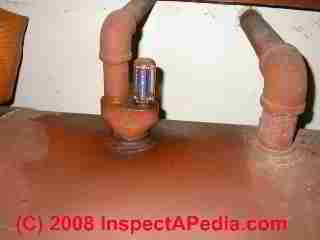
If your oil fired heating boiler, warm air furnace, or water heater has stopped working, one of the first things to check is whether or not you've run out of fuel. If your oil tank is above ground indoors or outside it should have a fuel level gauge installed similar to the one shown in our photo.
InspectAPedia tolerates no conflicts of interest. We have no relationship with advertisers, products, or services discussed at this website.
How to Find, Read, and Test an Oil Tank Fuel Level Gauge
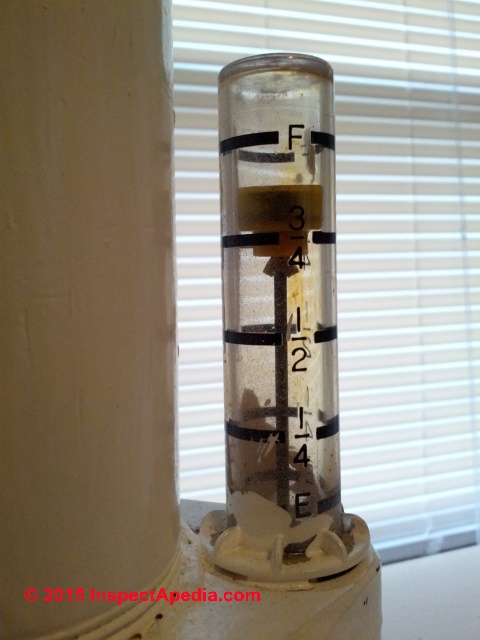 Oil tank gauges are pretty simple to find, recognize, and read. If your heating oil tank is above ground outdoors or indoors, look on top of the tank for a device similar to the one in the photos shown on this page.
If the heating oil tank has been enclosed for cosmetic or other reasons, it may be necessary to make an access door that can be opened to give a view of the oil tank gauge.
If the heating oil tank is inaccessible above ground or buried, remote oil level gauges are available. Installing a remote-reading oil tank gauge permits reading of the oil tank level from an readout device inside the building.
[Click to enlarge any image]
Article Contents
- OIL TANK GAUGES - home
How does an oil tank gauge work?

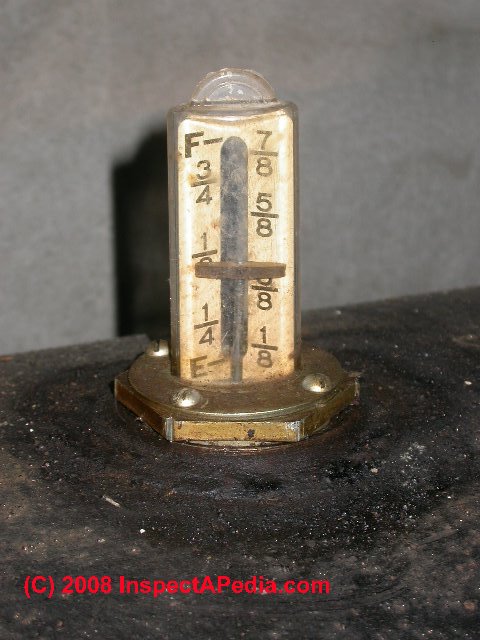
Shown above and below are the components of a typical hinged-type oil storage tank float gauge.
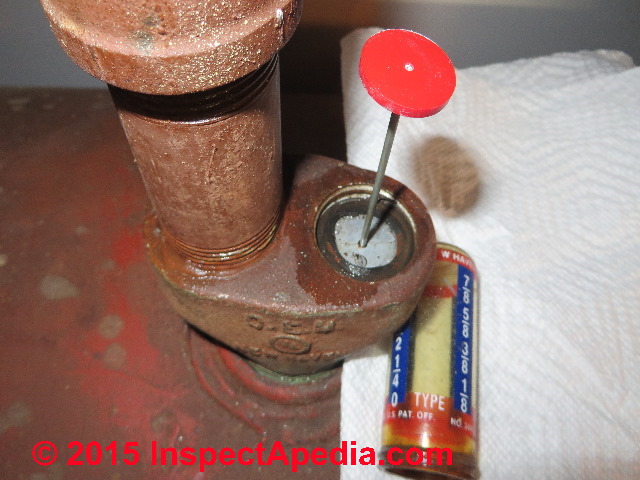
A float assembly inside the oil tank moves up and down along with the level of oil inside of the oil tank. As the float assembly moves up or down it pushes a metal rod upwards (oil level in the tank is going up) or lets the metal rod fall down (oil level in the tank is dropping).
On top of the metal rod is an indicator, such as the red plastic disk in our photo below. The red plastic disk forms a line inside the oil tank gauge, showing the level of oil in the tank.

In the photo of an oil tank gauge above, the red disk is sitting above 3/4 - showing that the heating oil level in this oil tank is more than 3/4 full.
Other oil tank gauges may use a rigid vertical rod and moving float or an electronic oil level sensor method. The gauge is only close to accurate when the oil tank (round or oval in shape) is empty, half-full, and completely full levels.
Oil tank gauges are more accurate on rectangular-shaped oil tanks and still more accurate oil tank measurement systems are available.
See OIL TANK GAUGE ACCURACY for details.
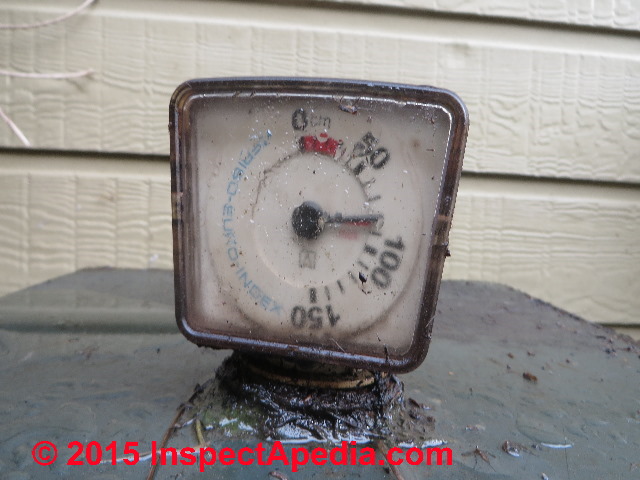
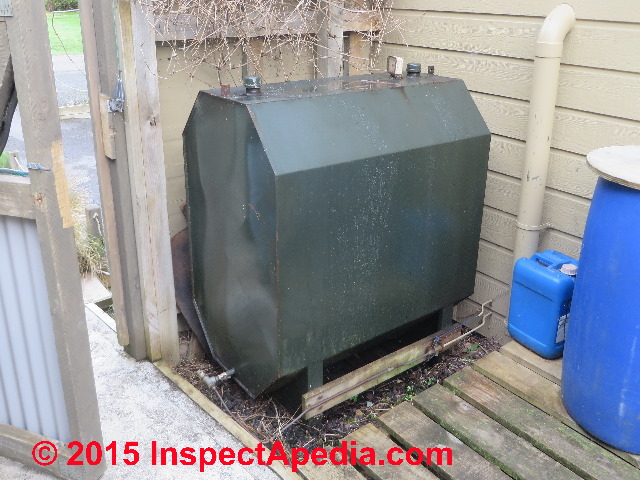
At above right the oil tank gauge installed on this Stewart Island, New Zealand oil storage tank reads oil tank level in cm - which works nicely to give an idera of how much oil remains if the tank's height is close to the gauge's operating range. The tank where this particular gauge is installed is shown below.
How do we know that the oil tank gauge is working?
Well it's easier than you might think.
On most oil tank gauges, the plastic tube that covers the actual moving gauge parts is just screwed into the cast iron base that holds the gauge assembly. Once in a while when we've wondered if our oil tank was really empty, or when an owner has reported that the oil gauge seems to "stick" we've done this simple test.
Unscrew the plastic cover by hand. Don't grab it with Vise Grips™ or you'll probably break the plastic. The gauge cover turns counter-clockwise to remove it.
If you did break the oil tank gauge cover it's not a catastrophe - the heating system will still work, but you should replace it before your next oil delivery because a broken or missing oil tank gauge cover could lead to a costly oil spill during an oil delivery.
Now that the cover over the oil tank gauge has been removed and set aside (where it won't roll under the oil tank and get lost), and presuming your tank gauge is not already sitting at the bottom of its range of travel (empty), just press the top of the gauge indicator rod downwards slowly and gently.
You will feel a little resistance because you're pushing a rod and float down into the heating oil inside tank. When you have pushed the indicator partly or all the way down, release it.
You should see the tank gauge rise back to about where it was before. This tells you that the hinged mechanism and float are still in place and that they are moving without obstruction.
If the gauge is broken, lost, or damaged, the entire assembly can be replaced by your heating oil technician. Remember that a heating oil tank gauge is not lab-grade equipment. It is not precise to the quart, probably not even to the gallon.
We have made a video of the procedure for testing an oil tank gauge and will post it here soon.
What else goes wrong with heating oil tank gauges?
- Oil leaks around the oil tank gauge:
if the oil tank gauge cover is damaged heating oil may be forced out of the oil tank during the oil tank fill-up operation. A loose oil tank level gauge or indicator gauge may be due to a loose oil tank gauge cover ("sight glass" or properly "gauge vial").
Other causes of leaks around the gauge include a cracked or damaged gauge vial or gauge cover base that doesn't seal properly against the gauge vial gasket, or on older oil tanks, a damaged or missing gauge vial gasket.
see OIL TANK GAUGE LEAK REPAIR for a step by step repair methods for oil leaks at the oil tank gauge or gauge vial.
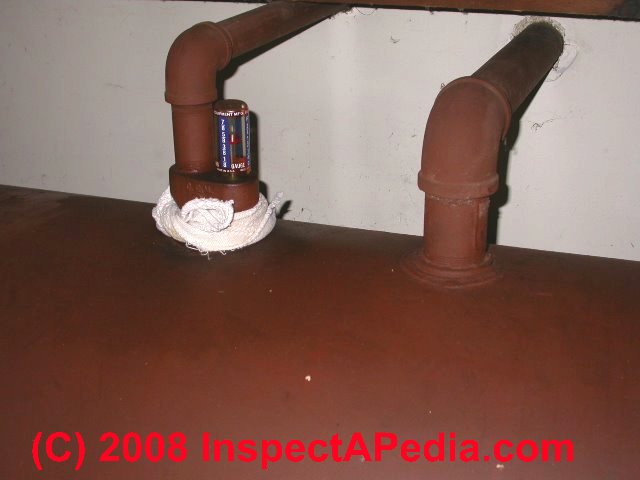
- Oil tank leaks at pipe fittings:
leaks at oil pipe fittings can occur around the oil tank gauge and can be mistaken for a leak at the gauge itself. In the oil tank gauge leak repair article cited just above we illustrate how to separate leaks at the gauge or gauge vial itself from leaks at nearby oil tank piping and fittings.
In the photo at above left the amount of seepage was just an ounce or so during fill up - the rag stopped oil from running down the sides of the oil tank and stinking up the garage where the tank was located. Once a year the owner replaces the dirty rag with a clean one.
Paint-on sealants or epoxy applied to a surface which has been thoroughly cleaned of oil residue might also work in this location if the leak is really a minor seep.
See OIL TANK FILL / VENT PIPE LEAK REPAIRS for details.
During oil tank fill-up oil may also seep out of pipe fittings at the top of the oil tank. If oil tank leaks at these locations are severe the pipes need to be removed and the connection re-made with a top quality pipe sealing compound that is oil resistant.
Our HEATING OIL TANK LEAKS VIDEO [link to YouTube video] posted at You Tube explains when, where, why, and how to stop an oil tank at this location.
OIL TANK LEAK & ODOR ADVICE contains detailed advice about leaky oil tanks that occur in the tank itself.
If the oil tank leak at the top of an oil tank is minor seepage, you may want to avoid the trouble of disassembling and reassembling all of the pipe fittings. - On the seeping oil tank fittings in our photograph, we left a rag tied around the leaky pipe. The leak was at the pipe fittings not the oil tank gauge.
- Oil tank gauges may stop working:
if the moving float arm parts become bent or simply disconnected inside the oil tank the gauge may jam or may not accurately represent the oil level in the tank.
If you cannot fish out the damaged parts for repair using a bent wire hook, your oil heating technician will probably leave the old gauge parts in the bottom of your oil tank and install a new gauge, hoping the new gauge float won't foul and jam up in the old parts on the tank bottom.
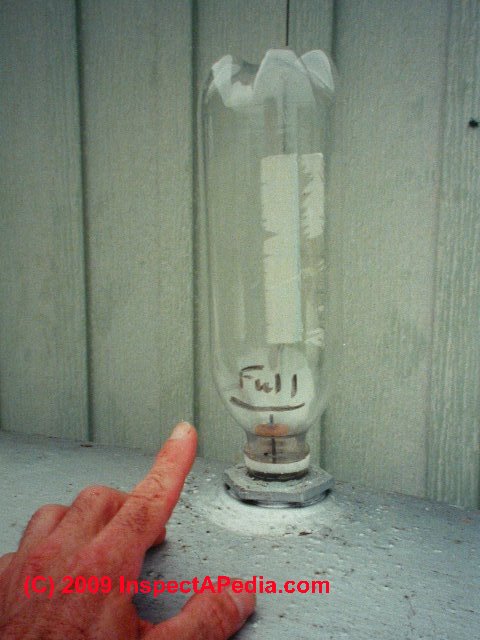
- Lost or broken oil tank gauge vial:
the plastic cover or gauge vial that provides the oil tank level markings against which the oil tank gauge float indicator is read can be broken or lost.
The soda bottle cover installed over this outdoor above-ground oil storage tank was an impressive expedient repair but it's not reliable.
The worry is that water from rain or melting snow may leak into the oil tank at the gauge cover mounting point and that oil may leak out at this point during oil tank fill-up.
The soda-bottle tank gauge cover is neat, though, right?
Our home-repaired oil tank gauge photo [left] shows a homeowner attempt at replacing a missing oil tank gauge vial. We worry that the plastic bottle stuck into the oil tank top around the float gauge indicator is fragile, leaky, and risks water contamination in the oil tank.
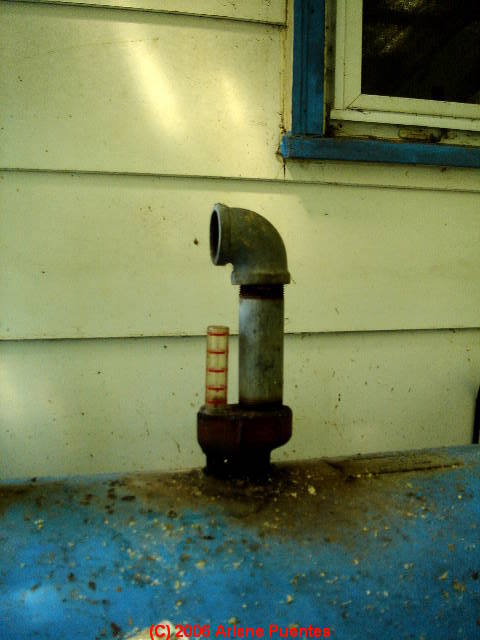
Here is a gauge on an outdoor oil tank. The red button resting at the bottom of the plastic tube to left of the galvanized tank vent pipe shows that this oil tank is probably empty.
This is a poorly installed oil tank, exposed to roof runoff, freezing temperatures, improperly closed vent opening, and more.
Watch out: Check to assure that the oil tank gauge is present, and that its protective cover is tight. Loose or broken oil tank gauges can cause spills during tank fill operations.
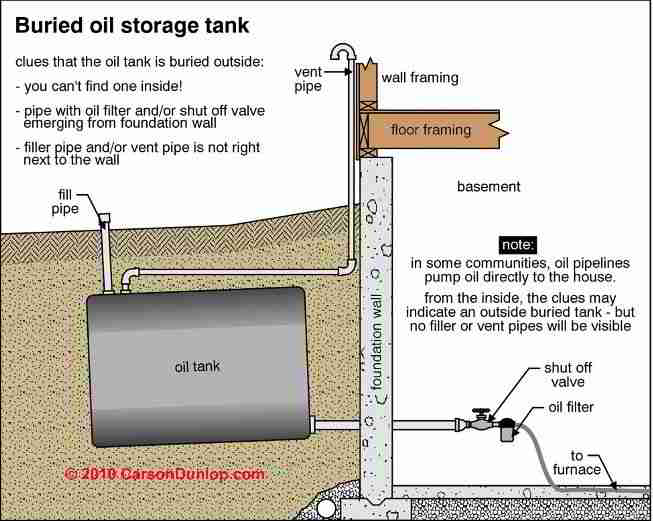
How to Find Out How Much Oil is in a Buried Oil Tank or an Above Ground Oil Storage Tank that is Missing its Gauge?
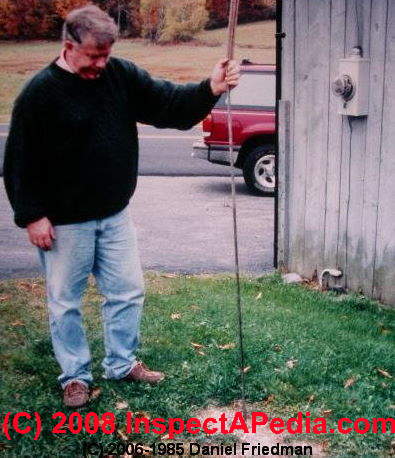
Your oil company can provide a stick, a folding rule, or even a string and weight that can be placed into an oil tank to locate the bottom of the tank and to determine the level of oil in the tank.
The depth of the oil in the tank is measured by marking the top of the tank on the stick or oil tank gauge, then placing the stick into the oil tank and withdrawing it.
The oil level seen on the stick is compared with the distance from bottom of the stick (bottom of the oil tank) to top of the oil tank (which we marked on the stick).
In the old days people kept an oil tank stick that was already marked and calibrated to tell them how much oil was in their tank.
Today if we use a folding measuring rule or a generic "stick" to "stick the oil tank" to check oil level, we need to know the volume and shape of the tank as well as the depth of oil on the stick in order to calculate the number of gallons in the oil tank accurately.
In the photo our client is discovering a surprise buried oil tank at a farm we were inspecting.
Remote Readout Oil Storage Tank Fuel Level Gauges
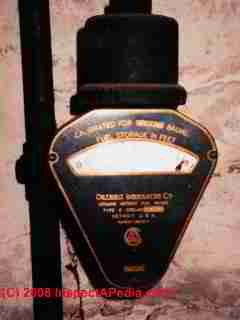
Some buried oil tank systems use an oil tank gauge that measures oil in the tank and gives a reading at a remote location such as indoors near the heating boiler - which is pretty convenient in nasty weather.
Our photo above shows an antique gauge used with a buried oil tank.
Modern remote oil tank gauges include sensors which provide an LED, an analog or digital dial, or another form of electronic indication of the level of oil in the buried or remote oil tank.
Remote oil tank readout gauges can communicate by wire, by wi-fi, and over the internet.
But roughly, the oil tank stick procedure can tell us if the tank is half full, 3/4 full, or nearly empty.
Oil Tank Fuel Level Gauge Sources & Types
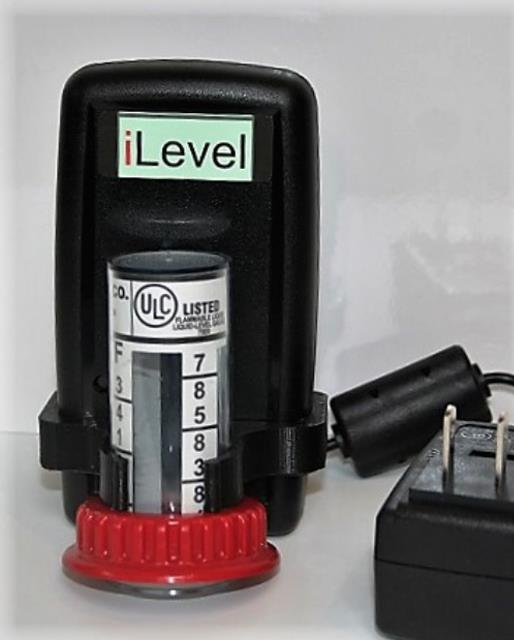 In addition to a range of types of oil tank gauges, several companies make sensors and remote-readouot gauges that permit reporting of the fuel level in an inaccessible or buried oil storage tank.
Technologies include (antique) fuel level gauges like the one we show above, operated by an actual oil level liquid tube, hard-wired fuel levek sensors and oil tank gauges, and oil tank level sensors that combine with a wireless technology to report oil tank level.
Illustration: the iLevel remote readout oil storage tank fuel level gauge that retrofits to an existing oil storage tank gauge.
[Click to enlarge any image]
Most of the remote reading oil tank gauges described below as well as other oil tank sensor products are available from Syba Systems, the first contact link given below. Some of these remote reading oil tank gauges are also sold on Amazon as well as at your local heating equipment parts supplier.
Other product brands besides those in our list include Sentry Tank Monitors, Afriso Unitel pneumatic oil tank gauges, Levelometer, Jarhead Tank Gauges, Petro-Meter oil tank gauges for industrial applications, and others.
- The Fuel Minder™ Store, Syba Systems, Syba Systems LLC 12 Weathervane Rd Bristol, CT 06010 USA Phone: 860-310-4097 or 860-608-8095 Send E-mail to: sybasystems@comcast.net or fuelminder@gmail.com Website: http://fuelminder.biz/fuel_minder_store_products.html
- Fuel Minder II™ and Fuel Minder III™, hard-wired oil tank fuel level gauges that report fuel level on an analog fuel level dial that you locate in your building at a convenient location. The sending unit mounts onto the oil tank and connects to a digital or analog gauge mounted in the building. About $240. to $330. U.S.
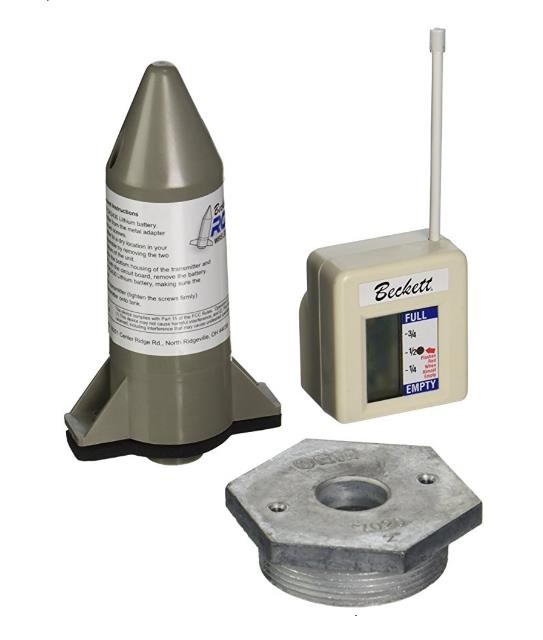
- Beckett Rocket™ wireless ultrasonic oil storage tank remote sensor unit communicates to a readout that plugs into any 120VAC electrical wall receptacle. About $130. Includes an audible alarm when the fuel level is low in the oil tank.
- Beckett OEM 7000 Wireless Fuel LEvel Monitor, about $145 at Amazon.com
- iLevel Wi-Fi Oil Tank Level Monitor, a Wi-Fi remote sensor oil tank fuel level monitor that retrofits to "almost any" existing oil tank fuel level gauge and connects to any web-enabled device. (This is our favorite solution for existing above-ground oil storage tanks located where reading the gauge is difficult). About $130.
- Krueger LED At A Glance, hardwired remote LED readout oil tank fuel level gauge - about $190
- PSI-Level Wi-Fi Oil Tank Fuel Level Monitor, pneumatic oil level monitor that communicates to a wireless transmitter to connect to any web-enabled device. About $150.
- Roth Fuel Level Gauges described in EcoDWT Plus 3 oil storage tank [Installation Instructions] [PDF] Roth Industries 268 Bellew Ave South Watertown, NY 13601 USA Website: http://www.roth-usa.com retrieved 2019/10/25 original source: http://www.roth-usa.com/PDF_Download_Files/DWT_install_instructions.pdf
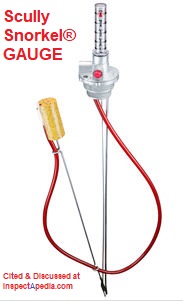
Illustration of a Scully Snorkel gauge and heating oil pickup shown above, courtesy Scully Signal Co. (permission req. 2013.) The Scully snorkel includes a floating oil burner feed line that draws oil frm just below the surface of the oil in the tank, avoiding picking up sludge, water, or debris often found at the oil tank bottom. Recommended by the company for smaller oil burners, mobile homes and other burners with low firing rates.
- Scully Signal Company, 70 Industrial Way, Wilmington MA 01887, Tel: 800-272-8559, email: sales@scully.com, website: scully.com
Scully OIL TANK GAUGES DATA SHEET [PDF] (2015) Op. Cit.
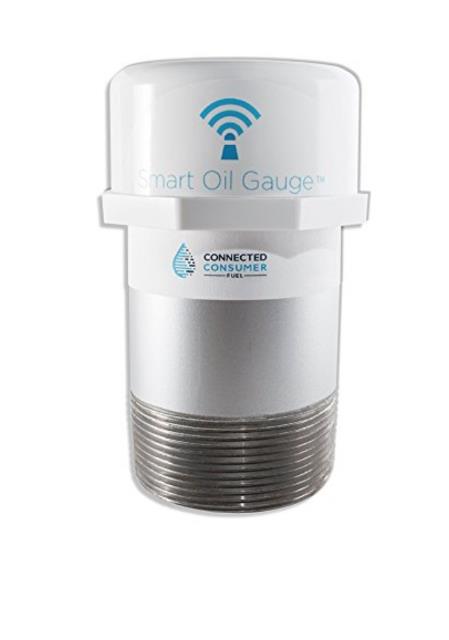
- Smart Oil Gauge, Connected Consumer Fuel,1 Prindle Ln.
Danbury, CT 06811 USA Tel: 1-203-456-1499 Website: www.smartoilgauge.com/support Customer Service Email: contact@connectedconsumerfuel.com Sales: sales@connectedconsumerfuel.com
See details at OIL TANK GAUGE SMART WIFI INSTALLATION - Syba Systems Wireless Internet Fuel/Fluid Tank Level Monitor Systems for monitoring an oil storage tank via internet, includes sensor, transmitter, and internet connected deviced. About $140.
- TEK-603 Eco Oil Monitor, a wireless oil tank fuel level gauge that communicates between the tank sensor and a readout unit wirelessly. $90. and up.
How accurate are oil tank gauges & how to read the oil tank gauge accurately
This topic has moved to OIL TANK GAUGE ACCURACY
...
Continue reading at OIL TANK GAUGE ACCURACY or select a topic from the closely-related articles below, or see the complete ARTICLE INDEX.
Or see OIL TANK GAUGE FAQs - questions & answers about oil tank gauges posted originally at this page.
Or see these
Recommended Articles
- HEATING OIL USAGE RATE to compare oil tank gauge readings with oil consumption rates.
- GAUGES ON HEATING EQUIPMENT
- OIL TANK FILL & VENT PIPING INSPECTION CHECKLIST
- OIL TANK GAUGES - home
Suggested citation for this web page
OIL TANK GAUGES at InspectApedia.com - online encyclopedia of building & environmental inspection, testing, diagnosis, repair, & problem prevention advice.
Or see this
INDEX to RELATED ARTICLES: ARTICLE INDEX to HEATING OIL, OIL BURNERS, OIL FIRED HEATERS, OIL TANKS
Or use the SEARCH BOX found below to Ask a Question or Search InspectApedia
Ask a Question or Search InspectApedia
Try the search box just below, or if you prefer, post a question or comment in the Comments box below and we will respond promptly.
Search the InspectApedia website
Note: appearance of your Comment below may be delayed: if your comment contains an image, photograph, web link, or text that looks to the software as if it might be a web link, your posting will appear after it has been approved by a moderator. Apologies for the delay.
Only one image can be added per comment but you can post as many comments, and therefore images, as you like.
You will not receive a notification when a response to your question has been posted.
Please bookmark this page to make it easy for you to check back for our response.
Our Comment Box is provided by Countable Web Productions countable.ca
Citations & References
In addition to any citations in the article above, a full list is available on request.
- Scully Signal Company, 70 Industrial Way, Wilmington MA 01887-0588 USA, Tel: 617-729-7510 / 800-272-8559, Email: sales@scully.com Web: scully.com
- [1] "Fuel Oil Piping and Storage", 2006 Mechanical Code, Chapter 13, International Code Council, 500 New Jersey Avenue, NW, 6th Floor, Washington, DC 20001, Tel: 888-ICC-SAFE (422-7233); Website: iccsafe.org/, Email: webmaster@iccsafe.org, Customer Store (buy publications) 800-786-4452. Also see 2009 International Codes and 2012 International Codes.
- [2] "The application of a continuous leak detection system to pipelines and associated equipment", Sandberg, C.
Raychem Corp., Menlo Park, CA, Holmes, J. ; McCoy, K. ; Koppitsch, H, Industry Applications, IEEE Transactions on, Sep/Oct 1989, Vol. 25 No. 5, pp. 906-909, ISSN : 0093-9994 INSPEC Accession Number: 3582593 Digital Object Identifier : 10.1109/28.41257, Abstract:
An overview of classical leak detection systems is given and the engineering basis of a novel type of detector is examined. This system is a flexible hydrocarbon-sensing cable that can be installed along pipelines, in double-containment tanks and piping, or in trenches to detect and locate leaks of common industrial hydrocarbon solvents or fuels while ignoring the presence of water. The simple electrical circuit that locates and detects a leak anywhere along the length of the sensor is also described - [3] "A Case Study of a Large Scale Precision [oil or fuel] Tank Testing Program", Diane H. Heck, Tetra Tech Richardson, Newark, Delaware, web search 4/27/12, original source: info.ngwa.org/GWOL/pdf/870143411.PDF, copy on file as /heating/OIl Tanks UST/Tank_Test_Heck_870143411.pdf
- Bottini Fuel service, 4/26/2011. Bottini Fuel is a residential and commercial heating oil distributor and oil heat service company in Wappingers Falls, NY and with offices in other New York locations. Bottini Fuel, 2785 W Main St, Wappingers Falls NY, 12590-1576 USA, Tel: (845) 297-5580 Web" bottinifuel.com/contact/
- Dave Ferris - M&S Environmental Systems, Dutchess County, New York. Mr. Ferris was an HVAC expert. Personal communication to DJF 1987. Remove the firematic or fusible oil supply line valve on return oil-line side - in case of fire if this one closes first the pump continues to run, blows its seal, and sprays oil all over the fire. Proper installation is to have a fusible link valve only on the supply side, and to install a check valve on the return line to prevent back-siphonage from the tank.
- In addition to citations & references found in this article, see the research citations given at the end of the related articles found at our suggested
CONTINUE READING or RECOMMENDED ARTICLES.
- Carson, Dunlop & Associates Ltd., 120 Carlton Street Suite 407, Toronto ON M5A 4K2. Tel: (416) 964-9415 1-800-268-7070 Email: info@carsondunlop.com. Alan Carson is a past president of ASHI, the American Society of Home Inspectors.
Thanks to Alan Carson and Bob Dunlop, for permission for InspectAPedia to use text excerpts from The HOME REFERENCE BOOK - the Encyclopedia of Homes and to use illustrations from The ILLUSTRATED HOME .
Carson Dunlop Associates provides extensive home inspection education and report writing material. In gratitude we provide links to tsome Carson Dunlop Associates products and services.
 | HOME | ABOUT | ASK a QUESTION | CONTACT | CONTENT USE POLICY | DESCRIPTION | POLICIES | PRIVACY | |
| © 2024 - 1985 Publisher InspectApedia.com - Daniel Friedman | |||||||||