 Heating Oil Storage Tank Inspection Procedure
- POST a QUESTION or COMMENT about heating oil storage tank inspection, diagnosis, & repair: location, leaks, piping, regulations
This fuel oil storage tank article describes common defects & problems found at above ground and buried oil storage tanks for both above ground oil storage tanks (ASTs) and underground or buried oil storage tanks (USTs).
We discuss problems with oil tank contamination by water or dirt, oil tank location and clearances, oil tank rusting and leaks, oil tank leak testing, oil tank piping, oil tank support and protection from damage, oil piping safety valves, & how to avoid trouble with oil tanks that are exposed to cold weather.
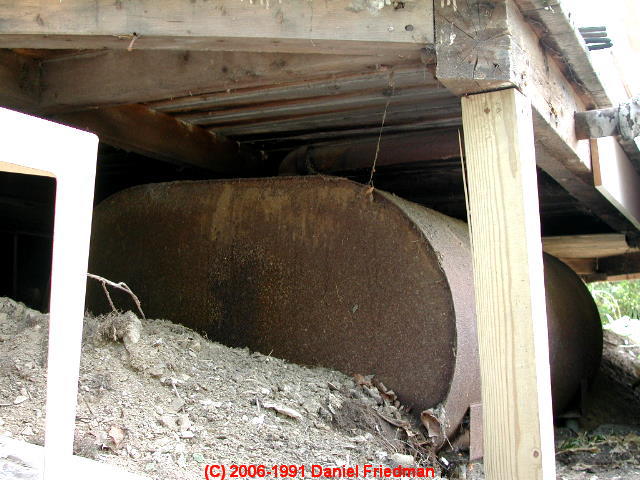
Photo above: this is an aboveground oil storage tank that lies half-buried below an improperly-constructed deck, risking rust-out of the oil tank and costly heating oil spillage.
InspectAPedia tolerates no conflicts of interest. We have no relationship with advertisers, products, or services discussed at this website.
- Daniel Friedman, Publisher/Editor/Author - See WHO ARE WE?
Finding & Reporting Oil Tank Defects by Visual Inspection
 This document describes and provides home inspection report language for defects in heating oil tanks, oil piping, and other oil storage tank installation defects that can be found by visual inspection for both above ground storage tanks (ASTs) and underground oil storage tanks (USTs).
Beyond the costly problem of leaky heating oil tanks, this document lists other important safety or oil-fired equipment operational defects in home and light commercial heating oil storage and piping systems.
This sample home inspection report language may assist home owners or home buyers in understanding risks associated with both buried and above ground oil or other fuel storage tanks at their property.
The oil tank and oil piping inspection report language explains the need for action and indicates where more information can be obtained. Contact us to suggest text changes and additions and, if you wish, to receive online listing and credit for that contribution.
Also see OIL TANK INSPECTION & TROUBLESHOOTING
and see OIL TANK INSPECTION REPORT TEXT.
Oil tank defect photographs are
at ABOVE GROUND OIL STORAGE TANK (AST) INSPECTION
NOTICE: while example report language is provided here, reproduction of this or any of our web pages or their contents online at other websites or in printed documents for sale is prohibited.
Sketch above and other sketches on this page were provided courtesy of Carson Dunlop Associates, a Toronto home inspection, report writing tool and education company.
Readers are welcome to use the text directly in home inspection reports, with citation of the website source.
OIL TANK IN GARAGE - Oil Tank in Garage - warning
The tank is in the garage. Caution: Don't hit the tank with your car - a leak could involve a costly cleanup. Some municipalities require protective caging or barriers be built around the tank to avoid this hazard.
OIL TANK NEAR WATER - Oil Tank - nearby waterway, risks & code HAZMAT
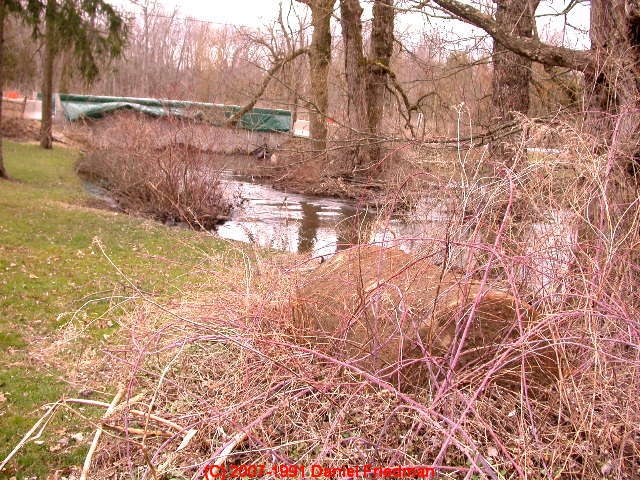
Photo above: a buried oil tank that floated-up out if the ground on Fox Hollow Road in Rhinebeck, New York, inspected by the author (DF).
Report Language suggestion:
Nearby waterway or Adjacent property
(estimated within ___') formed by the
stream (or other body of water) would be contaminated should this tank leak or fall over.
The OIL TANK at this location without protection is in possible violation of NYS Building Code 1002.2b and 1002.4c "Above ground tanks shall be provided with means to prevent accidental discharge from spreading to waterways,
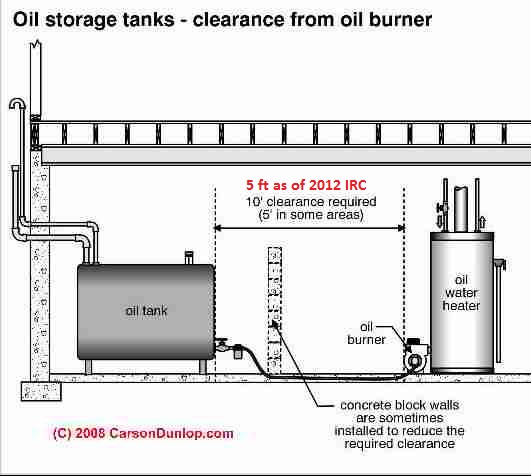
OIL TANK TOO CLOSE TO FURNACE - or Boiler or Water Heater - Oil Tank Clearance Distances from Heating Equipment
Technical Safety Recommendation: The oil tank may be located closer than recommended distance from the boiler. You should discuss this question with your heating service person.
Our sketch at above left, courtesy of Carson Dunlop Associates, shows the typical ten foot clearance recommended between the closest point of the oil tank and the closest point of an oil burner.
OIL TANK SAFETY CLEARANCE from heating equipment - Building and Fire Code Citations
- NYS Uniform Fire Prevention and Building Code, 1/1984 Para. 1002.3b.
- "--- tanks must not be closer than 5 ft to the burner, boiler, or furnace---" Domestic Oil Burners, Burkhart, McGraw Hill, 1969 p. 174.
- Other experts suggest a minimum of 7' or 10' separation between the closest point of the tank and boiler. "The Modern Service Manual for Residential Oil Fired Equipment", NOTA, & National Association of Oil Heat Managers, 1979, illustration in section on "Oil Tank and Piping".
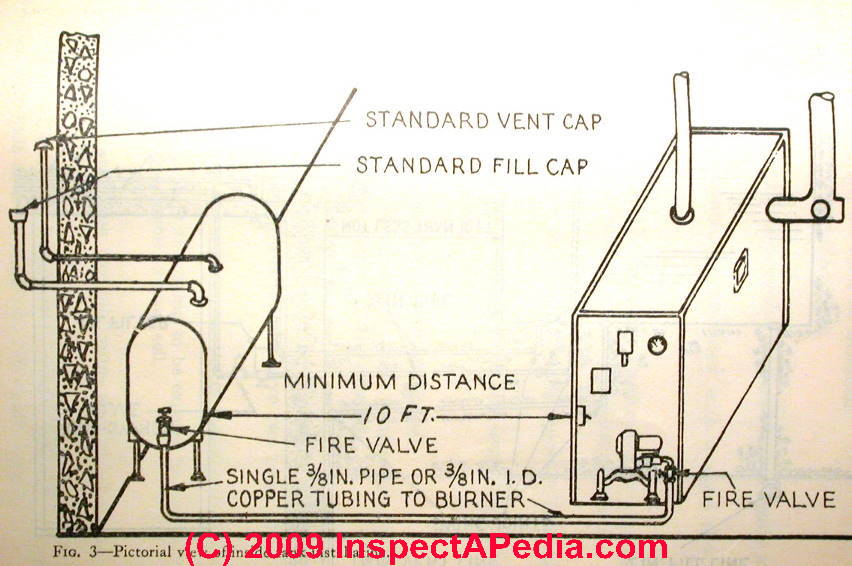
- This Audel Oil Burner Guide sketch (left) shows that the minimum ten-foot clearance rule between an oil tank and the boiler, furnace, or water heater, is an old one dating at least from 1947 in the U.S.
OIL STORAGE TANK EXPOSED TO WEATHER - Outside Oil Tank, (not buried) Exposed to Weather
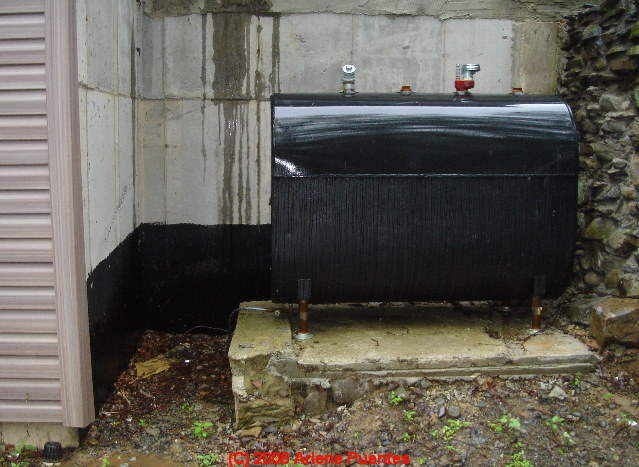
Caution: As this home heating oil tank is outside, it is exposed to water entry either through roof spillage onto the tank and splashing into the the filler or vent pipes.
Water may also accumulate in this outside oil storage tank by condensation due to temperature changes.
Water in heating oil can cause loss of heat if it reaches the oil filter or oil burner.
Water in heating oil tanks also often leads to internal corrosion and leaks in the oil storage tank itself, possibly ending in a costly oil leak or spill.
Details are at OIL TANK WATER CONTAMINATION
We recommend:
- Keep roof spillage off of the tank top by adding a roof or enclosure over or around the tank;
- Test the oil tank for water presence and remove any excessive water;
- Use a fuel oil additive such as 4 in 1 Hot(TM) to assist in removing moisture from the oil. Photograph courtesy of Arlene Puentes]
This is a new heating oil tank (rated for indoor use according to its UL label) located outdoors.
If you click-on and enlarge Ms. Puentes' photograph
of this oil tank you will see that its top is wet from roof spillage and splash and that water runs down the side of the tank.
The fill and vent piping on this tank appear intact from the photo but the tank and its heating oil contents have other risks which we discuss in this oil tank inspection report sample text section.
 When an indoor-use heating oil tank is located outside it is exposed to water entry either
through spillage (such as from a roof edge shown in this photo) onto the fill and vent pipes or by condensation due to temperature changes.
When an indoor-use heating oil tank is located outside it is exposed to water entry either
through spillage (such as from a roof edge shown in this photo) onto the fill and vent pipes or by condensation due to temperature changes.
Water in the fuel oil or simple exposure of the oil to cold temperatures can lead to loss of heat and resultant damage to a building by several means:
- oil tank leaks caused by water in the oil tank, which will reside at the bottom of the tank, may freeze in the tank or in the oil line, particularly for installations at which the oil line is attached to the bottom of the tank.
- oil burner damage: water can cause rusting which is pulled into the heating equipment where it clogs the filter, fuel pump, or oil burner nozzle
- heat loss: in some modern high efficiency systems a special filter is used which will stop flow completely, shutting down the burner in response to water or debris buildup in the filter - a move to protect the equipment.
- heat loss: heating oil in an outside line may "Jell" and stop flowing at cold temperatures.
- Heat tape fire hazards at heating oil piping: outside tanks in cold climates exposed to jelling of the heating fuel may be (in error) fitted with
a heating tape in an attempt to avoid freeze-up in the oil line itself. This is a potential fire hazard.
Heat tapes should not be used on heating oil lines.
Details are at HEAT TAPE HAZARD ON OIL TANK.
Also see FREEZE-PROOF A BUILDING where we describe GFCI protection on heat tape circuits powering heat tapes for manufactured and mobile homes.
Water in oil tanks also often leads to internal corrosion and leaks in the tank itself, regardless of the tank location, though buried tanks and indoor oil tanks are less prone to water accumulation due to in-tank condensation in response to temperature changes than a tank located above ground outside.
Oil storage tanks usually fail from rust perforation due to combination of water inside the tank with sulphur in the fuel oil. External rust, unless very heavy, isn't highly correlated with internal rust. A new tank, when required, may cost more $2000. installed, including removal of the old oil tank.
When an outdoor tank is exposed to these conditions and even for an indoor tank which we suspect has had a dose of water and sludge, we recommend regular use of a heating or fuel oil additive to absorb water and to help break up sludge. The best solution is to locate the tank indoors or to build a heated shelter over the outdoor tank.
How to Keep Water Out of Your Heating Oil Storage Tank and Avoid Loss of Heat
 Details about preventing water from accumulating in oil storage tanks are
at OIL TANK WATER PREVENTION. Excerpts are below.
- Keep the oil tank filled as near full as you can to minimize the tendency of the tank to draw in moist air and experience in-tank moisture condensation. Don't leave the oil tank near empty over the spring or summer months.
- Keeping Water Out Of Above ground Oil Tanks Located Outside
- Protect the oil tank from spillage from roof runoff
- Be sure that the oil tank filler opening cap is kept in place and sealed and that the oil filler cap o-ring or gasket are in good condition
- Be sure that the oil storage tank vent pipe is properly capped (a straight pipe pointing up with no cap permits water entry) (and also screened against insects which can clog the vent opening and lead to tank leaks)
- In cold-weather climates, enclose the tank on all sides, giving access for inspection; route fill and vent pipes outside of the enclosure;
where needed, provide a small heat source either from the building or by electric heater or even a light bulb to prevent freeze-ups.
At least one manufacturer presently sells an outdoor plastic oil tank enclosure for this purpose, though we haven't seen how they're providing a heat source to avoid oil waxing. - Use a heating oil additive which will help remove small amounts of water - see "Heating or Fuel Oil Additives" below.
- Route oil lines from the top of the tank rather than the bottom to reduce pick-up of water from the tank bottom.
- At annual service have the oil storage tank checked for water and remove water if it's found there.
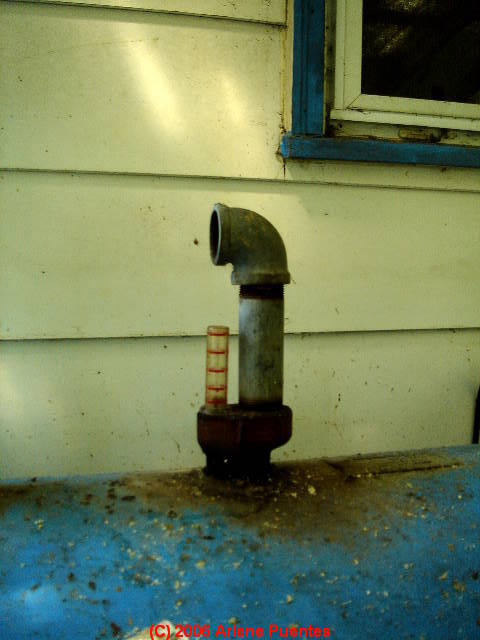
[Photo courtesy of Arlene Puentes. This photo shows an un-screened oil tank vent pipe which may also be under-sized.
The 90 deg. ell at the top of the pipe nipple is incomplete protection against water entry if roof spillage splashes on the tank top, and it lacks an insect screen. This is not an approved nor recommended oil tank venting detail.
- Keeping Water Out Of Underground Oil Storage Tanks
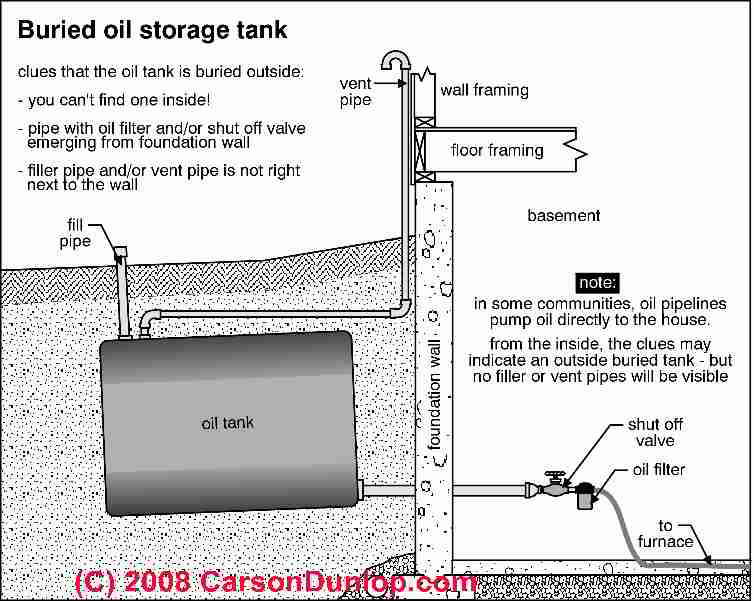
- Extend oil tank fill and vent valves above ground level to reduce the chances of surface water entering the piping
- At annual service have the oil storage tank checked for water and remove water if it's found there.
- If water is found in the oil tank, and if the oil delivery company is certain that they didn't deliver water from their tank, and if water is not entering by condensation and temperature change cycles, check the tank piping connections for leaks.
- Have the tank [low] pressure tested for leaks.
- Take oil piping off of the top of the buried oil tank, not the bottom.
Our sketch at left, courtesy of Carson Dunlop Associates, shows a common buried oil tank installation except that the oil line is shown leaving the bottom of the buried oil tank.
Modern practice usually connects a pair of oil lines to the top of a buried oil tank, avoiding picking up water and sludge from the oil storage tank bottom, and avoiding the chance that a leak in piping between oil and building interior will flood the inside of the building with oil.
Tips for Using Heating or Fuel Oil Additives in the Oil Storage Tank
Heating fuel additives such as "4-in-One Hot" (TM) can help prevent loss of heat by adding a pour point depressant which lowers the temperature at which the heating oil will form waxes or jell, and by adding a chemical, typically an alcohol, to remove [small amounts] of water from the oil. Such additives may also help break up sludge which tends to clog old heating oil lines.
Some oil companies will deliver a mix of heating oil and kerosene to outdoor above ground oil tanks as a way to avoid jelling and freeze-ups and loss of heat. It may be less costly to buy regular heating oil and put in the appropriate pour point depressant additives at each oil delivery.
Note: these tips are not a complete oil tank installation guide. Proper installation must be done by trained service technicians and must comply with local building codes.
See details about heating oil additives and chemicals
at ADDITIVES & TREATMENTS for OUTDOOR OIL TANKS
BURIED OIL TANK - Found or Suspected at a Property
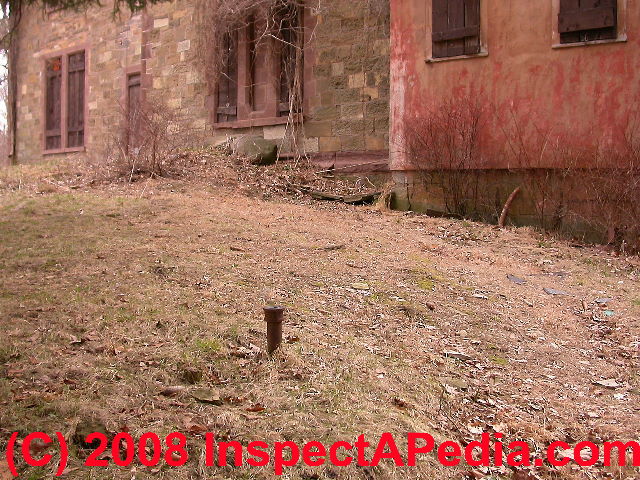 Our full article detailing how to suspect and find buried oil tanks at properties can be read
at BURIED / UNDERGROUND OIL TANK (UST), LOCATION METHODS.
Sample oil tank inspection report for buried oil tanks: A buried oil tank is installed and could not be inspected. Advice follows
- BURIED OIL TANKs should be tested for leaks since costly environmental cleanup can be required if the tank has leaked into surrounding soil. Perform this test before purchase of the property.
The following articles provide details on what to do if you own or are buying a property that has or might have a buried oil tank or underground storage tank (UST) on the land.
BURIED OIL STORAGE TANKS BURIED / UNDERGROUND OIL TANK (UST), LOCATION METHODS
- It is also diagnostic to test the amount of water present in tank bottom; and water should be pumped out.
Water mixes with sulphur in the fuel, forms sulfuric acid, and corrodes through the tank.
While we've found them lasting longer, a common life expectancy of buried tanks is 10-15 years. Ask your service person about using a fuel additive such as 4-in-1-Hot™ to help remove water. It will also increase heating system reliability.
- ENVIRONMENTAL ISSUES CONCERNING BURIED OIL TANKS: the NY Department of Environmental Conservation has a program registering buried oil tanks at any site storing more than 1100 gallons of heating oil. Eventually this concern may spread to smaller residential tanks. The concern is for leaks which contaminate the environment.
- OIL STORAGE TANK FAILURE RATE: Oil storage tanks usually fail from rust perforation due to combination of water
inside the tank with sulphur in the fuel oil. External rust, unless very heavy, isn't highly correlated
with internal rust.
A new tank can involve significant expense.
There are also proper methods of "abandoning" old unused buried tanks without removing them if the tanks have not leaked. Consult your heating company or local DEC officials if you have questions regarding this topic.
In New England for a two year period [1984-5] among customers who had buried tanks (16% of total customers) surveyors found an average of 1.7 tank leaks per thousand customers. They also found 2.5 fuel line leaks per 1000 customers. Source: Fuel Oil and Oil Heat magazine, August 1985 p.18.
See OIL TANK LEAK / FAILURE RATES for details.
OIL TANK TESTING & REMOVAL COs are specialty companies and some oil companies have equipment to test tanks for leaks. Testing for water in the tank is simple and can be done by any service person.
OIL TANK SUPPORT - Oil Tank legs need masonry piers or tank support piers are out of level
"Oil Tank legs for this outdoor tank should be supported by level and sound masonry piers to reduce the probability of the oil tank feet sinking or tipping and causing the tank to tip over.
Tipping or falling outside above ground oil tanks risk a fire, heating oil spill, or a "loss-of-heat" hazard.
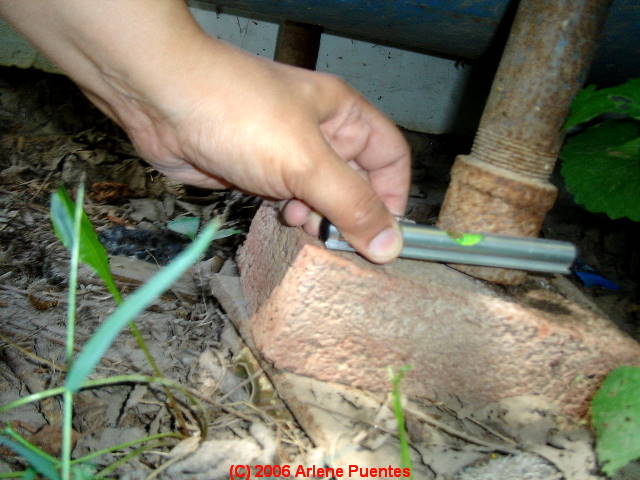
This repair/maintenance item should not be deferred. This is usually an inexpensive item to correct." [Photo courtesy of Arlene Puentes]
See OIL TANK SUPPORT for full details about proper support and protection for above ground oil storage tanks.
OIL TANK LEAKY/PATCHED - Oil Tank Leaky/Patched - replace soon
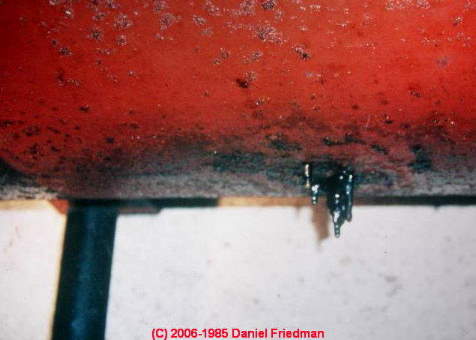
"The oil tank is very likely to have to be replaced soon if not immediately - the tank was leaking and a "patch" has been strapped to the tank bottom.
Removing old tanks and installing are placement oil tank will involve significant expense.
WARNING: serious and costly oil tank spillage can occur at any moment, but especially when this oil storage tank is being filled."
OIL PIPING DEFECTS - Reporting Oil Piping Defects by Visual Inspection
Defects in oil fill or vent piping are much more serious than you may think. That little drip of oil onto the basement floor is just a clue - but when your heating equipment is running, air drawn into the oil line at that same leak point can lead poor or dirty oil burner operation, a dangerous puffback, or loss of heat and related building damage.
And defects in the oil fill and vent piping can lead to catastrophic indoor or outdoor oil spills (
as we explain at OIL TANK PRESSURE.
Details about heating oil piping inspection and defects begin
at OIL TANK PIPING & PIPING DEFECTS.
MISSING SAFETY CONTROLS & SWITCHES at the Oil Tank & Oil Burner: Electrical shutoff switches for heat and oil line shut off valves
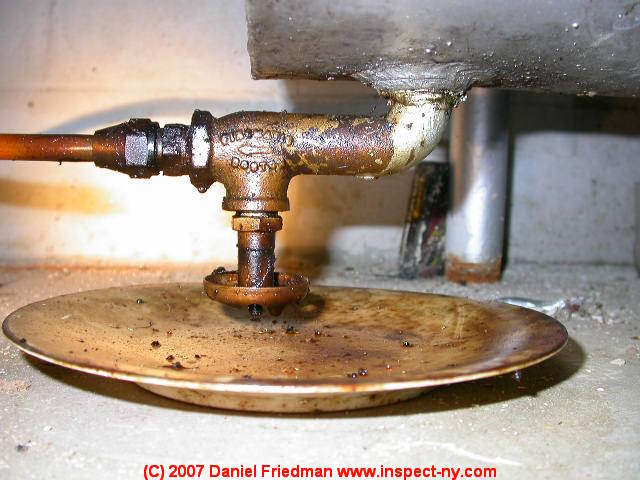
Oil heating equipment safety controls are discussed in detail
where we provide more information on oil heat equipment electrical switches and on the fusible-link oil supply piping valve, check valve, or related controls that help prevent pumping heating oil onto a building fire as well as avoiding other oil piping problems.
Reader Question: is it possible to have an indoor above ground oil tank and an outdoor underground tank installed at the same property?
 Is it possible to have an indoor above ground oil tank and a outdoor underground oil tank located on the same home property?
Reply: Yes.
Nic,
Your question, an excellent one, makes the point that just because you find an oil storage tank at a property, don't assume it is the only one present or only one that has ever been present. The older the property the more likely that there may have been more than one oil tank installed.
While there are no hard and fast rules or laws here are some examples and clues of cases that may arise - stuff to watch out for:
If you see a new-looking outdoor oil storage tank like the one shown here (above-left) installed on an OLD pad, an old above ground tank may have been replaced in the same spot.
If you see a new-looking outdoor oil storage tank and old oil piping remnants in the building then look for evidence or history of an old tank.
Local residential codes may limit the total volume of heating oil stored at a property (typically to 1100 gallons), but that does not limit the number of in use and old tanks that may be present.
There may be an indoor as well as an outdoor or even a buried outdoor oil storage tank all located at the same property.
The history that we have run across typically involves a buried or underground oil storage tank that was abandoned and not properly removed following discovery of leakage; the property owner, needing to keep heat working, installs an above-ground oil storage tank indoors, or if there is no space indoors, s/he might install an outdoor tank.
We have also come across properties at which an indoor tank was old and leaky but the owner found it difficult to remove and with no space for another indoor tank the owner opted for an outdoor oil storage tank.
Watch out: if there is evidence or a report that a buried oil tank was abandoned in place OR was removed completely, be sure you obtain documentation that provides reliable evidence that the work was done properly and that any contaminated soils or leaks were cleaned-up.
Failure to follow-up on this oil tank question can leave a new property owner with an old, expensive surprise.
...
Continue reading at ABOVE GROUND OIL STORAGE TANK (AST) INSPECTION or select a topic from the closely-related articles below, or see the complete ARTICLE INDEX.
Or see OIL TANK INSPECTION & TROUBLESHOOTING FAQs - questions & answers posted originally at this page.
Or see these
Recommended Articles
- OIL STORAGE TANKS - home
- OIL TANK INSPECTION & TROUBLESHOOTING
- ABOVE GROUND OIL STORAGE TANK (AST) INSPECTION
- OIL or GAS FUELED HEATING EQUIPMENT SHUTOFFS
- BURIED / UNDERGROUND OIL TANK (UST), LOCATION METHODS
- BURIED OIL TANK REPORTS
- OIL TANK FILL & VENT PIPING INSPECTION CHECKLIST
- OIL TANK FILL & VENT PIPE CLEARANCE DISTANCES
- OIL TANK FILL / VENT PIPE LEAK REPAIRS
- OIL TANK PIPING & PIPING DEFECTS
- OIL SUPPLY LINE PIPING LEAKS
- OIL TANK HISTORY REVIEW
- SPHERICAL OIL STORAGE TANKS - the HORTON SPHERE
- OIL TANK INSPECTION CHECKLIST
- OIL TANK INSPECTION REPORT TEXT
- OIL TANK LEAKS & SMELLS
- OIL TANK LEAK & ABANDONMENT REGULATIONS
- OIL TANK LEAK TEST METHODS
- OIL TANK TESTING & REMOVAL COs
Suggested citation for this web page
OIL TANK INSPECTION & TROUBLESHOOTING at InspectApedia.com - online encyclopedia of building & environmental inspection, testing, diagnosis, repair, & problem prevention advice.
Or see this
INDEX to RELATED ARTICLES: ARTICLE INDEX to HEATING OIL, OIL BURNERS, OIL FIRED HEATERS, OIL TANKS
Or use the SEARCH BOX found below to Ask a Question or Search InspectApedia
Ask a Question or Search InspectApedia
Share this article:Questions & answers or comments about heating oil storage tank inspection, diagnosis, & repair: location, leaks, piping, regulations
Ask a Question or Search the InspectApedia website using the box just below.
Need to make a private comment? Email editor@inspectApedia.com. We welcome email with your website content critique, corrections, suggestions or questions. Email is monitored daily but our workload may prevent an immediate reply. For immediate results, we hope you'll first try asking your question using the search box just above.
Citations & References
In addition to any citations in the article above, a full list is available on request.
- Mark Cramer Inspection Services Mark Cramer, Tampa Florida, Mr. Cramer is a past president of ASHI, the American Society of Home Inspectors and is a Florida home inspector and home inspection educator. Mr. Cramer serves on the ASHI Home Inspection Standards. Contact Mark Cramer at: 727-595-4211 mark@BestTampaInspector.com
- John Cranor [Website: /www.house-whisperer.com ] is an ASHI member and a home inspector (The House Whisperer) is located in Glen Allen, VA 23060. He is also a contributor to InspectApedia.com in several technical areas such as plumbing and appliances (dryer vents). Contact Mr. Cranor at 804-873-8534 or by Email: johncranor@verizon.net
- Arlene Puentes [Website: www.octoberhome.com ] , an ASHI home inspector in Kingston, NY, contributed the example photograph of an outdoor aboveground oil tank. Ms. Puentes can be contacted at ap@octoberhome.com
- [1]Audels Oil Burner Guide, Installing, Servicing, Repairing, Frank D. Graham, Theo. Audel & Co., New York 1946, 1947, 1955 (out of print, copies occasionally available from antique book dealers and on EBay). Usethis link to read a free online copy of this helpful classic textbook.
- [2] Beckett Model SR Oil Burner Instruction Manual, R.W. Beckett Corporation, PO Box 1289, Elyria OH 44036 and R.W. Beckett Canada, Ltd., 430 Laird St., Guelph, Ontario, Canada N1G 3x7
- [3] Thanks to Bottini Fuel service tecnician Bob for discussing the buzzing aquastat relay problem, 4/18/2012. Bottini Fuel is a residential and commercial heating oil distributor and oil heat service company in Wappingers Falls, NY and with offices in other New York locations. Bottini Fuel, 2785 W Main St, Wappingers Falls NY, 12590-1576 (845) 297-5580 more contact information for Bottini Fuel
- [4] Beckett Model SF Oil Burner Instruction Manual, op.cit.
- [5] Sunstrand Corporation - Sunstrand Fuel Units, 4949 Harrison Avenue P.O. Box 7003 Rockford, Illinois 61125-7003 U.S.A. Telephone: (815) 226-6000 Fax: (815) 226-5399 http://www.sundstrand.com
- [6] Sunstrand Transmission Service Manual, May 1974, web search 08/19/2011, original source: http://www.cushmantrackster.com/pay-pdfs/sundstrand.pdf - Sunstrand Series 15 hydrostatic transmissions
- [7] Webster Fuel Pumps & Valves, Capitol City Tool, Inc., http://www.websterfuelpumps.com/
- [8] Suntec Model A-7400 Fuel Unit Solenoid Dumping Pump,
Suntec Industries Inc., 60 Aberdeen Drive - PO Box 5000 Glasgow, KY 42142-5000 - USA Tel : 270 651 7116 - Fax : 270 651 9276 e-Mail : info@suntecpumps.com and
Suntec Industries France, 1 Rue Lavoisier - B.P. 102 F-21603 LONGVIC Cedex - FRANCE Tel : +33 (0)3 80 70 60 70 - Fax : +33 (0)3 80 70 61 11 e-Mail : information@suntec.fr, [copy on file as /heating/Oil pumps fuel units/Sunted_Solenoid_DumpingPPump.pdf] ,
Also /Suntech_Solonoid_Safety_Valves.pdf (brochure)
web search 4/19/12, original source: http://www.suntecpumps.com/Suntecus/PDFs/Form%202740%20
-%20Solenoid%20Dumping%20Pump.pdf - [9] Suntec Model PRV-38 Oil Safety Valve Installation Information, Suntec Industries Inc., 60 Aberdeen Drive - PO Box 5000
Glasgow, KY 42142-5000 - USA
Tel : 270 651 7116 - Fax : 270 651 9276
e-Mail : info@suntecpumps.com and
Suntec Industries France, 1 Rue Lavoisier - B.P. 102 F-21603 LONGVIC Cedex - FRANCE Tel : +33 (0)3 80 70 60 70 - Fax : +33 (0)3 80 70 61 11 e-Mail : information@suntec.fr, [copy on file as /heating/Oil pumps fuel units/Form 2155 - PRV-38 Installation.pdf]. You can download this file from Suntec's website. , - [10] Firomatic Globe Type Oil Line Valves & Lever Type Fusible Link Control Valves: ISP Automation, Inc., 1035 Old Georges Road, North Brunswick, NJ 08902, Phone: 866-383-3481, FAX 866-383-3482, Email: support@ispautomation.com
- [11] Fusible link oil line control valves for commercial equipment: ASCO products by Emerson Industrial Automation, P.O.Box 160, 17 Airport Road Brantford, Ontario Canada N3T 5M8 Tel: (519) 758-2700 Fax: (519) 758-5540
- [12] Fuel oil safety valves, Webster Fuel Pumps & Valves, 219 Hahn Road Frankfort, Ky. 40601, Tel: (800) 766-1233 Email: czahalka@cctoolinc.com (Curtis Zahalka Sales Mgr/Mkt /Cust Service/Tech Support/Webmaster ) web search 10/12/2011 original source http://www.websterfuelpumps.com/pdffiles/osv1.pdf
- [13] Webster Service Technicians' Handbook, Webster Fuel Pumps & Valves, 219 Hahn Road Frankfort, Ky. 40601, Tel: (800) 766-1233
- [14] "The Oil Safety Valve (Service)", Charles Bursey, Sr., Fuel Oil News, February 2006 (Still trying to get the full article - October 2008 - DF) Charles W. Bursey Sr. can be reached at F.W. Webb Co. www.fwwebb.com/
- [15] "Installation Information for Suntec A-2000, A-7000 Single Stage and B-8000 two stage fuel units"Suntec Industries, 60 Aberdeen Drive, Glasgow KY 42141, 270-651-7116 (1725 rpm black label, 3450 rpm white label)
- [16] Tigerloop: oil line de-aerator devices, Westwood Products Inc., 330 William St., PO Box 610, South River, NJ 08882-0610 - (732) 651-7700
- Mark Cramer Inspection Services Mark Cramer, Tampa Florida, Mr. Cramer is a past president of ASHI, the American Society of Home Inspectors and is a Florida home inspector and home inspection educator. Mr. Cramer serves on the ASHI Home Inspection Standards. Contact Mark Cramer at: 727-595-4211 mark@BestTampaInspector.com
- John Cranor [Website: /www.house-whisperer.com ] is an ASHI member and a home inspector (The House Whisperer) is located in Glen Allen, VA 23060. He is also a contributor to InspectApedia.com in several technical areas such as plumbing and appliances (dryer vents). Contact Mr. Cranor at 804-873-8534 or by Email: johncranor@verizon.net
- Dave Ferris - M&S Environmental Systems, Dutchess County, New York. Mr. Ferris was an HVAC expert. Personal communication to DJF 1987. Remove the firematic or fusible oil supply line valve on return oil-line side - in case of fire if this one closes first the pump continues to run, blows its seal, and sprays oil all over the fire. Proper installation is to have a fusible link valve only on the supply side, and to install a check valve on the return line to prevent back-siphonage from the tank.
- Our recommended books about building & mechanical systems design, inspection, problem diagnosis, and repair, and about indoor environment and IAQ testing, diagnosis, and cleanup are at the InspectAPedia Bookstore. Also see our Book Reviews - InspectAPedia.
- "Homeowners Guide to Fuel Storage," Agway Energy Products, Verbank, NY, November 1990
- In addition to citations & references found in this article, see the research citations given at the end of the related articles found at our suggested
CONTINUE READING or RECOMMENDED ARTICLES.
- Carson, Dunlop & Associates Ltd., 120 Carlton Street Suite 407, Toronto ON M5A 4K2. Tel: (416) 964-9415 1-800-268-7070 Email: info@carsondunlop.com. Alan Carson is a past president of ASHI, the American Society of Home Inspectors.
Thanks to Alan Carson and Bob Dunlop, for permission for InspectAPedia to use text excerpts from The HOME REFERENCE BOOK - the Encyclopedia of Homes and to use illustrations from The ILLUSTRATED HOME .
Carson Dunlop Associates provides extensive home inspection education and report writing material. In gratitude we provide links to tsome Carson Dunlop Associates products and services.
 |
HOME | ABOUT | ASK a QUESTION | CONTACT | CONTENT USE POLICY | DESCRIPTION | POLICIES | PRIVACY | |
| © 2026 - 1985 Publisher InspectApedia.com - Daniel Friedman | |||||||||