
InspectAPedia® FREE Encyclopedia of Building & Environmental Construction, Diagnosis, Maintenance & Repair |
Question? Just ask us! InspectAPedia
|
 Visual Clues & Instruments Used to Find Underground Oil Tanks
How to inspect for evidence of buried oil tanks.
Professional oil tank sweep
- POST a QUESTION or COMMENT about finding oil tanks buried outside - how to find buried oil tanks or evidence of previous installation of buried oil tanks even if the tank has been removed.
How to find buried oil tanks:
This article assists property buyers, owners, and inspectors in the location of buried oil tanks or the detection of evidence that an underground (or even an above ground) oil tank is or was in use at a property. We provide an illustrated guide to finding buried oil storage tanks by visual inspection.
The article and photographs used to show the reader ways to find buried oil tanks include examples of clues leading to the discovery of "nearly hidden" buried or underground oil tanks which were found at residential properties and which avoided very costly surprises later for the new owner.
InspectAPedia tolerates no conflicts of interest. We have no relationship with advertisers, products, or services discussed at this website.
UST Oil Tank Sweeps: Inspection of a Building Site for Evidence of "Nearly Hidden" Buried Oil Tanks
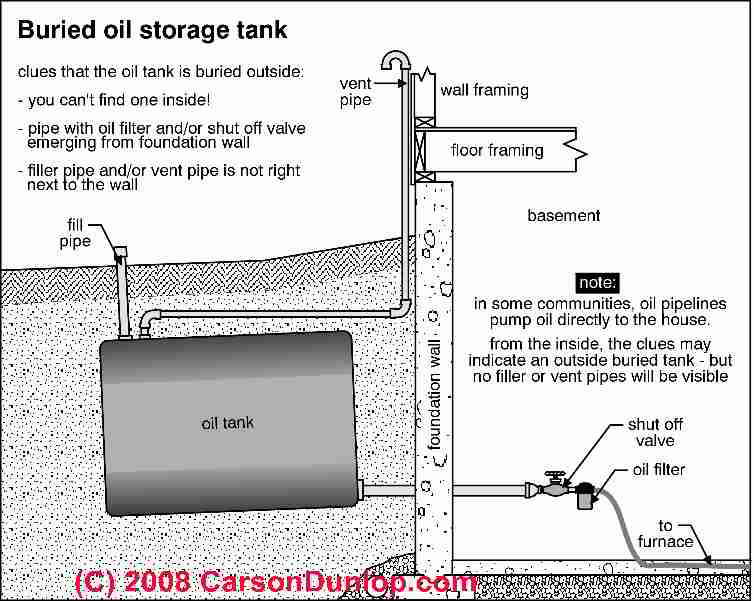 Underground oil storage tanks, or UST's, whether still present or previously removed, involve a
risk of costly oil leaks and soil contamination which may need to be addressed.
Underground oil storage tanks, or UST's, whether still present or previously removed, involve a
risk of costly oil leaks and soil contamination which may need to be addressed.
[Click to enlarge any image]
Here are investigation methods that any home buyer, owner, or home inspector can apply to reduce these risks by looking for evidence that a buried oil tank is or was at a property.
Article Contents
- VISUAL INSPECTION for BURIED OIL TANK CLUES - start with a thoughtful visual inspection for key clues
- OIL TANK SWEEP for PRESENCE of BURIED OIL TANKS - using metal detectors or other buried object detection methods
...
Visual Inspection of a Building Site for Evidence of "Nearly Hidden" Buried Oil Tanks
Before hiring an expert oil tank testing or removal company to find the oil tank, test an oil tank for leaks, and perhaps remove or abandon a buried oil tank in place, first review a series of visual clues, that we describe and illustrate here, that can help you find the most likely location for a buried oil tank at any property.
Take A Walk Around the Property Looking for Buried Tank Clues
Look at the property and its records before deciding to hire a tank testing company for professional inspection and testing. The outdoor and indoor visual clues that are described below may give you some of the information you seek. From these clues and records, you may be able to obtain basic information such as the age (property and tank), tank location, and type of oil tank.
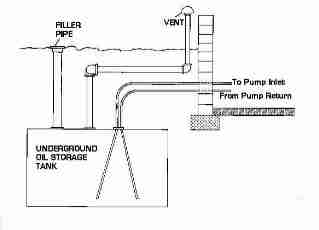
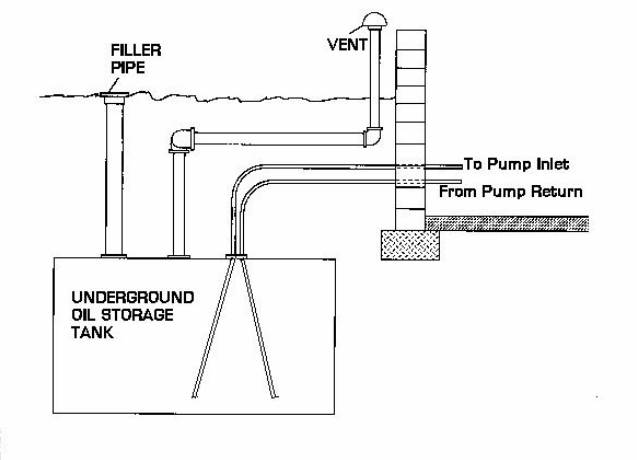
Our sketch above, courtesy of Carson Dunlop Associates, shows a common buried oil tank installation except that the oil line is shown leaving the bottom of the buried oil tank.
Modern practice usually connects a pair of oil lines to the top of a buried oil tank, avoiding picking up water and sludge from the tank bottom, and avoiding the chance that a leak in piping between oil and building interior will flood the inside of the building with oil.
But the sketch above shows that many buried oil tanks are installed close to the building foundation wall, usually parallel to the wall, since it's easiest to bury the tank in that position during new construction. (The sketch shows the tank at right angles to the wall so that we could portray the various piping arrangements with clarity.) So one of the first places to look for a buried oil tank is close to the building.
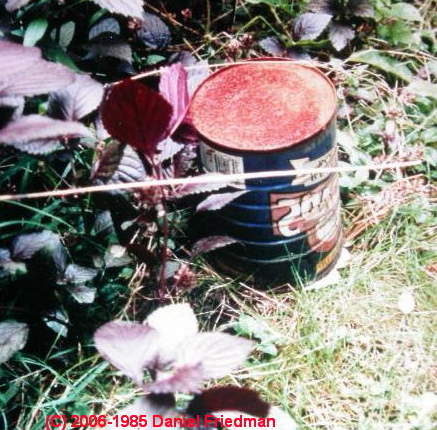 But that's not the only possible location for an outdoor buried oil tank at a property. We saw this coffee can in the bushes near a New York home and picked it up thinking we were just cleaning up trash left on the ground. Later in this article you'll see what we found.
Watch out: from a previous use, a buried oil tank may be present or may have been present at a property even if it is now served by an indoor, above ground oil tank or even by LP or natural gas.
So don't assume that because you don't see a tank that none was ever used or present at a property. Make a visual site inspection for clues suggesting that one or more tanks is or was present.
Even an alert home buyer or home inspector, not charged with an environmental site survey (nor paid for one) might discover evidence of very costly buried tank problems at a property, simply by attending certain visual details and thinking about what they mean.
Or in the case of buried oil tanks, the next few photographs show two cases of the discovery of a nearly hidden outside oil tank fill pipe which led to the discovery of buried oil tanks.
These tanks had not been properly abandoned, risking significant cost to the property owner or buyer.
Outdoor Visual Clues of the Presence of a Buried Oil Tank
The first three photos below show us exploring a hole in a bald patch of grass. Oil spills, such as during a heating oil delivery, can poison the soil so that even when no heating oil is visible or no odors remain, the grass may still refuse to grow in this spot. So we explored further as our photos show.
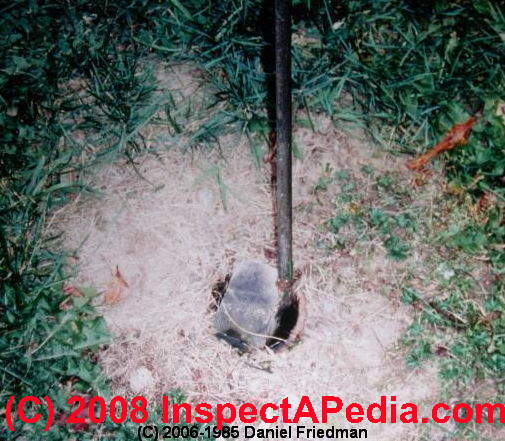
Many visual or historical clues may indicate that there is or was a buried oil or other fuel tank at a property.
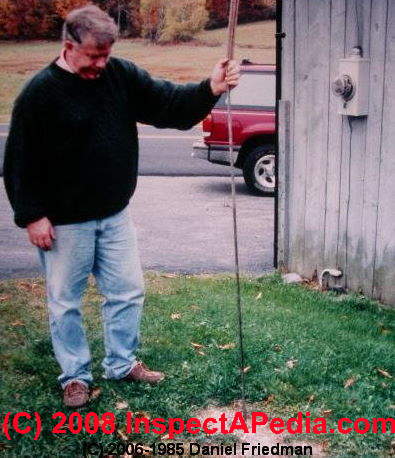
Visible oil tank fill or vent pipes protruding from the ground, depressions near a building, or even areas of dead grass or plantings in a small spot where a buried or previous fuel tank fill pipe may have been installed - from spillage of fuel.
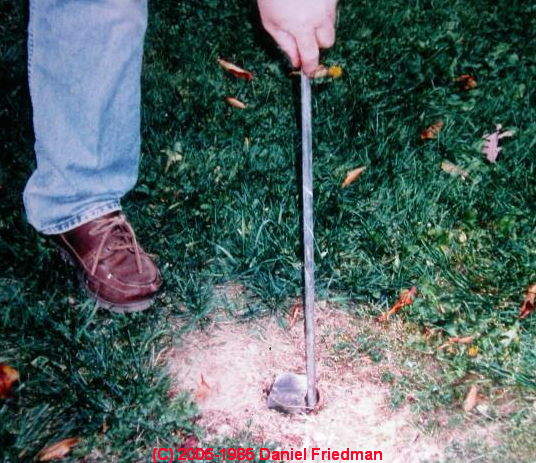
At one site that we investigated this clue led to the discovery that the tank "removal" had consisted of nothing more than the unscrewing and removal of the fill and vent pipes from the leaky oil tank.
There are many factors that can help gauge the risk of a buried oil tank or one not properly removed:
- Age and type of property,
- Existing oil fill and vent piping locations
- Existing oil tank size and ratings
- Abandoned heating oil lines
- Marks where equipment was previously mounted
- Footprints of old heating equipment
See details of outdoor clues that may point to a buried oil tank now found
at BURIED OIL TANKS, OUTDOOR CLUES
Coffee Can Hides an Improperly Abandoned Oil Tank Still in Place
The next two photos show us exploring what appeared to be a simple coffee can tossed in the yard of a residential property.
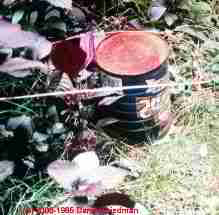
The buried oil tanks discovered below these "nearly hidden" filler pipe openings needed to be tested for leakage and then properly abandoned - a significant expense.
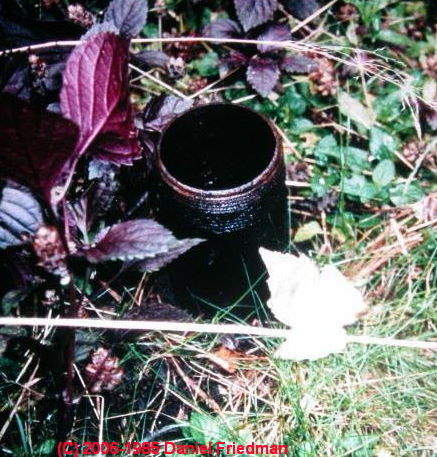
What is significant about this "abandoned" UST is that from the evidence right at ground level (we could see down into the oil storage tank still in place but not in use), one could infer that the oil storage tank had not been properly abandoned. The risks include undiscovered heating oil leaks into the soil at this property.
See SIGNS OF BURIED OIL TANKS for a detailed discussion of the study of outdoor clues used to find a buried oil tank at a residential property.
Indoor Visual Clues of the Presence of an Indoor or Outdoor Abandoned Oil Tank
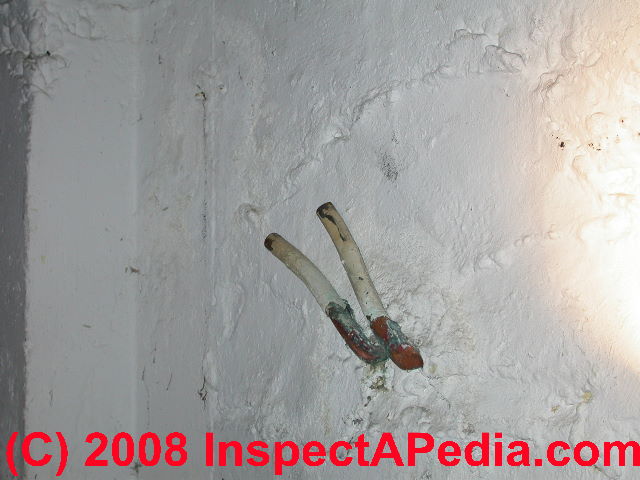
Photo above: a pair of uncapped, open but cut off, flexible copper tubes penetrating a foundation wall often indicate that a buried oil tank was previously in use fueling oil-fired heating equipment at a property, even if no oil burning equipment is currently present.
These open copper oil lines might hint that the oil tank itself could still be present, buried somewhere outside the building.
In the author's view (DJF), oil tank testing services and professional environmental inspectors performing an "oil tank sweep" are expected to include both a visual screen of the property for clues such as these, and also a combination of other methods to detect buried oil tanks. Some clues that are strong evidence of a buried oil tank at a property are listed and illustrated below.
- Building interior inspection for abandoned oil piping or fuel lines,
or patch marks on foundation walls where such lines may have been removed.- Our photo at above left shows a pair of copper oil lines exiting a basement foundation wall. These pipes were almost certainly connected to a buried oil tank. Is the tank still present?
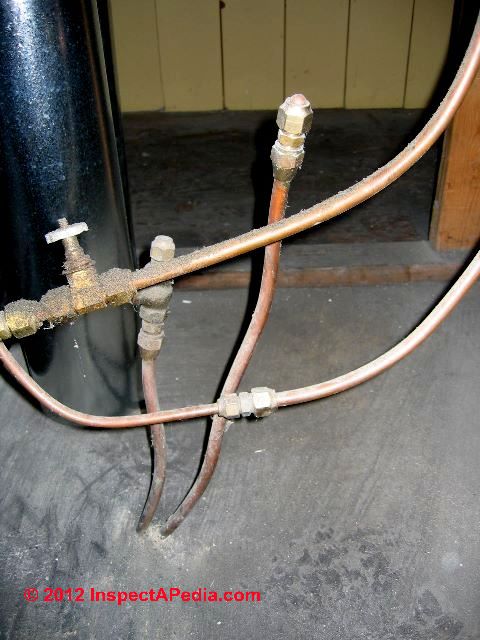
- Our photo at above right shows an "extra" pair of copper oil lines protruding out of the basement floor even though there was an indoor oil tank piped to the heating equipment. One could follow these older oil lines by markings in the concrete over to the building wall where they penetrated the wall to connect to an older outdoor buried oil tank.
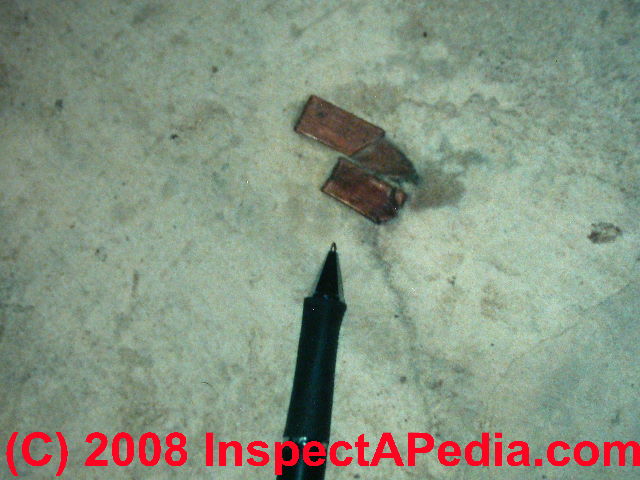
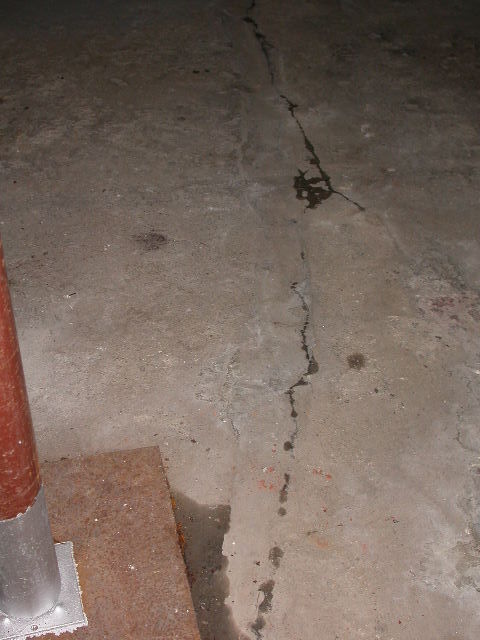
- Our photo below shows markings in a concrete basement floor that are characteristic of the floor having been cut open to install oil piping. Follow these marks to their destination; if you do not trace these markings to currently active oil piping then further investigation is needed: they probably mark abandoned oil lines and possibly an abandoned outdoor oil tank.
- Historical information
about the site is collected. - Oil company records
may be checked for indications of deliveries or of prior tank service or removal. - Ground scanning radar
may be employed to locate large buried metal objects including underground oil tanks. - Common sense observation of details,
such as the location and placement of oil tank fill and vent piping, if present, can indicate the probable size and type of tanks in some cases. - Review the history of the property's heating equipment -
what equipment has been present, removed, changed. - Examine the building interior and outside walls & floors
for evidence of heating oil leaks.
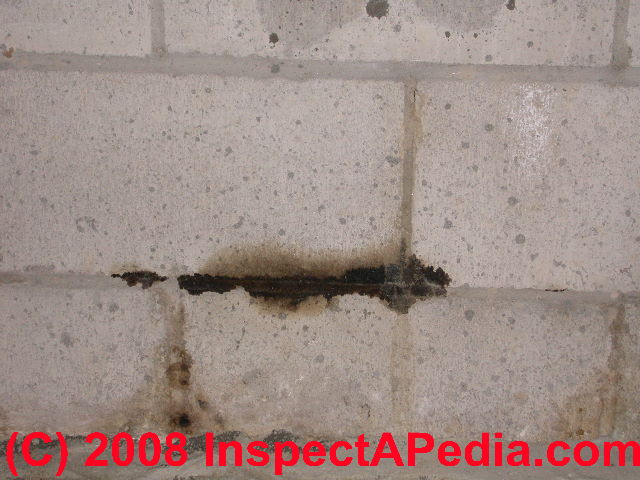
Our photo above shows heating oil found seeping through the foundation wall in a crawl space. We suspected that a buried oil tank was or had been outside of this foundation wall and that it had leaked through the building foundation.
Further investigation discovered an abandoned heating oil tank buried just outside of this wall, under a driveway.
See INDOOR CLUES TO BURIED OIL TANKS for a detailed discussion of the study of indoor visual clues used to find a buried oil tank at a residential property.
...
Professional Oil Storage Tank "Tank Sweeps" for USTs
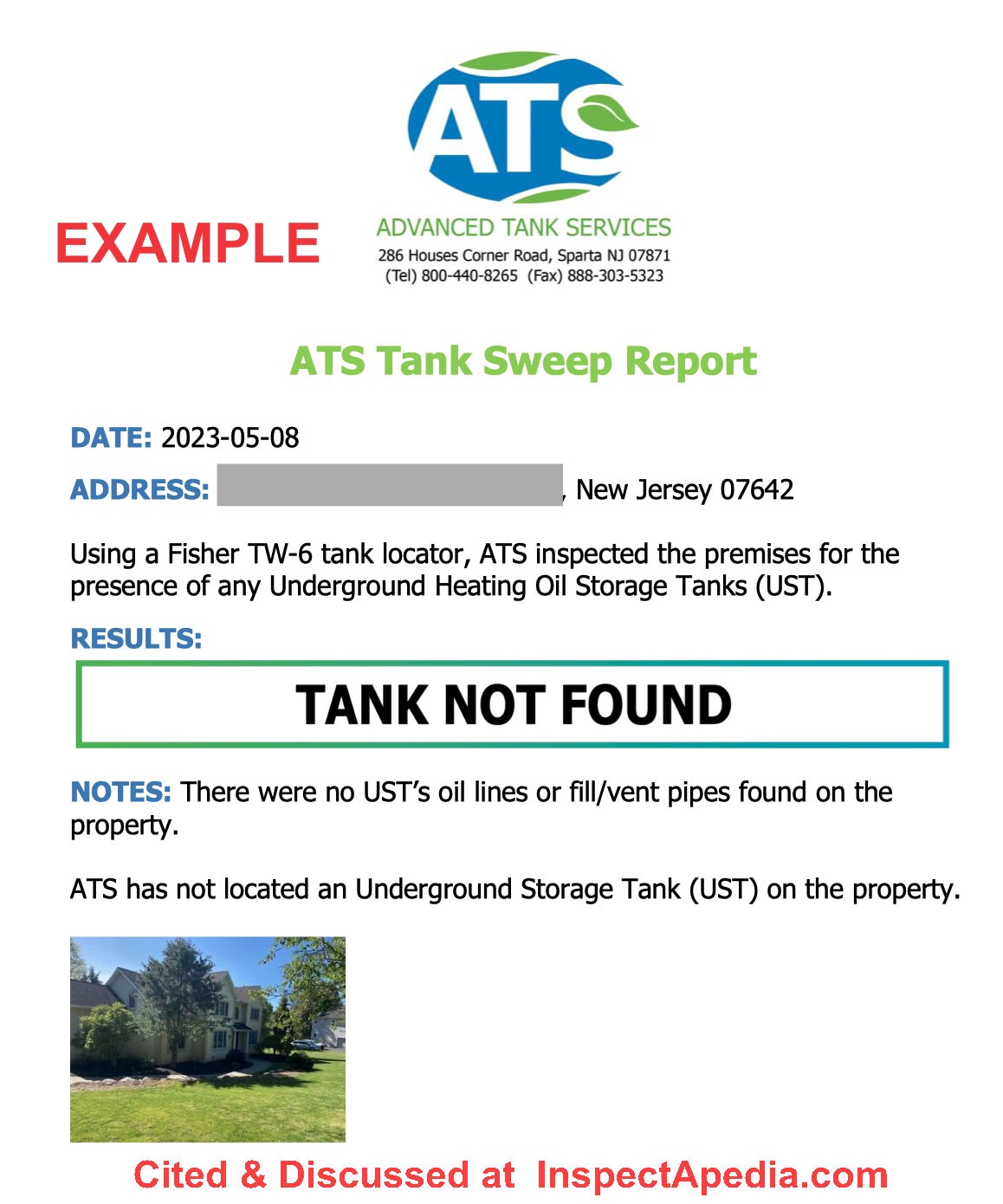 Illustrated above: an "oil tank sweep report" for a New Jersey home, performed by Advanced Tank Services in Sparta, NJ, courtesy of New Jersey Home Inspector Dov Ber Kahn. Notice that the report simply indicates "tank not found".
Oil tank sweeps are limited, not, in our OPINION, exhaustive nor infallaible.
In this simple oil tank sweep report there is no description of the process used, the actual or exact area surveyed nor does, or perhaps can the oil tank sweep inspection company promise that there is actually no buried tank at the property.
The company used a Fisher TW-6 Pipe & Cable Locator described below - a type of metal detector.
One of the most widely used methods of searching a site for buried storage tanks, including USTs or buried oil tanks is the use of magnetic detection instruments. Ground scanning radar (GSR) = Ground Penetrating Radar (GPR), an alternative, is a method that we think is less widely used.
For example GPR may detect non-metallic buried objects, such as a buried fiberglass storage tank that might be missed if relying on magnetic detection of iron. - (US EPA 2016)
Current underground storage tank experts use equipment that they say can locate both ferrous and non-ferrous metals, possibly useful in finding buried copper oil lines as well as steel storage tanks.
These six geophysical methods for locating buried oil tanks or underground soil and rock composition, presence of groundwater, etc. are described by various documents including the EPA 2016 document given in excerpts below, quoting from this U.S. EPA, A GUIDE for REGULATORS, Expedited Site Assessment Tools For Underground Storage Tank Sites [PDF] (2016)
- Ground Penetrating Radar - using high frequency electromagnetic waves sent into the soil using an antenna.
Ground penetrating radar (GPR) can be a very useful geophysical method for UST sites because it is appropriate for a broad range of investigations and is only rarely affected by cultural interferences (e.g., buildings, fences, power lines). - Electromagnetic Methods
Electromagnetic (EM) methods, also referred to as electromagnetic induction methods, are some of the most diverse and useful geophysical techniques. Although they are commonly subject to cultural interferences, they can locate buried objects, both metal and non-metal. - Electrical Resistivity
Electrical resistivity, also referred to as galvanic electrical methods, is occasionally useful at UST sites for determining shallow and deep geologic and hydrogeologic conditions. - Metal Detection
Metal detectors, also referred to as pipeline and cable detectors, are widely used at UST sites for the specific application of locating buried metal objects, both ferrous and non-ferrous in a process called metal detection (MD). MD can be used at UST sites to locate steel and composite (i.e. fiberglass-coated steel) tanks, metal piping, and utilities.
Watch out: keep in mind that magnetic detection can only locate ferrous (iron based) metal objects. Not copper, brass, bronze, nor buried fiberglass tanks.
- Seismic Methods are not generally used for UST location.
Seismic methods provide stratigraphic information by measuring how acoustic waves travel through the subsurface.
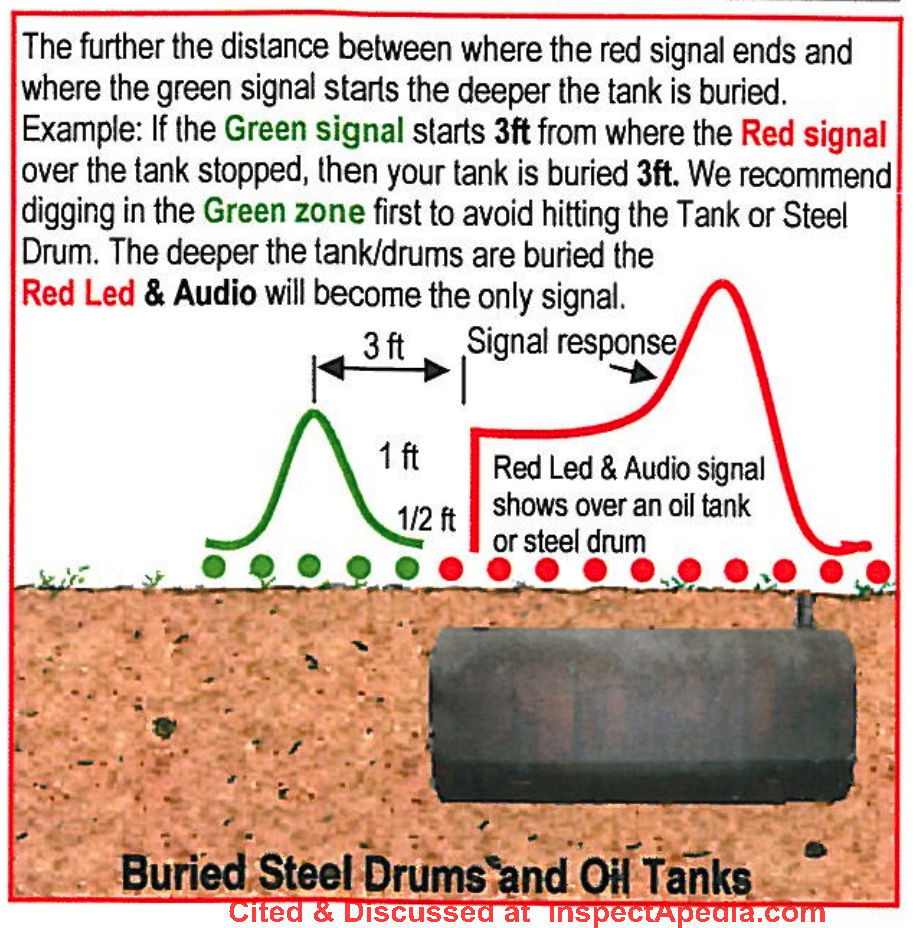
Fisher Labs illustrates in their sketch (above) why field experience and training are needed for effective use of metal detectors or for that matter any equipment that is used to search for or to locate the position of buried objects.
The signal produced by the detecting device varies by depth, angle, material, object size, etc. This illustration is from Fisher's FIPD21 ferro-magnetic locator described below.
- Magnetic Methods - note the EPA's reservations:
Magnetometers are useful at UST sites for locating tanks and piping made of ferrous materials.
Although highly sensitive magnetometers have been developed that can detect the void space within large buried objects of any material (e.g., fiberglass tanks), this technology is not often used in UST investigations because many cultural interferences present at UST sites will mask the affect.
Buried Oil Tank Location Methods - Oil Tank Sweeps
- Andres, A. Scott. EVALUATION OF REMOTE SENSING AND SURFACE GEOPHYSICAL METHODS FOR LOCATING UNDERGROUND STORAGE TANKS [PDF] Newark, DE: Delaware Geological Survey, University of Delaware, 1986.
Abstract excerpt:
... the Delaware Geological Survey has completed a survey of currently available remote sensing and geophysical tools to determine which methods may be utilized to locate underground storage tanks. Limited preliminary field testing has been performed.
Excerpts:
Of these four techniques, the metal detector is the least expensive to purchase and operate. Equipment costs are in the range of hundreds of dollars, and extensive personnel training is not required. An individual site survey can usually be completed in one hour or less.
Magnetometers are somewhat more expensive to purchase and operate. Equipment costs are in the range of $6,000-9,000, and minor personnel training is required to operate the equipment and analyze the data (David L. Pasciznyk, personal communication). An individual site can usually be investigated in one hour or less.
Electromagnetic methods, specifically terrain conductivity meters, are fairly expensive to purchase and operate. Equipment costs are in the range of $10,000 to $25,000, and extensive personnel training is required to operate the equipment and analyze the data (Kari G. Andres, personal communication). An individual site can usually be investigated in one hour or less.
Ground penetrating radar is likewise expensive to purchase and operate, with equipment costs in the range of $16,000-30,000 (Patricia Corbo, personal communication). Extensive personnel training is required to operate the equipment and analyze the data. An individual site investigation can usually be completed in one or two hours.
Even after a probable tank location is determined by remote sensing or surface geophysical methods, its condition can be accurately determined only by excavation.
- Barrows, Larry, and Judith E. Rocchio. MAGNETIC SURVEYING FOR BURIED METALLIC OBJECTS [PDF] Groundwater Monitoring & Remediation 10, no. 3 (1990): 204-211.
Abstract
Field tests were conducted to determine representative total-intensity magnetic anomalies due to the presence of underground storage tanks and 55-gallon steel drums. Three different drums were suspended from a non-magnetic tripod and the underlying field surveyed with each drum in an upright and a flipped plus rotated orientation.
At drum-to-sensor separations of 11 feet, the anomalies had peak values of around 50 gammas and half-widths about equal to the drum-to-sensor separation. Remanent and induced magnetizations were comparable; crushing one of the drums significantly reduced both.
A profile over a single underground storage tank had a 1000-gamma anomaly, which was similar to the modeled anomaly due to an infinitely long cylinder horizontally magnetized perpendicular to its axis. A profile over two adjacent tanks had a smooth 350-gamma single-peak anomaly even though models of two tanks produced dual-peaked anomalies.
Demagnetization could explain why crushing a drum reduced its induced magnetization and why two adjacent tanks produced a single-peak anomaly. A 40-acre abandoned landfill was surveyed on a 50- by 100-foot rectangular grid and along several detailed profiles.
The observed field had broad positive and negative anomalies that were similar to modeled anomalies due to thickness variations in a layer of uniformly magnetized material.
It was not comparable to the anomalies due to induced magnetization in multiple, randomly located, randomly sized, independent spheres, suggesting that demagnetization may have limited the effective susceptibility of the landfill material.
A different 6-acre site survey conducted on a 10- by 10-foot grid was analyzed to determine the maximum station spacing and line separation that could have been used. Essentially, all of the anomalies at this site would have been resolved by a survey conducted on a 20- by 20-foot grid and the larger anomalies would have been detected by a 50- by 50-foot grid.
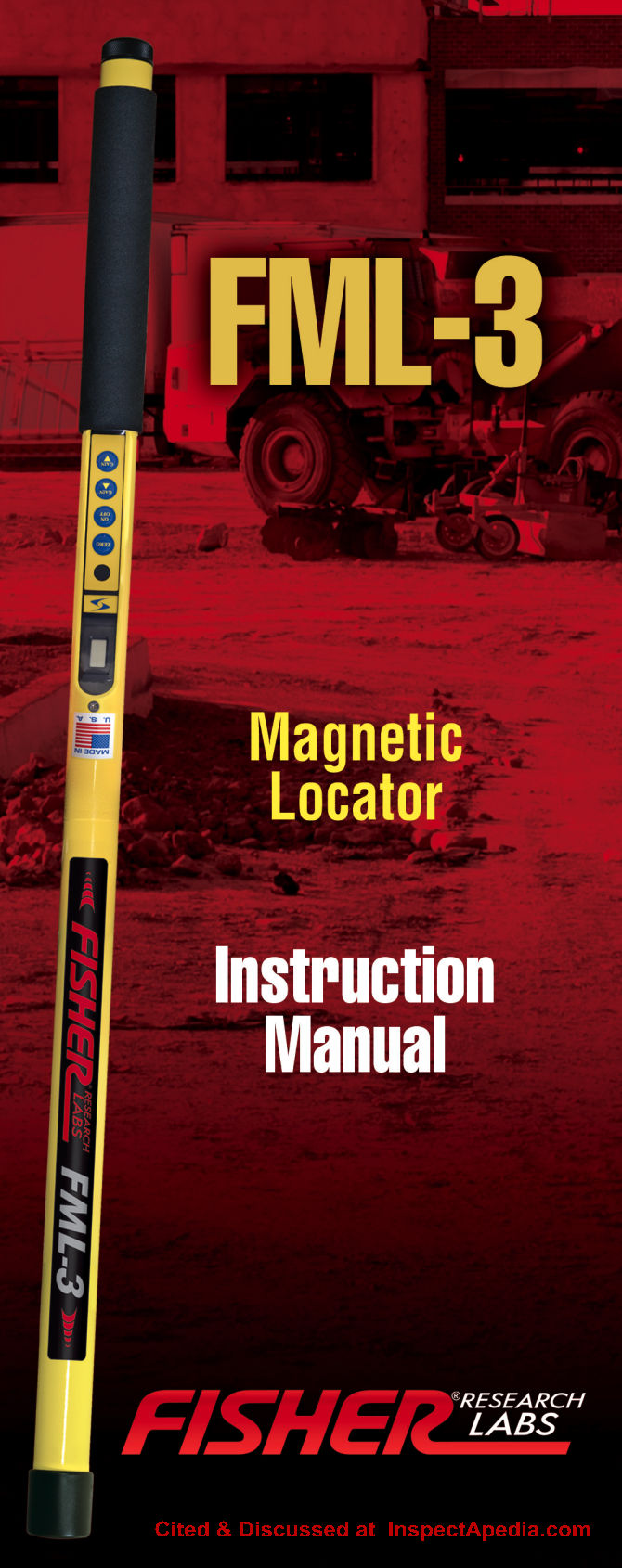
- Fisher Labs, FIPD 2100 FERRO-MAGNETIC LOCATOR DESCRIPTION [PDF] (Illustrated above) Fisher Utililty / Industrial Detectors,
Fisher Labs
1120 Alza Dr.
El Paso, Texas 79907 USA
Tel: : 915-225-0333 Tel: 1-800-685-5050,
E-mail: info@fisherlab.com, Web: fisherlab.com - retrieved 2023/09/28,
The company has produced equpment for locating buried utilities since 1931 and currently provides digital line tracers, magnetometers, leak deetectors, and other equipment.
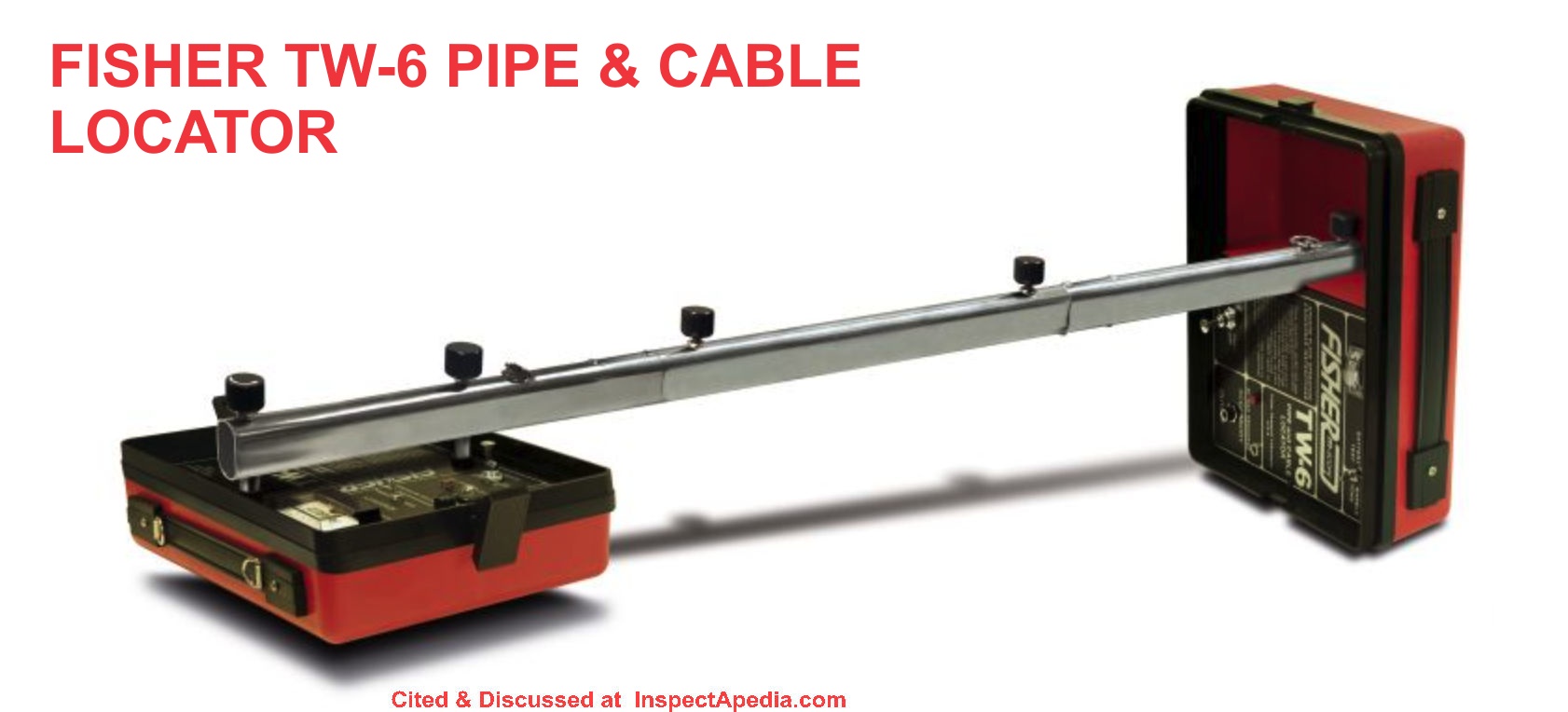
- Fisher Labs, TW-6 PIPE & CABLE LOCATOR OPERATING MANUAL [PDF] (Illustrated above) Fisher Labs, retrieved 2023/09/28, original source: fisherlab.com/industrial/manuals/TW-6%20Reader%20870241.pdf
Note: the words "tank" or "oil tank" do not appear in this manual.
The company also sells ferro-magnetic locators and metal detectors.
Excerpt:
The Model TW-6 with its many timesaving accessories continues the Fisher M-Scope tradition of giving you even greater speed and precision in locating underground pipes and cables.
The surest way to effectively use the TW-6 and its new accessories is to practice on known “conductors”. Such items a valve box covers, manhole covers, or valves clearly visible at the surface of the ground are excellent items to start locating.
This way you will quickly get the “feel” of the instrument before taking it into the field. - Heck, D.H., A Case Study of a Large Scale Precision [ OIL or FUEL ] TANK TESTING PROGRAM [PDF] Diane H. Heck, Tetra Tech Richardson, Newark, Delaware, web search 4/27/12, original source: http://info.ngwa.org/GWOL/pdf/870143411.PDF, copy on file as /heating/OIl Tanks UST/Tank_Test_Heck_870143411.pdf In Proceedings of the Fourth Annual Eastern Regional Ground Water Conference. Burlington Vermont. July 14-16, 1987.. National Water Well Association, Dublin, OH. 1987. p 133-144, 3 fig, 3 ref. 1987. - Web search 4/27/12, original source: info.ngwa.org/GWOL/pdf/870143411
Details from this study are at
OIL TANK FAILURE RATES - U.S. EPA, A GUIDE for REGULATORS, Expedited Site Assessment Tools For Underground Storage Tank Sites [PDF] (1996 - 2016) U.S. Environmental Protection Agency, - retrieved 2023/09./25, original source: epa.gov/sites/default/files/2014-03/documents/esa-ch3.pdf
- United States. Environmental Protection Agency. Office of Underground Storage Tanks. Expedited Site Assessment Tools for Underground Storage Tank Sites: A Guide for Regulators. US Government Printing Office, 1997.
- [10] Johnson, Cynthia, How do you choose the right tank testing method? Fuel Oil & Oil Heat Magazine, November 1995
Question: requirements for people offering oil tank sweeps in New Jersey & other states
Received a link from njahionline [dot] com/online-courses/course-detail/2-njahi-course/2-oil-tank-sweeps regarding a course on oil tank sweeps which will enable me to perform this service in NJ.
Does NYS have any requirements for oil tank sweep performance? Please advise.
In NJ, it's standard practice that together with a home inspection an oil tank sweep which is using a type of metal detector to search for buried oil tanks. When the test is done a letter from that company claims they did not find any buried oil tanks. I'll forward the one ATS did for my client. Usually it cost about $300.
Thank you DovBer Kahn - private email 2023/09/20
- Dov Ber Kahn, a home inspector in Rockland County, NY has contributed photographs of various building features to InspectApedia. Mr. Kahn is a licensed home inspector in New York and New Jersey, and can be reached at Website: Kahnbhomeinspectors, Tel: 845-445-8234, Email: kdovber@googlemail.com
Moderator reply: Buyer Beware conditions of real estate sales, not law, argue for an oil tank sweep at many but not all properties
In New Jersey, the state's Unregulated Heating Oil Tank program (UHOT) does not address inspections for the presence of underground tanks (USTs) and states simply
The Unregulated Heating Oil Tank (UHOT) Program allows qualified environmental professionals to investigate and remediate discharges from Unregulated Heating Oil Tanks, including all residential fuel oil underground storage tanks, with limited oversight by the New Jersey Department of Environmental Protection (NJDEP).
All such tank cases are subject to possible audit by NJDEP. - NJ DEP cited in detail below.
Watch out: however, New Jersey's UHOT Site Remediation Program homeowners guide FAQs also include this Q&A:
Question: Does a previous abandoned underground storage tank on my property need to be removed?
Answer: Heating oil underground storage tanks that service residential buildings are considered unregulated heating oil tank systems. The Program does not regulate the operation of these tanks, however, it does oversee the remediation of an unregulated heating oil tank once a discharge is discovered.
If there is no indication of a discharge, there is no state requirement that the tank be removed.
However, it is not uncommon that real estate or other professionals recommend that a tank be removed in preparation for the sale of a home.
In this instance, if a discharge is discovered during the removal of the underground storage tank, remediation is required. - source: NJ DEP UOT HOG FAQs cited in detail below.
When we researched "New Jersey Law on Oil Tank Sweeps" and related licensing, what dominated search results (25 Sept. 2023, Google Search), were websites advertising the services of environmental inspection and testing companies in New Jersey.
At least some of those sites contained language that is technically correct but in our opinion, a little misleading unless you read with care. Here's an example:
In New Jersey, any time someone buys or sells a home, he or she must perform an oil tank sweep.
followed later by
Under state law, if you buy a property with a contaminated oil tank on it, you are responsible for it. That means you must pay for the cleanup.
Really? Yes, sort of. "Must perform an oil tank sweep" here is NOT established by New Jersey state law. In fact residential oil storage tanks in New Jersey are not regulated - unless and until a leak is discovered.
The way to read this text, any time someone buys or sells a home, he or she must perform an oil tank sweep, is as an opinion, not law, but an opinion that makes perfect sense if there is reason to believe that a home might, at any time in its history, have used oil fired heating equipment.
The second statement, pointing out that once you've bought a property you're responsible for it in all regards, is certainly true of real estate transactions across the U.S. and in at least some other countries as well.
Particularly in real estate sales, caveat emptor - let the buyer beware - is behind your attorney's advice that the buyer perform their own due diligence, in various forms such as a title search (even if there's no mortgage involved), and a home inspection by a qualified expert who comes with no conflicting interests.
Really? No, an oil tank sweep is not appropriate in every case.
Home buyers might want to be careful following that oil tank sweep company's advice when, for example, the building is new, uses only electric, gas, solar, or other energy sources and is constructed on a site that was never previously a building site.
At that point in our opinion, the risk of a buried oil tank on that property, while not zero (nobody can promise zero risk), is extremely small.
See details about this problem at OTHER PEOPLE's MONEY - managing risks and watching out for advice that is better, safer, more profitable for the advice giver than for the advice receiver.
We list some easy visual inspection clues that can lower or raise the level of concern about the possibility of a prior UST at a property in these articles
Oil tank sweep surveys are also not regulated in New York nor - we think - most other jurisdictions as long as we are talking about typical residential tanks of smaller size - under 1110g.
Just three New York state counties regulate residential size buried oil tanks - Nassau, Suffolk, and Westchester.
How Reliable are Buried Oil Tank (UST) Site Surveys: Oil tank sweeps?
We both understand that for practical and economic reasons, oil tanks are normally (not necessarily always) quite close to the building when buried.
OPINION: Unfortunately when we, for cost or practical reasons, limit the area covered by an oil tank sweep to something less than the total lot size, and depending on buried tank materials (fiberglass for example) and the scanning method (usually metal detection) one can't really be completely confident in the test result.
Inspecting a New York property for a home buyer and where several thickly wooded acres were included in the purchase, I explored the woods as well as the more accessible property areas.
To my surprise I found the remains of an old building foundation that were not visible from the present home, and in them, remains of oil tank supply and return piping that hinted that there had been a buried tank at the site - quite distant from the current home.
However I think we'll agree that most old buried oil storage tanks at residential properties would have been steel and are usually (but not always) located close to the building. An oil tank sweep makes the most sense if there is any evidence that there might have ever been a UST at a property.
Research on New Jersey Oil Tank Sweep Law & Requirements
- NJ HOMEOWNER'S GUIDE to UNREGULATED HEATING OIL TANK PROGRAM (UHOT) [PDF] New Jersey Department of Environmental Protection (NJDEP), retrieved 2023/09/25, original source: nj.gov/dep/srp/unregulatedtanks/
- NJ Unregulated Heating Oil Tank Program (UHOT) Homeowner's Guide FAQs, NJ DEP, retrieved 2023/09/25, original source: nj.gov/dep/srp/unregulatedtanks/faqs.html quoted verbatim above on this page
- New Jersey STATE OIL TANK REGULATIONS [web page]
- Oil Tank Spill or Event Records:
New Jersey and some other states permit a search of the state's Department of Environmental Protection DEP Records using the state's DataMiner report that lets the user check the state records to see if an underground storage tank case has been recorded in the state, such as a report of a spill or leak. New Jersey residents can use the link given below, but remember that absence of evidence is not the same as evidence of absence - njems.nj.gov/DataMiner/RUN_REPORT.aspx?RN=All+SRP+Sites+by+Selected+PI+Address
Question: A buried oil tank was on a property 50 years ago - how can we be sure there is no remaining hazard? Can we assume the tank has dissolved away?
Looking at property to purchase. Now heated with gas....has been for over 50 years. Oil tank buried somewhere on property...detectors cannot locate. Can we safely assume tank deteriorated?? Soil samples = no oil contamination thanx - C.T. 2/26/13
Reply: how to decide when enough looking, soil scanning & soil testing for oil tanks and spills are enough to quit?
A competent onsite inspection by an expert usually finds additional clues that help accurately diagnose a problem or to get better clues about the history of oil tanks at a property.
That said, here are some things to consider:
Not I nor anyone with a modicum of sense would promise you, by email, about a property of which we know nothing, that your site is free of risk of an expensive cleanup job due to a prior oil tank leak or spill based on the information in your note.
If you have reason to believe that an oil tank was previously at the property, I would not assume that there was no leak or no remains of an old tank just because no one has seen anything.
With all of these dire warnings the question really is how much time, effort, and money are appropriate to pour into the ground trying to reduce risk of a hidden hazard.
Typically for a site that we know something about, people do soil testing in the most likely tank locations and, absent any other data, for a residential property they give up, accepting the risk of buried hazards and future costs. It makes sense to think that no one in their right mind would install a buried oil tank at some great distance away from the building it serves, but indeed sometimes tanks are more distant than one might guess.
I have, for example, wandered in the woods of a property being bought by a friend; we found a large above ground oil tank hidden way back in the woods - from years ago; happily there was no leakage. Worse, a buried steel tank, if not properly abandoned, could have been left empty and could lead to a sudden soil collapse, even someone falling into the hole, with serious consequences.
That tank was nowhere near any existing building, but we found the remains of an old building - just the foundation that the tank had served. In fact it was the site history, signs of an abandoned road through the woods, and the discovery of the old foundation that led me to the oil tank.
Remember that if you buy a property and do not find an oil spill, and if you are later selling the property and your new buyer finds a spill, it becomes your cost to bear.
For a site where people have reason to be extra careful or concerned (there are factors that can raise our Fear-o-Meter or lower it), other options are available including consulting with an environmental expert who will audit site history, do a records search, and who might use ground scanning radar or other methods to make a more accurate search of the property, ending with a report that either found something or makes the property owners comfortable.
Also see the FEAR-O-METER, a promotion theory to convert risk of hidden defects & hazards into action thresholds, for a discussion of how an accumulation of inspection evidence leads to a rational decision to perform invasive or destructive inspection measures.
You probably want some combination of research into site history, visual inspection, and testing to decide how much risk remains to you. But if we knew that there had been a buried tank at a property, or were pretty sure there was one that had not been professionally abandoned, presuming it magically disappeared with no work on anybody's part is a bit of a risky proposition.
In sum, when do we quit looking for a buried hazard? Armed with the information you have or can find out, and the extent of property that remains unexplored, and the probability that a buried oil tank was actually installed at some remote spot not near any building, you will decide how much remaining risk there is and and how much to spend on reducing that risk (you can't get it to zero in some cases). That's for you to decide with some advice from an on-site expert.
Reader follow-up:
Thanx....just had it inspected.
No tank, no soil contamination
Reply:
good news
be sure to keep documentation - in the event of a future property sale that will help.
Question: who is liable for buried oil tank disclosure
(Oct 14, 2014) Rosa said:
We had a property where we changed oil heating to electric heating.The property was sold 3 more times in a span of 28 years. the current owners dug up the soil to put in a French drain and came upon an oil tank. they had it removed and are now suing the person that sold the the property for damages. in turn the person who sold them the property is suing the person who sold it to them and he is suing us. Who is liable in this case? we sold the property in 1986.
Reply:
Rosa this is a legal question for your attorney and the reply will most likely depend on the terms of the various contracts of sale.
...
Continue reading at BURIED OIL TANK REPORTS or select a topic from the closely-related articles below, or see the complete ARTICLE INDEX.
Or see these
Recommended Articles
- BURIED OIL STORAGE TANKS (UST) GUIDE - home
- OIL TANKS - home
- OIL TANK LEAK & ABANDONMENT REGULATIONS
- OIL TANK LEAK / FAILURE RATES
- OIL TANK LEAK TEST METHODS
- OIL TANK TESTING & REMOVAL COs
Suggested citation for this web page
BURIED / UNDERGROUND OIL TANK (UST), LOCATION METHODS at InspectApedia.com - online encyclopedia of building & environmental inspection, testing, diagnosis, repair, & problem prevention advice.
Or see this
INDEX to RELATED ARTICLES: ARTICLE INDEX to HEATING OIL, OIL BURNERS, OIL FIRED HEATERS, OIL TANKS
Or use the SEARCH BOX found below to Ask a Question or Search InspectApedia
Ask a Question or Search InspectApedia
Try the search box just below, or if you prefer, post a question or comment in the Comments box below and we will respond promptly.
Search the InspectApedia website
Note: appearance of your Comment below may be delayed: if your comment contains an image, photograph, web link, or text that looks to the software as if it might be a web link, your posting will appear after it has been approved by a moderator. Apologies for the delay.
Only one image can be added per comment but you can post as many comments, and therefore images, as you like.
You will not receive a notification when a response to your question has been posted.
Please bookmark this page to make it easy for you to check back for our response.
Our Comment Box is provided by Countable Web Productions countable.ca
Citations & References
In addition to any citations in the article above, a full list is available on request.
- [4] Fuel Oil and Oil Heat Magazine, August 1985 p.18. Fuel Oil & Oil Heating Magazine, 3621 Hill Rd., Parsippany, NJ 07054, 973-331-9545
- [5] Standards of the National Board of Fire Underwriters, as referenced by "Domestic and Commercial Oil Burners,", Charles H. Burkhardt, 1961, 3rd Ed., McGraw Hill Book Company, p. 172
- [6] NFPA - the National Fire Protection Association can be found online at www.nfpa.org
- [7] "The Interim Prohibition Guidance for Design and Installation of Underground Oil Storage Tanks", U.S. EPA, EPA/530-SW-85203, Office of Underground Storage Tanks, Washington D.C.
- [11] National Association of Oil Heat Service Managers, PO Box 380, Elmwood Park, NJ 07407
- [12] "Homeowners Guide to Fuel Storage," Agway Energy Products, Verbank, NY, November 1990
- [13] "Causes of Underground Corrosion", Harco Corporation, Paper HC-36, Median OH
- In addition to citations & references found in this article, see the research citations given at the end of the related articles found at our suggested
CONTINUE READING or RECOMMENDED ARTICLES.
- Carson, Dunlop & Associates Ltd., 120 Carlton Street Suite 407, Toronto ON M5A 4K2. Tel: (416) 964-9415 1-800-268-7070 Email: info@carsondunlop.com. Alan Carson is a past president of ASHI, the American Society of Home Inspectors.
Thanks to Alan Carson and Bob Dunlop, for permission for InspectAPedia to use text excerpts from The HOME REFERENCE BOOK - the Encyclopedia of Homes and to use illustrations from The ILLUSTRATED HOME .
Carson Dunlop Associates provides extensive home inspection education and report writing material. In gratitude we provide links to tsome Carson Dunlop Associates products and services.
 | HOME | ABOUT | ASK a QUESTION | CONTACT | CONTENT USE POLICY | DESCRIPTION | POLICIES | PRIVACY | |
| © 2024 - 1985 Publisher InspectApedia.com - Daniel Friedman | |||||||||