
InspectAPedia® FREE Encyclopedia of Building & Environmental Construction, Diagnosis, Maintenance & Repair |
Question? Just ask us! InspectAPedia
|
 Guide to Indoor Residential Heating Oil Storage Tanks
ASTs: Find & Fix Oil Tank Leaks & Other Problems
- POST a QUESTION or COMMENT about indoor home heating oil storage tanks: installation, inspection, leaks, piping, troubleshooting
Indoor oil storage tank inspection guide:
Advice and example photos for the visual inspection of above ground oil tanks for leaks and damage, improper piping, wrong location, bad fire clearances, including these details: damaged or leaky oil storage tanks, improper oil tank piping, valves, and indoor-type oil tanks located outdoors.
Here are photographs & explanation of some important indicators of oil storage tank condition that any home owner or home inspector can examine when an oil storage tank is visible and accessible inside or at a building.
InspectAPedia tolerates no conflicts of interest. We have no relationship with advertisers, products, or services discussed at this website.
How to Inspect Indoor Oil Tanks
 Inspection of the Oil Storage Tank Exterior
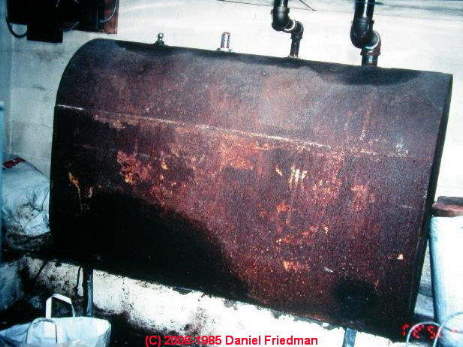
If an oil or other fuel storage tank is above ground and accessible for visual inspection it can and should be inspected for evidence of leaks or damage. Here are some inspection pointers for heating oil tanks.Is the tank exterior sound, without leaking seams or excessive rust?
Is there a patch or other evidence of a history of leaking?
[Click to enlarge any image]
In the photo at above-left, note the wet bottom of the tank? The inspector needs to decide if the oil on the tank exterior is from weeping at the fill or vent pipe fittings, from leaks at the oil line exiting the tank.
We were concerned about the evidence of seepage around the bottom left on this tank.
That oil stain does not seem to connect to the tank fill and vent fittings. The oil tank may have a perforation or an opening seam.
What about the next photo shown below?
A leak at fuel line or at the Fire-o-Matic shutoff valve, or perhaps due to an actual tank perforation?
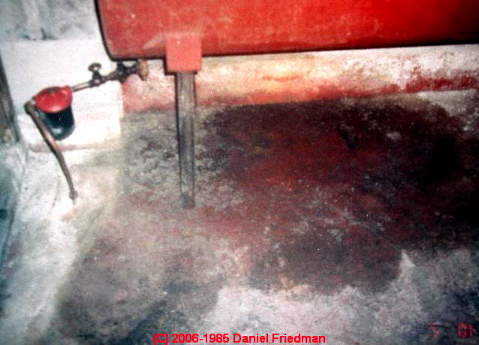
The size and wetness of the oil spill on this basement floor is a bit large to blame on a drippy fire safety valve.
But notice that in the upper portion of the photo the oil tank itself looks new. This oil spill was from the previous oil tank installed in this location.
Also look for water entry around the oil tank and don't confuse a water leak for an oil leak. Or more difficult, both leaks may be occurring at the same location. Look closely, and if necessary, touch, sniff, and sample the leak substance.
Leaky Oil Tanks That You Should Not Touch
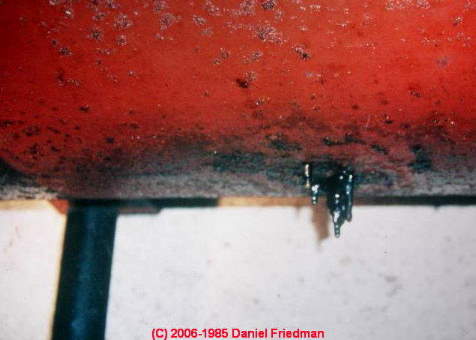
This last photo shows an actual tank leaking at its bottom from a perforation.
Memorize this photo and look under oil tanks when you're inspecting above ground indoor oil storage tanks.
If you see a tarry "stalactite" drip formation on the bottom portion of an oil storage tank, the tank is leaking, has perforated, and can leak catastrophically at any moment.
Watch out: do not pick, poke, or even touch an oil tank that looks like this. T
he risk is that you perforate the already thin tank bottom, leading to a much bigger and more costly oil leak mess.
What are the Clearance Distances Required for Indoor Oil Storage Tanks?
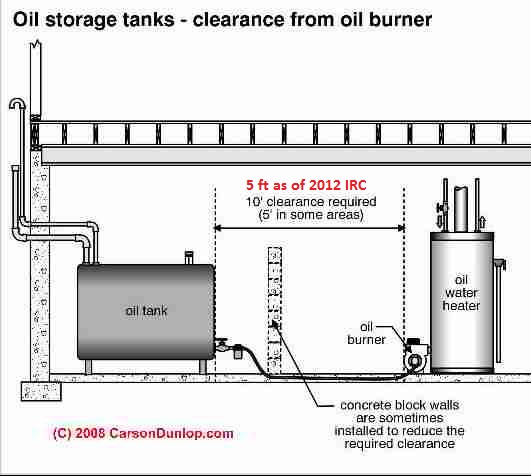 For fire safety indoor oil storage tanks should not be located too close to oil burners or other heaters. Typical indoor clearance requirements specify that the oil storage tank should be 10 feet from the oil burner.
Note: the 2012 IRC changed this minimum indoor clearance distance to 5 feet between the oil burner and the oil storage tank. Update courtesy of Carson Dunlop Associates, Toronto. You can see this design in our sketch at left, provided courtesy of Carson Dunlop Associates.
Even before the 2012 IRC change, some communities permited the oil tank to be located closer, just 5 feet away from the nearest oil burner.
If you cannot meet this distance requirement your local building officials or fire officials may approve the oil tank installation if you provide a fire barrier between the oil tank and the burner.
Tanks should also be located where they will not be damaged, such as by being struck by a vehicle entering a garage.
In some communities indoor oil storage tanks located in a garage must be protected against possible vehicle damage by steel posts or similar means.
In some communities indoor oil storage tanks must also be secured against possibly falling or tipping over, such as by using angled steel piping set into the floor and ceiling or floor and wall around the oil tank.
Also see OIL BURNER INSPECTION & REPAIR for a discussion of the impace of leaks at the oil burner assembly itself.
Reader Question: what's the code on distance and clearance for metalbestos chimneys & vents vs oil storage tanks?
I am installing a pellet boiler and will need a second metal chimney as I am leaving my oil burner as a backup. I live in maine. The only place I would like the metal asbestos chimney would run 40” away from my oil tank. Do you know what the code is on this? I am having a heck of a time getting any answers regarding this? - R. B. Windham ME 2/27/2014
Reply:
Insulated metal chimneys typically require a one-inch clearance from combustibles.
I think the reason you're not finding an answer to your question is that we're mixing up different constraints and safety concerns:
- The required separeation or clearance distances for flue vent connectors (generally single-wall uninsulated metal "flue pipes" or "stack pipes" that connect the heater to the chimney) - discussed
at FLUE VENT CONNECTORS, HEATING EQUIPMENT - The required separation of metal or insulated chimneys themselve from varous building components or combustibles - discussed
at FIRE CLEARANCES, METAL CHIMNEYS and
for height above roofs,
CHIMNEY HEIGHT & CLEARANCE CODE - The required separation of heating appliances (like an oil burner) from heating oil storage (the oil tank) - discussed in this article (above) beginning
at ABOVE GROUND OIL STORAGE TANK (AST) INSPECTION
If you were worrying about a horizontal distance for a flue vent connector, from a heater to the chimney, that'd be a different story. Suppose we wanted to run across an entire building from the heater to the chimney: the maximum horizontal length should not be more than 75% of the chimney height above the vent connector, or 100% if the chimney is insulated.
So you'd need a chimney at least 40 feet tall. But an option that may work acceptably is to include a draft inducer fan such as the type made by Field Controls.
Reader Comment: warning about improper oil storage tank support & code references
NHFireBear said:
We have found multiple situations where an owner has installed an AST supported by nothing more than a pile of wooden pallets or other combustibles (wooden structure, discarded tires, etc)
NFPA 31 requires that above-ground tanks rest on solid concrete and that any supports be made of concrete, steel or solid masonry. Supports for outside tanks shall be fastened to their foundation.
Outside tanks up to 275 gallons may be installed within 5 ft of a property line and up to 660 may be installed within 10 ft, assuming local setback or fire code does not make it more restrictive than NFPA 31: 7.8 "Installation of Outside Aboveground Tanks."
Reply:
Thanks NHFireBear - we've added your note. We appreciate the editing assistance. - Ed.
Oil Storage Tank & Piping Codes, Standards, Inspection Procedures
The oil tank piping installation and testing standards cited below are the most-widely adopted throughout states and cities in the U.S.
- 2008 UMC / ICC Chapter 13 on OIL TANK & PIPING CODE [PDF] example as adopted in the New York City Mechanical Code, retrieved 2015/11/26, original source: http://www2.iccsafe.org/states/newyorkcity/ Mechanical/PDFs/Chapter%2013_Fuel-Oil%20Piping%20and%20Storage.pdf
- NFPA 31, OIL STORAGE TANK INSTALLATION & PIPING [PDF] example as adopted by Warren County, VA, retrieved 2015/11/26, original source: http://www.warrencountyva.net/phocadownload/CountyForms/ BI_Dept/NFPA31%20Feul%20Oil%20Piping%20Installation%20and%20%20Testing.pdf.
- NORA OIL STORAGE TANK & PIPING NSPECTION PROCEDURES, [PDF] NORA, National Oil Heat Research Alliance, 600 Cameron Street, Alexandria, VA 22314 USA, Tel: 703-340-1660 Website: https://noraweb.org/ retrieved 2018/09/02, original source: https://noraweb.org/wp-content/uploads/2016/10/NORA-Silver-Chapter-3.pdf
- Roth Industries, Eco DWT Plus 3 Oil Tank Installation Instructions For Single and Multiple Tank Applications For Outside Tank Applications [PDF] (2014) Roth Indusdtries, 268 Bellew Ave South, Watertown, NY 13601 USA, Tel: 888-266-7684, Email: info@roth-usa.com
Canadian contact: Tel: 800-969-7684, Email: service@roth-canada.com, retrieved 2018/09/02, original source: http://www.roth-usa.com/PDF_Download_Files/DWT%20Installation%20Manual%202014.pdf - Above ground oil tank codes and standards for outdoor above-ground oil tanks are
at ABOVEGROUND OUTDOOR OIL TANK CLEARANCE DISTANCES & LOCATIONS - Also see our complete set
of OIL TANK LEAK & ABANDONMENT REGULATIONS Canadian & U.S. Regulations for installation, clearances, piping, reporting leaks
...
Continue reading at OIL TANK FILL & VENT PIPING INSPECTION CHECKLIST or select a topic from the closely-related articles below, or see the complete ARTICLE INDEX.
Or see ABOVE GROUND OIL TANK (AST) INSPECTION & TEST FAQs - questions & answers posted originally on this page
Or see these
Recommended Articles
- OIL TANK ABANDONING PROCEDURE
- OIL TANK INSPECTION & TROUBLESHOOTING
- ABOVE GROUND OIL STORAGE TANK (AST) INSPECTION
- OIL or GAS FUELED HEATING EQUIPMENT SHUTOFFS
- BURIED / UNDERGROUND OIL TANK (UST), LOCATION METHODS
- OIL TANK FILL & VENT PIPING INSPECTION CHECKLIST
- OIL TANK FILL & VENT PIPE CLEARANCE DISTANCES
- OIL TANK FILL / VENT PIPE LEAK REPAIRS
- OIL TANK PIPING & PIPING DEFECTS
- OIL SUPPLY LINE PIPING LEAKS
- OIL TANK HISTORY REVIEW
- SPHERICAL OIL STORAGE TANKS - the HORTON SPHERE
- OIL TANK INSPECTION CHECKLIST
- OIL TANK INSPECTION REPORT TEXT
- OIL TANK LEAKS & SMELLS
- OIL TANK LEAK & ABANDONMENT REGULATIONS
- OIL TANK LEAK TEST METHODS
- OIL TANK TESTING & REMOVAL COs
Suggested citation for this web page
ABOVE GROUND OIL STORAGE TANK (AST) INSPECTION at InspectApedia.com - online encyclopedia of building & environmental inspection, testing, diagnosis, repair, & problem prevention advice.
Or see this
INDEX to RELATED ARTICLES: ARTICLE INDEX to HEATING OIL, OIL BURNERS, OIL FIRED HEATERS, OIL TANKS
Or use the SEARCH BOX found below to Ask a Question or Search InspectApedia
Ask a Question or Search InspectApedia
Questions & answers or comments about indoor home heating oil storage tanks: installation, inspection, leaks, piping, troubleshooting
Try the search box just below, or if you prefer, post a question or comment in the Comments box below and we will respond promptly.
Search the InspectApedia website
Note: appearance of your Comment below may be delayed: if your comment contains an image, photograph, web link, or text that looks to the software as if it might be a web link, your posting will appear after it has been approved by a moderator. Apologies for the delay.
Only one image can be added per comment but you can post as many comments, and therefore images, as you like.
You will not receive a notification when a response to your question has been posted.
Please bookmark this page to make it easy for you to check back for our response.
Our Comment Box is provided by Countable Web Productions countable.ca
Citations & References
In addition to any citations in the article above, a full list is available on request.
- Mark Cramer Inspection Services Mark Cramer, Tampa Florida, Mr. Cramer is a past president of ASHI, the American Society of Home Inspectors and is a Florida home inspector and home inspection educator. Mr. Cramer serves on the ASHI Home Inspection Standards. Contact Mark Cramer at: 727-595-4211 mark@BestTampaInspector.com
- John Cranor [Website: /www.house-whisperer.com ] is an ASHI member and a home inspector (The House Whisperer) is located in Glen Allen, VA 23060. He is also a contributor to InspectApedia.com in several technical areas such as plumbing and appliances (dryer vents). Contact Mr. Cranor at 804-873-8534 or by Email: johncranor@verizon.net
- "How do you choose the right tank testing method?", Cynthia Johnson, Fuel Oil & Oil Heat Magazine, November 1995
- In addition to citations & references found in this article, see the research citations given at the end of the related articles found at our suggested
CONTINUE READING or RECOMMENDED ARTICLES.
- Carson, Dunlop & Associates Ltd., 120 Carlton Street Suite 407, Toronto ON M5A 4K2. Tel: (416) 964-9415 1-800-268-7070 Email: info@carsondunlop.com. Alan Carson is a past president of ASHI, the American Society of Home Inspectors.
Thanks to Alan Carson and Bob Dunlop, for permission for InspectAPedia to use text excerpts from The HOME REFERENCE BOOK - the Encyclopedia of Homes and to use illustrations from The ILLUSTRATED HOME .
Carson Dunlop Associates provides extensive home inspection education and report writing material. In gratitude we provide links to tsome Carson Dunlop Associates products and services.
 | HOME | ABOUT | ASK a QUESTION | CONTACT | CONTENT USE POLICY | DESCRIPTION | POLICIES | PRIVACY | |
| © 2024 - 1985 Publisher InspectApedia.com - Daniel Friedman | |||||||||