
InspectAPedia® FREE Encyclopedia of Building & Environmental Construction, Diagnosis, Maintenance & Repair |
Question? Just ask us! InspectAPedia
|
 16 Steps to Electric Hot Water Heater Diagnosis & Repair
How to diagnose & fix an electric water cylinder or water heater
- POST a QUESTION or COMMENT about how to diagnose and repair electric hot water heaters
Electric water heater diagnosis & repair procedures:
Here we explain how to test and repair an electric hot water heater that is not heating at all or is not producing enough hot water. We start with simple basic checks and then move to testing and replacing bad controls or bad water heater elements.
In this article series we explain how to test and repair an electric hot water heater that is not heating at all or is not producing enough hot water. We start with simple basic checks and then move to testing and replacing bad controls or bad water heater elements.
The articles at this website will answer most questions about electrical water heaters as well as many other building plumbing system inspection or defect topics.
InspectAPedia tolerates no conflicts of interest. We have no relationship with advertisers, products, or services discussed at this website.
How to Repair an Electric Water Heater
 Scroll down through these water heater repair procedures for each type of electric water heater (geyser, calorifier, cylinder) problem.
If you cannot find information you need here or if you have comments, questions, suggestions for inspecting and diagnosing water heaters Contact Us
Water Heater Tests When there is No Hot Water at All
The cause of no hot water at all coming from an electric water heater might be
- No electrical power to the heater
- A water heater timer is installed but is "off" or not working -
see TIMERS for ELECTRIC WATER HEATERS - Failed high temperature cutoff switch, or high temperature switch is "off on reset" and needs to be re-set -
see ELECTRIC WATER HEATER CONTROLS LIST - Both upper and lower heating elements have failed -
see TEST ELECTRIC WATER HEATER ELEMENTS
In this article we discuss these four possibilities in the order we've listed above.
If there is some hot water but it is limited in quantity or temperature, just one of the heating elements may have failed. Scale coating a water heater element can also reduce the quantity of hot water (or cause heating element failure) - a topic we review in more detail at
at WATER HEATER NOISE DIAGNOSIS, CURE.
If your electric water heater has stopped working
entirely, or if it produces less hot water quantity than normal, or the electric water heater produces warm but not hot water, the diagnosis of the water heater problem is pretty easy, and sometimes the repair is easy and inexpensive as well.
Here we outline steps to inspect, test, and repair an electric water heater.
Check to see if a water heater safety control needs to be re-set.
Details are at ELECTRIC WATER HEATER RESET BUTTON
Check the water heater for leaks.
If the water heater tank itself is leaking, you almost certainly need a new heater.
We discuss water heater leaks
Also see ELECTRIC WATER HEATER INSPECTION CHECKLIST - while you're at it, go through that checklist: while getting your electric water heater working properly you may find and need to correct other defects including some that are important for safety.
Check the circuit breaker or fuse for the electric water heater.
The heater is usually fused in the main electrical panel but some electric water heaters may be fed from a separate fuse or circuit breaker box. If the fuse is blown or breaker is tripped, replace the fuse or re-set the circuit breaker.
If the fuse blows again or the circuit breaker trips again, do not re-fuse or re-set the breaker as the system is unsafe and you need a professional electrician.
Or see CIRCUIT BREAKER RESET STEPS
 -
- 
Check the water heater timer:
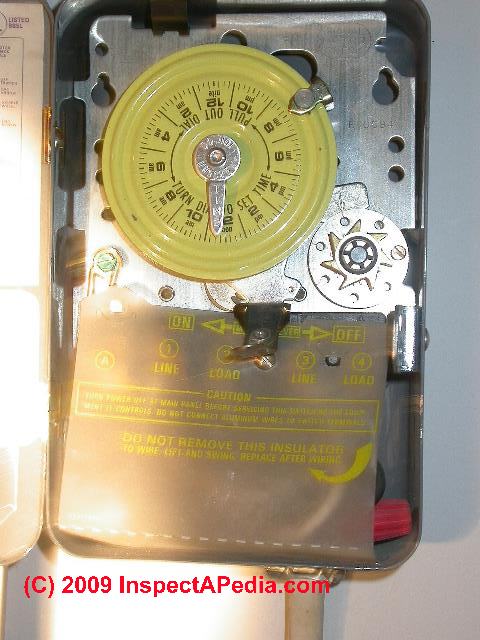
Some electric water heaters are installed with a timer (photographs above) that saves electricity costs by turning off the heater during periods when no one will be using hot water.
If a timer is installed for your heater, it might be in its "off" position. Instructions for setting the water heater timer are inside the timer cover.
See TIMERS for ELECTRIC WATER HEATERS.
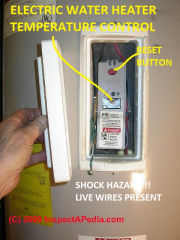
Check the water heater thermostat condition and its internal thermostat control reset switch. Below we show how to find the thermostat control and reset switch for an electric water heater.
See ELECTRIC WATER HEATER RESET & TEMPERATURE SET
If all of these items check out OK the water heater may have one or both of its heating elements burned out. We discuss finding, testing, and replacing an electric water heater heating element below.
What do I do if after replacing the water heater heating elements I still get no hot water?
I put in both heating elements and the upper thermostat and still cant get hot water what's should i do next - Earl Baker 2/19/2013
i have replaced both elements @ thermostats @ the reset switch but the reset switch keeps tripping, this is on a electric water heater what else could it be? - Pat 2/20/2013
@Pat---I got same problem. Changed out everything and still trips red reset. Did you figure it out? - Bill 3/16/2013
Reply:
Pat and Bill,
The good news, if there is any, is that with electric water heaters the total number of parts to check out and diagnose is small enough that there's no reason not to expect success.
If you have replaced what sounds like ALL of the parts involved: heating elements and thermostatic controllers, then I have to guess that when the heater still is not working the problem will most likely be traced to one of the following, listed in my guess at order of probability:
Watch out: : Danger of death by electrocution. If you are not trained for safe electrical work hire an expert who is.
1. bad power to the heater - test for voltage at the wires coming in to the heater first; if nothing there go to the panel. If you have power at the panel but not at the heater, there's an open wire in the circuit
2. improper wiring connection during the repairs
3. installed defective or wrong parts. Check the heating elements for continuity and resistance as we discuss in these articles. Check the controller or thermostat - it should be allowing current to flow on a temperature drop and call for heat.
Sometimes the thermostat high limit needs to be reset or replaced.
Leaky water heater can also mean no hot water: how to confirm & fix leaks & leak failures at a water heater
Water leaking from bottom element trips the breaker it makes a popping noise inside it tank - Ron 1/1/2013
water is streaming out of my hot water heater and the water is raging hot for about 4 day. i don't know hat to do, and what is the problem - Misty 1/5/2013
Reply: The correct leaky water heater repair depends: first ee what part of, on, or near the water heater is actually leaking
If a water heater is leaking you should take these steps:
- Watch out: : If the TP or pressure relief valve is leaking
the system is dangerously unsafe and should be shut down immediately - details are
at BLEVE EXPLOSIONS - If the leak at the water heater is at a pipe connection or fitting,
it should be possible to turn off the heater, let it cool down, and make an ordinary plumbing repair by replacing the leaky, corroded, damaged fittings.
You may need to drain water pressure from the system or even drain piping in order to make repairs, especially if soldering is needed. - If the leak is a fault in the water heater tank itself,
or if the leak is traced to severe corrosion around threaded pipe fittings connected to the water heater tank itself, most likely it's time for a new water heater.
Shut it off, shut off cold water supply into the heater (to stop feeding the leak) and drain the water heater to a floor drain or other acceptable location so that you stop leaking into the building.
If you hear a dripping hissing sound
at a gas or oil fired water heater, if on inspection you find that the bottom of the heater tank is leaking and dripping into the combustion chamber then the water heater is shot.
If you hear a hissing sound
at an electric water heater that may be a normal effect of water being heated, hissing at the heating elements,.
Check for water heater leaks around the T/P relief valve:
Watch out: If you see water on the floor around the water heater and by inspection you cannot find any leaks in pipes or connections to the water heater itself, I suspect the problem is the tank, but another possibility to check first is for leaks around a tank side or top mounted water heater pressure/temperature relief valve.
See ELECTRIC WATER HEATER INSPECTION CHECKLIST
If the valve was not properly secured and sealed, leaks around the valve mounting threads can leak down through the insulated jacket of the water heater, eventually appearing on the water heater burner or on the floor around the unit. In this case the heater might be repairable.
But be sure to see our warnings
at FLOOD DAMAGED WATER HEATER REPAIR
Poor Hot Water Flow or Pressure
Question: small white particles coming out of our hot water heater clog our faucets
I have small white particles that clog my faucet water savers I was told that plastic material was used in some water heaters and this deteriorates over time, causing this problem. Is this true? I have an A.O. Smith 55 gallon water heater made in 1995. - Bill 2/5/12
Reply: Replace the plastic dip tube that has disintegrated and flush the water tank to remove the debris
Bill,
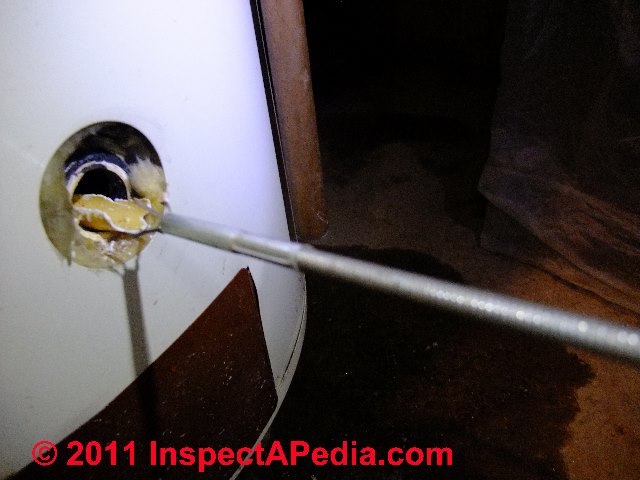
Reader Red Wood and others pointed out that plastic water heater dip tubes supplied by the Perfection Tube Company and installed in nearly all water heaters made between 1992 and 1997 proved to be defective with the plastic used disintegrating and producing the debris you describe.
Clogs that happen to block just the hot water piping, valves, controls, or heater outlet can explain reduced hot water flow rate (or "hot water pressure" in terms many people use).
Clogs may be due to debris (as we illustrate just below) or due to mineral clogging in hot water system piping or at a tankless coil.
At DEBRIS in WATER SUPPLY, WATER HEATER
we describe and illustrate with photos the diagnosis and correction of these white plastic debris particles left in the water heater when a plastic dip tube disintegrates.
At WATER HEATER ANODES, DIP TUBES
we describe inspection and replacement of water heater dip tubes. To help other readers we've copied your question and posted a longer reply at the Debris article cited just above - Editor.
Reader Comment from Red Wood [3]
2/15/2012 Bill, The symptoms of the white particles clogging the aerator are classic symptoms of a failed dip tube. The dip tube is a tube that extends from the inlet to the bottom of the water heater to prevent the incoming cold water from mixing with the hot water causing a rapid reduction in temperature of the water going out of the tank.
In the 90's there was a period from about 1992-1997 where almost every water heater made by any manufacturer with few exceptions used a dip tube supplied by the Perfection Tube Company which proved to be defective with the plastic used disintegrating.
This was also the subject of a class action lawsuit for which the claims period is now over. AO Smith was one of the companies and the manufacture date is in the middle of the defect period I have no doubt your dip tube is bad.
On a 17 year old water heater I would recommend replacement as the most viable option.
Electric Water Heater Thermostat Location, Adjustment, Settings, & Test or Replacement Procedure
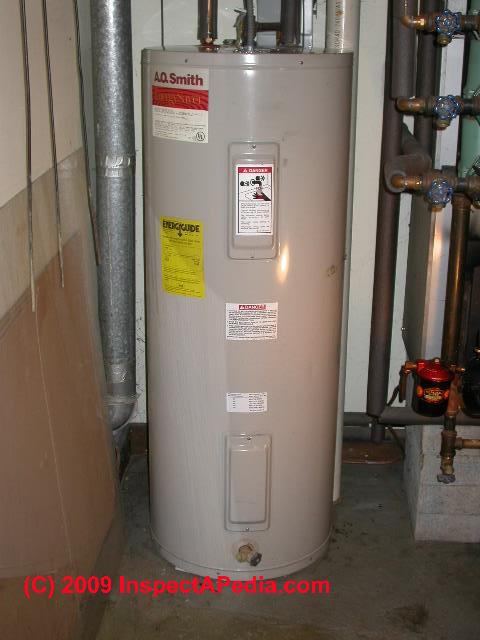
Electric water heaters usually have two thermostats, and to heating elements: an upper thermostat located behind a cover high on the heater tank, and a lower thermostat located behind a panel low on the water heater tank (photo at left).
The two access panels permit inspection, adjustment of the thermostat(s), access to an internal reset switch (that you may not have known about), and access to electrical wiring as well as access to the actual heater elements should one or both of them need to be tested and/or replaced.
Sequence of Operation of Electric Water Heater Elements
Most electric water heaters are what we call "flip flop" or "non-simultaneous" electric water heater systems, meaning that just one of the two heating elements is working at a time.
When the hot water heater's tank is full of all cold water, the upper thermostat flips on, heats up the water in the upper portion of the heater. That's also where hot water exits to the building - from the top of the tank at the hot connection.
The upper heating element heats about 1/3 of the water heater's volume, while the lower element heats the bottom 2/3.
Once the temperature set on the upper heater's thermostat has been reached, the thermostat control will then flip power down to the lower thermostat that controls the lower heating element.
The lower thermostat switch will turns on the lower heating element and that in turn heats water in the bottom of the water heater until that water reaches the temperature setting on the lower thermostat.
Now the whole water heater is "hot". Of course life is more complicated. When the water heater is in use cold water is entering at the tank bottom (out of the end of the dip tube) but also somewhat mixing up water in the tank. If the upper tank is still hot, cold water entering in the tank bottom will contact the lower element and thermostat and those will turn back on.
A.O. Smith (water heaters) has an excellent service handbook that explains these operating modes and instead of flip-flop they call it "non-simultaneous operation" of the electric water heater elements.
It is possible to convert some flipflop electric water heaters to operate the two elements simultaneously but as AOS points out you can't do that if the total amperage draw exceeds the circuit and equipment rating (say 40A).
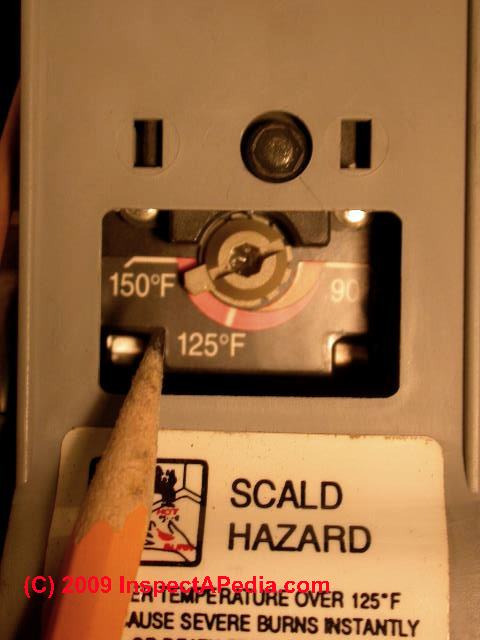
Watch out: setting any water heater to deliver temperatures above 120F can cause dangerous burns.
See SCALDING TEMPERATURES & TIMES
Accessing the Electrical Wiring on the Water Heater
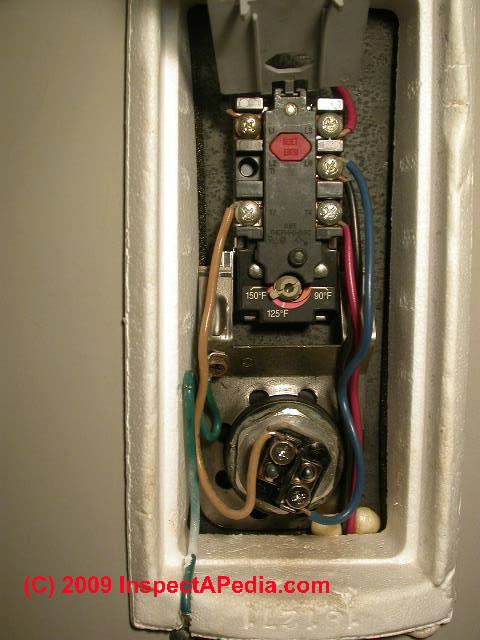
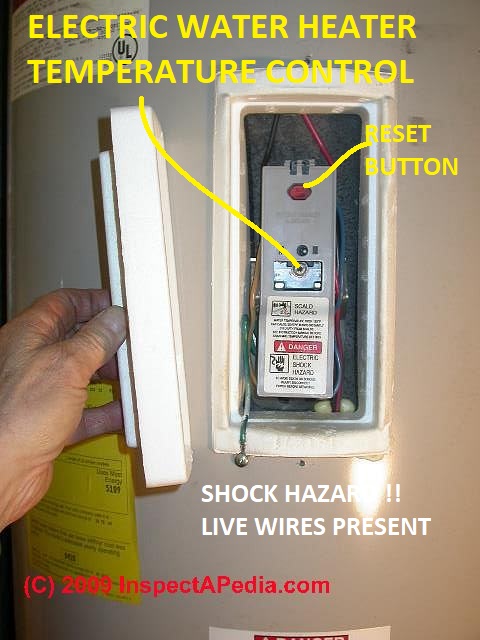
Behind each electric water heater panel you will see electrical wiring, a thermostat with a pointer and temperature setting numbers.
Watch out: Turn off electrical power to the water heater before opening the water heater access panels.
Otherwise you could be killed by electrical shock.
Smart repair people and owners use a neon tester or multimeter to absolutely confirm that electrical power has been turned off before ever touching electrical components.
We removed the upper panel metal cover (two screws), lifted off the styrofoam insulating cover, and revealed the water heater control in our photo at left.
If you break or lose the plastic cover that protects the water heater thermostat and heating element electrical connections, a replacement cover is provided with most water heater element replacement kits.
Also located behind each panel is the actual upper or lower heating element. Our photo (above right) is the same location as we showed above, but we removed a plastic safety cover to show the electrical connections and other controls available here.
- From the top of the control you can see
- Electrical wires bringing power to the heating element
- A red "reset switch" for the electric water heating element control.
- Electrical wires taking electrical power out of the thermostat control and into the electrical heating element itself.
- The electric water heater temperature setting dial.
- The electrical wires connected to the head of the water heater heating element.
If setting the water temperature to a lower setting does not work there is a problem with the control and it probably needs replacement.
Reader Question: overheating on electric water heater
I changed the element on my fathers boiler it only has a single top element
The old one was set to max so that's how I set the replacement
However I notice the metal cap was very hot and a day later it popped the reset with the brown wire not burnt but glazed like its been very hot
I have put it down to about 75% and reset it is this ok or still too hot? - Warbeast 10/22/12
Reply:
War, I'm not sure where the problem lies on your heater, but I'd start by being sure that the replacement element has the same wattage element as the original one. If you installed a mis-matched electric water heater element it may indeed be overheating.
Reader Question: water heater output water is just too hot
2 days ago we began getting extremely hot water from our water heater. Our thermostat is still set very low so we are surprised and confused.
There is also a slight metallic smell in the water and slight odd taste. Can you help us determine what's going on. - Becky NOrthrop 10/2/12
Reply:
Becky,
Most likely the thermostatic control on your water heater has failed and needs replacement.
See ELECTRIC WATER HEATER HIGH TEMP CUTOFF TEST for details.
Watch out: failure to replace a bad thermostat and overheating hot water is dangerous and risks scalding burns or worse, a BLEVE - explosion.
Electric Water Heater Internal Reset Switch & Temperature Setting Dial on the Thermostat
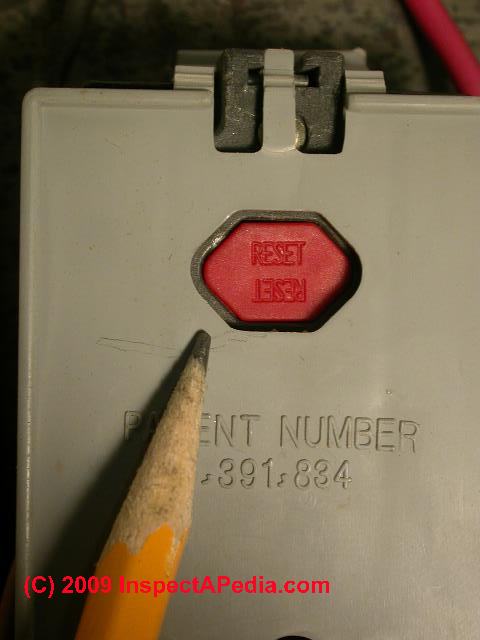
Just below we show closeups of the electric water heater internal reset switch (below left), and the water heater thermostat dial that sets the temperature control for (in this case) the upper heating element (since we are looking behind the upper panel on the electric water heater).
This water heater is set to its maximum output temperature, 150 degF. If water leaves a faucet at 150 degF. scalding can occur in about 1 1/2 seconds.
... 
If the electric water heater output water is too hot you can adjust the thermostat to a lower setting. Typical settings are 140 to 160 degF. Beware that any temperature above 120 degF. is scalding and a mixing valve may be needed for safety.
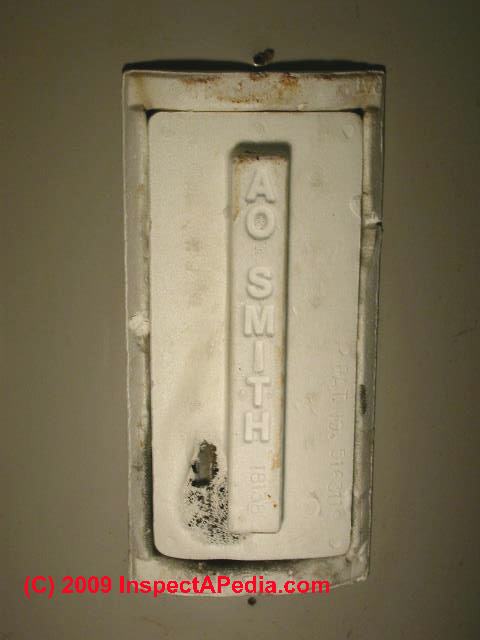 ...
...
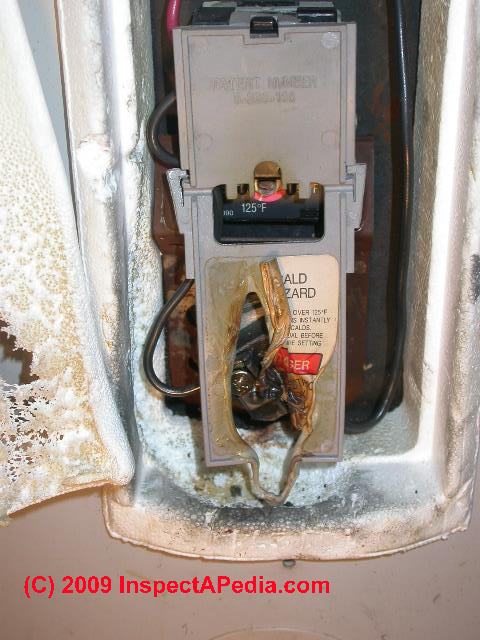
Our two photos above are of the lower heating element on this electric water heater. You can see from the burned and melted plastic that there was a problem with the lower heating element on this unit.
But if you see this condition on an electric water heater whose history is unknown, do not assume that this is a current problem.
On this water heater we replaced a burned-out bottom heating element several years ago, leaving the burned plastic cover and insulation cover on the unit.
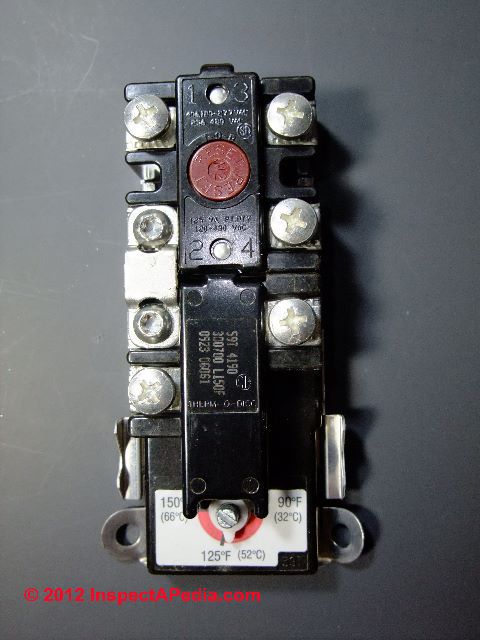 ...
... 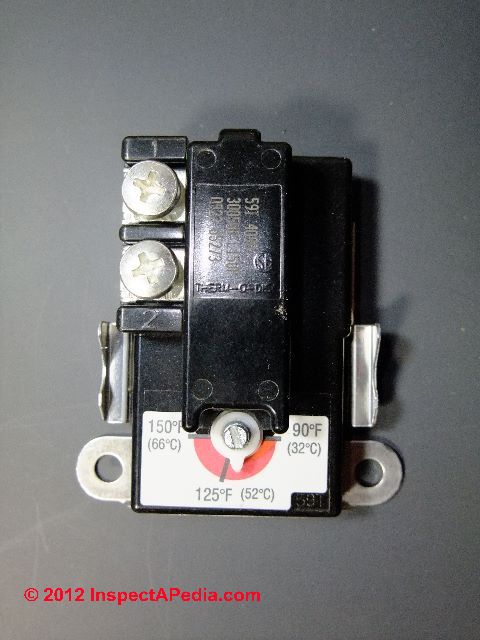
Above are photographs of a replacement electric water heater upper thermostat (including its reset button) and the smaller lower water heater thermostat. Wiring details provided with these water heater controls are
at ELECTRIC WATER HEATER ELEMENT REPLACEMENT
At links below we continue with more diagnostic testing and repair procedures for electric water heaters, looking at the high limit cutoff switch, the high temperature reset switch, and testing and replacing bad electric water heater electrodes.
Reader Question: where do I find the reset button on the water heater? other electric water heater reset button Q&As
hi how do you locate the reset button when theres insulation on cylinder thanks - Trevor 09/25/2011
The red reset button works for my electric hot water heater but after a few days I have to reset it again. I drained the water heater until it was clear, and I know both heating elements are working. No hot water at all, not even luke warm. - Nathan 6/28/12
Reset button will not reset on electric water heater replaced upper thermostat still will not reset - Russell 1/14/2013
2nd time in a month, I've had to push reset button. to get hot water working again. s this the start of something going out? Or just normal. Thank you for you help. - Tim 12/3/2012
My reset button light is very dimm and the water is not heater. I have replaced the upper element and the control board and the still no hot water and the reset light is dimm.- Lee 1/21/2013
Reply:
Trevor, quite so, if everything on a water heater is covered up by add-on exterior insulation you can't see a thing - and the system may be unsafe too, especially if the pressure/temperature relief valve has been covered over.
Water tank manufacturers do NOT want anyone to add insulation to the exterior their water tanks (safety concerns) and may even void the warranty if someone does so.
To find the reset button on a water heater element (if there is one) you'd need to
- turn off electrical power to the heater
- remove external insulation
- open the one or both access covers that are illustrated in our photographs above.
Nathan,
these thermostatic controls can fail themselves. If the elements are not shorted and there are no other electrical problems you can find, I'd replace the thermostat unit.
Russell,
Before replacing a water heater element I'd check to confirm that it is defective. In the case you describe the problem could be a bad second heating element OR the thermostat unit itself could be defective.
Tim,
Sounds like a failing control or control sensor; the control may be doing its job, switching off in response to a problem, but more often we find a failed or failing electrode (shorting) or a failed temperature sensor.
See ELECTRIC WATER HEATER RESET SWITCH in the article above.
Lee:
Test and replace one or both bad heating elements - if they're bad. If the two heating elements test out as OK I would replace the thermostat unit.
Reader Question: the reset button keeps popping out on our electric water heater control
When I reset the upper t-stat with red button fire jumps from wires on t-stat= water heater is a state select water heater.- Richard Cox 2/6/12
Reply:
Richard, it sounds as if there is a short in the wiring, the element, or the control.
Reader follow-up:
Also, there was evidence that a short had occurred in lower element region as there were burn marks on or near cover or where there was an electrical malfunction, both elements have been replaced, and still no hot water, both elements appeared to be normal when removed.
Reader Question: solar water heater with electric backup, - can I disconnect the red reset switch?
I have an 80 solar water tank with electric backup, mixing valve, upper heating element only, PT valve and solar panels upper manifold air release valve. Occasionally, the water reaches boiling and the PT and air valves do their job but the red element reset switch pops off too
. This means going up into the attic. Can I in any way disconnect the red reset switch? I presume this switch is not electrical but a bimetal strip mechanism, right? - Jeff 11/30/11
Reply:
Jeff,
I'd consult with a solar expert on how to control the system temperature,
Watch out: I would never disconnect a safety device. A combination of multiple errors could still lead to an overheated exploding water pressure tank - a catastrophe (search InspectApedia for BLEVE to read what can happen). I just wouldn't take a chance.
Which Water Heater Element is Burned Out?
Question: We suspect a burned out electric water heater element - how do we know if it is the upper or the lower heating element?
 How can I tell which water heater has burned out, the upper or the lower unit? - Anon.
Reply:
Upper element failure in an electric water heater
Usually if the upper element has burned out you'll find that the quantity of hot water has not been reduced as much as you'll observe that the water provided by the heater is tepid.
Lower element failure in an electric water heater
And if the lower electric water heater element has burned out you'll find that the water supply may be plenty hot, but less in quantity.
You can understand why these simple diagnostic observations usually work on residential electric water heaters by looking at Carson Dunlop Associates' sketch at left. For commercial electric water heaters, because both elements usually operate simultaneously, this distinction won't apply.
Bad Dip Tube Can Mean Water Is Not Hot Enough
Watch out: another water heater defect can also result in hot water that's not hot enough. If the dip tube in the water heater has fallen off or disintegrated, cold water will enter the water heater at its top rather than at its bottom.
The result will be constant dilution of the hottest water in the heater (at its top) with incoming cold water. The result is that the hot water may be just tepid, not hot enough, though the total quantity of hot water is unchanged.
Of course the heating elements can be tested to see which is burned out (open, or infinite resistance) or shorted (zero resistance), as we describe in detail
at ELECTRIC WATER HEATER ELEMENT TESTS
Reader clarification: here is the usual sequence of operation of residential electric water heater elements
Most Electric Residential Water Heaters are Sequential Operation where the upper element comes on first until the thermostat is satisfied then the upper T-Stat switches power to the to the lower element & T-Stat. Upper T-Stat has priority.
[See Carson Dunlop Associates' electric water heater element operating sequence illustration above - Ed.]
In Commercial Electric Water Heaters the controls are often wired for Simultaneous Operation and more than one element may fire at once.
Simultaneous heating element is seldom seen in Residential.
If the upper element is burned out once the hot water in the tank is depleted you will have no hot water as the upper thermostat will never be satisfied and switch over to the lower element.
If the lower element is burned out you will have hot water which is only in the upper portion of the tank which will rapidly run out and turn cold.
- Red Wood [3]
Editor's note: typically, cold water entering the electric water heater near the heater bottom (thanks to the dip tube) turns on the lower heating element when you begin drawing hot water out of the water heater tank (at the tank's top). When the water near the top of the tank cools (by rising cold water coming in at the tank bottom) the upper heating element comes on and the lower element shuts off.
This gives priority to heating the outgoing hot water from the top of the water tank.
When the upper heating element has heated the water to its cutoff temperature (which won't happen if you continue drawing hot water rapidly out of the tank), it allows the lower element to turn back on. Details are in our sketch above.- Ed.
Reader Question: should the upper and lower temperature thermostats be set the same on a water heater? what if I replace a heater element but still don't have much hot water?
When adjusting the temperature do you keep the upper and lower thermostat the same ? - John 4/15/12
I have replaced both T-states and both Elements and I still only have a small amount of hot water? - Patrick 1/22/2013
Reply:
John
that makes sense to me. I will research further. Also take a look at the electric water upper and lower heating element sequencing operation described at Electric Water Heater Element Tests
Patrick
I suspect that either one of your elements is not heating ( a bad element or bad wiring) or a thermostat or controller is not turning it on. If the total hot water quantity is small, check first for a bad LOWER heating element.
Reader Comments, Questions & Answers About The Article Above
Below you will find questions and answers previously posted on this page at its page bottom reader comment box.
Reader Q&A - also see RECOMMENDED ARTICLES & FAQs
On 2021-05-18 - by (mod) -
@Chris Ogden coggy53@outlook.com,It sounds as if you have replaced every part. Assuming you have the right parts and the wiring is correct, I suspect there may be a scale problem that is preventing the thermostat from sensing water temperature correctly.
On 2021-05-17 by Chris Ogden coggy53@outlook.com
Element undamaged, thermostat renewed, water still overheats.
element operating, thermostat renewed, still overheats.
@danjoefriedman Both replaced, overheating continues.
Only one element at the bottom, element and thermostat replaced with new units. Water still overheats. Clipsal does not trip, water is emitted steaming hot. What to do now?
Problem, no hot water. Only one heating element, found to be faulty and replaced. Water became too hot and vented through overflow. Thermostat presumed faulty and replaced. Problem continued, water too hot. Where to go from here?
On 2021-03-12 - by (mod) -
@alonzo h treadway,Sounds like you will need to replace the bottom element and / or thermostat
On 2021-03-12 by alonzo h treadway
does not heat water top element works bottom not working
On 2021-02-05 - by (mod) -
ChrisDid you turn the electrical power to the heater on for even an instant before it was filled with water and all are purchased? I'm sorry to say that if you did the elements probably burned up.
On 2021-02-05 by Chris
Replaced the hot water tank, a brand new one from Lowes, and getting power at top but nowhere else. No power in thermostat or either elements
On 2020-11-22 - by (mod) -
Thank you for the nice comment, Trade. We have worked hard on this data for years, seeking to make it accurate and unbiased; to that end I much welcome your questions, criticism, or content suggestions as well.On 2020-11-22 by Trade Plumbing
I really need this kind of information and must share it with my circle. Thanks for sharing this with us.
On 2020-08-08 by (mod) - new electric water heater does not draw electrcial current
Yoshi:
Watch out: if you are not familar with safe proper electrical wiring don't touch any wiring or connections as you could be shocked or killed.
You can, however be sure that the circuit breaker for your electric water heater is ON: try switching it all the way to OFF, waiting a moment, then switching it all the way to ON.
Your electrician will use a multimeter or voltmeter (DMM or VOM) to confirm that power is being delivered to the water heater, and if it's not, then there is a loose or disconnected wire in the circuit or the breaker or fuse is defective.
If electrical power is being delivered at the electric water heater's terminals but the heater never turns on, the heater could be improperly-wired or it could have a defective thermostatic control or even bad heating elements.
That can happen, even to a brand new water heater if you turned on electrical power to the heater before it was absolutely full of water and after making sure there was no air in the hot water system.
Watch out: turning on electrical power to an electric water heater if the heater's elements are not under-water, that is if there is air in the water heater cylinder or tank will usually result in an immediate burn-up and desctruction of the water heater elements.
On 2020-08-08 by Yoshi
Brand new electric water heater is not drawing any power. Our meter is barely spinning. What could the problem be?
On 2020-07-06 - by (mod) -
Heather
If the heater was turned on before it was filled with water than might burn out the heating elements. Did that happen?
See more-detailed diagnostic steps at
ELECTRIC WATER HEATER - NO HOT WATER https://inspectapedia.com/plumbing/Electric_Water_Heater_Repair.php#NoHW
On 2020-07-06 by Heather
Have new hot water heater and breaker and still no hot water can u help
On 2020-05-24 - by (mod) -
That sounds to me like a corroded heating element that is shorting out
On 2020-05-24 by Glenn
AO SMITH 40 gal shorty is flipping 30 amp breaker in panel box. Haven't inspected it. Will let me reset and after a few minutes it will trip breaker again. Water does heat after reset before tripping again. Ive put in several new water heaters, and repaired several. None of them acted like this.
On 2020-05-18 - by (mod) -
Roy
I would look first for a shutoff valve that has not been opened
On 2020-05-18 by Royale Stephenson
we replaced both elements in our water heater & now there's no water coming out at all at any temp. What are we missing??
On 2020-02-03 - by (mod) -
Denise
If that's really an electrical wire arcing noise then the wiring or heater is unsafe, should be shut down, inspected, and repaired. Electrical arcing sounds like a loose connection or improper wiring that could be a fire or shock risk.
On 2020-02-03 by Denise
every once in awhile I hear a arcing sound from my hot water heater im concerned the water heater is new and so are the electrical wires from the service box to the heater
On 2020-01-27 - by (mod) -
In refilling the water heater you may need to open the relief valve to speed getting air out of the tank. Dont turn it on before you get water at the hot faucets.
On 2020-01-27 by Bill
I turned off my water heater and drained it. I have not water coming out of the faucets but I haven't turned the water heater back on yet???
On 2020-01-02 by (mod) -
that could be a sign of an overheating or bag or arcing electrical connection
On 2019-12-31 by John
My unit doesn't need reset and no breaker problem. Only thing is lower thermostat control screw looks oxidized. What do you think?
On 2019-12-22 by gary moore
If it sets overnight the water cools down, then if you use the cool water it will heat up. Replaced upper thermostat , it is a 70 gal Rheem, has two heating elements
On 2019-12-07 by (mod) - water only gets lukewarm
Duane
Is this a heater with two heating elements - an upper and a lower?
If so the usual cause of just tepid warm water is that the lower element is working but the upper one is not.
If the water heater (calorifier, geyser, cylinder, or other synonyms - for other readers) uses only one heating element then it's possible that the thermostat is either not properly-set or is itself defective.
Let me know if these checks help you out. (This article series also includes procedures for testing water heater elements)
Watch out: if you're not familiar with safe electrical wiring you could be shocked or killed or could start a fire.
On 2019-12-07 by Duane proctor
I replaced heating element, thermastat & TP Valve...water onlu gets luke warm? 19 gal tank
On 2019-11-23 by (mod) -
I tend to worry first about possible safety concerns. Sometimes a buzzing noise at an electrical Appliance including a water heater can be a loose parking or overheating connection. The safe thing would be to turn that equipment off
Often a visual inspection of the controls and connections will turn up the culprit. It can also help to listen very carefully to pinpoint the source of buzzing.
To keep us posted as I'm concerned for your safety and because what you find will help other readers
On 2019-11-23 by Periodic Whirlpool heater buzzing, coninued
Hi, this is Sandy, again. My Whirlpool model # is ee2h40rd045v, serial # 0239130503, a 2002 unit.
There are no flashing lights at all. There are no ongoing beeps as in a water leak. This is just a periodic buzz which shuts off with the reset button, or by itself in about 30 seconds--from the junction box. I thought maybe the box needed replaced. thank you so much! Sandy
On 2019-11-20 by (mod) - where to get water heater repair or installation manuals
For other readers,
at WATER HEATER MANUALS - home
you will also find heater manuals by name such as
WHIRLPOOL WATER HEATERS
- also see AMERICAN WATER HEATER
as that company produces some heaters sold under the Whirlpool brand
On 2019-11-20 by (mod) - Whirlpool Electric Water Heater Diagnostic Codes & LED Flashes
Sandy and Melissa
To get to a more-reliable diagnosis and comment we need the specific Whirlpool electric water heater model number (post a photo of the data tag if you can).
Here is bit of typical diagnostic information from a Whirlpool "Energy Smart" electric water heater
Whirlpool Water Heater Diagnostic LED Light Codes
The Green/Red LED light indicates the status of the electronic thermostat (See Figure 10A).
• Green LED will signal normal operation. The green
LED will blink 2 times per second to indicate that power is
applied to the upper heating element and at a faster rate
(4 times per second) to indicate that the lower heating element is powered.
• Red LED will fl ash error codes. If a fault is detected by the electronic thermostat, the LED light indicator will use the red LED to indicate the fault detected.
The flash code sequence is to consist of 1/2 second flashes of the red LED each separated by a 1/2 second off period.
The number of fl ashes indicates the fault code number.
(See diagnostic code chart section in this manual).
After the last 1/2 second “on” period, the LED will remain
off until a total of 5 seconds has elapsed for the fault indication cycle (there is a 5 seconds delay before the fault
flash pattern repeats). After the 5 seconds are completed,
the fault indication cycle is repeated starting with the first
1/2 second-fl ash. The fl ash sequence will be repeated as
long as the fault remains.
Only one fault can be declared
at a time. NOTE: the green LED is turned off when a fault
code is being displayed, even though the heater may be
operating in limp mode with an element on. See diagnostic code chart section in this manual.
an EXCERPT from that table is given here
Source:
- Whirlpool ENERGY SMART WATER HEATER MANUAL [PDF] retrived 2019/11/19 original source: http://www.whirlpoolwaterheaters.com/media/123507/318686.pdf
On 2019-11-20 by Melissa
@Sandy,
Have you heard back from them yet? I wonder if they even answer questions any more.
Recent plumbing
work done... no hot water. Water heater is fine... I feel the outgoing copper hose and it is hot.... yet where it comes out under the house, the copper pipe is cold. Only getting cold water from both pipes??? I'm at a loss to figure this out... if there is a blockage or break.... I wouldn't get any water out of the hot pipe.
On 2019-11-17 by Sandy - 1 long beep (approx 30 seconds) from my junction box on my Whirlpool hot water tank
Periodically I get 1 long beep (approx 30 seconds) from my junction box on my Whirlpool hot water tank (electric), then it shuts off and I might not hear it for days or weeks. I have checked for water leaks, and the heating elements have recently been replaced.
I don't see anything in the book, or online about this issue, and wonder if someone might know. Thank you.
...
Continue reading at ELECTRIC WATER HEATER ELEMENT TESTS or select a topic from the closely-related articles below, or see the complete ARTICLE INDEX.
Or see ELECTRIC WATER HEATER REPAIR FAQs - questions & answers about how to repair an electric water heater, calorifier, or geyser
Or see these
Electric Water Heater Repair Articles
- ELECTRIC WATER HEATER CHECKLIST
- ELECTRIC WATER HEATER CONTROLS
- ELECTRIC WATER HEATER REPAIR GUIDE
- HOT WATER T&P RELIEF VALVE
- WATER HEATER ANODE & DIP TUBE CHECK
- ELECTRIC WATER HEATER REPLACEMENT
Suggested citation for this web page
ELECTRIC WATER HEATER REPAIR GUIDE at InspectApedia.com - online encyclopedia of building & environmental inspection, testing, diagnosis, repair, & problem prevention advice.
Or see this
INDEX to RELATED ARTICLES: ARTICLE INDEX to WATER HEATERS
Or use the SEARCH BOX found below to Ask a Question or Search InspectApedia
Ask a Question or Search InspectApedia
Try the search box just below, or if you prefer, post a question or comment in the Comments box below and we will respond promptly.
Search the InspectApedia website
Note: appearance of your Comment below may be delayed: if your comment contains an image, photograph, web link, or text that looks to the software as if it might be a web link, your posting will appear after it has been approved by a moderator. Apologies for the delay.
Only one image can be added per comment but you can post as many comments, and therefore images, as you like.
You will not receive a notification when a response to your question has been posted.
Please bookmark this page to make it easy for you to check back for our response.
Our Comment Box is provided by Countable Web Productions countable.ca
Citations & References
In addition to any citations in the article above, a full list is available on request.
- A.O. Smith, "Residential Gas & Electric Water Heatern Service Handbook", A.O. Smith Water Heaters, Technical Training Department, Ashland, TN, Tel: 1-800-527-1953, Website: www.aosmithwaterheaters.com, Publication #320991-000, July 2006. Retrieved 3/4/2014, [Copy on file]
- [3] Thanks to reader Red Wood for clarification about the operation of electric water heater elements. Red Wood offers plumbing information at his website: http://411plumb.com
- Carbon Monoxide Gas Toxicity, exposure limits, poisoning symptoms, and inspecting buildings for CO hazards
- In addition to citations & references found in this article, see the research citations given at the end of the related articles found at our suggested
CONTINUE READING or RECOMMENDED ARTICLES.
- Carson, Dunlop & Associates Ltd., 120 Carlton Street Suite 407, Toronto ON M5A 4K2. Tel: (416) 964-9415 1-800-268-7070 Email: info@carsondunlop.com. Alan Carson is a past president of ASHI, the American Society of Home Inspectors.
Thanks to Alan Carson and Bob Dunlop, for permission for InspectAPedia to use text excerpts from The HOME REFERENCE BOOK - the Encyclopedia of Homes and to use illustrations from The ILLUSTRATED HOME .
Carson Dunlop Associates provides extensive home inspection education and report writing material. In gratitude we provide links to tsome Carson Dunlop Associates products and services.
 | HOME | ABOUT | ASK a QUESTION | CONTACT | CONTENT USE POLICY | DESCRIPTION | POLICIES | PRIVACY | |
| © 2024 - 1985 Publisher InspectApedia.com - Daniel Friedman | |||||||||