
InspectAPedia® FREE Encyclopedia of Building & Environmental Construction, Diagnosis, Maintenance & Repair |
Question? Just ask us! InspectAPedia
|
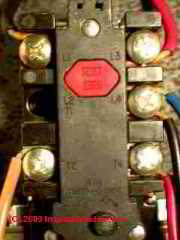 Water Heater High Temperature Control
How to Test & Repair the Electric Water Heater Cutoff & Reset Switch
- POST a QUESTION or COMMENT about troubleshooting, repairing, or replacing the electric water heater high temperature control & reset switch
Fix the electric water heater reset switch:
This article describes how and why to test the high temperature cutoff switch and how to use the hidden reset switch on electric water heaters.
InspectAPedia tolerates no conflicts of interest. We have no relationship with advertisers, products, or services discussed at this website.
How To Test High Temperature Cutoff Switch Located at the Upper Heating Element
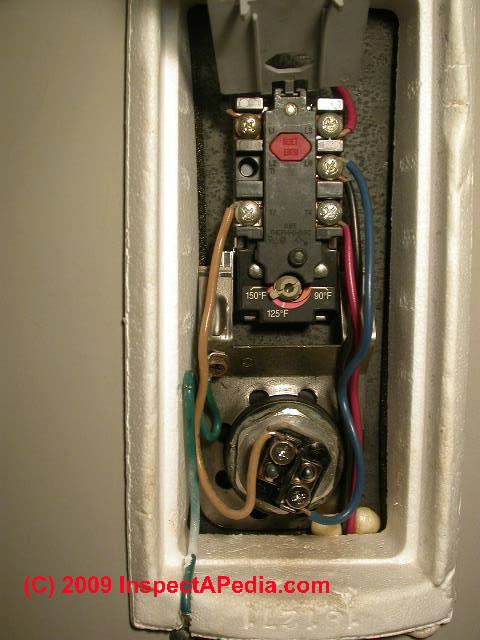 This series of articles describes how to inspect, operate, diagnose, and repair electric hot water heaters.
The articles at this website will answer most questions about electrical water heaters as well as many other building plumbing system inspection or defect topics. Reproduction of this web page electronically at other websites is prohibited.
Before testing the electric water heater elements we should check out the high temperature cutoff switch since a problem there will simply turn off power to both heating elements.
On an electric water heater the upper heating element may have two, three, or four electrical terminals, and above the upper thermostat is a high temperature cutoff switch with four terminals. You should be able to identify these parts by looking at the water heater's wiring diagram found on the tank or inside the panel cover.
The electric water heater high-temperature cutoff switch will turn off the entire water heater if temperatures are too high. If this cutoff is not working the water heater will simply not heat at all. You can use this switch to test to confirm that the incoming electrical power circuit is indeed bringing power to the water heater.
Turn off electrical power to the heater at the electrical panel: WARNING: possible fatal electrical shock.
See DMMs VOMs SAFE USE OF and
see VOLTS / AMPS MEASUREMENT EQUIP.
General electrical inspection safety advice is
at SAFETY for ELECTRICAL INSPECTORS.
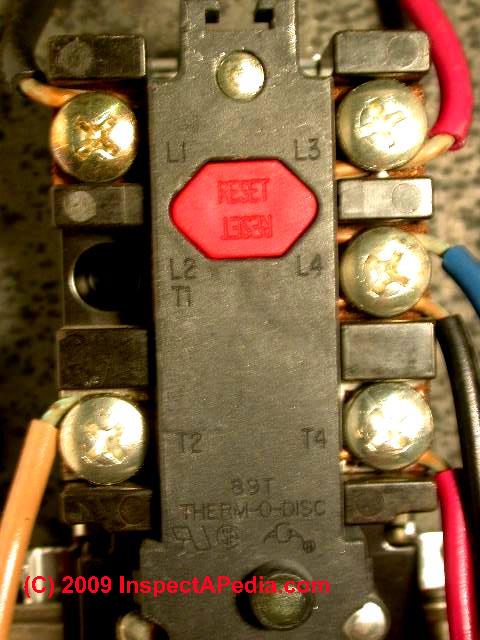
Set the multi tester or VOM to its 250 VAC scale, and attach the tester probes or alligator clips to the two uppermost terminals on the control (L1 and L3 on the top left and top right in our photo below). These are normally the incoming electrical wires from the power circuit to the heater. "L" refers to "Line voltage" on most controls.
Test for line voltage: Now you can turn on electrical power to the heater. Your VOM should show voltage close to the voltage on the water heater's identification tag: typically this will be 208V or 240V for a 240V water heater, or it might be just 115V or 120V for a 120V water heater. If you do not see voltage close to the rated voltage you need to call an electrician to diagnose and repair the problem.
 Turn off Electrical Power to the Water Heater again. Don't skip this step or you may be killed or you may ruin your test equipment.
Test the High Temperature Cutoff Switch itself: set the VOM to its Ohm or resistance scale using the most sensitive setting (R x 1).
- Touch one probe to the upper left terminal on the control (L1 in our photo at left).
- Touch the other probe to the lower left hand terminal on the control (T2 in our photo at left).
- The ohm meter needle should move (or your digital multimeter DMM should show some number other than infinity).
- If no continuity and infinite resistance is what you read, try pressing the reset button on this control (the red "RESET" button in our photo at left).
If you cannot reset the control then this device is not working and it needs to be replaced.
FYI we do not usually find a problem with this electric water heater high limit cutoff switch.
The most common problem on an electric water heater that is not heating is a burned-up water heating element - tests that we describe
at ELECTRIC WATER HEATER ELEMENT TESTS
Reader Comments, Questions & Answers About The Article Above
Below you will find questions and answers previously posted on this page at its page bottom reader comment box.
Reader Q&A - also see RECOMMENDED ARTICLES & FAQs
Question: my electric water heater is not working
We suddenly find we have no hot water. I have an electric hot water heater. - Paul 11/1/12
Reply:
Paul,
Check that the water heater has electrical power, then try pressing the reset switch described above.
Electric water heaters are among the easiest to troubleshoot;
There are just a few things to check, easily done with a digital multimeter (DMM)or volt ohmeter (VOM). Just go through the list starting with the links below at
Electric Water Heater Repair Guide (link shown below)
- check
- that water flows into and out of the heater
-for power to the heater
- that the thermostatic control is functional (article above)
- that the heating elements are not burned out
See ELECTRIC WATER HEATER REPAIR GUIDE for our complete & detailed electric water heater troubleshooting procedures.
Watch out: removing access covers on an electric water heater exposes live voltage-wires: touching them can cause injury, shock, or death.
On 2020-08-11 by Jim
the hot water coming out of faucets is still very hot, so there's no doubt that the very hot water is causing the thermostat to trip, but why?
Previous comment: The upper thermostat is the one tripping
I have replaced both elements about 2 weeks ago. I replaced the upper thermostat also at that time.
I still have the thermostat tripping about twice a day. I have turned bot thermostats down to their lowest setting. I have verified that all of the exposed wires are good , tightened and making good connections.
If it happens to be faulty wire within the outer case of water heater and the heater hasn't been moved since it was installed, what could cause the wire to become faulty?
On 2020-03-29 - by (mod) -
Thanks for the question, Ronnie.
When the high temperature cutoff control won't reset and we're confident that the heating elements are good I suspect either a wiring error or a defective control device itself. I'd replace the control.
Take care: you can be shocked or killed if you are not familiar with safe electrical wiring methods and procedures.
On 2020-03-28 by Ronnie
My electric water heater went off and, I tried to reset the reset button but it wouldn't reset, so I replaced both heating elements and they were pretty bad, but I put it back together and turned on the power at the breaker after filling it back up with water, and it will not reset, so I can't get it to come on.
On 2018-12-08 - by (mod) -
Yes your water heater probably has a reset button on the temperature limit or thermostat
On 2018-12-08 by Tim
Can I rest my water heater without having to turn off the main breaker
On 2018-11-14 - by (mod) -
Anon and Mandie:
First try re-setting the control.
If the temperature limit control is receiving power but can not be re-set even after waiting for the water heater to cool down (that is to say and the water heater is cool) then I suspect the control is defective and needs to be replaced.
On 2018-11-14 by Anonymous
Mine is doing the same thing did you ever find out what was wrong with yours?
On 2018-11-14 by Mandie
My electric water heater acts like it's not getting power but I know it is because I can touch the wires of a light to it and itll light up...I'm poor and that's the only way I can test to see if its getting power. Still not heating and it has new elements. Reset button makes no noise when pushed either. Any suggestions what could be wrong?
...
Continue reading at ELECTRIC WATER HEATER INSPECTION CHECKLIST or select a topic from the closely-related articles below, or see the complete ARTICLE INDEX.
Or see these
Electric Water Heater Articles
- ELECTRIC WATER HEATERS - home
- ELECTRIC SHOWER HEATERS
- ELECTRIC WATER HEATER CONTROLS
- ELECTRIC WATER HEATER REPAIR GUIDE
- ELECTRIC WATER HEATER INSPECTION CHECKLIST
- ELECTRIC WATER HEATER PARTS ID
- ELECTRIC WATER HEATER REPLACEMENT
- TIMERS for ELECTRIC WATER HEATERS
- WATER HEATER ANODE & DIP TUBE CHECK
- WATER HEATERS for HOME HEATING USE?
- WATER HEATER LEAK REPAIR
- WATER HEATER RESET BUTTONS & CONTROLS
Suggested citation for this web page
ELECTRIC WATER HEATER HIGH TEMP CUTOFF TEST at InspectApedia.com - online encyclopedia of building & environmental inspection, testing, diagnosis, repair, & problem prevention advice.
Or see this
INDEX to RELATED ARTICLES: ARTICLE INDEX to WATER HEATERS
Or use the SEARCH BOX found below to Ask a Question or Search InspectApedia
Ask a Question or Search InspectApedia
Try the search box just below, or if you prefer, post a question or comment in the Comments box below and we will respond promptly.
Search the InspectApedia website
Note: appearance of your Comment below may be delayed: if your comment contains an image, photograph, web link, or text that looks to the software as if it might be a web link, your posting will appear after it has been approved by a moderator. Apologies for the delay.
Only one image can be added per comment but you can post as many comments, and therefore images, as you like.
You will not receive a notification when a response to your question has been posted.
Please bookmark this page to make it easy for you to check back for our response.
Our Comment Box is provided by Countable Web Productions countable.ca
Citations & References
In addition to any citations in the article above, a full list is available on request.
- Mark Cramer Inspection Services Mark Cramer, Tampa Florida, Mr. Cramer is a past president of ASHI, the American Society of Home Inspectors and is a Florida home inspector and home inspection educator. Mr. Cramer serves on the ASHI Home Inspection Standards. Contact Mark Cramer at: 727-595-4211 mark@BestTampaInspector.com
- John Cranor [Website: /www.house-whisperer.com ] is an ASHI member and a home inspector (The House Whisperer) is located in Glen Allen, VA 23060. He is also a contributor to InspectApedia.com in several technical areas such as plumbing and appliances (dryer vents). Contact Mr. Cranor at 804-873-8534 or by Email: johncranor@verizon.net
- Carbon Monoxide Gas Toxicity, exposure limits, poisoning symptoms, and inspecting buildings for CO hazards
- In addition to citations & references found in this article, see the research citations given at the end of the related articles found at our suggested
CONTINUE READING or RECOMMENDED ARTICLES.
- Carson, Dunlop & Associates Ltd., 120 Carlton Street Suite 407, Toronto ON M5A 4K2. Tel: (416) 964-9415 1-800-268-7070 Email: info@carsondunlop.com. Alan Carson is a past president of ASHI, the American Society of Home Inspectors.
Thanks to Alan Carson and Bob Dunlop, for permission for InspectAPedia to use text excerpts from The HOME REFERENCE BOOK - the Encyclopedia of Homes and to use illustrations from The ILLUSTRATED HOME .
Carson Dunlop Associates provides extensive home inspection education and report writing material. In gratitude we provide links to tsome Carson Dunlop Associates products and services.
 | HOME | ABOUT | ASK a QUESTION | CONTACT | CONTENT USE POLICY | DESCRIPTION | POLICIES | PRIVACY | |
| © 2024 - 1985 Publisher InspectApedia.com - Daniel Friedman | |||||||||