
InspectAPedia® FREE Encyclopedia of Building & Environmental Construction, Diagnosis, Maintenance & Repair |
Question? Just ask us! InspectAPedia
|
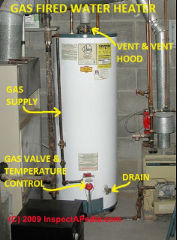 Guide to Gas-fired Hot Water Heaters
Inspection, Diagnosis, & Repair
- POST a QUESTION or COMMENT about gas fired hot water heaters: types, installation, troubleshooting, repairs
Gas water heater guide:
How to buy, install, inspect, troubleshoot & repair gas-fired hot water heaters.
The articles at this website will answer most questions about all types of hot water heaters as well as many other building plumbing system inspection or defect topics.
LP & Natural Gas-fueled calorifiers, hot water cylinders, water heaters. This page contains links to in-depth articles on inspecting, testing, and repairing problems residential hot water heaters of all types, including their parts, controls, and alternative sources for hot water as well as tips for improving hot water temperature, hot water pressure, and hot water quantity.
InspectAPedia tolerates no conflicts of interest. We have no relationship with advertisers, products, or services discussed at this website.
Inspection, Diagnostic, & Repair Guide to Gas-Fueled Hot Water Heaters
 How do we Identify a Natural Gas or LP Gas-fired Water Heater?
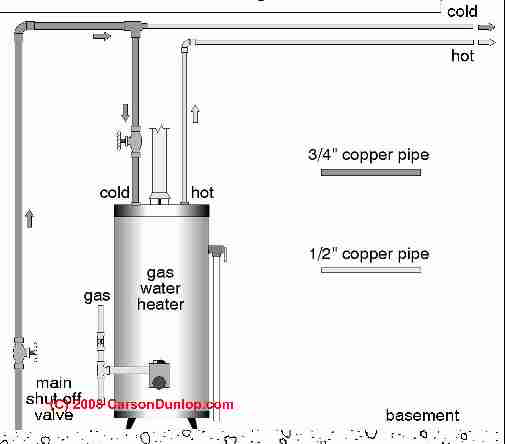
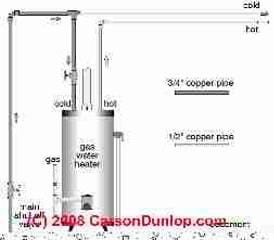
The sketch at left shows the basic components of a gas-fired water heater and is provided courtesy of Carson Dunlop Associates, a Toronto home inspection, education & report writing tool company [ carsondunlop.com ]. It's easy to identify a gas-fired water heater:
if you can find your water heater tank at all, take a look at what pipes and wires are connected to it.
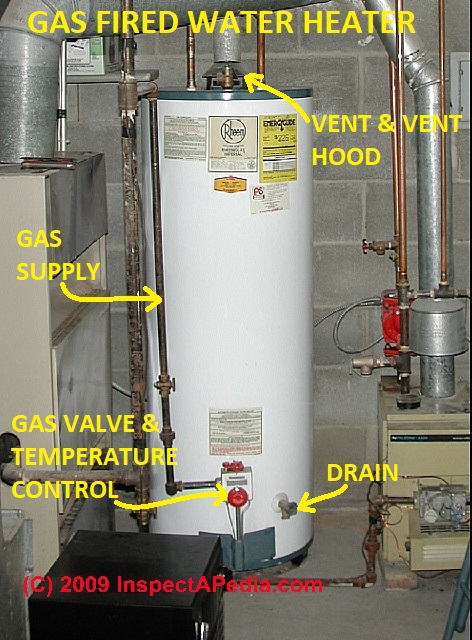
A gas-fired water heater will have two water pipes connected to it (cold-in and hot out), and a pipe or in some jurisdictions a flexible copper tube bringing LP gas or natural gas to the heater.
The gas fired water heater will have a flue or "chimney" which vents combustion gases outside, either by connection to an existing chimney or flue, or in the case of power-vented and high efficiency gas water heaters, flue gases may be vented outdoors by a plastic pipe.
You'll also see a thermostat and gas valve control which combines a temperature setting with a safety device that senses the presence of a gas flame. (If there is no flame the control will turn off the flow of gas to the appliance.) Lots of newer gas fired water heaters will also include a flue gas spill switch at the draft hood atop the water heater.
Caution: sometimes an electric or other additional water heater is installed as an additional or backup hot water source, so you'll also want to see if you have other hot water heating equipment installed besides the first water heater that you see.
Other hot water sources, such as a TANKLESS COIL for making domestic hot water may also be present.
Gas-fired water heater Inspection Checklist |
||
Gas Fired Water Heater (Calorifier, Cylinder, Geyser) Inspection Point |
Gas Water Heater Hazard Details in This Article |
More Information |
| Chimneys & Vents | Missing draft hood, blocked chimney, flue or vent, rusted or leaky flue or vent, short flue, short chimney, cold flue, shared flue with improper vent into chimney, backdrafting, flue gas spillage, blocked draft hood Dangerous Carbon Monoxide Hazards such as venting of a water heater alone into an old masonry chimney |
BACKDRAFTING HEATING EQUIPMENT DRAFT REGULATORS / HOODS GAS HEATERS GAS FIRED WATER HEATER VENTING CODES GAS FIRED WATER HEATER CHIMNEY & VENTING DEFECTS - topic home |
| Burner & Burner Flame | GAS FIRED WATER HEATER FLAME DEFECTS such as flame rollout, burn marks, improper flame color, uneven flame, noises, flame lift off burner |
|
| Combustion Air Supply | INADEQUATE COMBUSTION AIR AT GAS WATER HEATERS due to location in an enclosed space or where combustion air intake is blocked |
|
| Temperature & Pressure Relief Valve | GAS WATER HEATER RELIEF VALVE HAZARDS such as improper or missing TPR valve piping, TPR valve leaks, or TPR valve inaccessible |
|
| Installation Location & Position | such as located in a bedroom, installed horizontally |
GAS WATER HEATER INSTALLATION LOCATION, POSITION, MECHANICAL DAMAGE |
| Leaks at or around the Water Heater | & other leaks such as a leak at the TPR valve or at nearby water supply piping. |
|
| Temperature Settings for Water Heater | Water heater temperature settings may be too high: a scalding burn hazard, or too low, water is not hot enough. |
ANTI SCALD VALVES & TEMPERATURE CONTROL / MIXING VALVES GAS HOT WATER TEMPERATURE CONTROL - how to set |
| Piping & Controls | Piping materials, routing, such as leaks in the gas piping, use of plastic piping too close to the water heater, improper stop valve locations, corroded leaky piping or piping connections |
FLEXIBLE GAS CONNECTOR INSTALL |
| Insulation | CHECK GAS WATER HEATER INSULATION - add-on insulation is usually unnecessary and may be dangerous |
|
| Dip Tube / Sacrificial Anode | SACRIFICIAL ANODE & DIP TUBE OF THE WATER HEATER TANK a failed dip tube causes loss of hot water while a corroded sacrificial anode can cause odors in the hot water supply |
|
| Noises at the Water Heater | Water heater noises are often traced to the lime scale deposits on the water heater bottom or to water hammer (that can also cause TPR valve leaks) | WATER HAMMER NOISE DIAGNOSE & CURE |
| Odors in Hot Water Supply | Water heater odors or odors in hot water, particularly sulphur or rotten egg smells are often traced to a bad sacrificial anode | |
| Old or Antiquated Water Heaters | ANTIQUATED & ANTIQUE GAS FIRED WATER HEATERS may be unreliable or unsafe |
|
| Pilot Light OFF | Assure the gas supply is working, turned on, not leaking For heaters using a standing pilot, the control provides means to ignite the pilot flame; some gas fueled heating equipment use a spark igniter or a hot surface igniter instead of a standing pilot. |
GAS BURNER PILOT LIGHT PROCEDURE |
| Improper LPG <-> Natural Gas Fuel Conversion | To convert a gas fired water heater or any gas appliance between fuels requires changes to the regulator, gas orifices, and other adjustments. Otherwise the equipment will not operate properly and is unsafe. |
|
| Water Heater Safety: other concerns | ||
| Water Heater Exposed to Freezing | ||
Notes to the table above
Caution: no inspection checklist for any topic can ever be complete or comprehensive; important water heater inspection topics may be omitted as we're working on this section.
If you have comments, questions, suggestions, Contact Us by email.
Synonyms for "water heater" vary depending on where you live and include calorifier, hot water cylinder, geyser. The inspection points for gas water heating devices listed in this table apply equally to calorifiers, hot water cylinders and geysers.
Gas Water Heaters, Control Valves & Thermostat Manuals
- AO Smith RESIDENTIAL FVIR WATER HEATER SERVICE HANDBOOK [PDF] (2014) Models: GCV, GCVH, GVR, GCVL, GVRL, GCVT - SERIES 300/301 XCV, XVR, XCVL, XGV, XVRL, XCVT - SERIES 300/301
- Atwood GAS CONTROL VALVE THERMOSTAT REPLACEMENT [PDF] (pilot light models) Atwood Mobile Products, 1120 N. Main St., Elkhard IN 46514 USA Tel: 574-264-2131 Web: askforatwood.com
- Atwood WATER HEATER SERVICE MANUAL [PDF] (2004)
- Atwood WATER HEATER MANUAL [PDF]
- DOMETIC WATER HEATERS
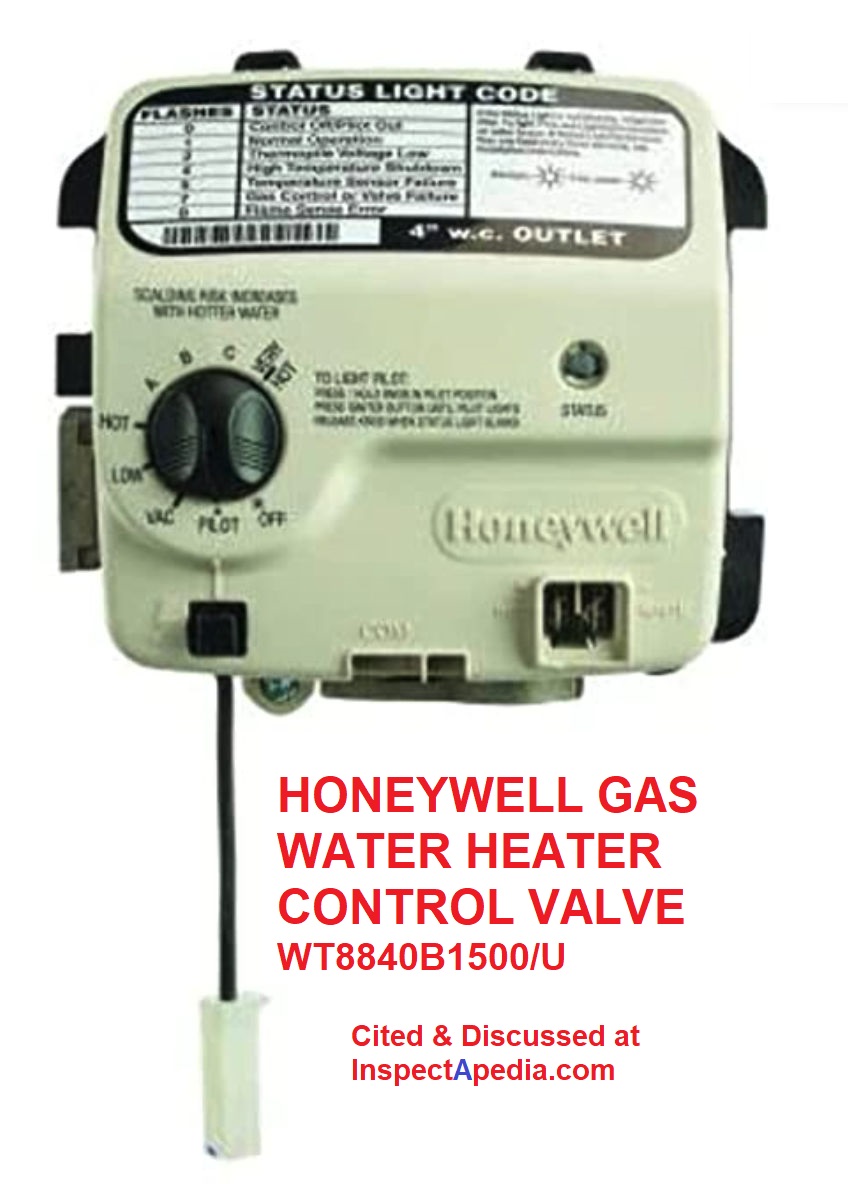
- HONEYWELL WATER HEATER GAS CONTROL VALVE MANUAL - WT8840B1500/U & WT8860 [PDF] (AO Smith brand water heater trade replacement control) [shown above]
Excerpts: The WT88xx Water Heater Control is designed for use in Standing Pilot applications using an immersion well for water temperature sensing.
All models of WT88xx controls include an integrated NTC temperature sensor. The WT88xx controls are powered from a thermopile heated by the standing pilot flame.
CS88xx pilot assemblies are designed for use with this control. The immersion well for sensing water temperature has matched NTC thermistor sensors.
These sensors provide the fail-safe mechanism through which the WT88xx controls can provide both accurate water temperature control as well as water temperature limit (Temperature Cut-Out [TCO]) function.
- HONEYWELL / RHEEM PROTECH NATURAL GAS CONTROL THERMOSTAT INSTRUCTIONS [PDF] Direct replacement for Rheem, Ruud and Richmond gas water heaters, these instructions also match the Honeywell WT88 valve shown above on this page.
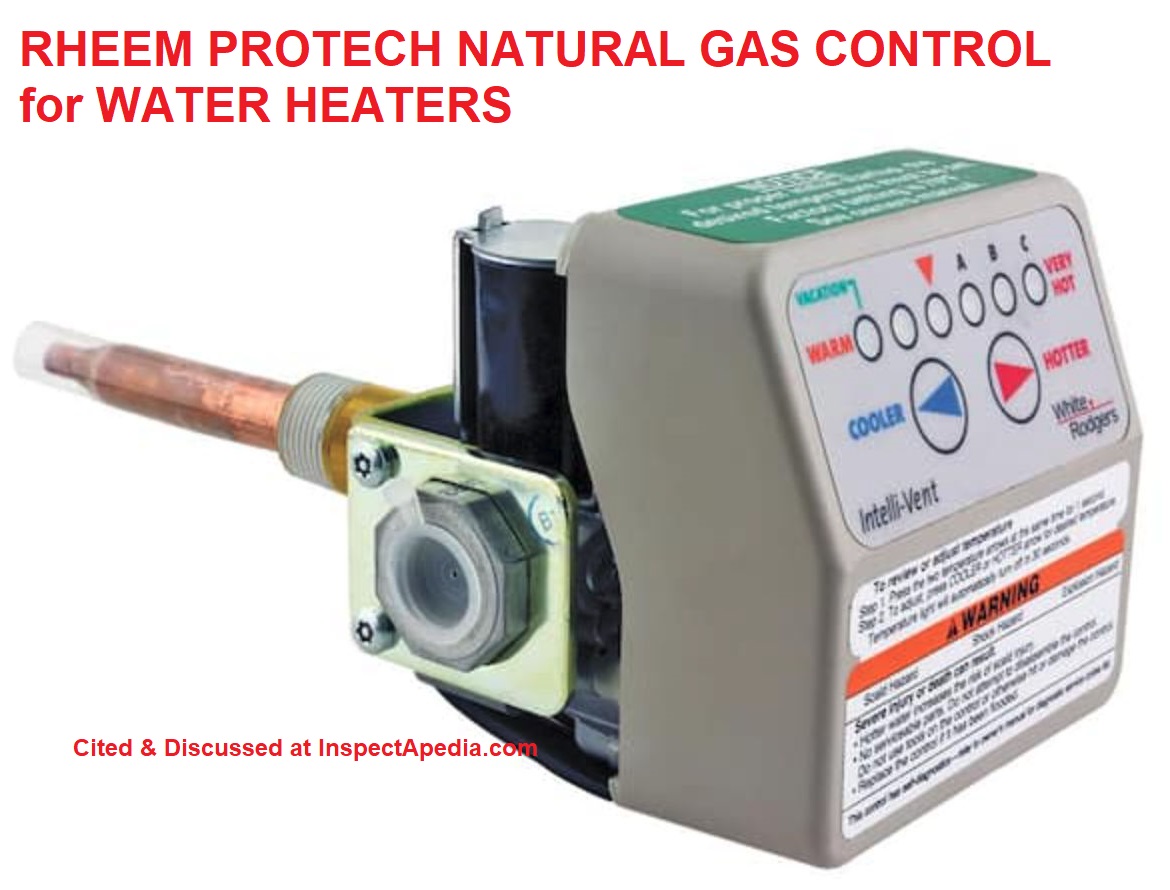
- RHEEM PROTECH NATURAL GAS CONTROL THERMOSTAT [PDF] [shown above] Home Depot says: For Information on installation, use and care, please call 1-800-432-8373
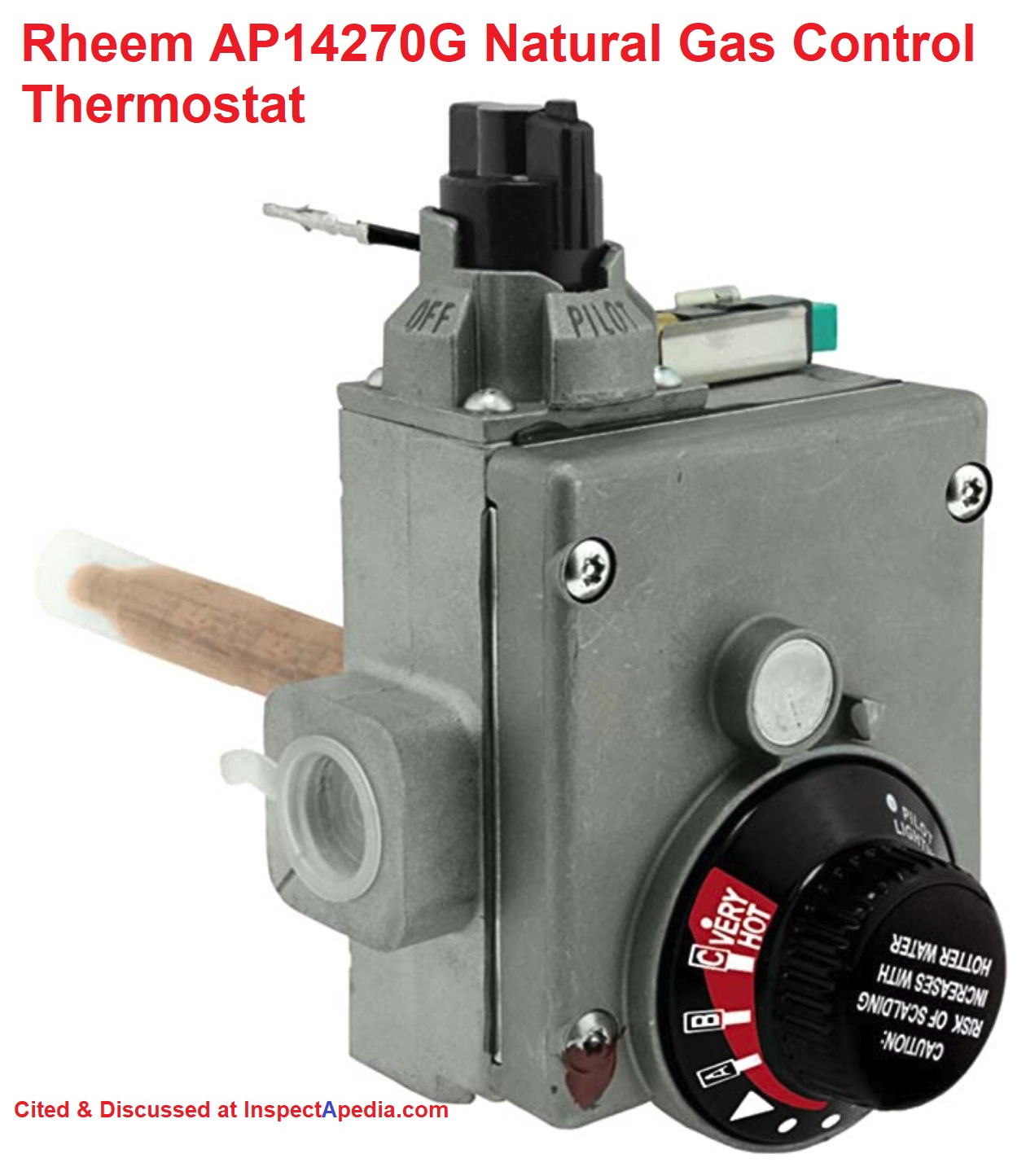
- RHEEM / WHITE RODGERS NATURAL GAS WTER HEATER CONTROL AP14270G INSTALLATION INSTRUCTIONS [PDF] - [ shown above ] Note: Rheem does not make it easy for consumers installation instructions or specifications for this control but at homedepot.com we found the somewhat generic control installation instructions & documents provided here
Rheem warranty: 1 Year Limited Warranty – This part will be replaced at no cost (upon receipt of the defective part and proof of purchase) if it becomes defective during normal use within one year from date of purchase. This Limited Warranty does not cover labor or any other related expenses.
Watch out: This part number has been replaced by SP14270G - also Ruud, Richmond-Rheem, Protech, & FVIR water heaters.
See also
RHEEM WATER HEATER AGE & MANUALS
 ...
... 
- ROBERTSHAW GAS VALVE INSTALLATION MANUAL Series 110 UNIVERSAL REPLACEMENT [PDF] (2014) Robertshaw Controls, Customer Service Telephone 1.800.304.6563 Customer Service HVACCustomerService@robertshaw.com
For Technical Service Telephone 1.800.445.8299 Facsimile 1.630.260.7294 TechnicalService@robertshaw.com
www.uni-line.com www.robertshaw.com
Excerpt:
The Robertshaw® 110 Series Water Heater Thermostat Uni-Kit® is designed for universal replacement applications.
All models feature a built-in, noncycling Energy Cut-Off (ECO) system to shut off all gas to the heater in case of excessive water temperatures.
All models have a 5-1/2” sensing element and vary by inlet and outlet size, shank length, high temperature stop, and regulator type and setting. - ROBERTSHAW GAS VALVE INSTALLATION MANUAL Series 110 Gas Water Heater Uni-Kit [PDF] (2014)Robertshaw Controls
Excerpt:
The Robertshaw® 110 Series Water Heater Thermostat Uni-Kit® is designed for universal replacement applications. All models feature a built-in, noncycling Energy Cut-Off (ECO) system to shut off all gas to the heater in case of excessive water temperatures. All models have a 5-1/2” sensing element and vary by inlet and outlet size, shank length, high temperature stop, and regulator type and setting.
Except for R103RV models, all are available in domestic (160°F Hi-Stop) or commercial (180°F Hi-Stop) versions. - ROBERTSHAW LP GAS VALVE INSTALLATION MANUAL Series 110 [PDF] Robertshaw Controls
Excerpt:
The Robertshaw® 110 Series Water Heater Thermostat Uni-Kit® is designed for universal replacement applications. All models feature a built-in, noncycling Energy Cut-Off (ECO) system to shut off all gas to the heater in case of excessive water temperatures. All models have a 5-1/2” sensing element and vary by inlet and outlet size, shank length, high temperature stop, and regulator type and setting. - Robertshaw GAS CONTROL MANUAL - Series 120 [PDF] typically used on water heaters
Excerpt:
The Robertshaw® 120 Series gas heating controls are designed for a variety of heating applications. Models are available with hydraulic or 24 volt operators.
Each control has positive snap-action, automatic pilot safety valve, pilot adjustment key, pilot filter and pilot outlet. Pressure regulation is optional by model. 24 volt models are thermostatically controlled by a remote electric wall thermostat. Hydraulic models are self-contained and require no outside control.
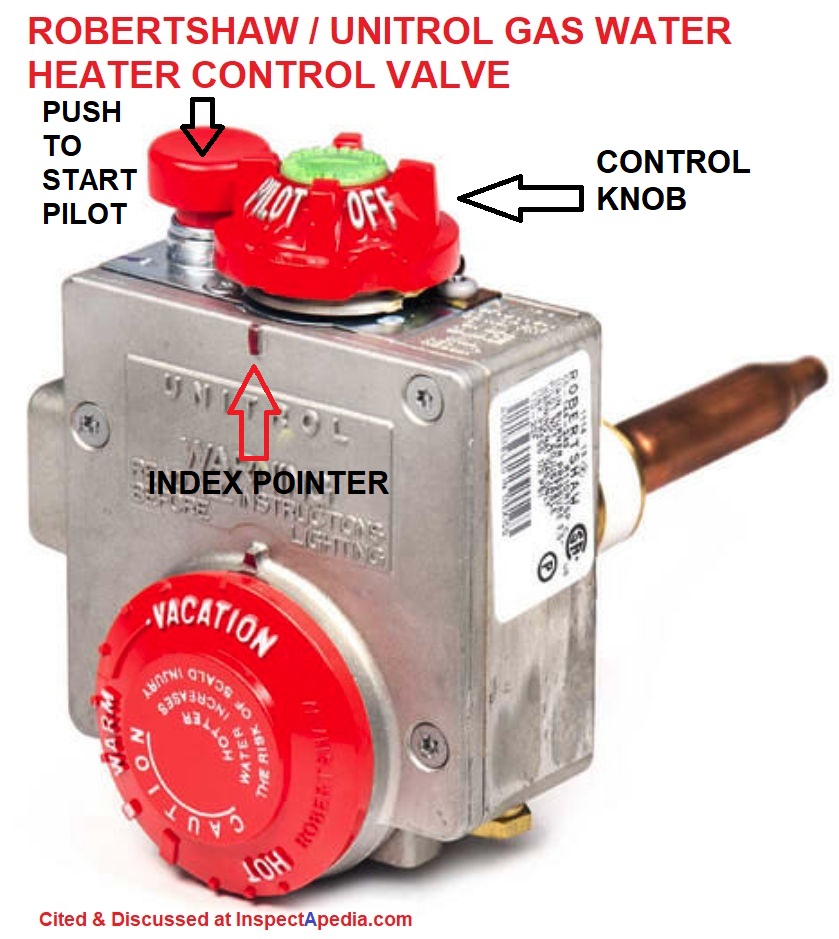
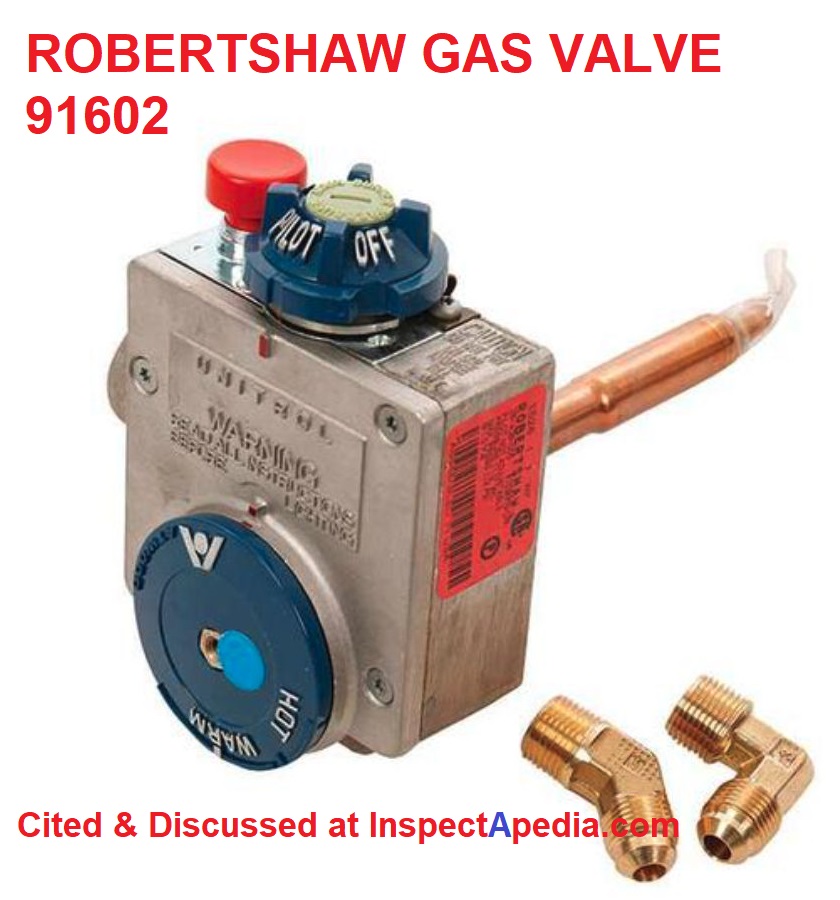
- Robertshaw (Unitrol) GAS WATER HEATER VALVE PRODUCT LIST [PDF] Robertshaw Gas Valve R110R Seris & R220R Series gas valves. [shown above]
Excerpt:
The 110 Series Water Heater Thermostat Uni-Kit® and Commercial Water Heater Thermostat Uni-Kit® were designed for universal replacement applications. All models feature built-in, non-cycling Energy Cut-Off (ECO) system to shut off all gas to the water heater in case of excessive water temperatures.
If an ECO has detected an over-temperature condition and has opened, the control will not function and a new replacement will be required. All domestic and RV models have a 160°F temperature high stop.
All commercial models have a 180°F temperature high stop. All models have a 5- 1/2" sensing element and vary by inlet and outlet size, shank length, regulator type and setting. See ordering chart for exact specifications. - See also Robetshaw gas controls & valves used on other gas fueled heating equipment
at GAS REGULATORS & APPLIANCE / HEATER CONTROLS
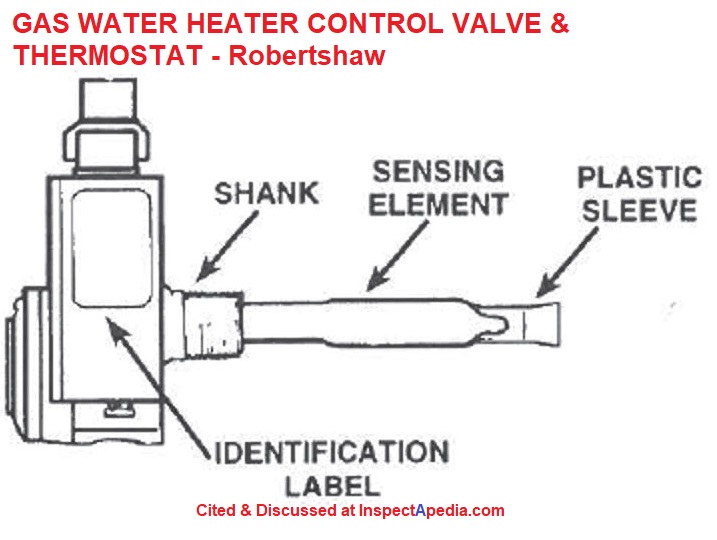
Below: Robertshaw 91602 Gas Control. This gas valve replaces Robertshaw AT91601 and is used on gas heaters that employ a pilot flame, Pilot Model Series: G4SM; G6A; G6A-2; G6A-3; G6A-6; G6A-6P; G6A-7; G6A-7P; GC10-1; G10-2; G10-2P; GC6A; GC6A-3; GC6A-6; GC6A-7; GC6AA-7P; GC6AA-A8; GC6AA-8P; GC10-2; GC10-2P; GC10A-2.
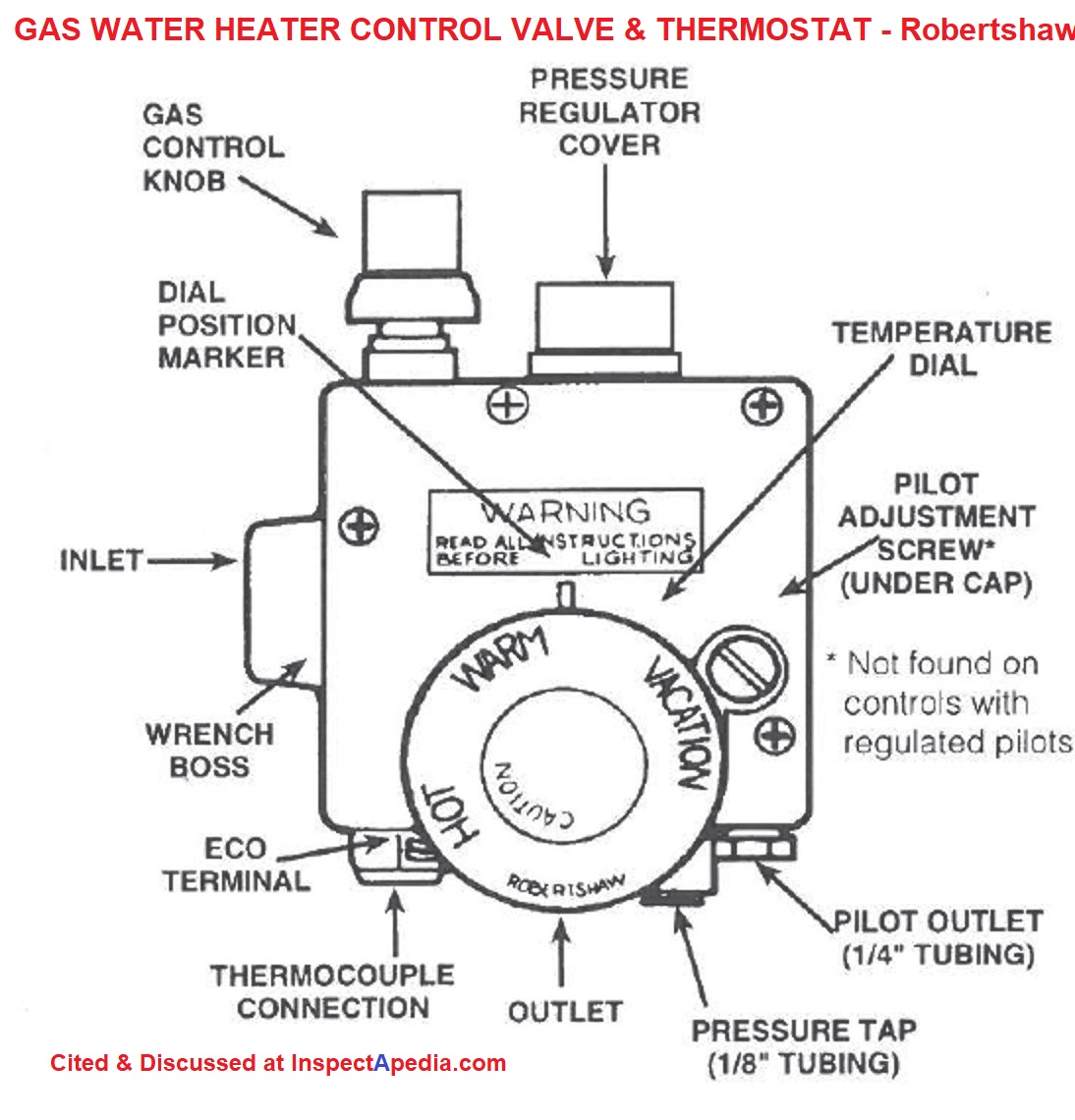 ...
...
Gas Water Heater Flame Defects
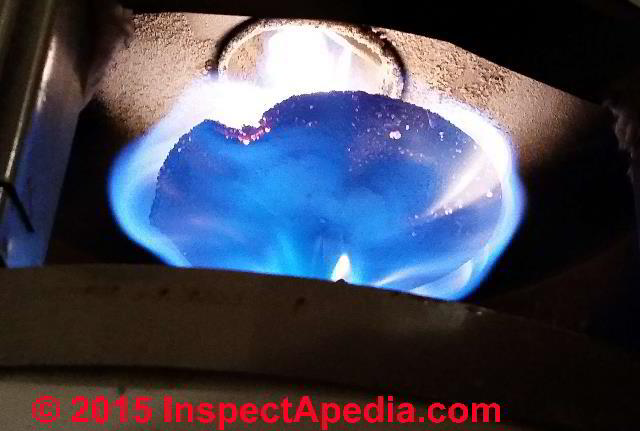
Check for flame color indicating inadequate combustion air, damaged gas burners, gas flame roll-out burn marks, dirty or obstructed gas burner orifices, uneven flames.
See GAS FLAME & NOISE DEFECTS for details
Inadequate Combustion Air at Gas Water Heaters
Check for proper combustion air supply for your gas fired water heater.
Failure to provide sufficient combustion air is dangerous: lack of adequate combustion air will cause a gas burner to produce dangerous, potentially fatal carbon monoxide gas.
Gas Water Heater Relief Valve Hazards
Check the pressure and temperature relief valve on your water heater: look for evidence of corrosion, leaks, improper installation, etc. A missing, modified, blocked, or leaky pressure relief valve is extremely dangerous and can lead to a catastrophic
BLEVE boiling liquid vapor explosion
that can cause severe damage or even fatalities at a building.
See details also at RELIEF VALVES - TP VALVES
Gas Water Heater Installation Location, Position, Mechanical Damage
Look for evidence of leaks in the hot water tank, or mechanical damage, or improper installation.
For example most water heaters are intended to be installed in a vertical position. Installing a hot water tank horizontally or in a hole in a crawl space is likely to cause early failure of the heater, violate the manufacturer's guidelines, and may be dangerous.
Leaky water heater tanks & other leaks

In our photo at above left a gas-fired water heater is leaking.
That puddle on the floor needs investigation. Look for leaks at valves and piping around the water heater, leaks in the water heater tank itself, and look for leaks at the pressure/temperature relief valve.
Check the settings of the Gas Water Heater Control Temperature settings
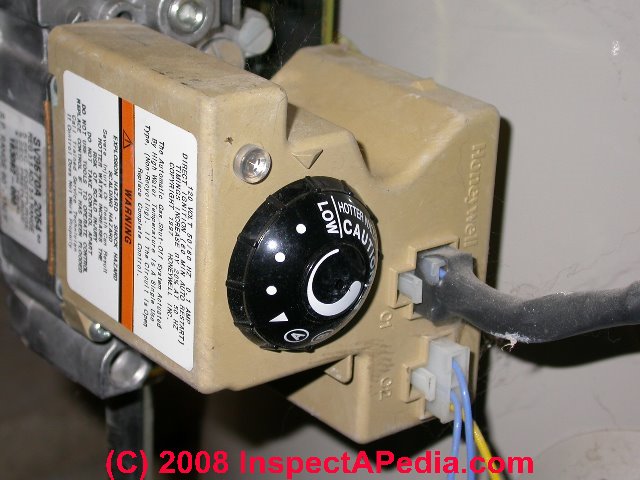
Watch out: Water heater temperatures set above 120F risk scalding the building occupants unless a mixing valve or anti-scald valve system has been installed.
See details at GAS HOT WATER TEMPERATURE CONTROL - instructions for setting the temperature control on gas fired water heaters
For a water heater temperature set too low, providing water that is not hot enough.
see WATER HEATER TEMPERATURE TOO LOW.
On a gas fired water heater the heater temperature control is usually on the gas valve itself - the black dial shown in the photo above..
See ANTI_SCALD VALVES & HOT WATER QUANTITY for details about safe hot water temperatures.
Check Gas Water Heater Piping, Valves, Controls
 Check the water piping and control valves connected to the water heater for leaks, support, and for proper location of shutoff valves. An improperly installed shutoff valve on a water heater can be very dangerous, risking an explosion.
Usually the "hot water tank shutoff valve" is installed only on the cold water pipe coming into the water tank (blue arrow in our photo at left)..
There should be no shutoff valve installed on the hot water line (red arrow in our photo) leaving the water tank.
Check for Gas Leaks: In addition to a characteristic odor that you may smell associated with LP or natural gas leaks, a prolonged gas leak may leave telltale dark stains on the gas piping or control.
See GAS LEAK DETECTION, LP / NG for details.
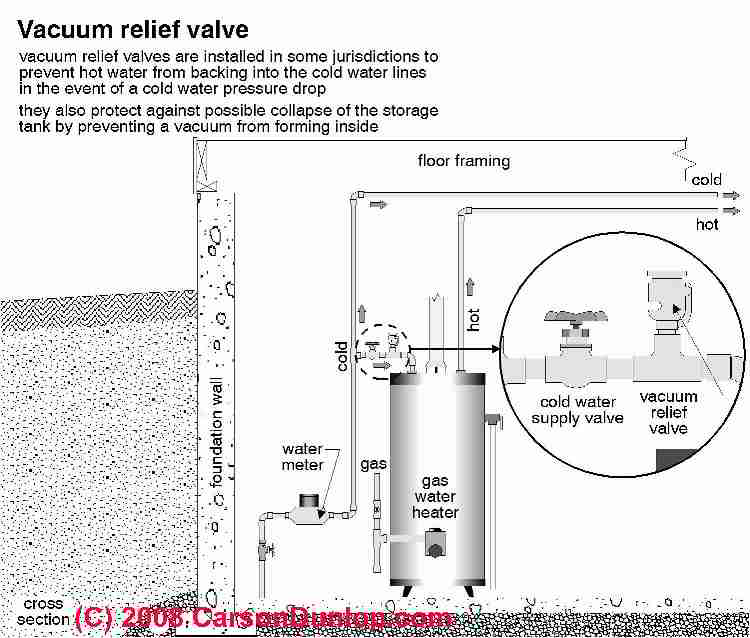
Vacuum relief valves are required at water heaters in some communities, to protect against collapse of the water storage tank and to prevent backup of hot water into the cold water piping should cold water pressure drop.
See this Carson Dunlop sketch of a vacuum relief valve [image].
Plastic piping used for hot water distribution & connected to a water heater
In our photo above a gas-fired water heater is connected to plastic water supply piping. The pressure rating of plastic water piping systems is usually specified in terms of the temperature as well as pressure in the piping system.
Watch out: hot water temperatures may reduce the permitted pressure rating of plastic water piping in some installations, depending on the brand and product type of plastic water piping installed.
The risk is a burst water pipe, scalding, or flooding in the building.
On some plastic water piping systems you may also find a hot water expansion relief valve installed to provide added protection to the system.
An expansion tank or additional pressure/temperature relief valves can prevent these problems and may also extend the life of the water heater. Details are
at HOT WATER EXPANSION TANKS
and at HOT WATER EXPANSION VALVES
If plastic water piping is installed, such as polybutylene water supply piping, it should be at least 18" from the water heater itself.
Corrosion & leaks at water heater piping & connections
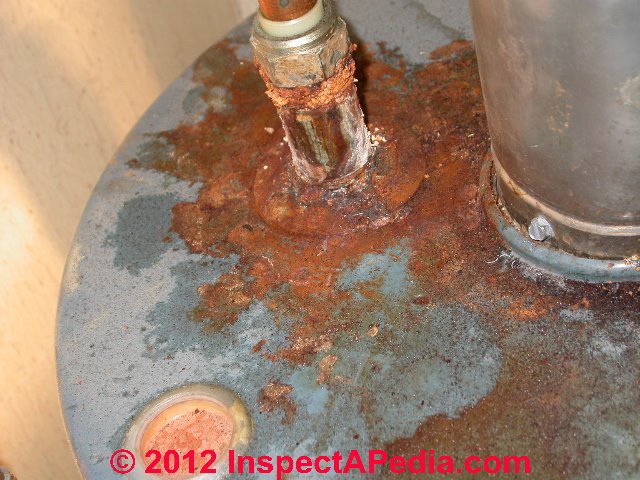
Our photo above shows corrosion at dissimilar metals at the top of a water heater tank. When the connections at the water heater top are sufficiently rusted and corroded the heater will be un-repairable.
Check Gas Water Heater Insulation
Look for insulation that has been improperly added to the water heater tank - it may be unsafe and may violate the manufacturer's installation instructions and warranty.
Antiquated & Antique Gas Fired Water Heaters
Just below we show a still-working Standard Combination Gas FIred Boiler / Water Heater manufactured by Keystone Supply in Philadelphia, PA. I think this water heater is more than 80 years old.
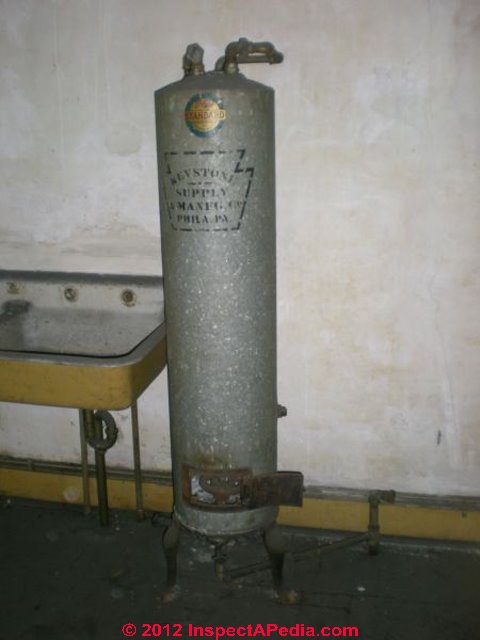
The antique wall-mounted gas-fired water heater shown below is installed in the Gaudi Apartments in Barcelona, Spain.
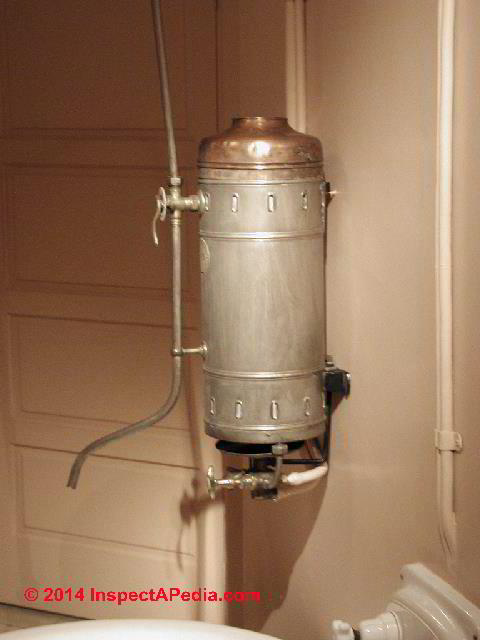
By modern standards this is an unsafe water heater, venting directly to the indoor space. I suspect that originally it vented outdoors.
Check the Sacrificial Anode & Dip Tube of the Water Heater Tank
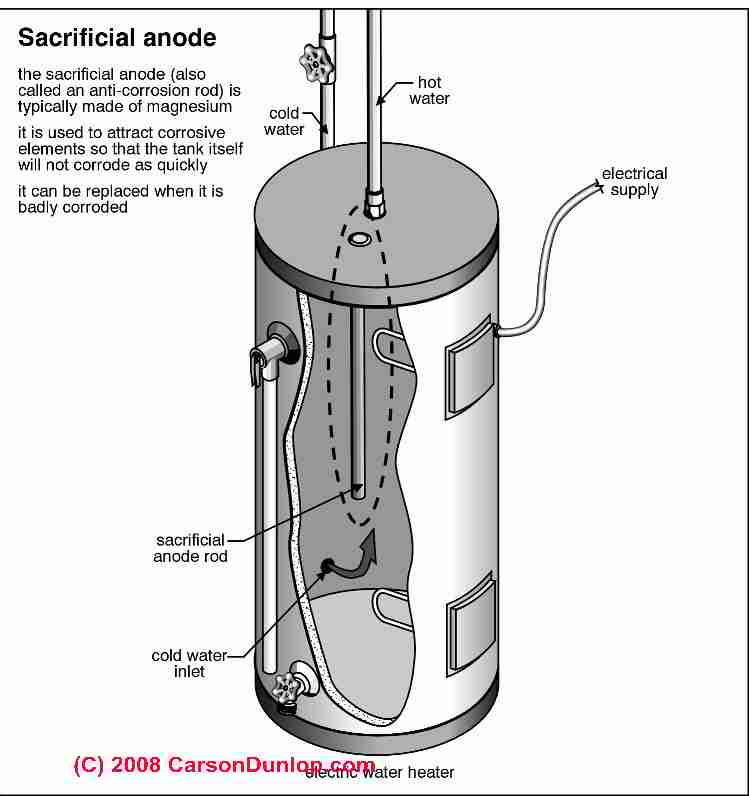
The dip tube on many water heaters functions as a sacrificial anode, as we show here.
By constructing the dip tube of a metal which is more readily corroded than the steel of a steel hot water tank, the anode protects the hot water tank from early failure due to corrosion.
Here Carson Dunlop Associates' sketch shows the location of the sacrificial anode on an electric water heater.
If your water supply happens to be highly conductive or corrosive
see WATER TESTING GUIDE for details
then the dip tub/sacrificial anode in the water tank may indeed corrode away until it leaks (dropping the hot water temperature) or disappears entirely.
If your hot water smells like rotten eggs, you should definitely check the condition of the sacrificial anode on the hot water heater, no matter what kind of water tank you've got installed.
For details of how to inspect or replace the sacrificial anode or dip-tube on a water heater, please
see WATER HEATER ANODES & DIP TUBES
Check the Gas-fired Hot Water Tank Temperature and Pressure Safety Relief Valve
Please see TESTING the Water Heater Temperature Pressure RELIEF VALVE
Gas Fired Water Heater Chimney & Venting Defects
 This discussion has moved
to GAS FIRED WATER HEATER CHIMNEY & VENTING DEFECTS - topic home
where we include a discussion
of GAS FIRED WATER HEATERS VENTING & COMBUSTION AIR HAZARDS
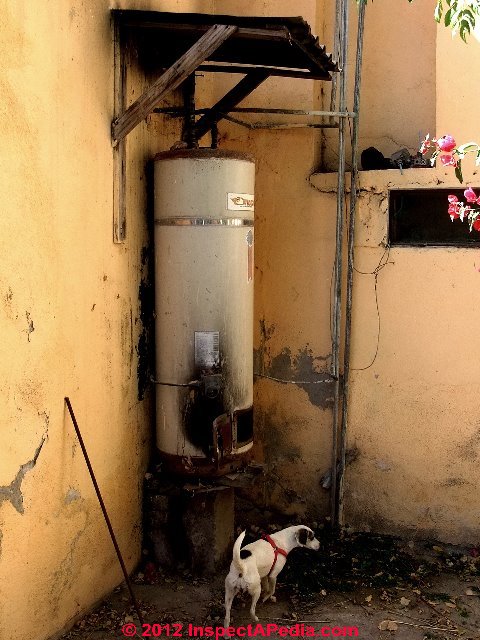
Our photo shows an LP gas fired water heater that caught fire. This outdoor water heater installation was observed at the Ex Hacienda, Gogorron, San Luis Potosi, Mexico.
The complete absence of a venting chimney on this heater may have been a factor in its poor operation.
The water heater inspection dog was a volunteer.
Check for proper exhaust venting of combustion products from your gas fired water heater (calorifier, geyser, hot water cylinder).
See also
Reader Comments, Questions & Answers About The Article Above
Below you will find questions and answers previously posted on this page at its page bottom reader comment box.
Reader Q&A - also see RECOMMENDED ARTICLES & FAQs
On 2021-02-18 - by (mod) -
So the frozen point is somewhere in the common cold-in to the water heater or in the hot-out from the water heater before it branches off to all of those various locations.
Take a look at the suggestions at PIPE FREEZE-UP POINTS https://inspectapedia.com/plumbing/Pipe_Freeze_Points.php
and then grab a hair dryer and see if you can thaw the freeze-point; when you find it you'll know where you need to add a heat source and fix cold drafts so as to avoid having the problem over and over.
On 2021-02-17 by Yvette
0° weather cold water is working and running fine and flowing fine. Hot water line in all faucets tub in bathroom bathroom sinks kitchen sinks the hot water line is not flowing at all. I have a gas water heater and the gas is on.
On 2021-01-06 - by (mod) -
Justin Heck said:
I drained a water heater at my mothers house that was over 30 years old and had never been cleaned. it was over 1/3 of the way full of black goop. The sediment had built up so much i ended up replacing the Unit. Proper Maintenance would have prevented this.
On 2020-06-18 - by (mod) -
Willie
Please forgive the delay in my answer, I have been in an area where new internet was available.
Let's start by inspecting every Plumbing connection above or near the top of the water heater and also the temperature pressure relief valve connection on the side of the water heater.
If any of those is leaking water could be running down inside the jacket of the water heater and out at the bottom. If you are absolutely confident that there are no plumbing leaks into the heater body or insulation jacket that it sounds to me as if the unit is defective and needs to be replaced under warranty
On 2020-06-10 by Willie Roberts
new water heater leaking from the bottom
On 2018-11-27 - by (mod) -
Jose
Qual forma de calentador usas: electrico, gas?
Si es electrico, cheque primero al panel por luz.
On 2018-11-27 by Jose
Mi calentador de agua dejo de trabajar. como si se hubiera apagado de repente. como trato de solucionarlo.
...
Continue reading at GAS FIRED WATER HEATER CHIMNEY & VENTING DEFECTS or select a topic from the closely-related articles below, or see the complete ARTICLE INDEX.
Or see GAS FIRED WATER HEATER FAQs - questions & answers about gas water heaters, cylinders, calorifiers, posted originally on this page
Or see these
Recommended Articles
- BACKDRAFTING HEATING EQUIPMENT
- GAS FIRED WATER HEATERS
- FLEXIBLE GAS CONNECTOR INSTALL
- FLUE GAS SWITCH INSTALLATION & WIRING
- FLUE GAS SPILL SWITCH SOURCES & SELECTION
- FLUE GAS SPILL SWITCH TRIPPING & RESET
- FLUE SPILL SWITCH & COMBUSTION AIR TESTS
- GAS BURNER FLAME & NOISE DEFECTS
- GAS BURNER SOOT CAUSE & CURE
- GAS BURNER PILOT LIGHT PROCEDURE
- GAS CONVERSION LP / Natural Gas
- GAS FIRED WATER HEATER CHIMNEY & VENTING DEFECTS
- GAS FIRED WATER HEATER VENTING CODES
- GAS FIRED WATER HEATER VENT UNSAFE
- GAS FLAME & NOISE DEFECTS
- GAS HEATERS, HIGH EFFICIENCY
- GAS HOT WATER TEMPERATURE CONTROL
- GAS IGNITER DIAGNOSIS & REPAIR
- GAS LEAK DETECTION, LP / NG
- GAS METER CODES & CLEARANCE DISTANCES
- GAS PILOT WON'T STAY LIT
- GAS REGULATORS & APPLIANCE / HEATER CONTROLS
- GAS SAFETY HAZARDS
- GAS WATER HEATER CONTROL VALVES - pilot light, gas valve, thermostat for temperature control
- THERMOCOUPLE REPAIR / REPLACEMENT
- GAS WATER HEATERS, HIGH EFFICIENCY
- RELIEF VALVE, WATER HEATER
- WATER HEATER AGE & MANUALS
Suggested citation for this web page
GAS FIRED WATER HEATERS at InspectApedia.com - online encyclopedia of building & environmental inspection, testing, diagnosis, repair, & problem prevention advice.
Or see this
INDEX to RELATED ARTICLES: ARTICLE INDEX to WATER HEATERS
Or use the SEARCH BOX found below to Ask a Question or Search InspectApedia
Ask a Question or Search InspectApedia
Try the search box just below, or if you prefer, post a question or comment in the Comments box below and we will respond promptly.
Search the InspectApedia website
Note: appearance of your Comment below may be delayed: if your comment contains an image, photograph, web link, or text that looks to the software as if it might be a web link, your posting will appear after it has been approved by a moderator. Apologies for the delay.
Only one image can be added per comment but you can post as many comments, and therefore images, as you like.
You will not receive a notification when a response to your question has been posted.
Please bookmark this page to make it easy for you to check back for our response.
Our Comment Box is provided by Countable Web Productions countable.ca
Citations & References
In addition to any citations in the article above, a full list is available on request.
- Mark Cramer Inspection Services Mark Cramer, Tampa Florida, Mr. Cramer is a past president of ASHI, the American Society of Home Inspectors and is a Florida home inspector and home inspection educator. Mr. Cramer serves on the ASHI Home Inspection Standards. Contact Mark Cramer at: 727-595-4211 mark@BestTampaInspector.com
- John Cranor [Website: /www.house-whisperer.com ] is an ASHI member and a home inspector (The House Whisperer) is located in Glen Allen, VA 23060. He is also a contributor to InspectApedia.com in several technical areas such as plumbing and appliances (dryer vents). Contact Mr. Cranor at 804-873-8534 or by Email: johncranor@verizon.net
- In addition to citations & references found in this article, see the research citations given at the end of the related articles found at our suggested
CONTINUE READING or RECOMMENDED ARTICLES.
- Carson, Dunlop & Associates Ltd., 120 Carlton Street Suite 407, Toronto ON M5A 4K2. Tel: (416) 964-9415 1-800-268-7070 Email: info@carsondunlop.com. Alan Carson is a past president of ASHI, the American Society of Home Inspectors.
Thanks to Alan Carson and Bob Dunlop, for permission for InspectAPedia to use text excerpts from The HOME REFERENCE BOOK - the Encyclopedia of Homes and to use illustrations from The ILLUSTRATED HOME .
Carson Dunlop Associates provides extensive home inspection education and report writing material. In gratitude we provide links to tsome Carson Dunlop Associates products and services.
 | HOME | ABOUT | ASK a QUESTION | CONTACT | CONTENT USE POLICY | DESCRIPTION | POLICIES | PRIVACY | |
| © 2024 - 1985 Publisher InspectApedia.com - Daniel Friedman | |||||||||