
InspectAPedia® FREE Encyclopedia of Building & Environmental Construction, Diagnosis, Maintenance & Repair |
Question? Just ask us! InspectAPedia
|
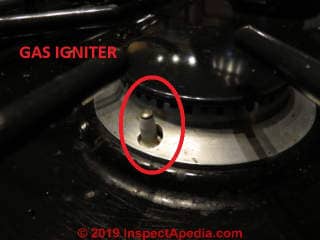 Diagnose & Repair Gas Igniters
Stoves, Water Heaters, Furnaces, Boilers
- POST a QUESTION or COMMENT about : diagnosis & repair help for home appliances
Gas igniter troubleshooting on heating equipment:
This article explains the cause, diagnosis, and cure of gas heater or gas appliance igniter problems that cause bangs, whooshes, noises, clicking, or failure to ignite properly.
Here we discuss: . Causes of gas top range burner to fail to ignite. Causes of short circuiting in cookstove electrical wiring.
Repair methods for gas burners that won't ignite. Repairs for furnace or boiler gas burner igniters that won't stop clicking. Diagnose and repair loud bang or whoosh when boiler or furnace gas burners igniters. Watch out: some of these conditions are dangerous.
We also discuss both gas igniters and gas regulators on gas fired heating equipment and LP or Natural Gas Pressure Regulators used on building appliances such as gas fired furnaces, boilers, water heaters, and stoves.
InspectAPedia tolerates no conflicts of interest. We have no relationship with advertisers, products, or services discussed at this website.
Diagnose & Repair Bad or Noisy Gas Burner Igniters
 This article series provides descriptions and photographs of unsafe gas piping, regulators, or controls on heating systems, indications of unsafe or improperly operating gas appliances, gas meters, and other gas installation defects.
This article describes types of problems at gas burners.
For an immediate step-by-step guide to fixing dead or clicking gas burner igniters
see GAS COOKTOP or STOVE IGNITER REPAIR
[Click to enlarge any image]
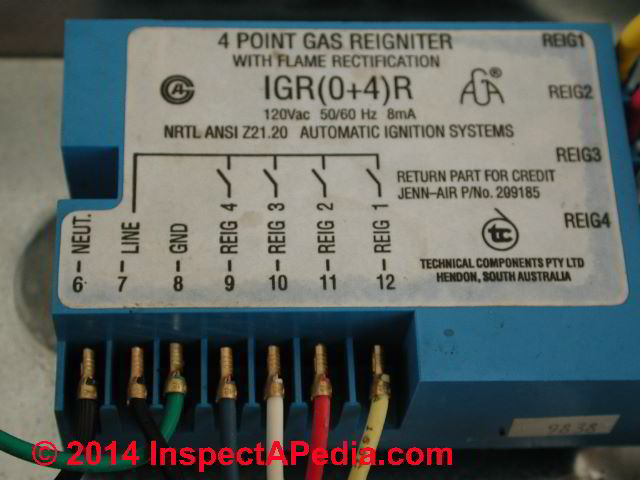
Photo at left: the igniter module for a Jenn-Air countertop gas cooktop. We replaced this item as well as the wiring and individual igniters to cure chronic gas burner ignition problems: endless clicking. Details of that repair are found in the article below.
General safety warning: improper installation and even improper inspection and testing methods involving natural or "LP" gas can involve dangerous conditions and risk fire or explosion.
If you smell gas you should leave the building immediately and should do so without doing anything that could create a spark such as operating a light switch or telephone. From a safe location, call your gas company's emergency line and/or your fire department. The text provided here is a working draft and may be incomplete or inaccurate
Question: Noisy gas burner igniter worry: when the valve opens it sounds like a hammer hitting a metal pipe
 Both times InspectAPedia has warned me about possible errors I avoided by reading
your website on Furnace Inspection.
You've heard it many times I'm sure, but thanks for the heads up.
Both times InspectAPedia has warned me about possible errors I avoided by reading
your website on Furnace Inspection.
You've heard it many times I'm sure, but thanks for the heads up.
Many times I've learned the expensive way what not to do in DIY project.
May I ask your opinion on intermittent pilot valves for gas furnace? My furnace works perfectly. However, when the valve opens it sounds like a hammer hitting a metal pipe..
Is it possible the electronic ignition is sending more than 24 volts to the valve solenoid and that's why it makes such a loud noise on opening?
There's a box that regulates and sends the 24 volt electronic signal to the pilotless ignition that I've thought about replacing.
About your pro bono advice, I'm 60 years old, no job, no pension and would appreciate any advice. - R.K., MI
Reply: Short answer: the gas burners may need cleaning, the system may be unsafe, you need a service call
A competent onsite inspection by an expert usually finds additional clues that help accurately diagnose a problem, but it sounds to me as if you are on the right track. Sort-of.
First we ought to rule out a dangerous noise that can be heard when the gas furnace ignites.
Properly when the thermostat calls for heat the igniter lights a pilot that then ignites gas when it is released into the burners.
If burners are dirty or clogged, the gas flame may not be igniting across all of the burner tubes as quickly as it should. A result could be incomplete ignition and a banging sound when the accumulated gas finally ignites.
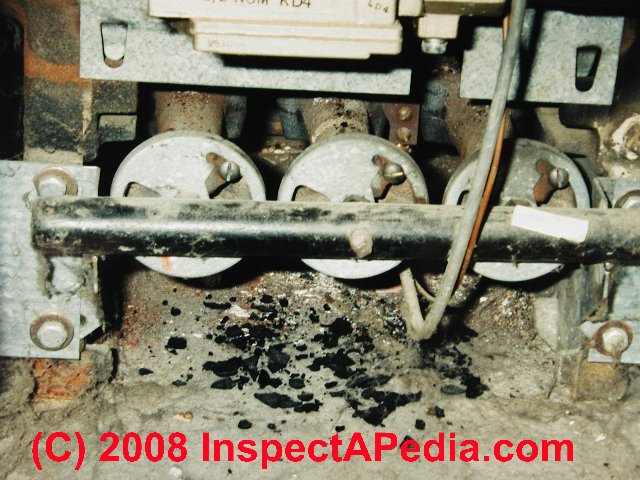 You should be able to detect this problem by observing with care just what happens during a heater on-cycle.
Watch Out: for sooty gas burners:b If you see soot on or around gas burners such as shown in our photo (above) you should shut off the equipment (it is unsafe) and call a heating service technician promptly.
And if this is the problem, a service call that includes cleaning rust and debris off of the pilot and igniter, or rust and debris off of the burners and checking their adjustment might fix the trouble.
If the gas burner tubes include flame crossover slots, those are intended to assist the spread of flame from the first ignited gas burner tube over to the other tubes.
Be sure those slots are cleaned as well. Be sure to also ask your service tech to check the proper operation of all of the heater safety controls while s/he is there.
Watch out: in boiler school our instructor came to class one night with his previously full-beard shaved off. His eyebrows looked odd too. He explained that he was kneeling by the burner, watching too closely when the flame was igniting. A flashback burned off half of his beard and one eyebrow. He had to finish the job himself with a razor.
Don't get your face too close to the gas burners while inspecting for trouble during flame ignition.
There might be a different problem, a delay in igniting the pilot itself, though that is probably less common.
What Causes the Bang, Kaboom, or Loud Whoosh When the Gas Burners are Igniting?
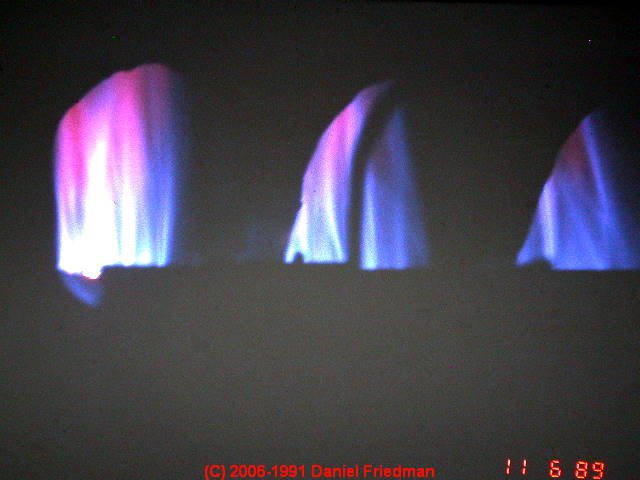 A "bang" or "kaboom" (as some folks describe it) sounds very dangerous, if that's what you've got. It can signal that you are getting "delayed ignition" of the gas in your combustion chamber.
If the gas valve opens and sends gas through the burners but actual ignition is delayed, gas accumulates, then ignites with an explosion when the spark finally occurs.
The risk is a damaged, cracked heat exchanger leading to a costly furnace replacement, or worse, a dangerous heating system leaking potentially fatal carbon monoxide into the building.
A loud "whoosh" during burner flame ignition may be caused by the same burner clog and debris problem, especially if it's heard earlier in the development of this dirt and debris difficulty.
Watch out: for questionable advice we've come across when researching the noisy gas burner ignition worry: advice that focuses on adjusting the burner air shutter to improve the flame may be confusing a dirty burner problem (discussed just above) with the need for proper burner adjustment.
The two could be related: if there is a shortage of combustion air the burners could be producing a bit of soot that in turn clogs the burners and leads to a bang or whoosh sound when the gas furnace or boiler burner ignites.
But if the root problem was improper combustion air to the heater or improper air mix adjustment at the burner tubes themselves, that problem would have probably been present from day one of the heater's installation.
If your heater has worked well for some time and now is developing noise, check the advice we gave at the start of this note.
Watch out: a heating appliance might have adequate combustion air only when the utility room door or some other nearby door is open. If the service tech adjusts and tests the system with the door open, the system may look just fine.
But when s/he leaves and shuts the door to the utility room there might be inadequate combustion air.
Details about diagnosing and correcting gas or oil appliance combustion air problems are
Watch out: also for the presence of soot anywhere in, on, or around the gas burners. If the system is producing visible soot its operation is improper and very dangerous as production of potentially fatal carbon monoxide is probably going on.
While natural gas and LP gas normally burn clean, a chimney or draft or combustion air problem can lead to very rapid system clogging, soot, and potentially fatal heating system troubles.
Also see BANGING BOOMING NOISE DIAGNOSIS & CURE - home
Sources of Heating System 24V Transformer Noise
Question: [continued] My first note should have mentioned that I narrowed the hammer on a pipe sound to the actual valve by shutting off the natural gas supply and reproducing the sound without an actual ignition.
However, I would guess you answered my question on improper voltage going to the ignition because your note did not even mention that as a possible issue.
I did replace the valve last fall. New Honeywell equivalent valve. You guessed it same issue. Maybe even a little more noisy than the 20 year old original. I will look into a transformer replacement.
Reply:
I have never seen a heating system coil develop a defect that led to high voltage coming out of a furnace or boiler 12V or 24 V transformer, so I didn't suspect that cause.
According to our electrical expert Paul Galow (Galow Consulting), the transformer is very unlikely to be the root cause of the sound you describe, and a more likely cause, if you have indeed traced the sound to the valve itself, is a mechanical problem in the valve that means it needs replacement.
The output voltage of a transformer is determined by the input voltage and the number of wire turns in the transformer winding. To double the output voltage of the heating system 24V output transformer you'd need to have cut or shorted the transformer in a way that eliminated half of those turns.
Such a defect would be not only unusual but it would more likely lead to burn-up of the device and it would stop working altogether. You could replace the 24V transformer as an experiment - they are quite inexpensive, but it doesn't sound as if the trouble lies there.
Transformers do make noise, but more likely they make a 60-cycle buzzing or humming sound. The transformer often has a core made up of laminated metal components. If the glue fails the core can vibrate, causing a hum.
So while we don't rule out some bizarre defect that causes the transformer to send an overcurrent to the gas valve mechanical solenoid that opens to actually send gas to the burners, it's not likely and more likley is wear or something breaking inside the mechanical parts of the solenoid itself.
Now to the Gas Solenoid Valve Itself
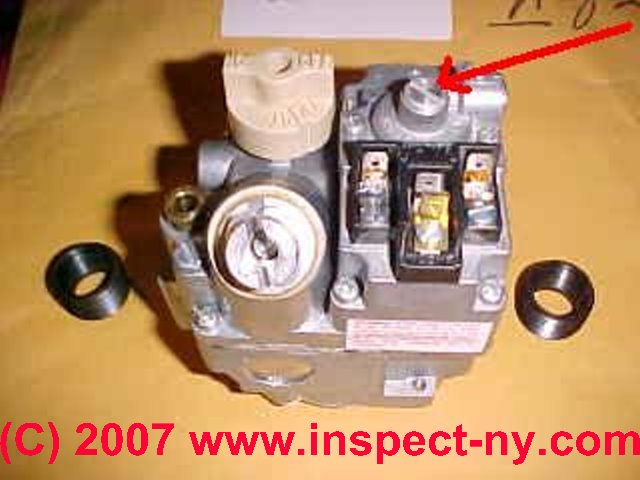
With all those safety warnings and dirty burners out of the way, if you do not see any burner troubles and you can trace the clicking hammering noise really right to the gas solenoid valve, it probably needs replacement.
As you have made clear that you are hearing a loud hammer-click that seems to come right from the gas solenoid valve itself, it sounds as if there lies a mechanical defect.
We [DF] fixed a humming transformer by whacking it once with a hammer. Not very elegant and certainly not recommended by a repairman, but the humming quit for another year or so. About replacing the solenoid valve, given that your previous replacement didn't last: It's a bit subtle but
Watch out for Batches of Bad HVAC Replacement Parts
Watch out: I [DF] have bought and replaced heating and air conditioning system replacement parts (and for that matter car parts) only to find the new parts were defective. Worse still is to go back to the same store, buy another new part, only to find it's defective too.
Keep in mind that often all of the replacement parts of a given part number that are stocked at a local supplier often arrived in the same box, on the same day, and came from the same production run. So if one of them is bad, sometimes all of them are.
Try buying the part somewhere else when you replace it, or check the lot numbers on the package to see if you can get a part from another production run.
See GAS REGULATORS & APPLIANCE / HEATER CONTROLS for details on how to inspect and test LP or natural gas regulators and controls.
Gas Igniter Problems on Stovetops
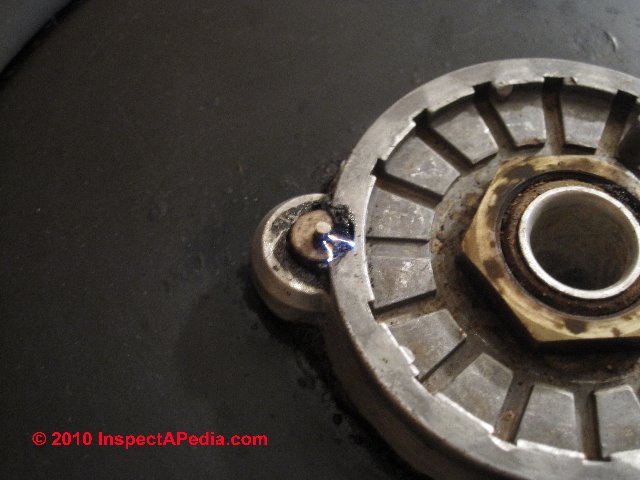
When a gas-fired heating appliance stops working the problem may be with the igniter, not other gas valve components.
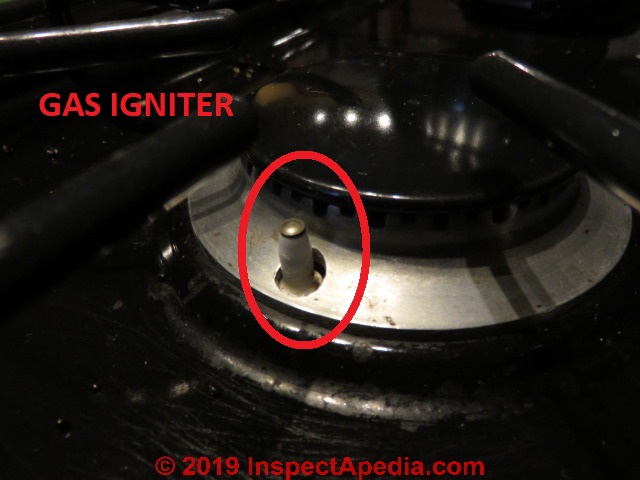
Our photo (left) shows an LP gas stove top burner igniter sparking away.
Watch out: we disassembled the stove top burner to make this photo. But don't turn on your gas stove with burner parts missing - the flame won't ignite properly and you could cause a dangerous gas explosion.
Start by checking the wire connected to the igniter itself. If the connection is loose or damaged that could be the problem.
If the ceramic igniter is cracked or damaged it may be shorting to ground and unable to ignite the gas flame.
We have seen recurrent problems with some stove-top gas igniters whose wires ran across the interior pan of the stovetop where they rested in water or cleaners used to clean that appliance.
The result was a shorted igniter wire and constant clicking that drove the homeowners crazy.
Details about how we diagnosed & repaired this problem are
at GAS COOKTOP or STOVE IGNITER REPAIR - in that article also
see GAS IGNITER CLICKING DIAGNOSIS for detailed diagnosis and repair suggestions for clicky gas burner igniters.
If you are having trouble removing an old cooktop gas igniter to replace it with a new one,
see GAS IGNITER REMOVAL where we use a Jenn-Air gas cooktop igniter as an example.
The gas igniter control module may itself fail and need replacement. This is a more costly part, and in our experience is less often the problem than the items above.
Basic Checks for Gas Appliances that Won't Work
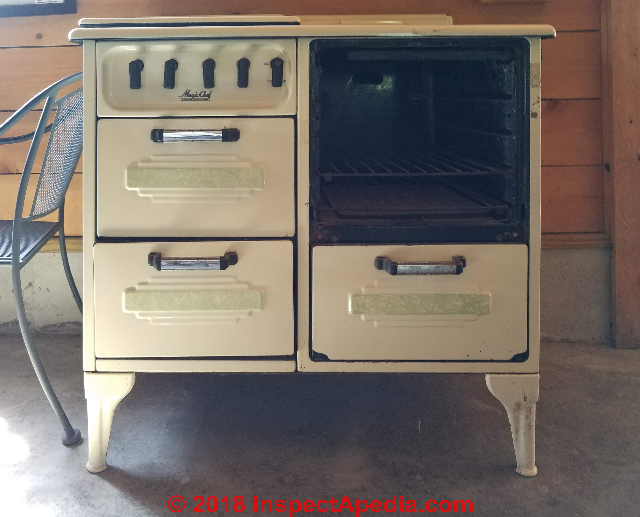
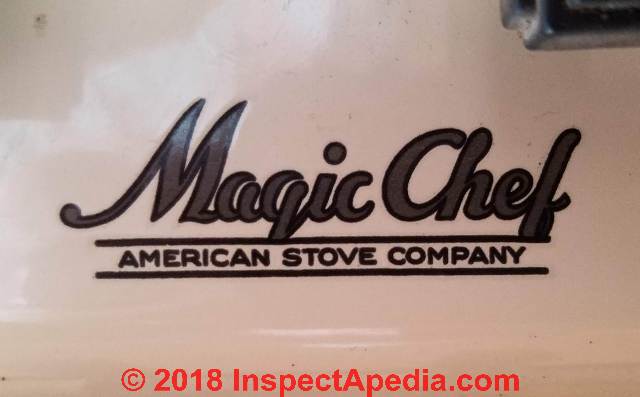
Photos here show an antique Magic Chef gas stove on display at DuBois Farms, a "pick your own" orchard in Highland NY. (Website: www.duboisfarms.com )
Older gas stoves like this MagicChef did not use an electric igniter, nor electricity at all, but typically had a standing gas pilot flame.
But most modern gas cooktops and gas stoves or ranges do use an electronic igniter.
Before tossing out your air conditioner or coffee maker and even before calling an appliance repairman for your washing machine, refrigerator, or clothes dryer, here are some things to check:
Electrical power: Is the appliance plugged-in?
Is there electrical power where the appliance is connected and is the receptacle itself properly wired?
Appliance instruction manuals often contain a troubleshooting guide:
have we found and read the installation and troubleshooting procedures given by the manufacturer for this appliance?
Often there are trivial problems that are easy to correct but that are not obvious before reading the instructions.
 See GAS COOKTOP RANGE & OVEN REPAIR & MANUALS or contact us for help finding one you need.
Controls & switches: Are the appliance controls and switches properly set? Is a control or switch acting funny: loose, makes a sparking noise, used to "click" but no longer does?
Hidden reset buttons: Is there a reset switch or button on an electric motor or elsewhere on the appliance
Noises or smells: something is burning? Is the appliance making a funny noise or smell.
Watch out: Unplug the appliance immediately to avoid a fire.
Appliance inspection for electrical problems: do we see something that looks burned when inspecting an appliance circuit board, wire, or switch?
Watch out: as we cite
at DISHWASHER SNAFUS, poking around inside or beneath an appliance may risk electrical shock.
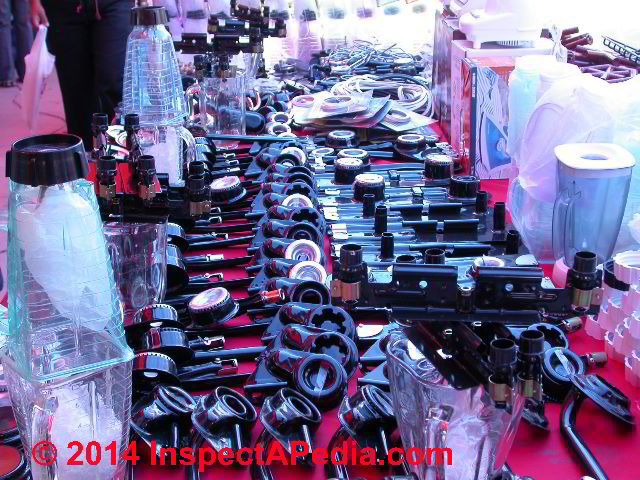
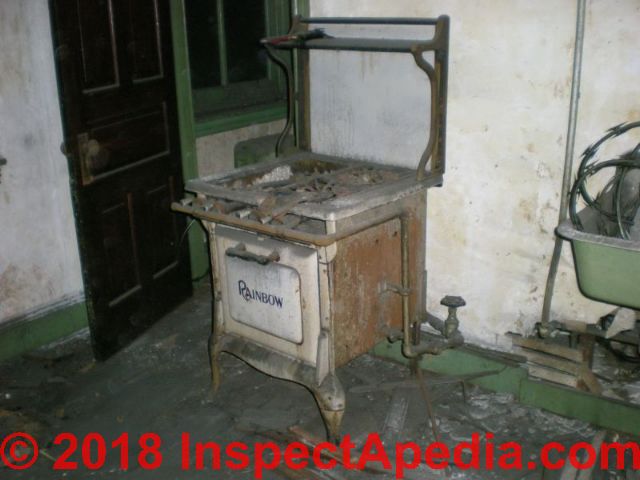
Above: gas range and other cookstove repair parts on display at the Tuesday Market, San Miguel de Allende, Guanajuato, Mexico. Below: an antique Rainbow Gas Stove (photo courtesy of anonymous reader).
Gas Appliance Manuals & Igniter Wiring Diagrams
- GAS COOKTOP RANGE & OVEN REPAIR & MANUALS - complete list
- MANUALS & PARTS GUIDES - HVAC and some other appliances - home, Master Index
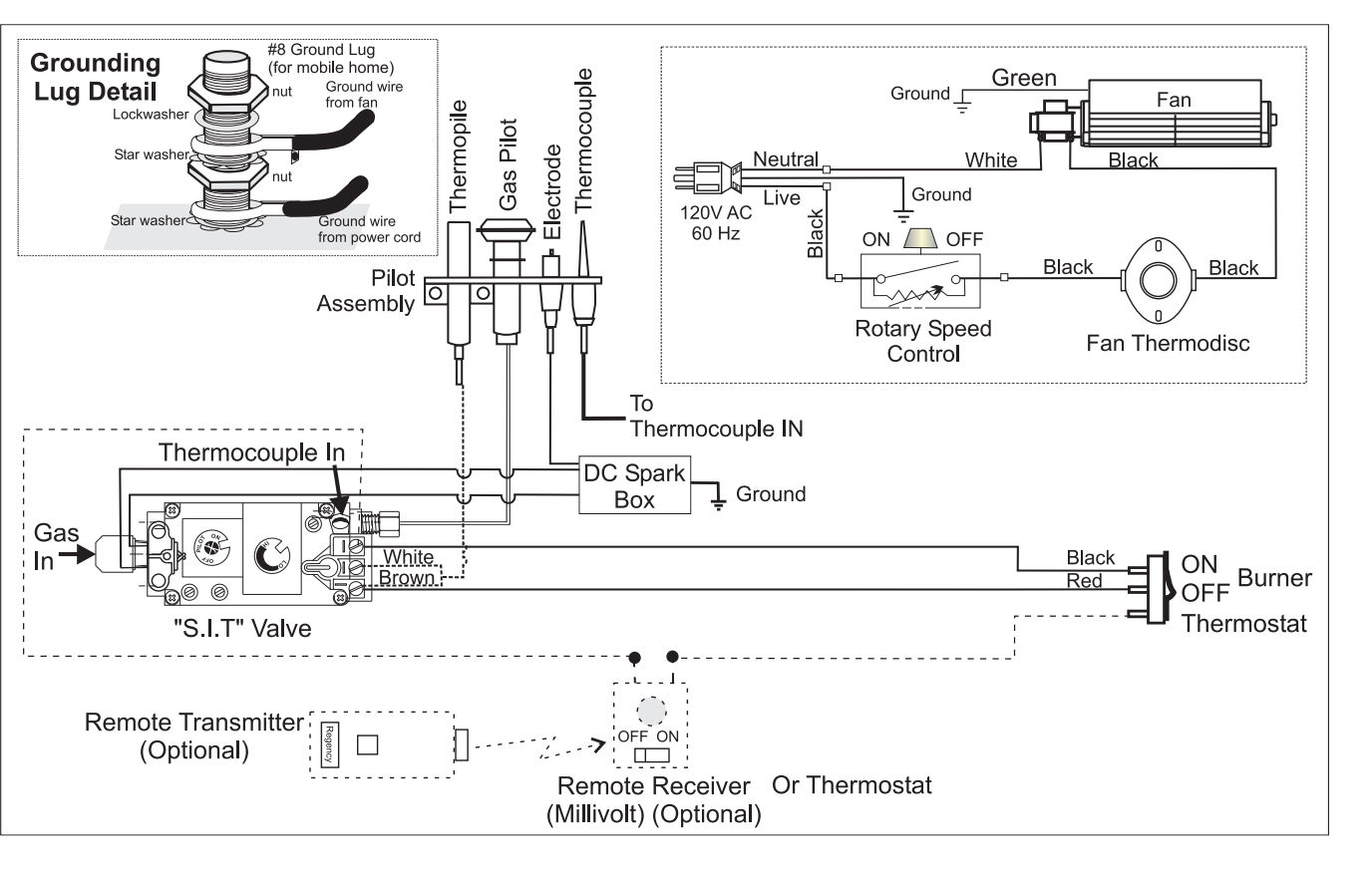
- Regency U39 Gas Heater SERVICE MANUAL [PDF] here's the wiring diagram Beware that fooling with stove wiring could make your heater unsafe. [Click to enlarge any image]
Reader Comments, Questions & Answers About The Article Above
Below you will find questions and answers previously posted on this page at its page bottom reader comment box.
Reader Q&A - also see RECOMMENDED ARTICLES & FAQs
On 2021-02-18 - by (mod) - Can't remove the cooktop surface until the burner base is removed, - it's stuck!
Take a look at the parts explosion in the IO manual for the GE Cooktop, Roger, that'll tell you if you've missed a connector somewhere.
With all of the burners disassembled I'd expect to be able to lift the whole cooktop surface away. That may expose whatever's stuck.
When I ran into this trouble on an old Jenn-Air gas cooktop I found that the pot-metal burner base threads and/or brass retaining nut threads were stripped and would not hold the burner securely in place after we'd remove them for cooktop repairs.
The "fix" was to replace those parts - still available from appliance parts sources or from the original manufactuer.
On 2021-02-17 by Roger
Can't remove the cooktop surface until the burner base is removed, and the last step to removing the burner base is to unscrew the orifice tube. When I try to unscrew the orifice tube it turns, but does not come out. Maybe a stripped thread under the cooktop surface? I fear I am screwed..
GE Monogram Gas Cooktop Model # ZGU375LS. I am trying to remove the orifice tube from the center of the burner base with the proper size socket. The tube turns, but nothing happens, i.e. the tube does not come out, and it sounds as if something may be turning underneath the cooktop. Any Suggestions? Thank you!
On 2020-05-11 - by (mod) -
Doug
If you've got a good spark at the igniter but the burner is not igniting I'd check for
- food, grease, oil, crud on the igniter and/or on the edge of the burner near the igniter
- blocked gas orifices on the burner
Try cleaning with a toothbrush and mild cleanser,
DO NOT get the wiring inside the cooktop wet
On 2020-05-10 by Doug Bodaly
The ignitors in our Frigidaire cook top have errant sparking and fail to ignite the gas sometimes. You ca see the spark shorting across the base, it's sort of like how the old distributor car ignition technology where you could develop a carbon print in the bakolite that would cause the spark to short and the car would misfire. Is there any suggestion of how to deal with this short of removal?
On 2017-09-15 by Pye
Both ovens plus the grill do not spark BUT the 5 top burners light immediately on a BEKO Cookmaster 101.
On 2017-03-21 - by (mod) -
Possibly, yes - I'm not smart enough to diagnose the gas burner by brief e-text.
My concern is that if you EVER see soot on the gas burner - as you described, the system is dangerous;
On 2017-03-21 by Andrew
I found no soot in the burner and the inside of the heat chamber is clean. Could the gas valve be letting in too much propane?
On 2017-03-18 by (mod) - intermittent ignition failure and bad sooting at a Suburban Furnace in a mobile home/camper
Andrew
Watch out: Sooting on a gas burner is an indication of very dangerous conditions, possibly fatal, as the system is likely to be producing fatal carbon monoxide.
DO NOT SLEEP in the home you describe without first assureing that there are working CO detectors, smoke detectors, and safe accessible emergency exits.
I'm not sure but it sounds as if there is a combustion air or flame adjustment problem. As carbon monoxide is so dangerous I'd ask for help from a trained service tech.
On 2017-03-18 by Andrew
I have a 1992 5th wheel that I call home. The suburban furnace is no longer made and most of the parts are obsolete. Every 5 to 6 lights the ignitor will cover up with black soot. It randomly backfires when lighting. Replaced sensor/electrode and circuit board. What could be wrong?
...
Continue reading at GAS COOKTOP or STOVE IGNITER REPAIR where we discuss the diagnosis & repair of gas igniters on cooktops & gas ranges or select a topic from the closely-related articles below, or see the complete ARTICLE INDEX.
Or see GAS IGNITER DIAGNOSIS FAQs - questions & answers originally posted at this article
Or see these
Recommended Articles
- BANGING HEATING SYSTEM NOISES
- BLUE vs YELLOW COMBUSTION FLAMES
- COMPLETE COMBUSTION, STOICHIOMETRIC
- GAS APPLIANCE CONVERT LP-to-NATURAL GAS
- GAS BURNER FLAME & NOISE DEFECTS
- GAS BURNER SOOT CAUSE & CURE
- GAS BURNER PILOT LIGHT PROCEDURE
- GAS BURNER POPPING NOISES
- GAS BURNER RUMBLING CHUGGING NOISES
- GAS COOKTOP or STOVE IGNITER REPAIR
- GAS COOKTOP RANGE & OVEN REPAIR & MANUALS
- GAS FIRED WATER HEATERS
- GAS IGNITER DIAGNOSIS & REPAIR
- GAS LEAK DETECTION, LP / NG
- GAS PILOT WON'T STAY LIT
- GAS PRESSURES LP vs NATURAL GAS
- GAS REGULATORS & APPLIANCE / HEATER CONTROLS
- GAS REGULATOR NOISES - buzzing, humming, and other noises at gas appliance regulators
- MANUALS & PARTS GUIDES - HVAC - home - Master Index to All Brand Names & HVAC manuals, wiring diagrams, installation and repair guides
- OIL BURNER MANUALS
- MANUALS for HEATING & A/C SYSTEM CONTROLS - gas burner controls, manuals, instructions, troubleshooting flowcharts
- WATER HEATER SCALE DE-LIMING PROCEDURE
Suggested citation for this web page
GAS IGNITER DIAGNOSIS & REPAIR at InspectApedia.com - online encyclopedia of building & environmental inspection, testing, diagnosis, repair, & problem prevention advice.
Or see this
INDEX to RELATED ARTICLES: ARTICLE INDEX to GAS APPLIANCES, PIPING, CONTROLS
Or use the SEARCH BOX found below to Ask a Question or Search InspectApedia
Ask a Question or Search InspectApedia
Try the search box just below, or if you prefer, post a question or comment in the Comments box below and we will respond promptly.
Search the InspectApedia website
Note: appearance of your Comment below may be delayed: if your comment contains an image, photograph, web link, or text that looks to the software as if it might be a web link, your posting will appear after it has been approved by a moderator. Apologies for the delay.
Only one image can be added per comment but you can post as many comments, and therefore images, as you like.
You will not receive a notification when a response to your question has been posted.
Please bookmark this page to make it easy for you to check back for our response.
Our Comment Box is provided by Countable Web Productions countable.ca
Citations & References
In addition to any citations in the article above, a full list is available on request.
- National Fuel Gas Code, ANSI Z223.1-yyyy - American Gas Association / National Fire Protection Association
- LP-Gas Serviceman's Handbook,Fisher-Rosemount, Fisher Controls
- National Fire Protection Association (NFPA) Pamphlets No. 54 and 58.
- Specifications for Gas Installations, Central Hudson Gas and Electric Corporation
- "Gaslight", Gary Quilliam, The Old House Journal, March/April 1989 article describes fixtures, modern fixtures, and sources of supply.
- Residential Gas Hot Water Heater Pocket Partner - Testing and Trouble Shooting, 19. State Corp., Ashland City, TN 37015
- Paul Galow [Website galowconsulting.com ] - technical consultant on networking, LAN design, applications support. Galow Consulting Services [Website galowconsulting.com ] , 914-204-1749, email: paulgalow@galowconsulting.com
- Carbon Monoxide Gas Toxicity, exposure limits, poisoning symptoms, and inspecting buildings for CO hazards
- HOT WATER HEATERS - a detailed guide to all types of hot water sources, problems, inspection, repair
- SEWER GAS ODORS in COLD / WET WEATHER - Septic Odors or Sewage Odor Diagnosis & Repair Guide for diagnosing and eliminating cold weather sewer gas odors
- Water Pressure Loss - Diagnosis how to determine why water pressure has been lost or why there is no water at all in a building
- In addition to citations & references found in this article, see the research citations given at the end of the related articles found at our suggested
CONTINUE READING or RECOMMENDED ARTICLES.
- Carson, Dunlop & Associates Ltd., 120 Carlton Street Suite 407, Toronto ON M5A 4K2. Tel: (416) 964-9415 1-800-268-7070 Email: info@carsondunlop.com. Alan Carson is a past president of ASHI, the American Society of Home Inspectors.
Thanks to Alan Carson and Bob Dunlop, for permission for InspectAPedia to use text excerpts from The HOME REFERENCE BOOK - the Encyclopedia of Homes and to use illustrations from The ILLUSTRATED HOME .
Carson Dunlop Associates provides extensive home inspection education and report writing material. In gratitude we provide links to tsome Carson Dunlop Associates products and services.
 | HOME | ABOUT | ASK a QUESTION | CONTACT | CONTENT USE POLICY | DESCRIPTION | POLICIES | PRIVACY | |
| © 2024 - 1985 Publisher InspectApedia.com - Daniel Friedman | |||||||||