
InspectAPedia® FREE Encyclopedia of Building & Environmental Construction, Diagnosis, Maintenance & Repair |
Question? Just ask us! InspectAPedia
|
Get More Hot Water Quantity or Faster Hot Water Flow
Also Water Heater Sizing Guidelines
- POST a QUESTION or COMMENT about how to improve hot water quantity and flow rate from a residential hot water heating system.
How to get more hot water:
This article explains how to improve the total quantity of hot water available from your water heating system. Here we discuss How much hot water do we get out of a hot water heater tank? How to improve hot water water quantity from any water heater.
We explain how to increase the total hot water quantity available from your water heater and how to improve the hot water flow rate if your hot water runs too slowly. We also discuss how much hot water to expect from your water heater.
We make hot water quantity improvement suggestions here and we also give a list of detailed diagnostic articles to fix insufficient hot water quantity or flow.
Key to articles describing steps to improve hot water quantity such as how to use extra water storage tanks to pre-heat hot water or to increase hot water quantity, switching to a high efficiency water heater, suggestions for saving on water heating, a cost guide to adding insulation to hot water piping & insulating water heater tanks, and how to use larger diameter supply piping to increase hot water quantity and flow at plumbing fixtures.
InspectAPedia tolerates no conflicts of interest. We have no relationship with advertisers, products, or services discussed at this website.
How to Get More Hot Water Quantity or Faster Hot Water Flow
Thanks to Carson Dunlop Associates, a Toronto Home Inspection Firm and Home Inspection Educator, for permission to use sketches shown in this article.
Before you start fixing or buying stuff to fix a hot water problem hot water problems and diagnostic guides for all kinds of hot water troubles are summarized
at WATER HEATER PROBLEM DIAGNOSIS. You might want to check there to be sure you're fixing the right problem.
Question: My 40 gallon hot water tank is not giving me 40 gallons of really hot water. Why?
How much hot water should I expect from my new 50 gallon hot water heater? I'm getting 32 gallons before the next 4 gallon bucket starts cooling and runs cold. - J.
Reply: List of factors that determine how much hot water you get out of a water heater tank
You didn't indicate the type of water heater. If your heater is electric, and if the lower heating element has burned out, the total quantity of hot water from the heater would be significantly reduced. (By contrast if the upper element is burned out the total quantity may not be reduced but the temperature of the hot water will be lower).
Some other factors that determine just how much hot water you get out of a water heater of a given size (that is without changing the size of the water heater tank) are:
- The setting of the water heater temperature dial -
setting the water heater temperature up increases the heat, allows mixing in more cold (manually or at a tempering valve to avoid scalding), thus giving the effect of more total hot water that can be drawn - The temperature of the incoming water supply
that enters the water tank - that is, how cold is the incoming water?
Colder incoming water cools down water in the water heater tank.
Therefore even if we start with a 50 gallon water heater whose water contents is fully heated, as soon as we start drawing off hot water (someone turns on a hot water faucet) cold water is entering the tank to make up the volume of hot water that was withdrawn.
Typically cold water enters the bottom of the tank and hot water leaves at the top of the tank, assuring that the water drawn off is as hot as possible. - Condition of the water heater tank dip tube:
Even so, especially at higher water pressures (or if the dip tube in the tank that carries incoming water to the tank bottom has been corroded, become leaky, or fallen off), the cold water entering the water heater can stir up water in the tank, mixing with and cooling down the water inside so that before a full 50 gallons of "hot" water has been drawn off, the outgoing water temperature will be cooler, or even tepid. - Exposure of the hot water pipes to cold temperatures
where they pass through the building - losing heat to the building or to outdoors - The flow rate of water through the building piping
in gallons per minute (larger diameter pipes, valves fully open, higher water pressure) means that hot water may be run out of the tank "faster" or "slower" - this does not change the total quantity available, just how fast you use it up.
So there is a trade off between how long we can run hot water and hot water supply pressure, as we explain
at LARGER DIAMETER WATER SUPPLY PIPING.
Also see WATER PRESSURE MEASUREMENT. - The recovery rate of the water heater
how fast the water heater can put heat back into water in the tank when the tank temperature drops below the "cut-in" setting on the water heater temperature control.
A water heater with a fast recovery rate (such as oil) will put heat into the tank faster than a slow-recovery water heater (such as electric water heaters).
A faster recovery rate water heater may be able to deliver a bit more hot water before the outgoing water feels tepid.
See WATER HEATER RECOVERY SPEED COMPARISONS for details.
Also see WATER HEATER HOT WATER QUANTIY COMPARISONS
Steps to Increase Hot Water Quantity
Having a greater quantity of hot water (more total hot water volume available) also opens the way to taking steps to improve hot water pressure and flow rate in a building. On the other hand, if we increase hot water pressure or flow but lack adequate hot water quantity, the result is we just run out of hot water faster than ever.
The approach to improving hot water quantity itself involves these ideas:
- How is hot water being made?
Start by understanding what you've got installed.
A water heater tank? How big is it in gallons or liters? A tankless coil? Tankless coils have no stored hot water quantity but depends on boiler size and flow rates. An instant water heater?
Instant or point of use demand water heaters have no stored hot water quantity and depend on the heater size and flow rate capacity. If you never had enough hot water ever, keep this category of problems in mind when reviewing our hot water quantity diagnostic articles just below. - Has something changed in the hot water supply?
If you used to have more hot water but it has become reduced, there is a problem to find, diagnose, and fix such as mineral scale insulating the water heater tank, a leaky water heater tank dip tube, an electric water heater with one of its elements burned out.
If something has changed, keep this in mind when reviewing our diagnostic list below. - Define hot water quantity, flow & pressure clearly.
Quantity of hot water means the total volume of hot water available. Flow rate of hot water, is the gallons per minute of hot water delivered somewhere (out of the heater or at a plumbing fixture). Hot water pressure, as most folks mean it, refers to the flow rate at the fixture.
To a plumber, pressure is measured not in gallons per minute, but in pounds per square inch or an equivalent. Your water supply system might sit at 50 psi of pressure when everything is turned off.
When you turn water on, the actual psi of water pressure that you could measure at a fixture will depend on the source supply psi (street water pressure or well pump and tank pressure settings), and any pressure regulators installed in the piping system, and the effects of any flow rate restriction at the fixture.
Restricting the flow rate actually increases the pressure measurable in the water supply piping system.
Hot Water Quantity Diagnosis & Improvement Articles
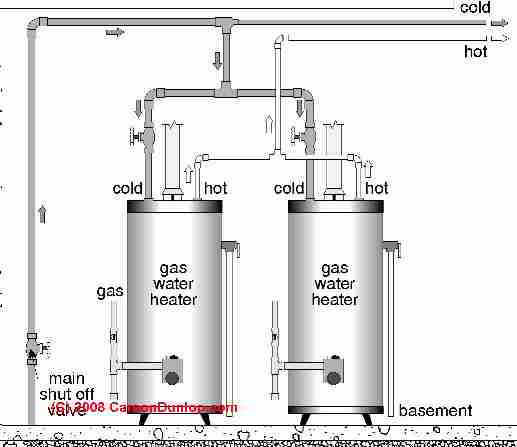
As Carson Dunlop Associates ' illustration (left) shows, one way to improve hot quantity in a building is by hooking up more than one water heater, in parallel or in series.
The articles listed below offer more details about steps one can take to increase hot water quantity, pressure, and flow in a building.
Below we list hot water quantity, pressure & flow problem diagnosis, repair, and improvement articles. For each item we describe how the topic pertains to hot water quantity, pressure, or flow complaints.
The list below is in alphabetic order, not in order of priority of things to try.
Diagnosis and repair for hot water temperature and more about hot water pressure are explained separately
- ALTERNATIVE HOT WATER SOURCES - besides electric, gas, oil, solar, indirect, & range boilers, are alternatives
- ANODES & DIP TUBES on WATER HEATERS discusses hot water tank sacrificial anodes and dip tubes whose problems can produce both sulphur smells, reduced hot water quantity (incoming cold at the wrong place in the tank is rapidly diluting outgoing hot) and even reduced hot water pressure and flow (debris from degraded tube clogs pipes) .
- ANTI_SCALD VALVES & HOT WATER QUANTITY - improve safety and meter hot water more slowly - makes it last longer.
- CLOGGED PIPING & Hot Water Flow - diagnose and correct poor hot water pressure and flow due to pipe clogging
- ELECTRIC WATER HEATERS - suggestions for inspection, diagnosis, repair
- EXTRA TANKS to INCREASE HOT WATER - pre-heat your hot water absorbing ambient building heat or increase hot water quantity with cascaded, staged, multiple water heaters, possibly using more than one energy source
- GAS FIRED WATER HEATERS - suggestions for inspection, diagnosis, repair
- GAS HEATERS, HIGH EFFICIENCY - if replacing a water heater, consider a model that saves money in operating cost
- HOT WATER CIRCULATOR PUMP SPEEDS DELIVERY - hot water pump and loop systems for instant hot water in large buildings. Ways to improve hot water quantity, pressure, and flow are discussed
beginning- HOT WATER IMPROVEMENTS and continuing at
- HOT WATER QUANTITY IMPROVEMENT and at
- HOT WATER PRESSURE IMPROVEMENT
Hot Water Usage Efficiency Improvements
Often efficiency improvements in hot water use (or production) include include recommendations for installing restrictions on the flow rate of hot water in a building (flow restrictors or restrictors combined with an anti-scald valve), either right at the fixtures, or at the water heating device. You are trading off total flow rate for reduced water heating costs.
- Change home appliances and plumbing fixtures
to install devices that consume less hot water. For example, replace showerheads that have a flow rate greater than 2.5 gallons per minute (the current National Energy Policy Act standard), with low flow shower heads.
Watch out: for increased hot water scalding burn risk hazards where low-flow shower heads are installed in homes without an anti-scald device.
See MIXING / ANTI-SCALD VALVE - How to take an efficient but nice and hot shower
especially for older fixtures that do not make use of a reduced-flow shower head, take shorter showers, and better still, use your shower more intelligently. Our daughter Mara used to start a shower by turning the hot water all the way on, to its fastest flow rate, then tempering the hot by turning on enough cold to avoid getting burned.
This gives a wonderful power, fast, huge water flow out of the shower head.
But if you instead turn the hot water, say just half way on, or fully on until water is hot, then backing it off to half-speed, you will need less cold mixed-in to make the shower comfortable, and you'll suck hot water out of your water heater at half the rate. - When replacing a clothes washer
install a models that uses less water by installing a high efficiency washing machine with a "low water factor" and always wash full loads rather than smaller loads in your washing machine - HOT WATER QUANTITY IMPROVEMENT -
this article on improving the quantity of hot water in buildings, includes this list of diagnostic and improvement articles and descriptions (below) of specific things you can do. - INDIRECT FIRED WATER HEATERS -
allow a larger tank of hot water, heated efficiently by a separate heating boiler. Larger tanks mean more hot water, especially if you are converting from a tankless coil. - INSULATE HOT WATER PIPING - worth doing where piping is accessible, especially on piping running through cool areas will improve temperature of the hot water where it is delivered.
By losing less heat as hot water moves from the water heater to the fixture, you are obtaining more hot water because you are wasting less heat (and hot water) just to heat up the pipes between the water heater and the fixture. - INSULATE HOT WATER TANK? -
probably not worth doing except in special cases; important safety warnings suggest not to even try this on modern water heaters. - LARGER DIAMETER WATER SUPPLY PIPING -
worth doing if you are replacing clogged pipes or building new construction, will increase the flow rate or perceived "pressure" at a plumbing fixture.
This can mean you actually use your hot water up faster, reducing the total hot water quantity available rather than increasing it.
So keep flow rate or "pressure" and quantity separate and clear when thinking about hot water supply. - MIXING / ANTI-SCALD VALVES -
can not only avoid scalding hot water dangers, but can meter hot water usage to give a longer bathing shower time. The flow rate can be the same (at lower temperature) or may be less, but the total time in the shower before you run out of hot water is increased.
So if "quantity" means "how long can I stay in the shower" rather than "how much shower water can I use", then a mixing valve increases the time in the shower. - MULTIPLE WATER HEATERS IN PARALLEL
to increase total hot water quantity - MULTIPLE WATER HEATERS IN SERIES
to stage hot water heating for varying levels of demand - OIL FIRED WATER HEATERS -
fast recovery water heaters, suggestions for inspection, diagnosis, repair - RANGE BOILER WATER HEATER
an older form of indirect-fired hot water heating used with separate heating boilers - SIDE ARM COIL WATER HEATER
similar to instantaneous and tankless coil water heaters, often used with range boilers - SOLAR HOT WATER HEATERS -
lower energy cost, effective hot water source in sunny climates - TANKLESS COIL HOT WATER INCREASE -
various tricks can significantly improve the safety and water quantity available - TANKLESS WATER HEATERS -
no hot water tank tank, no standby losses, just hot instant hot water, at various flow rates - WATER HEATER TEMPERATURE TOO COLD or TOO HOT
where to look for problems when the "hot water" is not hot enough - Water heater choices: The characteristics of various water heaters such as life expectancy, cost, safety, and capacity are discussed
at ALTERNATIVE WATER HEATER PROPERTIES - WATER HEATER SCALE DE-LIMING PROCEDURE
explains how mineral scale build-up in a water heater (or in building water piping) can result in both poor hot water quantity
and WATER HEATER SCALE PREVENTION
explains how to prevent lime and scale formation in water heating equipment - WATER HEATER SIZE SPECIFICATION & Capacity Charts or Tables
gives advice on choosing the water heating equipment size or capacity in gallons or flow rates for both residential and commercial buildings
For tankless or demand type water heating,
see TANKLESS WATER HEATER SIZE REQUIREMENTS
and see MULTIPLE GANGED TANKLESS WATER HEATERS - WATER PRESSURE LOSS DIAGNOSIS & REPAIR -
overall guide to improving building water pressure - WATER SOFTENERS & CONDITIONERS -
how to install and adjust a water softener to avoid hot water piping or tankless coil clogging due to hard water and minerals
Using Extra Tanks to Increase Hot Water Pressure, Flow, and Volume in a Building
As we illustrate with Carson Dunlop Associates' sketch, it is possible to install multiple active water heaters in a parallel design for simple increase in total hot water quantity, or these tanks could have been installed in series, leaving the first or up-stream tank turned off when less hot water need was anticipated.
Leaving a hot water tank turned "off" can still cut water heating costs a bit, as we discuss next.
Passive water pre-warming tank: Use a water tank or hot water tank or old water heater tank installed upstream from water entering the tankless coil (or primary water heating tank, whatever water heating method is used).
Remove insulation from the holding or staging tank. Water sitting in this tank will absorb water from the indoor environment and in most locales will be warmer than water coming directly from a well or municipal water supply.
Often people will simply salvage an old water tank and use it for this purpose. By pre-warming water headed for the tankless coil, the coil itself will not have to raise the water temperature as much as otherwise.
Thus when the occupants are drawing hot water in the building, heat will be drawn out of the heating boiler at the coil at a slower rate - you'll have more domestic hot water.
Active water pre-heating tank:
install a water heater (oil, gas, solar, electric) on the water piping upstream, that is, before water enters the tankless coil (or primary water heating tank, whatever water heating method is used).
This water tank can be left off when there is not much demand for hot water, in which case it will function as a passive water pre-warming tank as we discussed above. When a greater quantity of hot water is going to be needed (say many weekend visitors to a building), turn on the water heater to permit it to "boost" hot water headed for the tankless coil.
As occupants in the building draw hot water out of the system, heat will be drawn from the heating boiler and tankless coil at a very low rate, possibly not at all, until we've exhausted the hot water that was stored in the separate water heater tank.
Some people install this system backwards: hot water is fed from the tankless coil into a water heater tank. This is a much less efficient way to make hot water as all of the water entering the water heater tank will always cause the heating boiler to run. We do not recommend this arrangement.
See our discussion of MULTIPLE WATER HEATERS IN PARALLEL
and also MULTIPLE WATER HEATERS IN SERIES for more details regarding this approach to increasing hot water quantity.
Insulate Hot Water Supply Piping

Be sure that the hot water supply piping in the building has been insulated throughout its run.
In our photo at left our client is pointing out that foam insulation applied over the hot water pipe leaving the water heater was placed too close to the water heater draft hood. Spillage at the draft hood was melting the water pipe insulation - indicating an unsafe flue gas spillage problem.
The length of hot water supply pipe running between the building hot water source and the building faucet or fixture where hot water is being delivered will affect the temperature of water received there.
A long run of un-insulated hot water pipe will deliver cooler water than a well-insulated water supply pipe of any length.
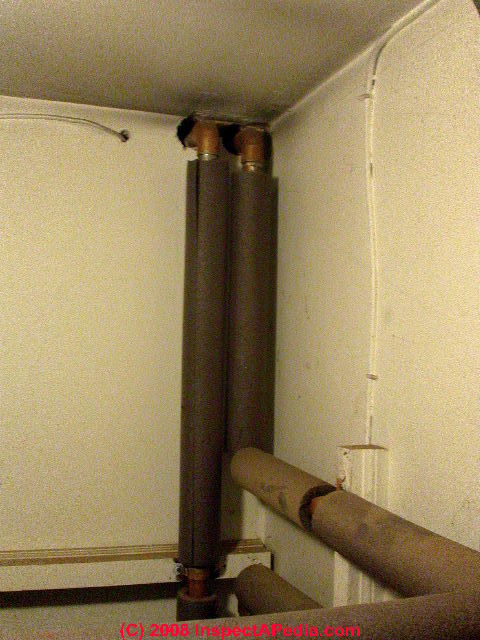
The reason that insulation on hot water piping increases the total hot water quantity (and temperature) is that the hot water is not giving up so much of its heat in the form of radiant losses during movement of hot water from the water tank to the destination plumbing fixture.
The foam insulation on hot water lines (or hot water heating pipes) in our photo at left is readily available at building supply stores.
This foam pipe insulation is purchased according to the diameter of the pipe it is going to cover. In residential applications that's usually 1/2" pipe or 3/4" copper or galvanized steel pipe. The insulation is split so that it can be simply pushed onto the pipe that is to be insulated.
We insulate hot water piping to minimize heat loss between the heater and the point of use.
We also like to insulate cold water piping in order to reduce condensation and dripping off of the cold water lines during warm humid weather.
Also see our advice and safety warnings about water tank insulation
Install Larger Diameter Water Supply Piping to Improve Hot Water Pressure & Flow
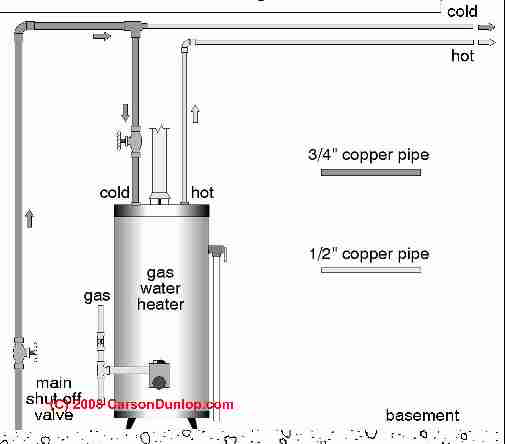
As we discussed at WATER PIPE CLOG REPAIR, and as we illustrate with Carson Dunlop Associates' sketch shown here, installing larger diameter water supply piping makes a large difference in the water flow rate.
In fact you can improve hot water flow in a building by replacing only part of the supply piping - perhaps that portion which is easily accessible. Installing larger water supply piping feeding the water heater may alone improve the hot water pressure and flow in the building.
Watch out: if your hot water is provided by a tankless coil, increasing water pipe diameter may not be of much use, and it could make matters worse!
A tankless coil (and also an instantaneous water heater) is normally rated by its manufacturer as capable of increasing water temperature to a desired level only if water flow through the coil is limited to a specific rate, perhaps 5 gpm. Flowing water through the tankless coil or instantaneous water heater too fast will mean that the water temperature may be too low at the fixture.
In sum, larger diameter piping increases water pressure and flow. It does not increase the total volume of hot water that is available from a water heater. This improvement may be of most value where water pressure is poor and where water piping has previously become clogged by rust or mineral deposits.
You may regain some of this loss by insulating hot water supply piping or by setting water heater or boiler temperatures higher as well as by an adjustment at
Water Heater Size Requirements & Specifications
How to determine the size of water heating equipment needed for a residential or commercial building. This topic has been moved to a separte article found
at WATER HEATER SIZE SPECIFICATION
For tankless or demand type water heating,
see TANKLESS WATER HEATER SIZE REQUIREMENTS
and see MULTIPLE GANGED TANKLESS WATER HEATERS
Reader Comments, Questions & Answers About The Article Above
Below you will find questions and answers previously posted on this page at its page bottom reader comment box.
Reader Q&A - also see RECOMMENDED ARTICLES & FAQs
Impact of Changing Pipe Diameter on Water Flow Rate
Reader Question: how much water pressure will we lose if we replace copper pipe with PEX of the same nominal size
I have municipal water and a combination furnace. The bathroom shower has separate hot and cold faucets and a diverter from tub spout to shower head. Recently I noticed that I was using less and less cold water to moderate the hot but only in the shower. The hot in the bathroom sink was still scalding so I knew it wasn't the thermostatic control valve at the furnace.
The only thing I could think it could be was the shower control unit. My thought was that even though the cold was off there was still some cold water somehow mixing with the hot. It had got to the point where you could comfortably take a shower just in hot water while the hot in the sink would scald my hand after a second. The only logical explanation I could come up with was a failing control as suggested above.
So I have cut out the old unit and replaced it with a Glacier Bay (Home Depot) similar unit. I also replaced the cut out copper with pex and used shark bite fittings to complete the job.
Well, the hot water problem has gone but now I have lower pressure from the shower. I haven't changed the shower head itself, just a few feet of copper to pex, shark bites instead of soldered unions and the fitting itself. I can't say if the tub spout has also been negatively affected.
Do shark bites or pex piping reduce flow ?
Could the new fitting reduce flow, after all, it's a cheapo from Home depot ?
If the water is too hot, should I adjust the thermostatic control at the furnace so I can turn the hot water up in the shower and so increase the volume at the shower head ? That said, it was higher pressure in the old unit so where has that pressure gone ?
Reply:
If the internal diameter of the Pex piping wer as large or larger than the piping that you removed and I would not expect it to make a difference in the flow rate. But of course we know PEX has a smaller ID than copper of the same nominal size.
Generally, before ripping out the PEX you may want to be sure other easier obvious fixes have been done.
Have you checked the shower head itself?
See
SHARKBITE INSTALLATION GUIDE [PDF] (2018) Reliance Worldwide Corporation 2300 Defoor Hills Rd NW, Atlanta, GA 30318 Phone: 1-877-700-4242 Fax: 1-877-700-4280 rwc.com Reliance Worldwide Corporation (Canada) Inc. 74 Alex Avenue Vaughan, Ontario, L4L 5X1 Phone: 1-888-820-0120 Sales Inquiries: canadasales@rwc.com Orders: canadaorders@rwc.com retrieved 2019/08/13 original source: https://www.sharkbite.com/sites/g/files/rgohfh321/files/2018-05/SharkBite_Installation_Instructions_2018_WEB.p
Reader follow-up:
2020/01/02 Will said:
I have not, it didn't really make sense to me that when changing the fitting the shower would lose pressure because of a part I didn't change.
I'll put a new one on tonight and report back :-)
Also, PEX 1/2" seems to maybe have a slightly smaller internal diameter than copper 1/2" due to the thickness of the pipe wall.
Moderator reply: Calculating the reduction in pipe cross-sectional area when changing from Copper to PEX = Reduction in Water Flow Rate
Will
Thank you for asking a great question: how much difference to water flow does changing from Copper to PEX make if the nominal pipe sizes remain the same.
At WATER PIPE CLOG REPAIR we explain that as illustrated with Carson Dunlop Associates' sketch, installing larger diameter water supply piping makes a big difference in the water flow rate.
I am (sorry to say) far too familiar with the effects on water flow rate (popularly called "water pressure") of reductions in the diameter of a supply pipe, thanks to a lazy local Poughkeepsie plumber who used 1/2" instead of 3/4" ID PEX on a job.
That reduction in diameter when changing to PEX or when including ANY PEX in the piping run can show up as a complaint of a weaker shower flow just as you’ve suggested.
In general, the greater the percentage of smaller diameter piping in a water system the greater the reduction in flow rate, all other factors (such as pressure, total piping length, number of elbows, valves, etc. ) remaining the same).
The ID of copper pipes is ROUGHLY 1/8 less than the OD. But the actual copper piping inside diameter (ID) number varies as across types L and M the OD stays the same.
"Type K tube has thicker walls than Type L tube, and Type L walls are thicker than Type M, for any given diameter. All inside diameters depend on tube size and wall thickness." - copper.org cited below
- Nominal 1/2” K Copper: OD: 0.625” ID: 0.527” Wall: 0.49” Cross-Sectional Area: 0.218”
- Nominal 3/4” K Copper: OD: 0.875” ID: 0.745” Wall: 0.65” Cross-Sectional Area: 0.436”
- Nominal 1/2” PEX: OD: 0.625” (same as copper), ID: 0.485” (0.005” smaller than copper), Wall: 0.70” Cross-sectional area: (pi r squared = area of a circle & r= 1/2 diameter): (3.1416 x 0.2425 (squared)) = 0.185”
- Nominal 3/4" PEX: OD: 0.875” (same as copper), ID: 0.681” (0.064” smaller than copper), Wall: 0.097” Cross-sectional area: .364”
Percent decrease in cross sectional area going from copper to PEX
Percent decrease in cross sectional area going from copper to PEX is about the same as the percent reduction in water flow through the piping, if all other factors are kept equal:
- 1/2” PEX = 15% less cross-sectional area & flow rate than 1/2” copper [ 1 - (0.185 / 0.218) x 100 ]
- 3/4” PEX = 16% less cross-sectional area & flow rate than 3/4” copper [ 1 - (0.364 / 0.436) x 100 ]
Pressure Drop When Using a Smaller Pipe Size
Pexuniverse gives nominal pressure drosp in psi per 100 ft. of tubing length for several flow rates from which we excerpt below.
At Flow Rate of 1 GPM
- 1/2” PEX has a pressure drop of 1.70 gpm per 100 ft. of run
- 3/4” PEX has a pressure drop of 0.34 gpm per 100 ft. of run.
This is very significant as it illustrates that a reduction of 1/4" in the ID of PEX going from 3/4" down to 1/2" tubing will give a net change in pressure drop of (1.70 - 0.34) or 1.36 gpm over a 100 foot run (all else unchanged).
That's a 400% greater pressure drop per 100 ft. of run when going to one nominal smaller pipe diameter smaller. The numbers for copper piping pressure drop as diameter changes will be similar.
Resources:
- ASTM-F876 “Crosslinked Polyethylene (PEX) Tubing
- COPPER TUBE HANDBOOK [PDF] at inspectapedia.com Copper Development Association, Inc., 7918 Jones Branch Dr., Suite 300, McLean VA 22102 USA Website: https://www.copper.org/ Original source: https://www.copper.org/publications/pub_list/pdf/copper_tube_handbook.pdf
- LARGER DIAMETER WATER SUPPLY PIPING - worth doing if replacing clogged pipes or building new construction, will increase the flow rate or perceived "pressure" at a plumbing fixture.
- PEX TUBING TECHNICAL SPECIFICATIONS [PDF] PEX Universe.com (Sales of PEX tubing) Tel: 800-818-3201 original source: https://www.pexuniverse.com/pex-tubing-technical-specs
- WATER FLOW RATE CALCULATE or MEASURE
On 2020-11-07 by Christo C - ok to reduce pipe size at water heater?
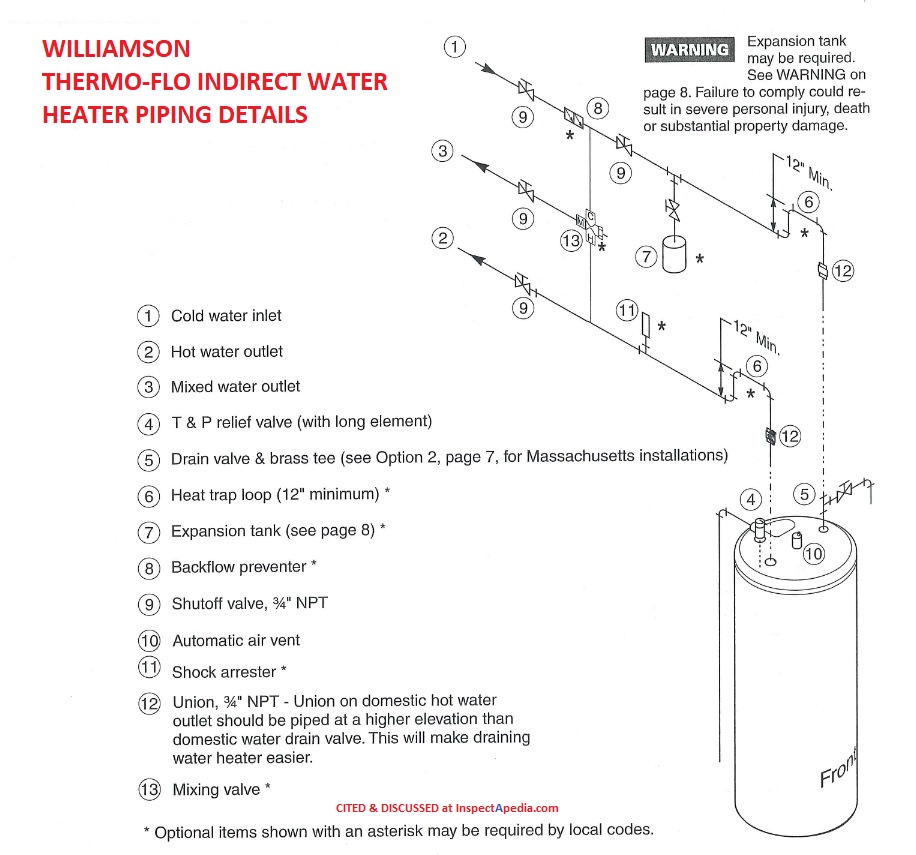 I’m replacing an indirect water heater that lasted 30 yrs. The house is a 4 bedroom colonial in northeast fueled by oil and a boiler.
The boiler supply and return lines are both 3/4 piping, but all the 45+gal indirect options have 1” boiler connections. Is it a problem to put reducers at the tank?
Will this interfere with flow or recovery or efficiency?
On 2020-11-07 by (mod) - 3/4" pipe diameter OK on indirect water heaters
Christo
My OPINION is that if the indirect water heater is being heated by a coil through which water is pushed by a circulator pump you should be able to use a reducer to go from 1" to 3/4" - though even then I'd want a careful review of the manufacturer's installation instructions on piping requirements.
Some older hot water systems relied on gravity to heat the indirect hot water tank- those may not work properly if piping is constricted.
At least some indirect water heater manuals don't even mention pipe diameter, such as this
ECR H2O INDIRECT WATER HEATER INSTALLATION MANUAL [PDF] ECR International, Inc 2201 Dwyer Avenue, Utica NY 13504-4729web site: www.ecrinternational.com
and this
WILLIAMSON THERMO-FLO INDIRECT WATER HEATER MANUAL [PDF] W.T. Manufacturing, 8201 W. Calumet Rd., Milwaukee WI 53233 Tel: 800-736-BEST
from which the indirect water heater piping illustration below is excerpted.Here is an older BRADFORD WHITE PowerCor INDIRECT WATER HEATER IO MANUAL [PDF]
Watch out: of course it's critical to consult the IO manual for your specific indirect water heater brand and model.
If you don't have the Installation and Operation manual give me the brand and model and if we don't already have it in our downloads sectionat WATER HEATER AGE & MANUALS - home
On 2016-12-28 by Sandy smith - where is the on-off switch on a water heater?
Where on the water heater do you get the hot water-is there a button or something you can turn on?
On 2016-12-28 - by (mod) -
Sandy:
If your water heater is electric there will be one or two adjustable thermostats behind access covers on the heater - watch out: touching live electrical components in there can kill you.
If your water heater is gas-fired the temperature setting is usually on the gas control.
If your water heater is an oil fired unit the temperature setting is on the aquastat or limit control.
Watch out: setting temperatures too high risks scalding burns. Search InspectApedia.com for ANTI SCALD VALVES to read more details.
Search InspectApedia.com for MORE HOT WATER to see other ways to improve the amount or temperature of your hot water.
On 2016-05-23 by Andrew Barnes - how do I know how much hot water is in the water heater & how hot it is?
Is there a device for telling how hot the hot water is in your hot water tank and also how much water there is, or is the 2nd part a function of the first based upon volume?
On 2016-06-01 - by (mod) -
1 measure water temp at the tap
2 Infra Red scan pipe temp anywhere enroute
3 install an in line temp gauge at the water tank hot water line above the tank
4 some tanks may have an extra tank top tapping where a gauge can be installed
...
Continue reading at ALTERNATIVE HOT WATER SOURCES or select a topic from the closely-related articles below, or see the complete ARTICLE INDEX.
Or see these
Recommended Articles
- HOT WATER IMPROVEMENTS - home
- ALTERNATIVE HOT WATER SOURCES
- GAS HEATERS, HIGH EFFICIENCY
- HOT WATER CIRCULATOR PUMP SPEEDS DELIVERY
- HOT WATER EFFICIENCY IMPROVEMENT
- HOT WATER PRESSURE IMPROVEMENT
- HOT WATER PRESSURE LOSS
- HOT WATER QUANTITY IMPROVEMENT
- INSULATE HOT WATER TANK?
- MULTIPLE GANGED TANKLESS WATER HEATERS
- TANKLESS WATER HEATERS
- WATER CONSERVATION MEASURES
- WATER HEATER COMPARISONS, PROPERTIES
- WATER HEATER PIPING
- WATER HEATER PROBLEM DIAGNOSIS
- WATER HEATER SIZE SPECIFICATION
- WATER HEATER STANDBY LOSSES
- WATER HEATER TEMPERATURE TOO COLD or TOO HOT
Suggested citation for this web page
HOT WATER QUANTITY IMPROVEMENT at InspectApedia.com - online encyclopedia of building & environmental inspection, testing, diagnosis, repair, & problem prevention advice.
Or see this
INDEX to RELATED ARTICLES: ARTICLE INDEX to WATER HEATERS
Or use the SEARCH BOX found below to Ask a Question or Search InspectApedia
Ask a Question or Search InspectApedia
Questions & answers or comments about how to improve hot water quantity and flow rate from a residential hot water heating system.
Try the search box just below, or if you prefer, post a question or comment in the Comments box below and we will respond promptly.
Search the InspectApedia website
Note: appearance of your Comment below may be delayed: if your comment contains an image, photograph, web link, or text that looks to the software as if it might be a web link, your posting will appear after it has been approved by a moderator. Apologies for the delay.
Only one image can be added per comment but you can post as many comments, and therefore images, as you like.
You will not receive a notification when a response to your question has been posted.
Please bookmark this page to make it easy for you to check back for our response.
Our Comment Box is provided by Countable Web Productions countable.ca
Citations & References
In addition to any citations in the article above, a full list is available on request.
- Thanks to Alan Carson and Bob Dunlop, Carson Dunlop, Associates, Toronto, for permission to use illustrations from their publication, The Illustrated Home which illustrates construction details and building components. Carson Dunlop provides home inspection education, publications, report writing materials, and home inspection services. Alan Carson is a past president of ASHI, the American Society of Home Inspectors.
- Arlene Puentes [Website: www.octoberhome.com ] , an ASHI member and a licensed home inspector in Kingston, NY, and has served on ASHI national committees as well as HVASHI Chapter President. Ms. Puentes can be contacted at ap@octoberhome.com Thanks to reader J. for discussing hot water tank quantity, temperature, and performance - January 2011
- AO Smith produces AO Smith water heaters in addition to Reliance, State, Maytag and others.
www.aosmith.com/prod/wpc.htm AOS's gas water heater manuals offering advice and safety warnings about adding water heater insulation are available at
www.statewaterheaters.com/lit/im/res-Elec/184671-000.pdf and at
www.hotwater.com/lit/im/res_gas/184123-000.pdf - Rheem who also makes electric water heaters provides a manual for electric water heaters at
waterheating.rheem.com/content/resources/documents/use_care/ResElecProfessional.pdf. Rheem says, as do other water heater producers, that their water heaters meet the "National Appliance Energy Conservation Act standards with respect to insulation and standby loss requirements making an insulation blanket unnecessary"
Rheem also warns consumers that adding an insulation product [or making any other modification to their equipment] is likely to void the product warranty and may be unsafe:
"The manufacturer’s warranty does not cover any damage or defect caused by installation, attachment or use of any type of energy saving or other unapproved devices (other than those authorized by the manufacturer) into, onto or in conjunction with the water heater. The use of unauthorized energy saving devices may shorten the life of the water heater and may endanger life and property. The manufacturer disclaims any responsibility for such loss or injury resulting from the use of such unauthorized devices " - Our recommended books about building & mechanical systems design, inspection, problem diagnosis, and repair, and about indoor environment and IAQ testing, diagnosis, and cleanup are at the InspectAPedia Bookstore. Also see our Book Reviews - InspectAPedia.
- Carbon Monoxide Gas Toxicity, exposure limits, poisoning symptoms, and inspecting buildings for CO hazards
- Carson Dunlop, Associates, Toronto, have provided us with (and we recommend) Carson Dunlop Weldon & Associates'Technical Reference Guide to manufacturer's model and serial number information for heating and cooling equipment
Special Offer: Carson Dunlop Associates offers InspectAPedia readers in the U.S.A. a 5% discount on any number of copies of the Technical Reference Guide purchased as a single order. Just enter INSPECTATRG in the order payment page "Promo/Redemption" space.HOT WATER HEATERS - a detailed guide to all types of hot water sources, problems, inspection, repair - Water Pressure Loss - Diagnosis how to determine why water pressure has been lost or why there is no water at all in a building
- In addition to citations & references found in this article, see the research citations given at the end of the related articles found at our suggested
CONTINUE READING or RECOMMENDED ARTICLES.
- Carson, Dunlop & Associates Ltd., 120 Carlton Street Suite 407, Toronto ON M5A 4K2. Tel: (416) 964-9415 1-800-268-7070 Email: info@carsondunlop.com. Alan Carson is a past president of ASHI, the American Society of Home Inspectors.
Thanks to Alan Carson and Bob Dunlop, for permission for InspectAPedia to use text excerpts from The HOME REFERENCE BOOK - the Encyclopedia of Homes and to use illustrations from The ILLUSTRATED HOME .
Carson Dunlop Associates provides extensive home inspection education and report writing material. In gratitude we provide links to tsome Carson Dunlop Associates products and services.
 | HOME | ABOUT | ASK a QUESTION | CONTACT | CONTENT USE POLICY | DESCRIPTION | POLICIES | PRIVACY | |
| © 2024 - 1985 Publisher InspectApedia.com - Daniel Friedman | |||||||||