
InspectAPedia® FREE Encyclopedia of Building & Environmental Construction, Diagnosis, Maintenance & Repair |
Question? Just ask us! InspectAPedia
|
 Guide to Alternative Hot Water Sources
how to choose among different ways to make domestic hot water
- POST a QUESTION or COMMENT about alternative ways to make domestic hot water
This article describes alternative methods of providing domestic hot water, comparing the characteristics of various hot water heating methods and describing different ways to heat water for washing and bathing.
Whether you make your building hot water using a water heater, geyser, or hot water cylinder, there are alternative methods that can dramatically change the hot water quantity, pressure, flow rate, and operating cost.
InspectAPedia tolerates no conflicts of interest. We have no relationship with advertisers, products, or services discussed at this website.
A Comparison of Alternative Hot Water Heaters & Sources
 Thanks to Carson Dunlop Associates, a Toronto Home Inspection Firm and Home Inspection Educator, for permission to use sketches shown in this article.
There are easy steps one can take to determine why the hot water pressure or quantity in a building are inadequate. We discussed tankless coils for making hot water, anti scald valves, and the problem of clogged hot water piping or clogged tankless coils.
Then we discussed steps to increase hot water quantity such as insulating water piping and water tanks, and the use of extra tanks to pre-warm or store hot water.
Before you start fixing or buying stuff to fix a hot water problem hot water problems and diagnostic guides for all kinds of hot water troubles are summarized
at WATER HEATER PROBLEM DIAGNOSIS. You might want to check there to be sure you're fixing the right problem.
Below we describe some alternative ways to make hot water, either to replace or to supplement an existing hot water supply system. After knowing what the hot water problem really is, there are steps we can take to get more hot water or to increase hot water pressure.
Ways to improve total hot water quantity, pressure, temperature and flow are discussed beginning
at HOT WATER IMPROVEMENTS
and continuing
at HOT WATER QUANTITY IMPROVEMENT. Here we provide links to articles describing alternative methods for obtaining hot water or for obtaining improved quantity of hot water at buildings.
The following articles discuss alternative ways to produce domestic hot water for washing and bathing.
- ELECTRIC WATER HEATERS: if you have no hot water or insufficient hot water, check that the electric water heater power is on - check the water heater switch as well as other fuses or circuit breakers that control the heater.
If the water heater has power, check that the water heater electrodes have not been damaged.
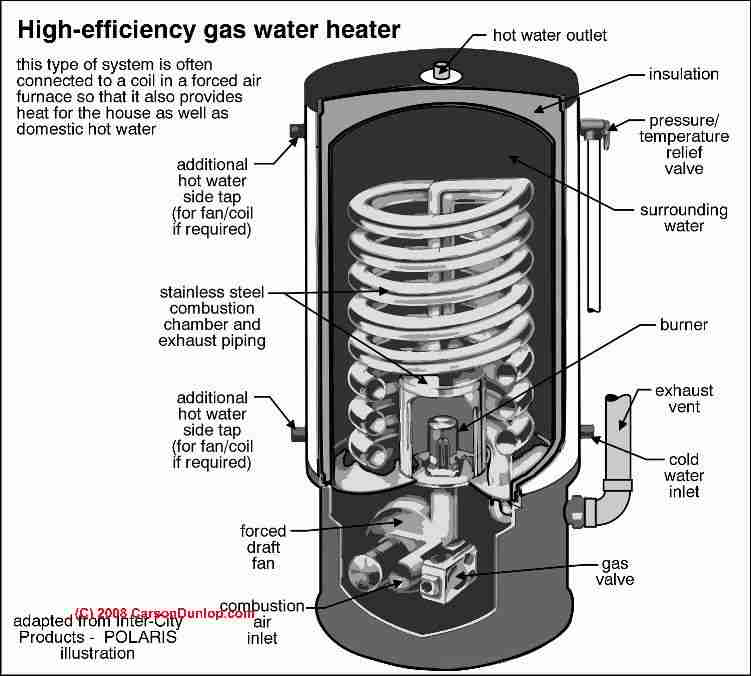
Finally, check the water heater and its heating elements for scale deposits. - HIGH EFFICIENCY WATER HEATERS such as direct-vent gas-fired water heaters
- INDIRECT-FIRED WATER HEATERS which use a separate heating boiler to produce a larger quantity of hot water
- INSTANTANEOUS WATER HEATERS point of use systems that have little or no standby energy losses, demand water heaters
- MULTIPLE WATER HEATERS in PARALLEL to increase total hot water quantity
- MULTIPLE WATER HEATERS in SERIES to stage hot water heating for varying levels of demand
- RANGE BOILER WATER HEATER an older form of indirect-fired hot water heating used with separate heating boilers
- SCALE MINERAL DEPOSITES LIME deposits in water heaterrs reduce hot water quantity: because scale, mineral deposits, lime, and silt in any water heater, and certainly scale on electric water heating elements can reduce the amount of hot water available as well as slowing water heater recovery time,
see WATER HEATER NOISE DIAGNOSIS, CURE where we describe de liming and scaling in water heaters. - SIDE ARM COIL WATER HEATER similar to instantaneous and tankless coil water heaters, often used with range boilers
- SOLAR WATER HEATERS using solar collectors, an indoor water tank, pump and controls, using minimal "on-grid" energy
- TANKLESS COIL HOT WATER INCREASE a heat exchanging coil immersed inside of a heating boiler heats provides (somewhat limited) hot water. various tricks can significantly improve the safety and water quantity available
- TANKLESS WATER HEATERS for instant hot water and tankless coil heaters
The characteristics of various water heaters such as life expectancy, cost, safety, and capacity are discussed at
WATER HEATER COMPARISONS, PROPERTIES
Described at WATER HEATER NOISE
we explain that Scale, mineral deposits, lime reduce hot water quantity: because scale, mineral deposits, lime, and silt in any water heater, and certainly scale on electric water heating elements can reduce the amount of hot water available as well as slowing water heater recovery time,
see WATER HEATER SCALE DE-LIMING PROCEDURE where we describe deliming and scaling in water heaters.
Multiple Hot Water Sources? How to Use Separate Oil, Gas, or Electric, Solar, Wind, or Combination-fuel Water Heaters for More Hot Water
Separate water heaters can provide more hot water than a tankless coil in most cases and choices among water heater types by fuel, size, recovery rate, etc. can make a big difference in the hot water quantity, pressure, flow, and cost at a building. This article explains some alternative water heating methods.
Use Instantaneous Water Heaters for Increased Hot Water Supply
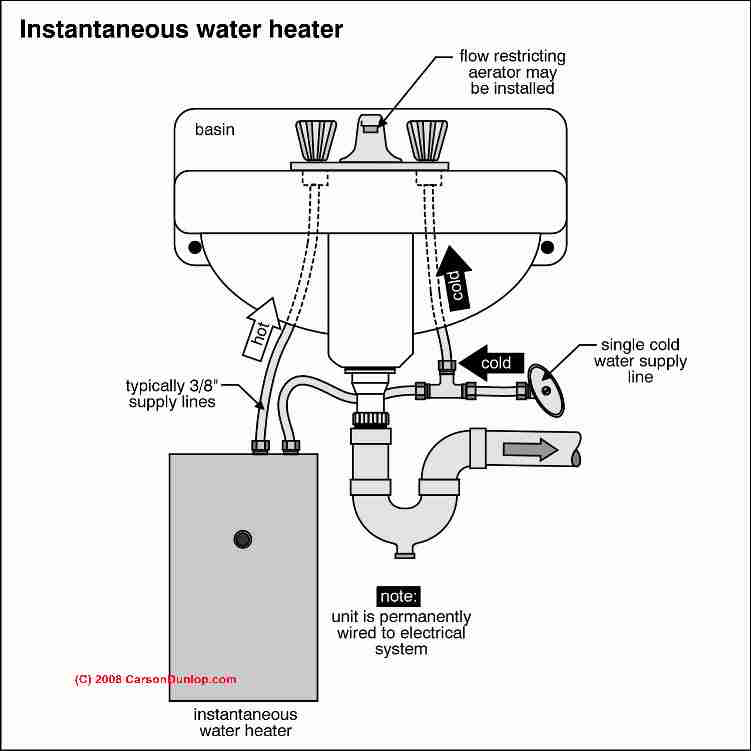
Installing an instantaneous water heaters are usually installed as a 'point-of-use' hot water system. You can see the basic appearance of a point-of-use instantaneous water heater in the sketch at left, provided courtesy of Carson Dunlop Associates, a Toronto home inspection, education & report writing tool company [ carsondunlop.com ].
For example an instantaneous water heater, electric or gas fired, may be installed at a single kitchen or bathroom.
In the U.S. and Canada, this is an approach to providing hot water that is usually applied where the total hot water delivery rate needed is modest or where only a limited number of fixtures need to be supplied with hot water.
Higher-capacity instantaneous water heaters are available, and in countries where people use water more modestly, these systems are sometimes installed as the only hot water supply.
How to connect multiple water heaters in parallel to increase total hot water quantity
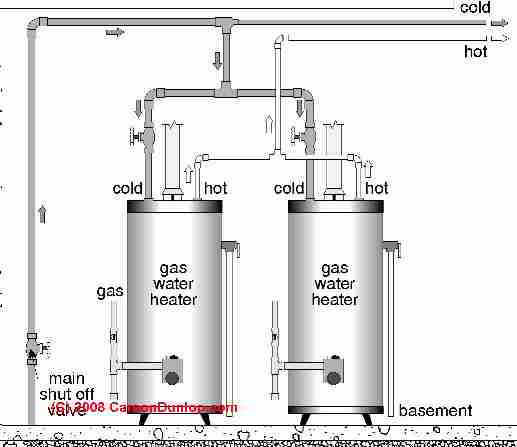
Where hot water volume requirements are high, in addition to installing a single larger-capacity water heater, one can install a several water heaters connected in parallel. You can see this design in our sketch at left, provided courtesy of Carson Dunlop Associates, a Toronto home inspection, education & report writing tool company [ carsondunlop.com ].
Parallel water heaters means that all of them are "on" and heating water at the same time, providing a very large quantity of hot water to the building.
We see this installation most often when building occupants find that they do not have enough hot water but their present water heater is in good condition.
Rather than scrapping a perfectly good water heater to install a single larger unit, a second water heater is simply added, installed in parallel to the first one.
How to increase hot water quantity using multiple water heaters in series for lower hot water cost
Some buildings use water heaters installed in series to handle variations in hot water demand more economically.
Unlike the illustration of parallel water heaters shown above, water heaters connected in series means that incoming cold water flows first into heater #1, then out of heater #1 into heater #2, then out of heater #2 into the building hot water supply piping (or into additional water heaters if more than two are used.)
A synonym for water heaters connected in series is a cascaded water heater design. Cascaded or in-series water heaters is an economical way to handle large variations in hot water demand in a building.
- When the anticipated hot water demand is low, only water heater #2 may be running.
- When the anticipated hot water demand is high, water heater #1 is turned on as well, doubling the volume of hot water available (if the heaters are of the same capacity in gallons or liters).
- Water heater controls can be adjusted so that the "upstream" water heater, (water heater #1 in our example), is left turned off or perhaps set to a very low temperature. In either of these cases, the upstream water heater or tank functions as a "booster water warmer" reducing the energy use by water heater #2 by pre-warming water entering the active heater#2.
See EXTRA TANKS to INCREASE HOT WATER for more discussion of extra tanks to provide more hot water.
Use of a Side Arm Coil to Make Hot Water from a Heating Boiler
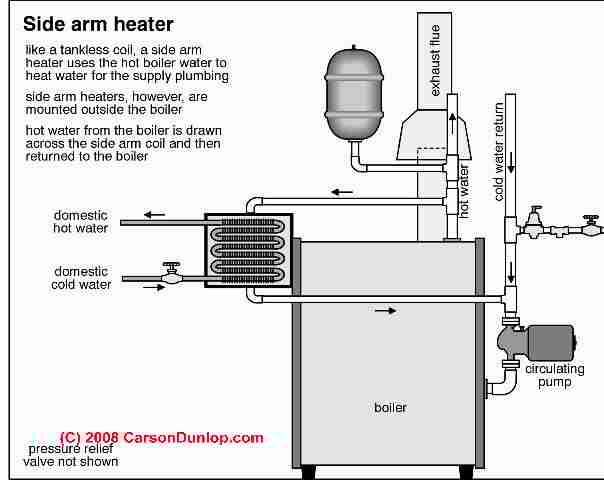
As the sketch at left shows (courtesy of Carson Dunlop Associates ), a side arm coil is a variation on the tankless coil (inside the boiler) discussed
at TANKLESS COILS where we explain how these work and what goes wrong,
and further at TANKLESS COIL FOR HOT WATER INCREASE where we describe how to get more hot water from a tankless coil.
A side arm coil is quite similar to an in-boiler tankless coil except that it is located outside of the the heating boiler itself.
We found this system common on older home heating systems such as those using a GE down-fire heating boiler or other boilers whose original design did not include an opening and fittings to mount the tankless coil right into the boiler itself.
For setting the hot water temperature for a side-arm coil system
see SIDE ARM COIL HOT WATER TEMPERATURE CONTROL
Also see WATER SOFTENERS & CONDITIONERS - how to install and adjust a water softener to avoid hot water piping or tankless coil clogging due to hard water and minerals - since a side arm coil can also become clogged by the minerals in hard water.
...
Continue reading at HOT WATER EFFICIENCY IMPROVEMENT or select a topic from the closely-related articles below, or see the complete ARTICLE INDEX.
Or see these
Recommended Articles
- HOT WATER IMPROVEMENTS - home
- ALTERNATIVE HOT WATER SOURCES
- GAS HEATERS, HIGH EFFICIENCY
- HOT WATER CIRCULATOR PUMP SPEEDS DELIVERY
- HOT WATER EFFICIENCY IMPROVEMENT
- HOT WATER PRESSURE IMPROVEMENT
- HOT WATER PRESSURE LOSS
- HOT WATER QUANTITY IMPROVEMENT
- INSULATE HOT WATER TANK?
- MULTIPLE GANGED TANKLESS WATER HEATERS
- TANKLESS WATER HEATERS
- WATER CONSERVATION MEASURES
- WATER HEATER COMPARISONS, PROPERTIES
- WATER HEATER SIZE SPECIFICATION
- WATER HEATER STANDBY LOSSES
- WATER HEATER TEMPERATURE ADJUSTMENT CONTROLS
Suggested citation for this web page
ALTERNATIVE HOT WATER SOURCES at InspectApedia.com - online encyclopedia of building & environmental inspection, testing, diagnosis, repair, & problem prevention advice.
Or see this
INDEX to RELATED ARTICLES: ARTICLE INDEX to WATER HEATERS
Or use the SEARCH BOX found below to Ask a Question or Search InspectApedia
Ask a Question or Search InspectApedia
Questions & answers or comments about alternative ways to make domestic hot water
Try the search box just below, or if you prefer, post a question or comment in the Comments box below and we will respond promptly.
Search the InspectApedia website
Note: appearance of your Comment below may be delayed: if your comment contains an image, photograph, web link, or text that looks to the software as if it might be a web link, your posting will appear after it has been approved by a moderator. Apologies for the delay.
Only one image can be added per comment but you can post as many comments, and therefore images, as you like.
You will not receive a notification when a response to your question has been posted.
Please bookmark this page to make it easy for you to check back for our response.
Our Comment Box is provided by Countable Web Productions countable.ca
Citations & References
In addition to any citations in the article above, a full list is available on request.
- Mark Cramer Inspection Services Mark Cramer, Tampa Florida, Mr. Cramer is a past president of ASHI, the American Society of Home Inspectors and is a Florida home inspector and home inspection educator. Mr. Cramer serves on the ASHI Home Inspection Standards. Contact Mark Cramer at: 727-595-4211 mark@BestTampaInspector.com
- John Cranor [Website: /www.house-whisperer.com ] is an ASHI member and a home inspector (The House Whisperer) is located in Glen Allen, VA 23060. He is also a contributor to InspectApedia.com in several technical areas such as plumbing and appliances (dryer vents). Contact Mr. Cranor at 804-873-8534 or by Email: johncranor@verizon.net
- Carbon Monoxide Gas Toxicity, exposure limits, poisoning symptoms, and inspecting buildings for CO hazards
- HOT WATER HEATERS - a detailed guide to all types of hot water sources, problems, inspection, repair
- Water Pressure Loss - Diagnosis how to determine why water pressure has been lost or why there is no water at all in a building
- WATER PUMP REPAIR GUIDE an specific case offers an example of diagnosis of loss of water pressure, loss of water, and analyzes the actual repair cost
- Carson Dunlop, Associates, Toronto, have provided us with (and we recommend) Carson Dunlop Weldon & Associates'Technical Reference Guide to manufacturer's model and serial number information for heating and cooling equipment
Special Offer: Carson Dunlop Associates offers InspectAPedia readers in the U.S.A. a 5% discount on any number of copies of the Technical Reference Guide purchased as a single order. Just enter INSPECTATRG in the order payment page "Promo/Redemption" space. - Water pressure tank failures & water pump short cycling diagnosis and repair
- In addition to citations & references found in this article, see the research citations given at the end of the related articles found at our suggested
CONTINUE READING or RECOMMENDED ARTICLES.
- Carson, Dunlop & Associates Ltd., 120 Carlton Street Suite 407, Toronto ON M5A 4K2. Tel: (416) 964-9415 1-800-268-7070 Email: info@carsondunlop.com. Alan Carson is a past president of ASHI, the American Society of Home Inspectors.
Thanks to Alan Carson and Bob Dunlop, for permission for InspectAPedia to use text excerpts from The HOME REFERENCE BOOK - the Encyclopedia of Homes and to use illustrations from The ILLUSTRATED HOME .
Carson Dunlop Associates provides extensive home inspection education and report writing material. In gratitude we provide links to tsome Carson Dunlop Associates products and services.
 | HOME | ABOUT | ASK a QUESTION | CONTACT | CONTENT USE POLICY | DESCRIPTION | POLICIES | PRIVACY | |
| © 2024 - 1985 Publisher InspectApedia.com - Daniel Friedman | |||||||||