
InspectAPedia® FREE Encyclopedia of Building & Environmental Construction, Diagnosis, Maintenance & Repair |
Question? Just ask us! InspectAPedia
|
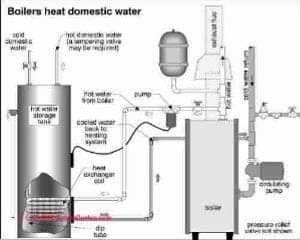 Guide to Indirect-Fired Hot Water Heaters
Indirect calorifier, geyser, hot water cylinder, hot water tank

- POST a QUESTION or COMMENT about indirect-fired hot water heaters
Indirect water heater definition, properties, plumbing, controls, efficiency & manuals.
Here we define and explain indirect-fired hot water heaters, describing the characteristics & advantages of this method for making domestic hot water where a gas or oil fired heating boiler is installed.
InspectAPedia tolerates no conflicts of interest. We have no relationship with advertisers, products, or services discussed at this website.
How & Why to Install an Indirect-fired Water Heater - get more hot water
 Thanks to Carson Dunlop Associates, a Toronto Home Inspection Firm and Home Inspection Educator, for permission to use sketches shown in this article.
Below we describe some alternative ways to make hot water by using an indirect water heater or on older systems a range boiler water heater, either to replace or to supplement an existing hot water supply system.
After knowing what the hot water problem really is, there are steps we can take to get more hot water or to increase hot water pressure. Here we explain how indirect water heaters and range boilers work.
[Click to enlarge any image]
Article Series Contents
- DEFINITION of INDIRECT WATER HEATER
- INDIRECT WATER HEATER COIL LEAKS INTO the BOILER
- INDIRECT WATER HEATER PLUMBING CONNECTIONS
- INDIRECT WATER HEATER TEMPERATURE CONTROLS
- INDIRECT WATER HEATER EFFICIENCY
- INDIRECT WATER HEATER LEAKS
- INDIRECT WATER HEATER REPAIR
- INDIRECT HOT WATER HEATER TEMPERATURE CONTROL
- INDIRECT WATER HEATER STANDBY LOSSES
Definitions of Indirect Water Heaters
As we explain at TANKLESS COILS, a conventional tankless coil system imbeds a finned copper tube coil inside of the hot heating boiler water, running domestic cold water through the tankless coil where physically separated boiler water heats the coil and thus heats water passing through the coil.
An indirect-fired water heater also uses a finned-copper tube coil in a different approach to providing more domestic hot water.
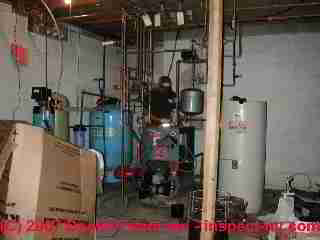
In our photo at above-left, the white Super Stor™ tank is an indirect-fired water heater. Water in this tank is heated by a plumbing loop circulating hot boiler water through a heating coil in the bottom of the Super Stor™ water heater tank.
Indirect fired water heaters: In some other buildings domestic hot water is produced by cycling hot water from a hydronic or steam boiler through a loop inside of a steel tank. The water in the tank is heated by the water in the coil.
Modern systems using this approach use the term indirect-fired water heater and such systems are sold by various companies such as the SuperStorTM unit shown here as the white tank to the right of the heating boiler.
At above-left you may also notice the WellXTrolTM blue water tank off to the left of the boiler as well as in the left foreground covered partly by a cardboard box we have a white-yellow fiberglass close to the thin blue vertical water softener - water treatment equipment in the same photo.
And just to be complete, the little tank over the boiler next to our service technician is the expansion tank for this heating boiler.
...
Plumbing Connections for an Indirect Fired Water Heater
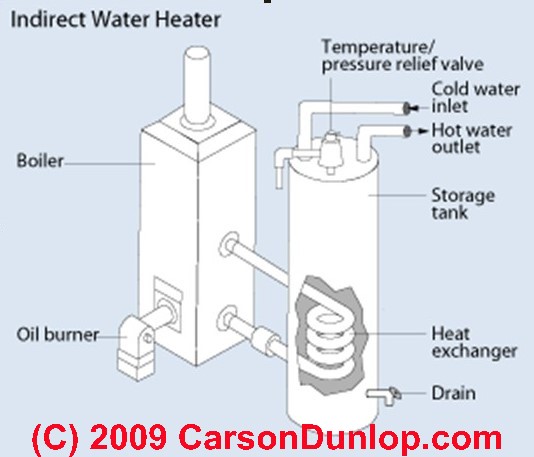 Indirect fired water heater tanks for domestic hot water, such as the SuperStorTM are usually located close to the heating boiler and will have both cold and hot water lines leaving the tank to supply the
building with domestic hot water and a loop of piping that runs between the [usually the] bottom of the tank and a nearby heating boiler.
Indirect fired water heater tanks for domestic hot water, such as the SuperStorTM are usually located close to the heating boiler and will have both cold and hot water lines leaving the tank to supply the
building with domestic hot water and a loop of piping that runs between the [usually the] bottom of the tank and a nearby heating boiler.
Follow the pipes to see which pipes are performing which function.
[Click to enlarge any image]
At left we can see the hot water heating coil found inside the indirect fired water heater.
The coil connects to and from the heating boiler while the building's potable water supply enters (cold) and exits (hot) from the indirect water heater's tank.
At the heating boiler or between the heating boiler and the indirect water heater tank, a separate circulator pump is used to circulate boiler water from the heating boiler through the heat exchanger inside the water heater tank.
The water in an indirect fired water heater such as the SuperStorTM unit is heated by a finned copper coil located inside the hot water tank. The internal coil is in turn heated by circulating water inside the coil to and from the heating boiler.
Below: example plumbing connections for an indirect water heater connected to a high efficiency boiler, adapted from an HTC water heater manual cited below as well.
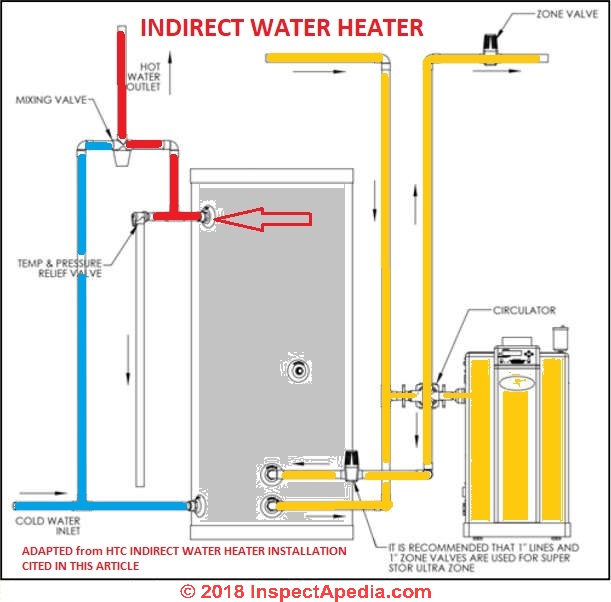
Source of the sketch adaptation above:
HTP (Heat Transfer Products) Superstor Ultra INSTALLATION MANUAL [PDF] HTP, Inc Corporate Office, 272 Duchaine Boulevard, New Bedford, MA 02745 USA Tel: 800 323 9651 E-mail: sales@htproducts.com HTP Technical Support: 800-323-9651
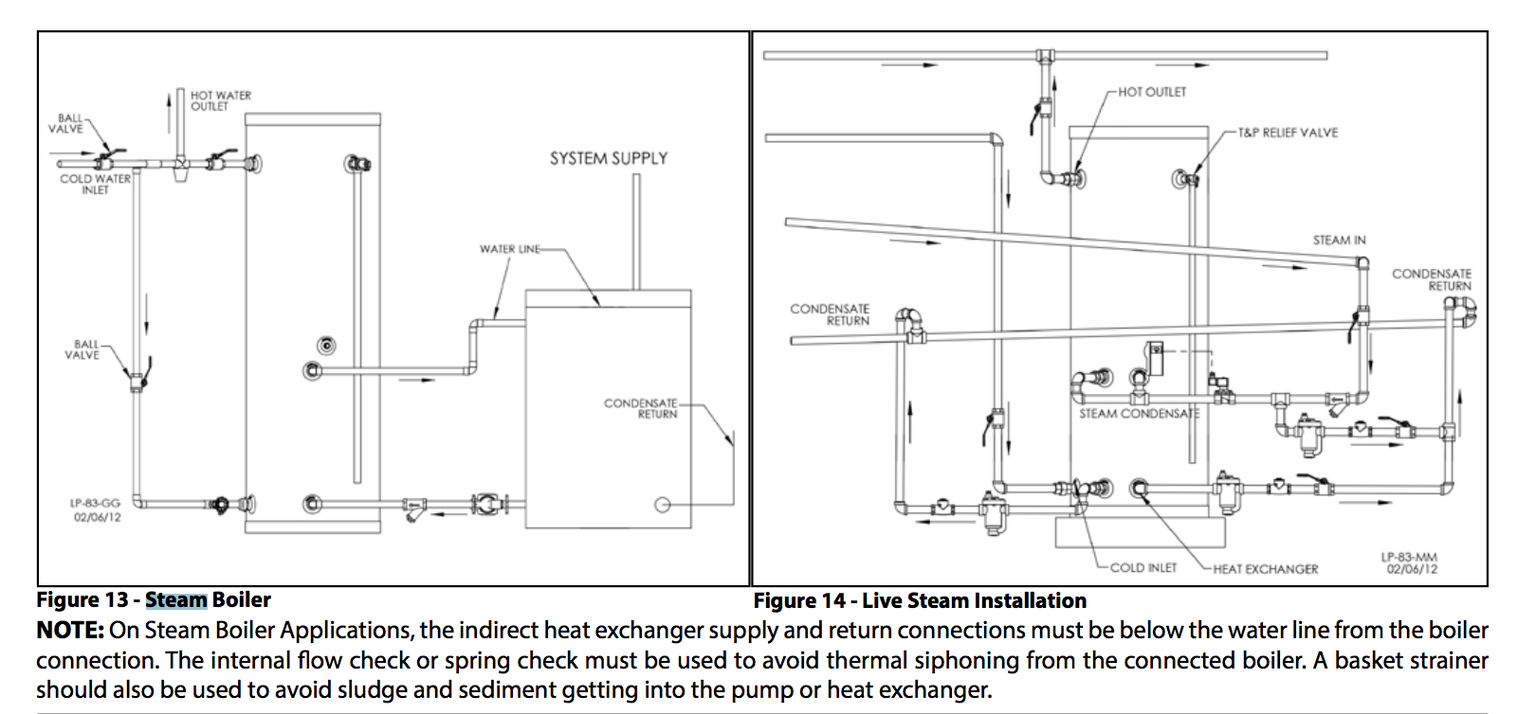
Indirect Water Heater Connections to Steam Boilers
Using a SuperStor on a steam boiler, manual excerpts:
In a steam boiler, the tank supply must be connected to the boiler well below the minimum water level. A strainer and drain valve should be installed at the boiler for periodic draining of scale and sludge.
Banging and steam bound traps will occur if the boiler water supplied to the heat exchanger has steam or is slightly above the low water cut-off. - Op. Cit.
Here are the company's sketches for steam boiler installation.
Click the image to see a larger version.
Difference Between an Indirect Water Heater & a Range Boiler Water Heater
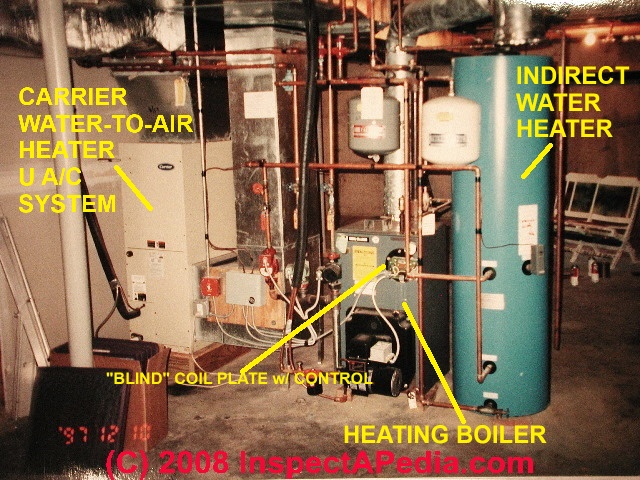 Shown in our photographs here and below are two indirect water heaters.
Similar piping and tanks are used to construct a range boiler water heater.
The difference
between a RANGE BOILER WATER HEATER and Indirect-fired Water Heaters is in the details.
The heat exchanger that heats water in the range boiler is in or at the heating boiler rather than inside the hot water tank itself.
And typically a range boiler heats water in the hot water tank by circulating hot boiler water through the heat exchanger by convection, not by use of a mechanically-driven circulator pump. .
The range boiler is an old concept in use for about 100 years. Indirect fired water heaters are a modern system and are in current sales and use.
Where an indirect-fired water heater is installed, the coil is inserted not in the heating boiler, but rather in the bottom of a hot water tank.
You can see this design in our photo (the blue tank is the indirect fired water heater) and also in our sketch at page top.
Water from the heating boiler (not domestic cold water) is circulated from the boiler, through the coil, and back to the heating boiler. The coil, in turn, heats water stored in the separate hot water tank.
This installation is a bit fancy: the blue indirect fired water heater is heated by the gray Weil McLain™ oil fired heating boiler.
The blue water heater tank is in turn being used in this case to provide a big reservoir of hot water to a water-to-air heating coil installed in the light gray/tan air handler at far left in the photo. This home uses that air handler for both central air conditioning and also for heat.
 Other pipes connected to the Weil McLain boiler may indicate that that boiler also provides hot water heat to some building areas.
But the principle is the same. Hot water from the blue indirect-fired water heater tank could have just as well been used to provide domestic hot water for washing and bathing as well as for heating the water-to-air heating system, as well as serving both purposes.
Plumbing Connections & Water Flow Directions at an Indirect Water Heater
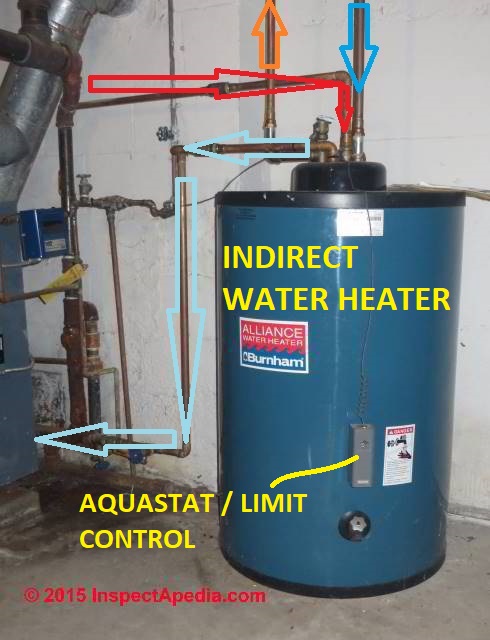
At left is an Alliance indirect water heater from Burnham (also discussed below).
The indirect water heater will have multiple plumbing connections and piping loops but it's pretty easy to figure them out.
Domestic hot water supply piping:
will include a cold-water supply line into the indirect water heater tank (dark blue arrow at top center of the photo and pointing down) and a hot water supply line exiting the indirect water heater tank to supply hot water to the building's plumbing fixtures (orange arrow pointing up at the top center of the photo).
Indirect water heater's hot water heating coil piping:
will include a loop of pipes that bring hot water from the separate hydronic heating boiler (barely visible in the left of this photo) to the inlet side of the heating coil in the indirect water heater (bright red arrows), and that carries water back to the heating boiler to be re-heated (light blue arrows).
It is this second piping loop that heats the hot water coil inside the indirect water heater, essentially transferring heat from the hydronic heating boiler into the hot water storage tank.
Usually this boiler water piping loop will include its own circulator pump that in turn is turned on and off by a thermostat mounted on the indirect water heater.
...
Temperature & Other Controls on Indirect Fired Water Heaters
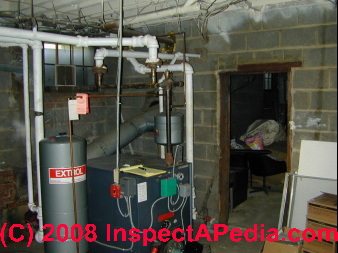
An indirect fired water heater such as the Super Stor™ or Extrol™ water heater (shown at above left) unit will include a temperature control that is usually mounted on the water tank itself.
When the hot water temperature drops below the control set point, the control will turn on a circulator pump that will cycle hot boiler water through the heating coil inside of the Super Stor™ tank.
The indirect-fired water heater does not itself turn on the heating boiler.
Rather, when temperatures inside the separate heating boiler drop below a low limit (or hot water maintenance level) set on the heating boiler's own control, that system will turn on its burner to re-heat the boiler water directly.
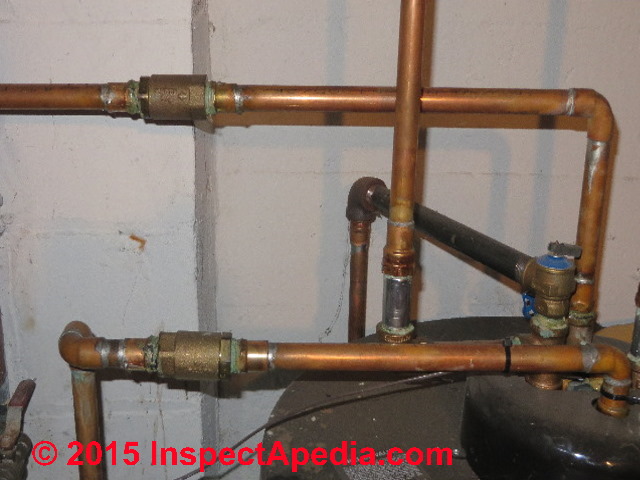
Above we see check valves on the inlet and return sides of the boiler hot water loop supplying the hot water heating coil on an indirect water heater.
Where are the Temperature Controls on an Indirect Water Heater?
 The temperature in the indirect water heater is controlled by a thermostat mounted on the water heater tank.
That thermostat turns on or off the circulator pump. Separate, independent temperature controls back in the heating boiler actually turn the heating boiler's burner on or off as needed.
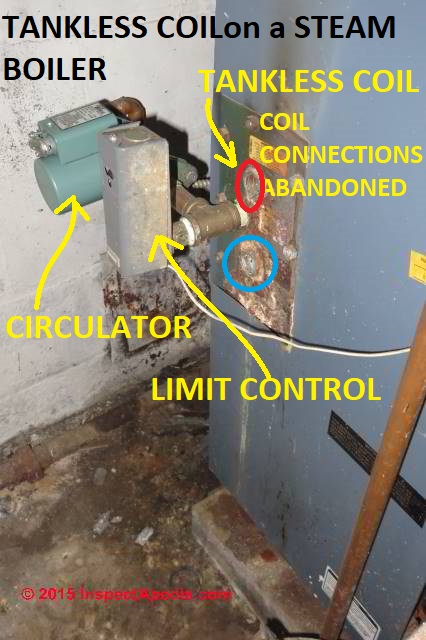
In this photo of hot water and controls on an old steam boiler we see a limit switch and a circulator pump mounted on the hot water outlet from a steam boiler whose hot water is being used to heat the hot water heating coil in an indirect fired hot water tank (not shown in this photo).
You can see that this steam boiler used to heat a tankless coil. But the original piping connections (cold-in, hot out of the coil) that provided domestic hot water have been removed (abandoned).
However the installer kept the coil mounting plate and coil and has connected an aquastat (limit control) as well as a circulator to bring hot water out of the boiler, presumably to circulate to an indirect hot water tank. The return pipe to the boiler is not visible.
The circulator is used to circulate hot water to and from the indirect fired water heater but the control at above left is an aquastat and is not the control that maintains hot water in the separate indirect hot water tank.
Rather, this control turns the boiler's burner on if needed to re-heat the water in the boiler to assure that it can in turn re-heat the indirect water heater.
Above and mounted right on the indirect fired water heater tank we see the aquastat that controls the temperature in the hot water tank itself.
This control will switch the circulator on or off as needed to use boiler water to re-heat water in the indirect hot water tank.
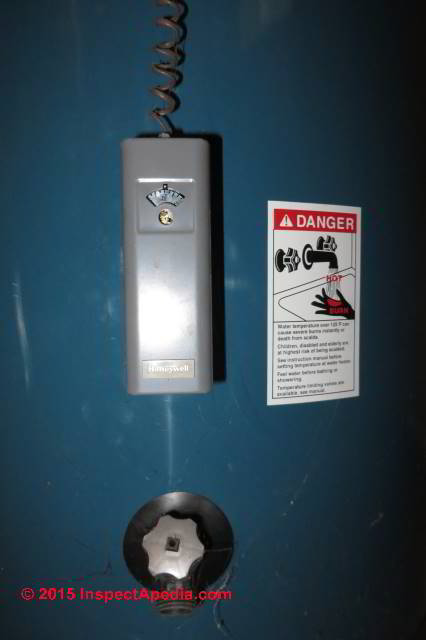
The indirect water heater's aquastat is typically set at 120°F.
See more details about setting or adjusting hot water temperature at an indirect water heater in our separate hot water temperature control instructions found
at INDIRECT HOT WATER HEATER TEMPERATURE CONTROL
To understand the circulator that cycles hot water from the heating boiler through the heat exchanger inside the indirect water heater,
see CIRCULATOR PUMPS & RELAYS - home and also
Also see RELAY CONTROL SWITCHES for details about how the circulator pump relay operates.
Watch out: the indirect water heater must have its own temperature & pressure relief valve. You can see this TPR in the close-up photo earlier on this page where we also show the check valves on the boiler piping loop.
...
Efficiency of Indirect Fired Water Heaters
An indirect-fired water heater is a more efficient way to use a home heating boiler to make domestic hot water. Why?
Because the heating boiler will run less often, and when it does run, it will have a longer "on" cycle (as it has to heat up the tank of hot water). Both of these conditions are a more efficient way to burn home heating oil than using a tankless coil.
In sum, during the heating season, when a heating boiler is likely to be "hot" most of the time anyway because it is heating the home, a tankless coil installed on a heating boiler is a reasonable way to obtain some domestic hot water from the system, though in most installations a tankless coil will not be able to produce as much hot water for as long a time period as what we can obtain from a separate water heater.
But an indirect-fired water heater always makes more efficient use of the home heating boiler, year round. And since the consumer can decide how big a hot water tank she wants, 50 or even 100 gallons of hot water can be kept in reserve.
More than we can normally obtain from a conventional domestic tankless coil on a heating boiler.
...
Indirect Water Heater Leaks
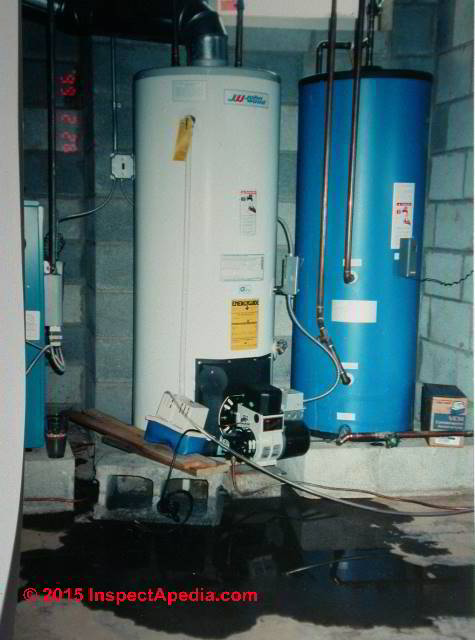
Above we see water on the floor at two water heaters: an oil fired water heater (white, at left in the photo) and an indirect water heater (blue) at right in the photo.
We need a closer inspection to find where this water is actually coming-from as there could be several sources including even the separate hydronic heating boiler (just visible in the far left of the photo).
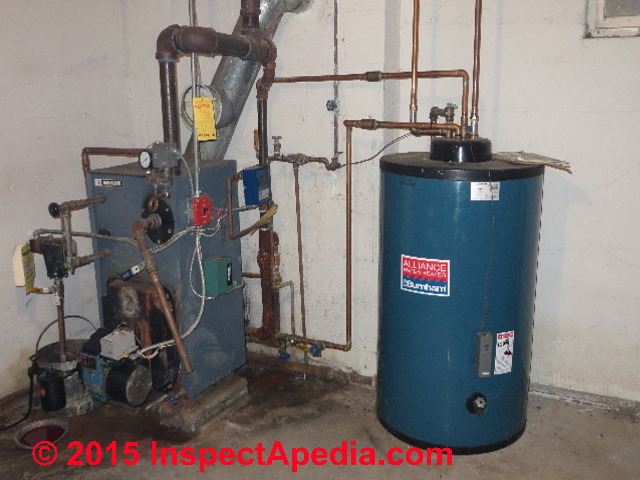
Above we illustrate another indirect-fired water heater brand, an Alliance hot water system from Burnham. Here we see water on the floor not at the indirect water heater itself but around the nearby heating boiler.
Leaks in or at an indirect water heater can occur at a variety of locations and are caused by different problems.
Any of these leaks, if found and repaired promptly, can salvage the water heater and keep it operating safely.
Leaving any of these leaks unattended risks destroying the heater as it can become too corroded to repair, and some of these leaks are also dangerous.
- A leak in the indirect water heater tank
itself due to corrosion or damage may show up as a puddle on the floor or as wet insulation that steams when the heater is being heated. - Leaks can occur at connecting piping fittings
on or around the indirect water heater or calorifier such as where cold inlet or hot water outlet building water supply piping or at the TPR valve mounting fittings or at the connections of the heating piping loop between the separate heating boiler and the heating coil mounted in the indirect water heater. - A leak at the indirect water heaters temperature/pressure relief valve
shows up as dripping or spillage at the valve's discharge tube and is typically caused by excessive pressure, by thermal expansion of hot water, by water hammer, or by other more subtle causes.
Watch out: leaks at a TPR valve are an unsafe condition, as we explain
at RELIEF VALVE LEAKS - A leak out of the indirect water heater into the heating boiler
can occur if the heat exchanger coil itself develops a leak.
At INDIRECT WATER HEATER COIL LEAKS INTO the BOILER we discuss the water found around the heating boiler at the left of the potograph above, and we explain why a leak in the indirect water heater's heating coil can cause leaks at the heating boiler's TPR valve. There we also explain how to detect this condition.
...
Diagnose & Repair Indirect Water Heaters - no hot water? water not hot enough?
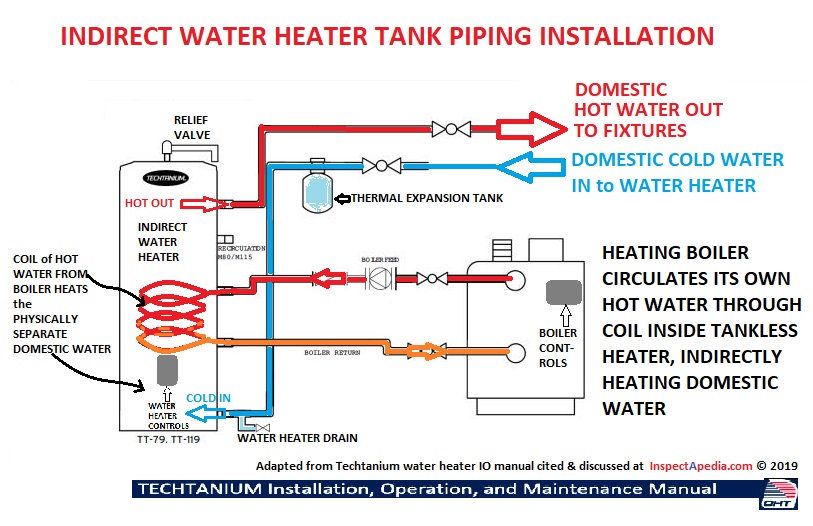 Illustration above: typical piping of an indirect water heater shows the two sets of piping at the heater: a loop from the heating boiler, operating as a separate "heating zone" heats a coil inside the tankless water heater.
In turn that coil heats incoming cold domestic supply water to produce domestic hot water.
Adapted from Techtanium water heater IO manual cited below.
[Click to enlarge any image]
Question: Techtanium indirect hot water heater stopped working
2019/10/26 Juan Vazquez said:
My Techtanium indirect hot water heater stopped working all of a sudden. It's is 9 years old and the anode rods were changed I'm February of this year. What could be the problem
Reply:
Juan
We need to understand just what you mean by "stopped working" - does no hot water flow at all, or does water flow but it does not get hot? More help is below.
Basic steps in troubleshooting "no hot water" at an indirect-fired water heater
- If you turn on a hot water faucet does any water at all come out at the faucet? If cool or tepid water flows at the faucet then the water heater's incoming water supply and all of the supply piping from water heater to fixture is working: this confirms that water enters and exits the indirect water heater tank.
Note regarding your anode change: indeed instructions from the manufacturer require periodic replacement of a sacrificial anode in the water heater - a step to avoid corrosion damage.
But a bad anode rod in the indirect water heater tank itself wouldn't exactly cause the boiler or circulator to fail to run;
Watch out, however: a collection of scale or debris inside the indirect water tank could block water entry or exit; a symptom would be weak or slow flow of hot water at the faucets.
- Compare hot and cold water pressure at the same faucet.
If cold water flow is noticeably stronger than hot water flow then yes, there's a clog of blockage (perhaps debris or scale) in the hot water system.
See help at HOT WATER PRESSURE LOSS
As opposed to debris, mineral scale formation inside the heating coil of an indirect water heater would be quite unusual but to read more
See SCALE REMOVAL, WATER HEATERS - Confirm that the heating boiler is working: Start at the boiler: the heat source for your water heater; is the boiler working?
If the boiler itself is not working see
DIAGNOSE & FIX HEATING PROBLEMS-BOILER - home - Confirm that the hot water thermostat at the water heater and the zone control at the boiler are working.
Does a call for heat at the indirect water cause the circulator that sends hot water from the boiler through the indirect water heater's heating coil run?
This confirms that the thermostatic control at the water heater and the circulator for the water heater work.
If the circulator to the water heater runs, when the boiler temperature drops the boiler's own burner should run; This confirms that the boiler works.
More help is at
AQUASTAT CONTROLS - home - heating boiler controls
CIRCULATOR DIAGNOSTICS
- Confirm that hot water from the boiler is circulating through the indirect water heater internal coil.
Does hot water from the boiler both enter and leave the heater coil inside the indirect water heater tank?
Feel the pipes; if the return line from the water heater is not getting hot then boiler water isn't making the full circuit and you'd look for a clogged coil or clogged piping in the boiler-water heater coil circuit.
See WATER HEATER DEBRIS FLUSH
Clogging is more common than an air blockage but depending on piping arrangement it's also possible that the heating zone used to heat the coil in the indirect water heater is air-bound.
See details at AIR-BOUND HEATING SYSTEMS - home - If you're still stuck see
HOT WATER PROBLEM DIAGNOSIS
You can download the Techtanium indirect water heater IO manual from the manufacturer at www.dhtnet.com/wp-content/uploads/2019/05/Techtanium-Manual-5.2019.pdf
or here at InspectApedia.com at TECHTANIUM INDIRECT WATER HEATER MANUALS where we also include company contact information.
The piping sketch shown above illustrates the typical hook-up of an indirect water heater. It is adapted from a drawing from the company's Techtanium water heater service manual (cited above) and it may help you understand the system piping arrangement.
For help from the manufacturer of Techtanium water heaters Contact: Diversified Heat Transfer Inc., New Jersey Headquarters 439 Main Road Towaco NJ 07082 USA Tel: 800-221-1521 Website: www.dhtnet.com
...
Indirect Water Heater Manuals, Instructions, Research, Standby Losses
- Aguilar, Carolina, D. J. White, and David L. Ryan. DOMESTIC WATER HEATING AND WATER HEATER ENERGY CONSUMPTION IN CANADA [PDF] (2005) Canadian Building Energy End-Use Data and Analysis Centre (2005): 805-813.
Excerpt:
The purpose of this study is to review relevant literature and technology concerning energy consumption for domestic water heating. - Alissa K. Johnson, James D. Lutz, Michael A. McNeil, & Theo Covary. (2013). An international Survey of Electric Storage Tank Water Heater Efficiency and Standards. In Southern African Energy Efficiency Convention 2013.
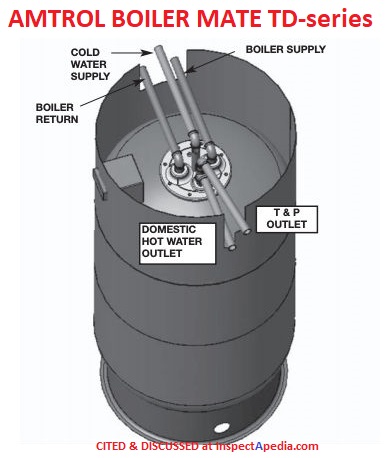
- AMTROL INDIRECT WATER HEATERS [web article]
- BUDERUS INDIRECT WATER HEATER Manuals
- BURNHAM INDIRECT FIRED WATER HEATER MANUAL [PDF]
- ECCOTEMP ECR H2O INDIRECT WATER HEATER INSTALLATION MANUAL [PDF]
- Farahan, Ebrahim. RESIDENTIAL ELECTRIC AND GSAS WATER HEATERS [PDF] (1977) No. ANL/CES/TE-77-2. ANL (Argonne National Laboratory (ANL), Argonne, IL (United States)), 1977.
Includes examples of calculation of water heatert standby losses and appliance efficiency vs hot water consumption.
Excerpts:
3.2.4 Standby (Jacket) Losses
The major standby loss of an electric water heater is through the jacket. The only other heat loss is through the piping system, which is maximum when hot water flow is terminated and the distribution pipes are filled with hot water.
During the standby period, this hot water cools to ambient temperature. The rate of this heat loss is related directly to a number of draws, water temperature, ambient temperature, and the length of distribution pipes.
If the distribution pipes are imbedded in a poured-concrete floor, the heat loss through the distribution pipes will increase considerably.
Table 3.3 shows standby heat losses for electric water heaters as calculated by various investigators. s-s This loss·, which varies with ambient temperatures and hot water temperatures, can be reduced by increasing the insulation thickness. - Hiller, Carl C. "Comparing Water Heater vs. Hot Water Distribution System Energy Losses." ASHRAE transactions 111, no. 2 (2005).
- Hohne, P. A., Kanzumba Kusakana, and B. P. Numbi. "A review of water heating technologies: An application to the South African context." Energy Reports 5 (2019): 1-19
- Lekov, Alex B., James D. Lutz, Camilla Dunham Whitehead, and James E. McMahon. "Cost of increased energy efficiency for residential water heaters/Discussion." ASHRAE Transactions 106 (2000): 875.
- Lekov, Alex, James Lutz, and James E. McMahon. PAYBACK ANALYSIS OF DESIGN OPTIONS FOR RESIDENTIAL WATER HEATERS [PDF] (2000) In Proceedings of the ACEEE Summer Study on Energy Efficiency in Buildings, vol. 1, pp. 1163-1174. 2000.
Includes discussion of the water heater standby heatloss coefficient,.
Abstract excerpt: This paper describes the results of an analysis to determinet he costs ofincreased energy efficiency for residential water heaters. In this study, cost and efficiency data were developed fora total of23 design options for typical tank sizes applied to one or more of three water heater product classes, i.e., electric, gas-fired, and oil-fired.
Excerpt: Designs that reduce standby losses—heat traps and increased jacket insulation—are frequently applicable to all fueltypes. Aheat trappreventslosses associated with the circulation of hot water into the water heater plumbing when hot water is not being drawn and thus minimizing standby heat loss.
To model the impacts of heattraps forwater heaters, the natural convection heat transfer losses at the supply and draw lines were reduced. Manufacturersinsulate waterheatersby filling thecavity betweenthejacketand the tank with polyurethane foaminsulation.
Most waterheaters on the market today have at least 1-inch thick foam insulation, while some models have 2- or 3-inch thick insulation. Although increasing the insulation thickness reduced standby heat loss, the increased overall diameterof the water heater could pose shipping cost increases and installation problems.
Other design options reduce standby losses, but are usually unique to a given water heater class. - Maguire, J., Fang, X., & Wilson, E. (2013). Comparison of Advanced Residential Water Heating Technologies in the United States (No. NREL/TP-5500-55475, 1081391). https://doi.org/10.2172/1081391
- TECHTANIUM INDIRECT WATER HEATER Manuals
- TECHTANIUM INDIRECT WATER HEATER INSTRUCTIONS [PDF] op. cit.
- TFI EVERHOT EXTERNAL TANKLESS WATER HEATERS [PDF], Everhot, is a division of Therma-Flow, Tel: 617-924-3877 1-800-654-8045 Email: sales@tfi-everhot.com Website: www.tfi-everhot.com Therma-Flow, Inc. 191 Arlington Street Watertown, MA 02472 MAIL: P.O. Box 416 Watertown, MA 02471-0416 - product specifications, solid copper shell tankless water heaters
- US DOE, WATER HEATING: Energy-efficient strategies for supplying hot water in the home [PDF] (2001) DOE/GO10099-785. Abgerufen von http://www.homeinnovation.com/~/media/Files/Reports/waterheatingFS.pdf
Includes a chart comparing thpes of storage water heaters in energy efficiency and annual cost. - Weiner, C., WATER HEATING in COLORADO HOMES [PDF] (2019) Colorado State University Extension, Fact Sheet 10.637, Doctoral dissertation, Colorado State University. Libraries).
Excerpt:
According to the U.S. Energy Information Administration, water heating makes up 19% of energy use in Colorado homes. This fact sheet examines ways to reduce energy use and expenses related to domestic hot water heating including simple conservation measures and investments in new equipment. - WILLIAMSON THERMO-FLO INDIRECT WATER HEATER MANUAL [PDF]
- Williamson-Thermopride WT INDIRECT-FIRED WATER HEATER MANUAL [PDF]
- Wilson Jr, R. P. "Energy conservation options for residential water heaters." Energy 3, no. 2 (1978): 149-172.
- See WATER HEATER AGE & MANUALS - free PDF downloads of water heater installation & repair manuals
Reader Comments, Questions & Answers About The Article Above
Below you will find questions and answers previously posted on this page at its page bottom reader comment box.
Reader Q&A - also see RECOMMENDED ARTICLES & FAQs
On 2023-08-23 by InspectApedia Publisher (mod) - Indirect water heater standby losses, costs, cost reduction methods
@Rich,
Summary of water heater standby operating costs, cost comparisons, and tips for reducing standby-losses or eliminating them entirely
Have you tried reading through the article above where we describe indirect water heaters and how they work?
In essence, it's your separate oil fired heating boiler that provides the heat that in turn warms the water in the indirect water heater tank.
If you're leaving the boiler OFF then the indirect water heater is also OFF.
If you're leaving the boiler ON, the cost of allowing the indirect water heater to be kept hot is very small because no one is actually consuming hot water in the building. The stand-by losses of such a system are comprable to the stand by losses of other water heaters.
Typical standby loss costs for an indirect water heater
Depending on the water heater type that we use for comparison, stand-by losses range from as little as 80 cents a month for a small under-sink point of use heater to as little as $5. a month for a typical electric water heater.
Your standby loss costs for an oil fired heating boiler, particularly if it's being left on to keep the building warm but at a typical thermostat set-back temperature, will almost certainly be considerably lower than for an electric water heater.
How to Reduce or Eliminate Standby Losses & Costs for an Indirect Water Heater
You can reduce the standby water heater operating cost by setting down the set-temperature on the thermostat that controls the re-heating of the indirect water heater.
That will be a control mounted (usually) on the heater itself. Our photo above shows a typical location of the temperature control on an indirect water heater tank.
For setting the indirect water heater temperature, see details above on this page
at INDIRECT HOT WATER HEATER TEMPERATURE CONTROL
Or
If you want to reduce that cost to zero, while leaving the home heating boiler itself "on", you can simply turn off power to the thermostat that circulates boiler water between the heating boiler and the indirect water heater tank.
If you still can't find the thermostat that controls the circulator and temperature of your indirect water heater, post some photos here, one per comment, of the indirect water heater, its circulator, and the boiler that supplies it.
Thank you for a helpful question.
On 2023-08-23 by Rich - how do I shut down or start-up an indirect water heater to save costs when we're away?
Bought a house with an indirect water heater, oil-fired boiler. I still haven't figured out how to shut it down or start it up. Can't find anything on the breaker boxes, there is no "red switch" at the top of the stairs or anywhere that I've found.
While going on vacation, should the circulator be shut down somehow, or the trigger that starts the circulator?
Disable the thermostat? Sorry for my ignorance.
The plumber couldn't find it either. I suppose I should ask Tevis when they are here.
On 2021-06-18 by inspectapedia.com.moderator (mod)
@fred d,
Is that anode replacement schedule required as per the Techtanium water heater manual or was it your field experience?
Have you tested your water for corrosivity? Let's find out before getting still more upset by discovering that your replacement heater also fails early.
On 2021-06-18 by fred d
techtanium tt- 40 is the worst indeirect water heater i ever had installed .
i had to replace two of them in less than 10 years. the heaters have to be maintained every year by replacing anodes which cost about $300.00 so any money i had save heating water with with the unit is offset by the maintenance of the unit in fact i am losing money the next time they break down i will install and AO Smith personally i think its a crap unit
On 2020-08-25 by GREG M
Hi i have a oil fired hot water heading boiler in my house. I also have a coal fired hot water boiler in my shed witch is 100 feed from my house, the heading lines are installed in the ground to the boiler in the house ,
I would like to install an indrect water header in the house and i would like to have both boilers boilers hooked up to the hot water header so i can use one or the other as required.can you send me a piping diagram i can use to install this system. thank you
,Greg
On 2020-02-14 by danjoefriedman (mod)
I don't think so. If you likeed the equipment that you had it would make sense to me to replace it in kind.
On 2020-02-14 0 by loven
I have a 25 year old but good condition cast iron Burnham boiler with a 5 gpm tankless coil, to which was installed a 40 gal Ford AQUA BOOSTER which finally sprung a leak after 25 years. This set up always served our needs adequately {four person household} and
my question is to just replace the AQUA BOOSTER, which is now made by Vaughn, or step up to an indirect. Household hot water needs will likely remain about the same for several years or even reduce. Suggestions? Thanks.
On 2020-02-07 0 by danjoefriedman (mod)
Its not like a heating system, and air traps aren't a likely problem.
On 2020-02-07 by John M
Why do indirect hot water heaters have the SUPPLY water going into the TOP of the coil ? This makes it hard to get rid of air trapped in the coil. Seems like it would make more sense to have the supply go into the bottom of the coil and push air out the top.
...
Continue reading at TANKLESS WATER HEATER INSTALLATION or select a topic from the closely-related articles below, or see the complete ARTICLE INDEX.
Or see INDIRECT FIRED WATER HEATER FAQs - questions and answers posted originally on this page.
Or see these
Recommended Articles
- HOT WATER QUANTITY IMPROVEMENT
- INDIRECT FIRED WATER HEATERS
- INDIRECT WATER HEATER COIL LEAKS INTO the BOILER
- INDIRECT HOT WATER HEATER TEMPERATURE CONTROL
- TANKLESS WATER HEATER INSTALLATION
- WATER HEATER AGE & MANUALS - free PDF downloads of water heater installation & repair manuals
- WATER HEATER LEAK REPAIR
- WATER HEATER TEMPERATURE ADJUSTMENT CONTROLS - home
Suggested citation for this web page
INDIRECT FIRED WATER HEATERS at InspectApedia.com - online encyclopedia of building & environmental inspection, testing, diagnosis, repair, & problem prevention advice.
Or see this
INDEX to RELATED ARTICLES: ARTICLE INDEX to WATER HEATERS
Or use the SEARCH BOX found below to Ask a Question or Search InspectApedia
Ask a Question or Search InspectApedia
Try the search box just below, or if you prefer, post a question or comment in the Comments box below and we will respond promptly.
Search the InspectApedia website
Note: appearance of your Comment below may be delayed: if your comment contains an image, photograph, web link, or text that looks to the software as if it might be a web link, your posting will appear after it has been approved by a moderator. Apologies for the delay.
Only one image can be added per comment but you can post as many comments, and therefore images, as you like.
You will not receive a notification when a response to your question has been posted.
Please bookmark this page to make it easy for you to check back for our response.
Our Comment Box is provided by Countable Web Productions countable.ca
Citations & References
In addition to any citations in the article above, a full list is available on request.
- Inspection Procedures for Oil-Fired Heating Systems Detailed step by step approaches for inspecting complex systems]
- In addition to citations & references found in this article, see the research citations given at the end of the related articles found at our suggested
CONTINUE READING or RECOMMENDED ARTICLES.
- Carson, Dunlop & Associates Ltd., 120 Carlton Street Suite 407, Toronto ON M5A 4K2. Tel: (416) 964-9415 1-800-268-7070 Email: info@carsondunlop.com. Alan Carson is a past president of ASHI, the American Society of Home Inspectors.
Thanks to Alan Carson and Bob Dunlop, for permission for InspectAPedia to use text excerpts from The HOME REFERENCE BOOK - the Encyclopedia of Homes and to use illustrations from The ILLUSTRATED HOME .
Carson Dunlop Associates provides extensive home inspection education and report writing material. In gratitude we provide links to tsome Carson Dunlop Associates products and services.
 | HOME | ABOUT | ASK a QUESTION | CONTACT | CONTENT USE POLICY | DESCRIPTION | POLICIES | PRIVACY | |
| © 2024 - 1985 Publisher InspectApedia.com - Daniel Friedman | |||||||||