
InspectAPedia® FREE Encyclopedia of Building & Environmental Construction, Diagnosis, Maintenance & Repair |
Question? Just ask us! InspectAPedia
|
 Guide to Hot Water Tank Insulation
Water heater insulation safety
- POST a QUESTION or COMMENT about how to insulate a hot water tank (or safety and warranty reasons not to insulate the water heater)
This article discusses when and how water heater tanks may be insulated, gives important water heater insulation safety warnings, and discusses whether you should insulate your water heater at all.
This discussion is part of a series of articles on how to improve the hot water pressure, quantity, flow, and water temperature safety in a building.
InspectAPedia tolerates no conflicts of interest. We have no relationship with advertisers, products, or services discussed at this website.
Should You Add Insulation to the Water Heater Tank?
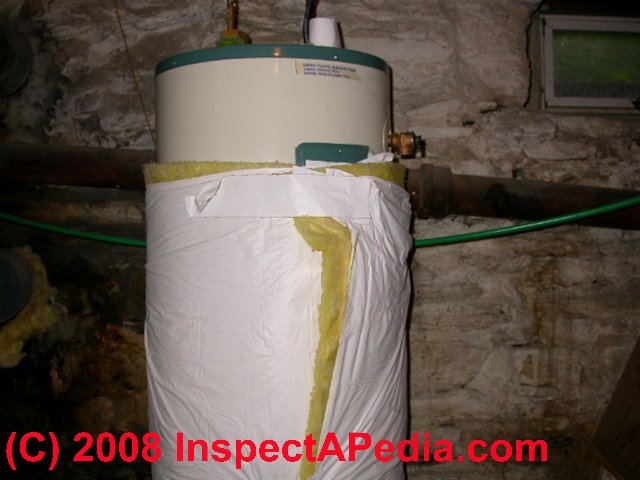
Most new water heater tanks come with factory-installed insulation.
If your water heater tank was purchased in the last decade it may be a model that is already adequately insulated.
In fact some water heater manufacturers recommend against adding external water heater insulating blankets to their equipment, or indicate that their equipment does not need extra insulation.. (Arlene Puentes).
Quoting from A.O. Smith's "Gas Water Heater's Owner's Manual"
Insulation blankets available to the general public for external use on gas water heaters are not necessary with A.O. Smith products. The purpose of an insulation blanket is to reduce the standby heat loss encountered with storage tank heaters.
Your A.O. Smith water heater meets and exceeds the National Appliance Energy Conservation Act standards with respect to insulation and standby loss requirements, making an insulation blanket unnecessary. - A.O. Smith Water Products Co., seeReferences or Citations
Still, some owners want to reduce standby heat losses from their water heater by adding an insulating blanket sold for that purpose.
Below we provide important safety advice for people planning to add water heater insulation, and we offer a concluding opinion about the value of adding insulation to a modern water heater tank.
Water Heater Insulation Safety Advice
 If your water tank is old, poorly insulated or if your water heater is not insulated at all, your plumbing supplier or building supply store can provide a water heater insulating blanket kit.
See RANGE BOILER WATER HEATER for an example of heaters that were commonly left completely uninsulated (when heating oil and gas were cheap).
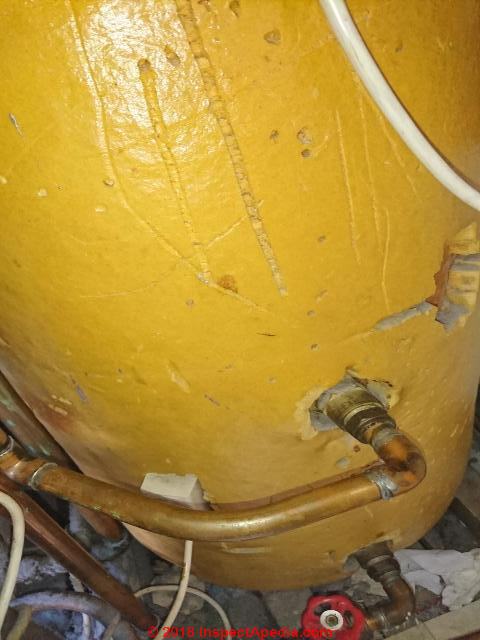
It can make sense to add insulation to such devices. External insulation is also exposed and visible on some types of water cylinders or calorifiers such as the one shown in our photo.
Watch out: in some cases heating boilers, storage heaters, and even warm air heating systems used asbestos-containing insulation. But that is not what is shown in our photograph of yellow foam material on a hot water cylinder.
In the U.K. hot water cylinders such as the one shown here bear solid foam external insulation. This photo was contributed by U.K. InspectApedia reader Barney who asked if this was asbestos insulation.
It's not. Foam insulation on a water cylinder would not be expected to include asbestos.
Where asbestos was used on water cylinders, boilers, or similar equipment it would typically appear as a white plaster-like cementious material or as white-gray corrugated asbestos paper.
Watch Out: Do not add water heater insulation without reviewing both the safety warnings we list below and also any safety warnings issued by the manufacturer of your own water heater brand and model.
Failure to follow safe procedures when insulating a water heater could result in a fire or explosion, or as A.O. Smith puts it,
Failure to follow these instructions can restrict the air flow required for proper combustion, potentially resulting in fire, asphyxiation, serious personal injury or death. - A.O. Smith Water Products Co.
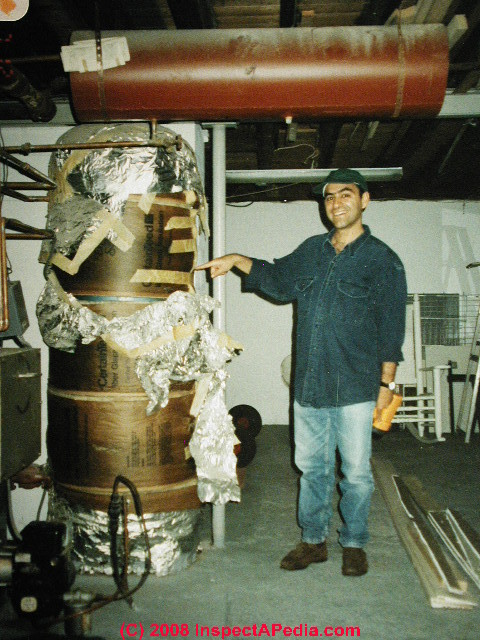
In our photos at page top and just above, the water heater blanket has been poorly installed. Above the insulation has been installed on an electric water heater, the relief valve is improperly installed, and other details about this particular insulating blanket installation suggest that it has not been installed following the recommendations of the water heater manufacturer. In the photo you can see that this valve is missing its discharge tube as well - an unsafe condition.
The warnings we issue below were suggested by Arlene Puentes and are based on a review of water heater instruction manuals from Rheem and AO Smith, two prominent manufacturers of residential water heaters. - Rheem & A.O. Smith Water Products Co.
- Is extra water heater insulation permitted and safe? If adding insulation to a water heater, first make sure that external insulation is permitted for your model and brand of water heater, then be sure it's installed safely. If in doubt, check with the manufacturer of your water heater before adding insulation - most water heaters will include a label which has a toll-free telephone number for this purpose.
- Don't let insulation cover or block operation of a temperature/pressure relief valve: The water tank insulating blanket should be cut to permit the relief valve and its discharge tube to remain visible and unobstructed so that it can open in an emergency and so that we can see if it is leaking (which means there is a safety concern)
- Flue gas safety: Don't let water heater insulation cover or block the flue gas vent draft hood on gas fired water heaters or you may prevent proper venting and the system may be unsafe, risking carbon monoxide hazards. AO Smith, a gas water heater manufacturer advises that you should not put insulation over any part of the top of the water heater.
Do not allow insulation to come within 2" of the dilution air inlet [on the blower], to prevent the dilution of dilution air. - Gas valve safety: do not let water heater insulation cover any part of the gas valve or controls
- Fire safety: Don't place insulation where it can be damaged or set on fire by exhaust flues or oil or gas burners
- Gas burner or Oil burner safety: don't place insulation on a water heater where it could block combustion air that the gas or oil burner need or the system may be unsafe. Keep water heater tank insulation at least 8" from the floor on gas-fired water heaters to be sure that there will be adequate combustion air for the gas burner. Otherwise your water heater may produce deadly carbon monoxide gas.
[A.O. Smith, discussing their gas fired water heaters, specifies a minimum floor clearance of 2" - to avoid blockage of combustion air flow to the burner"] - Do not cover the access cover or door that opens for inspection or service of the gas burner.
- Preserve all of the labels, instructions, safety warnings, etc. that are affixed to the water heater. This means that you should either not cover them with insulation, or you should obtain new stick-on labels from the manufacturer, and install them on the outside of the new insulating blanket. This includes the water heater instruction manual that may be mounted in a plastic sleeve on the side of the water heater.
- Inspect the insulating blanket frequently to be sure that it has not moved or sagged so as to violate any of the safety clearances specified above.
Also see our advice and safety warnings about water piping insulation
Concluding Opinions about Adding Insulation to a Residential Water Heater
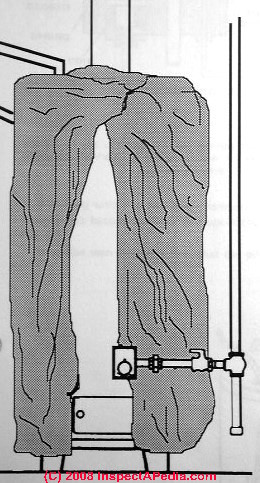
Regrettably, by the time we respect all of these "don't cover" this or that warnings from the water heater manufacturers, it becomes apparent that adding water heater insulation on a modern already-insulated unit is probably more trouble and risk than it's worth.
You may be able to skip adding water heater insulation and you may be able to save more on water heating cost if you simply use some of our other recommendations such as turning down hot water temperature, using less total hot water volume, or using staging tanks to "pre heat" incoming water to the water tank from ambient building heat.
And doing anything to your water heater that does not follow the manufacturer's recommendations may be both unsafe and a cause for voiding the warranty:
"The manufacturer’s warranty does not cover any damage or defect caused by installation, attachment or use of any type of energy saving or other unapproved devices (other than those authorized by the manufacturer) into, onto or in conjunction with the water heater. The use of unauthorized energy saving devices may shorten the life of the water heater and may endanger life and property.
The manufacturer disclaims any responsibility for such loss or injury resulting from the use of such unauthorized devices " -- Rheem.
- ASBESTOS SAFETY CARDS [PDF], U.K. HSE, retrieved 2018/07/29, original source: http://www.hse.gov.uk/asbestos/assets/docs/beware-asbestos-reference-cards.pdf
HOT WATER EFFICIENCY IMPROVEMENT - separate article
HOT WATER QUANTITY IMPROVEMENT - separate article
...
Continue reading at HOT WATER IMPROVEMENTS or select a topic from the closely-related articles below, or see the complete ARTICLE INDEX.
Or see these
Recommended Articles
- HOT WATER IMPROVEMENTS - home
- HOT WATER CIRCULATOR PUMP SPEEDS DELIVERY
- HOT WATER EFFICIENCY IMPROVEMENT
- HOT WATER PRESSURE IMPROVEMENT
- HOT WATER QUANTITY IMPROVEMENT
- INSULATE HOT WATER PIPES
- INSULATE HOT WATER TANK?
- MULTIPLE GANGED TANKLESS WATER HEATERS
- TANKLESS WATER HEATERS
- WATER HEATER STANDBY LOSSES
- WATER HEATER TEMPERATURE TOO COLD or TOO HOT
Suggested citation for this web page
INSULATE HOT WATER TANK? at InspectApedia.com - online encyclopedia of building & environmental inspection, testing, diagnosis, repair, & problem prevention advice.
Or see this
INDEX to RELATED ARTICLES: ARTICLE INDEX to WATER HEATERS
Or use the SEARCH BOX found below to Ask a Question or Search InspectApedia
Ask a Question or Search InspectApedia
Questions & answers or comments about how to insulate a hot water tank (or safety and warranty reasons not to insulate the water heater).
Try the search box just below, or if you prefer, post a question or comment in the Comments box below and we will respond promptly.
Search the InspectApedia website
Note: appearance of your Comment below may be delayed: if your comment contains an image, photograph, web link, or text that looks to the software as if it might be a web link, your posting will appear after it has been approved by a moderator. Apologies for the delay.
Only one image can be added per comment but you can post as many comments, and therefore images, as you like.
You will not receive a notification when a response to your question has been posted.
Please bookmark this page to make it easy for you to check back for our response.
Our Comment Box is provided by Countable Web Productions countable.ca
Citations & References
In addition to any citations in the article above, a full list is available on request.
- "Residential Gas Water Heaters Owner's Manual, Gas Models FPSH-75 270 Series with Hot Surface Ignition", [PDF], A.O. Smith Water Products Company, 5621 W. 115th St., Alsip IL 60803 USA, Tel: 1-800-433-2545, Website: www.hotwater.com, Email: www.hotwater.com/parts, retrieved 15 March 2015, orginal source: http://www.hotwater.com/lit/im/res_gas/195785-000.pdf
Quoting
INSULATION BLANKETS [for water heaters]
Insulation blankets available to the general public for external use on gas water heaters are not necessary with A.O. Smith products. The purpose of an insulation blanket is to reduce the standby heat loss encountered with storage tank heaters. Your A.O. Smith water heater meets and exceeds the National Appliance Energy Conservation Act standards with respect to insulation and standby loss requirements, making an insulation blanket unnecessary. - Thanks to Alan Carson and Bob Dunlop, Carson Dunlop, Associates, Toronto, for permission to use illustrations from their publication, The Illustrated Home which illustrates construction details and building components. Carson Dunlop provides home inspection education, publications, report writing materials, and home inspection services. Alan Carson is a past president of ASHI, the American Society of Home Inspectors.
- Arlene Puentes [Website: www.octoberhome.com ] , an ASHI member and a licensed home inspector in Kingston, NY, and has served on ASHI national committees as well as HVASHI Chapter President. Ms. Puentes can be contacted at ap@octoberhome.com
- AO Smith produces AO Smith water heaters in addition to Reliance, State, Maytag and others.
www.aosmith.com/prod/wpc.htm AOS's gas water heater manuals offering advice and safety warnings about adding water heater insulation are available at
www.statewaterheaters.com/lit/im/res-Elec/184671-000.pdf and at
www.hotwater.com/lit/im/res_gas/184123-000.pdf - Rheem who also makes electric water heaters provides a manual for electric water heaters at
waterheating.rheem.com/content/resources/documents/use_care/ResElecProfessional.pdf. Rheem says, as do other water heater producers, that their water heaters meet the "National Appliance Energy Conservation Act standards with respect to insulation and standby loss requirements making an insulation blanket unnecessary"
Rheem also warns consumers that adding an insulation product [or making any other modification to their equipment] is likely to void the product warranty and may be unsafe. - Carson Dunlop, Associates, Toronto, have provided us with (and we recommend) Carson Dunlop Weldon & Associates'Technical Reference Guide to manufacturer's model and serial number information for heating and cooling equipment
Special Offer: Carson Dunlop Associates offers InspectAPedia readers in the U.S.A. a 5% discount on any number of copies of the Technical Reference Guide purchased as a single order. Just enter INSPECTATRG in the order payment page "Promo/Redemption" space. - Carbon Monoxide Gas Toxicity, exposure limits, poisoning symptoms, and inspecting buildings for CO hazards
- HOT WATER HEATERS - a detailed guide to all types of hot water sources, problems, inspection, repair
- Water Pressure Loss - Diagnosis how to determine why water pressure has been lost or why there is no water at all in a building
- In addition to citations & references found in this article, see the research citations given at the end of the related articles found at our suggested
CONTINUE READING or RECOMMENDED ARTICLES.
- Carson, Dunlop & Associates Ltd., 120 Carlton Street Suite 407, Toronto ON M5A 4K2. Tel: (416) 964-9415 1-800-268-7070 Email: info@carsondunlop.com. Alan Carson is a past president of ASHI, the American Society of Home Inspectors.
Thanks to Alan Carson and Bob Dunlop, for permission for InspectAPedia to use text excerpts from The HOME REFERENCE BOOK - the Encyclopedia of Homes and to use illustrations from The ILLUSTRATED HOME .
Carson Dunlop Associates provides extensive home inspection education and report writing material. In gratitude we provide links to tsome Carson Dunlop Associates products and services.
 | HOME | ABOUT | ASK a QUESTION | CONTACT | CONTENT USE POLICY | DESCRIPTION | POLICIES | PRIVACY | |
| © 2024 - 1985 Publisher InspectApedia.com - Daniel Friedman | |||||||||