
InspectAPedia® FREE Encyclopedia of Building & Environmental Construction, Diagnosis, Maintenance & Repair |
Question? Just ask us! InspectAPedia
|
 Water Heater Temperature Controls
How to Safely Set the Hot Water Temperature
- POST a QUESTION or COMMENT about troubleshooting hot water temperature that is too low
Hot water temperature improvement:
This article explains how to diagnose & improve the hot water water temperature that is too cool, and how to check water temperature safety in a building.
InspectAPedia tolerates no conflicts of interest. We have no relationship with advertisers, products, or services discussed at this website.
How to Correct Hot Water Temperature that is Too Low or Too High
Water Heater Temperature is Too Low
Here is a list of what to check when your domestic Hot Water Temperature is Too Low - What to Do When the "Hot Water" is Not Hot Enough:
If your hot water temperature is just not ever hot enough here are some things to check:
First Check the Water Heater Temperature Settings
Check the water temperature settings on the water heater control. You can increase the water temperature setting, but beware of scalding.
See MIXING / ANTI-SCALD VALVES for a discussion of the installation and use of anti-scald valves to avoid hot water burns, and for a table of temperatures at which hot water burns occur.
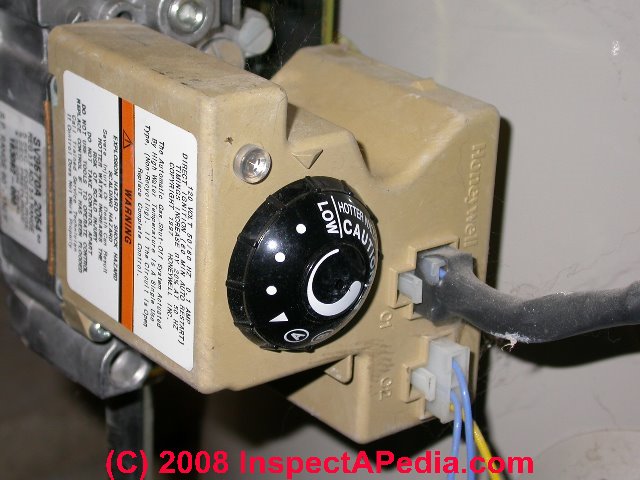
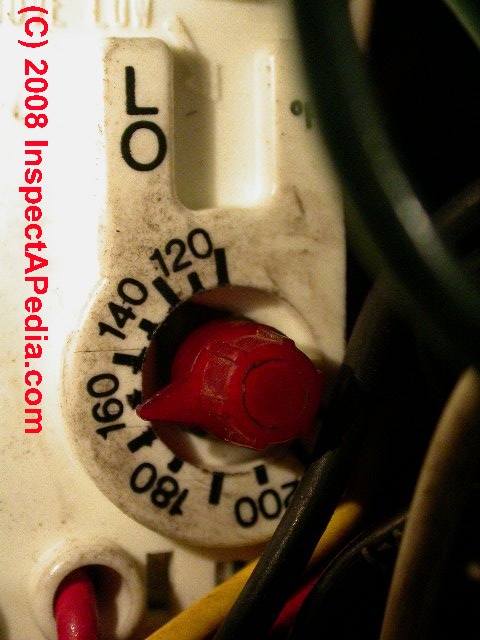
The temperature control on the gas fired water heater shown in our photo at left has been set to "Low" and could be turned "up" to a hotter temperature if building hot water is found to be too cool.
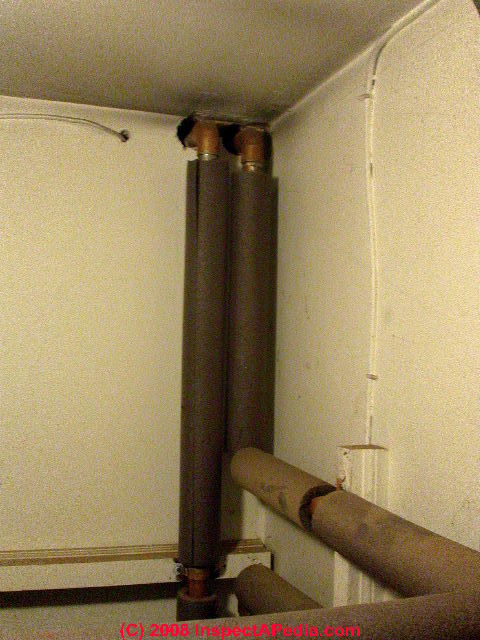
Check for long runs of un-insulated hot water piping
Long hot water piping runs can mean not enough or not hot enough hot water, especially if the piping runs through cold walls, basements, crawl spaces, or attics
If this is the cause of water not being hot enough, the problem will not usually occur suddenly, but it will vary by season, with "hot" water being "cooler" in cold weather.
Even sudden appearance of hot water running cooler could be caused by uninsulated water pipe runs if the water pipes happen to be located in an area normally protected from weather but suddenly left exposed, such as a basement door left open or a mobile home surrounding skirt falling off..
If the water is leaving your water heater at a high temperature but arriving too cool at the sink, shower, or tub, see Insulate Hot Water Piping for details.
Check for a leaky or bad water heater tank dip tube
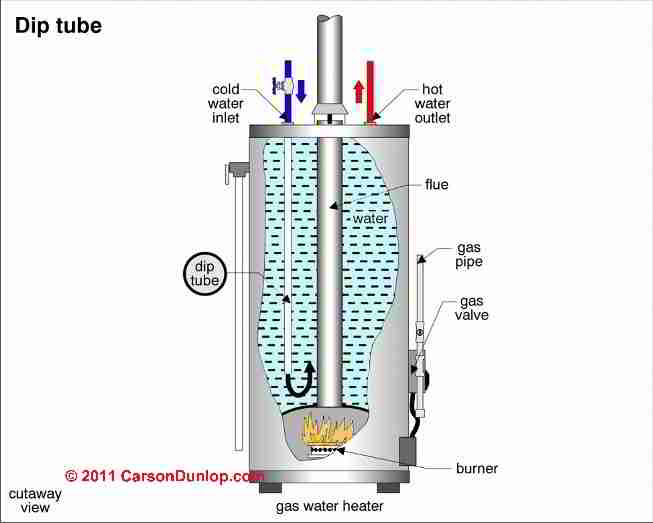
(Sketch courtesy Carson Dunlop Associates ) at your water heater tank. If your water is heated by an electric, gas, oil, or even solar-heated water tank, the tank probably uses a dip-tube to direct incoming cold water to the bottom of the hot water tank.
If the dip tube is leaking (metal dip tubes are often intended to corrode) it may be leaking incoming cold water into the top of the water heater tank.
Or the dip tube may have corroded away or dissolved completely, or parts of it may have fallen into the water heater tank.
See WATER HEATER DEBRIS FLUSH for an example of a dip tube that dissolved and fell into the water heater interior.
Either of these dip tube problems means that cold water running into the water heater tank is no longer delivered to thte tank bottom. Rather it enters at the heater tank top where it mixes with and cools the "hot" water in the water heater.
Bad Dip Tube Can Mean Water Is Not Hot Enough
Watch out: another water heater defect can also result in hot water that's not hot enough.
If the dip tube in the water heater has fallen off or disintegrated, cold water will enter the water heater at its top rather than at its bottom.
The result will be constant dilution of the hottest water in the heater (at its top) with incoming cold water. The result is that the hot water may be just tepid, not hot enough, though the total quantity of hot water is unchanged.
Watch out: a bad dip tube OR a burned out electric water heater lower heating element both give the symptom of tepid hot water output.
So test the lower water heater element and also inspect for debris coming out of the water heater; debris from hot water piping clogging a sink strainer might be traced to a deteriorated tip tube. .
Thanks to Carson Dunlop Associates, a Toronto Home Inspection Firm and to Alan Carson, a Home Inspection Educator, for permission to use sketches shown in this article.
Details about water heater anodes and dip tubes, how they work and why they are needed, are
at ANODES & DIP TUBES on WATER HEATERS.
Check for a burned out electric water heater heating element

if your water heater is electric it probably has two heating elements, an upper and a lower unit. It's easy to diagnose a bad electric water heating element, and you can suspect a problem with the heating elements in an electric water heater even before doing any testing: (Sketch courtesy Carson Dunlop Associates )
If the hot water coming out of the electric water heater is hot but runs out more quickly than previously, we suspect that the lower heating element has burned out.
The upper water heating element is heating up just the water in the top of the water tank. So you have just a small amount of hot water before you run out.
If the hot water coming out of the electric water heater has become tepid when it used to be hot (and no one has changed any other hot water settings), we suspect that the upper heating element has burned out.
When only the lower heating element in an electric water heater is working, it will warm the water but it will normally be unable to raise the temperature in the whole water tank to a high enough level.
So you have plenty of tepid "hot" water.
Watch out: as we described just above, a failed water heater dip tube also causes "hot" water to come out tepid or at a lower temperature than normal.
Check for an oil fired water heater that needs oil burner service & cleaning
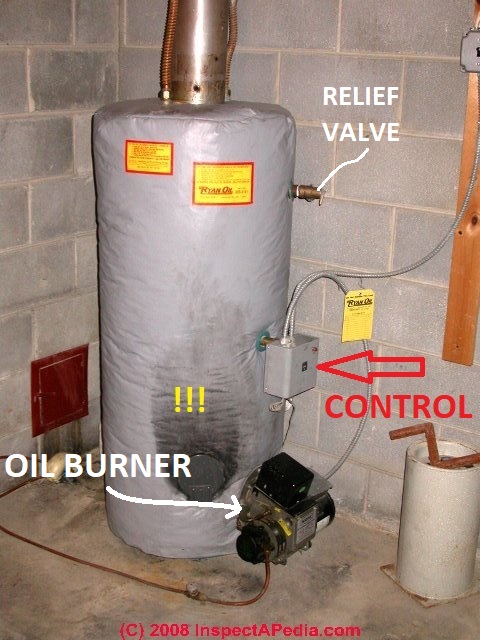
Oil fired heating equipment, when properly adjusted, does not burn perfectly clean.
Burning heating oil produces soot which over time sticks to the interior surfaces of the water heater's interior.
There the soot acts like an insulator, reducing the transfer of heat from the burning heating oil through the metal of the water heater's heat exchanger, into the hot water itself.
You may have plenty of water but its temperature is not as hot as it used to be.
Often service people called to clean and tune an oil fired heating boiler do not clean and adjust the oil-fired water heater unless specifically asked (and paid) to do so.
Just as your oil fired furnace or boiler should be serviced annual (for safety and to lower heating costs), so should your oil-fired water heater be cleaned and tuned annually.
It's likely that this service will be earned back easily in reduced heating oil costs.\
See HOW TO CUT HEATING COSTS for details.
Check Water Heater Mixing Valve Settings and Aquastat Settings
Check the temperature settings at the mixing valve installed on your water heating system.
See MIXING / ANTI-SCALD VALVES for a discussion of the installation and use of anti-scald valves to avoid hot water burns, and for a table of temperatures at which hot water burns occur.
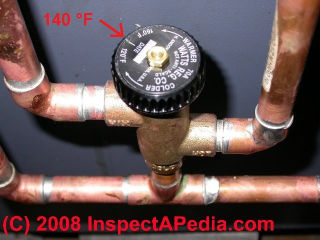
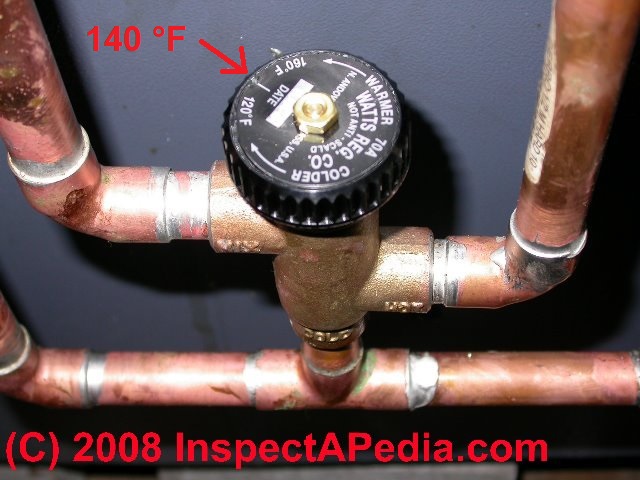
At the top of this page we show a photo of a mixing valve on a heating boiler.
Check the temperature settings at the aquastat combination control if your hot water is made by a tankless coil on a heating boiler.
The "low limit" control shown in our photograph at left maintains hot water in the heating boiler to assure that the tankless coil can produce domestic hot water.
During the heating season, the "high limit" will control boiler operation and boiler temperatures will normally be hotter than what was set here at the "LO" control.
See MIXING / ANTI-SCALD VALVES for a discussion of the installation and use of anti-scald valves to avoid hot water burns, and for a table of temperatures at which hot water burns occur.
Adust Hot Water that is Too Hot
Hot Water Temperature Safety Warning
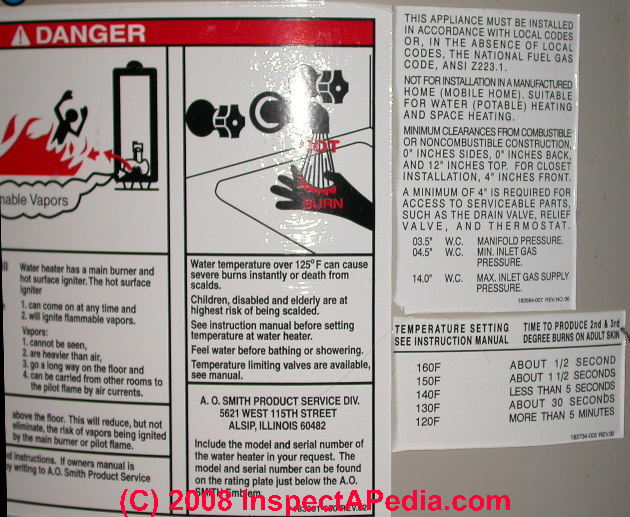 Setting water temperature above 100 degF may cause serious scalding burns.A.O. Smith, the manufacturer of this water heater warns about water temperatures over 125 degF.
See MIXING / ANTI-SCALD VALVES for a discussion of the installation and use of anti-scald valves to avoid hot water burns, and for a table of temperatures at which hot water burns occur.
See SCALDING TEMPERATURES & TIMES for details about how long it takes to be injured in hot water of different temperatures.
How do we Improve the Hot Water Volume & Quantity?
As we discussed beginning in the previous section of this article, there are several different hot water problems:
- Poor hot water flow, or bad hot water pressure, which is usually a piping or clogging problem or an overall building water pressure problem.
See CLOGGED PIPING & Hot Water Flow and see - Poor hot water quantity: not enough total quantity of hot water, or running out of hot water very quickly. Insufficient hot water quantity may be due to the way hot water is being made (a water heater that is too small, a tankless coil on a new small heating boiler, or an instantaneous water heater that is being asked to supply hot water too rapidly.
We describe various ways to improve hot water quantity, pressure, and flow are discussed beginning
at HOT WATER IMPROVEMENTS and
continues
at HOT WATER QUANTITY IMPROVEMENT. - Hot water temperature that is not hot enough: water temperature is just too cool. Insufficient hot water temperature may be due simply to the setting of a temperature control on a water heater or mixing valve, or it may be due to flowing water too fast through a tankless coil.
Hot water that is not hot enough can be caused by quite a list of problems, some of which are easy to correct.
See WATER HEATER TEMPERATURE too LOW for steps to correct water that just won't get hot.
Why do people set water temperature above the recommended safe minimum?
As we warn in more detail below, setting the water temperature too high can cause dangerous, even fatal scalding burns. Yet many of us (author DF included) often set the water heater thermostatic control to a high number.
Why?
Because the hot water delivery piping distance between the water heater or calorifier and the point of use plumbing fixture varies in a building and because by the time hot water reaches its destination it may be too cool.
A second reason we set the water heater output temperature to a high number is to increase the total volume of hot water available at the plumbing fixcture. If your water heater is small in capacity you may not be able to fill a large bath tub with enough hot water to satisfy building occupants.
A "solution" is to increase the temperature of hot water supplied to the tub, mixing it there with enough cold such that the total volume of hot-enough water will also be sufficient.
But the result can be scalding burns especially when people unfamiliar with the home use that plumbing fixture.
A proper, safe solution to "not enough hot water" can be obtained by increasing the water heater output temperature but also including an anti-scald device either at the point of use or at the water heater itself.
See ANTI_SCALD VALVES & HOT WATER QUANTITY
Depending on the type of water heater, cylinder or calorifier that you use and its fuel: electric, gas, oil, solar, the controls that manage hot water temperature will vary.
...
Continue reading at ELECTRIC WATER HEATER THERMOSTATS for electric water heaters or water cylinders, or select a topic from the closely-related articles below, or see the complete ARTICLE INDEX.
Or see WATER HEATER TEMPERATURE TOO COLD or TOO HOT FAQs - questions and answers posted originally on this page
Or see these
Recommended Articles
- HOT WATER PRESSURE IMPROVEMENT - hot water flow or pressure is too weak
- HOT WATER QUANTITY IMPROVEMENT - not enough hot water
- HOT WATER TEMPERATURE ADJUSTMENT
- PRESSURE & TEMPERATURE SETTINGS, CONTROLS for temperature control of building heating systems using hot water or steam
- WATER HEATER MANUALS - home
- WATER HEATER SAFETY
- WATER HEATER TEMPERATURE ADJUSTMENT CONTROLS - home - how to set hot water temperature
- ANTI SCALD VALVES & TEMPERATURE CONTROL / MIXING VALVES - home
- ANTI-SCALD TEMPERING VALVES, MANUAL
- ANTI-SCALD VALVES, POINT OF USE
- ANTI SCALD VALVE at TANKLESS COIL
- ANTI-SCALD WATER TEMPERATURE CONTROL TYPES
- AQUASTAT CONTROL FUNCTIONS
- ELECTRIC WATER HEATER HIGH TEMP CUTOFF
- ELECTRIC WATER HEATER THERMOSTATS
- GAS WATER HEATER TEMPERATURE
- LIMIT SWITCH, SINGLE FUNCTION AQUASTATS Oil Heater
- MIXING / ANTI-SCALD VALVES
- RELIEF VALVE, WATER HEATER
- SCALDING TEMPERATURES & TIMES
- THERMOSTATS, WATER HEATER for oil fired water heaters or water cylinders
- WATER HEATER TEMPERATURE ADJUSTMENT CONTROLS - home
- WATER HEATER TEMPERATURE TOO COLD or TOO HOT
- WATER HEATER TEMPERATURE TOO HIGH
- WATER HEATER TEMPERATURE TOO LOW
Suggested citation for this web page
WATER HEATER TEMPERATURE TOO COLD or TOO HOT at InspectApedia.com - online encyclopedia of building & environmental inspection, testing, diagnosis, repair, & problem prevention advice.
Or see this
INDEX to RELATED ARTICLES: ARTICLE INDEX to WATER HEATERS
Or use the SEARCH BOX found below to Ask a Question or Search InspectApedia
Ask a Question or Search InspectApedia
Try the search box just below, or if you prefer, post a question or comment in the Comments box below and we will respond promptly.
Search the InspectApedia website
Note: appearance of your Comment below may be delayed: if your comment contains an image, photograph, web link, or text that looks to the software as if it might be a web link, your posting will appear after it has been approved by a moderator. Apologies for the delay.
Only one image can be added per comment but you can post as many comments, and therefore images, as you like.
You will not receive a notification when a response to your question has been posted.
Please bookmark this page to make it easy for you to check back for our response.
Our Comment Box is provided by Countable Web Productions countable.ca
Citations & References
In addition to any citations in the article above, a full list is available on request.
- Thanks to Alan Carson and Bob Dunlop, Carson Dunlop, Associates, Toronto, for permission to use illustrations from their publication, The Illustrated Home which illustrates construction details and building components. Carson Dunlop provides home inspection education, publications, report writing materials, and home inspection services. Alan Carson is a past president of ASHI, the American Society of Home Inspectors.
- AO Smith produces AO Smith water heaters in addition to Reliance, State, Maytag and others.
www.aosmith.com/prod/wpc.htm AOS's gas water heater manuals offering advice and safety warnings about adding water heater insulation are available at
www.statewaterheaters.com/lit/im/res-Elec/184671-000.pdf and at
www.hotwater.com/lit/im/res_gas/184123-000.pdf - Rheem who also makes electric water heaters provides a manual for electric water heaters at
waterheating.rheem.com/content/resources/documents/use_care/ResElecProfessional.pdf. Rheem says, as do other water heater producers, that their water heaters meet the "National
Appliance Energy Conservation Act standards with respect to insulation and standby loss requirements making an insulation blanket unnecessary"
Rheem also warns consumers that adding an insulation product [or making any other modification to their equipment] is likely to void the product warranty and may be unsafe:
"The manufacturer’s warranty does not cover any damage or defect caused by installation, attachment or use of any type of energy saving or other unapproved devices (other than those authorized by the manufacturer) into, onto or in conjunction with the water heater. The use of unauthorized energy saving devices may shorten the life of the water heater and may endanger life and property. The manufacturer disclaims any responsibility for such loss or injury resulting from the use of such unauthorized devices " - Our recommended books about building & mechanical systems design, inspection, problem diagnosis, and repair, and about indoor environment and IAQ testing, diagnosis, and cleanup are at the InspectAPedia Bookstore. Also see our Book Reviews - InspectAPedia.
- Carbon Monoxide Gas Toxicity, exposure limits, poisoning symptoms, and inspecting buildings for CO hazards
- In addition to citations & references found in this article, see the research citations given at the end of the related articles found at our suggested
CONTINUE READING or RECOMMENDED ARTICLES.
- Carson, Dunlop & Associates Ltd., 120 Carlton Street Suite 407, Toronto ON M5A 4K2. Tel: (416) 964-9415 1-800-268-7070 Email: info@carsondunlop.com. Alan Carson is a past president of ASHI, the American Society of Home Inspectors.
Thanks to Alan Carson and Bob Dunlop, for permission for InspectAPedia to use text excerpts from The HOME REFERENCE BOOK - the Encyclopedia of Homes and to use illustrations from The ILLUSTRATED HOME .
Carson Dunlop Associates provides extensive home inspection education and report writing material. In gratitude we provide links to tsome Carson Dunlop Associates products and services.
 | HOME | ABOUT | ASK a QUESTION | CONTACT | CONTENT USE POLICY | DESCRIPTION | POLICIES | PRIVACY | |
| © 2024 - 1985 Publisher InspectApedia.com - Daniel Friedman | |||||||||