
InspectAPedia® FREE Encyclopedia of Building & Environmental Construction, Diagnosis, Maintenance & Repair |
Question? Just ask us! InspectAPedia
|
 Winterizing Guide: How to Find & Fix the Spots where Pipes are Likely to Freeze
High-risk freeze points for water piping, drain piping, heating system piping

- POST a QUESTION or COMMENT about where the freeze risk is greatest on building water piping or drain pipes
How to freezeproof a building: where pipes freeze.
This article discusses the details of winterizing a building to prevent freezing pipes, focusing on how to find and fix cold spots that lead to frozen pipes in a building.
If your pipes are already frozen this article points to places to look for the most-likely places where freezing may have occurred in your water supply system.
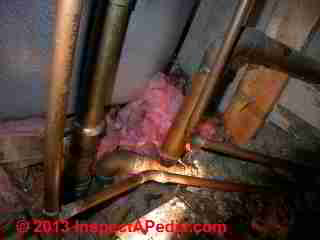
Our page top photo illustrates a common point at which water supply piping is at extra risk of freezing - in a hard-to-access, poorly-insulated corner of a building.
The articles at this website will answer most questions about freeze protection for piping and other building plumbing and heating system components: how to winterize a building to avoid frozen pipes, and how to thaw frozen water supply & dr ain piping, wells, & water tanks.
InspectAPedia tolerates no conflicts of interest. We have no relationship with advertisers, products, or services discussed at this website.
Guide to Finding & Correcting Freeze-Up Risk Points in buildings
 You can do a lot to correct a freezing pipe problem in a building that is exposed to cold weather. Even in an occupied building pipes can freeze in some conditions. Here are some examples of places to look for freezing trouble and what to do about them:
What are the most common places where water pipes, drain pipes, or heating pipes freeze?
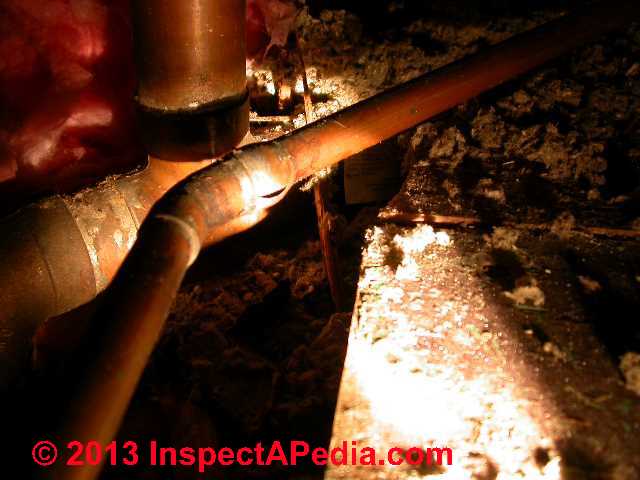
Our photo at left, a close-up of the page top photo, shows one way that pipes burst from freezing: ice forming at a specific location in the copper pipe expanded causing a round bulge that ultimately splits.
Common locations where heating tapes are used on plumbing to prevent freezing pipes include these high risk freeze spots for water supply piping, water drain piping, and in some circumstances even the hot water heating piping, baseboards, or radiators in a building:
- Water pipes run through attics
- Water pipes run through un-heated floors
- Water pipes run through un-heated crawl spaces
- Water pipes and equipment in un-heated garages
- Water equipment in well pits
- Water pipes running under porches
- Water pipes run along or near the building perimeter in a basement or crawl space, where lack of insulation or cold air drafts create pipe freeze risk points
- Hot water heating system pipes that run along the foundation wall top, at building outside corners, where there are outside cold-air drafts, and when heat is left off sufficiently long for the pipe to freeze. Rather than relying on heating tapes on heating pipes (which sounds ridiculous if not dangerous) you should be fixing drafts, re-routing piping if necessary, or for heating system piping, using an antifreeze mix.
See ANTIFREEZE for BOILERS
Some older or less costly models of heating tapes present a fire risk, particularly if the heating tape is crossed over itself. Be sure to read the product specifications, safety warnings, and installation guide before installing a heating tape on building piping of any kind.
Check the routing of both hot and cold water supply pipes to identify spots where freezeproofing is needed
Water pipes
(both supply & drain) & hot water heating pipes or steam heat condensate pipes or building drains routed through un-heated areas or passing by areas exposed to cold drafts.
Check piping that runs along or near the building sills or building perimeter in basements, crawl spaces, attics.
Check water supply piping and horizontal drain lines and fixture traps in cold areas where building heat does not easily enter, such as the pipe chase at left.
Often you can simply cut an opening to let warm air enter such spots - a technique that we illustrate later in this article.
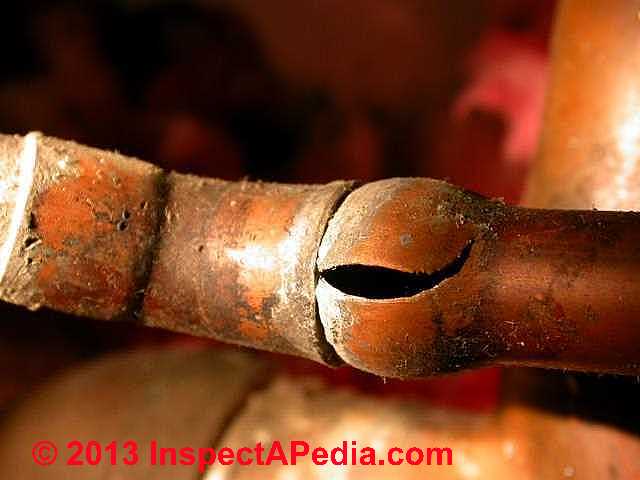
Our photo (above left) provides a closeup showing one of several patterns in which a copper water pipe will swell and burst due to freezing. Details about the different patterns in which pipes freeze and burst are
at PIPE FREEZE-BURST PATTERNS.
- Look for drafts:
On a cold, windy day, explore your home, especially the un-heated areas such as where pipes pass along or close to the building perimeter sills or foundation top in basements or crawl spaces.
If the building has sections of floor that overhang lower parts of the building (such as a raised ranch) be sure the floor under-side is well-insulated and thoroughly sealed against drafts. When cold wind blows against a home which has an overhanging floor, wind against the building can force cold air into the wall cavity or even up into the building walls through a poorly-sealed under-side of the overhanging floor.
Explore the building on a cold windy day, looking for drafts: feel for cold drafts that blow on water piping or heating piping. Fix those drafts and you'll significantly reduce the chances of a frozen pipe. Fixing a draft means adding caulking, a plastic air barrier, using foam insulation, or other means to block un-wanted air flow into a building.

- Look for places where pipes touch un-heated surfaces,
such as foundation surfaces or framing. These may conduct heat away from the pipe and speed freezing at that point.
Our photo (left) illustrates a solution to a problem with pipes that froze repeatedly where they ran along the floor touching baseboard trim that was against a cold wall of a 1920's home in New York.
We moved the hot and cold water pipes to the room interior, used supports to hold the pipes 1/2-inch off of the trim board, then for better appearance we "boxed in" the hot and cold water pipes with a white-painted cover.
The red and blue lines portray water pipes that are actually hidden by the cover. By leaving 1/2" of air space at the cover bottom and a still smaller gap between the L-shaped cover and its abutment to the house wall, warm air circulates by convection (orange arrow) keeping these pipes from freezing. - Look for the coldest of the un-heated areas
where pipes run, such as an un-insulated attic, a pipe chase in a building corner, a crawl space (especially near foundation vents or other drafty spots), or as we explained just above,
in a raised-ranch type home, where pipes run in the section of an upper floor which overhangs the building foundation (and may be poorly insulated).
- Look for evidence that pipes have frozen before,
and find out why the freeze occurred in that spot. - You may see a bulged pipe that didn't burst
(if it burst it would have leaked and been repaired),
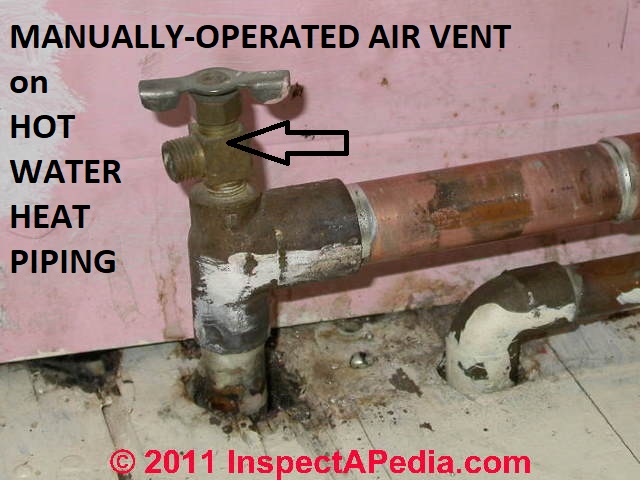
or you may see a section of piping with one or even several pipe couplings soldered in place, a likely indicator that that section of piping has frozen before.
In our photo at left you can see that freezing has damaged the heating baseboard pipe and a copper pipe coupling has been used to make a repair by replacing a damaged section.
Plumbing fixtures in un-heated areas such as a bathroom or kitchen sink in a room that does not have its own heat source;
in kitchens and bathrooms we may leave open vanity cabinet doors to permit warmer building air to reach pipes in those areas.
Freeze-protect outdoor faucets to avoid a building flood
Plumbing faucets outdoors:
traditional simple hose bibs or outdoor faucets can easily freeze where they pass through the building wall if the faucet is not shut off and drained; longer-stem frost-proof outdoor faucets are available and are used in new construction in most jurisdictions.
These newer faucets make sure that the actual valve that turns off water flow is well inside the (supposedly heated) space.
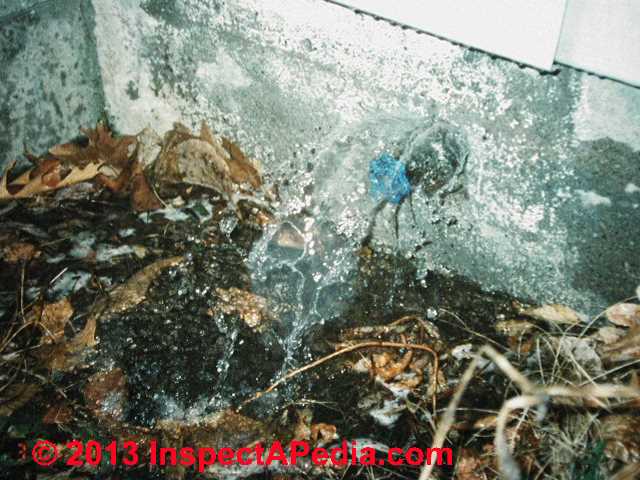 Our photo (left) shows what we found on arriving at an unoccupied New York home shortly after freezing conditions had abated. Water was spewing out of the building wall just above the foundation.
The owner/occupant had forgotten to turn off water to the outside hose hook-up, leaving that line full of water. The water line just inside the foundation froze and burst.
If your outdoor faucet is the older type that is not frost-proof, you should be able to turn off water to that faucet and open a small screw fitting on the faucet body side to assist in draining that device when draining the building piping.
Even in a building where heat and water are being left on for the winter we make sure to find and use (or install if needed) the valve to turn off water to each outdoor faucet. Then we open the faucet to let it drain, leaving it open (and making sure it's not dripping from an indoor shutoff valve that is not working well).
Never leave a garden hose attached to your outdoor faucet in winter as water in the hose may add to the risk that the faucet will be freeze damaged.
See details about outdoor faucets, hose bibbs, sillcocks at FAUCETS, OUTDOOR HOSE BIBBS
and at SILLCOCK INSTALLATION & REPAIR.
Reader Comments, Questions & Answers About The Article Above
Below you will find questions and answers previously posted on this page at its page bottom reader comment box.
Reader Q&A - also see RECOMMENDED ARTICLES & FAQs
Question: our space heaters still haven't thawed out our frozen water supply pipes
2018/02/03 Jeanette said:
Space heaters been on 13 hours and no water
This question and reply were posted originally at WELL PITS - designed to avoid frozen well heads for well casings that are not completely buried below the frost line.
Reply: where to look to find which pipes are frozen when you have no water
Jeanette
I am GUESSING that you are saying your pipes were frozen and you had no water and you're trying to thaw things out.
You need to trace the piping to find the most-likely frozen spots and add heat in those areas.
See details in the article above on this page where we mention where water supply pipes are most-likely to freeze
and HEAT SOURCES to AVOID FROZEN PIPES (live link is given in the article list below) where we suggest where to add heat.
If your drains are also found frozen, see DRAIN FREEZE PROTECTION (live link is given in the article list below) where we give examples of where pipes freeze on drains
On 2017-01-28 by Donna
we have a crawl space under our house. with a sump pump and it discharges outside this year we had very cold weather and our pipe froze. Should we try heat tapes?
...
Continue reading at PIPE FREEZE PROTECTION or select a topic from the closely-related articles below, or see the complete ARTICLE INDEX.
Or see these
Pipe Freeze Protection Articles
- ANTIFREEZE for BOILERS
- DRAIN a WATER HEATER TANK
- FAUCETS, OUTDOOR HOSE BIBBS
- FREEZING FORCE of ICE
- FROZEN PIPE THAW-OUT
- GREYWATER FREEZE PROTECTION
- PIPE FREEZE PROTECTION - home
- DRAIN FREEZE PROTECTION
- HEAT SOURCES to AVOID FROZEN PIPES
- HEAT TAPES to AVOID FROZEN PIPES
- HEAT TAPES on OIL TANK PIPING
- HEAT TAPE HAZARD ON OIL TANK
- INSULATION to AVOID FROZEN PIPES
- PIPE FREEZE-BURST PATTERNS
- PIPE FREEZE-UP POINTS
- PIPE INSULATION CHOICES, MATERIALS, TYPES
- WELL SNIFTER & DRAIN BACK VALVES
- WINTERIZE A BUILDING - home
Suggested citation for this web page
PIPE FREEZE-UP POINTS at InspectApedia.com - online encyclopedia of building & environmental inspection, testing, diagnosis, repair, & problem prevention advice.
Or see this
INDEX to RELATED ARTICLES: ARTICLE INDEX to BUILDING FREEZE PROTECTION
Or use the SEARCH BOX found below to Ask a Question or Search InspectApedia
Ask a Question or Search InspectApedia
Try the search box just below, or if you prefer, post a question or comment in the Comments box below and we will respond promptly.
Search the InspectApedia website
Note: appearance of your Comment below may be delayed: if your comment contains an image, photograph, web link, or text that looks to the software as if it might be a web link, your posting will appear after it has been approved by a moderator. Apologies for the delay.
Only one image can be added per comment but you can post as many comments, and therefore images, as you like.
You will not receive a notification when a response to your question has been posted.
Please bookmark this page to make it easy for you to check back for our response.
Our Comment Box is provided by Countable Web Productions countable.ca
Citations & References
In addition to any citations in the article above, a full list is available on request.
- Eric Galow, Galow Homes, Lagrangeville, NY. Mr. Galow can be reached by email: ericgalow@gmail.com or by telephone: 914-474-6613. Mr. Galow specializes in residential construction including both new homes and repairs, renovations, and additions.
- In addition to citations & references found in this article, see the research citations given at the end of the related articles found at our suggested
CONTINUE READING or RECOMMENDED ARTICLES.
- Carson, Dunlop & Associates Ltd., 120 Carlton Street Suite 407, Toronto ON M5A 4K2. Tel: (416) 964-9415 1-800-268-7070 Email: info@carsondunlop.com. Alan Carson is a past president of ASHI, the American Society of Home Inspectors.
Thanks to Alan Carson and Bob Dunlop, for permission for InspectAPedia to use text excerpts from The HOME REFERENCE BOOK - the Encyclopedia of Homes and to use illustrations from The ILLUSTRATED HOME .
Carson Dunlop Associates provides extensive home inspection education and report writing material. In gratitude we provide links to tsome Carson Dunlop Associates products and services.
 | HOME | ABOUT | ASK a QUESTION | CONTACT | CONTENT USE POLICY | DESCRIPTION | POLICIES | PRIVACY | |
| © 2024 - 1985 Publisher InspectApedia.com - Daniel Friedman | |||||||||