 Plumbing Traps & Trap Defects
- POST a QUESTION or COMMENT about plumbing traps or plumbing interceptors
Plumbing drain traps:
This plumbing traps (interceptors) article describes plumbing traps (interceptors) and how to diagnose, find, and cure odors in buildings including septic or sewage or sewer gas smells or GAS ODORS in buildings with a focus on homes with a private onsite septic tank but including tips for owners whose home is connected to a sewer system as well.
We describe the common problems that occur at plumbing traps: odors, leaks, noises, and we discuss plumbing trap types, requirements, locations, connections, installation, repair and replacement.
This article series distinguishes between P-traps and older S-traps and explains trap siphonage and the dangers that can result from dry plumbing traps.
InspectAPedia tolerates no conflicts of interest. We have no relationship with advertisers, products, or services discussed at this website.
- Daniel Friedman, Publisher/Editor/Author - See WHO ARE WE?
Problems With Plumbing Fixtures or Fixture Traps (Interceptors) & Sewer Gas Leaks & Odors
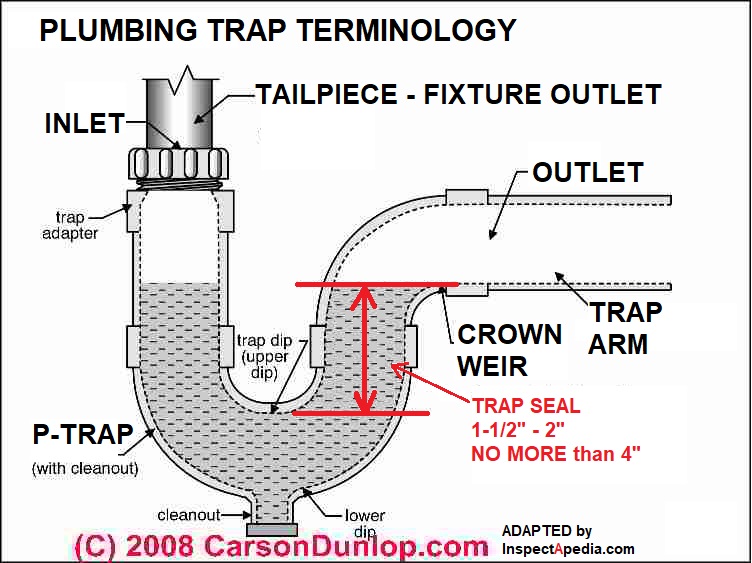
 A plumbing trap is a U-shaped bent building plumbing drain component whose job is to maintain a water seal to keep sewer gases from rising back up into the building from the building's sewer drain piping system.
Watch out: Improperly installed, damaged, leaky, or missing plumbing drain traps can release smelly and even dangerous sewer gas odors in the building.
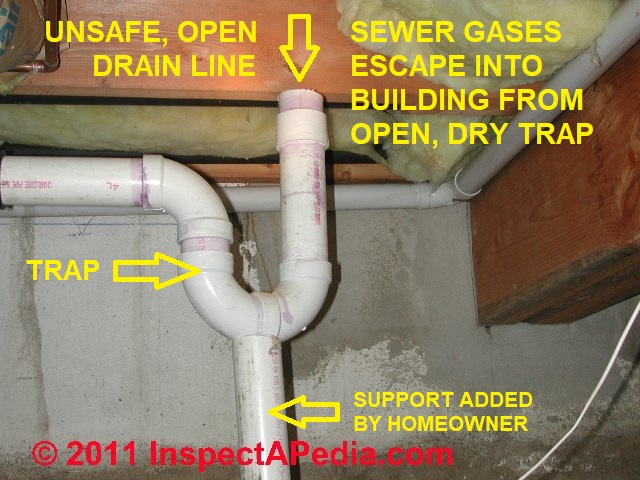
Our photo (left) shows a plumbing trap that was abandoned in a building basement.
The chopped-off, open drain line combined with eventual dry-out of the water in the plumbing trap shown will provide a ready path for sewer gases to enter the structure - a sanitary hazard and even an explosion hazard.
This article series describes both plumbing drain traps and how properly installed traps or interceptors should prevent or cure sewer gas odors from septic systems, building plumbing, & similar sources.
Checklists in this article series will help with sewer gas smell diagnosis or septic gas smell diagnosis. Other causes of sewage odors, septic odors, sewer gas, rotten egg, or other indoor gas odors are also described.
The page top sketch of the detailed parts of a plumbing trap was provided courtesy of Carson Dunlop Associates, a Toronto home inspection, education, & report writing company.
Clogged Plumbing Traps / Interceptors
Clogged or blocked plumbing traps can cause leakage, and organic debris in plumbing traps may itself be a source of odors which people mistake for sewer gas backups.
If your drains are slow at only certain fixtures, one of the first things to check is for clogging of the individual fixture traps.
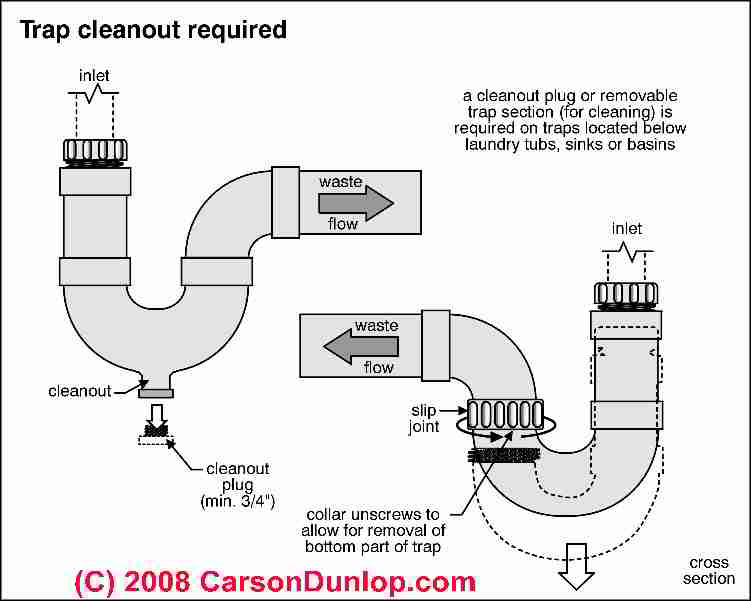
As Carson Dunlop's sketch shows, some fixtures such as laundry sinks are required to have traps which include a cleanout plug, making cleaning of the trap easier.
Otherwise you'll have to remove the entire plumbing trap to clean it.
(Remember to put a bucket under a trap before trying to remove it, and remember not to try working on plumbing traps on Sunday night when you can't dash out to the building supply store to replace parts you've broken.)
Definition: What's the difference between Plumbing Traps vs Plumbing Interceptors?
Note: recent changes in plumbing codes, including ASME Standards, the Uniform Plumbing Code (UPC), Canadian Standards Association (CSA) and the International Plumbing Code (IPC), have dropped the term plumbing trap, and substitute a more inclusive word, "interceptor".
So what's being "intercepted"?
In this usage, sewer gases are "intercepted" or prevented from entering the building from the drain system.
In some building codes and plumbing texts you will see increased use of the term interceptor where you may be more familiar with the term plumbing trap.
In particular, grease traps are referred to now as hydromechanical grease interceptors or gravity grease interceptors.
Bottom line: A plumbing drain "trap" and a plumbing drain "interceptor" mean the same thing - they're synonyms.
See also this International Plumbing Code IPC CHAPTER 10 TRAPS, INTERCEPTORS AND SEPARATORS [PDF]
Causes & Cures for Dry Plumbing Traps / Interceptors & Dry Plumbing Trap Odors
 Definition of Dry Plumbing Traps:
a dry trap is a plumbing trap or interceptor that has lost its water seal, thus permitting sewer gases to escape back up building drain piping and out into the building through the fixture - an unsafe, unsanitary, and potentially dangerous condition.
When a plumbing trap remains unused for a long time, the water can simply evaporate from the trap, permitting sewer gases to back up into the building.
Watch out: Because sewer gas contains methane gas (CH4) there is a risk of an explosion hazard or even fatal asphyxiation.
See ODORS, DRAIN & SEWER LINE SOURCES and
also DRAIN PIPING & SEWER ODORS
and also see METHANE GAS SOURCES
Some places where we often find dry plumbing traps include:
- Unused basement plumbing fixtures like laundry sinks or basement bathrooms
- Basement floor drains often become sources of sewer odors because they remain unused and dry out.
See FLOOR DRAIN / TRAP ODORS - Backdrafting caused by exhaust fans used in tight buildings can sometimes both draw sewer gases out of a dry plumbing trap or other drain piping leaks and may move such odors through the building.
See BACKDRAFTING & SEWER/SEPTIC ODORS
Watch out: backdrafting in buildings is more than a bad smell problem as it may cause unsafe back-drafting of combustion products and carbon monoxide into the occupied space - potentially fatal hazards. - Buildings left unoccupied for months, permitting the water in other traps to dry out
- Buildings in which plumbing traps are leaky, thus losing their water seal even over just a short time
- Buildings in which the plumbing vent system is incomplete, missing, or improperly constructed. Improper plumbing vents or absence or clogging of a vent system can cause plumbing trap siphonage: water flowing down the building drain line can siphon or "pull" the water seal out of plumbing traps.
See PLUMBING VENT DEFECTS & NOISES
Remedies for Dry Plumbing Traps
There are various ways to deal with dry plumbing traps to stop smelly and dangerous sewer gas backups into the building. These include:
- Use of self-sealing traps
- Pour clean mineral oil into the trap when the building is to remain unoccupied for a month or longer.
Simply pouring enough clean mineral oil into the trap to fill the trap bottom is an effective preventive measure and mineral oil in small quantities won't harm a septic or sewer system.
Mineral oil will not evaporate, even over months of trap disuse. - Pour food-grade antifreeze into the plumbing trap. When winterizing a building where traps are left in place, they may be filled with food-grade antifreeze.
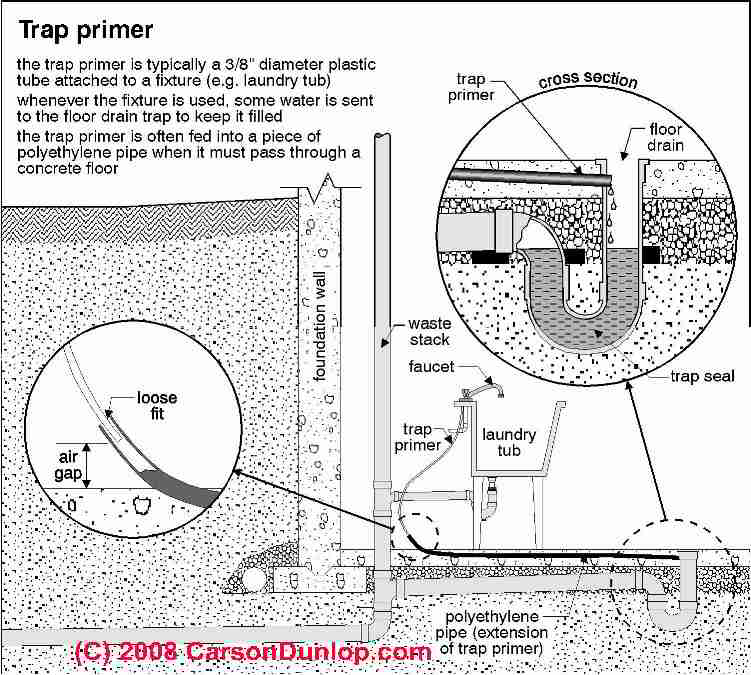
- Use a trap primer to keep a water charge in the plumbing trap. Carson Dunlop Associates' sketch at above left shows how a trap primer system can be installed from a laundry tub.
Self-Sealing Traps for Floor Drains
Self-sealing plumbing traps (interceptors) containing check valves are available and are suited for floor drains.
If water on the floor needs to escape it can flow out of the trapped floor drain, but the trap contains a mechanical seal which prevents sewer gas backups even if the floor drain trap is dry.
Leaky Plumbing Trap or Interceptor & Other Defects
Our explanation of plumbing trap (interceptor) leaks has moved to
Loose Toilets Can Produce Sewer Gas Odors Indoors

Why sewer gases may leak into a building at the toilet:
There is no actual plumbing trap in the waste pipe immediately below a toilet.
Toilet bowls are themselves in effect the largest plumbing trap in most buildings. The water in the toilet bowl is providing the trap seal that prevents sewer gases from rising up the drain piping and exiting through the toilet base into the building.
So if the toilet bowl is dry - from many months of no use (or more rare, from leaks at a cracked toilet bowl), then sewer gases can indeed enter the building through the toilet. We might prevent this hazard at an unused toilet by pouring clean mineral oil into the toilet bowl just enough to fill the bottom trap weir.
But toilets can still leak sewer gases into a building if the toilet is or has been loose or if the toilet base was not properly sealed to the waste pipe.
Check your toilets for leaks at the toilet base:
The wax ring used to seal the toilet base to the waste pipe at the floor may
be deteriorated or leaky, especially if the toilet is loose or was previously loose.
A wobbly toilet compresses the wax ring seal, leading to leaks and sewer gas odors in the bathroom.
In the photograph shown here, stains around the toilet base suggested that this toilet had been leaking at its base - a condition both unsanitary and smelly.
How to check for a loose toilet:
Straddle the toilet and gently pinch it between your knees. Then gently push on each side of the toilet to see if it moves.
If the toilet moves, it may be leaking into the floor (and ceiling below) - an unsanitary condition.
The toilet needs to be removed, any damaged floor repaired, and then the toilet is TOILET is REINSTALLED [photo] using a new WAX TOILET SEAL RING [image] before bolting it securely to the floor.
Details about how to fix a loose or leaky toilet are at LOOSE TOILET REPAIRS.
Plumbing Trap Materials: Metal vs PVC Plumbing Traps & Interceptors
This discussion has moved to PLUMBING TRAP MATERIALS & PROPERTIES.
Plumbing traps are constructed of any of a number of old traditional materials, principally metals, occasionally wood, or of newer plastic materials.
That photo series can identify the type of plumbing trap or interceptor material in a building.
S-Traps on Plumbing Fixtures & Drains
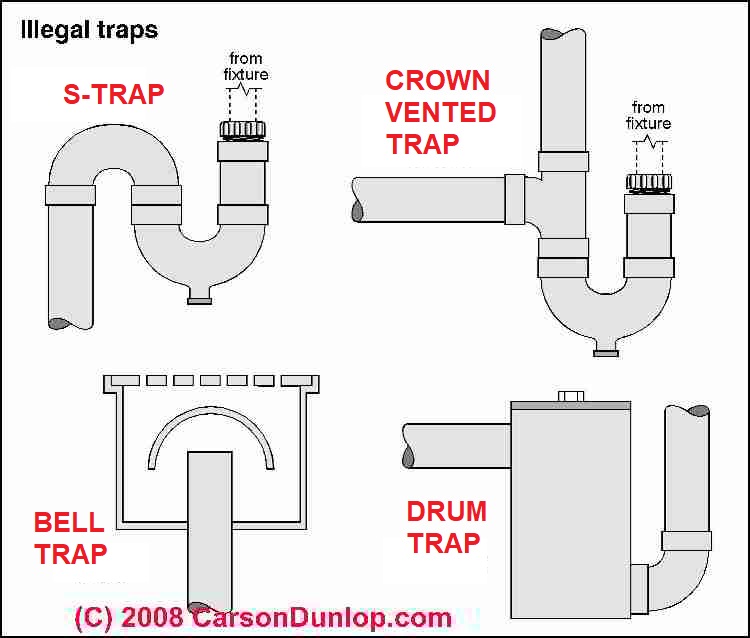 Use of "S" Traps or other illegal and obsolete plumbing fixture traps where a "P" trap is required:
S-traps are often installed in older buildings where there is no venting provided for that plumbing fixture.
S-traps easily lose the water from the plumbing trap, especially if the S-trapped fixture is near a toilet or other large plumbing fixture. Carson Dunlop Associates' sketch at left shows several types of illegal plumbing traps including the "S" trap.
When the larger fixture is draining, the sudden and large volume of water rushing down the drain creates a vacuum in the drain line that can siphon water out of the nearby plumbing traps.
When a plumbing trap has lost its water seal, sewer gases pass readily back into the building.
Look below the sinks for antiquated or un-vented drains - if you see an "S" trap rather than a modern "P" shaped plumbing drain trap, the fixture is almost certainly not properly vented.
Details about S-traps are now found at PLUMBING S-TRAP CODES & HAZARDS
Garbage Disposers (food grinders) and Plumbing Traps / Interceptors
Don't forget to check for smells at your garbage disposer drain too.
And in buildings where GREASE INTERCEPTORS TRAPS or grease interceptor is installed, the garbage disposer (food grinder) drainage is required to bypass the grease trap. This requirement is notwithstanding that garbage disposers (and the pre-rinse function of some dishwashers) is a substantial source of fats, oils, grease (FOG) that clog plumbing drain systems.
If that is the odor source you may be able to remove the odor by cleaning liquids or even simple vinegar.
Sewer Gas or Methane Gas Hazards & Plumbing Traps
Smelly and potentially explosive sewer gases are lighter than air and will rise up through plumbing drain or sewer systems unless these gases are blocked from entering the building.
Our photo shows a plumbing trap that was abandoned in a building basement.
The chopped-off, open drain line combined with eventual dry-out of the water in the plumbing trap shown will provide a ready path for sewer gases to enter the structure - a sanitary hazard and even an explosion hazard.
The two principal features that prevent sewer gases from entering a building through its plumbing drain system are water-filled plumbing traps [the blue area of the plumbing trap in our sketch just below] at sinks and tubs or other plumbing fixtures, and the building plumbing drain vent system [labeled in our sketch] that vents sewer gases above the building roof.
The water trap is critical to keep sewer gases from rising from a sewer or even from a septic system back into the building.
The blue area showing where water rests in the plumbing trap has a maximum allowable height of 4".
But water must remain in this space to act as a seal. The page top schematic of a typical plumbing trap is courtesy of Carson Dunlop Associates '.
What makes the smell in sewer gas? Sewer gases are more than an obnoxious odor.
Watch out: Because sewer gas contains methane gas (CH4) there is a risk of an explosion hazard or even fatal asphyxiation.
Sewer gases also probably contain hydrogen sulfide gas (H2S). In addition, some writers opine that there are possible health hazards from sewer gas exposure, such as a bacterial infection of the sinuses (which can occur due to any sinus irritation).
Depending on the sewer gas source and other factors such as humidity and building and weather conditions, mold spores may also be present in sewer gases.
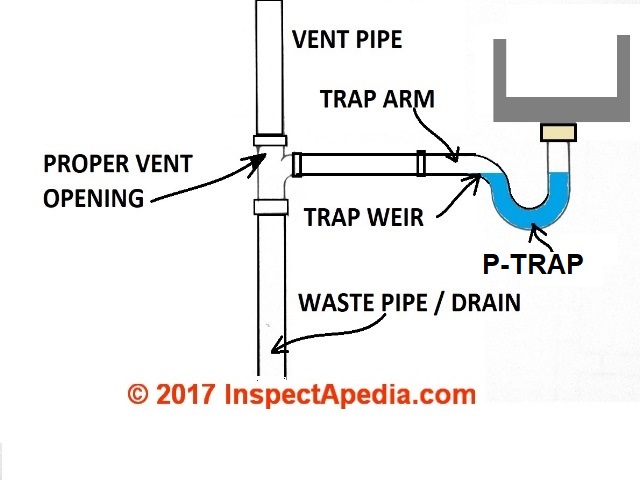
Above: a proper fixture trap installation includes a P-trap, trap arm of sufficient length, and a drain plus vent pipe that permits makeup air to enter the building drain as wastewater moves downwards - avoiding siphoining water out of the plumbing trap.
Technical note on sewer gas smells:
because the "sulphur smell" that some people may associate with dangerous sewer gases can have other sources having nothing to do with building plumbing systems, readers should also see
ODORS, SULPHUR SMELL SOURCES and
ODORS, SEPTIC or SEWER and finally,
ODORS GASES SMELLS, DIAGNOSIS & CURE where we describe how to track odors to their source or cause.
...
Reader Comments, Questions & Answers About The Article Above
Below you will find questions and answers previously posted on this page at its page bottom reader comment box.
Reader Q&A - also see RECOMMENDED ARTICLES & FAQs
Toilet bowl fills up, then goes very low.
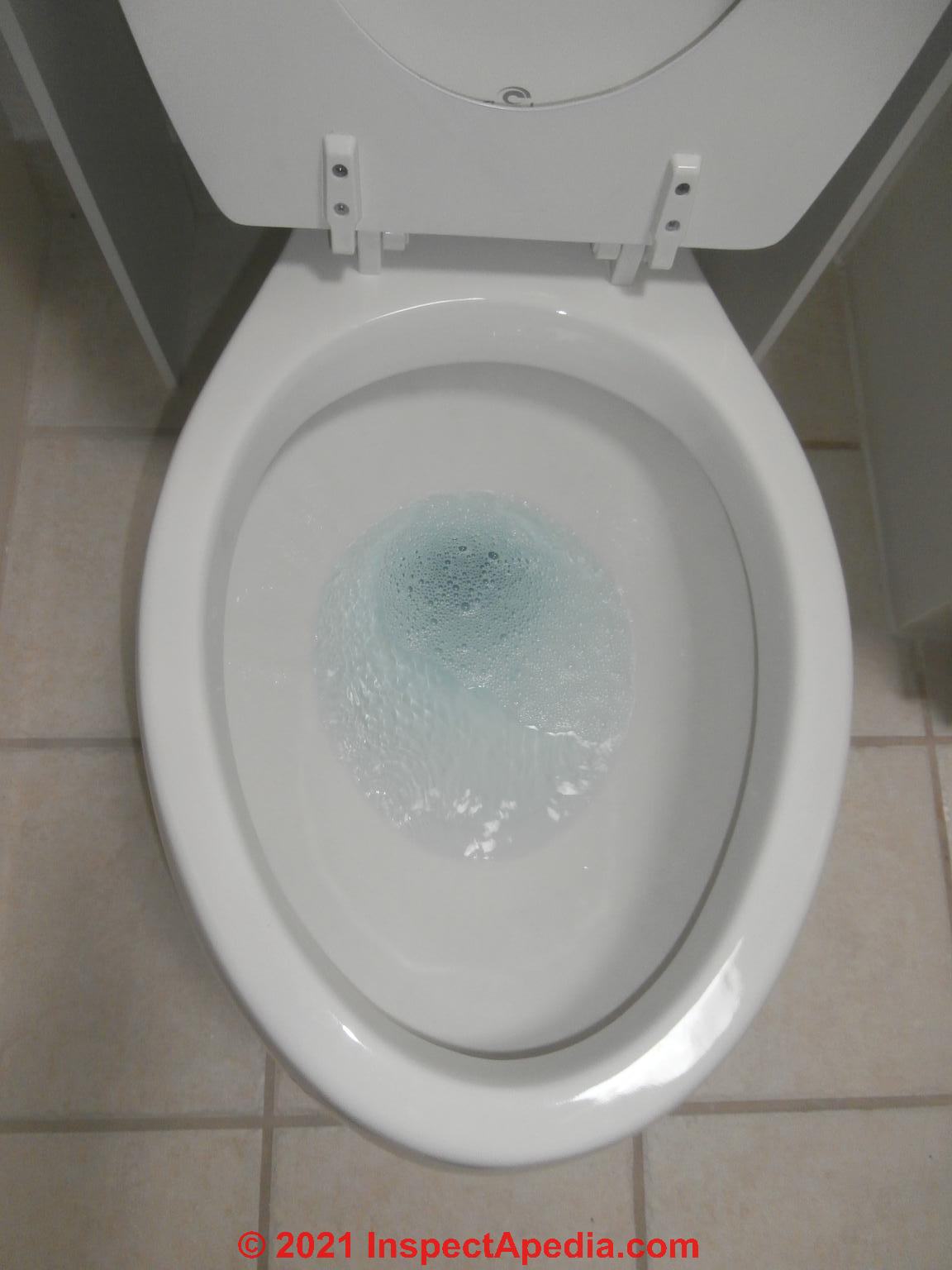 I have a wall that separates 2 toilets: one is a KOHLER, the other is a CRANE.
When I flush the Crane the toilet bowl fills up- as the day goes by, the water level goes real low. There are no visible leaks.
It does not back up or smell. The Kohler was put in by the previous owner a little over a year ago.
The Crane, model # 31742, I don't know how old it is.
The house was built in 1974.
My son went on the roof, and flushed the air tube.
Still the problem with the water level in toilet bowl exists. All the tank 'inners' are new and working in both toilets. HELP! Please. On 2020-10-08
by Lydiah
by (mod) - more likely the problem is a slow drain
I do not think a problem has to do with the toilet brand. More likely there is a slow leak at the toilet flush valve or overflow tube (if the toilet is running and over-filling) that fills the bowl; when the bowl gets enough water then it "flushes itself".
by Lydiah
HI danjoefriedman, I was not asking IF it was a brand problem-I was giving DETAILS to get help.
I have used a Root cleaner foam, because a previous owner planted a Pine tree by my water ground meter/and sewer line to county line. Being that it is strong, I thought it would clean out just about anything that was in the sewer line. I used it once a month for 6 months, now every other month.
Still the problem persists. A plumber who works for KOHLER said: it may be a sloppy install of the KOHLER toilet and the Y joint does not match up-so if and when I flush the Kohler toilet: does the water level in the Crane toilet go down? I said yes!
They told me it was the Y JOINT. So, I contacted YOU as a 2nd opinion. Still think it is a blocked drain now?Reply by (mod)
L
In the ARTICLE INDEX you will see a series of articles on unclogging blocked or slow toilet drains
It would be odd for toilet placement to be the trouble, but it we could get past the finger pointing and your irritation with facts: let's get a plumber to run a sewer camera through the drain to find out exactly what's going on.
That will show up improper piping, damage, leaks, clogs, root invasion, or any other snafu.
Can I swap a tub drain trap with a check valve to avoid trap freezing?
My P-trap for my bath drain is located under the house in open air. Temps can be -20. I keep it from freezing using heat tape, but that fails and the trap freezes up.
Would it be permissable to swap out the trap with a checkvalve?
Thanks in advance On 2020-01-15 by Craig
by (mod) -
Craig:
For a building to be left un-occupied in freezing weather, a dose of clean mineral oil will protect from sewer gas back-drafting while avoiding freezing.
For a house that remains in use and has a freezing trap issue, I wouldn't assume that a check valve won't freeze-up and give you no drainage at all.
A solution I've seen is to box in the trap and drain piping under the home, insulate and provide heat to that tiny space.
At a New York home we enclosed the piping in a chase, insulated it from outdoor freezing temperatures, and simply cut a couple of screened openings to allow warmed house air to circulate therein.
There are plumbing trap insulation kits but in my opinion, insulation alone, unless the drain is in very frequent use, just delay the problem rather than prevent it. And in some temperature change sequences that plan makes matters worse.
Watch out: do NOT try the old trick of leaving water running or dripping slowly. In very cold weather that pretty much guarantees that the slow flowing water will freeze somewhere in the drain line, ultimately leading to a burst drain.by Craig
Thanks for your reply. I wondered about the check valve freezing too. Because of that, I'll not try it.
I have an insulated heated box around it now, but it fails with the heat tape. I was trying to avoid that.
Again, thanks for the reply. I'll fix the box.
Craig On 2020-01-16 by (mod) -And you may read with some heat tapes that they can 't be insulated over while others can.
I've also used something as simple as a light bulb nearby to provide sufficient heat to avoid freezing.
What's the minimum length of the horizontal arm of a P-trap?
Does the trap arm need to be a certain length. A plumber replaced my trap. A smaller vanity was put in and the trap arm was shortened. Everything looks good but I am getting the sewer smell coming out of my bathroom drain. On 2018-08-19 y Charlie
by (mod) -
I speculate that if a P-trap arm is made very short it could possibly result in siphoning out of the required water in the trap.
Fill the sink.
Let it run out.
Shine a light into the trap to see if the trap is siphoning.
Also try flushing a nearby toilet - does the trap siphon dry?
...
Continue reading at PLUMBING TRAP LEAKS & MISSING INTERCEPTORS or select a topic from the closely-related articles below, or see the complete ARTICLE INDEX.
Or see PLUMBING TRAP, INTERCEPTOR FAQs - questions, answers, comments posted originally at this article
Or see these
Recommended Articles
- PLUMBING DRAIN NOISES how errors cause trap siphonage, odors, and noises
- PLUMBING TRAPS & INTERCEPTORS - home
- CLOGGED PLUMBING TRAP CAUSE & CURE
- DEFINITION: PLUMBING TRAPS & PLUMBING INTERCEPTORS>
- DRY PLUMBING TRAP CAUSE & PREVENTION
- GREASE INTERCEPTORS TRAPS
- LOOSE TOILETS LEAK SEWER ODORS
- PLUMBING S-TRAP CODES & HAZARDS
- PLUMBING TRAP HISTORY
- PLUMBING TRAPS, ILLEGAL
- PLUMBING TRAP LEAKS & MISSING INTERCEPTORS
- PLUMBING TRAP LEAK POINTS
- PLUMBING TRAP MATERIALS & PROPERTIES
- PLUMBING VENT DEFECTS & NOISES - home
- SEWER GAS ODORS
- SEWER GASES vs PLUMBING TRAPS & VENTS
Suggested citation for this web page
PLUMBING TRAPS & INTERCEPTORS at InspectApedia.com - online encyclopedia of building & environmental inspection, testing, diagnosis, repair, & problem prevention advice.
Or see this
INDEX to RELATED ARTICLES: ARTICLE INDEX to PLUMBING SYSTEMS
Or use the SEARCH BOX found below to Ask a Question or Search InspectApedia
Ask a Question or Search InspectApedia
Share this article:Ask a Question or Search the InspectApedia website using the box just below.
Need to make a private comment? Email editor@inspectApedia.com. We welcome email with your website content critique, corrections, suggestions or questions. Email is monitored daily but our workload may prevent an immediate reply. For immediate results, we hope you'll first try asking your question using the search box just above.
Citations & References
In addition to any citations in the article above, a full list is available on request.
- "Guidance Document for Sizing and Installation of Grease Traps and Interceptors", Carrolton Texas, January 2012, retrieved 2/16/2014, original source: http://cityofcarrollton.com/Modules/ShowDocument.aspx?documentid=8181
- Kia Gregory, "New York Tries to Clear Its Sewers of FOG (Fat, Oil, and Grease)", The New York Times, p. A18, 15 February 2014
- Thanks to Slade Franklin for the reminder that a leaky wax ring at a toilet can lead to septic odors in bathrooms. 11/2007
- Thanks to J.V. (privacy protected) for the reminder to make a detailed inspection of the plumbing vent system when sewer gas odors are present. 07/2008
- Thanks to Roger Hankey & Cheryll Brown, www.hankeyandbrown.com, ASHI home inspectors in Minnesota, for the deteriorated transite pipe gas flue vent photograph and comments. Mr. Hankey is a past chairman of the ASHI Technical Committee, serves as co-chairman of ASHI legislative committee, and has served in other ASHI professional and leadership roles. 7/2007.
- Thanks to Alan Carson and Bob Dunlop, Carson Dunlop, Associates, Toronto, for permission to use illustrations from their publication, The Illustrated Home which illustrates construction details and building components. Carson Dunlop provides home inspection education, publications, report writing materials, and home inspection services. Alan Carson is a past president of ASHI, the American Society of Home Inspectors.
- Steve Smallman, Raleigh, NC, Email: steve@stevesmallman.com, Website: http://stevesmallman.com/ - Quoting: Steve Smallman Property Inspections (SSPI) inspectors have performed or supervised over 25,000 inspections since we introduced home inspections to the Triangle area in 1980. Mr. Smallman is a contributor to InspectApedia.com and has commented on or provided information on plumbing traps, commercial FPE electrical panels and DIY Tests of FPE equipment,, roofing underlayment, and building exteriors.
- Our recommended books about building & mechanical systems design, inspection, problem diagnosis, and repair, and about indoor environment and IAQ testing, diagnosis, and cleanup are at the InspectAPedia Bookstore. Also see our Book Reviews - InspectAPedia.
- In addition to citations & references found in this article, see the research citations given at the end of the related articles found at our suggested
CONTINUE READING or RECOMMENDED ARTICLES.
- Carson, Dunlop & Associates Ltd., 120 Carlton Street Suite 407, Toronto ON M5A 4K2. Tel: (416) 964-9415 1-800-268-7070 Email: info@carsondunlop.com. Alan Carson is a past president of ASHI, the American Society of Home Inspectors.
Thanks to Alan Carson and Bob Dunlop, for permission for InspectAPedia to use text excerpts from The HOME REFERENCE BOOK - the Encyclopedia of Homes and to use illustrations from The ILLUSTRATED HOME .
Carson Dunlop Associates provides extensive home inspection education and report writing material. In gratitude we provide links to tsome Carson Dunlop Associates products and services.
 |
HOME | ABOUT | ASK a QUESTION | CONTACT | CONTENT USE POLICY | DESCRIPTION | POLICIES | PRIVACY | |
| © 2026 - 1985 Publisher InspectApedia.com - Daniel Friedman | |||||||||