
InspectAPedia® FREE Encyclopedia of Building & Environmental Construction, Diagnosis, Maintenance & Repair |
Question? Just ask us! InspectAPedia
|
 Plumbing Vent Defects
Drain Noises, Gas Smells & Septic Tank Odors
- POST a QUESTION or COMMENT about troubleshooting plumbing drain waste vent system noises & odors
Troubleshooting plumbing vents:
This article describes how to examine the building's plumbing vent system piping and connections in order to diagnose, find, and cure odors in buildings including septic or sewage or sewer gas smells or plumbing drain and fixture noises that may appear indoors or outside.
Here we list common causes of plumbing problems related to improper plumbing vents.
We describe how to track down and correct these "gas odors" in buildings with a focus on homes with a private onsite septic tank but including tips for owners whose home is connected to a sewer system as well. What makes the smell in sewer gas? Sewer gases are more than an obnoxious odor.
How to prevent or cure sewer gas odors from septic systems, building plumbing, & other causes. Sewer gas smell Septic gas smell diagnosis - plumbing checklist.
What causes that gurgling noise in a sink, tub or shower drain, and why do some fixtures "gurgle" when a toilet is flushed nearby? Here are the answers.
InspectAPedia tolerates no conflicts of interest. We have no relationship with advertisers, products, or services discussed at this website.
Plumbing Vent Piping Defects May Cause Drain Noises or May Release Dangerous Sewer Gas Odors Indoors
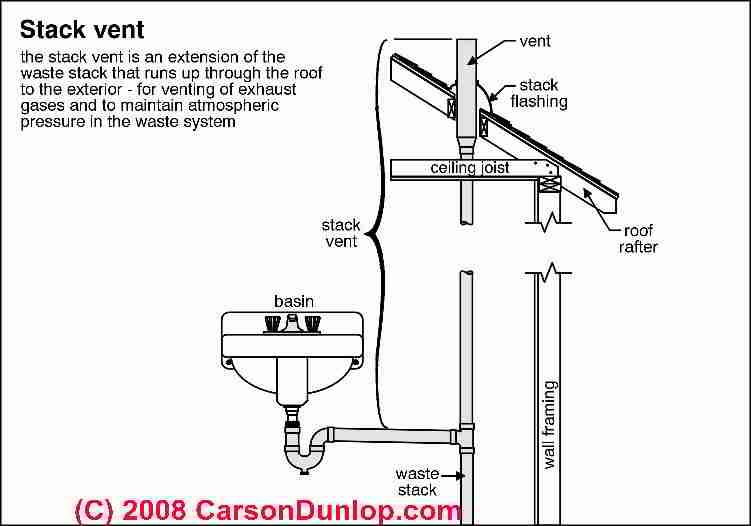
 Our page top sketch of a plumbing stack vent and other sketches included below are provided courtesy of Carson Dunlop Associates, a Toronto home inspection, education & report writing tool company [ carsondunlop.com ].
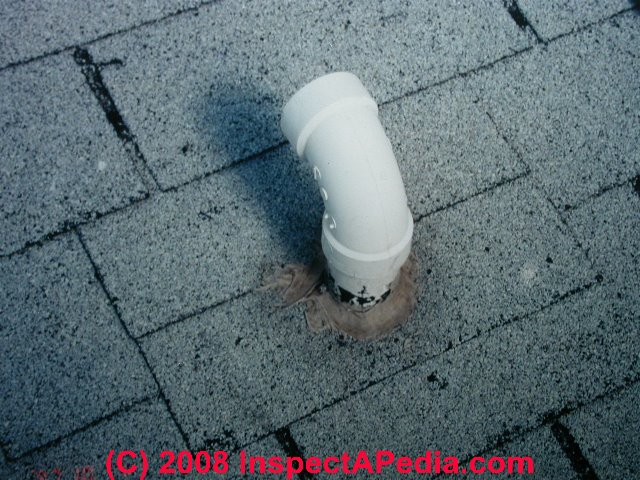
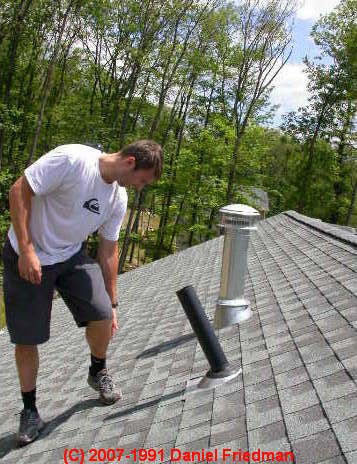
At left is a plumbing vent installed on an angle, making us question the workmanship of this job and raising an alert for other plumbing vent snafus.
[Click to enlarge any image]
Plumbing drain or sewer gas odors:
If you smell sewer gases in your building conditions could be dangerous (risking a methane gas explosion) or unsanitary.
Also see REMEDIES for SEWER ODORS, PLUMBING
Watch out: Because sewer gas contains methane gas (CH4) there is a risk of an explosion hazard or even fatal asphyxiation. Sewer gases also probably contain hydrogen sulfide gas (H2S) In addition some writers opine that there are possible health hazards from sewer gas exposure, such as a bacterial infection of the sinuses (which can occur due to any sinus irritation).
Depending on the sewer gas source and other factors such as humidity and building and weather conditions, mold spores may also be present in sewer gases.
Plumbing drain or fixture noises: Other advice about controlling plumbing noises in buildings is
at PLUMBING DRAIN NOISE DIAGNOSIS and also
at SOUND CONTROL for PLUMBING.
- Missing, inadequate, or improperly installed drain-waste-vent (DWV) piping in the building:
sometimes a building drain system has inadequate or missing plumbing vents. We list a variety of plumbing vent defects in this article.
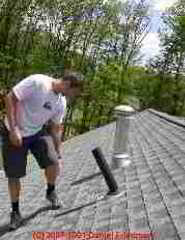
Our first photo (above) shows our client observing a very questionable plumbing vent on a new house.
The vent is so far from vertical that we wondered if it had been connected to anything inside, and even if it was, we took this detail to suggest work by someone who lacked proper training - so we were alert for other plumbing defects in the building.
- Plumbing vents outside but by a window or door:
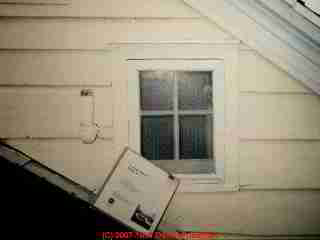
Just as is shown in the photograph (above), plumbing vents which terminate outside but right next to an upper story window permit sewer gas entered the room when the window is open.
 ...
... 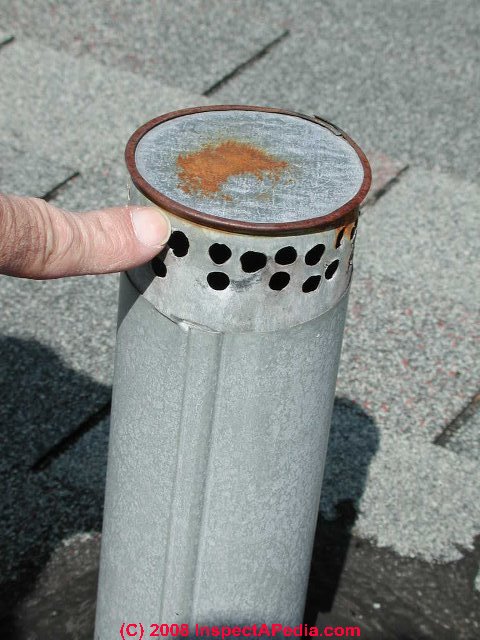
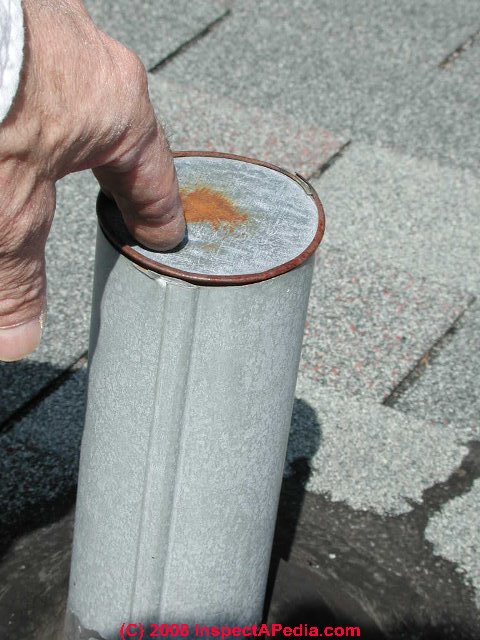
- Plumbing vents which have been accidentally closed off or blocked: (photos above)
some plumbing vents include a screen which can slide down, closing off the vent and causing sewer gas backups in the building.
We've also found plumbing bents blocked by wasps nests, birds, and once even
a FROG in the ROOFTOP PLUMBING VENT STACK [Image file]
Our photos above show how we simply raised the screen back up to open an old sheet-metal vent. - Leaking plumbing vent system piping:
check that all of the pipe connections in the building's plumbing vent system have been properly made and sealed.
Particularly with plastic piping it's possible for an installer to push vent pipe sections together while forgetting the glue.
 ...
... 
- Our plumbing vent stack leak
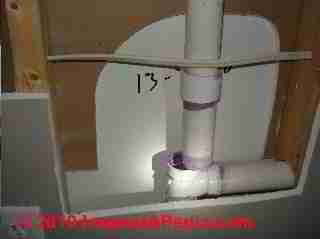
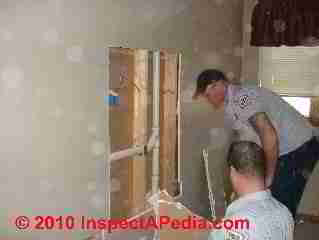
photographs above and just below show a hidden plumbing vent leak in a building wall cavity - exposed by drywall removal during an odor investigation, courtesy of reader Cheryl Lidawer, show what happens when plumbing vent pipe connections are not properly made.
In this case the installer coated the pvc vent pipes with primer but not glue, then assembled them.
After lots of detective work and difficulties tracking down sewer gas odors in this home, the owners found multiple sewer gas leaks including the one shown in the two photos above, inside of the building wall cavity.
The defective vent piping and sewer gas leaks were discovered by pressure-testing the plumbing drain-waste-vent system.
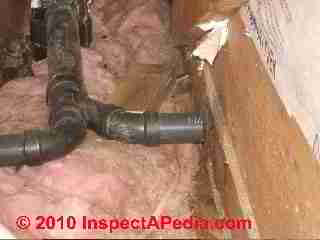
Troubles and mistaken sewer gas odor-sources along the way to finding this plumbing vent sewer gas leak problem included
- a red-tagged gas-fired heating furnace (people thought the odor was due to the heating system) -
an apparent mistake since odors persisted when the heating system was not running - suspecting odors traveling through heating air ducts -
was sewer gas or LP gas leaking into the duct work? - suspicions of a chimney problem -
was there back-drafting into the gas fired heater?, and finally - visual discovery of open plumbing vents in the building attic
(photo above left - that gray pipe stub at center of the photo ends with a saw cut and you can see staining on nearby wall surfaces), and more - confusion about odor and plumbing error responsibility
among multiple contractors.
Clues surrounding this problem included visual evidence of inexperienced or untrained workers such as the extensive use
of MIXED PVC/ABS PLASTIC VENT AND DRAIN PIPING [Image] in an older home.
While modern glues can secure PVC to ABS plastic, in older homes, before such adhesives were available, a mix of black ABS and white PVC drain waste vent piping often meant leaks due to incompatible glues. Don't assume mixed plastic piping is properly secured.
When you find evidence of un-trained workers having been part of the construction team, remember to be alert for other improper or even unsafe conditions such as
this UNSAFE ELECTRICAL WIRING [Photo] found in the same building attic as the chopped off plumbing vent pipe. - Because a plumbing vent is passing only sewer gas, not liquid waste that causes a drain not to function, no one notices that it's leaking into the building until there is an odor complaint, the pipe falls apart (which may never happen), or there is a sewer gas explosion.
An experienced plumber may spot a loose vent piping correction quickly, especially in an attic or basement. It helps if you've already traced the sewer gas smell to its strongest location. - Pressure test the vent piping or drain piping systems:
It is also possible to perform a pressure test of the vent piping system or the drain piping system - a procedure which will diagnose for sure whether or not the plumbing vent system is leaking sewer gas. A plumber installs seals at appropriate locations and pressurizes the piping to check for leaks. [Thanks to J.V. for this detail.]
In the Lidawer sewer gas odor diagnosis case described just above, pressure testing the plumbing system disclosed un-glued drain-waste-vent piping joints. - Missing plumbing vents:
I've seen systems with no vents at all - which often leads to sewer gases reentering the building through sink and shower traps. 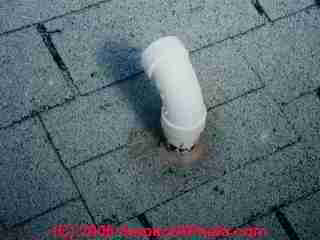
Plumbing vents which are too short in their above-roof projection can be blocked by snow and ice in freezing climates.- Plumbing vents which are blocked by ice
freezing inside the vent line: in freezing weather if a lot of water vapor is passing up the vent line, for example from long steamy showers or perhaps from a hot water fixture left running or leaking into the drain system, frost can form in the vent piping where it passes through a cold attic and outside.
When the frost becomes heavy enough it can block the plumbing vent system completely.
In freezing climates, check that a plumbing vent is not being blocked by frost or by snow-cover. Waste line sounds heard in piping or at plumbing fixtures, such as "drain gurgling" or "glub glub" sounds, or similar noises may indicate defective or clogged plumbing.
We discuss how to diagnose and cure drain sounds
at PLUMBING DRAIN NOISES,
and we discuss diagnosing sewer gas odors in cold weather further
at DIAGNOSING SEWER ODORS.
Watch out: snow and ice can rip a plumbing vent right off the roof, risking both roof leaks and plumbing vent condensate leaks into the roof structure or other building areas.
See an example at SNOW GUARD FAILURES . - Remedies for sewer gas odors are discussed
at REMEDIES for SEWER ODORS, PLUMBING.
Also see WET WEATHER OR COLD WEATHER SEPTIC ODORS
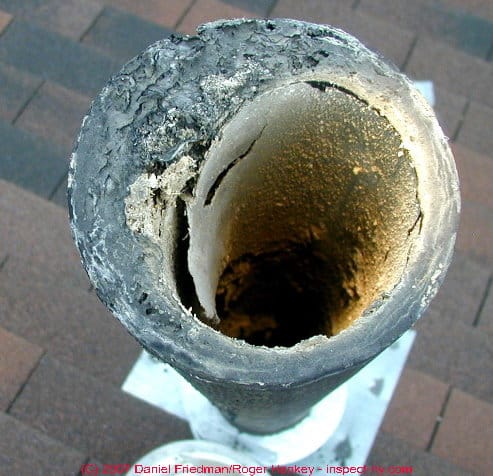
- Transite pipe plumbing vents -
[photo just above] an cement-asbestos material, can become delaminated and clogged with age, blocking the plumbing vent system.
See TRANSITE ASBESTOS CHIMNEYS, DUCTS, PIPES [Photograph courtesy of Roger Hankey].
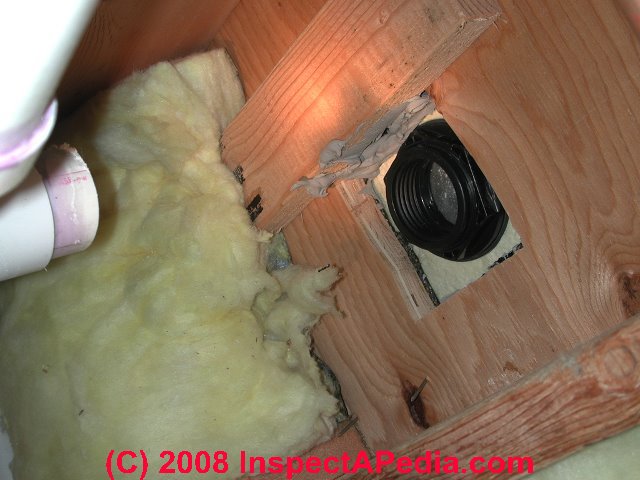
- Plumbing vents terminating indoors:
As shown in the photograph just above, we sometimes find plumbing vents which terminated in the house attic rather than being vented outside.
The plumber didn't want to cut the hole in the roof, perhaps because she didn't have the proper tools, ladder, or roof vent flashing at hand.
We've also found plumbing vent lines that had been cut indoors where a fixture was removed or moved, leaving an open vent line that should have been capped or sealed.
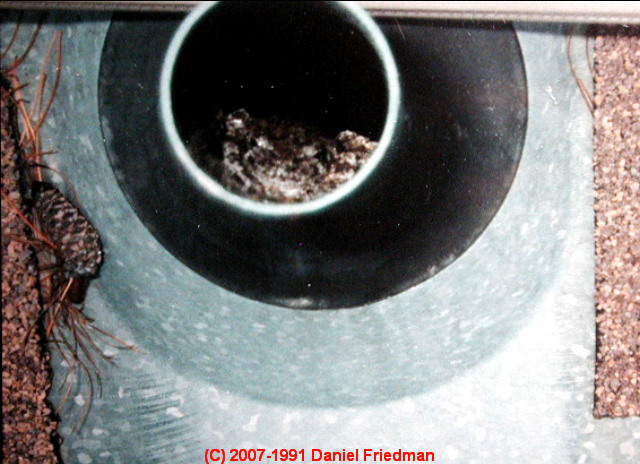
- Check for blocked building plumbing vents
such as a vent blocked by an insect nest, birds nest, or even a dead animal. Incidentally, a dead animal anywhere in a building might be mistaken for a sewer gas smell as the animal decays. Live animals can block a plumbing vent too.
We found a live frog in one building plumbing vent, right at the rooftop, as shown in this photo!
See PLUMBING VENT ROOFTOP CAP or SCREEN for covers to prevent vent clogs from leaves, pine needles, animals.
In freezing climates, check that a plumbing vent is not being blocked by frost or by snow-cover.
See COLD WEATHER SEPTIC ODORS OR SEWAGE ODOR DIAGNOSIS
- Noisy drain piping or plumbing fixtures:
Drain-waste line piping sounds heard in piping or noises heard at plumbing fixtures, such as "drain gurgling" or "glub glub" sounds, or similar noises may indicate defective or clogged plumbing or even if the drains are not clogged, odors and noises are often caused by blocked or improperly installed plumbing vent piping.
At PLUMBING DRAIN NOISES we explain the basics of proper plumbing vent piping and how errors cause trap siphonage, odors, and noises. We discuss how to diagnose and cure drain sounds in that article.
Other advice about controlling plumbing noises in buildings is
at SOUND CONTROL for PLUMBING. - Plumbing vent distances to fixtures:
Plumbing codes require that plumbing vent lines be installed sufficiently close to plumbing fixtures to vent those drains (typically 5' or less) and that the vent system conducts any sewer gases outside and above the building (not in the attic).
See PLUMBING DRAIN NOISES for details. - Plumbing trap arm too long or not properly sloped:
can cause plumbing trap siphonage and lead to both poor drainage and sewer gas odors in buildings.
See PLUMBING DRAIN NOISES for details.
- Through Wall or Free-Setanding House Traps, Vents: Risks of Blockages, Backups & Sewer or Septic Gas Odors
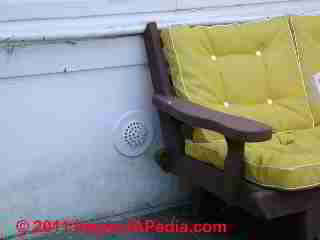 Some residential plumbers like to install a trap in the main house sewer line at the point where the line exits the house wall to head for the septic tank.
Such traps may protect copper waste lines from corrosive sewer gases. They also may prevent gases from a septic tank from passing back up the waste line and up the house plumbing vent stack.
See DIAGNOSING SEWER ODORS.
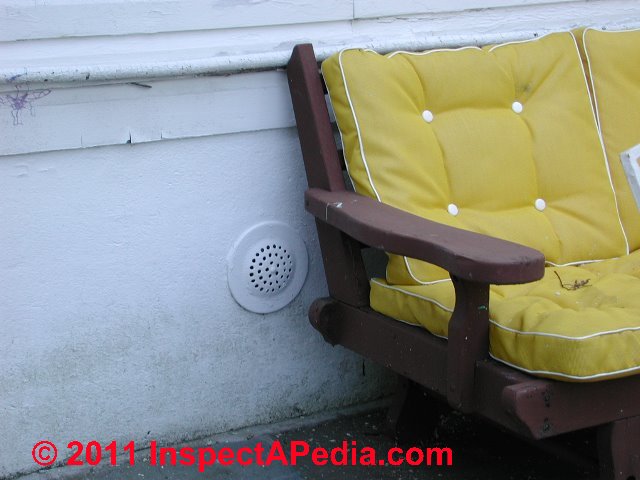
Our photo above hows a sewer line vent through the building exterior wall.
Sewer gases exiting this vent empty next to anyone seated on the chair that has been placed on the patio that was added long after the house was built - a condition that was not anticipated by the installing plumber.
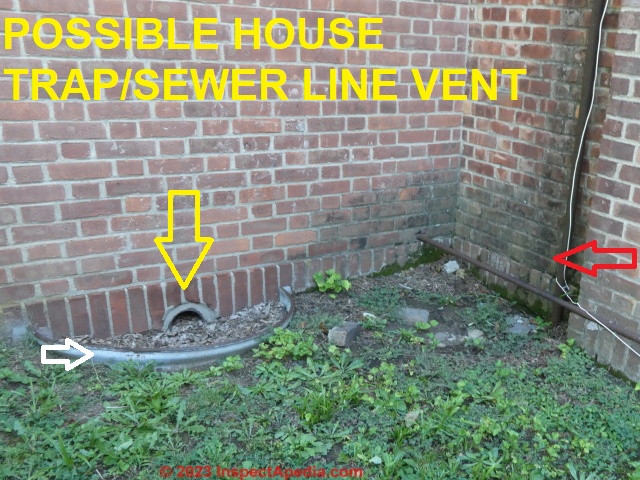
Our photo below, courtesy of home inspector Dovber Kahn, shows what we think is a sewer line vent on a 1930s building in New York state.
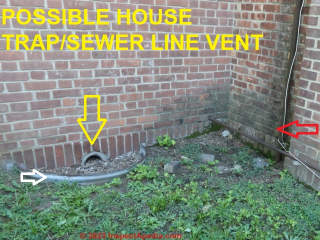 We include here excerpts from our discussion of what we think might be an improper house trap vent or sewer line vent.

Inspecting this property
Mr. Khan noted:
I was wondering if you had an idea what this drainage was for. There were no gutters at the roof with a valley from the rear draining at this area
Evan Grugett (senior ASHI home inspector) noted that this was likely the house trap vent terminal.
Daniel Friedman
Sun, Sep 3, to Dovber, egrugett
If you're asking about that steel window-well that surrounds what looks like a round concrete pipe or opening at the bottom of a brick wall, then
No, Dov, I don't know for certain what that is - not without more context; I don't know what we're looking at: a free-standing wall, a building with a basement, a building with a crawl space, or some other sort of structure.
If this is a building, is there a basement? could this have been an air inlet such as for combustion air or, I agree with Evan Grugett, we might see t this mostly-blocked pipe as an outdoor air inlet to a main sewer line or building drain system vent.
It doesn't look like a "drain" - in fact the raised lip of steel window-well material is placed to keep surface runoff from running into the opening; if that pipe were intended to accept surface water runoff the installation wouldn't make sense to me - you wouldn't block water flow into it with a steel half-round window well guard.
It also looks as if there is a long history of roof runoff spillage at an inside building corner - if this is a building; if so that's an invitation to basement/crawlspace water entry and if the small round opening of which we see only the upper half was supposed to be an air vent, it's mostly blocked, but the window well around it would suggest that indeed someone knew a lot of water spills in this area and they were trying to keep it out of that opening.
If you enter the basement or crawl space you should look at this location to see if it's a building drain vent or something else. And in any event it's largely blocked by debris or perhaps soil too - doesn't look good.
Got any more info about this building? Did you enter it?
Dovber Kahn replied:
There was one accessible crawlspace at the right side of the structure but it was only about 10' x 15'. There's no other accessible access to view framing etc. There were no gutters at the roof with a valley from the rear draining at this area.
Danjoe (mod) Warning: Watch out for blocked or flooded sewer line, inadequate venting, risking sewer backup or other unsafe conditions
Watch out: I would have issued a warning that if there was no screen over that opening (as appears to be the case) and because it was partly blocked, if this is a plumbing vent it's likely to lead to a drain problem, risking a costly sewage backup under or even in the building.
Soil backfill into what is supposed to be a main house drain line vent can block the drain, and there's also risk of back-flooding of roof spillage and surface runoff into the sewer line (probably the reason for that "window well" barrier that IMO is too low and is ineffective).
And if it's an air intake vent for heating equipment, which now sounds less likely, there could have been a heating safety concern. A view into that crawl space would have been critical.
...
Other examples of sewer line vents as a source of septic or sewer gases noticed outside are found
at SEWER GAS ODORS in COLD / WET WEATHER
- Dov Ber Kahn, a home inspector in Rockland County, NY has contributed photographs of various building features to InspectApedia. Mr. Kahn is a licensed home inspector in New York and New Jersey, and can be reached at Website: Kahnbhomeinspectors, Tel: 845-445-8234, Email: kdovber@googlemail.com
Original installation of plumbing vent stack flashing on a metal roof
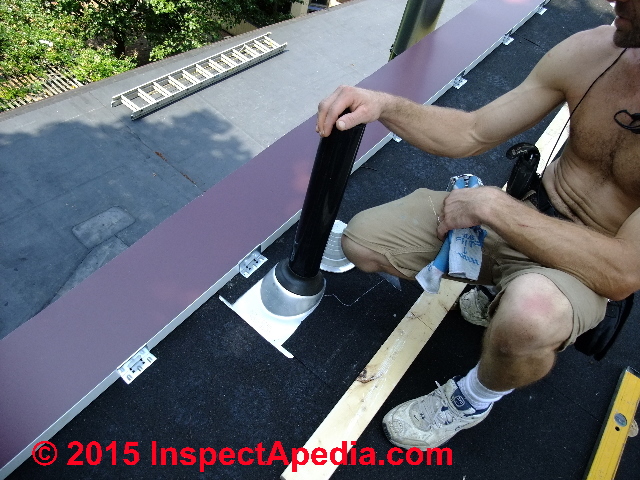
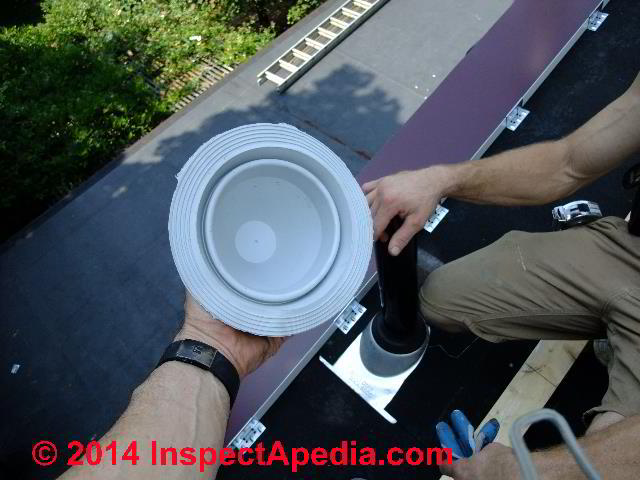
Below are details from the original plumbing vent installation of a 3-inch ABS plumbing vent through a standing seam metal roof.
We had installed a conventional plumbing vent stack and boot (below left) along with a roof membrane, while waiting for the metal roof to arrive at the jobsite.
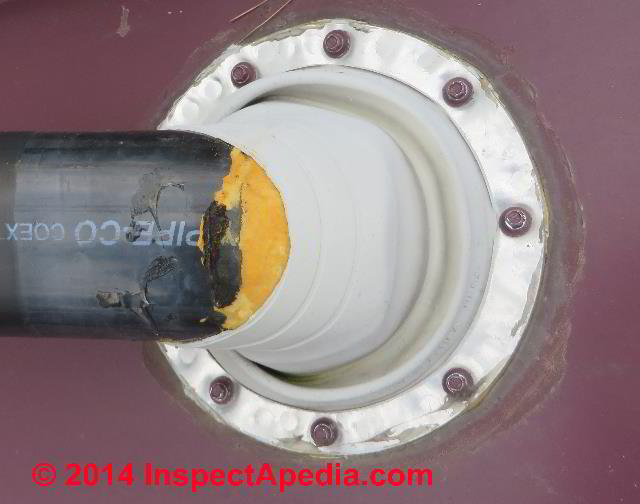
To properly seal the plumbing vent to the metal roof we replaced the shingle-roof type vent flashing with the white rubber flashing shown at below right. That flashing is sealed to the metal roof surface by both adhesive sealant and a ring of metal screws.
 ...
... 
Photos courtesy of Eric Galow, Galow Homes in Poughkeepsie, NY.
At below left you'll see that even with the plumbing vent stack broken and bent over nearly touching the roof surface, the rubber boot installed in the photos above managed to avoid a flood of melting snow into the roof cavity. This broken plumbing vent was caused by the property-owner's reluctance to finish the job of installing snow guards on the roof.
Details about the snow guard system and its proper installation (done after this damage occurred) are
at SNOW GUARDS on METAL ROOFS
and step by step details of how we repaired this snapped-off plumbing vent without having to cut open the roof from above nor the cathedral ceiling from below are
at PLUMBING VENT REPAIR
We discuss how to diagnose and cure drain sounds (gurgling, bubbling, smells, poor drainage)
at PLUMBING DRAIN NOISE DIAGNOSIS (gurgling drains means bad vent piping or clogged drains)
and at CLOGGED DRAIN DIAGNOSIS & REPAIR.
We discuss drainage for plumbing fixtures, such as loose toilets, as sources of sewer gas odors separately
Roof Vent Caps & Screens
Where the vent pipe exits the roof, and depending on variables such as roof slope, site or terrain features, wind direction, and other factors, there is potential for downdrafts sending sewer gas odors back down the plumbing vent system where at a dry trap or leak in the piping those gases and smells may enter the building.
Photo: we found a frog happily resting inside this rooftop plumbing vent - discussed in more detail at PLUMBING VENT DEFECTS & NOISES
Additionally, precipitation, debris from trees, or small rodents or birds may enter the vent pipe leading to a possible clog, blockage, or dead animal that was unable to get out again.
There are roof vent caps and screens designed specifically for the purpose of preventing these issues and the type of vent cap you choose will depend on what problem you are trying to address.
Reader question: How can I keep pine needles from falling down the vent pipe on the roof?
On 2023-07-27 by Bill
I have a customer that has pine trees dropping needles into the vent pipe on the roof, causing it to become clogged up. Is it legal to put a 90’ elbow on the top to stop this from happening?
On 2023-07-27 by InspectApedia Publisher
@Bill,
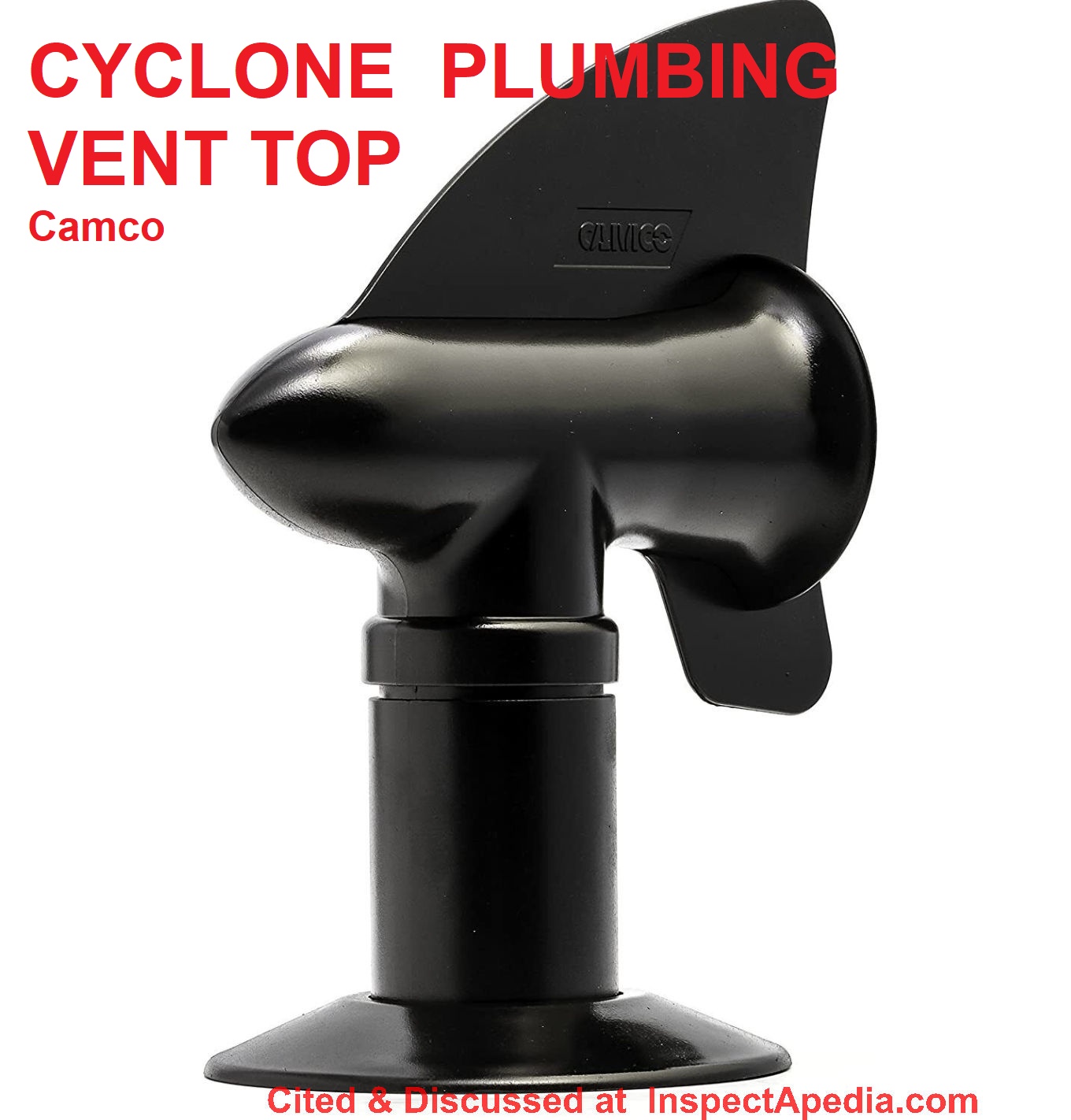
Yes, and in fact there are plumbing vent top opening caps specifically designed to turn down-wind to prevent wind down-drafts into the plumbing vent system: one of those would work for you.
Above we llustrate one of these, Camco's Cyclone plumbing vent top.
We cited this vent also in a reader Q&A discussion at SEWER GAS ODORS in COLD / WET WEATHER
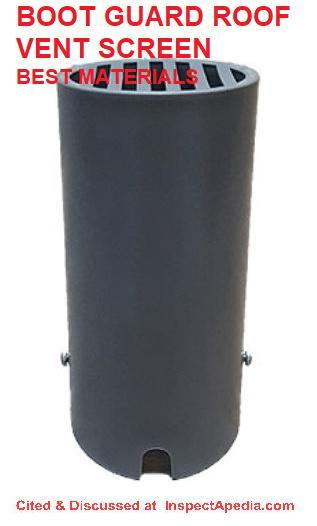
Other roof vent guards that prevent trash or animals from entering the vent system include the Boot Guard shown below - sold by Best Materials and other vendors.
See this
- PLUMBING VENT BOOT GUARD INSTRUCTIONS [PDF] Best Materials, also available from Roof Vent Boot Guard, LLC, Mount Dora, FL 32757 USA, Tel: (352) 552-1068 Web: roofventbootguard.com/instructions.html
...
Plumbing Codes, Citations & Plumbing Code References
Plumbing codes, including free PDF downloads, has moved
to PLUMBING VENT CODES, DEFINITIONS, TYPES
Reader Comments, Questions & Answers About The Article Above
Below you will find questions and answers previously posted on this page at its page bottom reader comment box.
Reader Q&A - also see RECOMMENDED ARTICLES & FAQs
On 2023-01-14 by InspectApedia Publisher - focus on where odor is strongest
@Dave,
You're the man on the scene.
Try to focus on where odor is strongest.
Don't rule out a broken waste line, including under the floor.
On 2023-01-14 by Dave
@InspectApedia Publisher,
Hi - it is definitely not floor drains as I have checked the traps and sealed the drains off. The basement has an overhead sewer too so those drains are no longer connected to the sewer line. The floor drains also wouldn’t be involved in the pine sol test that produced the smell in the basement
On 2023-01-14 by InspectApedia Publisher - basement smells like sewer whenever I run dishwasher on the first floor
@Dave,
I would look first for a basement floor drain that connects to your sewer line and that has lost its water seal. Try taping over the floor drain with masking tape to confirm that it's the odor source.
On 2023-01-14 by Dave
Hi there. My basement smells like sewer whenever I run my dishwasher on the first floor. The kitchen dishwasher and sink are directly over the area in the basement where the smell originates. I've also tested this by pouring pine sol down the kitchen sink and this creates the pine sol smell in the basement.
Oddly enough, there is zero smell on the first or second floor of the house, including in the kitchen, when I did the pine sol test or when I run the dishwasher. All smells are isolated to the basement.
There do not appear to be any leaks with the plumbing anywhere and the pvc pipes in the basement that run from the dishwasher/sink above to the overhead sewer system appear to be well sealed. There is a vent that goes up the side of the house from where the kitchen/dishwasher are up to the roof.
I live in a cold environment so tomorrow I am going to run hot water from the kitchen sink to see if any steam comes out of the roof vent but not sure if/what that will tell me. Any idea what could be going on here or how I can figure it out without going behind the walls and millwork in my kitchen? Thanks!
On 2023-01-04 by InspectApedia Publisher - find odor source as well as a plumbing leak or in adequate venting
@Bri,
I don't think they're just having an oversized hole or a pipe passes through a building wall floor or ceiling would explain an odor problem. There has to be an odor source as well such as a plumbing leak or in adequate venting or a blocked plumbing vent.
Check the diagnostic suggestions at
SEWER GAS ODORS in COLD / WET WEATHER
and
SEWER GAS ODORS
On 2023-01-04 by Bri
I have a 1918-built pier and beam. The plumbing was all redone in 2018. After that I would get a sewage smell in the bedroom right next to the bathroom, but it would only happen in the winter.
After some investigating I found that where they'd cut the tile for the clawfoot tub pipes, they left the hole way too big. I sealed this and any other gaps I could find. This fix lasted for two years, but now the smell is back. I've checked for clogs and dried p-traps, and made sure my seals were still good.
There is no smell in the attic nor under the house. My suspicion is a vent leak in the shared wall between the bathroom and bedroom, but the seasonal (winter only) nature of the smell and the fact that it disappeared for two years after I sealed the floors confounds me. Any ideas?
I'm in south Texas, by the way, so weather shouldn't be the issue. We very rarely freeze.
On 2022-11-05 by InspectApedia (Editor) - sewer gas odor problem
@Lucile,
You certainly have our sympathy for what sounds like a really troublesome sewer gas odor problem and possibly a local health hazard, particularly if sewage is being discharged to the surface.
At some concentrations sewer gas is not only unpleasant but can be explosive if it is inside of a building but it sounds as if your case is all an outdoor odor. If that's not the case you should discuss the safety question with the local Sewer Authority.
And you should be sure to be on record in writing as that will often motivate people differently than a simple oral report or telephone call.
On 2022-11-05 by Lucile
I purchased a condominium 12 years ago, one story no basement 20 feet from my back door is a Sewer lift station, installed 1996 above ground I've put up with smells entire 12 years it helped by putting water in a floor drain, the Township would come out very often when alarms sounded,
(Now) around 6 months or so I heard aloud swishing sound still ongoing, prior to then it had been quiet, around 3 months ago I started to smell Sewer gas, the rotten egg smell and at the lift station also, and I am getting symptoms of toxic Sewer gas first affected my eyes and and more,
apparently Township water and Sewer was alerted by alarms and by the way the emergency light outside of the Sewer was turned off because they said they were getting too many calls. Service was here serval times, I asked about the swishing sound and service guy reluctantly said (that's what I'm trying to stop) but didn't.
I don't smell the rotten egg now but the Sewer gas smells is still in my entire House, from doing research I wonder if is caused by clogs in the line and or rooftop vent??? I am unable to get any help from EPA,condo association Management or the Director of the water and Sewer. Thanks for taking my long story and question.
On 2022-10-16 by InspectApedia (Editor) = broken white piping might be for condensate
@Herbert Bowers,
Your photo is much too blurry to really be able to identify the issue.
That tube might be from a condensate drain system or something similar.
You can briefly cap off the tube to stop its spilling but if you're sure it's wastewater you'll need to connect it to a drain.
Follow the tubing and look for its other end at an AC condensate pump or other HVAC equipment - as a likely candidate.
let me know what you find.
On 2022-10-16 by Herbert Bowers
There is a strange small white plastic pipe/tube coming from the waste underneath the sink. After some recent plumbing work, waste water started coming out of it. The pipe was broken and really didn't go anywhere. What could it be? And what do I do about it?
On 2022-10-05 by InspectApedia-911 (mod) - trace the source of the sewer odors
@Tim,
We would really like to help solve this problem but from just the information you've given I don't understand whether or not we have it correctly traced the source of the sewer odors.
On 2022-10-05 by Tim
We have 3 under sink vents and one outside vent. Having installing a new septic, 25 feet farther than the old one, we are getting sewer odors. The plumber has come in, replaced those under sink vents and yet we still are getting the smell. He saw no leaks under the house in the crawl space.
What I am thinking is the outside vent pipe which is legal height but with the wind it follows the roof line. I am wondering if we raise up the vent to not follow the roof, if this would prevent the smell from coming down into our home via the breezes off the roof?
On 2022-08-04 by InspectApedia-911 (mod) - black spots in vent stack
@Mark,
Thanks, that's an interesting question, why would mold grow on one plastic and pipe and not another on the same building.
Since all mold genera and species are pretty much everywhere all the time, they show at a level we can see when there are conditions particularly conducive to their growth.
Without doing a scientific analysis of surfaces, plastic chemistry, waste water volume, temperature, and chemistry analysis, moisture, when directions Etc
I can put speculate with the general answer that there is probably a subtle difference such as the chemistry of the plastic, the general or persistent moisture level if that vent, even particular gases or organic debris in that grain, differences in sun exposure, Etc.
On 2022-08-04 by Mark
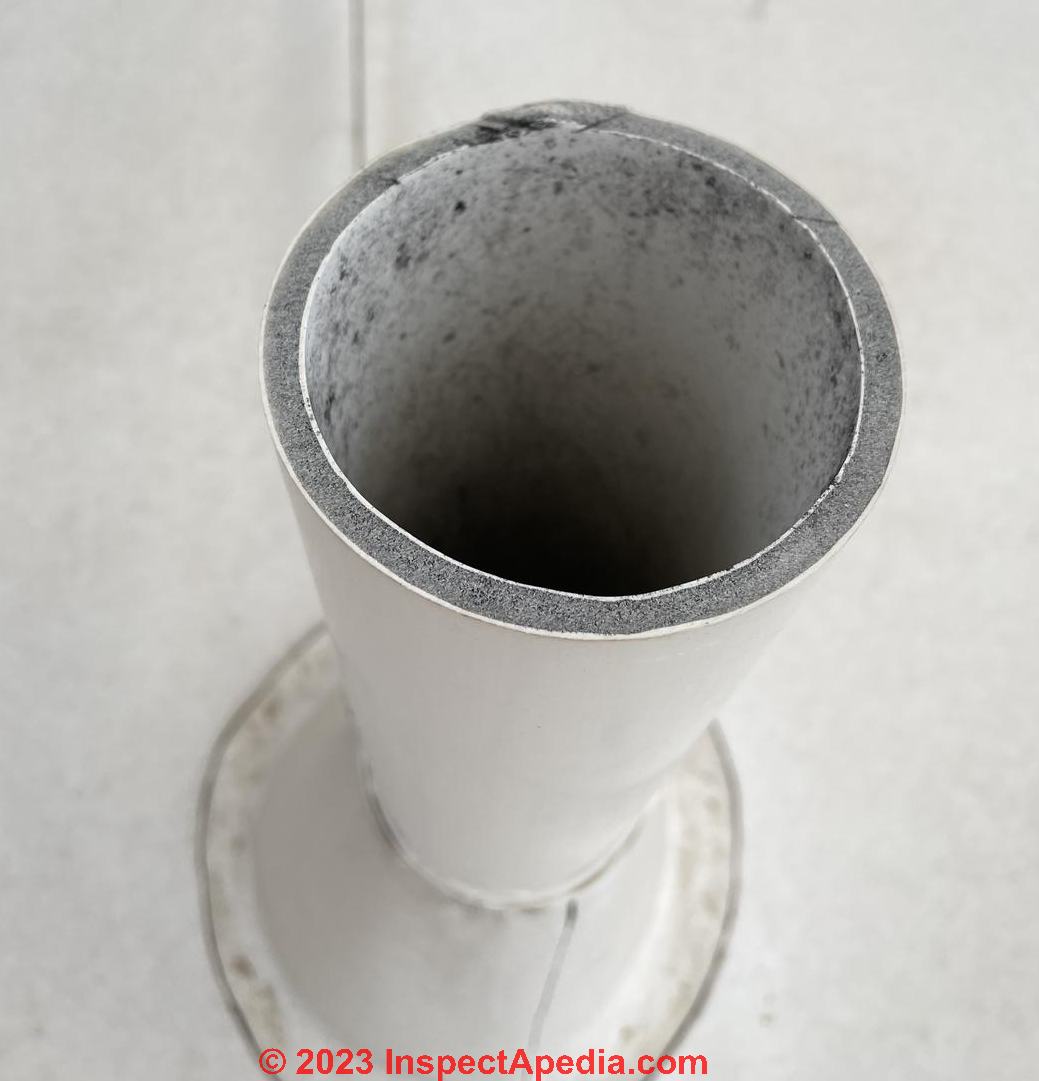
One of the vent stacks on my roof has black spots that kind of looks like soot or mold.
There are 5 other vent stacks on the roof (its a multi-family building) and they all appear to be clean. Why would only one vent stack be stained?
On 2022-05-01 by Inspectapedia Com Moderator - leaky sewer pipe
@Lindsey N.,
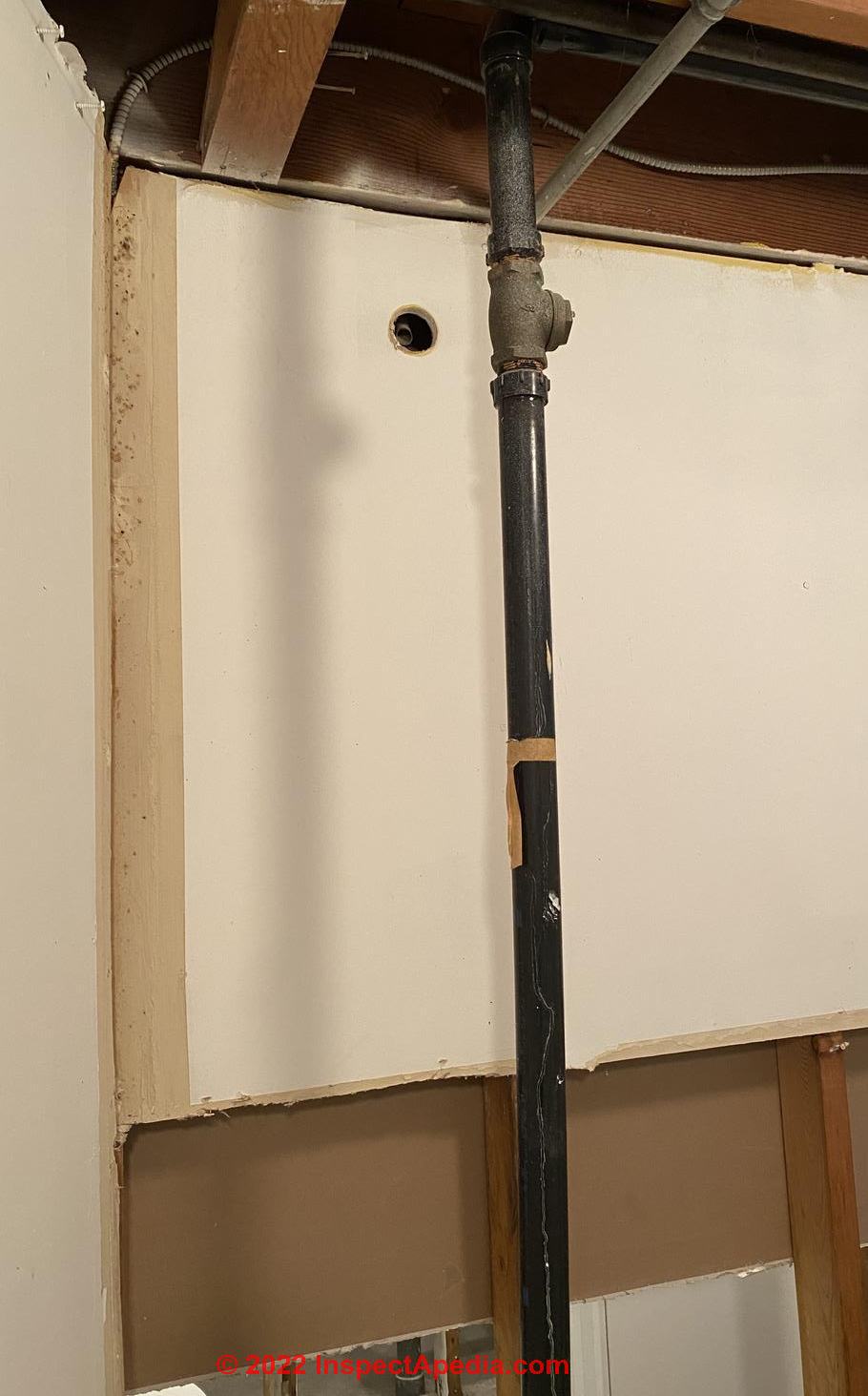
That large vertical pipe that combines what looks like black Iron or black plastic with a brass fitting is leaking or at least has leak stains. So it could be a drain line. I'm not sure what you're asking about. Are you referring to the vertical pipe or to those holes in the wall.
If your question is about the holes in the wall, I can't see enough to have an opinion about what they are.
On 2022-04-30 by Lindsey N.
Found this coming out of drywall in basement. Is this plumbing venting, that previous owners may have installed, venting indoors in my basement?
On 2022-03-15 by Inspectapedia Com Moderator - plumbing vent roof extension
@James J,
You should be able to extend that plumbing vent around the obstruction using a pair of 45-degree elbows and short lengths of pipe of the same diameter.
On 2022-03-15 by James J
Can this be extended through the soffit to the upper roof? Or can it be modified with a slight angle to get passed the roof line?
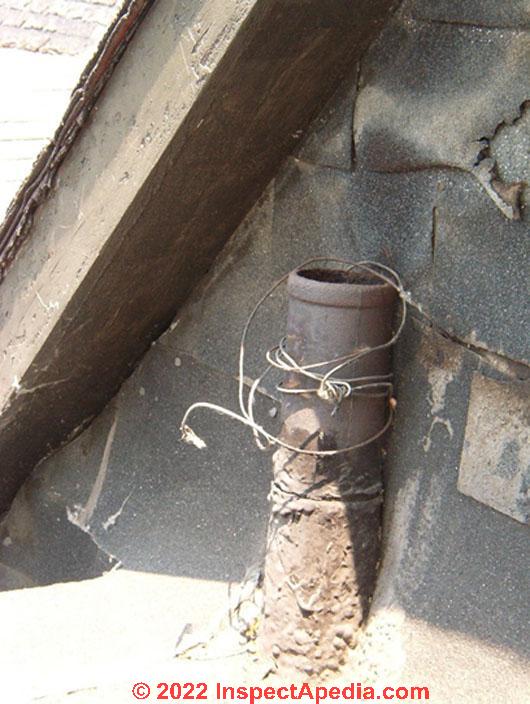
On 2021-11-06 by Inspectapedia Com Moderator - intermittent foul sewer smell in the bathroom
@Charlene Z,
It's possible for a toilet wax ring seal to be a leaky even when the toilet is not wobbly.
So that might be something to replace.
Beyond that you may need to have a sewer line camera inspection of the plumbing vents/ drains, and to look carefully through the drain system to be sure there are no leaks.
On 2021-11-06 by Charlene Z
I live in Massachusetts. have a small cape, built in the 50's. For a year I have been dealing with an intermittent foul sewer smell in the bathroom. I called a plumber, who told me to call a contractor. I called a contractor who told me to call a plumber.
I have town sewer. There is just the one bath with toilet, sink, tub and washer. The sink and toilet were replaced about 18 months ago. There aren't any apparent leaks. The toilet is not wobbly. The drains run freely without any gurgling or noise. I've just opened the windows and dealt with the problem.
However, my granddaughter lives with me now, and I am concerned about her being exposed to the smell. It is unbearable when it happens. And, with the cost of oil...opening the windows to vent the house isn't wise. I'm on a fixed income and want to find the right type of contractor.
Would it be a wise investment to see if I can find a company that does a smoke test to evaluate and narrow where the problem is? Any suggestions would be greatly appreciated.
On 2021-11-05 by Inspectapedia Com Moderator - diagnose leak at plumbing vent
@Cory,
In order to fix this problem we need to understand what happened. Your plumber should be able to explain to you why your plumbing vent was clogged.
Was it frozen or did debris fall into it or was there an animal there or something else?
Obviously we need to diagnose the cause and then we can fix it.
On 2021-11-05 by Cory
roofer took pics of vent stack and all 4 of them were filled w/ water. plumber went on the roof and stick 4 ft down where he realized there was a 90 degree turn. I’m afraid if we have it unplugged it’s just going 2 happen again. what can we do?
On 2021-10-25 by inspectapedia.com.moderator - proper slope and support required for vent piping
@Susan Foreman,
We need to know why the plumbing vent boot is leaking. It may be that it's the wrong size, or that it's torn or damaged, or that it was not correctly installed.
When we diagnose the cause of a problem we can make it better stab at the best repair. Meanwhile it's perfectly fine to use a makeshift repair or even to Simply Clean the surfaces and use some silicone sealant around the vent boot opening.
From what you've described so far I don't see any reason to anyone would need to cut a hole in the roof. But if the vent boot flashing is leaking because it's not properly installed , or if the entire boot flashing assembly was the wrong one and needed to be replaced, then it may be necessary to remove and replace a few shingles.
Since the plumbing drain vent pipe that you've described apparently moves easily up and down it should be a trivial job to lift it to the proper elevation and secure it in place.
That repair would probably take less time than the two of us have spent in this correspondence.
On 2021-10-24 by Susan Foreman
@inspectapedia.com.moderator,
Thank you for the quick response. I have an issue with the vent boot leaking on the roof into the ceiling, but have had a lot of really high estimates from people who did not even assess the problem visually.
One guy told me they had to cut a big hole in my roof - not happening. But because of that we decided to investigate further ourselves. And also temporarily my son wrapped some flex seal tape around that roof boot that is bad to try to keep water out.
So the plan is to call my plumber in and get the venting corrected. Once that is done and the pipe is no longer leaning out of the roof or able to move around, then I think I have found two good choices to try for a roofer.
Does not seem to make sense to try to fix the boot first, so hoping my son's temp leak fix will hold.
On 2021-10-24 by inspectapedia.com.moderator
@Susan Foreman,
Kudos to both of you for catching a poor plumbing vent installation that can indeed lead to trouble.
Yes the piping should slope back to the wet drain - at perhaps 1/8" to 1/4" per foot of horizontal run.
When the vent pipe slopes down towards the elbow located at the change from horizontal to vertical the result can be a water trap that can lead to blocked venting, poor drainage, even loss of sink or tub trap seals, and even the escape of smelly and potentially dangerous sewer gases into a building.
That's because condensate forms in the vent when warm, moist air is being vented, e.g. when a shower is draining in the building. Especially in cool weather that moisture condenses in the vertical, cooler vent pipe near the roof or even outside; there it runs back down to pool at that low elbow.
Repair should be easy and trivial. Slope the vent properly and secure it in place.
On 2021-10-24 by Susan Foreman
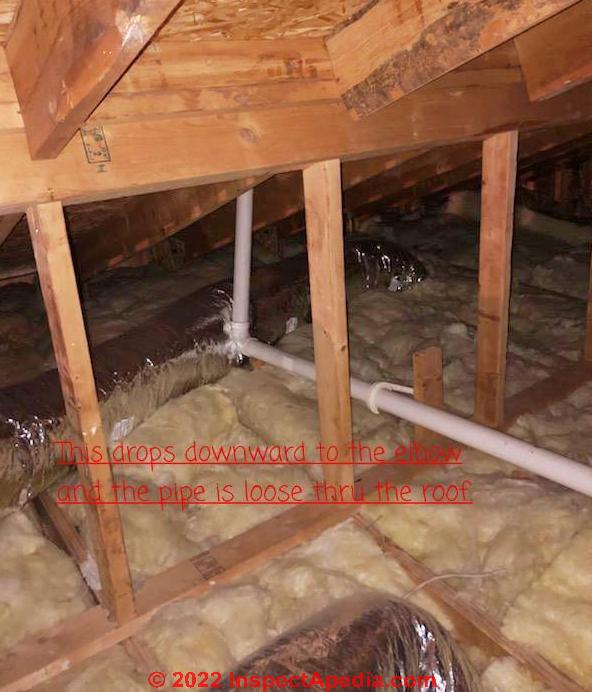
I have a vent pipe that seems wobbly in my attic and it leans coming out of roof. This vent line goes through the bathroom wall cavity up tonthe attic and runs approximately 25 feet horizontally toward the back of the house and then exits through the roof.
My son took a look in the attic yesterday and we found that the horizontal run of the pipe slopes up, but then drops back down along the path it travels across the joists. We are not sure if it should be level or slope steadily upward.
When it gets to the elbow where it goes upward to exit the roof, the elbow is unsupported -- on the roof you can pull the vent pipe up and down.
I intend to call my plumber to look at this as I am in need of replacing the vent boot on the roof now since it started leaking. But I find it always better if I at least understand issues with my house before talking to a pro.
Shouldnthat vent pipe move up and down? Should the horizontal run across the attic slope upward?
The toilet in this bathroom and tub have a long standing issue of seeming to easily plug, or the toilet at times siphons out.
On 2021-07-24 by inspectapedia.com.moderator - explosion at roof vent is sign of dangerous condition
@Donald,
There's something wrong with this situation or claim.
Septic tank risers simply give access to the septic tank. That should have not any effect whatsoever on the plumbing vent system in your building.
It's normal for sewer gas to exit through Plumbing vents above the Rooftop.
If you're not kidding me and you actually are seeing literal explosions at roof vents, then you have a very unsafe condition plus a source of ignition that needs to be found and stopped immediately as you could have a dangerous building explosion.
On 2021-07-24 by Donald
Since I put risers on my septic tank I have trouble with methane explosion out the roof stack. Should I of vented the Maine tanks.
On 2021-01-18 by danjoefriedman (mod) - add a vent or an air admittance valve?
If you follow the drain piping you may see a vent to the building exterior or they may actually be none. It's possible to add venting but it can be disrupted to run the vent line inside of wall cavities.
An alternative that can work if approved by your local plumbing inspector is to install air admittance valve at various fixtures. If you search this website for air admittance valves you can read the details
On 2021-01-18 by Tammy
Hello- In the process of remodeling a bathroom in our house, it appears that there are no septic/drain vent lines for any of the drains in the bathroom, nor is there a vent stack on the roof. nor do I know of any outside vents, would they be underground? Is it possible to be located anywhere else?
If there isn't a vent line, is it possible to "install" one now?
I've read through some of the very helpful info you have posted here, but I'm not seeing anything that answers my questions. I haven't really experienced any "symptoms" such as smell, although there are noises in the lines occasionally, nothing persistent, and recently my kitchen sink has started draining extremely slow despite trying to clear with draino.
No apparent issues outside, and no outside vent, as far as I can tell. The house has a crawl space. There is no line in the attic that hasn't already claimed another function.
What type of professional would we contact for in home service for this kind of problem? Any idea how much it would cost (general range)? Thank you!
On 2020-12-10 by (mod) - cause & cure for leaks at this plumbing Drain-Waste-Vent line
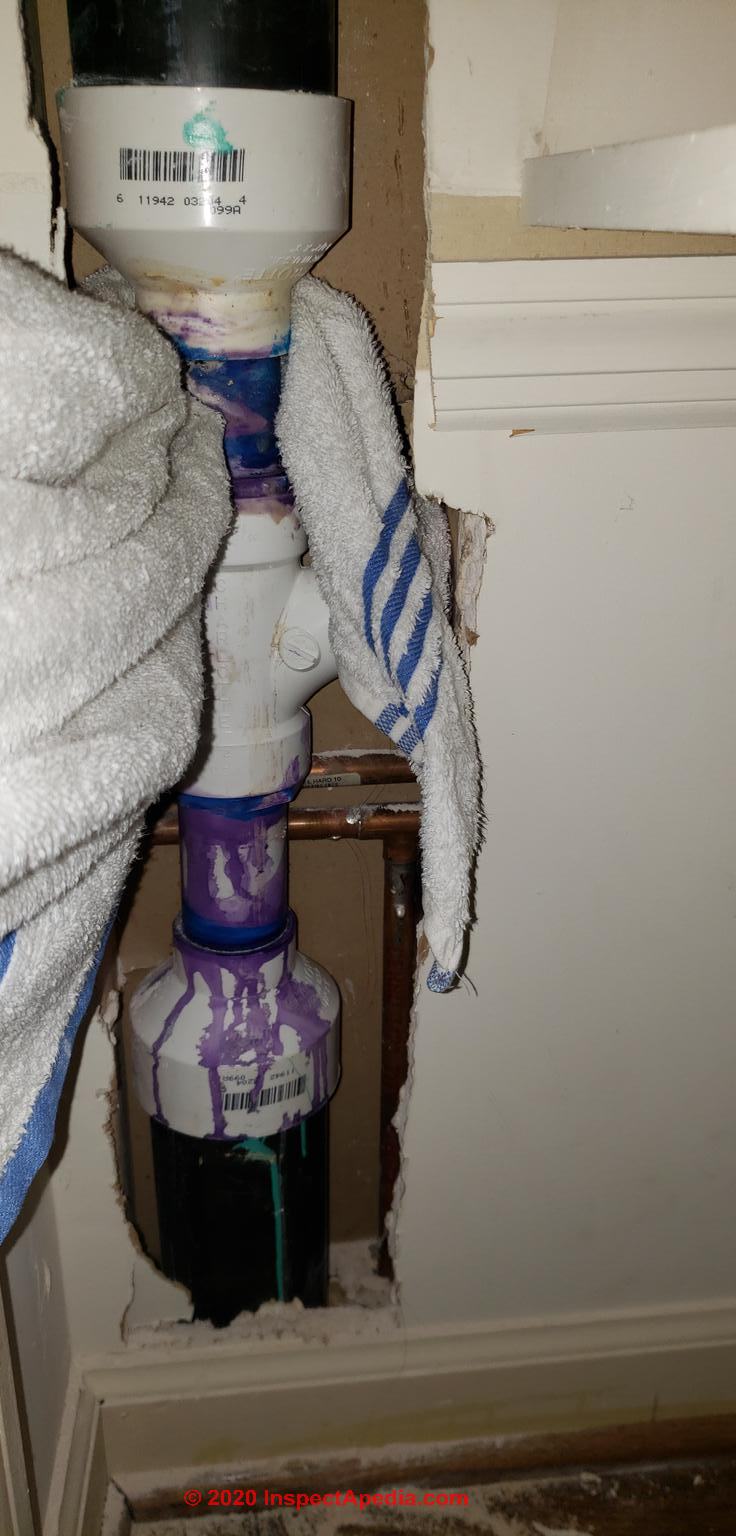 AJ
AJ
Thank you for the photo and question about ABS-PVC glue joint leaks.
Indeed some years back (what was the year of your plumbing work?) there was a problem with incompatibility of gluing PVC to ABS, and we warned people not to do that.
There have also been leaks due to ABS cracking failures independent of the glue problem.
Currently there are plastic pipe adhesives that are specifically formulated to bond ABS to PVC so the compatibility issue is, in essence, resolved.
The illustration below is from ABS PLASTIC PIPE FAILURES
DWV Leak Repair Suggestions
These plastic parts are inexpensive as is the glue; the hourly rate of your plumber will be a bit more, but it makes sense to
1. ask for an inspection, perhaps by sewer line camera, of the troubling vent system that seems to leak without an explanation of the water source (I suspect frost accumulation or something draining into the vent that you've missed such as a condensate disposal drain),
2. cut out, toss away, and replace the plastic parts in that area of leakage with new ones, properly sized (those middle pipes are under-sized and in my OPINION show incompetent or at least ignorant plumbing work) parts using an adhesive that will bond both types of pipe together.
By "Improperly sized" notice that you've got a large-diameter drain-waste-vent vertical line that suddenly steps down to a small-diameter constriction where a horizontal drain line (probably your sink) joins to the vertical DWV.
I suspect that happened because the plumber did not have the proper part in hand. But you can be certain that the proper drain part exists.
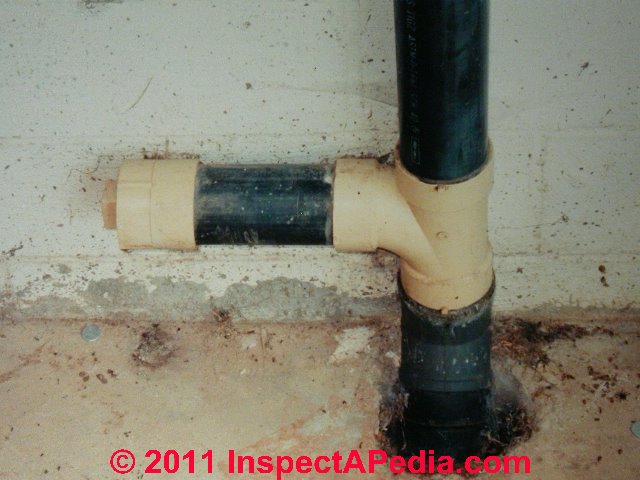
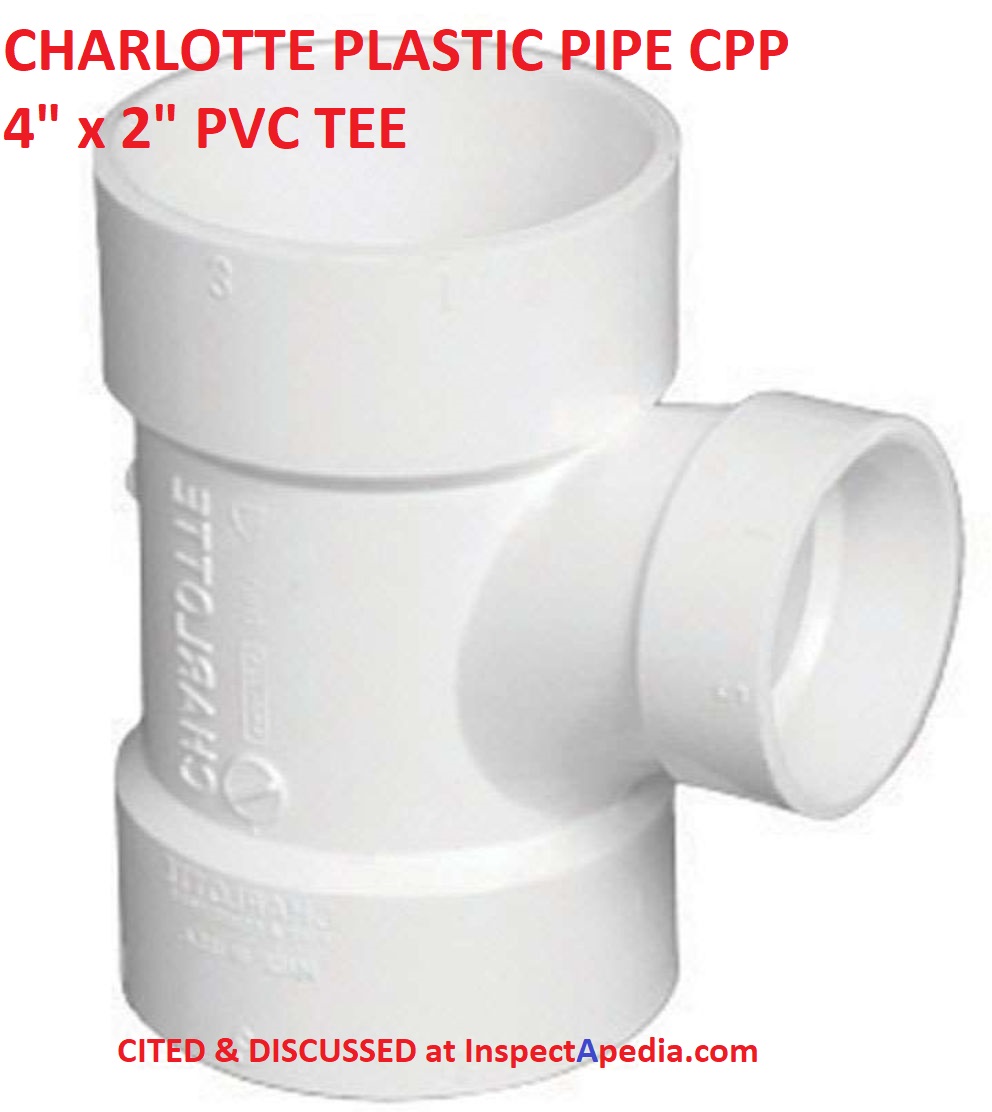
Shown below from Charlotte Plastic Pipe is a 4-inch PVC drain tee that sports a 2-inch connection.
On 2020-12-09 by AJ Smith
I have water leaking from a joint connection in sewer vent piping [photo at start of Moderator reply, above] .
Picture shows the work done during a remodel a few years ago that I am now told is not to code because of the mixed abs and pvc as well as the reduction/ expansion to accommodate the water supply lines.
Leak is where the pvc reducer connects to abs pipe (towel location) above where sink drains connect.
This is on top floor of my house so I do not think anything should be draining from above. We have not used sinks for several days, but water is still leaking from above the joint above the drains.
On 2020-11-22 - by (mod) - plumbing vent boot flashing "sunken"
IMO that's a bit short and the "sunk in" may simply be that someone pushed on the boot (or something like snow or ice)
OR
if the whole vent pipe is moving down in the building you ought to see that as leaks or pipe movement indoors.
On 2020-11-18 by Anonymous
The home inspector came back with this on the report. "The boot at the right side vent stack is sunk in."
The pipe only sticks up 3 to 4 inches above the roof boot. (terms might not be correct)
On 2020-11-17 by (mod) - methane gas hazards and exposure symptoms
Teresa here are articles that discuss plumbing drain waste vent gas exposure hazards, symptoms, levels, that you'll want to review:
GAS EXPOSURE EFFECTS, TOXIC
and
METHANE & SEWER GAS HAZARDS
and
GAS EXPOSURE LIMITS & STANDARDS where on that page search for or scroll down to "Methane Gas Exposure Limits"
On 2020-11-17 by Teresa Thomas
What are symptoms you have been exposed to some of these gases
On 2020-11-08 by (mod) - collapsed toilet closet vent located in the crawlspace
That's pretty interesting, as I'm not sure what a collapsed vent would look like.
Perhaps someone means that the piping has become disconnected. If someone's inspecting there should be trivial for them to snap a photo or two to show you exactly what's going on.
If a vent line has broken open underneath your building the drains may appear to continue to work normally but depending on where the line has come disconnected you may find waste water spilling into the basement or crawl area.
On 2020-11-08 by Rick
I was told I have a collapsed toilet closet vent located in the crawlspace of my house. What signs would be showing if this is true? What is an average estimate to have this done by a professional plumber or is it something I can do myself?
On 2020-10-27 by (mod) - When the closest fixture, a sink, has a S-trap
Gibb
When the closest fixture, a sink, has a S-trap I figure this is an older plumbing installation and it's possible that the venting is simply inadequate; But if none of the piping changed and the toilet drainage problem is a new one, then something **has** changed: a blocked vent, blocked drain.
The gurgling from the sink argues for inadequate venting; bubbling in the toilet bowl argue for a drain clog.
NO roof vent? Where does the plumbing system vent?
Finally, just snaking a drain doesn't necessarily open it, it just means that the snake got through; there could still be a partial blockage OR the blockage could be further away than was reached by the snake.
On 2020-10-27 by Gibb - toilet tank flushes, but bowl drains too slowly
Tank flushes, but bowl drains too slowly. Gurgling from nearby sink and occasional explosive bubble in toilet bowl. No release of odors. Waste lines have been snaked, and toilet has been replaced, but problem persists.
Vent problem sounds quite plausible, as it is an old house, nearby sink has S trap, and no vent to roof is evident. However, none of this has changed in many years, yet problem is only recent. Thoughts?
On 2020-10-15 - by (mod) - use inspection camera to find source of leak
RK
I think the best way to sort this out is to have the entire DWV system examined by an inspection camera. That should show you just where damage has occurred so that you don't have to tear other building areas open to access sections of the piping where the damage is not to be found.
On 2020-10-15 by RK
Any help or thoughts appreciated, just installed a new roof, during the installation the roofers drooped a large metal plank onto the roof and it vibrated the house structure.( possible crack of cast iron vent pipe) Roof vent on external is fine and shows no cracks.
When the 2nd floor toilet is flushed occasionally we have dripping water coming from the cast iron piping in the basement from a location above the basement pipe run behind the sheetrock.
No water drips occur when then bottom sink is used, when the bathroom tub is used or second floor sink is used. It drips only when the toilet is flushed but drips much more rapidly when the adjacent second floor sink is ran prior to the toilet been flushed.
I would assume my issue is toilet related but am looking for advise why the adjacent sink causes the leak drips to be more rapid when used in conjunction with the toilet bowl. I know I need to break open the sheet rock to search for the leak source but should the initial breakdown be done at the basement level or on the second floor where the toilet is located.
Appreciate any help. ( I believe the cast iron pipe vent is made up of several lengths of 5 feet length sections from the basement to the roof similar to my neighbors house and plumbing built in the same era )
On 2020-09-01 - by (mod) - daily smell from our plumbing fixtures
Please see
SEWER GAS ODOR SOURCES
On 2020-08-31 by Susir
What's the deal that sewer smell comes and goes......all fixtures used daily?
On 2020-08-11 - by (mod) - plumbing vent into the attic is capped off
Capping a vent stack - that is, sealing its outlet - means drains won't drain properly.
In some cases the situation is dangerous! Example: drains are not vented, so traps are siphoned dry, then methane gas and sewer gas leak into the building; if the gas reaches a critical level the building can explode. It happens a couple of times a year in some large Cities.
On 2020-08-10 by Linda Maclean
Hi,
I am installing a new roof, the previous owner didn’t vent the plumbing stack though the roof instead he capped it in the attic. Can this be a problem ? It is going to be resolved when we install the roof.
On 2020-07-20 - by (mod) - proper installation of horizontal vent piping
Chuck,
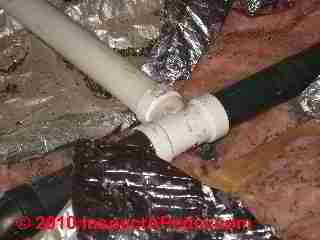
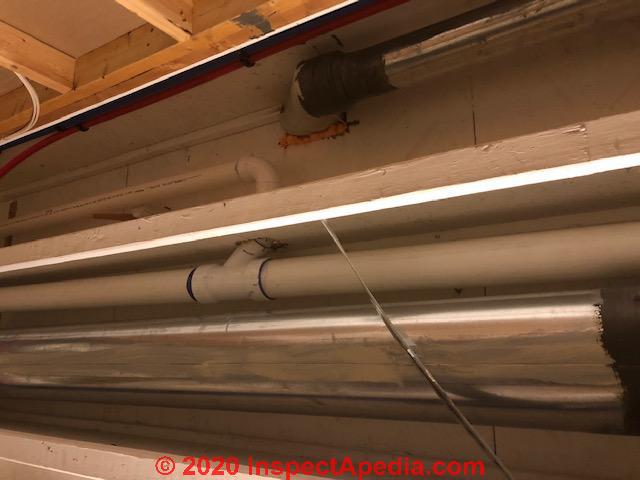
If I understand the photo, we're looking at the underside of a floor, and the smaller diameter white PVC piping is a vent line. If I've got that right, sure I agree that the vent is not installed in a position that can work reliably and was quite possibly going to clog with sewage.
Plumbing codes require that where a plumbing vent is connected to a horizontal drain pipe,
the connection shall be to ... the top half of a horizontal drain pipe.
As common sense would tell us, that's because in a horizontal vent air that must be vented flows in the top half of the horizontal drain line. This is particularly critical in a circuit vent but is important for any vent-to-horizontal drain connection.
While the local building code inspector is the final legal authority on approval of your vent arrangement, in my opinion, the side-vented pipe shown in your photo means that half of the diameter of the vent pipe is below the center line of the larger drain line and thus is not in the top half of the drain.
Or is your photo upside down?
On 2020-07-20 by chuck r
Home was professionally built 3 years ago. Master bathroom toilet is not flushing properly and upon inspection I found the vent pipe to be installed on the side of the soil line piping, exiting horizontally from the soil line instead of on the top of the soil line vertically.
I believe that the 3 year timeline would be sufficient to block the vent that is horizontal to the soil flow and could have blocked it causing a hydraulic lockup of the soil line.
please confirm that the vent line must be installed on the top of a horizontal soil line per code to allow air to flow for proper flushing
On 2020-07-06 by David
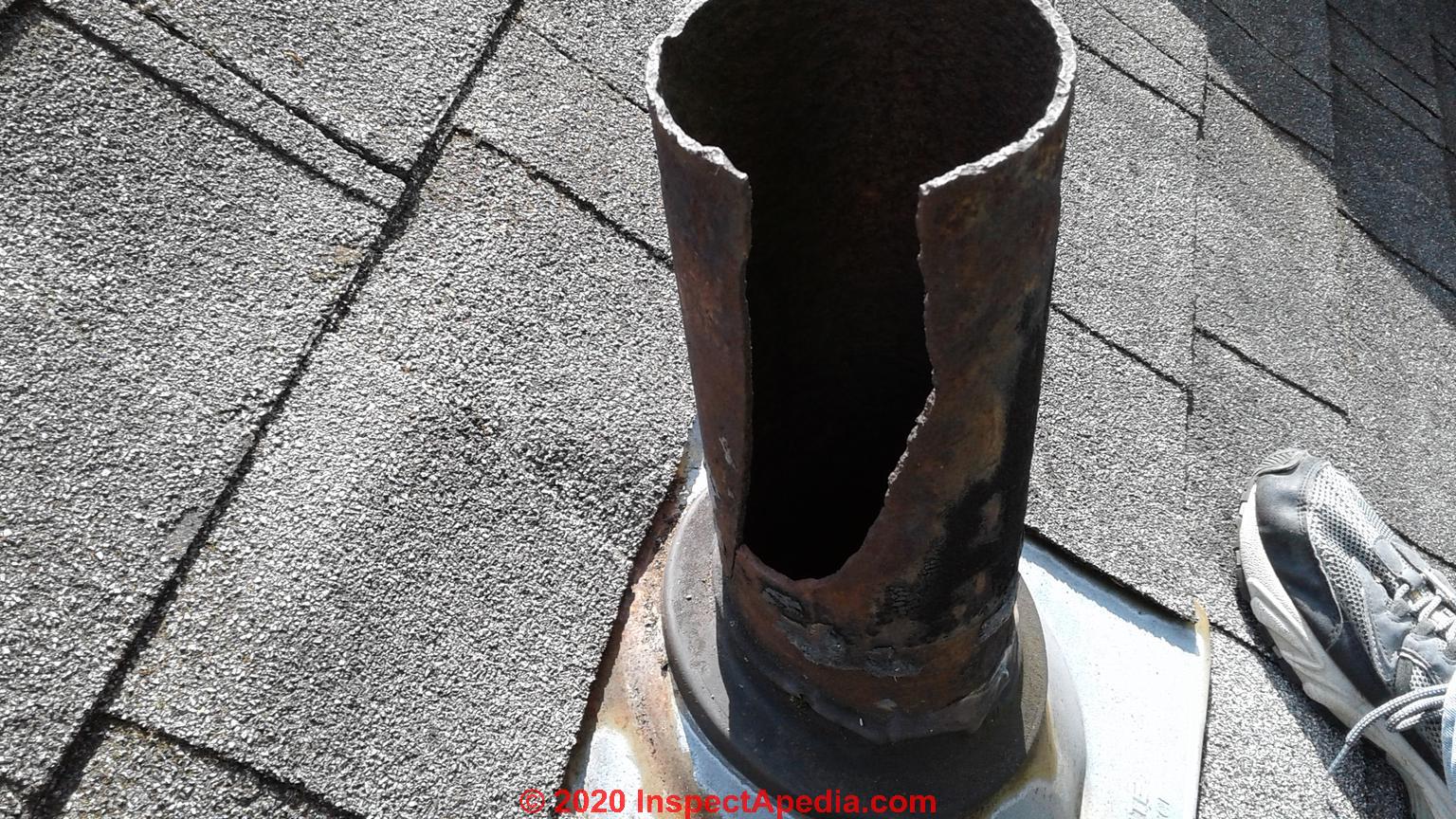
My sewer vent is cracked or rather has a chunk missing probably from a tree limb. No sewer smelll in the house. Should I do something like sleeve it with a pvc pipe?
On 2020-05-12 - by (mod) - terrible sewer smell after rain
Let's start diagnosing by identifying exactly what changes were made for years ago to your house plumbing system or to any other component on the house or any activity around the house such as excavating or driving heavy vehicles near the building or across the yard that could have affected plumbing and vent system. So were there changes and additions to your plumbing system or fixtures?
On 2020-05-11 by cjoyn
We have a terrible sewer smell that has started up after heavy rains. It is most pronounced in the basement in the heater room. There are 2 floor drains in the heater room as well. When the heater turns on, the sewer smell is piped throughout the house.
We are connected to a domestic city sewer system and none of our neighbours have this issue.
We had our house reno'd 4 years ago and the smell is getting worse since then- also had a A/c put in at the time but havent used that this spring yet. We cant use our heating system know. Is definitely sewer gas smell/not natural gas smell. We have poured water down the floor drains/and basement bathroom drains mutliple times but smell keeps coming back after heavy rain.
We have called plumbers who keep telling us to pour water down the floor drains but no other bright ideas. Other suggestions?
Starting to worry about our kids/own health with this smell.
On 2020-05-07 - by (mod) - check size and installation of air admittance valves
Dave
If the local vents at your sinks, properly called "AAVs" or air-admittance-valves were properly sized and installed then they should not be an odor source as they should operate only to let air "in" to the drain system, never letting sewer gases out.
But if the vents are the wrong size or are not placed according to the manufacturer's instructions (e.g. too low or too distant from the trap) then they might not work properly and might leak gases.
Take a close look at your vents and note the manufacturer's name, then you (or we) can find the installation instructions so that you can compare details of the "should have" with the "did".
On 2020-05-07 by Dave
My House does not have a roof vent. Each sink has a plumbers vent attached. Is this causing a sewer smell in the house ?
On 2020-05-04 - by (mod) - check the indoor vents and check the drain lines for signs of a blockage or septic failure
Right.
Checking the drain-waste-vent system is one step in looking for the causes of odors: such as vents that downdraft, though principally we're looking for evidence of either a drain or septic system failure that's either backing up or leaking outdoors (where you smell odors) or a rooftop vent that's down-drafting.
Is the building connected to a private septic or sewer?
What changed around the time this odor problem was first noticed?
Are you sure the odor source is your building and not a neighbour?
We have a lot of other diagnostic questions that can help you find the source of sewer gases in the article series starting at
SEWER GAS ODORS
On 2020-05-03 by ArticHare
I appreciate receiving your response.
I really can't say when this odour problem started. It has been noticeable for at least a year, but it might two years, or three years. Certainly, it has been offensive for the last year or so. Again, the odour is only present outdoors and is most concentrated on one side of the house.
It varies greatly in intensity and I suspect that wind and wind gusts is the predominant determinant of the variation in intensity. If you stand in the spot that is most prone to the smell, you might stand there for five minutes not smelling anything and then, bang, you get a strong shot of sewage lasting for a second and then it diminishes again.
I've read through the diagnostics and nothing jumps out to me as relevant.
BTW, I am an engineer and have designed sewage plants and worked with H2S hazards and have also worked for a natural gas utility and I can clearly distinguish mercaptan from sewage odour.
But, I'm not an expert in domestic plumbing and stack vents. I'm also confident this odour is not caused by a dead/decaying animal or the like. Also, it is rather pungent smell that varies wildly in intensity. It is not a muted, constant smell like manure spread on a lawn.
If I want to get someone to inspect the stack vents on the two houses and determine whether one of them is emitting the foul odour, would I call a plumber? Is a plumber the right trade to go up on the 3 story roof and check for a stinky stack vent?
The smell can be smelt by all of my family, my parents, my neighbours, etc. Everyone agrees that there is a sewer gas smell between the houses.
On 2020-05-03 - by (mod) - how to diagnose source of sewer gas smell
ArcticHare
Let's start with the diagnostics at our top page on the sewer gas odor problem
SEWER GAS ODORS
And add to those diagnostics any details you think of: such as what has changed around or in the house about the time this odor problem started?
On 2020-05-03 by ArcticHare - persistent sewer gas smell outside our house, predominantly noticed on one side
There is a persistent sewer gas smell outside our house, predominantly noticed on one side of the house, but also noticeable at the front and rear of the house. As far as I can ascertain, the smell is coming from the stack vent either on our house or our immediate neighbours house.
Considering stack vent locations, wind direction, and other factors, it seems most probable that the odour is emanating from our neighbours stack (i.e. the smell is strongest on the side of our house that is opposite the stack vent location, but on the same side as our neighbour's stack vent). Both houses are less than 10 years old.
We have been bothered by sewer gas smell outside our home for the last year or more. The sewer gas smell is very strong at times outside the house, but never noticed inside the house except on the rarest occasion with the windows open. We live in a climate where it is very cold in winter and hot in summer and the smell is present all year around.
What are the possible causes of the problem? What tradesperson should we call - a home inspector, a plumber or a roofer (these homes are 2-stories plus walk out basements, so the stack vent is effectively three stories off grade at the rear of the house)? What are possible solutions?
Adding:
Fixtures drain properly. Not sure how long smell has been at the house as we purchased and remodeled prior to moving in. Dwv has not been pressure tested. Smell only present in basement bathroom which was not remodeled
On 2020-03-10 - by (mod) - sewer smell starts near toilet
Base
Do all fixtures drain normally or are some drains slow?
Have these issues been present ever since the plumbing was installed or are they more-recent?
Has your plumber discussed pressure-testing the DWV system?
On 2020-03-10 by Basement smell
Have home built in 1987 with full bath in basement also adjacent washer in closet that has been removed.
Drain for washer has been covered temporarily with plastic wrap to help isolate issue. House is on septic system. House was remodeled and existing basement dvw was connected to new bathroom upstairs and continued to roof.
New studer vents have been used as part of remodeling. Basement toilet was reset by professional plumber after repair to flange. We have sewer gas smell i. Bathroom in basement. More concentrated in cold weather and after use. Added studer vent near clean out close to septic tank little impact on smell.
We belive smell may originate from near toilet? starting to think issue is with toilet or vent pipe behind sheetrock. Any way to isolate the source before we remove toilet and cut Sheetrock?
On 2020-03-04 by Anonymous
Leaks through the roof at a plumbing vent are probably not due to the vent material itself (unless there's condensation running down the outside of the vent or an actual hole in the vent piping or its connectors).
Rather it's usually a poorly-installed boot flashing around the vent. That problem can be more-difficult if your roof is low slope or flat.
Perhaps you can post an image.
On 2020-03-04 by lou
Old house built 1955. I moved in 9 years ago. Leaks in kitchen ceiling near where a vent pipe is located on roof. Two roofers have replaced shingles, added ice and water shield and replaced some insulation board which overlays wooden boards on part of the roof in the oldest section around vent pipe. Newer sections of roof added 30 years ago when house enlarged.
No trouble there. Still have leaks in heavy rain after 5 tries to fix it. Vent pipe on roof is short, not up to code and is either galvanized steel or iron in good condition. In the south, heavy rainstorms at times, but no real snow.
Vent pipe inside diameter is 1 1/2 inches. I think this problem is new, not longstanding. No apparent blockages in vent pipe at least 5 feet down. Attic not accessible.
No sewer smells. So what could this be? Driving me crazy and not helping my ceiling. Roof tarp becoming frequent fixture.
On 2020-03-02 by Anonymous
Tracy
If you had a sewage leak into your home or into a floor or wall cavity, just fixing the leak won't be sufficient; you need to have any areas that were contacted by sewage either removed and replaced or sanitized/disinfected.
Check with your doctor about the role of your home in your health complaints.
On 2020-03-02 by Tracy Fenton
A while back we had a sewage leak in our home. The smell was very strong. Then we had a smoke test done and it revealed two bad seals in toilets.
During the time of the leak I was getting very sick it had unusual symptoms but after the seals were replaced the toilets that took care of the sewage smell and a lot of my symptoms but there still remained smell but not that of raw sewage and one of the symptoms that remained with me was severe bloating like gas filling my belly and burning my nose.
I personally believe that since most of the smell went away most of the symptoms what away but there is still an issue that lies what's in the plumbing, maybe in the walls. Please help! I cannot even live in my home other than to sleep with windows open because of these strange symptoms
On 2020-03-02 y Anonymous - just fixing a sewage leak may not be enough: disinfection/sanitizing needed
Tracy
If you had a sewage leak into your home or into a floor or wall cavity, just fixing the leak won't be sufficient; you need to have any areas that were contacted by sewage either removed and replaced or sanitized/disinfected.
Check with your doctor about the role of your home in your health complaints.
On 2020-03-02 by Tracy Fenton
A while back we had a sewage leak in our home. The smell was very strong. Then we had a smoke test done and it revealed two bad seals in toilets.
During the time of the leak I was getting very sick it had unusual symptoms but after the seals were replaced the toilets that took care of the sewage smell and a lot of my symptoms but there still remained smell but not that of raw sewage and one of the symptoms that remained with me was severe bloating like gas filling my belly and burning my nose
. I personally believe that since most of the smell went away most of the symptoms what away but there is still an issue that lies what's in the plumbing, maybe in the walls. Please help! I cannot even live in my home other than to sleep with windows open because of these strange symptoms
On 2020-03-02 - by (mod) - backup in our laundry tub when using our dishwasher
Sounds like a clogged vent or drain; Have you had a plumber clear both the drain system and the vent system?
On 2020-03-02 by Jo S
Hi!
We have a town/row home built in '62! Been hearing gurgling! We are getting backup in our laundry tub when using our dishwasher, kitchen sink, garbage disposal!
We have found that there is a white, caulk-like foam (almost insulation looking) in the roof vent! Water is backing up in that vent..thus our problem? Has anyone seen anything like this..cant't seem to clear
On 2020-02-09 - by (mod) - vent stack has a drip noise
Could be frost or ice in a vent passing through a cold attic or above the roof if you are in a freezing climate.
Increasingly vent diameter can help ensure that it doesn't become totally blocked by Frost. If that's what's going on. The remaining steps may be to provide some sound insulation. Im reluctant to start adding heat tapes into a plumbing vent.
On 2020-02-09 by Russ Newman
The vent stack has a drip noise from water falling from above and hitting the bottom. What’s the fix?
On 2020-01-02 - by (mod) - excess moisture in the attic near existing vent pipe
A plumber pressure tests the vent system by installing expandable rubber plugs in all of the drain openings and then using one of the plugs that contains a special Schrader valve she puts air pressure on the system and a gauge and monitor is it for pressure drop.
On 2019-12-31 by Nick
Have noticed excess moisture in the attic near existing vent pipe that properly terminates through the roof. When we run the dishwasher (1st floor) we can hear dripping noises in the wall near the vent Pipe (2nd) Floor and where moisture is appearing in the attic sheathing. (New Roof)
How can I pressure test the vent pipe? I have found other PVC pipes that were not glued by the org. builder. No Clean Out in Vent
On 2019-12-19 by Zaheer
Hi all,
I bought a house about 6 months ago. And recently I have had backed up some in my first floor bathroom. The sink and toilet drain slow on the first floor. At the side of the house water from the sewer is over flowing from the fresh air in let.
I had roto rooter come out to snake my line but there was no issue. I started to do a little research myself and went to my attic and found that they took out the stack vent when they add the new plumbing. Please advise.
On 2019-09-16 - by (mod) - glub-glub sound when water is let out of sink?
Typically a blocked drain, or occasionally a blocked vent.
On 2019-09-10 by Anonymous
Cause of glub-glub sound when water is let out of sink?
On 2019-07-15 - by (mod) - toilet backs up
That sounds to me like a clogged drain line or if you are connected to a septic system possibly a failed drain field that is backing up through the septic tank.
On 2019-07-12 by Barry Brown
Had our drain line augered. Toilet flushes a couple times then backs up again. Ran hose down roof vent and it eventually backs the toilet up instead of draining out. Is this a clog afterall or roof vent issues?
On 2018-11-12 - by (mod) - want to tie into the vent line from the ejector pit.
That might work if the vent is a drive and not a wet vent. It's not clear to me what your ejector vent is capable of handling or where it is routed.
On 2018-11-12 by Charlie
I am installing a half bath in the basement and want to tie into the vent line from the ejector pit. My new vent will run vertical about 8', then change direction and run parallel between two joists until it meets the existing ejector pit vent line.
The existing ejector pit vent runs vertical then runs horizontal for about 4 feet and is below the joists, then goes up through the ceiling. My question is, Can I drop down from between the joist to the horizontal top side of the ejector pit vent?
Question: Roof leaks at plumbing vent flashing
29 October 2014 Beverly Gaydos said:
We had High Definition Roofing Timberline installed over 3 tab asphalt roofing.The flashing &vent piping were not redone & still leak. WE purchased new flashing for vent pipes & chimney & swamp cooler. What would be the best way to install this new flashing over these 2 layers of roofing ?
I was thinking of removing the few appropriate courses of HIGH Definition Roofing install the new flashing then cutting out the new Timberline asphalt shingles appropriately & replacing it with the lower portion of flashing exposed & sandwiching it between old 3 tab & new high definition roofing using adhesive nails etc.
As recommended on a new one layer roof. Can't seem to find info. about this on roof overlayment.
What is your recommendation ? Everyone asked seems to have different opinions.
The so called roofers aren't worth calling back. So please give your PRO ADVICE. THANK YOU beverlygaydos13@gmail.com Roof is 3to 12 pitch in windy snowy
Reply:
Beverly,
As the old vent piping flashing installation leaks and there are now three layers of roofing, the best approach is probably to remove enough of the new roofing to give access to cut and remove the old flashing down flush with the original 2 layers of roofing that remain,
then install a new vent flashing boot and shingle over it with proper flashing positioning so that any water entering around the new flashing and boot is delivered atop the shingles down roof.
For added protection you can include sealant both beneath and atop the top and sides of the new flashing boot.
Question: removed plumbing vent, cut holes in roof for new vent - structural damage?
(July 22, 2014) Anonymous said:
We had our roof re shingled and had an electric vent removed and 2 new holes were cut to install 2 of the larger max vents.
What is the correct procedure for repairing the hole in the roof where the old electric vent was removed.
Also is there any chance of structural damage to the roof if approximately one inch x the length of the vent was cut off of the roof truss where the new vents were installed?
Reply:
Anon I can't say I've got a clear idea of the situation, but generally if we are removing something that leaves a hole in roof sheathing, before re-roofing we patch the hole, typically by a filler inside the sheathing opening (plywood?), supported by additional plywood screwed to the sheathing underside from below.
Roof Trusses: manufacturer's instructions, many texts, and in this InspectApedia article
inspectapedia.com/structure/Floor_or_Roof_Trusses.php
you're warned not to chop, hack, shorten or modify trusses as the truss strength is compromised. From what I *think* you are describing, if repair is needed it's probably minor.
...
Continue reading at PLUMBING VENT CODES, DEFINITIONS, TYPES or select a topic from the closely-related articles below, or see the complete ARTICLE INDEX.
Or see these
Recommended Articles
- BUILDING CODE DOWNLOADS - free downloadable PDF files of building codes & standards
- CLOGGED DRAIN DIAGNOSIS & REPAIR - home
- SEPTIC DRAINFIELD FAILURE DIAGNOSIS
- SEWER GAS ODORS
- PLUMBING DRAIN NOISE DIAGNOSIS
- PLUMBING SYSTEM NOISE DIAGNOSIS & CURE - home
- PLUMBING SYSTEM ODORS - home
- PLUMBING TRAPS & INTERCEPTORS - home
- PLUMBING VENT DEFECTS & NOISES - home
Suggested citation for this web page
PLUMBING VENT DEFECTS & NOISES - home at InspectApedia.com - online encyclopedia of building & environmental inspection, testing, diagnosis, repair, & problem prevention advice.
Or see this
INDEX to RELATED ARTICLES: ARTICLE INDEX to PLUMBING SYSTEMS
Or use the SEARCH BOX found below to Ask a Question or Search InspectApedia
Ask a Question or Search InspectApedia
Questions & answers or comments about how to control annoying sounds in buildings.
Try the search box just below, or if you prefer, post a question or comment in the Comments box below and we will respond promptly.
Search the InspectApedia website
Note: appearance of your Comment below may be delayed: if your comment contains an image, photograph, web link, or text that looks to the software as if it might be a web link, your posting will appear after it has been approved by a moderator. Apologies for the delay.
Only one image can be added per comment but you can post as many comments, and therefore images, as you like.
You will not receive a notification when a response to your question has been posted.
Please bookmark this page to make it easy for you to check back for our response.
Our Comment Box is provided by Countable Web Productions countable.ca
Citations & References
In addition to any citations in the article above, a full list is available on request.
- Cheryl Lidawer generously provided both case history and photographs of efforts to track down the source of sewer gas in a building. March 2010.
- In addition to citations & references found in this article, see the research citations given at the end of the related articles found at our suggested
CONTINUE READING or RECOMMENDED ARTICLES.
- Carson, Dunlop & Associates Ltd., 120 Carlton Street Suite 407, Toronto ON M5A 4K2. Tel: (416) 964-9415 1-800-268-7070 Email: info@carsondunlop.com. Alan Carson is a past president of ASHI, the American Society of Home Inspectors.
Thanks to Alan Carson and Bob Dunlop, for permission for InspectAPedia to use text excerpts from The HOME REFERENCE BOOK - the Encyclopedia of Homes and to use illustrations from The ILLUSTRATED HOME .
Carson Dunlop Associates provides extensive home inspection education and report writing material. In gratitude we provide links to tsome Carson Dunlop Associates products and services.
 | HOME | ABOUT | ASK a QUESTION | CONTACT | CONTENT USE POLICY | DESCRIPTION | POLICIES | PRIVACY | |
| © 2024 - 1985 Publisher InspectApedia.com - Daniel Friedman | |||||||||