
InspectAPedia® FREE Encyclopedia of Building & Environmental Construction, Diagnosis, Maintenance & Repair |
Question? Just ask us! InspectAPedia
|
 Drill Pumps, Pony Pumps & Transfer Pumps
- POST a QUESTION or COMMENT about about Buying & Using a Pony Pump or a Drill Pump for plumbing & heating draining, servicing, or repairs
Guide to pony pumps and drill pumps:
This article describes small portable pumps such as pony pumps and electric-drill-operated pumps that can be used to pump water or some other fluids.
We use pony pumps to service or repair heating systems and plumbing systems and to empty water tanks; some portable pumps may be used to transfer other fluids from or between storage tanks or other reservoirs.
InspectAPedia tolerates no conflicts of interest. We have no relationship with advertisers, products, or services discussed at this website.
Pony Pumps, Transfer Pumps, & Other Portable Pumps Used for Plumbing, Heating, or Other Building Maintenance & Repair Tasks
 Article Contents
- PUMPS, PONY PUMPS
- Definition & Properties of a Pony Pump
- Definition & Properties of an Electric Drill Operated Pump
- What size (horsepower) of Pony Pump do We Need ?
- Variations in actual performance of Pony Pump, Transfer Pump, or Drill Powered Pump
- Where to buy a pony pump or drill pump
- How to empty a water pressure tank or water heater tank using a pony pump or a drill pump
- How to empty an inaccessible water or water heater tank without a usable tank drain
Definition & Properties of a Pony Pump
A "pony pump" is a small electric utility pump whose inlet side can be connected to a water (or other liquid) source such as a water tank and whose outlet end is typically connected to a length of garden hose to deliver the emptied water to a floor drain, sink, or an outside location.
Pony pumps are used in a variety of plumbing and heating service calls such as
- emptying a water pressure tank
- emptying a water heater tank
- installing antifreeze in a hydronic heating system
- flushing an acid mixture through mineral-clogged water pipes, tankless coils, or other fixtures
- forcing water through a hydronic heating system to eliminate air
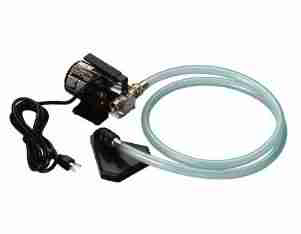
Shown in our photo is a Wayne transfer pump; other models and alternatives are at Where to buy a pony pump or drill pump.
A common use of pony pumps or transfer pumps is to empty a water tank or hot water tank at which the tank drain is below a suitable floor drain or sink, meaning that we need to "lift" the water from the tank to a drainage location.
The pony pump use procedure at a water heater that was located too low to use a floor drain or sink is described at DEBRIS in WATER SUPPLY, Water Heater.
Other examples of of use of a pony pump are at AIR BOUND HEAT SYSTEM REPAIR by PUMP and CLOGGED PIPES / TANKLESS COIL DE-SCALE.
Watch out: be sure to match the pony pump specifications to its intended use. For example, flammable liquids cannot be safely pumped by most pump models without danger of a potentially fatal explosion or fire, and corrosive liquids such as acids will destroy pumps whose internal working parts are not designed for that application. Don't even think about using a transfer pump designed solely for water to move gasoline or other flammable liquids.
In a pinch, some models of sump pumps can also be used as a transfer pump - see PUMPS, SUMP PUMPS.
Definition & Properties of an Electric Drill Operated Pump
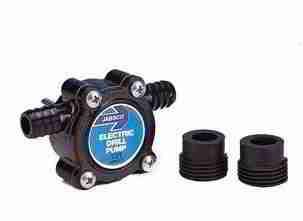 A "drill pump" is a low capacity liquid pump impeller assembly that is driven or operated by connection of the impeller's drive shaft to the chick of a portable electric drill.
Drill powered transfer pumps can work attached to both line-cord powered drills and battery-operated electric drills, though depending on the pump and application, the battery time may limit the use of battery drills.
Drill pumps have the advantage of low cost compared to a self-contained pony pump or transfer pump, but typically drill pumps also have a lower pumping capacity in gpm and lower lift capacity.
In matching the drill powered transfer pump to your requirements, be sure to review Variation in Actual Pony Pump, Transfer Pump, or Drill Powered Pump Performance found below.
Shown in our photo is the Jabsco electric drill pump; other models and alternatives are at Where to buy a pony pump or drill pump.
What size (horsepower) of Pony Pump, Transfer Pump, or Powered Pump do We Need ?
The answer is that you need to choose a pump that matches your application. For emptying an aquarium you don't need a lot of pumping power. And you should not need a very powerful pump to force water through an air-bound hydronic heating system, since the fact that nearly all of the heating pipes are already full of water means the pump does not have to have enormous lift capacity.
For rapid emptying of water tanks or water heater tanks, or for most pluming and heating applications, you'll want a self-powered transfer pump not a drill-operated pump.
And for emergency sump pump use such as emptying out a flooded basement or for using a nearby pond to water lawns and gardens, you'll need a higher capacity self-powered electric transfer pump.
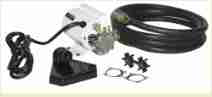 The Little Giant™ MPFVK115 Portable 115 Volt Non-Submersible Steel Transfer Pump is one that we have used successfully in this application. The company's image (left) includes spare impeller parts, gaskets, transfer hose, and a sump pickup element.
This is a non-submersible transfer pump made of stainless steel, operating on 115 Volts, and rated for 365 gallons per hour, produced by manufacturer Little Giant. Part No. MPFVK115. You can purchase that pump from plumbing suppliers or online
Watch out not to confuse gallons per hour with gallons per minute when choosing a portable pump or transfer pump to meet your needs. 356 gph equals about 6 gpm - six gallons per minute (which is not bad). To empty a 40-gallon hot water tank at 6 gpm will take a bit under 7 minutes.
Watch out also to look at the total lift capacity of the transfer pump you are considering. If you need to lift liquids to a height above the pump's maximum gph pumping rate and lift capacity, expect the pumping time to be longer, or in the worst case, not to work at all.
Conversely, a typical low-cost drill powered transfer pump such as the Wayne utility pump transfer kit (dpftk1) described at our buying guide below is low cost (under $20. U.S.) but pumps at up to 150 gph (about 2.5 gpm) - 2 and one half gallons per minute (which is fine for small jobs). To empty a 40-gallon hot water tank at 2.5 gpm will take about 16 minutes.
Thanks to reader David Gould for discussing pump requirements (2010);
Sources of Variation in Actual Pony Pump, Transfer Pump, or Drill Powered Pump Performance
Watch out for "up to" promises in any advertisement. In advertising law, a manufacturer who promises "up to" some performance level has to deliver that performance in perhaps ten percent of cases, so your actual pump performance will vary depending on
- the actual lift height required when moving the liquid and the lift capacity of the pump (not specified for all pump models)
- for self-contained pumps, the pump motor horsepower
- for drill powered transfer pumps, the drill horsepower and drill rotating speed in rpm (most such pumps set a limit on allowable drill speed)
- the condition of the pump impeller assembly (has it been damaged?)
- the diameter of input and output hoses connected to the pump
- the length of input and output hoses connected to the pump; note that some pumps list a maximum discharge head length in feet;
- the viscosity of the liquid being transferred
- the temperature of the liquid being transferred.
Watch out: while some transfer pump instructions say to warm motor oil before trying to move it, make sure that both the pump and the transfer hoses connected to the pump can handle the warm liquid. Trying to pump a too warm or actually hot liquid (hot water or motor oil, for example) can cause the hose on the pump intake side to collapse, stalling the whole operation and potentially damaging the pump.
How to empty a water pressure tank or water heater tank using a pony pump or a drill pump
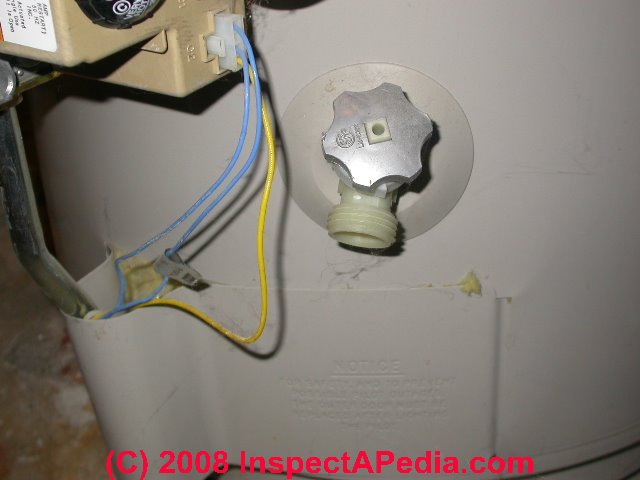
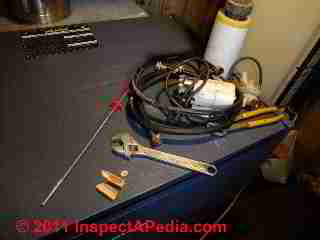
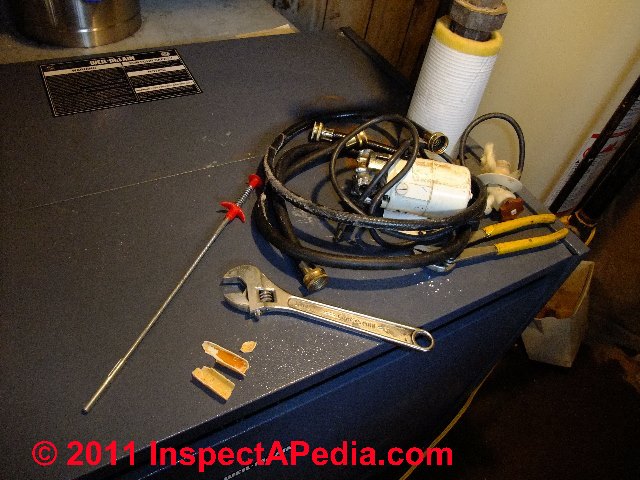
Our photo at page top shows our little pony pump at a job where we used it to empty a water heater tank through a garden hose to an outdoor location.
Here I had not yet hooked up the pump but you can see the white pump body and the washing machine hose needed to hook it up to a tank drain. (This pony pump use procedure is described at DEBRIS in WATER SUPPLY, Water Heater)
To connect a pony pump to the drain on a water pressure tank or to the drain on a water heater, we use a washing machine hookup-hose (double female hose fittings on its ends) to connect the pony pump inlet side to the tank drain valve. The pony pump outlet side is connected to a garden hose that is terminated at a floor drain, plumbing drain, or outside the building at a suitable location.
When draining or pumping out a water tank or hot water tank you'll find the job much faster and easier if you provide a way to let air into the tank as it is being emptied. See AIR INLET VALVE, WATER TANK for suggestions.
Watch out: both pony pumps and (lower capacity) drill pumps are available in a variety of models, prices, and pumping rates in gpm. But regardless of the pumping capacity, many lower-cost pony pumps and most drill pumps are not designed to be run "dry" - running the pump dry for more than 10-15 seconds may damage the impeller assembly.
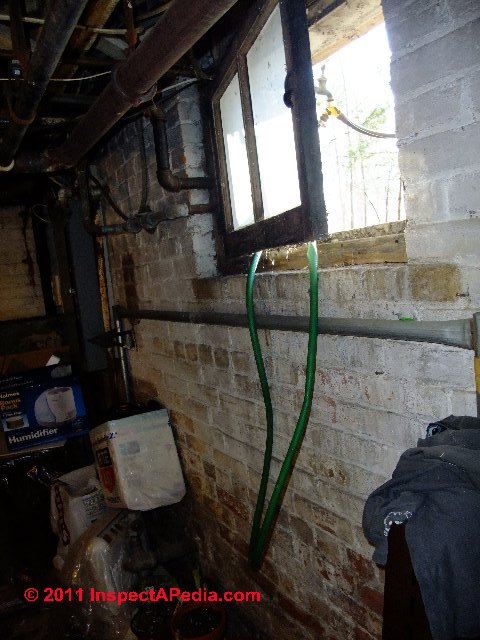
Our photo (left) shows the basement window out of which we routed our drain hose fed by the pump.
Watch out: when you are finished pumping water out of the water heater (the pump sound will change because it's running dry) quickly turn off the pump so it's not damaged, and also quickly close the drain opening at the bottom of the water heater tank so that you don't siphon back water from the garden hose into the water tank.
It's not a catastrophe but we're trying to spill as little water into the basement as possible.
With the hose removed you can open the water heater tank drain valve again to see if you really successfully pumped all of the water out. If you didn't you may spill a bit.
We graded ourselves a "C" on step as we spilled water.
How to empty an inaccessible water or water heater tank without a usable tank drain
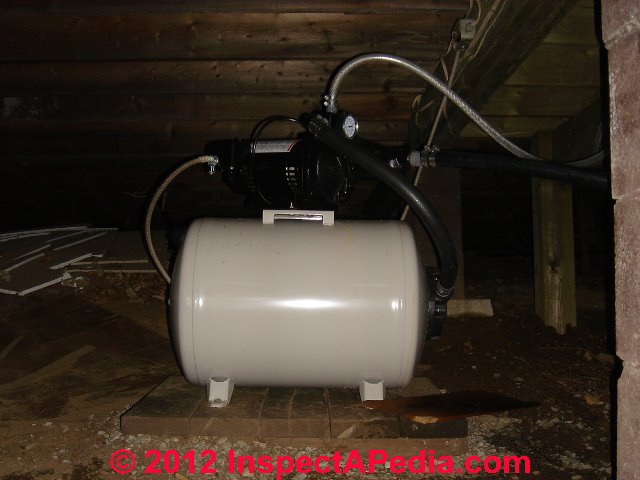 For inaccessible water tanks or water heater tanks that are not properly installed and lack a tank drain the most effective means of getting most of the water out of the tank in this circumstance would be to use an available tapping on the upper tank to insert a tube and use a pony pump or drill pump to pump water out of the tank, through a hose, to outdoors or to a nearby drain.
When circumstances demand tank replacement or when there is an opportunity for any other reason, I'd either relocate these tanks to an accessible area or provide easier access (in one such case we made an openable floor panel).
Our photo (above left) of a horizontal water pressure tank was provided courtesy of reader Doug Mehak.
Where to buy a pony pump or drill powered transfer pump, lake pump, or portable sump pump
- The Little Giant™ MPFVK115 Portable 115 Volt Non-Submersible Steel Transfer Pump is a non-submersible transfer pump made of stainless steel, operating on 115 Volts, and rated for 365 gallons per hour, produced by manufacturer Little Giant. Part No. MPFVK115. Available from plumbing suppliers or online
- Dayton 3YU62 Pump, Drill Driven Kit, (Under $20. U.S.), 5 ft. head capable, available from plumbing suppliers or online at Amazon.com.
- Flotec FPDMP21SA-P2 Self Priming Drill Pump , (under $10. U.S.), portable electric drill powered transfer pump, up to 225 gph, maximum drill speed 1200 rpm; self priming, available from plumbing suppliers or online at Amazon.com.OK for transferring automotive oil;
- Jabsco 17215-0000 Drill Pump Kit, (Under $41. U.S.), self priming, available from plumbing suppliers or online at Amazon.com. OK for transferring automotive oil;
- Wayne Drill Powered Fluid Transfer Utility Pump Kit (dpftk1), (under $15. U.S.), portable electric drill powered transfer pump, up to 150 gph, available from plumbing suppliers or online at Amazon.com.OK for transferring automotive oil;
- Wayne PC2 115-Volt 340 GPH Portable Transfer Water Pump, Bronze, (Under $75. U.S.), 310 gph, includes suction attachment to operate as a sump pump, standard garden hose fittings; available from plumbing suppliers or online at Amazon.com.
Note that this pump is also available in a 12-volt version that might be operated from a vehicle. - Wayne PC4 1/2 HP 115-Volt Transfer Water Pump, Cast Iron, (Under $125. U.S.), 1/2 HP, cast iron, can function as sump pump, develops 40 psi, used also for watering gardens and washing autos; manual priming through top fitting; used as a "lake pump" to transfer water from a lake, pond or stream; available from plumbing suppliers or online at Amazon.com.
- Wayne PLS100 1 HP 720 GPH Portable Lawn Sprinkling Pump, Stainless, (Under $140. U.S.), multi-purpose 1HP, stainless steel, to 720 GPH, 20 ft. lift, maximum discharge head 180 ft, designed to water lawns or gardens by transferring water from a pond, lake, or stream; includes automatic thermal overload protection switch; available from plumbing suppliers or online at Amazon.com.
Note: InspectApedia is committed to providing our readers with unbiased research and the writing of technical content that is free from marketing, sales pitches, or conflicts of interest. With the exception of links to recommended books or products at Amazon.com who pays us a microscopic commission, we do not sell anything at InspectAPedia.com ®. Please do not call or write asking to us to buy or sell anything.
...
Continue reading at PUMPS, SUMP PUMPS or select a topic from the closely-related articles below, or see the complete ARTICLE INDEX.
Or see these
Recommended Articles
Suggested citation for this web page
PUMPS, PONY PUMPS at InspectApedia.com - online encyclopedia of building & environmental inspection, testing, diagnosis, repair, & problem prevention advice.
Or see this
INDEX to RELATED ARTICLES: ARTICLE INDEX to PLUMBING SYSTEMS
Or use the SEARCH BOX found below to Ask a Question or Search InspectApedia
Ask a Question or Search InspectApedia
Try the search box just below, or if you prefer, post a question or comment in the Comments box below and we will respond promptly.
Search the InspectApedia website
Note: appearance of your Comment below may be delayed: if your comment contains an image, photograph, web link, or text that looks to the software as if it might be a web link, your posting will appear after it has been approved by a moderator. Apologies for the delay.
Only one image can be added per comment but you can post as many comments, and therefore images, as you like.
You will not receive a notification when a response to your question has been posted.
Please bookmark this page to make it easy for you to check back for our response.
Our Comment Box is provided by Countable Web Productions countable.ca
Citations & References
In addition to any citations in the article above, a full list is available on request.
- ...
- Thanks to reader David Gould, BC, Canada, for pony pump requirements discussion, 1/27/2010
- Our recommended books about building & mechanical systems design, inspection, problem diagnosis, and repair, and about indoor environment and IAQ testing, diagnosis, and cleanup are at the InspectAPedia Bookstore. Also see our Book Reviews - InspectAPedia.
- In addition to citations & references found in this article, see the research citations given at the end of the related articles found at our suggested
CONTINUE READING or RECOMMENDED ARTICLES.
- Carson, Dunlop & Associates Ltd., 120 Carlton Street Suite 407, Toronto ON M5A 4K2. Tel: (416) 964-9415 1-800-268-7070 Email: info@carsondunlop.com. Alan Carson is a past president of ASHI, the American Society of Home Inspectors.
Thanks to Alan Carson and Bob Dunlop, for permission for InspectAPedia to use text excerpts from The HOME REFERENCE BOOK - the Encyclopedia of Homes and to use illustrations from The ILLUSTRATED HOME .
Carson Dunlop Associates provides extensive home inspection education and report writing material. In gratitude we provide links to tsome Carson Dunlop Associates products and services.
 | HOME | ABOUT | ASK a QUESTION | CONTACT | CONTENT USE POLICY | DESCRIPTION | POLICIES | PRIVACY | |
| © 2024 - 1985 Publisher InspectApedia.com - Daniel Friedman | |||||||||