
InspectAPedia® FREE Encyclopedia of Building & Environmental Construction, Diagnosis, Maintenance & Repair |
Question? Just ask us! InspectAPedia
|
 How to Test for & Trace Sewer Gas Smells and Septic Tank Odors in a Building
- POST a QUESTION or COMMENT about how to track down sewer gas or septic odors in buildings
Sewer gas leak or contamination test procedures:
This article describes how to How to Test for & Trace Sewer Gas Smells and Septic Tank Odors in a Building or how we might trace "gas odors" in buildings with a focus on homes with a private onsite septic tank or for owners whose home is connected to a public sewer system as well. What makes the smell in sewer gas? Sewer gases are more than an obnoxious odor.
InspectAPedia tolerates no conflicts of interest. We have no relationship with advertisers, products, or services discussed at this website.
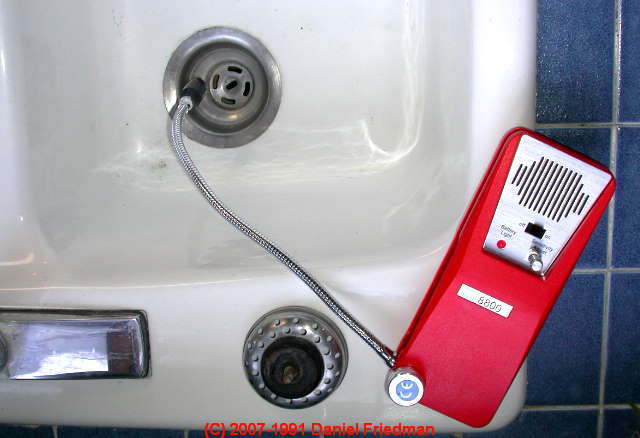
Tests for Indoor Sewer Gas & Septic Odors - Indoor Gas Leaks using the TIF 8800 Combustible Gas Analyzer
Watch out: Because sewer gas contains methane gas (CH4) there is a risk of an explosion hazard or even fatal asphyxiation. Sewer gases also probably contain hydrogen sulfide gas (H2S)
In addition some writers opine that there are possible health hazards from sewer gas exposure, such as a bacterial infection of the sinuses (which can occur due to any sinus irritation). Depending on the sewer gas source and other factors such as humidity and building and weather conditions, mold spores may also be present in sewer gases.
[Click to enlarge any image]
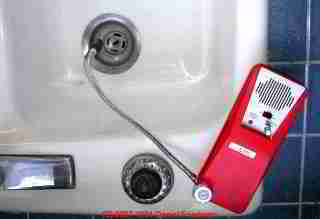
Tests for sewer gas or septic odor gas leaks: When looking for gas leaks and tracking gas smells, one method to get more precise is to use an instrument sensitive to a broad range of combustible organic gases.We use a TIF 8800 combustible gas analyzer set at its most sensitive setting to sniff for gas leaks.
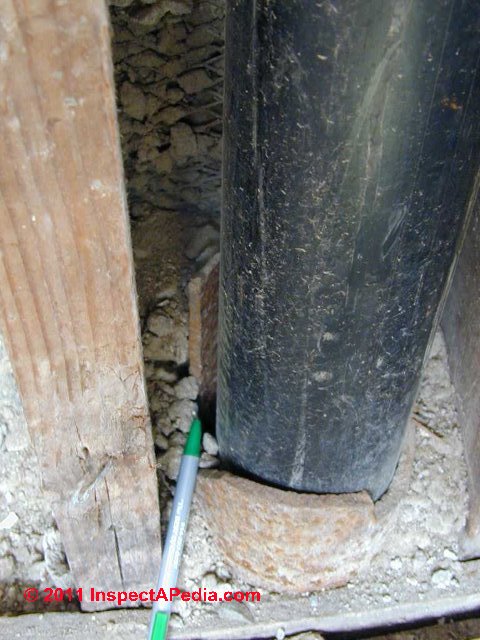
Our photo at above left illustrates a type of hidden and subtle source of sewer gas odors in buildings: defects in the building drain, waste, or vent piping that are hidden in wall or ceiling cavities.
This particular leak is discussed
at DRAIN PIPING & SEWER ODORS .
This instrument will respond to a very wide range
of volatile organics, including pipe dope on a plumbing joint, so be careful.The TIF8800 will also respond a little to the gases found at almost any plumbing drain since the trap is often producing some organic gases.
But if you find that
there is one drain that responds unusually strongly, or if you find a leak in a fuel gas line, you've found a problem to correct before going further.Many home inspectors have this tool and can be hired to apply it
carefully in your home, or it may be less costly (than hiring an inspector) to just buy the tool itself.
Here are some ways we use the TIF 8800 to screen for and trace sewer gases in a building
- Turn on the instrument outside (not near a busy highway or running vehicle) and enter the building to screen for the detection of any combustible gas;
- Enter each building area with the instrument freshly-set to outdoor ambient air conditions
- Don't forget to try the sensor tip at different heights indoors - warm air rising can carry flue gases or other combustibles to unanticipated areas higher than the gas source
- Adjust the instrument to its most sensitive setting, using its response sound to move towards stronger sources of any gas that has been detected.
- Remember to check not only plumbing drains but gas fittings
- Remember that the presence of organic solvents in some pipe joint compounds may make the instrument respond even though no leak may be present
- Confirm that the instrument is responding to gases by testing it such as in or near a (not too hot) heating flue, gas source, or preferably, using the sensing tip calibrating vial provided by the manufacturer.
Also see TIF 8800 GAS DETECTOR for a detailed procedure of how this instrument is employed and for a list of gases to which it will respond.
Watch out: The use of most test instruments gives only an instantaneous indicator of a substance that is present at the time of the test and in the location tested. Tests for individual substance or even individual classes of substances are never a complete assurance of building conditions, as other substances not within the scope of the test may be present.
And instrument tests are never a sure indicator that hazardous substances are not present or have not been present at other times or under different building conditions. Never rely only on the results of test instruments when examining a building for unsafe conditions such as gas leaks.
Expert visual inspection of the building exterior, interior, and mechanical systems as well as an understanding of the building's damage, leak, and repair history and of the vulnerability of particular construction designs and materials are all important considerations when evaluating the condition of a structure.
Other Tests for Methane Gas (besides the TIF 8800)
Certainly there are quite a few (often more expensive) instruments that can test for combustible gases, and there are gas-specific tests that address methane-only. For general use a broad-spectrum test instrument such as the TIF8800 discussed here offer the advantage of sensitivity to a wide range of gases, increasing the chance of detecting a concern when the instrument is used, and also increasing the chance of confusion about just what gas is present.
At TIF 8800 GAS DETECTOR we provide details about the use of the instrument described in the article above.
At Drager GAS DETECTORS we describe a simple pump instrument that can, by selecting the proper detector tube, test for a very large range of individual gases at various concentrations.
For readers interested in monitoring specifically for methane gas, perhaps as an indicator of sewer gas leaks, take a look at the Xintex Methane Gas Detector S2B-M-X, described by its manufacturer as follows:
The Xintex® Methane Gas Detector / Monitor, Model S2B-M-X-Display-D, constantly monitors the level of highly explosive methane and goes into alarm prior to a dangerous situation occurring. This advanced micro-processor, state of the art, Methane Gas Detector is incorporated into the design and re-design of vehicles using CNG or LNG as a fuel.
The company offers other methane gas detection systems as well, including sensors designed to react to specific elevated levels of methane and natural gas.
Watch out: when buying any gas detection instrument be sure to compare the detection and reporting range of the instrument with the level of concern that you need to address. Otherwise dangerous conditions may exist without detection.
- Fireboy®- Xintex® Inc P.O. Box 152 · Grand Rapids, Michigan USA 49501-0152 O-379 Lake Michigan Dr NW · Grand Rapids, MI USA 49534 Phone: 616-735-9380 Fax: 616-735-9381 Toll-free: 866-350-9500 Website: http://www.fireboy-xintex.com/
- European inquiries: Fireboy- Xintex, LTD Unit 10 Holton Road · Holton Heath Industrial Estate · Poole, Dorset · BH16 6LT · UK Phone: +44 (0) 845 389 9462 Fax: +44 (0) 1202 625376 Email Registration No. 05789560 England Reg. Office 14 New Street, London EC2M 4HE, United Kingdom
Question: How do you measure sewer gas concentrations?
(May 14, 2016) Anonymous said:
How do you detect and measure concentrations of sewer gas?
Reply:
Anon:
Because of the significant variation in the rate, density, concentration and composition of sewer gas that might be leaking into a building, concentration is not measured by the typical investigator. Rather she uses a broad-spectrum combustible gas detection instrument such as the TIF8800 discussed in these pages
- with the caveat that that sort of instrument will respond to a wide range of combustible gases. It's the use of the tool in proper context that makes it a reliable and appropriate method.
If for technical reasons you needed to know the concentration of sewer gases, or perhaps of just methane - a primary component - there are more costly and sophisticated electronic instruments that can do that.
- The BW HONEYWELL GASALERT MICROCLIP XL 4-GAS MONITOR MCXL-XWHM-Y-NA - is about $500.
- the RKI INSTRUMENTS MULTI-GAS DETECTOR GX-2012 - is about $1000.
Similarly, some natural gas service companies use a quantitative measurement rather than mere detection.
Sewer Gas Detection Research
- Barsky, J. B., SS Que Hee, and C. S. Clark. "An evaluation of the response of some portable, direct-reading 10.2 eV and 11.8 eV photoionization detectors, and a flame ionization gas chromatograph for organic vapors in high humidity atmospheres." The American Industrial Hygiene Association Journal 46, no. 1 (1985): 9-14.
- Beardsley, C. W., N. J. Krotinger, and J. H. Rigdon. "Removal of sewer odors by scrubbing with alkaline solutions." Sewage and Industrial Wastes (1958): 220-225.
- Dincer, Faruk, and Aysen Muezzinoglu. "Odor determination at wastewater collection systems: Olfactometry versus H2S analyses." CLEAN–Soil, Air, Water 35, no. 6 (2007): 565-570.
- Fan, Chi-Yuan, Richard Field, William C. Pisano, James Barsanti, James J. Joyce, and Harvey Sorenson. "Sewer and tank flushing for sediment, corrosion, and pollution control." Journal of Water Resources Planning and Management 127, no. 3 (2001): 194-201.
- Frechen, Franz-Bernd, and Wulf Köster. "Odour emission capacity of wastewaters—standardization of measurement method and application." Water Science and technology 38, no. 3 (1998): 61-69.
- Guisasola, Albert, David de Haas, Jurg Keller, and Zhiguo Yuan. "Methane formation in sewer systems." Water Research 42, no. 6 (2008): 1421-1430.
- Hurwitz, L. J., and GwenethI Taylor. "POISONING BY SEWER GAS: WITH UNUSUAL SEQUELÆ." The Lancet 263, no. 6822 (1954): 1110-1112.
- Kim, Jihyoung, Jung Soo Lim, Jonathan Friedman, Uichin Lee, Luiz Vieira, Diego Rosso, Mario Gerla, and Mani B. Srivastava. "SewerSnort: A drifting sensor for in-situ sewer gas monitoring." In Sensor, Mesh and Ad Hoc Communications and Networks, 2009. SECON'09. 6th Annual IEEE Communications Society Conference on, pp. 1-9. IEEE, 2009.
- Koo, Dae-Hyun, and Samuel T. Ariaratnam. "Innovative method for assessment of underground sewer pipe condition." Automation in Construction 15, no. 4 (2006): 479-488.
- LUO, Yong, Xiao-bo MAO, and Jun-jie HUANG. "Development of Infrared Methane Sensor." Instrument Technique and Sensor 8 (2007): 001.
- Marrin, Donn L. "Soil‐Gas Sampling and Misinterpretation." Groundwater Monitoring & Remediation 8, no. 2 (1988): 51-54.
- Pandey, Sudhir Kumar, Ki-Hyun Kim, and Kea-Tiong Tang. "A review of sensor-based methods for monitoring hydrogen sulfide." TrAC Trends in Analytical Chemistry 32 (2012): 87-99.
- Stuart, R. D. "Weil's disease in Glasgow sewer workers." British medical journal 1, no. 4076 (1939): 324.
- Watt, Monika M., Stephen J. Watt, and Anthony Seaton. "Episode of toxic gas exposure in sewer workers." Occupational and environmental medicine 54, no. 4 (1997): 277-280
- YANG, Jing, Wei-zhen LIANG, and Qing-qiang MENG. "Monitoring Method for the Combustible and Poisonous Gas from Urban Sewer [J]." China Water & Wastewater 1 (2005): 026.
...
Continue reading at TIF 8800 GAS DETECTOR or select a topic from the closely-related articles below, or see the complete ARTICLE INDEX.
Or see SEWER GAS ODOR SOURCE TEST FAQs - questions and answers posted originally at this page
Or see these
Sewer Gas Odor Articles
- BACKDRAFTING & SEWER/SEPTIC ODORS
- CLOGGED DRAIN DIAGNOSIS & REPAIR
- DRAIN NOISE DIAGNOSIS
- DRAIN PIPING & SEWER ODORS
- GAS DETECTION INSTRUMENTS
- METHANE & SEWER GAS HAZARDS
- ODORS GASES SMELLS, DIAGNOSIS & CURE - home
- PLUMBING FIXTURE TRAPS
- PLUMBING VENT DEFECTS & NOISES
- FORENSIC INVESTIGATION of BUILDINGS
- SEPTIC & CESSPOOL SAFEY
- SEPTIC SYSTEM ODORS
- SEPTIC METHANE GAS
- SEWAGE & SEPTIC CONTAMINANTS
- SEWAGE CONTAMINATION in BUILDING
- SEWAGE EJECTOR / GRINDER PUMPS
- SEWAGE PATHOGENS in SEPTIC SLUDGE
- SEWAGE BACKUP, WHAT TO DO
- SEWAGE BACKUP TEST & CLEANUP
- SEWER GAS ODORS - home
- SEWER GAS ODORS in COLD / WET WEATHER
- SEWER GAS ODOR REMEDIES
- SEWER LINE REPLACEMENT
- SULPHUR & SEWER GAS SMELL SOURCES
- TEST FOR INDOOR SEWER GAS
- TIF 8800 GAS DETECTOR
Suggested citation for this web page
TEST FOR INDOOR SEWER GAS at InspectApedia.com - online encyclopedia of building & environmental inspection, testing, diagnosis, repair, & problem prevention advice.
Or see this
INDEX to RELATED ARTICLES: ARTICLE INDEX to PLUMBING SYSTEMS
Or use the SEARCH BOX found below to Ask a Question or Search InspectApedia
Ask a Question or Search InspectApedia
Questions & answers or comments about how to test for & track down the source of sewer gases or odors in buildings. .
Try the search box just below, or if you prefer, post a question or comment in the Comments box below and we will respond promptly.
Search the InspectApedia website
Note: appearance of your Comment below may be delayed: if your comment contains an image, photograph, web link, or text that looks to the software as if it might be a web link, your posting will appear after it has been approved by a moderator. Apologies for the delay.
Only one image can be added per comment but you can post as many comments, and therefore images, as you like.
You will not receive a notification when a response to your question has been posted.
Please bookmark this page to make it easy for you to check back for our response.
Our Comment Box is provided by Countable Web Productions countable.ca
Citations & References
In addition to any citations in the article above, a full list is available on request.
- Mark Cramer Inspection Services Mark Cramer, Tampa Florida, Mr. Cramer is a past president of ASHI, the American Society of Home Inspectors and is a Florida home inspector and home inspection educator. Mr. Cramer serves on the ASHI Home Inspection Standards. Contact Mark Cramer at: 727-595-4211 mark@BestTampaInspector.com
- John Cranor [Website: /www.house-whisperer.com ] is an ASHI member and a home inspector (The House Whisperer) is located in Glen Allen, VA 23060. He is also a contributor to InspectApedia.com in several technical areas such as plumbing and appliances (dryer vents). Contact Mr. Cranor at 804-873-8534 or by Email: johncranor@verizon.net
- Thanks to Slade Franklin for the reminder that a leaky wax ring at a toilet can lead to septic odors in bathrooms. 11/2007
- Thanks to J.V. (privacy protected) for the reminder to make a detailed inspection of the plumbing vent system when sewer gas odors are present. 07/2008
- Thanks to Roger Hankey & Cheryll Brown, www.hankeyandbrown.com, ASHI home inspectors in Minnesota, for the deteriorated transite pipe gas flue vent photograph and comments. Mr. Hankey is a past chairman of the ASHI Technical Committee, serves as co-chairman of ASHI legislative committee, and has served in other ASHI professional and leadership roles. 7/2007.
- Pennsylvania State Fact Sheets relating to domestic wastewater treatment systems include
- Pennsylvania State Wastewater Treatment Fact Sheet SW-161, Septic System Failure: Diagnosis and Treatment
- Pennsylvania State Wastewater Treatment Fact Sheet SW-162, The Soil Media and the Percolation Test
- Pennsylvania State Wastewater Treatment Fact Sheet SW-l64, Mound Systems for Wastewater Treatment
- Pennsylvania State Wastewater Treatment Fact Sheet SW-165, Septic Tank-Soil Absorption Systems
- Document Sources used for this web page include but are not limited to: Agricultural Fact Sheet #SW-161 "Septic Tank Pumping," by Paul D. Robillard and Kelli S. Martin. Penn State College of Agriculture - Cooperative Extension, edited and annotated by Dan Friedman (Thanks: to Bob Mackey for proofreading the original source material.)
- In addition to citations & references found in this article, see the research citations given at the end of the related articles found at our suggested
CONTINUE READING or RECOMMENDED ARTICLES.
- Carson, Dunlop & Associates Ltd., 120 Carlton Street Suite 407, Toronto ON M5A 4K2. Tel: (416) 964-9415 1-800-268-7070 Email: info@carsondunlop.com. Alan Carson is a past president of ASHI, the American Society of Home Inspectors.
Thanks to Alan Carson and Bob Dunlop, for permission for InspectAPedia to use text excerpts from The HOME REFERENCE BOOK - the Encyclopedia of Homes and to use illustrations from The ILLUSTRATED HOME .
Carson Dunlop Associates provides extensive home inspection education and report writing material. In gratitude we provide links to tsome Carson Dunlop Associates products and services.
 | HOME | ABOUT | ASK a QUESTION | CONTACT | CONTENT USE POLICY | DESCRIPTION | POLICIES | PRIVACY | |
| © 2024 - 1985 Publisher InspectApedia.com - Daniel Friedman | |||||||||