
InspectAPedia® FREE Encyclopedia of Building & Environmental Construction, Diagnosis, Maintenance & Repair |
Question? Just ask us! InspectAPedia
|
 Sizing Tankless Water Heaters
Demand Water Heaters or Instantaneous Water Heaters or
Endless Hot Water Systems
- POST a QUESTION or COMMENT about how to determine the size or capacity of tankless water heater or instant water heater that you require
How to Calculate Tankless Water Heater Requirements - tankless water heater capacity sizing guidelines:
Here we explain how to calculate the size or capacity of tankless water heater you will need in a building.
We name all of the factors that you should consider when buying a tankless or demand or point of use type water heater, such as incoming water temperature, desired output water temperature, and the total hot water flow rate in gallons per minute.
InspectAPedia tolerates no conflicts of interest. We have no relationship with advertisers, products, or services discussed at this website.
How to Calculate Tankless Water Heater Requirements
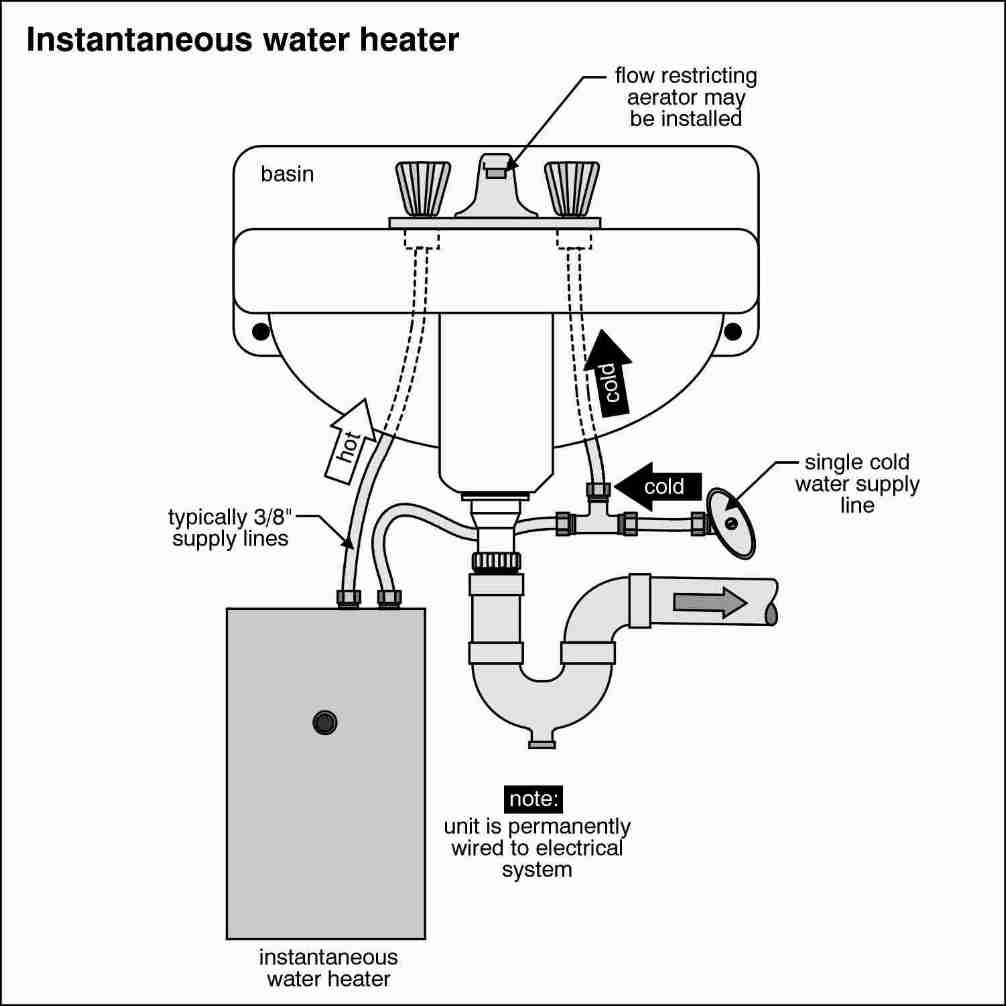 You can calculate the approximate tankless water heater capacity required for any application as follows: Sketch of a point of use tankless water heater courtesy of Carson Dunlop Associates, a Toronto home inspection, education & report writing tool company [ carsondunlop.com ].
[Click to enlarge any image]
T1 = incoming water temperature
T2 = desired output hot water temperature at the plumbing fixture (say a shower)
GPM = anticipated hot water flow rate or usage rate in gallons per minute.
Example:
If your incoming water temperature to the building is 40 deg.F. and you want to provide hot water at a bath shower at 100 deg. F., and if your shower fixture runs at 3 gpm, then
T1 = 40 deg.F., T2 = 100 deg.F.
T2 - T1 = 60 deg.F. - that's the temperature rise you need.
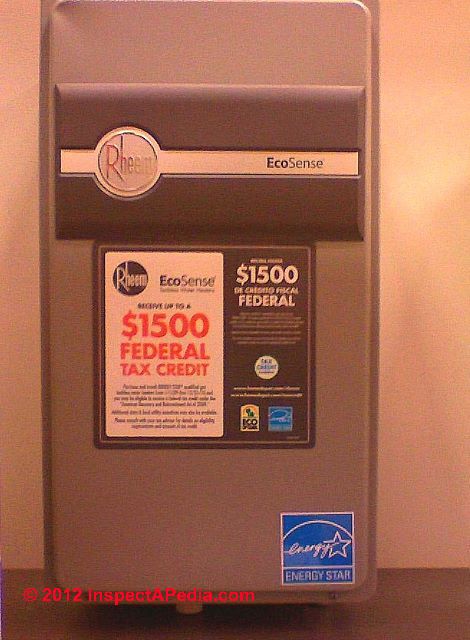 Our photo (left) illustrates a Rheem EcoSense® tankless water heater. A wide range of sizes and capacities of demand type water heaters are available, so indeed it makes sense to look carefully at your requirements.
Your tankless water heater will need to be able to provide a 60 deg. temperature rise at 3 GPM.
Note 1: our example does not consider temperature losses in the piping between the water heater and the point of use nor the use of temperature limiting or anti-scald valves in the plumbing system, both of which reduce the actual hot water flow rate in gpm
While 100° may be a good shower temperature, this means that mixing valves at the shower will be delivering almost 100% hot water. This may make filling a bathtub slow or result in lower water pressure than anticipated. When we blend hot and cold water, we enjoy a higher flow rate and commensurately higher pressure at the shower.
Note 2: it's quickly apparent that if the hot water system is going to be asked to provide 100 deg.F. hot water to multiple fixtures simultaneously, the gpm heating rate of your tankless water heater is going to have to be big - and may be beyond the capacity of the equipment.
In this case see MULTIPLE GANGED TANKLESS WATER HEATERS.
Gas fired tankless water heaters can usually produce more hot water faster than an electric unit. Electric tankless water heaters are simplest to install and operate, requiring only wiring and water piping, no fuel piping, no venting or chimney.
If your building includes three or four bathrooms or even just two baths, and if the occupants are likely to want to run hot showers simultaneously at multiple fixtures, the performance of a single demand water heater or tankless water heater may be marginal unless the unit is quite large.
An Example of Sizing a tankless water heater: specifying hot water flow rate & temperature rise required
- Adapted & expanded from Tankless or Demand Type Water Heaters, & from Sizing a Water Heater, - U.S. DOE[15][17].
As we explain in detail at TANKLESS WATER HEATER CAPACITIES, since there is no reservoir of hot water in a demand type water heating system, instead, tankless or demand-type water heaters are rated by the maximum temperature rise possible at a given flow rate through the device. As DOE points out in their article, to size a demand water heater, you need to determine
- Hot water flow rate: calculate the maximum combined hot water flow rate that may be required in the building at any one time (say two people taking showers or one person showering while a dishwasher and clothes washer are filling), etc.
- List all plumbing fixtures that use hot water and that may be run simultaneously in the building
- Determine the maximum hot water flow rate at each of these fixtures
- Make a realistic assumption about the chances that two or more of these fixtures really can be expected to operate simultaneously
- Add the effects of flow restrictors or other changes you are willing to make in hot water delivery rates - like low flow shower heads & faucets - be honest since kidding yourself about what flow rates you will accept will risk installing a water heater that is inadequate
- Add all of the simultaneous flow rates = Total gallons per hour or TGPH
- Check that that total is at least equal to or greater than any individual appliance or device that you may have left out of the "simultaneous" group and use the larger of those two numbers
- The temperature rise required - that is, the difference between the incoming cold water (that may be as low as or even lower than 40 degF in some locations) and the hot water temperature that is required (say 120 degF).
- Determine the coldest expected incoming water temperature to the building. This can be as low as 40 degF in winter in cold climates in North America; If you don't know this number use 50 degF for cool or cold climates. In hot climates (Arizona, South Texas, etc.) you can use 65F. [16]
- Determine the maximum temperature to which you want to heat your hot water, keeping in mind that if you are not using a point-of-use demand heater, there may be heat losses as water travels through building piping, but also keeping in mind that you don't want to scald anyone.
See ANTI SCALD VALVES for advice on maximum hot water temperatures and on scald protection devices.
If you are not sure, you can use 120F as a maximum hot water temperature for washing and bathing; special applications such as dishwashers and commercial washing facilities may use higher temperatures.
- Compare the building hot water temperature & flow rate with the capacity of the demand type tankless hot water heater appliance being considered. The demand water heater you are planning to install must meet your building usage requirements and for economy, and presuming you are ignoring peak hot water demands that exceed your sample data, then you may not want the unit to significantly exceed your requirements.
DOE example: simultaneously the building occupants will run a hot water faucet with a flow rate of 0.75 gallons (2.84 liters) per minute and a shower head with a flow rate of 2.5 gallons (9.46 liters) per minute. No one else is bathing, no dishwasher nor washing machine operation. The flow rate through the demand water heater would need to be at least 3.25 gallons (12.3 liters) per minute. [15][16]
Typically, a 70ºF (39ºC) water temperature rise is possible at a flow rate of 5 gallons per minute through gas-fired demand water heaters and 2 gallons per minute through electric ones. [15][16][17]
...
Continue reading at TANKLESS WATER HEATERS or select a topic from the closely-related articles below, or see the complete ARTICLE INDEX.
Or see these
Recommended Articles
- TANKLESS WATER HEATERS
- ELECTRIC SHOWER HEATERS
- RHEEM TANKLESS WATER HEATER LEAK REPAIR
- TANKLESS WATER HEATER CAPACITIES
- TANKLESS WATER HEATER CONVERT TO?
- TANKLESS WATER HEATER INSTALLATION
- TANKLESS WATER HEATER INSTALLATION REQUIREMENTS, COSTS
- TANKLESS WATER HEATER LIFE & USES
- TANKLESS WATER HEATER MULTIPLE GANGED
- TANKLESS WATER HEATER REPAIR GUIDE
- TANKLESS WATER HEATER SIZE REQUIREMENTS
- TANKLESS HOT WATER HEATER TEMPERATURE CONTROL
- TANKLESS WATER HEATER WHISTLE
- WATER HEATER SIZE SPECIFICATION & Capacity Charts or Tables gives advice on choosing the water heating equipment size or capacity in gallons or flow rates for both residential and commercial buildings
Suggested citation for this web page
TANKLESS WATER HEATER SIZE REQUIREMENTS at InspectApedia.com - online encyclopedia of building & environmental inspection, testing, diagnosis, repair, & problem prevention advice.
Or see this
INDEX to RELATED ARTICLES: ARTICLE INDEX to WATER HEATERS
Or use the SEARCH BOX found below to Ask a Question or Search InspectApedia
Ask a Question or Search InspectApedia
Questions & answers or comments about how to determine the size of tankless or demand water heater needed.
Try the search box just below, or if you prefer, post a question or comment in the Comments box below and we will respond promptly.
Search the InspectApedia website
Note: appearance of your Comment below may be delayed: if your comment contains an image, photograph, web link, or text that looks to the software as if it might be a web link, your posting will appear after it has been approved by a moderator. Apologies for the delay.
Only one image can be added per comment but you can post as many comments, and therefore images, as you like.
You will not receive a notification when a response to your question has been posted.
Please bookmark this page to make it easy for you to check back for our response.
Our Comment Box is provided by Countable Web Productions countable.ca
Citations & References
In addition to any citations in the article above, a full list is available on request.
- Mark Cramer Inspection Services Mark Cramer, Tampa Florida, Mr. Cramer is a past president of ASHI, the American Society of Home Inspectors and is a Florida home inspector and home inspection educator. Mr. Cramer serves on the ASHI Home Inspection Standards. Contact Mark Cramer at: 727-595-4211 mark@BestTampaInspector.com
- John Cranor [Website: /www.house-whisperer.com ] is an ASHI member and a home inspector (The House Whisperer) is located in Glen Allen, VA 23060. He is also a contributor to InspectApedia.com in several technical areas such as plumbing and appliances (dryer vents). Contact Mr. Cranor at 804-873-8534 or by Email: johncranor@verizon.net
- Consumer Reports offers an article on the efficiency versus the economy of tankless water heaters - see http://www.consumerreports.org/cro/Appliances/heating-cooling-and-air/water-heaters/tankless-water-heaters/overview/tankless-water-heaters-ov.htm
- Bosch Tankless Water Heaters - http://www.boschhotwater.com/
- Chromolite Tankless Water Heaters
- Bradford White Everhot Tankless Water Heaters - Bradford White offers this step by step hot water retrofit installation file (large, slow PDF) - www.bradfordwhite.com
- Eemax Tankless Water Heaters - http://www.eemaxinc.com/
- Noritz Tankless Water Heaters - http://www.noritz.com/
- Rheem Tankless Water Heaters - http://www.rheemtankless.com/content/
- Rinnai Tankless Water Heaters - http://www.rinnai.us/tankless-water-heaters/
- Stiebel Eltron Tankless Water Heaters - http://www.stiebel-eltron-usa.com/
- Takagi USA Tankless Water Heaters - http://www.takagi.com/
- Titan Tankless Water Heaters - http://www.titanheater.com/
- U.S. Department of Energy on Tankless Water Heaters - http://apps1.eere.energy.gov/consumer/your_home/water_heating/index.cfm/mytopic=12820
- [15] "Tankless or Demand Type Water Heaters," U.S. Department of Energy, retrieved 10/14/2012, original source: http://energy.gov/energysaver/articles/tankless-or-demand-type-water-heaters [Copy on file as Tankless_Water Heaters_DOE.pdf]
- [16] "Arizona Water Atlas, Volume 8, Active Management Area Planning Area, Arizona Department of Water Resources, April 2010, retrieved 10/14/12, original source http://www.azwater.gov/azdwr/StatewidePlanning/ WaterAtlas/ActiveManagementAreas/documents /Volume_8_TOC_final.pdf [copy on file as Arizona_Water_Atlas_Volume_8.pdf]
- [17] "Sizing a Water Heater", U.S. Department of Energy, retrieved 10/14/2012, original source: http://energy.gov/energysaver/articles/sizing-new-water-heater, [copy on file as Sizing_Water_Heater_DOE.pdf
- [18] "15 Ways to Save on Your Water Heating Bill", Allison Casey, Senior Communicator, NREL, October 26, 2009, retrieved 10/14/12, original source: http://energy.gov/energysaver/articles/15-ways-save-your-water-heating-bill [copy on file as 15_Hot_Water_Cost_Savings_DOE.pdf] - excellent list of fifteen ways to reduce hot water heating costs in residential applications. Note that this list does not suggest installing a demand type tankless water heater.
- Carbon Monoxide Gas Toxicity, exposure limits, poisoning symptoms, and inspecting buildings for CO hazards
- In addition to citations & references found in this article, see the research citations given at the end of the related articles found at our suggested
CONTINUE READING or RECOMMENDED ARTICLES.
- Carson, Dunlop & Associates Ltd., 120 Carlton Street Suite 407, Toronto ON M5A 4K2. Tel: (416) 964-9415 1-800-268-7070 Email: info@carsondunlop.com. Alan Carson is a past president of ASHI, the American Society of Home Inspectors.
Thanks to Alan Carson and Bob Dunlop, for permission for InspectAPedia to use text excerpts from The HOME REFERENCE BOOK - the Encyclopedia of Homes and to use illustrations from The ILLUSTRATED HOME .
Carson Dunlop Associates provides extensive home inspection education and report writing material. In gratitude we provide links to tsome Carson Dunlop Associates products and services.
 | HOME | ABOUT | ASK a QUESTION | CONTACT | CONTENT USE POLICY | DESCRIPTION | POLICIES | PRIVACY | |
| © 2024 - 1985 Publisher InspectApedia.com - Daniel Friedman | |||||||||