
InspectAPedia® FREE Encyclopedia of Building & Environmental Construction, Diagnosis, Maintenance & Repair |
Question? Just ask us! InspectAPedia
|
 Running Toilet Repair Guide - How to Diagnose & Repair a Toilet that Runs
How to fix a running toilet: Here we explain how to diagnose and fix the cause of a running toilet. If you hear your toilet tank refilling when the toilet is not in use, or if there is always condensation on the toilet tank, you are wasting water and you may be ruining the septic drainfield. More subtle running toilet problems include periodic poor flush of the toilet too.
This article series discusses the cause, diagnosis, and repair of toilet problems (water closet problems) such as a toilet that does not flush well, clogged toilets, slow-filling toilets, running toilets, loose wobbly toilets, and odors at leaky toilets. Here we explain how to diagnose and repair problems with toilets, leaks, flushes, odors, noises, running and wasted water.
InspectAPedia tolerates no conflicts of interest. We have no relationship with advertisers, products, or services discussed at this website.
 Is your toilet running? Better go catch it!
That was a joke when we were kids. But a running toilet wastes water and it can flood a septic drainfield leading to very costly septic repairs.
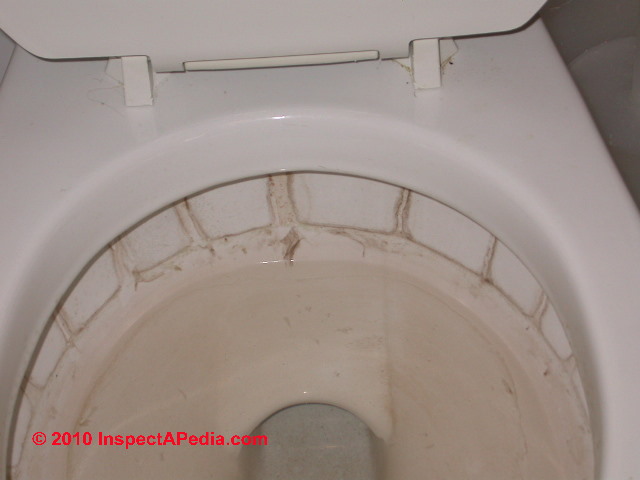
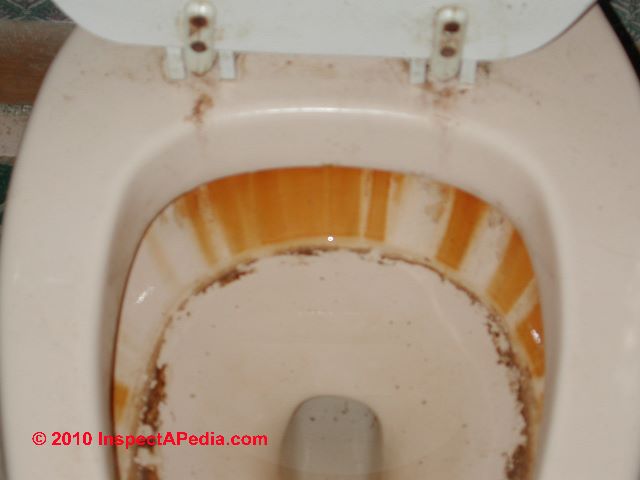
Our page top photo as well as the photograph below both show ugly staining in a toilet bowl - strong evidence that both of these toilets have been running, wasting water, and sometimes giving bad flush performance as well.
[Click to enlarge any image]
And if your building is connected to a private septic system, a running toilet can easily flood and damage the septic drainfield or soakaway bed, inviting a sewage backup into the building.
There are also more subtle but troublesome snafus that occur when a building toilet keeps running. For example in a freezing climate building sewer lines close to the building may not be below the frost line. Instead the sewer line depends on the fact that it slopes to the sewer or septic tank to remain empty and thus immune to freeze-up problems.
But a dripping faucet or a running toilet, by sending a slow trickle of wastewater into the drain system, can cause a drain to freeze and back-up during cold weather.
Readers should also
see ALTERNATIVE & WATERLESS TOILETS for a discussion of camping toilets, chemical toilets, emergency-use toilets, waterless toilets, graywater systems, composting toilets, home health care toilets, incinerating toilets, outhouses, and latrines.
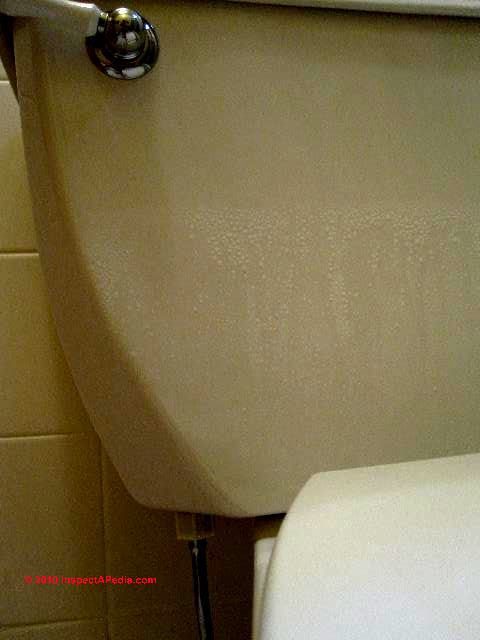
A plumbing leak that causes a toilet to run, the only clues might be noticing that the toilet fill valve is sometimes re-filling the tank even though no one has used the toilet, or one might hear water running in the building drains, or if the property is served by a private septic system, the system may experience flooding and backups.
See PLUMBING DRAIN NOISE DIAGNOSIS for tracing noises to individual toilets or plumbing drains.
[Click to enlarge any image]
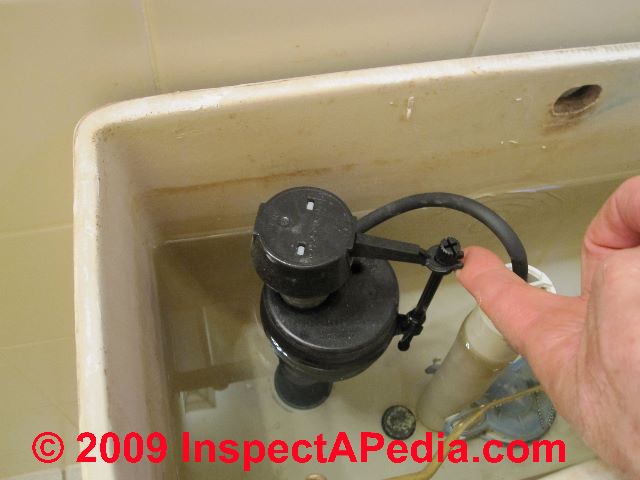
Above: the black assembly is the fill valve that includes a float and an internal valve that allows water to fill the toilet tank following a flush.
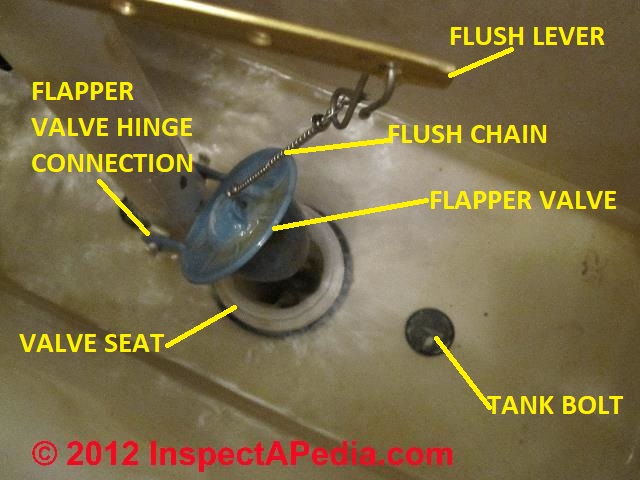
Above: some of the basic parts in a toilet flush valve or "flapper valve". The original flush valve or flapper valve in our first photo is blue.

Second photo above: a red rubber flapper valve from Korky. You can see that the valve's two "ears" simply push over plastic mounting pins on the valve base, and the flush chain hooks between the flush lever and the connection point on the front of the flapper valve.
Below: this leaky blue flush valve was both deformed - out of round - and covered in algae and a bit of scale. It's best to simply replace a valve in this condition.
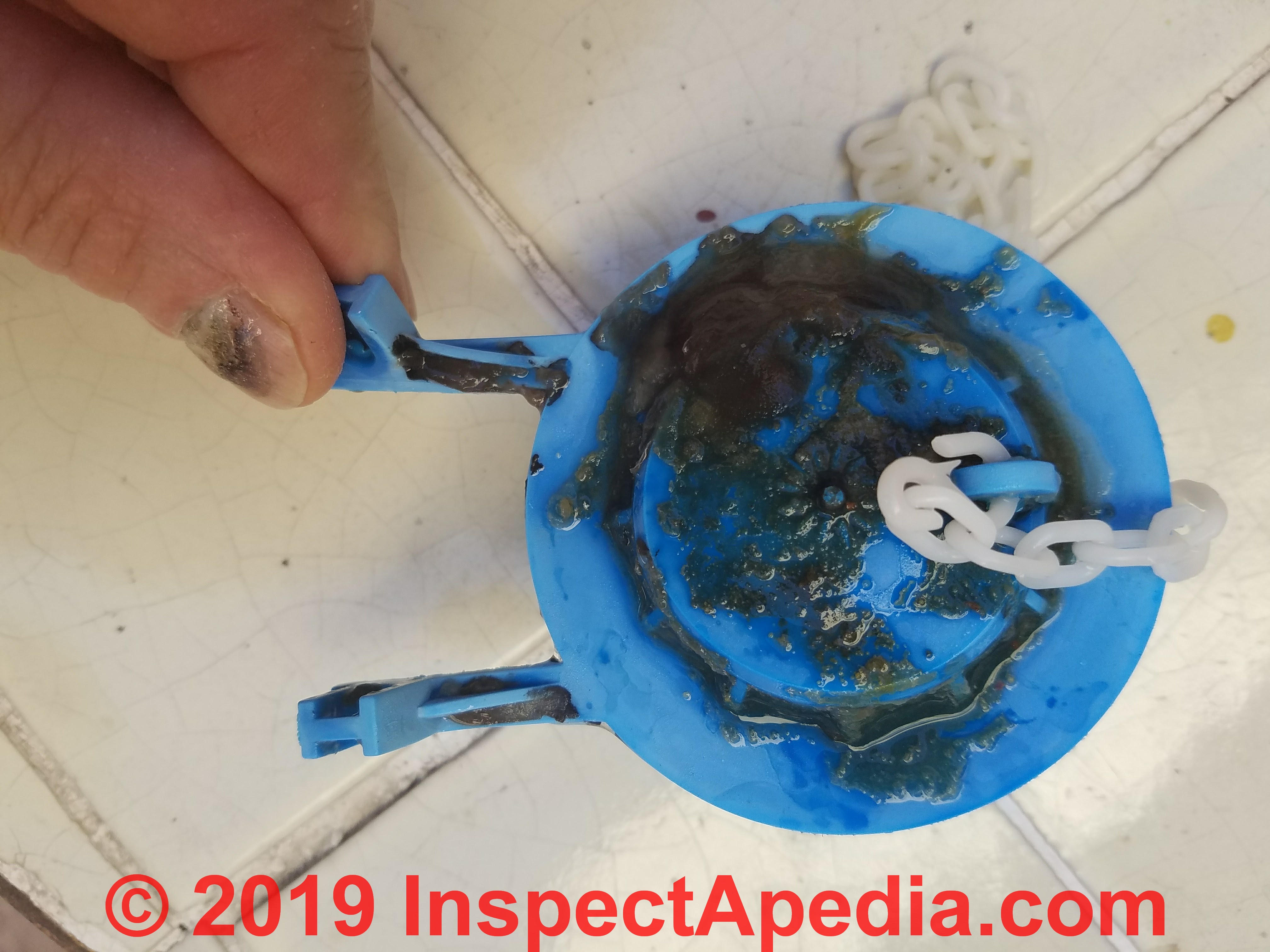
If the flush valve is deformed it may not seat properly and it is likely to leak.
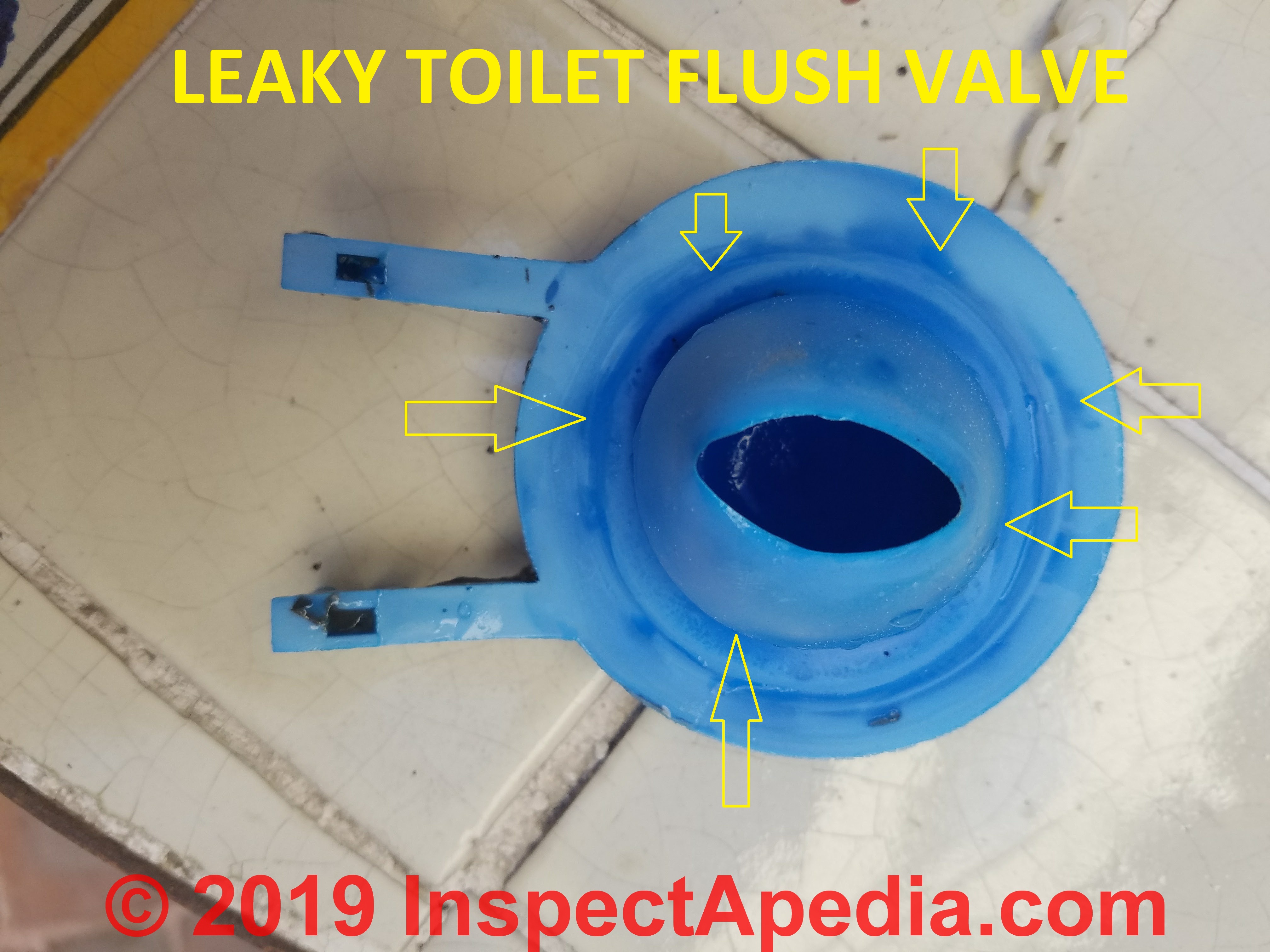
The yellow arrows point to discolorations on the under-side of this valve that may mark leak points where the valve was not seating properly.
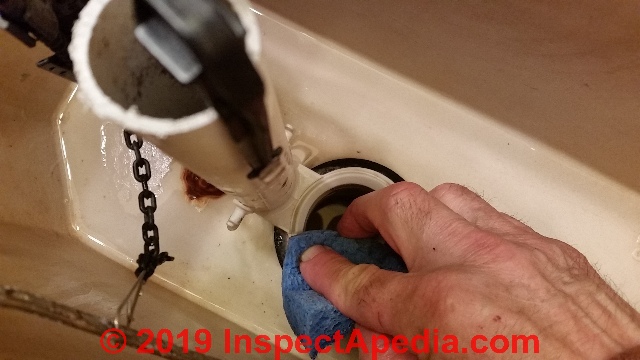
Remember to clean off the flush valve seat before installing the new valve.
Some of these simple toilet diagnosis steps require that you look into the toilet flush tank on the back of the toilet.
Just lift the top off of the toilet tank and set it carefully aside on the floor where you won't break it or trip over it.
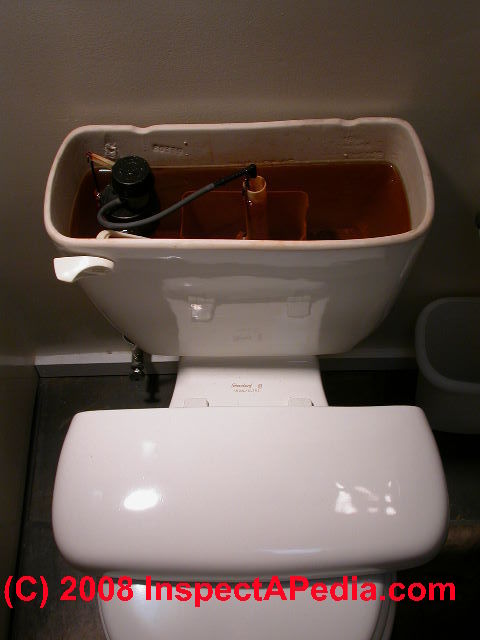
If you leave the tank top on the toilet seat (as we did for this photo) you're asking for trouble, and also, it's a bit in the way.
Our sketch below shows the parts you'll see inside the toilet tank. You may want to refer back to this drawing while reading the details of each class if individual toilet problems listed above and how they are detected, diagnosed, and repaired.
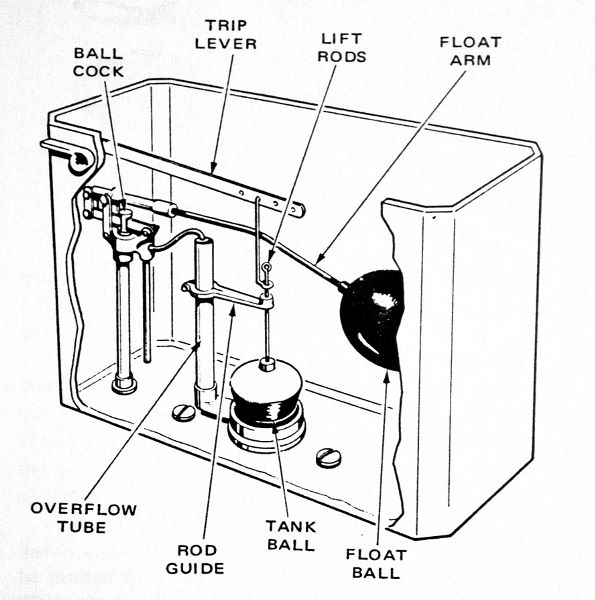
Tank reservoir toilets like the toilet in the sketch and in our photo just above, have been in wide use in North America since the 1940's.
While there have been improvements in toilet tank fill valves, flush valves, floats, and water savings, the design has remained about the same.
[Click to enlarge any image]
A flush lever moves an arm to lift a flapper valve or tank ball to permit water to rush into the toilet bowl below, washing away waste into the sewer pipe.
At the end of the flush cycle, a float arm, or a float moving on a vertical stalk (newer valves) drops to open a valve permitting the toilet tank to refill with water.
When the toilet tank water level reaches the proper level, the float closes the toilet tank fill valve.
Below you will find questions and answers previously posted on this page at its page bottom reader comment box.
On 2019-10-31
by quinn
Water seems to leak into toilet bowl causing flushing
This Q&A were posted originally at TOILET REPAIR GUIDE - home
On 2019-10-31 by (mod) - water leaks into toilet bowl causing the toilet to flush itself
Quinn
When a toilet seems to flush itself without being asked there is a water leak from the tank or cistern down into the bowl. Eventually enough water leaks out of the cistern and into the bowl that the water level in the cistern drops enough that the toilet fill valve opens to re-fill the toilet.
The most-common leak point is the flapper valve or flush valve. That's something easily replaced by the homeowner on most toilets and it's inexpensive. Take a look in the toilet tank, buy a new flapper valve, remove the old one, clean off the opening edges against which the valve seats (I use a scrubby sponge), and install the new valve, connecting its pull chain to the flush arm lever.
If the flapper valve is NOT leaking or if after replacing it the problem continues, it's possible that the whole flush assembly in the center of the cistern is leaking around its base and into the toilet.
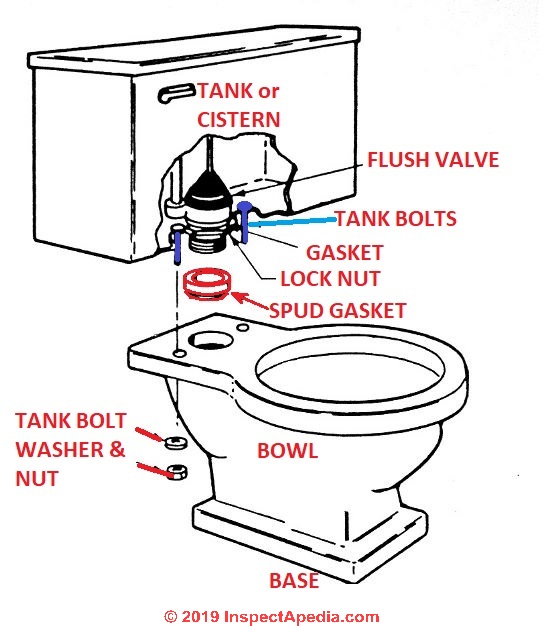
Replacing the toilet flush valve seat assembly is a bigger job as one has to turn off water to the toilet, disconnect the toilet water riser supply pipe from the bottom of the tank, unbolt the tank, remove the center flush assembly, and install a new one with new gasket.
This sounds more intimidating that it ought as a homeowner who's familiar with an adjustable wrench and screwdriver is usually up to the task;
Building suppliers like Lowes or Home Depot sell repair kits for both of these repairs, made by Fluidmaster and other vendors. The kits include illustrated, detailed instructions.
Watch out: What can go wrong? The worst snafu would be a toilet water supply valve that won't shut off.

So before undertaking this repair I would turn off water to the toilet, then flush it, and observe that no new water is entering the tank or cistern.
If no water's re-filling the tank then hurrah, the shutoff works and we can proceed with the repair.
(Apr 24, 2014) Anonymous said:
My toilet ran all the time. I fixed it by installing new inner workings. (valve?). Then it started again......running all the time with low water pressure and slow recovery time. Now all the rest of the house has low water pressure. Is there a connection? thanks, Bridget
Bridget, you want to look very closely at where the toilet is losing water. Even if the fill valve is in perfect shape, if the toilet fill level is adjusted wrong it will overflow into the overflow tube into the bowl, OR you could have a leak at the gaskets between the toilet tank and the bowl.
Try turning off water into the toilet entirely. Then pour some food coloring (I use septic test dye) into the toilet tank. Now watch the bowl. If you see the colored water entering the problem is a leak.
A repair kit for toilets can replace the bolts and gaskets between tank and bowl.
Also review our notes above about running toilet leaks at the spud gasket.
On 2016-08-14 by (mod) -
Excellent; glad you were able to find and fix the trouble.
Indeed sometimes a leak at the toilet flush valve can be a devil to find and fix: the flapper itself may leak slowly, or as you found the leak could be at the mounting gasket below the flapper-valve seat
. I've also found on some toilets, leaks at the bolts mounting the tank to the toilet base. Usually those leak onto the floor, but not in all toilet designs.
On 2016-08-14 y Doug
Thank you for the dye test. Dye was going into bowl. Replaced flapper gasket and no more dye in bowl.
On 2016-01-24 by (mod) - toss a working Bic lighter in the toilet tank?
A flame could ignite sewer gases and cause an explosion.
Watch out: such an explosion could cause fire, injury, death. However it's pretty unlikely - only if a toilet bowl were completely dry could sewer gases easily re-enter the building from the sewer piping. Even then the gases would be in the toilet bowl and general bathroom area, not specifically in the toilet tank or cistern.
Watch out: while it is rare, in some communities natural gas leaks into water wells can send combustible gases through the water supply system. At
Methane gas in well water: in WATER POLLUTANT SOURCES from the U.S. EPA cites and we elaborate that methane gas or musty/earthy smell in water may be from decaying organic matter in water.
[or from direct methane gas leaks into aquifers and water wells. We've had reports, especially from mining areas such as portions of Pennsylvania in the U.S. in which underground methane was seeping into the well through rock fissures.
On 2016-01-19 by Jean
This is a serious question! Why would a person intent on causing damage toss a working Bic lighter in the toilet tank? What can this do?
On 2015-12-31 by (mod) -
Check the flapper pull chain length - it may be too short.
On 2015-12-31 by AL
Toilet flushes, but the tank drin flapper does not close
...
Continue reading at TOILET TANK SWEATS - condensation may also indicate a running toilet, or select a topic from the closely-related articles below, or see the complete ARTICLE INDEX.
Or see these
TOILET RUNS CONTINUOUSLY at InspectApedia.com - online encyclopedia of building & environmental inspection, testing, diagnosis, repair, & problem prevention advice.
Or see this
Or use the SEARCH BOX found below to Ask a Question or Search InspectApedia
Try the search box just below, or if you prefer, post a question or comment in the Comments box below and we will respond promptly.
Search the InspectApedia website
Note: appearance of your Comment below may be delayed: if your comment contains an image, photograph, web link, or text that looks to the software as if it might be a web link, your posting will appear after it has been approved by a moderator. Apologies for the delay.
Only one image can be added per comment but you can post as many comments, and therefore images, as you like.
You will not receive a notification when a response to your question has been posted.
Please bookmark this page to make it easy for you to check back for our response.
Our Comment Box is provided by Countable Web Productions countable.ca
In addition to any citations in the article above, a full list is available on request.
 | HOME | ABOUT | ASK a QUESTION | CONTACT | CONTENT USE POLICY | DESCRIPTION | POLICIES | PRIVACY | |
| © 2024 - 1985 Publisher InspectApedia.com - Daniel Friedman | |||||||||