
InspectAPedia® FREE Encyclopedia of Building & Environmental Construction, Diagnosis, Maintenance & Repair |
Question? Just ask us! InspectAPedia
|
 Hot Water Heater Tank or Electrode Lime & Scale Removal Procedure - How to De-Lime the Water Heater
- POST a QUESTION or COMMENT about scale and lime formation in water heaters
How to de-scale a water heater, hot water geyser, water cylinder, etc:
This article describes in complete detail the steps in the procedure to remove scale or lime from a hot water heater tank - hot water heater de-scaling or de-liming procedural steps.
InspectAPedia tolerates no conflicts of interest. We have no relationship with advertisers, products, or services discussed at this website.
How to Remove Lime or Scale from a Hot Water Heater
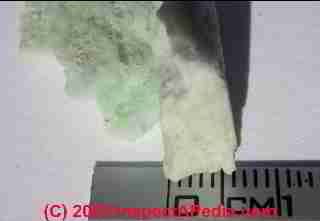
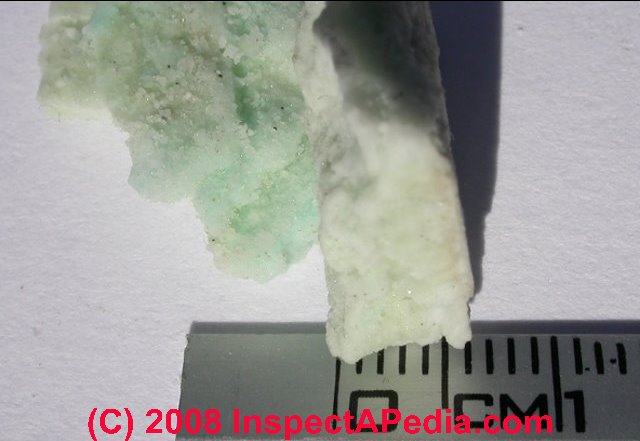
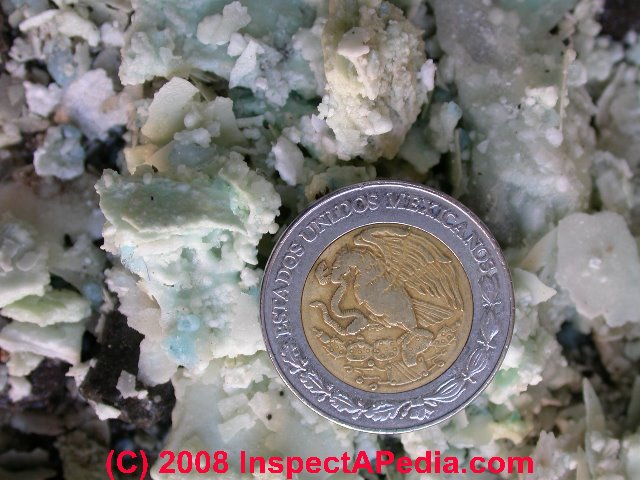 Lime or scale in plumbing systems is caused by hard water as well as silicates, sulfates, and similar materials form water scale that coats the bottom of a hot water tank or the surface of the electrodes in an electric water heater, interfering with proper water heater operation, causing water heater noises, reduction in hot water quantity, increased water heater operating costs, and a shorter water heater life.
Silt and soil debris can also collect in a water heater tank where it can cause similar problems even if the water supply is not hard.
Silt and debris can be easily removed from a hot water tank by periodic flushing. In fact if your water heater is quite noisy, it will probably be easier to remove un-wanted mineral deposits from the water tank than it will be later if you wait until the heater is no longer making much noise (because the mineral layer has solidified).
Install a sediment filter on the incoming water supply to avoid this problem in the first place.
But lime or water scale are more difficult to remove from a water heater: manually scraping the tank bottom through the drain opening or use of a de-limer chemical will be needed. Below we describe these procedures.
Readers should also see our discussion of mineral clogging of water piping, water heaters, and tankless coils, organized
at HOT WATER IMPROVEMENTS.
Other gas fired water heater noises are discussed at GAS FLAME & NOISE DEFECTS.
- To drain your water heater tank, for example to replace a part,
see WATER HEATER DRAIN PROCEDURE. - To flush accumulated crud or debris from a water heater (yearly maintenance)
see WATER HEATER FLUSH PROCEDURE - To de-scale or de-lime your hot water heater,
see WATER HEATER SCALE DE-LIMING PROCEDURE - To diagnose and repair a bad water heater dip tube or anode,
see WATER HEATER ANODES, DIP TUBES - To diagnose particulate debris in the building water supply, faucet strainers, etc. that comes from the hot water tank, and how to fix that problem,
see WATER HEATER DEBRIS FLUSH
The articles at this website will answer most questions about diagnosing and curing noisy domestic water heaters and about the procedure to remove mineral deposits, lime, water scale, silicates, sulfates, aluminates, or silt and sand from a water heater tank.
- If your hot water source is from a tankless coil, or if you suspect that the clogging problem in your building is in the piping itself,
see CLOGGED PIPING & Hot Water Flow.
Why do we need to remove lime or scale from a water heater?
At WATER HEATER NOISE DIAGNOSIS, CURE we explain how scale in a water heater can reduce the quantity of hot water, reduce water heater life, and cause water heater noises. We explain why it is important to remove the scale from a hot water heater.
Step 1: Flush the Hot Water Tank to Remove Silt & Debris
The first step in curing water heater noises or poor hot water quantity is to turn off and flush out the water heater.
See WATER HEATER FLUSH PROCEDURE for the full article on the detailed procedure for draining and flushing out water heaters to remove scale, dirt, or debris - a first step in cleaning a water heater to increase hot water quantity, temperature, and water heater life, and to stop water heater noises.
Watch Out: Safety Warnings: don't tackle this water heater cleanout project on a Sunday night when you can't call a plumber or buy a replacement part. Water heaters, their heating source (oil or gas burner or electricity or solar hot water), and particularly their relief valves include critical safety components.
Do not modify or remove relief valves, chimney connections, draft hoods, etc. as you may create dangerous conditions. Turn off all electrical and or gas power to the water heater and let it cool.
This means turning off electricity that controls the water heater oil burner or electric heating elements, or for gas fired water heaters, turning off the gas supply to the device.
Additional tips on draining a water heater tank can be found
Step 2 - Remove Scale Deposits from a Water Heater Tank - Scraping the Bottom of the Hot Water Tank
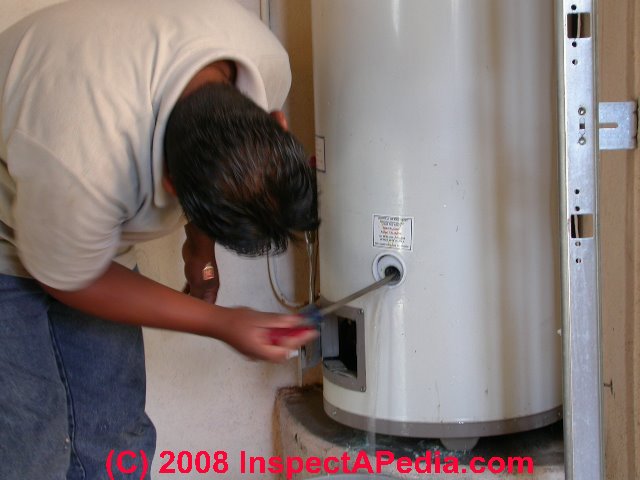
Draining and flushing the water heater without taking more steps to loosen and remove scale from the water heater bottom may be only marginally effective at stopping water heater noise and removing debris.
If there are thick, hard mineral deposits in the bottom of the hot water tank it may be necessary to take a more aggressive approach:
- Turn off and drain the hot water heater as described in detail above
- Remove the hot water heater drain valve (buy a new replacement valve if your old one is damaged)
- Use a stiff wire such as a coat hanger to scrape and loosen debris from bottom of the heater. Scraping the water heater tank bottom is an alternative to using a professional deliming kit which we describe
below at DE-LIMING USING SCALE REMOVERS - Intermittently flush the water heater into a bucket by opening the cold water supply valve into the water heater
- Continue this water heater cleanout process until you are no longer able to remove any debris
- Replace the water heater tank drain valve and the temperature relief safety valve if you removed it earlier
- Re-fill the water heater slowly as we described above.
- Check the water heater and all fittings for leaks, flush all air out of the system as we described in detail above
- Turn the water heater back on.
- Check the system for leaks again, including after the water tank is hot
Safety Warning: never turn on a water heater's heat source before the hot water tank has been re-filled. Otherwise you may damage the heater or create a dangerous condition.
Be sure the water heater pressure and temperature relief valve is properly installed and is the proper type.
See RELIEF VALVES - TP VALVES.
How to Use Scale Removers to Clean a Hot Water Tank or to Clean Scale from the Electric Water Heater Electrodes: Chemical Methods
Currently there are products such as UN-Lime® (a professional non-muriatic food-grade phosphoric acid based chemical de-limer intended for removing scale from water heaters, recommended by A.O. Smith, available in 1 gal. or 5 gal. containers) or possibly other acid-based products that can dissolve mineral or lime deposits in a hot water tank.
Our opinion (feedback is invited) is that using a de-scaling chemical other than one intended for water heaters or other than one specifically recommended by the water heater manufacturer would be a potentially dangerous approach for a water heater for several reasons:
- Acid etching of a water heater tank may cause hidden damage and weakening of the tank itself
- One is exposed to possible acid burns during cleanout, given the sloppy way we need to drain at the tank drain valve opening
- There is a risk of leaving acid in the water system if you do not flush it adequately
We suggest suggest dislodging as much water heater tank bottom crud as possible, but also taking a gentle approach so as to avoid even the slightest possibility of damage to the tank.
If you elect to use a deliming chemical in your hot water tank be sure to follow the manufacturer's instructions, including these general steps:
- Safety Warning
Use of any de-liming product that comes in contact with the sacrificial anode of a water heater can lead to production of an explosive gas. Some large (125g and more) vertical commercial water heaters include a sacrificial anode in the tank bottom. (Sacrificial anodes are intended to reduce tank corrosion.) - Turn off and drain
at the water heater tank as described above - Use a standpipe
(simple 3/4" N.P.T. plastic PVC or CPBC Sch. 80 plumbing fittings & teflon tape or pipe dope including a short nipple, ell or tee, and standpipe of sufficient height to provide a way to pour in the delimer at the hot water tank drain opening) or
a de-limer installation kit
provided by the manufacturer to place the deliming solution only in the bottom of the tank. The "kit" may simply be a connector that joins the container of de-limer by a hose to the water tank drain valve so that by lifting the container higher than the tank drain valve, de-limer flows into the water tank; the delimer later is drained out of the water tank back into the delimer container.
Watch out: cleaning and de-liming chemicals such as rust or lime removers can be dangerous if not used according to the manufacturer's instructions.
See Lime Out / Lime Out Extra, lime remover MSDS, a Summit Brands product and
see Super Iron Out, MSDS Material Data Safety Sheet rust and stain remover, also from Summit Brands. - Do not smoke
or have sparks or open flame nearby during deliming - explosive or flammable gases may be produced. - Do not let delimer chemicals come in contact
with skin, eyes, etc - dangerous burns can result. Delimers should be treated as dangerous chemicals. Use safety goggles, gloves, etc. - Use the proper quantity of deliming solution
which depends on your water heater size. A table of quantity versus tank size is provided by the water heater manufacturer or the de-liming product manufacturer. For example, a 30 gallon water heater uses 2 gallons of delimer and a 30-66 gallon water heater can use 3 gallons of de-limer. - Flush the hot water tank
After the delimer has been used and drained from the water tank, you'll need to flush the tank with clean water - typically for ten minutes. (See the instructions provided by the delimer manufacturer). - Return the hot water heater to operation: bleeding air, replacing relief valve, etc
Continue with the steps we described in detail above
Delimer disposal note: if the delimer is draining into a sump pit be sure to run enough water to cycle the sump pump several times to flush that component out as well - leaving acid and debris from the hot water cleanout in the sump pump could damage it.
Don't Over-Do Acid or Scale Removing Chemicals
In Krappe's 1940 experiments muriatic acid (HCL) and hexametaphosphate solution were discussed for non-mechanical efforts to reduce or dissolve scale in piping, tankless coils, side-arm heaters, water heaters. The author reported that when the zinc coating is removed by acid (older galvanized steel water heating equipment and tanks), rusty water problems were likely.
For this reason, in the 1940's mechanical scale removal was preferred. Modern water heater tanks may be glass lined and less vulnerable to these problems.
Muriatic acid is much less harmful to copper-nickel or copper-silicone surfaces than it is to iron and steel, provided it is not left in metal contact longer than necessary to remove the scale. The message: don't over-do it: more and longer is not necessarily "better".
How to Remove Lime and Mineral Scale from A Tankless Coil
Krappe described using an acid-resistant pump and tubing connected to fittings to circulate an acid-wash through scale-clogged copper piping back in 1940. Plumbers still use this method today. The apparatus must be designed to let the scale particles and gases escape. Plumbers may simply use an acid-proof pony pump and fittings to cycle the acid wash using a plastic bucket as the receiving sump.
Watch out: this is a dangerous procedure risking acid burns or other hazards. Don't try this procedure if you are not trained and equipped to do so.
See LIME OUT / Lime Out Extra, lime remover MSDS, [PDF] a Summit Brands product.
But we have been informed by some plumbers that using acids to clean a tankless coil leave the coil internal surfaces etched and that the result can be faster scale formation than previously.
A detailed procedure for cleaning lime and scale clogged tankless coils, also suitable for some other piping and coil type water heaters is found
at CLOGGED TANKLESS COIL & HOT WATER FLOW.
How to Remove Lime and Mineral Scale from an Electric Water Heater's Heating Electrodes
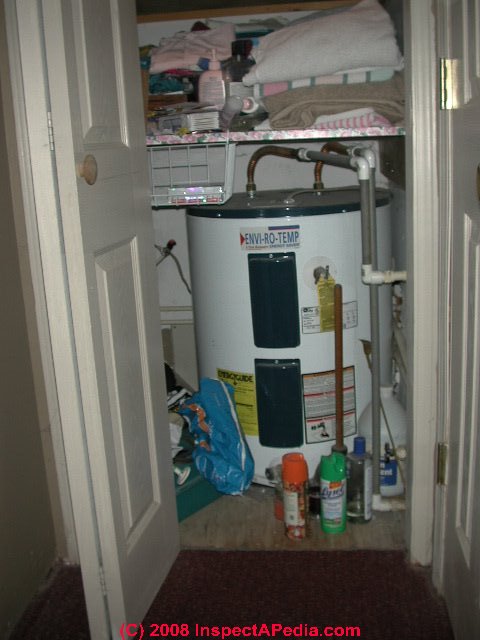 Electric water heaters use one or two electrodes inserted into the bottom and top of the hot water tank. Controlled by a thermostat that senses water temperature inside the hot water tank, the electrodes are turned on to heat water inside the water tank.
On some electric water heater models (Rheem for example) the top heating unit is called the "Booster" and operates only during periods of high demand for hot water. Wiring and controls on the water heater may on some models ensure that only one of the heating elements operates at a time.
Our photo (left) shows a small electric water heater with two heating electrodes - one is located behind each of the dark access panels on the front of the heater.
- Turn off all electrical power
to the water heater and drain the hot water tank as we've described in detail above. - Remove the upper and lower water heating electrodes
and inspect each for lime or scale build-up (or other visible damage) - Clean the scale from the water tank heating electrodes. Soaking the electrodes in vinegar may be sufficient, or you'll need to use a professional de-liming product.
- Replace the electric water heater electrodes
you may want to test each electrode for proper function before replacing it, or if the electrode is visibly damaged, simply buy and install a new one of the same wattage and length. - Re-fill the hot water heater tank
slowly, as we described above, including the steps to remove air from the system before electricity to the water heater is turned back on. - Watch out: Never turn on an electric water heater that has not been filled
completely with water with all air removed from the system - doing otherwise is likely to burn-out the heating electrode(s) and could be unsafe. - Check the hot water tank for leaks
and repair any that are found before turning on the water heater.
Reader Comments, Questions & Answers About The Article Above
Below you will find questions and answers previously posted on this page at its page bottom reader comment box.
Reader Q&A - also see RECOMMENDED ARTICLES & FAQs
On 2021-03-06 - by (mod) -
@neal,
To de-scale or de-lime your hot water heater, see WATER HEATER SCALE DE-LIMING PROCEDURE
https://inspectapedia.com/plumbing/Water_Heater_Scale_Removal.php
described above on this page;
It's always best to start with the least-aggressive cleaner and thus the safest, such as vinegar.
let me know if that leaves you with any questions.
On 2021-03-06 by neal
how to clean scale from rv water heater with aluminum tank? thanks
On 2017-03-22 - by (mod) -
Sure, Nancy, please see https://inspectapedia.com/plumbing/Water_Softener_Alternatives.php OTHER WATER SOFTENING METHODS
On 2017-03-21 by Nancy
We just recently installed a stainless steel water heater (two months ago) and already having trouble with scale accumulating on the heating coils despite having a electric scale remover. We don't want to use a water softener that uses salt. What are some possible solutions?
On 2016-04-14 - by (mod) -
DB
I think the safety of any cleaning chemicals depends on volume and concentration; If I were using a cleaner in a water heater or geyser tank I'd prefer not to send such waste into a septic system, and it shouldn't be necessary.
On 2016-04-14 by Dbear
Are flushing chemicals Septic safe ?
On 2016-04-14 by Anonymous
Are the gas water heater flushing chemicals Septic safe ?
On 2016-04-14 by Dbear
Are the chemicals Septic safe ?
On 2015-10-05 - by (mod) -
Yes you can use lime or de-scaling treatments; do your solar geyser manufacturer or instructions say otherwise?
On 2015-10-05 by sunpays4@hotmail.com
Chemical removal of Lime in my solar geaser
On 2015-08-02 by kenneth
can u use clr to get lime out of hot water heater
...
Continue reading at WATER HEATER SCALE PREVENTION or select a topic from the closely-related articles below, or see the complete ARTICLE INDEX.
Or see these
Recommended Articles
- CLOGGED SUPPLY PIPES, DIAGNOSIS
- CLOGGED SUPPLY PIPES, REPAIR
- CLOGGED TANKLESS COIL or PIPES, LIME SCALE
- HOT WATER PRESSURE IMPROVEMENT
- WATER HEATER FLUSH PROCEDURE
- WATER HEATER SCALE DE-LIMING PROCEDURE
- WATER HEATER SCALE PREVENTION
- WATER PRESSURE MEASUREMENT - what is the dynamic or static water pressure in a water supply system of faucets, fixtures, pipes, tanks, pumps, meters, pressure regulators?
- WATER SOFTENERS & CONDITIONERS for suggestions about dealing with hard water in buildings.
- WATER SUPPLY PIPE DIAMETER vs FLOW
Suggested citation for this web page
WATER HEATER SCALE DE-LIMING PROCEDURE at InspectApedia.com - online encyclopedia of building & environmental inspection, testing, diagnosis, repair, & problem prevention advice.
Or see this
INDEX to RELATED ARTICLES: ARTICLE INDEX to WATER HEATERS
Or use the SEARCH BOX found below to Ask a Question or Search InspectApedia
Ask a Question or Search InspectApedia
Questions & answers or comments about scale and lime formation in water heaters.
Try the search box just below, or if you prefer, post a question or comment in the Comments box below and we will respond promptly.
Search the InspectApedia website
Note: appearance of your Comment below may be delayed: if your comment contains an image, photograph, web link, or text that looks to the software as if it might be a web link, your posting will appear after it has been approved by a moderator. Apologies for the delay.
Only one image can be added per comment but you can post as many comments, and therefore images, as you like.
You will not receive a notification when a response to your question has been posted.
Please bookmark this page to make it easy for you to check back for our response.
Our Comment Box is provided by Countable Web Productions countable.ca
Citations & References
In addition to any citations in the article above, a full list is available on request.
- Mark Cramer Inspection Services Mark Cramer, Tampa Florida, Mr. Cramer is a past president of ASHI, the American Society of Home Inspectors and is a Florida home inspector and home inspection educator. Mr. Cramer serves on the ASHI Home Inspection Standards. Contact Mark Cramer at: 727-595-4211 mark@BestTampaInspector.com
- John Cranor [Website: /www.house-whisperer.com ] is an ASHI member and a home inspector (The House Whisperer) is located in Glen Allen, VA 23060. He is also a contributor to InspectApedia.com in several technical areas such as plumbing and appliances (dryer vents). Contact Mr. Cranor at 804-873-8534 or by Email: johncranor@verizon.net
- Thanks to researcher Robyn Goldstein, Rush Manager, Information Express, 650-812-3585, email: service@ieonline.com,for researching the Purdue bulletin No. 74 original citation 03/2010 . Information Express supplies "... institutional document delivery needs - A full service company specializing in the fast, accurate and competitively priced delivery of published articles for all industries"
- Pounds of lime deposited vs. temperature and hot water usage: see Purdue Bulletin #74 (also provided by A.O. Smith in the article below). Purdue's chart shows the number of pounds of lime deposited per year as a function of the water usage in gallons per day, with an assumed 10 grains of water hardness.
- "When, Why, and How to Remove Water Scale from Tank Type Glass-Lined Water Heaters (for non glass-lined tanks, consult water heater manufacturer)" PDF provided by A.O. Smith Water Products Company - hotwater.com/lit/training/4800r9.pdf 800-433-2545 - 01/07/2009.
- A.O. Smith's Form No. 4800 Rev. 8 Why? When? & How? /UN•LIME Specific Deliming Instructions for use with Up-N-Down Transfer Kit for Tank Type Heaters. (Normally supplied in UN-LIME shipping cartons), Supersedes Form Nos. 4800 Rev. 7 and 4813-100.
- A.O. Smith's Form No. 4778* All about Deliming Coil-Type/Tube-Type Commercial Water Heaters and Hydronic Boilers *Normally supplied when ordering Part No. 4930 Motorized Deliming Pump Kit
- Rheem Electric Water Heater "Owners Guide and Installation Instructions", (Australian models) rheem.com
- "Scale formation in water heaters and methods of prevention", Krappe,
Justus Maximilian, Engineering experiment station. Gas engineering
bulletin; no. 6; Research series; no. 74; On cover: Engineering
bulletin, Purdue university. Vol. xxiv, no.
3a. June, 1940 (Layfayette Indiana) commonly referred to in some references as "Purdue University Bulletin No. 74" - thanks to researcher Robyn Goldstein for the full citation. LCCN: 40028844 & OCLC: 1038544 - Water analysis, water softening, hot-water supply. 27pages. You can obtain this document through your local library.
(A Full copy on file at InspectAPedia 3/31/2010 Purdue_Bulletin74-1940_DF.pdf) Purdue B074 can be hard to locate online, but Bradford White Corporation (a manufacturer of water heaters) has published excerpts from that document, available at Purdue_B074_BradfordW.pdf - e_B074_BradfordW.pdf">Purdue_B074_BradfordW.pdf - Lime-A-Way, Jelmar CLR-CL-12 Cleaner, Vanish DRK cleaner, Simple Green Lime Scale Remover, Eco Friendly lime and scale removerand other plumbing de-liming and de-scaling products mentioned in this article are examples of products used to remove calcium, lime, other minerals, and in some cases rust or other clogs or scaling in piping and on plumbing fixtures. Other products are available from your plumbing supplier.
- Super Iron Out, MSDS Material Data Safety Sheet rust and stain remover; the manufacturer indicates this product can be used to clean rust sediment from water softeners. Summit Brands. See Iron Removal from Water Softener
- Lime Out / Lime Out Extra, lime remover MSDS, produced by Summit Brands, 7201 Engle Road, Fort Wayne, Indiana 46804–222, Tel: 1–888–476–6688, Email: info@summitbrands.com Email See WATER HEATER SCALE DE-LIMING PROCEDURE
- Other sources of information on calculating the rate of lime deposition from hard and hot water:
- Wilkes University Center for Environmental Quality Environmental Engineering and Earth Sciences Hardwater, Water Hardness "Hard Water Hardness Calcium Magnesium Water Corrosion Mineral Scale" http://www.water-research.net/hardness.htm
- Chemical Engineering, Joseph D. Hagerty Editor, McGraw-Hill, 1989,
ISBN 0685270831, 9780685270837
"To calculate the amount of material that will be deposited in 1000 gal. of water per day, take the number of grains per gallon of each as shown by the ..." also difficult to obtain except as a used copy. - Our recommended books about building & mechanical systems design, inspection, problem diagnosis, and repair, and about indoor environment and IAQ testing, diagnosis, and cleanup are at the InspectAPedia Bookstore. Also see our Book Reviews - InspectAPedia.
- Carbon Monoxide Gas Toxicity, exposure limits, poisoning symptoms, and inspecting buildings for CO hazards
- In addition to citations & references found in this article, see the research citations given at the end of the related articles found at our suggested
CONTINUE READING or RECOMMENDED ARTICLES.
- Carson, Dunlop & Associates Ltd., 120 Carlton Street Suite 407, Toronto ON M5A 4K2. Tel: (416) 964-9415 1-800-268-7070 Email: info@carsondunlop.com. Alan Carson is a past president of ASHI, the American Society of Home Inspectors.
Thanks to Alan Carson and Bob Dunlop, for permission for InspectAPedia to use text excerpts from The HOME REFERENCE BOOK - the Encyclopedia of Homes and to use illustrations from The ILLUSTRATED HOME .
Carson Dunlop Associates provides extensive home inspection education and report writing material. In gratitude we provide links to tsome Carson Dunlop Associates products and services.
 | HOME | ABOUT | ASK a QUESTION | CONTACT | CONTENT USE POLICY | DESCRIPTION | POLICIES | PRIVACY | |
| © 2024 - 1985 Publisher InspectApedia.com - Daniel Friedman | |||||||||