
InspectAPedia® FREE Encyclopedia of Building & Environmental Construction, Diagnosis, Maintenance & Repair |
Question? Just ask us! InspectAPedia
|
 Asphalt Shingle Blister Rash
Cause & Effects of
Asphalt Roof Shingle Blistering & Blister Rash vs. Storm or Hail Damage
- POST a QUESTION or COMMENT about blistering & hail damage on roof shingles.
Asphalt shingle blister rash:
Definition, causes, impact on roof life of small blisters formed on the surface of asphalt shingles or some asphalt roll roofing products: this article explains how to identify & explain the causes of asphalt roof shingle blistering or "blister rash" on asphalt roofing. Storm damage from wind and hail occur and need to be and can be distinguished from defective (or cosmetically-defective) asphalt shingle product or asphalt shingle installation errors.
By listing common causes of asphalt roof shingle failures and how to recognize them, building owners and roofing contractors may also be able to reduce the occurrence of asphalt roof shingle storage, handling, and installation errors that affect roof life.
InspectAPedia tolerates no conflicts of interest. We have no relationship with advertisers, products, or services discussed at this website.
Asphalt Shingle Blisters - Are Shingle Rash Blisters Cosmetic?
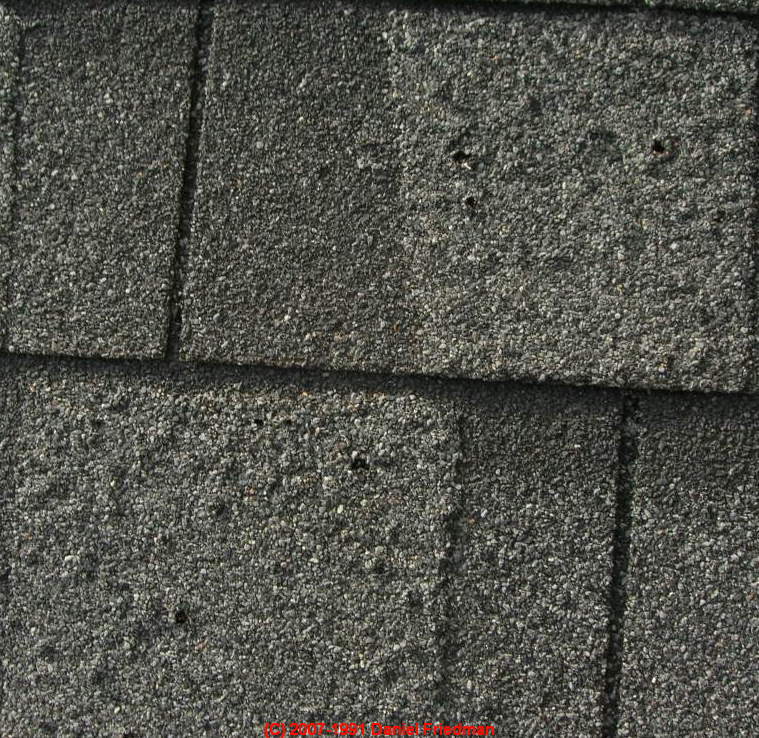
Blisters in shingles or "rash blisters" are a cosmetic defect in the opinion of some roofing manufacturers and an indicator of reduced shingle life in the opinion of some building professionals. In the photo shown here, some blister tops have lost granules and are beginning to expose the shingle interior substrate. The Atlas™ roof shingles shown in our photo are less than one year old.
OPINION: Few roof defects, cosmetic or more serious, have been subject to more arm-waving and speculation than "blister rash".
Yet the science underpinning the understanding of blisters in asphalt shingles, similar to the explanation of solvent blisters in some paint failures, is quite clear, as we explain in this article.
Building professionals, contractors, and homeowners enmeshed in debate and speculation about shingle blister rash can help sort through the claims and blames by resorting to ... well heck: the experts, science, and physical evidence - sources of data that underpin all good building science and investigation.
Notice: while Atlas roof shingles are used to illustrate some of this discussion of shingle blister rash, we emphasize that this phenomenon is by no means endemic to one specific roof manufacturer.
Rash blistering considered cosmetic: Atlas roofing has offered reassurance to their customers by indicating that rash blistering is an aesthetic characteristic only.
Atlas roofing does not classify blistering as a manufacturing defect. The company has said that rash blistering will not affect the intended performance or life of the shingles and that the shingle warranty will not be affected.
Shingle blistering as a roof defect: although the Atlas view is reassuring, based on field observation and experience (and visible in beginning stages in the photo of an Atlas™ roof shingle above), we've seen early granule loss at the blister site. So at least on some roof shingles, rash blisters may indeed be an indication of a reduced-life expectancy.
Some roof inspectors, home inspectors and roofing contractors have observed a shingle wear pattern characteristic of granule loss at the shingle blister sites. Mineral granules at the raised portion of each rash blister can wear off from weather or foot traffic, becoming pits which expose the underlying shingle substrate.
Exposed granule-loss pits on roof shingles increase moisture absorption into the shingle body and in cold climates increase in wear rate from frost. This becomes more apparent when inspecting an older pitted asphalt roof shingle.
Causes of Shingle Blisters & Blister Rash on Asphalt Roof Products
Details about the cause of asphalt shingle blister rash or roll roofing blisters along with authoritative citations are found
at ASPHALT SHINGLE BLISTER RASH CAUSE . Excerpts are here.
Rash blisters on asphalt shingles result from the manufacturing process, (and may be cosmetic or possibly a more serious defect) which are sometimes mistaken for hail damage or other types of asphalt shingle roof wear or damage indicators.
The most likely causes of asphalt shingle blisters or "blister rash" visible in product right from the factory is the expansion in gas form of either moisture trapped in the shingle substrate at the time of manufacture or gases from volatile organics or resins used in the shingle construction. Either of these can produce trapped gas bubbles as the shingles are exposed to high temperatures during production.
Shingle blisters might be caused as well by excessive use of roofing mastic or additional adhesives that are applied during or after roof installation. A warning to this effect issued by GAF Materials Corporation is found
In such a case of adhesive-caused blister rash, the blisters ought to appear in a pattern that matches the blobs of adhesive, not in the regular pattern such as shown in our photo at above left (click to enlarge).
Is Asphalt Shingle Blister Rash More than a Cosmetic Concern? Is Roof Life Affected?
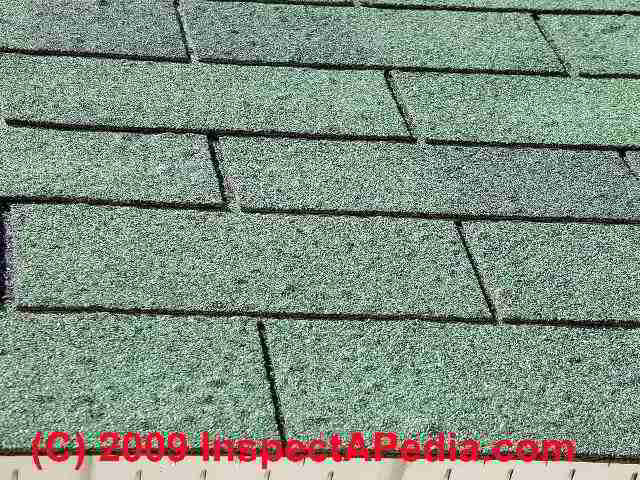
This asphalt roof shingle blister pattern is classic "cosmetic shingle blistering" by usual manufacturer description.
Reader Marcia Reid provided these photographs of blisters on an 8 1/2 year old IKO Asphalt shingle roof in Saskatoon, Saskatchewan, Canada. The shingle manufacturer's local representative opined that the blisters were due to tree overhang debris or bird droppings.
What the rep told the owner sounded silly to everyone else: the blistering pattern is just too uniform to be due to a tree or droppings.
Besides, as this shingle blister rash photo shows, we don't have much in the way of overhanging tree branches at this home.
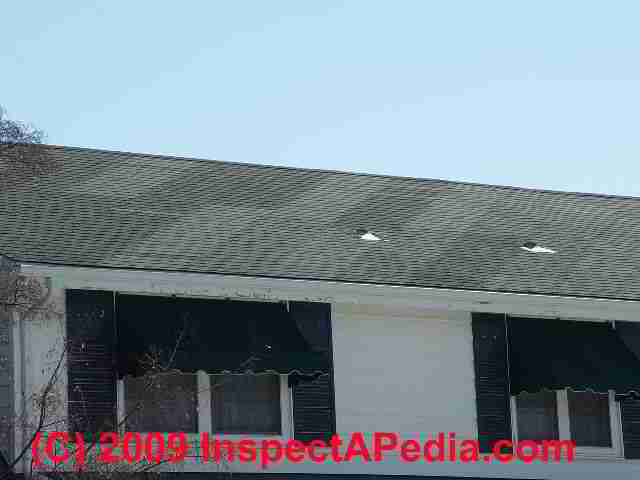
It is true that we do indeed look at differences in shingle exposure (sun vs shade for example) to explain differences in roof wear. The owner reports that the blistering appears only on the rear slope of the home.
We speculated that the blistering shingles were from a common pallet of shingle bundles, perhaps a different one from those used on the front slope.
Unfortunately, on some roofing shingles asphalt shingle bumps or blisters that may appear early in the life of the product or may even be present when the bundle is unwrapped sometimes convert into wear pits when the tops of each blister give up their mineral granules to the weathering process before the remaining area of the shingle. Our photo above shows the beginning of this process.
Each asphalt shingle blister that becomes an asphalt shingle "pit" has exposed the asphalt substrate or mat of the shingle. Where the protective mineral granules are lost from roof shingles wear accelerates and the remaining life of the product shortens at an increasing rate as the shingle begins to absorb water and suffer more in freeze-thaw cycles than before.
This IKO® shingle (photo, above left), (in April 2009) at about 8 1/2 years old, was about 1/3 through the rated life of a 25-year shingle.
But if pits and exposure of the shingle substrate appear soon, then the remaining life of this asphalt shingle roof may be less than the rated period. Otherwise, indeed this will have proven to be only a cosmetic concern. We will include future roof condition reports here.
The two photographs of shingle blister rash shown below were provided by reader Jim Todd, a homeowner who commented that both blisters and pitting (where the blister top has ruptured) on these four year old Atlas Chalet™asphalt roof shingles.
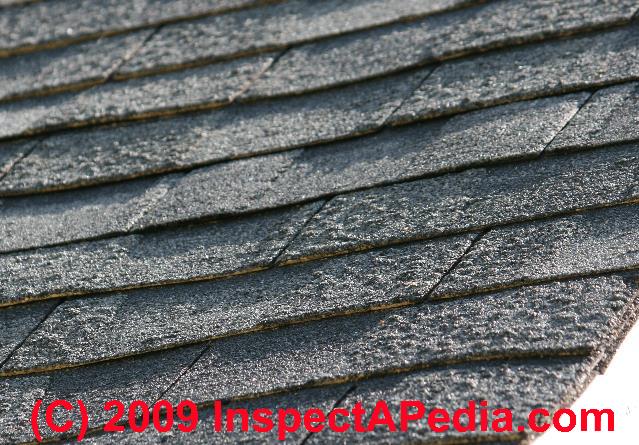
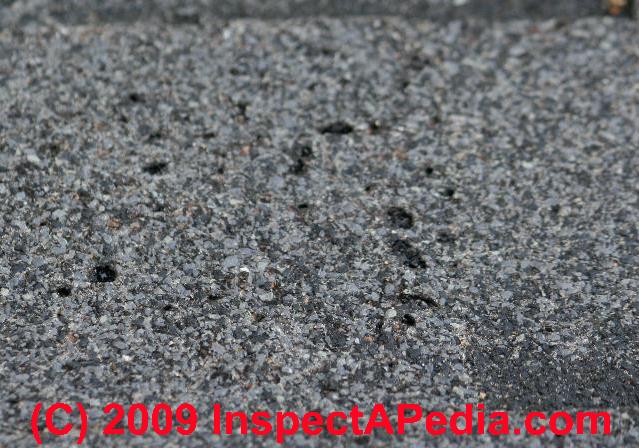
At left, oblique sunlight shows blister rash on these asphalt Atlas brand roof shingles. The photo at above right provides a closeup of ruptured shingle blisters, exposing the asphalt shingle mat substrate. Mr. Todd described this blistering pattern as common on several hundred roofs that he has observed, located in Statham Georgia. Close ups of the photo at right are also found
at HAIL DAMAGED SHINGLES & OTHER ROOF COVERINGS.
Atlas roofing is to be commended for attention client satisfaction: While the reader above reported dissatisfaction with Atlas, in an earlier client letter from Atlas to a concerned homeowner the company and provided to us by that homeowner, Atlas also stated that "in the unlikely event that the rash blistering should negatively affect the intended shingle performance regarding weather protection of the roof, please contact Atlas and we will further evaluate the roof."
So is it aesthetic or not?
Perhaps the company is saying "time will tell, But we will stand behind our product warranty."
See ROOFING WARRANTIES for general comments on that topic.
Just how much shingle life reduction can be attributed to rash blistering will doubtless remain a debated topic since many factors enter into asphalt shingle life (sun orientation, weather exposure, shingle color, roof slope, nailing, venting, and material quality). OPINION-DF: we figure that the rated life of the shingle is going to be reduced by 5% to 15% based on field observations.
How to Distinguish Hail Damage from Asphalt Shingle Blister Damage - relationship of hail to blister damage on roofs
Reader Question: could hail damage to roof shingles lead to later shingle rash or shingle blisters?
Thank you for your web site and all the information you provide!!! I have done some research on hail damage and blistering.
I was wondering if it would be reasonable to suggest that hail damagecould be a cause of blistering? Seems blistering requires some sort of initiating cause such as manufacture defect or moisture.
Some hail damage is quite small, only the removal of few granules and possible underlying asphalt leaving behind a small void. Could moisture then get absorbed into the shingle? And later cause blistering?
See HAIL DAMAGED SHINGLES & OTHER ROOF COVERINGS
I have lived in both AZ and N. TX. Hail occurs more frequently in TX. And, roof in AZ undoubtedly get hotter than in N. TX. But I didn't find that blistering (of asphalt shingles) was much of a problem in AZ. The examples found seem to be in areas which are more prone to hail. So, this is pushing me to believe that hail could be causing the blistering in many cases. What do you think? - B.S.
Reply:
I hadnot thought about hail damage as causing shingle blistering since that is a different phenomenon. But you raise an interesting question about the the relationship between blistered asphalt roof shingles and hail damage. Let's start by stating clearly that hail damage would not and could not cause asphalt shingle blistering.
My OPINION supported by technical research cited
at ASPHALT SHINGLE BLISTER RASH CAUSE
has loong been been that blistering or shingle rash starts as a manufacturing artifact, a bumpy shingle surface that is caused by the manufacturing process itself - perhaps the shingle granules are clustered or stuck together, or perhaps there are temperature variations that cause bubbles or just lumps in the asphalt on the shingle substrate to which the granules are applied. But I do not know - and I bet the manufacturers know exactly how this is happening.
There is no doubt that we see blistered or rashed shingles that come out of the bundle, new, from the factory in that condition. And manufacturers generally opine that it's a cosmetic only condition - a viewpoint with which I do not always agree.
What's the Difference Between Hail Damage and Asphalt Shingle Blister Damage?
But you raise the interesting question of whether or not hail impact could cause a more subtle damage to shingles that leads to a second type or source of shingle blistering. We discuss hail damage to roof shingles in detail
at HAIL DAMAGED SHINGLES & OTHER ROOF COVERINGS.
That explanation doesn't match with the close-up examination I've made of some hail damaged roofs on which I saw that granules are dislodged or scoured off of the shingle surface. But I grant that an impact that leaves granules in place could have the more subtle effect you suggest: a loosening or opening of the granule surface to allow water and perhaps freezing impact on the shingle surface.
To investigate the question in a more credible and scholarly way would involve at least dissecting some hail impacted asphalt roof shingles. We'd cut the shingle in cross section and make microscopic examination of the cross section for visual evidence of changes in the material - as a start.
Even more subtle effects of hail impact on the adhesive properties of the shingle surface, adhering granules to the asphalt substrate, could be present and would require a more technical, perhaps chemical analysis to observe.
Frankly I don't think the hail as previously un-recognized source of shingle blisters explanation sounds at all likely. Blisters are formed in an asphalt shingle by trapped gas bubbles in a very hot substrate. Conversely, there is sufficient (size, mass, velocity, angle of impact) hail damage to an asphalt shingle roof that was already blistered, I would expect the blisters to play a role in the subsequent hail damage or roof wear that would be observed.
But it's worth taking a closer look at your hypothesis by examining some representative shingles microscopically and by asking shingle manufacturers for their opinion.
Significantly, on an already blistered roof shingle, it is plausible that subsequent exposure to hail might indeed cause the blisters on the asphalt shingle to open. So in addition to the roof shingle granule loss caused by hail storms we might find open pits where mineral granules were lost more at the raised blister tops on a shingle than on the flatter and better-adhered shingle surface areas.
Question: Class Action Lawsuit vs Atlas regarding Blister Damage on Atlas Storm Master® Shake Shingles?
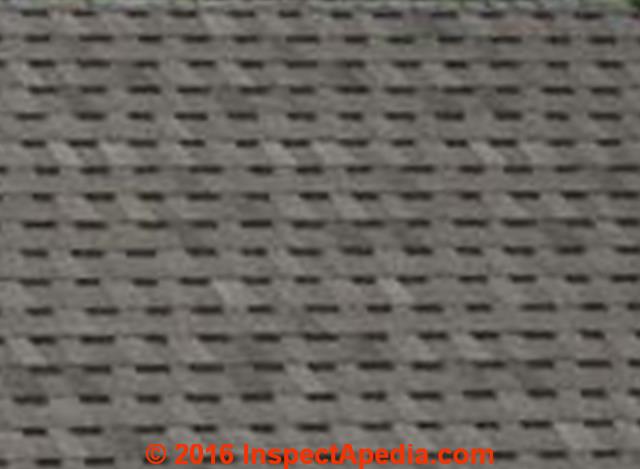 2016/08/12 Charlene Cogdill said:
Is there a Class Action Law Suit against Atlas Storm Master Shake shingles? I bought mine in 2011 and now they are blistering and no one is willing to take care of the problem. They are Class 4. What can I do?
This question was posted originally at WARRANTIES for ROOF SHINGLES
[Click to enlarge any image] Shown here: Atlas StormMaster® Shake "high wind and impact resistant" asphalt roof shingles, in hearthstone gray color. - sources cited below
Reply: manufacturers generally consider shingle blisters as not a defect and not warranted
Charlene (and for other readers)
Atlas Storm Mater Shake Shingles are an laminate-style asphalt roof shingle colored and shaded to resemble (somewhat) wood shake roofing. The shingle sport copper-coated mineral granules intended to improve algae resistance and the shingles are described as having impact resistance, perhaps improving resistance to hail damage.
Blistering on asphalt shingles (or roll roofing) is discussed in detail beginning at
at BLISTERS on ASPHALT SHINGLES found by searching InspectApedia for SHINGLE BLISTERS and the cause of asphalt shingle blister rash is explained
at ASPHALT SHINGLE BLISTER RASH CAUSE
There you'll read that manufacturers describe shingle blisters as a generally unimportant cosmetic feature on some roofing shingles that may be an artifact of the manufacturing process, one that is more visible in oblique lighting. There you'll also read that in my experience and that of some other inspectors and roofers, a cosmetic "defect" (that is not likely to be covered by any shingle warranty ) can quickly convert to a wear feature, particularly following a hailstorm or foot traffic in hot weather. Either of those situations can cause mineral granules to be lost from the tops of the blisters, exposing the shingle substrate.
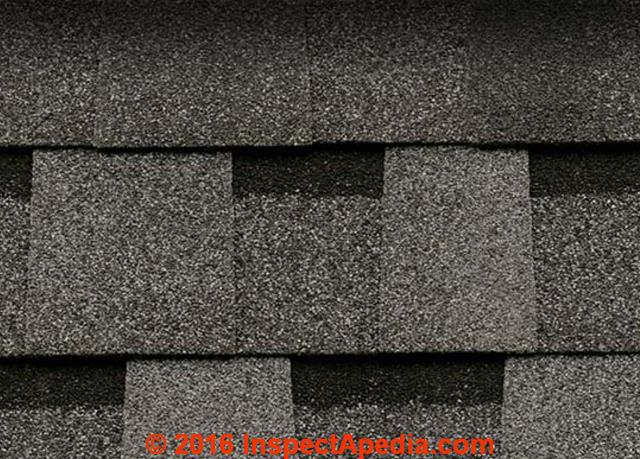 Regarding the subsequent "appearance"of blistering on asphalt shingles, that's doubtful as shingle blisters are normally an artifact of the manufacuring process. More likely either a homeowner never noticed the blisters until seen under specific lighting conditions, OR never noticed them until the blisters converted into craters or wear/damage on the shingle surface.
Shingle cracking, on the other hand, is a wear condition that develops over time as a result of the combination of shingle construction, materials, installation, weather exposure and perhaps other conditions.
When that has occurred, although the result is not immediate roof leakage, it is reasonable to argue that the remaining life of the roof shingles has been reduced: once we lose the protective granules on a shingle surface it becomes increasingly permeable and the rate at which water, sun, weather age the shingle increases.
Class 4 rated shingles are defined as most-resistant to damage. Here is what Atlas says about their impact-resistant shingles:
To get a better idea of their stability, it’s good to know that shingles are ranked into four classes based on their strength and overall durability. Class 1 is the least durable and Class 4 is the most resistant to damage.
With this clarification, homeowners can have peace of mind as all StormMaster impact resistant shingles are defined by Class 4 certification as they uphold the highest standards when it comes to protecting a home.
Keep in mind, Class 4 shingles are not only important from a protection standpoint, impact resistant shingles also lend their value to curb appeal by preserving the integrity of the roof’s looks as well. - 2016/08/12 source: www.atlasroofing.com/impact-resistant-shingles
Without more historic data and careful field inspections and photo-illustrated reports, we do not know and won't know how blistering - a cosmetic feature that can convert to a wear and damage feature - will convert to wear and damage during the life of this specific product: Atlas's Class 4 shingles. In sum, while shingle blisters can convert to wear and damage, on a more-durable shingle the rate of that conversion remains to be discovered.
There have been class action litigation reports concerning a different Atlas shingle, a 3-tab asphalt shingle: Atlas Chalet Shingles.
Among others, law firm Parker Waichman LLP have filed a lawsuit, though my reading of the firm's description finds that they seem to confound shingle blistering and shingle cracking - two different shingle wear and damage phenomenon whose causes and effects may also differ. It's interesting that company's website quotes our own InspectApedia article on shingle blisters. - 2016/08/12, source: www.yourlawyer.com/topics/overview/atlas-chalet-shingles-class-action-lawsuit.
On December 19, 2013, after several lawsuits were filed against Atlas around the country, the Judicial Panel on Multi-district Litigation (JPML) ordered that all lawsuits against Atlas involving Atlas Chalet shingles be consolidated in federal court in Atlanta, GA before the Honorable Thomas W. Thrash, Jr. (Judge Thrash). Subsequently, the JPML has transferred a case filed in Florida regarding Atlas Stratford shingles to Judge Thrash as well. In other words, no matter what state you live in, any lawsuit filed against Atlas in federal court involving Atlas Chalet and Stratford shingles will likely be handled in Atlanta, Georgia. - retrieved 2016/08/12 original source http://www.atlas-information.com/
According to Atlas, the company's Stormmaster Shake (asphalt shingles) can include
- A limited lifetime warranty against manufacturing defects. Note that the shingle manufacturers do not consider shingle blister rash a manufacturing defect and eligibility for additional warranty coverage under Atlas' Signature Select program (adding ice and water shield underlayment and premkium underlayment, special starter shingles and hip and ridge shingles). .
- A 130 mph limited wind damage warranty
- Class 4 impact resistance (may qualify for a homeowners insurance discount regarding hail damage)
- Scotchgard protection - a waterproofing treatment that is designed to reduce algae stains on roof surfaces, in my OPINION probably of limited effectiveness as such treatments generally are not permanent - source: Atlas Roofing, retrieved 2016/08/12 original source: https://www.atlasroofing.com/roof-shingles/stormmaster-shake
Take a close look at the terms of your shingle warranty, and review our warnings regarding WARRANTIES for ROOF SHINGLES
What you should do about your asphalt shingle blistering concern
- Keep people off of the roof surface. Walking on a blistered-asphalt shingle surface, particularly in hot weather, can cause serious damage to the shingles by scraping off the tops of the blisters.
- Document the roof condition as it is right now (as I detail in step 4)
- Inspect and document its condition annually so that you have a record of roof shingle condition and wear during its life; that may be useful if a future warranty claim is justified.
- Send us photographs for comment: Use our page top or bottom CONTACT link to send me some sharp photos of the shingle blisters or other damage about which you have questions concerning your specific roof and we should be able to comment further.
Photos of asphalt shingle blistering will show up best when lit from light at a low angle, or in early morning or later afternoon. Close-up sharp photos are particlularly helpful. I'd also want to know if you are seeing differences in the pattern or occurrence of blistering or other damage varying by individual roof slope or different areas on your roof. - See: ASPHALT SHINGLE BLISTERED ROOF LIFE EXTENSION
How to Extend the Life of an Asphalt Roof with Shingle Blisters or Shingle Rash
OPINION: you may be able to extend the life of any asphalt roof, including one that has shingle blisters or rash by
- Keep foot traffic on the roof to a minimum. Walking on shingles in hot weather when they are soft easily damages them, especially if you "turn" with weight on your shoe, twisting the shingle surface. Walking on shingles that are blistered, cupped, or curled, or simply brittle with age is likely to damage them.
We have tracked the footsteps of some roof inspectors by observing where roof shingle blisters have become wear pits and craters. - Make sure that your roof is properly vented - a cooler roof lasts longer. If your under-roof ventilation is inadequate, correcting those conditions will extend roof life.
See ATTIC CONDENSATION CAUSE & CURE
and ROOF ICE DAM LEAKS. - Proper roof maintenance: in addition to inadequate roof ventilation, repair any roof leaks promptly, keep debris
DEBRIS STAINING ON ROOFS, moss, and lichens off of roofs
and
MOSS & LICHENS on SHINGLES, and inspect your roof annually for damage that may need additional repair. - Proper roof installation: once your roof has been installed it's a bit late to "make sure that the roof was installed according to the manufacturer's specifications as well as industry best practices such as nailing pattern and location, proper fasteners, sound roof decking, and shingle layout pattern. Next time.
- Document the roof condition: while documentation itself will, of course, not do a thing for the life of your roof, you should document the roof's status as we describe
at ASPHALT SHINGLE BLISTER DAMAGE LAWSUIT?
Reader Comments, Questions & Answers About The Article Above
Below you will find questions and answers previously posted on this page at its page bottom reader comment box.
Reader Q&A - also see RECOMMENDED ARTICLES & FAQs
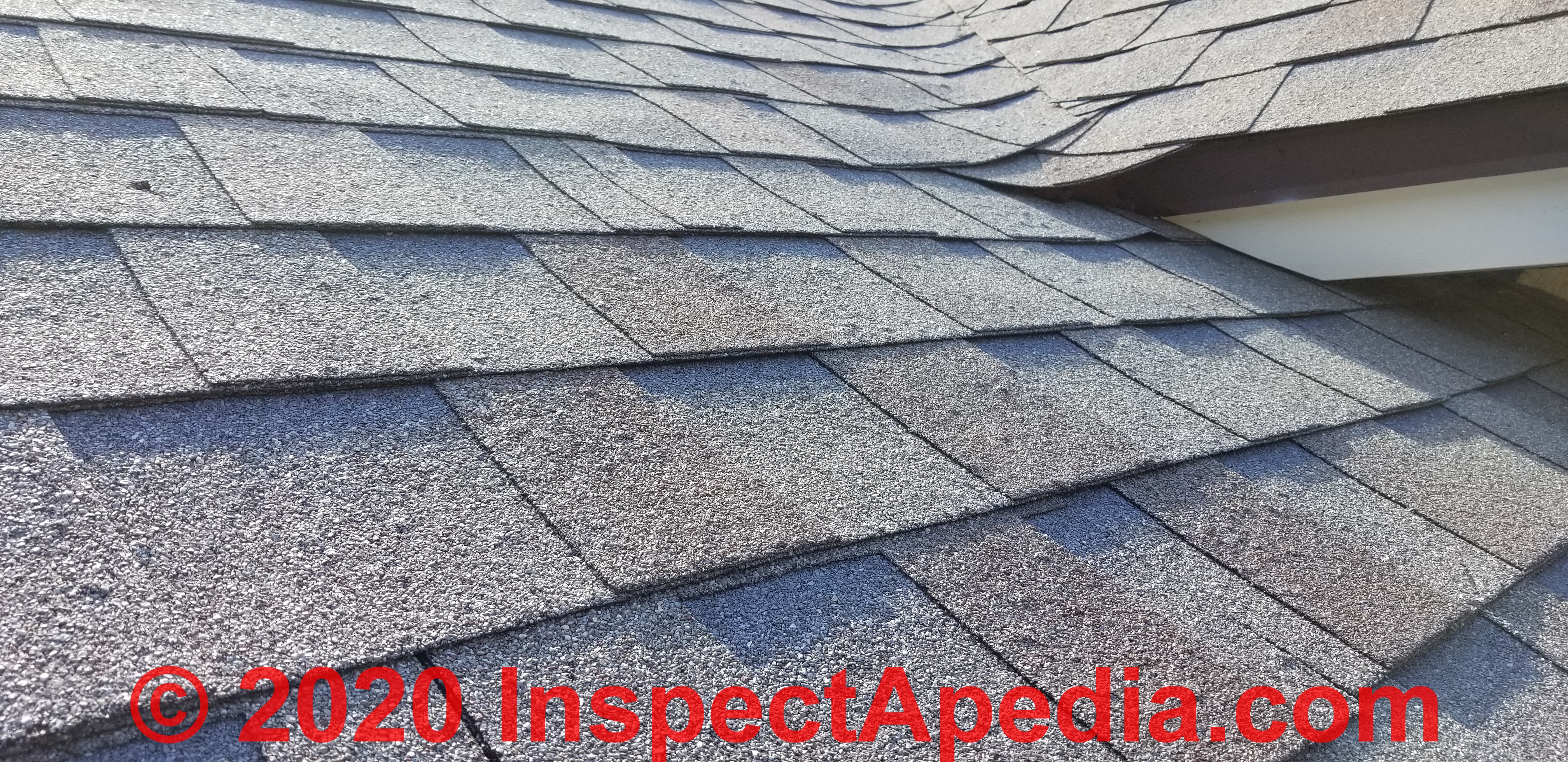
Comment: "This is not what I paid for" - "Cosmetic Breakdown" of Atlas Storm Master Shake 42-inch shingles
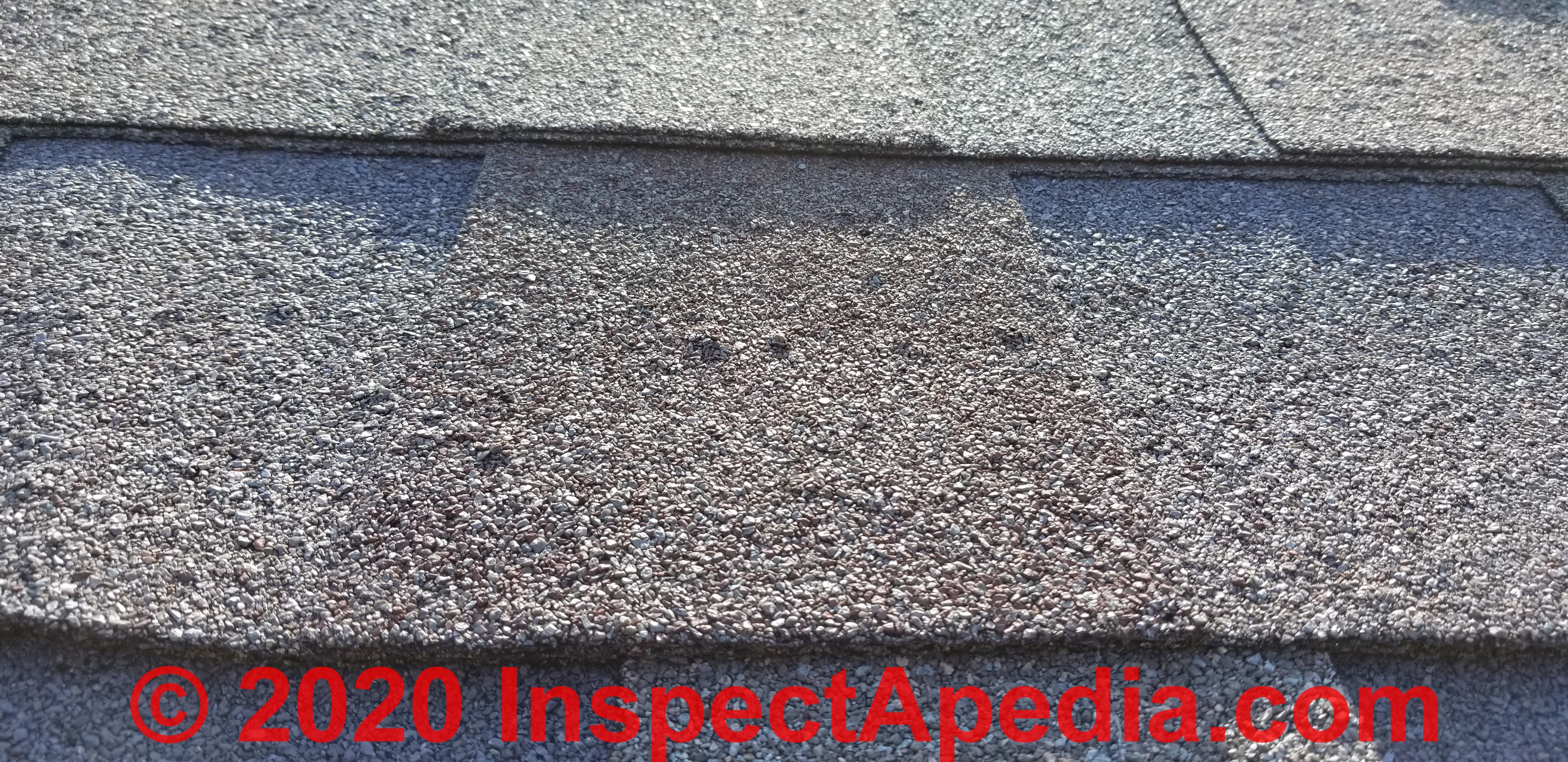
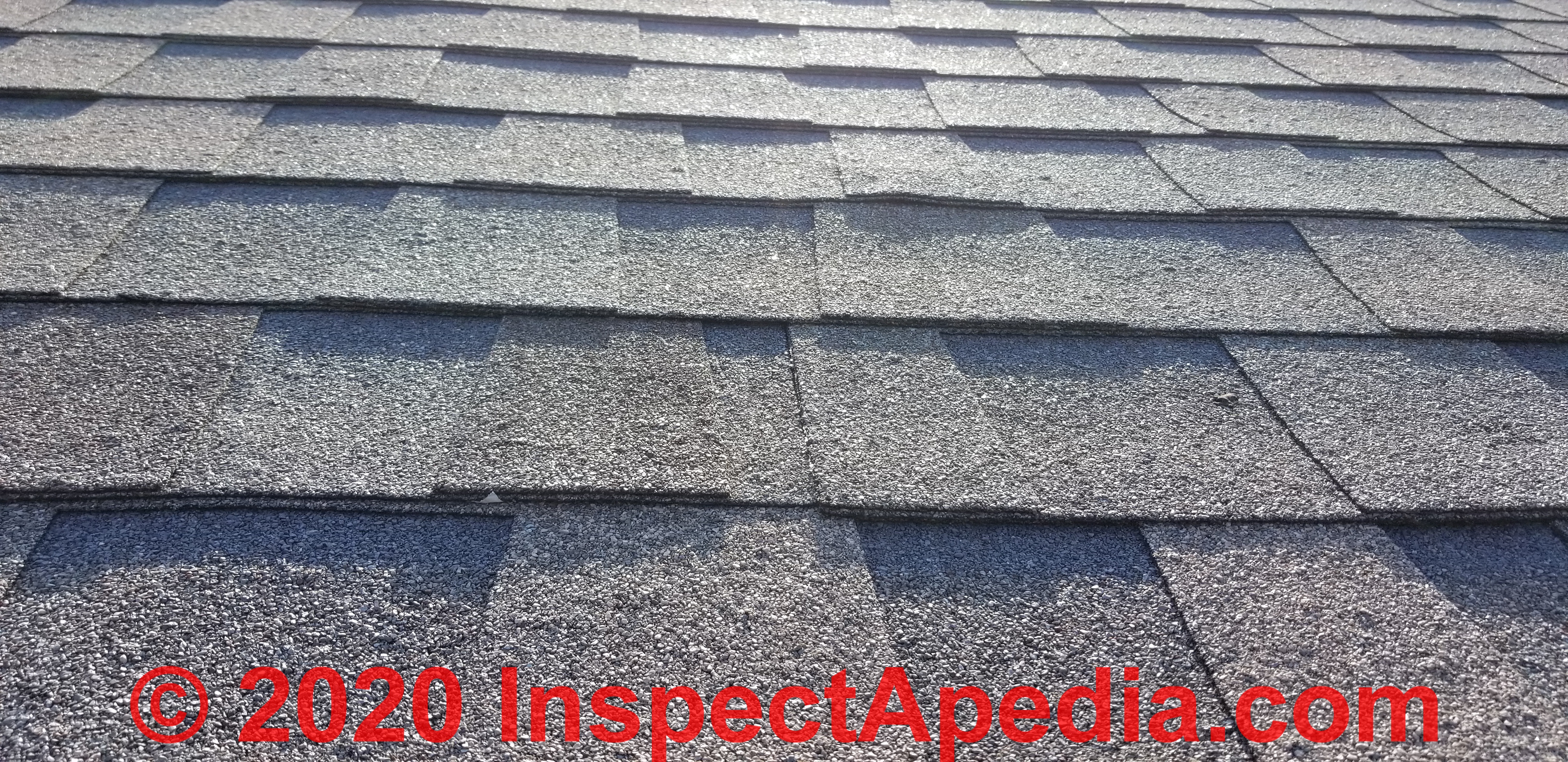
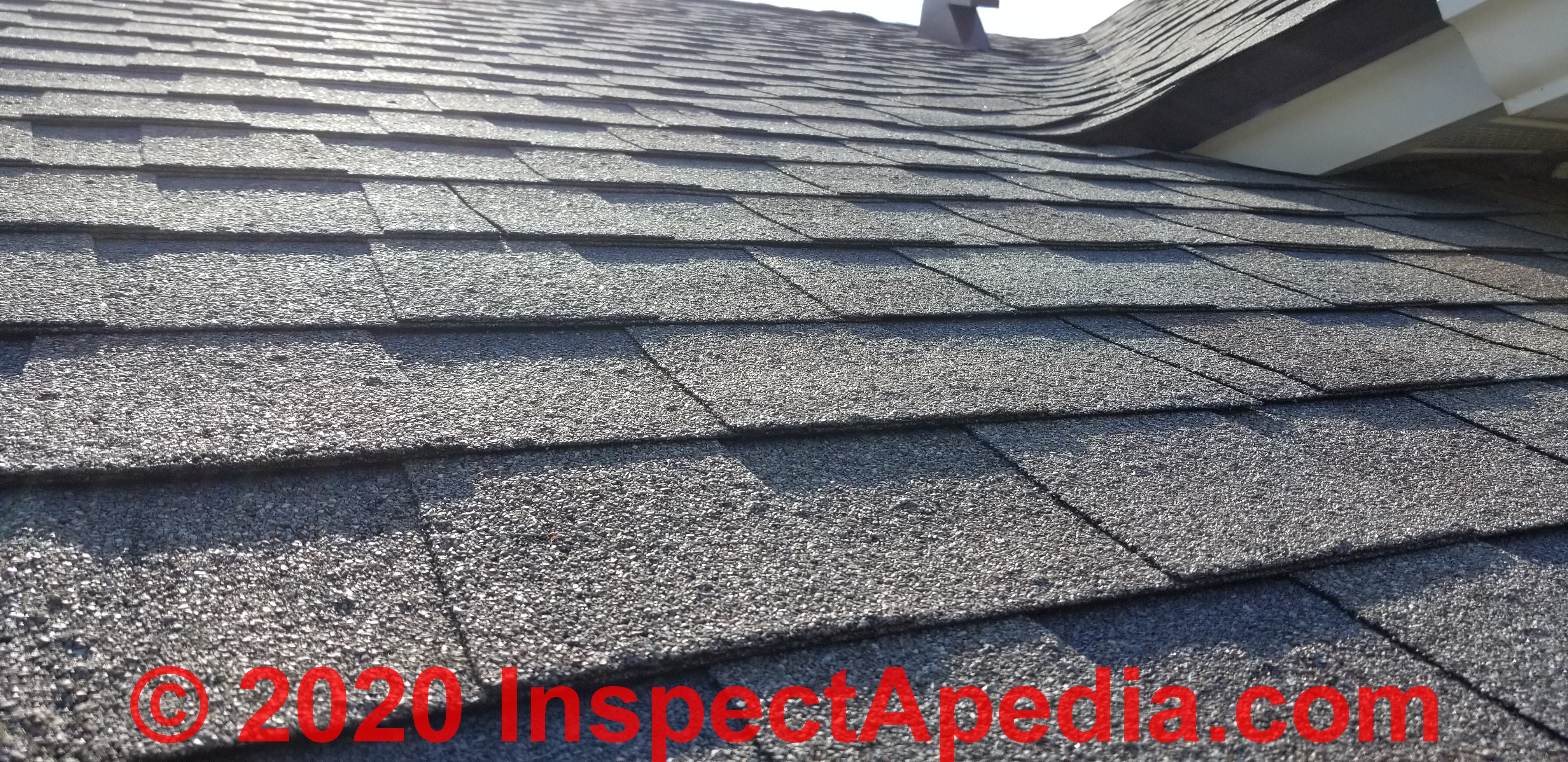 I had Atlas Storm Master Shake 42 inch shingles installed in 2018. They appear to be Blistering.
[Click to enlarge any image]
I have ridge vents. Ironically,it is worse on a side of the roof that doesn't get as much Florida Sun.
As your website mentioned,it could be a manufacturing defect,and some batches of shingles might be worse than others.This could explain why one area is worse than others...Here are a few pictures taken on 6/17/2020..I will be taking pictures as you suggested to document the condition over time.
Also,I was inspecting the roof as little as 1 month ago and didn't see the Blisters.Then all of a sudden,they appeared recently. It has not been brutal hot,but instead it has been raining a lot..I will monitor it as I said. Just let me know if you want more pictures.
I will be selling the house in about a year,so not going to bother with another claim..Also I read the blistering isn't just one particular company..I was wondering if it could be a Class 4 Shingle thing,because they are so much thicker with more chemicals/etc.
 ...
...  ...
...
I do agree that this will be a cosmetic issue more than anything else..HOWEVER,I chose this color/style for appearance reasons.There is NO mention that Blistering could occur..EVER.
This would be like buying a new Red car, but then after 2 years the paint fades to Purple, yes the paint is still doing its job,but that's NOT what you paid for.If you buy a red car,you expect it to remain red,especially within the first few years.
So then,someone needs to file a claim against them based on product failure failure of it to maintain appearance/style/intended design looks. The difference between Mr Jekyl and Mr Hide.
Cosmetic Break Down,that's how I'm labeling this.
Moderator reply:
Thank you for the photos and comments on blistering on your shingles.
I have not seen this defect confined to any one manufacturer nor any one shingle thickness or design. I suspect it's an artifact of variations in the manufacturing process where temperature, speed, asphalt mix, etc. are variables.
You want to keep foot traffic to a minimum, especially on hot days, as you don't want to scuff off the blister tops. As long as they're closed the manufacturer will insist it's only a cosmetic condition.
As you saw in the article onthe page above, my opinion is a bit different.
...
Continue reading at ASPHALT SHINGLE BLISTER RASH CAUSE or select a topic from the closely-related articles below, or see the complete ARTICLE INDEX.
Or see these
Recommended Articles
- ASPHALT SHINGLE FAILURE TYPES
- ASPHALT SHINGLE LIFE / WEAR FACTORS
- ASPHALT SHINGLES on LOW SLOPE ROOFS
- GRANULE LOSS from SHINGLES
- SHINGLE HAIL DAMAGE vs SHINGLE BLISTER RASH
- SHINGLE HAIL DAMAGE REPLICATION
- SHINGLE HAIL DAMAGE CHALK MARKING CODES
- SHINGLE HAIL DAMAGE RESISTANT PRODUCTS
- WARRANTIES for ROOF SHINGLES
Suggested citation for this web page
BLISTERS on ASPHALT SHINGLES at InspectApedia.com - online encyclopedia of building & environmental inspection, testing, diagnosis, repair, & problem prevention advice.
Or see this
INDEX to RELATED ARTICLES: ARTICLE INDEX to BUILDING ROOFING
Or use the SEARCH BOX found below to Ask a Question or Search InspectApedia
Ask a Question or Search InspectApedia
Try the search box just below, or if you prefer, post a question or comment in the Comments box below and we will respond promptly.
Search the InspectApedia website
Note: appearance of your Comment below may be delayed: if your comment contains an image, photograph, web link, or text that looks to the software as if it might be a web link, your posting will appear after it has been approved by a moderator. Apologies for the delay.
Only one image can be added per comment but you can post as many comments, and therefore images, as you like.
You will not receive a notification when a response to your question has been posted.
Please bookmark this page to make it easy for you to check back for our response.
Our Comment Box is provided by Countable Web Productions countable.ca
Citations & References
In addition to any citations in the article above, a full list is available on request.
- Cash, Carl G., and Frank W. Kan. "Finite Element Analysis of Racked vs. Traditionally Applied Three Tab, Seal Tab, Strip Shingles, and Blister Tests for Asphalt-Glass Felt Shingles." ASTM SPECIAL TECHNICAL PUBLICATION 1349 (1999): 123-131.
- McNulty, Raymond A. "COMPOSITION, PERFORMANCE, FUNCTION, AND STANDARDS." Interface (2000). [http://www.rci-online.org/interface/2000-01-mcnulty.pdf]
- Petty, Stephen E. "Attic and Crawlspace Ventilation." Forensic Engineering: Damage Assessments for Residential and Commercial Structures (2013): 437.
- Marcia Reid generously shared her photographs of IKO roof shingle blistering 4/8/2009. Ms. Reed lives in Saskatoon, Saskatchewan.
- Jim Todd, provided photographs and description of shingle blister rash on a four year old Atlas Chalet™ shingle roof. 9 July 2009.
- Low Slope Roofing, Manual of, 4th Ed., C.W. Griffin, Richard Fricklas,
McGraw-Hill Professional; 4 edition, 2006, ISBN-10: 007145828X, ISBN-13: 978-0071458283
- Roof failure causes in depth (and specific methods for avoiding them)
- Roof design fundamentals and flourishes, based on voluminous industry research and experience
- New technologies and materials -- using them safely and correctly
- Comprehensive coverage of all major roofing systems pecifications, inspection, and maintenance tools for roofing work
- Problems in Roofing Design, B. Harrison McCampbell, Butterworth Heineman, 1991 ISBN 0-7506-9162-X (available used)
- Roofing The Right Way, Steven Bolt, McGraw-Hill Professional; 3rd Ed (1996), ISBN-10: 0070066507, ISBN-13: 978-0070066502
- Smart Guide: Roofing: Step-by-Step Projects, Creative Homeowner (Ed), 2004, ISBN-10: 1580111491, ISBN-13: 978-1580111492
- Asphalt Roofing Residential Manual from ARMA the Asphalt Roofing Manufacturers Association Website https://www.asphaltroofing.org/product/residential-asphalt-roofing-manual/ ,
- Building Pathology, Deterioration, Diagnostics, and Intervention, Samuel Y. Harris, P.E., AIA, Esq., ISBN 0-471-33172-4, John Wiley & Sons, 2001 [General building science-DF] ISBN-10: 0471331724 ISBN-13: 978-0471331728
- Building Pathology: Principles and Practice, David Watt, Wiley-Blackwell; 2 edition (March 7, 2008) ISBN-10: 1405161035 ISBN-13: 978-1405161039
- Our recommended books about building & mechanical systems design, inspection, problem diagnosis, and repair, and about indoor environment and IAQ testing, diagnosis, and cleanup are at the InspectAPedia Bookstore. Also see our Book Reviews - InspectAPedia.
- Historic Preservation Technology: A Primer, Robert A. Young, Wiley (March 21, 2008) ISBN-10: 0471788368 ISBN-13: 978-0471788362
- In addition to citations & references found in this article, see the research citations given at the end of the related articles found at our suggested
CONTINUE READING or RECOMMENDED ARTICLES.
- Carson, Dunlop & Associates Ltd., 120 Carlton Street Suite 407, Toronto ON M5A 4K2. Tel: (416) 964-9415 1-800-268-7070 Email: info@carsondunlop.com. Alan Carson is a past president of ASHI, the American Society of Home Inspectors.
Thanks to Alan Carson and Bob Dunlop, for permission for InspectAPedia to use text excerpts from The HOME REFERENCE BOOK - the Encyclopedia of Homes and to use illustrations from The ILLUSTRATED HOME .
Carson Dunlop Associates provides extensive home inspection education and report writing material. In gratitude we provide links to tsome Carson Dunlop Associates products and services.
 | HOME | ABOUT | ASK a QUESTION | CONTACT | CONTENT USE POLICY | DESCRIPTION | POLICIES | PRIVACY | |
| © 2024 - 1985 Publisher InspectApedia.com - Daniel Friedman | |||||||||