
InspectAPedia® FREE Encyclopedia of Building & Environmental Construction, Diagnosis, Maintenance & Repair |
Question? Just ask us! InspectAPedia
|
 Asphalt Roof Shingle Splices as a Roof Defect
- POST a QUESTION or COMMENT about asphalt shingle splices found on roofs
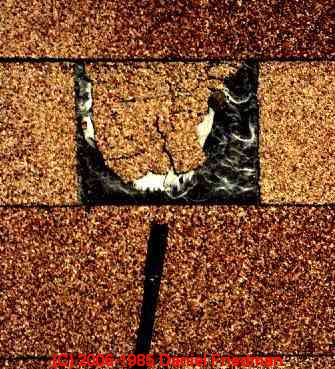
Splice Shingles used to keep material moving during the manufacturing process should be discarded but they almost always end up installed on the roof.
Spliced asphalt shingles are a factory defect - and were not supposed to have been installed. The occurrence of spliced shingles on an asphalt shingle roof will be rare and multiple spliced-shingles quite rare.
This defect is very unlikely to be a substantive roofing defect though if the splice is left un repaired a local leak and related water damage could occur.
InspectAPedia tolerates no conflicts of interest. We have no relationship with advertisers, products, or services discussed at this website.
How to Identify & Repair Splice-Damaged Asphalt Shingle Splices
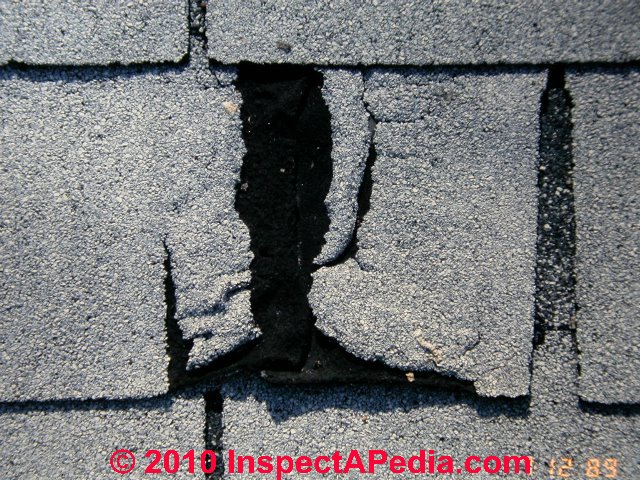
Repair for a Spliced Roof Shingle Failure
Because these shingle wear spots or potential leaks are almost always individual and limited roof defects, we recommend simply replacing the damaged shingle with a new shingle.
Temporary roof repair to prevent roof leaks at a splice-shingle can be made by sliding a piece of metal flashing under the damaged area.
4 Visual Clues Confirm Splice-Shingle Damage on Roofs
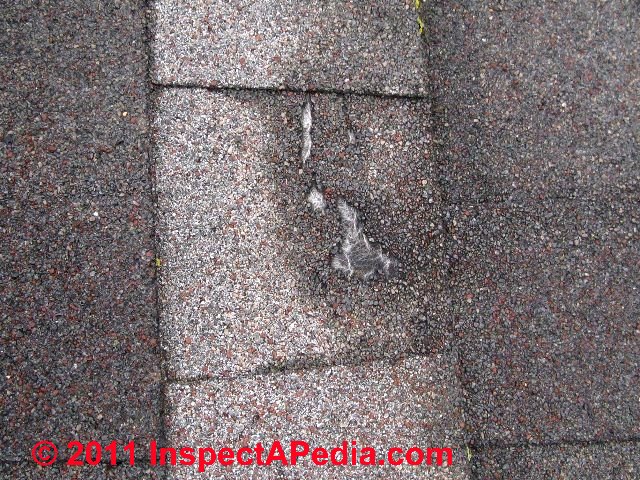
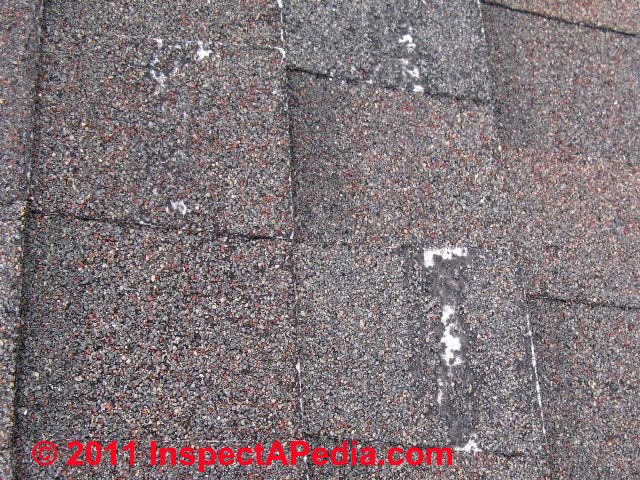
Spliced shingle substrate materials can show up on both organic asphalt shingle roofs (photo above) and fiberglass-based substrate asphalt shingle roofs (photo below).
An individual defective roof shingle such as a splice-shingle (shown above and at below left) is not a significant roof defect - though of course if left unattended and the roof leaks, significant water damage could occur. Therefore, where a spliced roof shingle is observed, repair is needed, but it's unlikely that many "splice shingles" will appear on any individual building roof.
We find a common point of recognition for splice-shingle defects on roofs: they tend to be isolated - just one will appear in the field of most roofs, because not many of these shingles end up in an individual shingle shipment or pallet.
And if you look closely at the damaged shingle you'll see a combination of three visual clues and there may be a fourth hidden clue:
- Granule loss from the shingle, usually extreme
- Tearing or breaks in the shingle,
- Twisting or distortion in the area of shingle tearing
- Isolation: very often a splice shingle defect such as the ones illustrated here occur alone - that is on most (but not all) roofs, this defect occurs alone and the rest of the roof may be in normal condition and may be wearing normally. There are of course exceptions as we describe just below.
- A fourth clue might be visible on the underside or "back" of this shingle: an actual visible material splice line.
Defective Individual Shingles are Independent of But May Accompany More Significant Defects on Shingle Roofs
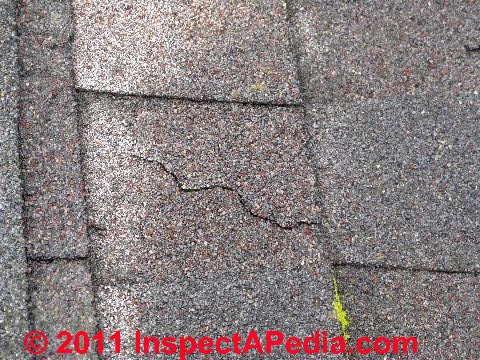
Watch out: a minor individual defective shingle such as a splice unit (above) might also appear on a roof with more serious problems. Below, the picture of thermal splitting or tearing damage to a laminated asphalt shingle roof was provided by ASHI Home inspector Steve Mauer and photographed in 2009.
And at below right you can also see that this unfortunate roof, also suffered from granule loss (below-right) that in our OPINION looked like a defective product.
The same roof also included a damaged shingle that looked like a cracking and granule loss problem combined, but we think this was a shingle splice created at the factory during production - a bad individual shingle that is sometimes created when ends of shingle production substrate are spliced together.
See CRACKS & THERMAL SPLITTING in FIBERGLASS SHINGLES for the shingle problem at left, and see GRANULE LOSS from SHINGLES for the shingle problem at right.
This asphalt shingle roof article series explains how to identify & explain the most-common asphalt roof shingle failures and how to obtain asphalt roofing shingle failure claims assistance. By listing common causes of asphalt roof shingle failures and how to recognize them, building owners and roofing contractors may also be able to reduce the occurrence of asphalt roof shingle storage, handling, and installation errors that affect roof life.
Readers are also invited contribute roof failure information to the web author for research purposes. CONTACT us to contribute photos or ask questions about roof failures.
...
Continue reading at CRACKS & THERMAL SPLITTING in FIBERGLASS SHINGLES or select a topic from the closely-related articles below, or see the complete ARTICLE INDEX.
Or see these
Recommended Articles
- ASPHALT SHINGLE FAILURE TYPES
- GRANULE LOSS from SHINGLES
- ASPHALT SHINGLE LIFE / WEAR FACTORS
- ASPHALT ROOF SHINGLES - topic home, for all articles about asphalt roof shingles
Suggested citation for this web page
SPLICE DEFECTS on ASPHALT SHINGLES at InspectApedia.com - online encyclopedia of building & environmental inspection, testing, diagnosis, repair, & problem prevention advice.
Or see this
INDEX to RELATED ARTICLES: ARTICLE INDEX to BUILDING ROOFING
Or use the SEARCH BOX found below to Ask a Question or Search InspectApedia
Ask a Question or Search InspectApedia
Questions & answers or comments about spliced shingles on asphalt shingle roofs.
Try the search box just below, or if you prefer, post a question or comment in the Comments box below and we will respond promptly.
Search the InspectApedia website
Note: appearance of your Comment below may be delayed: if your comment contains an image, photograph, web link, or text that looks to the software as if it might be a web link, your posting will appear after it has been approved by a moderator. Apologies for the delay.
Only one image can be added per comment but you can post as many comments, and therefore images, as you like.
You will not receive a notification when a response to your question has been posted.
Please bookmark this page to make it easy for you to check back for our response.
Our Comment Box is provided by Countable Web Productions countable.ca
Citations & References
In addition to any citations in the article above, a full list is available on request.
- Best Practices Guide to Residential Construction, by Steven Bliss. John Wiley & Sons, 2006. ISBN-10: 0471648361, ISBN-13: 978-0471648369, Hardcover: 320 pages, available from Amazon.com and also Wiley.com. See our book review of this publication.
- Decks and Porches, the JLC Guide to, Best Practices for Outdoor Spaces, Steve Bliss (Editor), The Journal of Light Construction, Williston VT, 2010 ISBN 10: 1-928580-42-4, ISBN 13: 978-1-928580-42-3, available from Amazon.com
- The Journal of Light Construction has generously given reprint permission to InspectAPedia.com for this article. All rights and contents are ©Journal of Light Construction and may not be reproduced in any form.
- Architectural elements: the technological revolution: Galvanized iron roof plates and corrugated sheets; cast iron facades, columns, door and window caps, ... (American historical catalog collection), Diana S Waite, available used out of Amazon.
- Asphalt Roofing Residential Manual from ARMA the Asphalt Roofing Manufacturers Association Website https://www.asphaltroofing.org/product/residential-asphalt-roofing-manual/ ,
- Building Pathology, Deterioration, Diagnostics, and Intervention, Samuel Y. Harris, P.E., AIA, Esq., ISBN 0-471-33172-4, John Wiley & Sons, 2001 [General building science-DF] ISBN-10: 0471331724 ISBN-13: 978-0471331728
- Building Pathology: Principles and Practice, David Watt, Wiley-Blackwell; 2 edition (March 7, 2008) ISBN-10: 1405161035 ISBN-13: 978-1405161039
- Patio Roofs, how to build, Sunset Books
- Problems in Roofing Design, B. Harrison McCampbell, Butterworth Heineman, 1991 ISBN 0-7506-9162-X (available used)
- Roofing The Right Way, Steven Bolt, McGraw-Hill Professional; 3rd Ed (1996), ISBN-10: 0070066507, ISBN-13: 978-0070066502
- In addition to citations & references found in this article, see the research citations given at the end of the related articles found at our suggested
CONTINUE READING or RECOMMENDED ARTICLES.
- Carson, Dunlop & Associates Ltd., 120 Carlton Street Suite 407, Toronto ON M5A 4K2. Tel: (416) 964-9415 1-800-268-7070 Email: info@carsondunlop.com. Alan Carson is a past president of ASHI, the American Society of Home Inspectors.
Thanks to Alan Carson and Bob Dunlop, for permission for InspectAPedia to use text excerpts from The HOME REFERENCE BOOK - the Encyclopedia of Homes and to use illustrations from The ILLUSTRATED HOME .
Carson Dunlop Associates provides extensive home inspection education and report writing material. In gratitude we provide links to tsome Carson Dunlop Associates products and services.
 | HOME | ABOUT | ASK a QUESTION | CONTACT | CONTENT USE POLICY | DESCRIPTION | POLICIES | PRIVACY | |
| © 2024 - 1985 Publisher InspectApedia.com - Daniel Friedman | |||||||||