
InspectAPedia® FREE Encyclopedia of Building & Environmental Construction, Diagnosis, Maintenance & Repair |
Question? Just ask us! InspectAPedia
|
 Causes of Wear or Leaks in Asphalt Shingle Roofs
- POST a QUESTION or COMMENT about causes of wear or leaks in asphalt shingle roofs
This document describes most of the factors which determine the life expectancy of an asphalt shingle roof - "roofing shingle wear factors". These wear factors affect most asphalt roof shingle types, whether organic felt based or fiberglass fabric based, and whether the shingle type is "cutout" or three-tab, strip-type, or a laminate-type roof shingle.
InspectAPedia tolerates no conflicts of interest. We have no relationship with advertisers, products, or services discussed at this website.
SHINGLE LIFE / WEAR FACTORS for Asphalt Shingle Roofing Products
 This article is part of our series on inspecting, diagnosing, installing and repairing Asphalt Roof Shingles which tells readers how to identify & explain the most-common asphalt roof shingle failures.
[Click to enlarge any photo or image]
By listing common causes of asphalt roof shingle failures and how to recognize them, building owners and roofing contractors may also be able to reduce the occurrence of asphalt roof shingle storage, handling, and installation errors that affect roof life. Readers are also invited contribute roof failure information to the web author for research purposes.
While the historical cost-performance of this product has been good in most cases, durability issues and wear-out or material failures occur earlier than expected in some situations. The expected life of a roof covering depends on many variables including:
- Asphalt Shingle Quality: type, quality, thickness, shingle design (cutout 3-tab versus laminated) and rated or design-life of roofing material selected
- Asphalt Shingle Color: in hot sunny climates lighter colors tend to resist sunlight damage and last longer. See ROOF COLOR RECOMMENDATIONS for details.
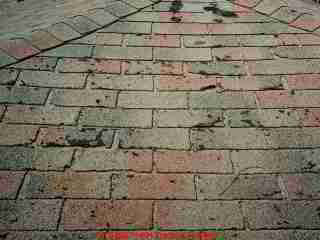
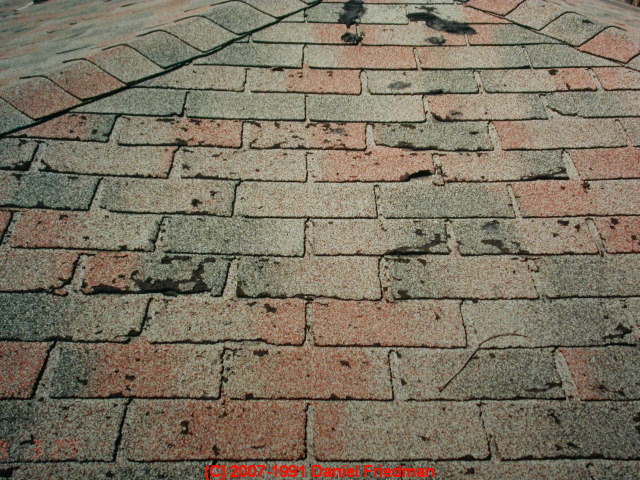
- Roof Shingle Age: the shingles in the photo at the top of this page are organic based asphalt (asphalt-impregnated paper coated with mineral granules) at or near the end of their life. Typical life expectancy for roofing products can vary widely as a function of the material composition, type, installation details, and other factors discussed in depth at this website. Typical shingle life expectancies range from about 15 years to 40 years.

- Roofing material storage conditions
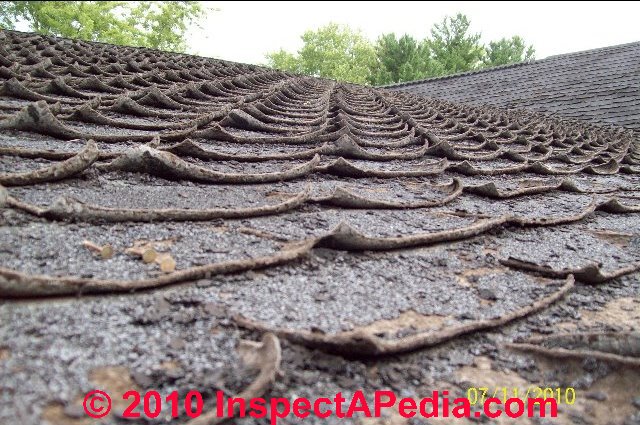
before & during installation can cause early roof failure and leaks and may also violate the roofing manufacturer's warranty.
Our photo at left shows water absorbed and soaked shingles taken from the middle of a pallet of asphalt roof shingles.
[Click to enlarge any image or photo].
At ROOF SHINGLE STORAGE we list the roof shingle storage conditions that affect the future life of the roof:
Building factors affecting asphalt shingle roof life:
- Roof slope: On what degree of roof slope can asphalt shingles be installed?
- According to the National Roofing Contractor's Association (NRCA) and the Asphalt Roofing Manufacturers' Association (ARMA) roofing guidelines, conventional roof shingles should not be used on slopes less than 3 in 12 - that is 3" of rise in 12" of run on a roof slope.
If asphalt roof shingles must be applied on such a low slope, say for aesthetic reasons, they're installed as a cosmetic applause on top of a nailable waterproof membrane, or laminated with courses of sealing membrane between every shingle course (costly and still a bit risky).
We discuss roof slope in detail at
ASPHALT SHINGLE INSTALLATION - Roof problem areas
due to roof shape & building design. Examples are complex roof shapes that make under-roof venting difficult or unfortunate architecture that places obstructions such as a wall or a chimney right in a roof valley, or causes other shapes which interfere with good roof drainage. (Shingles depend on slope and drainage to avoid roof leaks). - Sun exposure: orientation some roof slopes towards sunlight can cause faster wear on those slopes than on shaded roof slopes
- Roof Ventilation: attic or under-roof ventilation. Un-vented roofs, especially in sunny hot climates, stay at a higher surface temperature and can be expected to have a shorter life.
Roof ventilation is discussed in detail at
ROOF VENTILATION SPECIFICATIONS. - Technical material composition
and asphalt shingle design details (roofing material components, manufacturing process, wind-uplift prevention).
We compare types of asphalt shingles at
ASPHALT SHINGLE PROPERTIES - Marketing and economic considerations
(aggressive sale of new roofing material by some contractors, reluctance to or economic reasonableness of patching damaged areas on older roofs) - Manufacturing Defects and Asphalt Shingles:
even the best manufacturers are at risk of episodes of producing a defective product. The asphalt shingle manufacturing line is a challenging environment where variations in control of the process can produce a defective product with a reduced life.
The thermal splitting failure discussed at this website is an example of a widespread fabrication defect that affected many asphalt shingle manufacturers.
See - Mechanical-damage to roof shingles:
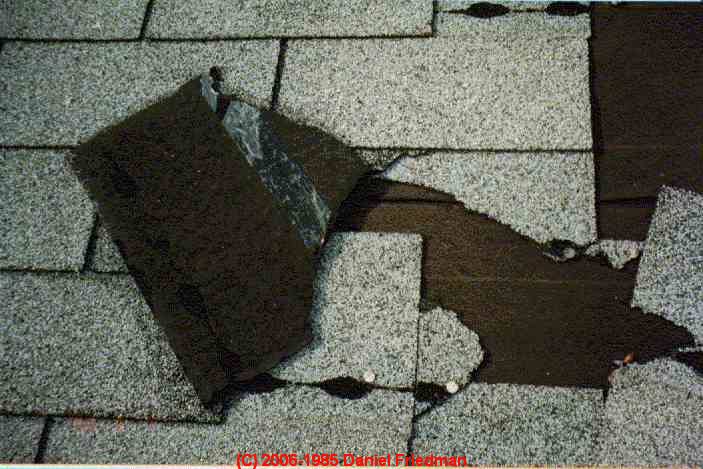
mechanical damage to asphalt roofing results in granule loss, cuts, chips, pits, tears and can result from foot traffic, hail damage, wind damage, ice dam chopping, snow shoveling, falling tree limbs and a variety of other external means. Mechanical damage to shingles may require only spot repairs or it may be so extensive as to require complete roof replacement.
See MECHANICAL DAMAGE of SHINGLES
also
see HAIL DAMAGED SHINGLES & OTHER ROOF COVERINGS
and
see WIND DAMAGE to ROOFS - Weather and Weather Exposure:
variations in climate and other local weather conditions affect roof shingle life  Wind Effects on Roofing: exposure to damage (wind, tree limbs, hail, snow, ice, foot traffic).
Key in wind blow-off of asphalt shingles
is whether or not the shingles were properly installed, especially properly nailed according to the manufacturer's recommendations.
Also on occasion a brand new roof that has not had a chance for its self-sealing adhesive to work may blow off in windy conditions even if it was nailed properly. Review the workmanship defects below as a number of them constitute improper nailing and can cause a wind failure of roofing that may otherwise may be misdiagnosed.
Shingle wind damage details are
at WIND DAMAGE to ROOFS. Roof Installation Workmanship: installation/workmanship details such as the following:
- Nailing of Asphalt Shingles:
asphalt shingle roof nailing errors: improper nailing pattern, omitted nails, too many nails, nails not properly placed in the shingle, and lazy use of the roofing nailing gun: nailing without moving on the roof, leaning out too far, making nails enter the shingle on an angle so that the nail head cuts the shingle; failure to set nails properly (too deep - cuts shingle, too shallow, cuts shingle above).
The older roof nailing guns that used staples required even more careful use of that tool. If the roof shingle staple was driven too deeply it cut the shingle and it would blow off of the roof. If the shingle was left too high or canted (lazy-leaning out too far again) the protruding staple cut the overlapping shingle above.
Shingle nailing details are
at ASPHALT SHINGLE INSTALLATION
Workmanship and roof failures are discussed
at WORKMANSHIP & ROOF DAMAGE
and
at LADDERING vs STAIR STEPPING SHINGLES - Underlayment Effects on Shingle Life:
omitting the roofing underlayment (roofing felt or "tar paper" installed over the roof deck before shingles are applied), installing underlayment or shingles over a wet, icy, or snow-covered roof deck
Roofing underlayment details are
at UNDERLAYMENT REQUIREMENTS on ROOFS - Roof Flashing Errors:
there are too many of these to list on this asphalt shingle page. Water runs down hill. Flashing installers sometimes forget that, misplacing flashing, omitting flashing, using continuous rather than step flashing at roof-wall abutments and at chimneys, improper valley flashing, nails through flashing, relying on roof cement rather than flashing, and misplacement of drip edge with its vertical section behind rather than over gutters.
OPINION: some roofers opine that underlayment is completely unnecessary. I go with the manufacturer's recommendations. They have a high interest in the successful application of their product.
See these roof flashing articles: - FLASHING, ASPHALT SHINGLE VALLEYS
- FLASHING MEMBRANES PEEL & STICK
- FLASHING for METAL ROOFS
- FLASHING ROOF WALL DETAILS
- FLASHING ROOF-WALL SNAFU FLASHING SIDING DETAILS
- FLASHING WALL DETAILS
- FLASHING WINDOW DETAILS
- FLASHING WOOD ROOF DETAILS

Effects of Climate On Asphalt Shingles:
Carl Cash asserts that the mean durability of
"20-year" shingles is less than 20 years everywhere in the U.S. except Alaska.
Variations in climate
permit calculation of a wear-acceleration factor for various cities. Higher
thermal load (hotter climates) means shorter life. Yuma, AZ mean durability
was calculated at 12.6 years, for example, and Ft. Meyer FL 14.1 years while
Chicago at 19.7 years and Erie, PA at 20.7 years showed longer life in cooler
climates.
Cost Effectiveness of Asphalt Shingles:
Other roofing materials also are affected by thermal loading. Cash calculates that the life cycle cost of steep-slope roofing shows that asphalt shingles still provide the most economical performance for the home owner! ("Asphalt Shingle Performance," - - Carl Cash.)
Given these variables, it is not likely that a "20-year" shingle will expire exactly twenty years after it is installed. When a roof lasts longer than its promised life no one complains. If a roof needs replacement substantially sooner than its anticipated life, consumers are understandably concerned.
Asphalt Roof Shingle Wear Factors Research Citations
- Also see key citations found at the end of this article atReferences or Citations
- Bailey, David M. Roofer: Steep Roofing Inventory Procedures and Inspection and Distress Manual for Asphalt Shingle Roofs. No. CERL-TR-99/100. CONSTRUCTION ENGINEERING RESEARCH LAB (ARMY) CHAMPAIGN IL, 1999.
- Dunlop, Carson. Essentials of Home Inspection: Home Reference Book. Dearborn Real Estate, 2003.
- Dunlop, Carson. Principles of Home Inspection: Roofing. Vol. 5. Dearborn Real Estate, 2003.
- Dunlop, Carson. Principles of Home Inspection: Systems & standards. Review questions & answers. Vol. 15. Dearborn Trade Publishing, 2003.
- Krivit, Dan, "Shingles, Recycling Tear-Off Asphalt. "Best Practices Guide."" [PDF] Construction Materials 21 (2007), Dan Krivit & Assoc., St. Paul MN, DKrivit@bitstream.net, Tel: 651-489-4990, Construction Materials Recycling Association (CMRA), Email: info@cdrecycling.org, Tel: 630-585-7530, retrieved 8/8/2014, original source: https://www.shinglerecycling.org/sites/www.shinglerecycling.org/files/shingle_PDF/ShingleBPG%2010-07.pdf
- Fry, Lloyd A. "Method of treating asphalt shingles and composition therefor." U.S. Patent 2,000,226, issued May 7, 1935.
- Marshall, Timothy P., Richard F. Herzog, and Scott J. Morrison. "Hail Damage to Asphalt Roof Shingles." In 22nd Conference on Severe Local Storms. 2004.
- Turos, Mugurel I., Augusto Cannone Falchetto, Gabriele Tebaldi, and Mihai O. Marasteanu. "The Flexural Strength of Asphalt Mixtures Using the Bending Beam Rheometer." In 7th RILEM International Conference on Cracking in Pavements, pp. 11-20. Springer Netherlands, 2012.
- Taunton Press. Roofing. Taunton Press, 1997.
- Verwimp, Jo, Marleen Rombouts, Eric Geerinckx, and Filip Motmans. "Applications of laser cladded WC-based wear resistant coatings." Physics procedia 12 (2011): 330-337.
- Weiss, John Morris. "Asphalt Shingles." Industrial & Engineering Chemistry 23, no. 2 (1931): 168-170.
Reader Comments, Questions & Answers About The Article Above
Below you will find questions and answers previously posted on this page at its page bottom reader comment box.
Reader Q&A - also see RECOMMENDED ARTICLES & FAQs
On 2020-12-05 4 - by (mod) -
at the lower roof pitches where the quantity of water is greatest and in the cutouts between the shingle tabs
On 2020-12-05 by Curtie
Three tap asphalt roofs are most likely to wear at what location first.
On 2017-07-06 by Barbara Beardsley Brandt
pine branches on the 1940s barn/garage roof. Neighbor's tree. Problem. lots of moss on shingles and seems related to branches. Afraid to use baking soda in he event rmoving moss would cause deterioration and leaks. Or perhaps some way to put composite panels over the existing roof with roofing company to avoid this.
Cost for a roof quoted at $2000 plus with removing shingles for new. Insurance pays for the new roof but deductible determines when I can undertake the new roof or fixed roof.
On 2016-07-05 - by (mod) -
Anon I can't imagine; Start at the roof: what is it made-of, what coatings, flashings, mastics, cements were applied where?
On 2016-07-05 by Anonymous
Why is my new roof leaking brown sticky slime all around my patio driveway etc
On 2016-04-20 by Anonymous
Jahn,
I would not rely on paint to stop roof leaks. Look for the actual point of water entry, have the roof surface inspected carefully from above for nailing errors, damaged shingles, improper flashing, missing flashing at a ridge vent etc.
On 2016-04-20 by jahn
Can asphalt shingle roof be painted in water based acrylic.
What is the best way to stop water leaking in the ridge areas
On 2013-02-10 by Petro
Thanks for the info, it is useful in making decision to buy.
On 2013-01-25 by Anonymous
I see some sort of shiny stuff, or lines, at the left and right edges of numerous shingles on the upper south side of our house roof. Facing southerly, steep roof. So...are they shrinking (put in about 1996) so an adhesive is showing, or ?? Houston, Texas area.
On 2012-04-05 by Cheryle
I just purchased a 61-yr old Cape style home in Randolph, MA. The roof is multi shingled--2 layers of asphalt shingles. The top shingles are less than 8 yrs old. My HO insurance was just cancelled because shingles are lifting. Home inspector indicates lifting is caused by lack of appropriate venting.
I am having 2 12" mushroom vents installed. The question my insurance co is asking is, with proper venting will the lifting shingles settle down?
On 2011-11-02 by Anonymous
Thank you so much-I'll keep you posted
On 2011-11-02 - by (mod) -
Anon:
ALSO you are welcome to send me some sharp up close photos as well as general photos of the field of the roof - for comment. Use the CONTACT link found on our pages.
On 2011-11-02 - by (mod) -
Anon:
Certainly it's possible for foot traffic as well as falling masonry debris to damage a roof surface. Possible damage that can be spotted by careful visual inspection includes at least:
Mineral granule loss that reduces the remaining roof life
Punctures in the roof covering caused by falling debris
Disturbed flashing that leaves lifts, bends, tears, cuts that may leak
Even torn or broken shingles if this is an a asphalt shingle roof.
To demonstrate that such damage has occurred you'll need a competent on-roof inspection by a neutral professional who will photograph and document his or her findings. Key in placing responsibility would be being able to show that the damage observed is
Recent
Occurs only in the area where work took place
and to be unimpeachible you'd need to claim if not actually demonstrate that no one else had been on the roof in the area of damage and that the damage was not pre-existing.
I'd prefer that the roof be inspected before it is rinsed or treated in any way since rinsing off the roof may remove useful evidence such as an area of loose, disturbed granules not found elsewhere, and worse, if the roof was damaged it may leak.
If the wear from foot traffic is quite modest and there are no actual shingle areas (assuming we're talking about mineral granule coated shingles or roll roofing or a similar product) that show the shingle substrate, that is, if there is remaining at least some mineral granule coating all over the shingles, then the impact on remaining roof life may not be measurable.
Keep us posted on how things are resolved - what you learn will help other readers.
On 2011-11-02 by Anonymous
I need some answers from an unbiased but knowledgeable source. Workers came to my house to remove a brick chimney but believing no one was home, got on the roof to do this job and in addition to standing on the roof they allowed the broken protions of chimney (6-10 brick sheets) to fall on the roof. I stopped their work but now their company head says the roof isn't damaged just needs to be rinsed.
I think that brick and the two workers on the roof had to have caused damage, even if it isn't obvious. What is likely, damaged or not? If damaged, how do I prove it. Thanks in advance!
On 2011-06-16 - by (mod) -
Sticky asphalt roof shingles:
Yes indeed, if you leave asphalt shingles on a roof for long in the hot sun there is a real risk that they will stick together. You can reduce the risk by storing them in shade or covering them with a light colored tarp.
On 2011-06-14 by Anonymous
if i leave asphalt shingles on roof will they stick together
...
Continue reading at ASPHALT SHINGLE FAILURE TYPES or select a topic from the closely-related articles below, or see the complete ARTICLE INDEX.
Or see these
Recommended Articles
- ASPHALT ROOF SHINGLES - home
- ASPHALT SHINGLE INSTALLATION
- ASPHALT SHINGLE PROPERTIES
- ASPHALT SHINGLE RE-ROOF GUIDE
- ASPHALT SHINGLE REMOVAL TOOLS
- ASPHALT SHINGLE UNDERLAYMENT SPECS
- ASPHALT SHINGLE LIFE / WEAR FACTORS
- ASPHALT SHINGLES on LOW SLOPE ROOFS
- ATTIC MOLD ROOF TEAROFF
- ROOF LEAK DIAGNOSIS & REPAIR
- ROOFING MATERIALS, AGE, TYPES
- ROOFING MATERIAL AGE vs BUILDING AGE
- ROOF SHINGLE STORAGE - improper storage can damage shingles & reduce their on-roof life
- SHINGLE EXPOSURE AMOUNT
- WARRANTIES for ROOF SHINGLES
- WIND DAMAGE to ROOFS
Suggested citation for this web page
ASPHALT SHINGLE LIFE / WEAR FACTORS at InspectApedia.com - online encyclopedia of building & environmental inspection, testing, diagnosis, repair, & problem prevention advice.
Or see this
INDEX to RELATED ARTICLES: ARTICLE INDEX to BUILDING ROOFING
Or use the SEARCH BOX found below to Ask a Question or Search InspectApedia
Ask a Question or Search InspectApedia
Try the search box just below, or if you prefer, post a question or comment in the Comments box below and we will respond promptly.
Search the InspectApedia website
Note: appearance of your Comment below may be delayed: if your comment contains an image, photograph, web link, or text that looks to the software as if it might be a web link, your posting will appear after it has been approved by a moderator. Apologies for the delay.
Only one image can be added per comment but you can post as many comments, and therefore images, as you like.
You will not receive a notification when a response to your question has been posted.
Please bookmark this page to make it easy for you to check back for our response.
Our Comment Box is provided by Countable Web Productions countable.ca
Citations & References
In addition to any citations in the article above, a full list is available on request.
- Carl Cash, P.E., Construction Business and Technology Conference, Providence Rhode Island, 2/28/97
- Asphalt Roofing Residential Manual from ARMA the Asphalt Roofing Manufacturers Association Website https://www.asphaltroofing.org/product/residential-asphalt-roofing-manual/ ,
- Problems in Roofing Design, B. Harrison McCampbell, Butterworth Heineman, 1991 ISBN 0-7506-9162-X (available used)
- Roofing The Right Way, Steven Bolt, McGraw-Hill Professional; 3rd Ed (1996), ISBN-10: 0070066507, ISBN-13: 978-0070066502
- In addition to citations & references found in this article, see the research citations given at the end of the related articles found at our suggested
CONTINUE READING or RECOMMENDED ARTICLES.
- Carson, Dunlop & Associates Ltd., 120 Carlton Street Suite 407, Toronto ON M5A 4K2. Tel: (416) 964-9415 1-800-268-7070 Email: info@carsondunlop.com. Alan Carson is a past president of ASHI, the American Society of Home Inspectors.
Thanks to Alan Carson and Bob Dunlop, for permission for InspectAPedia to use text excerpts from The HOME REFERENCE BOOK - the Encyclopedia of Homes and to use illustrations from The ILLUSTRATED HOME .
Carson Dunlop Associates provides extensive home inspection education and report writing material. In gratitude we provide links to tsome Carson Dunlop Associates products and services.
 | HOME | ABOUT | ASK a QUESTION | CONTACT | CONTENT USE POLICY | DESCRIPTION | POLICIES | PRIVACY | |
| © 2024 - 1985 Publisher InspectApedia.com - Daniel Friedman | |||||||||