
InspectAPedia® FREE Encyclopedia of Building & Environmental Construction, Diagnosis, Maintenance & Repair |
Question? Just ask us! InspectAPedia
|
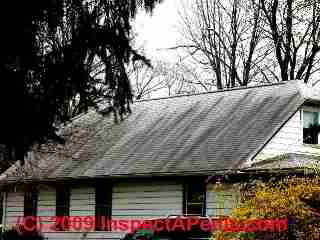 Extractive Bleeding - Black Stains on Asphalt Roof Shingles
Does extractive bleeding really occur on roof shingles? Causes & Diagnosis of extractive bleeding stains.
- POST a QUESTION or COMMENT about how to diagnose, clean off, or prevent stains on roof surfaces, including extractive bleeding, algae, dirt and debris, moss, lichens
Extractive bleeding stains found on asphalt shingle roof surfaces:
Definition of extractive bleeding; does extractive bleeding actually occur? what is extractive bleeding on roofs?
Extractive bleeding can occur in some roofing products and is an asphalt shingle or roll roofing defect often confused with algae or other roof stains as well as an actual product failure. Is extractive bleeding different from black stains caused by roof algae?
Joining other roof stain sources, extractive bleeding stains on roof are part of a catalog of the types of black stains that are found on roofs. Black or dark stains on building roofs may be traced to extractive bleeding (or more often algae staining) where we find some asphalt shingle roofs offering a prime example.
InspectAPedia tolerates no conflicts of interest. We have no relationship with advertisers, products, or services discussed at this website.
Black Bleed-Through or Extractive Bleeding Black Stains May Occur on Asphalt Shingles or Roll Roofing
Extractive bleeding - bleed-through asphalt shingle stains may be mistaken for but are not black algae or black "fungus", nor are they soot.
Extractive bleeding stains on asphalt shingles, though in my OPINION much less common than sooty mold or algae stains, do occur in some defective asphalt roof products, and are caused by loss of black pigment in the asphalt mix intended to impregnate the shingle mat itself.
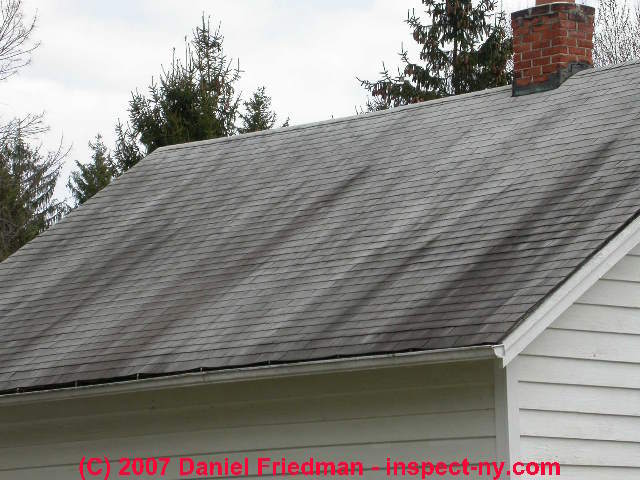

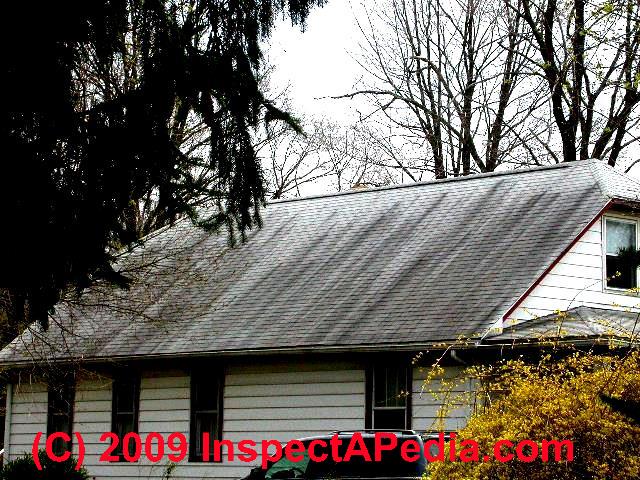
Extractive bleeding or "bleed through" stains leaving black streaks running down an asphalt shingle roof is an indication of a defective roofing product.
The chemistry of the shingle is permitting black pigment from the asphalt to leach to the shingle surface and run down the roof. Typically bleed-through on asphalt shingles appears as black streaks running down shingles.
You'll see black streaks of varying length and width (photos above and at page top).
Other black stains on roofs correlate with the growth of algae, the presence of roof debris or with soot from chimneys, particularly where an oil fired heating appliance is not operating properly.
Extractive bleeding on roof shingles originates at individual points: When the roof shingle staining or bleeding appears to run down the roof, originating from individual small points or "spots" (photos above) this is probably extractive bleeding or "asphalt roof shingle bleed through" on shingles - a product defect described by manufacturers as cosmetic.
Extractive bleeding occurs on asphalt shingles when an excessive amount of bitumen is released from the shingle surface - we pose that this effect may occur because some of the bitumen was not well bound in the asphalt mix.
Furthermore, bleed-through stains, since they are a feature of the asphalt shingle product itself, should occur on a roof regardless of the roof orientation, slope, or shading.By comparison, the location and pattern of black algae stains on an asphalt shingle roof are more likely to correlate with shade, areas of less sun exposure, or slope orientation (North) - factors that affect roof surface moisture, temperatures, and sun exposure - factors in algal growth.
Because of variations during the shingle manufacturing process, and possibly because of variations in site conditions (sun, shading, slope, moisture), different roof areas or slopes on the same building may display different amounts of black staining. This term is commonly used with wood shingles where use of steel or possibly even copper nails can also produce staining. (Try stainless steel nails when re-roofing with wood shingles or shakes).
Also see ROOFING MATERIAL DEFECT / environmentally-caused roof shingle stains for more examples of this problem.
Extractive bleeding on roof shingles will (probably) not be affected by presence of flashings whose wash-down of metal salts will often kill off or suppress biological stain sources such as stains from algae or mold.
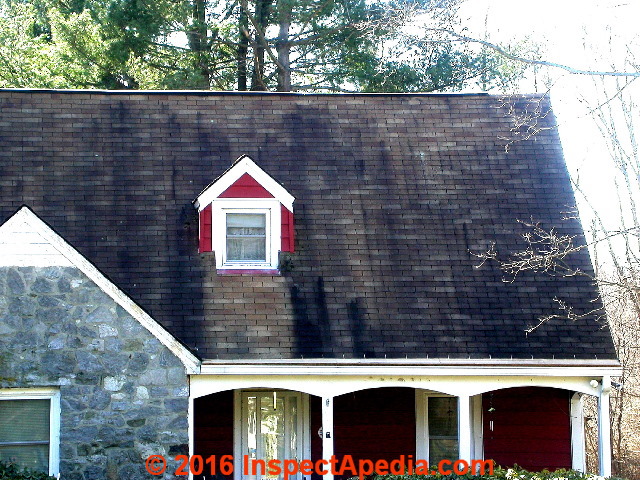
The black stains on the roof above are probably biological - because we note that below the dormer flashing, where metal salts wash down the roof surface, no black shingle stains appear.
Remedies for bleed through staining on asphalt shingles: we wouldn't do much to a roof with this staining since we worry that power washing or chemical treatments may reduce the remaining roof life. At re-roof time you might want to purchase a better-grade replacement shingle.
Background on Asphalt Roofing Shingle or Roll Roofing Black Bleeding Stains
Extractive bleeding is a term often applied to problems with paint or coatings over resin-containing wood products such as western red cedar shingles.
But it has also been used in the roofing industry to describe bleed-out stains from asphalt roofing products. "Bleeding" in this context refers to the penetration of color from the underlying surface.
Are all black roof stains algae? Some roofing experts such as Norman [cited at page end] opine that the bleeding stains we discuss here are due to algae. Certainly in many cases black stains on asphalt roof products are due to algal growth, not extractive bleeding.
See BLACK or GREEN ALGAE for a description of black stains on roofs due to algae. Readers will notice that the pattern of stains we ascribe to algal growth (and include in roof photographs) do not appear as originating at a point
. Where we find algae stains on roofs it appears in wider areas, it does not originate in an inverted vee point, and it is correlated with other roof conditions such as shaded spots or spots that tend to stay wet. There is less algae growth in areas of more sun.
Also, on roofs where there is wash-down of salts from copper or aluminum flashing, you will see that it's effective in killing off algae (as well as moss and lichens).
But on a roof with extractive bleeding you will see that the mineral salts washing down from similar flashings and metal at higher points does not make much of an impact on the black stain.
Extractive bleeding of asphalt roof products was described in a peer reviewed professional journal, in an interesting article
A Performance Approach to Aging Tests for Bituminous Roofing Membranes, under a discussion of roof weathering tests where the researchers defined changes in the surface appearance of roofing materials and named categories A-F:
A: no significant change
B: Paler, otherwise no significant change
C: Darker
D: Darker and brownish
E: Black staining, "bleeding", and embedment of surface mineral matter
F: Dull black and formation of elephant skin.
Bleeding of bituminous material was readily identified as a surface stain or discoloration on the roofing membrane.
We pose that the loss of bitumen might signal a reduced roof shingle life for two reasons,
- Shingle bleeding stains may be a clue that the asphalt mix for the particular shingle batch lacked adequate bonding, and
- The loss of substrate material from a shingle may correlate with aging and wear.
A change in shingle weight is the dominant feature appearing in shingle wear and the same article explains that loss of weight (caused by loss of surface material or loss of membrane material) correlates with shingle wear and life. Loss of volatile material correlates with loss of shingle flexibility which is a contributor to shingle wear and ultimately tears or cracking.
Some roofing consultants, including Mr. Norman (above) assert that many of the black stains on asphalt shingle roofs are due to algae growth and that extractive bleeding may not be a current roof problem.
This article series tells readers how to identify & explain the most-common causes of black, brown, red, gray, green,
or white stains appearing on roof shingles and on other building surfaces. Roof shingle stains are often caused by black algae, bleed-through or extractive bleeding
of asphalt, dirt, soot, or organic debris.
...
Continue reading at ALGAE STAINS on ROOFS or select a topic from the closely-related articles below, or see the complete ARTICLE INDEX.
Or see these
Roof Stain Diagnosis, Repair, Prevention Articles
- STAIN DIAGNOSIS on ROOFS - home
- ALGAE, FUNGUS, LICHENS, MOSS on ROOFS
- BLACK ROOF STAIN CAUSES
- BLACK or GREEN ALGAE STAINS on ROOFS
- BLACK or GREEN ALGAE STAIN REMOVE / PREVENT
- CHIMNEYS, STAINS on / near
- DEBRIS STAINS on ROOFS
- EXTRACTIVE BLEEDING on SHINGLES
- LICHENS on ROOFS
- MOSS on ROOFS
- POWER WASHING ROOFS
- RUST STAINS on ROOFS
- SOOT STAINS on ROOFS
- TARRY BLEED on ROOFS
- TOBACCO JUICING SHINGLE STAINS
- WHITE STAINS on ROOFS
- TEST LABS - ROOF SHINGLE
Suggested citation for this web page
EXTRACTIVE BLEEDING on SHINGLES at InspectApedia.com - online encyclopedia of building & environmental inspection, testing, diagnosis, repair, & problem prevention advice.
Or see this
INDEX to RELATED ARTICLES: ARTICLE INDEX to BUILDING ROOFING
Or use the SEARCH BOX found below to Ask a Question or Search InspectApedia
Ask a Question or Search InspectApedia
Questions & answers or comments about how to diagnose, clean off, or prevent stains on roof surfaces, including extractive bleeding, algae, dirt and debris, moss, lichens.
Try the search box just below, or if you prefer, post a question or comment in the Comments box below and we will respond promptly.
Search the InspectApedia website
Note: appearance of your Comment below may be delayed: if your comment contains an image, photograph, web link, or text that looks to the software as if it might be a web link, your posting will appear after it has been approved by a moderator. Apologies for the delay.
Only one image can be added per comment but you can post as many comments, and therefore images, as you like.
You will not receive a notification when a response to your question has been posted.
Please bookmark this page to make it easy for you to check back for our response.
Our Comment Box is provided by Countable Web Productions countable.ca
Citations & References
In addition to any citations in the article above, a full list is available on request.
- Roger Hankey is principal of Hankey and Brown Inspections, Winter Park, CO. Mr. Hankey is a past chairman of the ASHI Standards Committee and served in other ASHI chapter and national leadership roles. Mr. Hankey is a National Radon Proficiency Program certified measurement professional and a Level II infrared thermographer. Contact Roger Hankey at: 970-393-6604 - rogerhankey47@gmail.com . Website: www.HankeyandBrown.com Mr. Hankey is a frequent contributor to InspectAPedia.com.
- 04/09: thanks to William M. Norman, P.E., S.E., Keeler-Webb Associates, 486 Gradle Drive, Carmel, IN 46032 for opening discussion regarding the legitimacy of extractive bleeding as a term to apply to asphalt roofing material. Mr. Norman suggests that many (not all) black stains on asphalt roofing may be due to algal growth. We will report progress in this discussion as updates to this web article.
- "A Performance Approach to Aging Tests for Bituminous Roofing Membranes", Einar M. Paulsen, Norwegian Building Research Institute, Trondheim, Norway, International Journal of Roofing Technology, 1990 Vol. 2., p. 27-39.
- Other online references to roofing standards, stains, bleeding questions include:
- http://www.absoluteastronomy.com/topics/Asphalt
- http://www.newworldencyclopedia.org/entry/Asphalt
- http://www.esperanzaproperties.com/glossary.php?letter=b (see their entry for bleeding)
http://www.sasolwax.com/More_about_Sasolwax_Flex.html (entry for roofing products) - Roofing Standards & Related Standards
C772 Standard Test Method for Oil Migration or Plasticizer Bleed-Out of Preformed Tape Sealants
D279 Standard Test Methods for Bleeding of Pigments
D3018-90(1994)e1 Standard Specification for Class A Asphalt Shingles Surfaced with Mineral Granules
D1079 Terminology Relating to Roofing, Waterproofing, and Bituminous Materials
D228 Test Methods for Sampling, Testing, and Analysis of Asphalt Roll Roofing, Cap Sheets, and Shingles Used in Roofing and Waterproofing
D3161 Test Method for Wind Resistance of Asphalt Shingles (Fan-Induced Method)
E108 Test Methods for Fire Tests of Roof Covering
and curiously, where reclaimed asphalt shingles were used as a road product, this topic came up as well at
http://auto.ihs.com/collections/aashto/aashto-standards-2.htm
- Our recommended books about building & mechanical systems design, inspection, problem diagnosis, and repair, and about indoor environment and IAQ testing, diagnosis, and cleanup are at the InspectAPedia Bookstore. Also see our Book Reviews - InspectAPedia.
- Building Pathology, Deterioration, Diagnostics, and Intervention, Samuel Y. Harris, P.E., AIA, Esq., ISBN 0-471-33172-4, John Wiley & Sons, 2001 [General building science-DF] ISBN-10: 0471331724 ISBN-13: 978-0471331728
- Building Pathology: Principles and Practice, David Watt, Wiley-Blackwell; 2 edition (March 7, 2008) ISBN-10: 1405161035 ISBN-13: 978-1405161039
- In addition to citations & references found in this article, see the research citations given at the end of the related articles found at our suggested
CONTINUE READING or RECOMMENDED ARTICLES.
- Carson, Dunlop & Associates Ltd., 120 Carlton Street Suite 407, Toronto ON M5A 4K2. Tel: (416) 964-9415 1-800-268-7070 Email: info@carsondunlop.com. Alan Carson is a past president of ASHI, the American Society of Home Inspectors.
Thanks to Alan Carson and Bob Dunlop, for permission for InspectAPedia to use text excerpts from The HOME REFERENCE BOOK - the Encyclopedia of Homes and to use illustrations from The ILLUSTRATED HOME .
Carson Dunlop Associates provides extensive home inspection education and report writing material. In gratitude we provide links to tsome Carson Dunlop Associates products and services.
 | HOME | ABOUT | ASK a QUESTION | CONTACT | CONTENT USE POLICY | DESCRIPTION | POLICIES | PRIVACY | |
| © 2024 - 1985 Publisher InspectApedia.com - Daniel Friedman | |||||||||