
InspectAPedia® FREE Encyclopedia of Building & Environmental Construction, Diagnosis, Maintenance & Repair |
Question? Just ask us! InspectAPedia
|
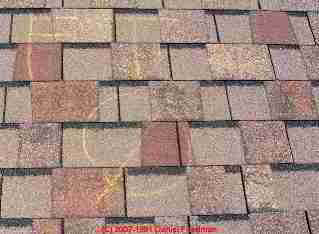 Asphalt Roof Shingle Storm or Hail Damage Identification
Hail damage
types, causes, identification, photographs, claims
- POST a QUESTION or COMMENT about Roof Shingle Hail Damage & how Hail Damage is Distinguished from Blistering, Foot Traffic, or Other Roof Wear, & about Roof Inspection Procedures
Hail damage to asphalt roofing:
This article tells readers how to identify roof shingle hail damage and how to distinguish a hail damaged roof from blister rash damage, foot traffic damage, wind, and other conditions such as shingle rash blistering, cracking, and granule loss associated with normal shingle aging.
We include photographs and text that help identify different types of roof damage and wear, and we discuss up-close examination of wear areas to improve the accuracy of roof damage or wear diagnosis. We explain the role of hailstone size, direction, and velocity in roof damage from hailstorms, and we discuss the role of roof slope or pitch, orientation and other factors in roof wear.
We also include a set of codes that can be used in marking areas of wear or damage on roofs to assist in photo documentation of roof condition. The article includes a list of manufacturers of hail-damage resistant roofing products and invites questions or comments from building owners, roofing experts, insurance company adjusters and roofing manufacturers.
InspectAPedia tolerates no conflicts of interest. We have no relationship with advertisers, products, or services discussed at this website.
How to Distinguish Wear Types on Asphalt Shingle Roofs: hail storm damage vs. blister rash vs. foot traffic wear on asphalt shingles
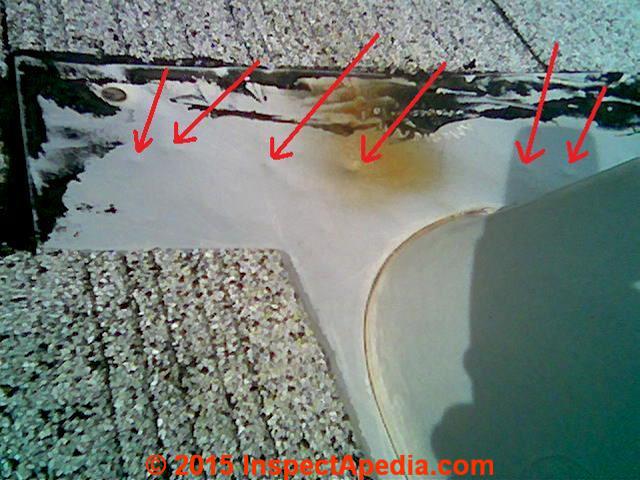
[Click to enlarge any image]
The dented metal flashing shown in the roof photo just above, contributed by a reader, is compelling evidence that the roof has been exposed to a hail storm. This observation forms part of evidence used in assessing the extent of hail damage to a building roof.
Readers are also invited contribute roof failure information to the web author for research purposes. web author for research purposes.
Article Series Contents
- HAIL DAMAGED SHINGLES & OTHER ROOF COVERINGS - home
- SHINGLE HAIL DAMAGE: WHEN TO INSPECT FOR
- SHINGLE HAIL DAMAGE IDENTIFICATION
- SHINGLE HAIL DAMAGE vs NORMAL WEAR
- SHINGLE HAIL DAMAGE vs Hailstone Size, Mass, Velocity, Wind Direction, Roof Slope
- SHINGLE HAIL DAMAGE vs SLOPE, WEATHER, SUN
- SHINGLE HAIL DAMAGE INSPECTORS
- SHINGLE HAIL DAMAGE EXAMPLES
- ROOF HAIL DAMAGE RESEARCH
Notice to insurance adjusters, building owners, roofing contractors:
We invite questions, comments, polite debate, and importantly, sharp photographs of damaged and un-damaged roof shingles to permit us to develop a free public reference library of roof conditions, damage types, and thus to assist in damage assessment.
Inspect your roof as soon as possible after any storm
- Inspect your roof regularly,
annually would be great, so that you can find and fix damage before it becomes a more costly leak. If you inspect the roof regularly you then can have information to compare with the condition of the roof after a severe storm - you can document when damage occurred and can establish that damage was or was not present before a particular storm.
Take photographs of the roof in its un-damaged or normal wear state. Having "before the hail storm" and "after the hail storm" photos can completely put to bed any debate about whether or not hail damaged a roof. - Inspect your roof promptly after a storm:
Any storm or wind alone can damage a roof, so the sooner you inspect the roof after a storm the better you can avoid leak damage inside the home, and if an insurance claim for roof damage is warranted, the better will be the data you can provide in support of your claim. - Inspect your roof gutters:
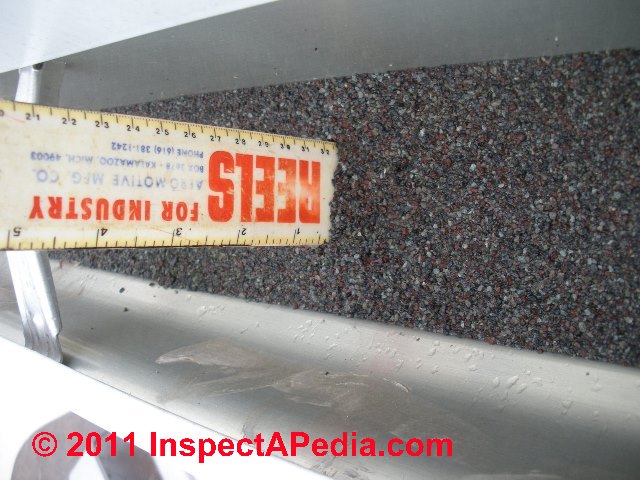
before and after a storm. If the gutters were clean and after the storm they are loaded with mineral granules you have strong evidence of roof wear and damage due to the hail storm.
What does hail damage look like on asphalt shingle roofs?
Hail damage visible from ground level:
Start by looking for evidence of hailstorm damage from the ground: mineral granules from asphalt roofing may appear at the ends of downspouts; metal components such as metal siding, air conditioner or heat pump condensers, and of course automobiles left outdoors may be dented or damaged.
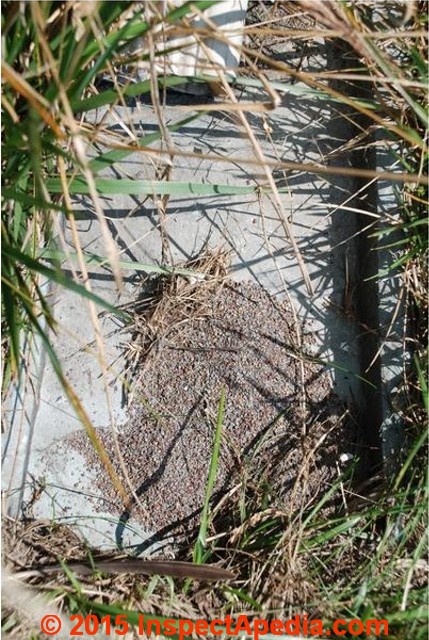
Watch out: before investigating further, what we know from the photo above is that mineral granules have washed off of the roof on this building; we don't yet know the cause of granule loss.
Hail-damaged metal components
Justin Reichl (cited at the end of this article) adds that you might see scouring of painted or coated metal surfaces (metal roofing or flashings or gutters) or you may see damage spots on painted or stained wood surfaces at the building as well.
Look for hail damage to on-roof components such as dented metal gutters or chimney caps, and valley flashing.
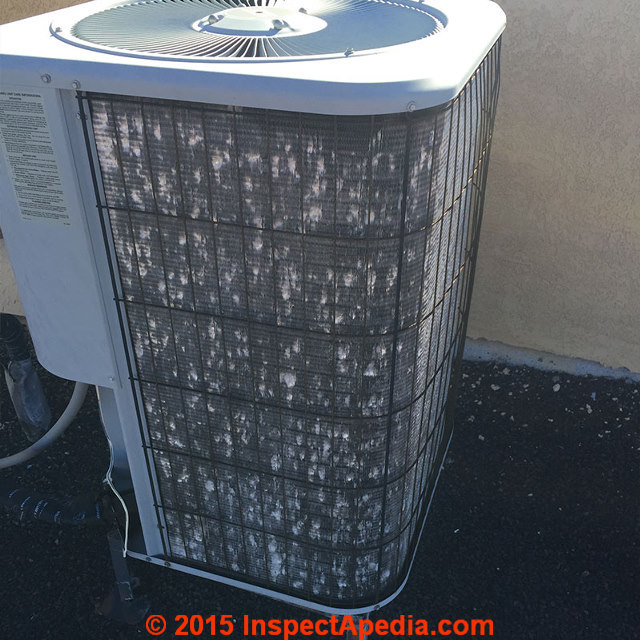
Photo provided courtesy of Justin Reichl, cited at the end of this article.
Hail-damaged asphalt roofing
For asphalt shingle roofs or roll-roofing or mineral-granule coated modified bitumen covered roofs, continue hail damage investigation by looking in your roof gutters and on the ground for large amounts of mineral granules lost from the roof.
And if you are on-site during the hail storm, record the storm details: storm duration, hail size, wind direction, if you can. Some of the photos immediately below of mineral granules in a previously clean roof gutter, and of actual hailstones (later in this article) were provided by reader L.B. whose roof damage case is discussed below.
Watch out: do not attempt to use ladders nor to access your roof if you don't know how to do so safely; ladder falls are a significant cause of injuries and deaths world-wide.
Areas of lost mineral granules
will be apparent, with more severe granule loss on roof slopes facing the direction from which the hailstones fell (or blew) during the storm.
Inspecting an asphalt shingle roof shortly after a hail storm, if the roof has been damaged, should show that the areas of mineral granule loss have exposed "fresh" looking shingle substrate - the asphalt impregnated shingle substrate will not yet have been weathered by sun exposure.
Watch out: Hail damage to roof surfaces or coatings is principally an impact damage effect.
A close inspection of the surface of an asphalt shingle suffering hail damage might show round areas of impact where shingle granules have been removed, but the size, shape, location, pattern and number of such mineral granule loss areas need to be considered with care because other events can also cause granule loss that takes some care to identify.
For example, depending on wind velocity and direction, a hailstone may not make a direct right-angled impact onto a building surface; its effect might be tear-drop shaped or even streaked.
Hail damaged metal roofing, tile roofing, wood shingle or shake roofs:
may be evident as the loss of metal coatings by hail scouring, dents in metal roofing, dents in wood shingles or shakes, or broken clay or concrete tile roof coverings.
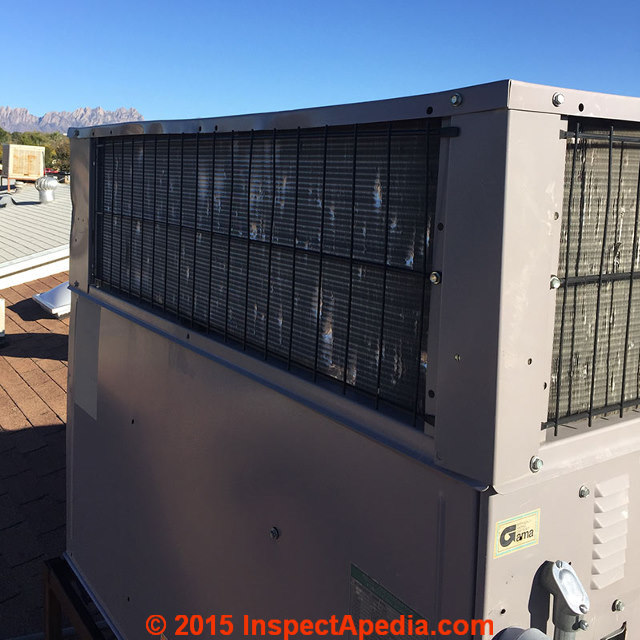
The photo of hail-damage to a rooftop air conditioning unit shown above, the damaged B-vent chimney cap shown below, and the hail scoured chimney cap or shroud top also shown below were provided by Justin Reichl, a source cited at the end of this article.
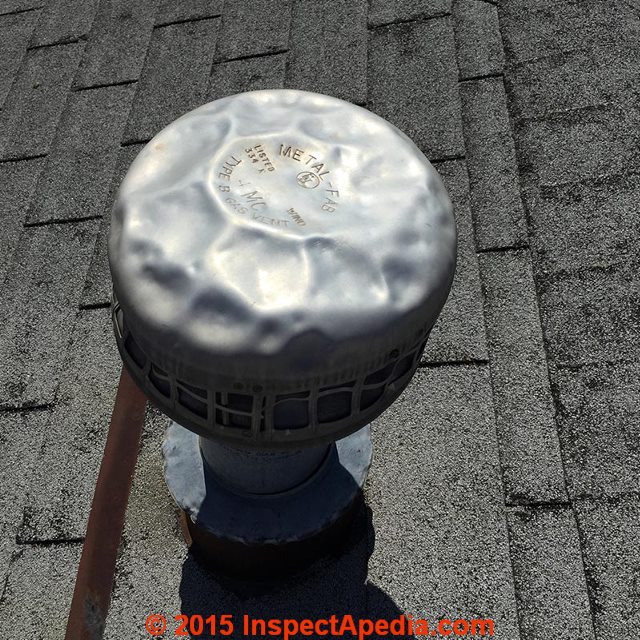
Scouring of coatings or deposits on outdoor or rooftop mounted components can also indicate hail damage. Hail may scour or remove soot or oxidation from a metal chimney cap such as that shown in our reader-contributed photo below.
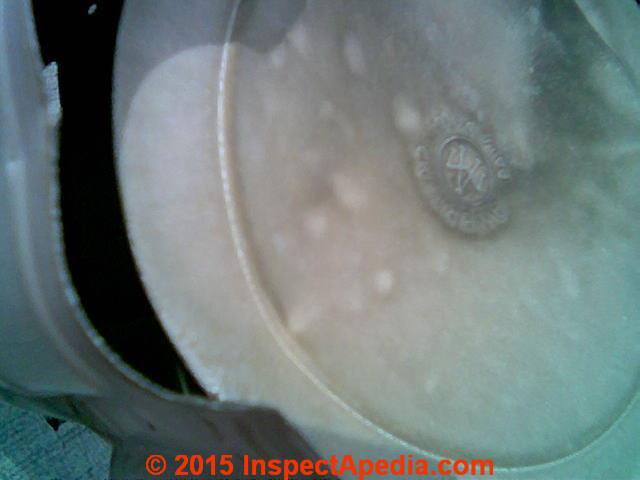
Hail scouring of coated metal roofing or hail scouring of rooftop chimney caps and shrouds such as the case shown below also confirm exposure of the roof to hail likely to have damaged the roof surface.
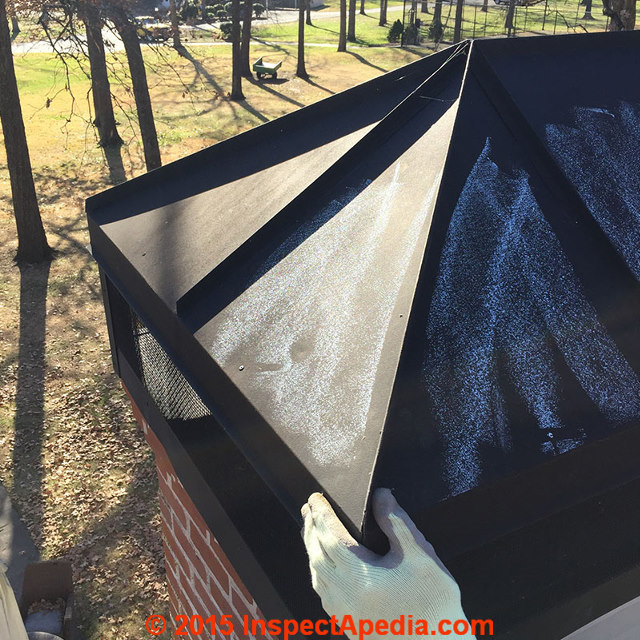
Really? The remarkable scouring patterns on the coated metal chimney shroud top shown above looks to me like it wasa treated by a power washer not damaged by hail. However the author (through email correspondent R.F.) explained that they used chalk rubbed along the surface to show-up hail impact dents.
Document the size of hailstones that damaged your building
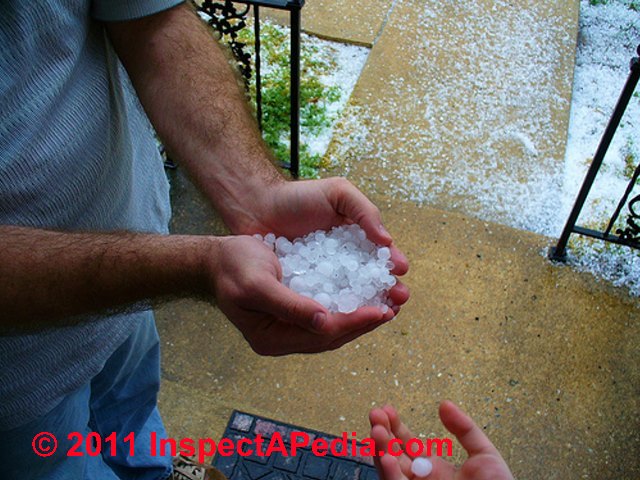
If you are inspecting a building immediately following a hail storm, provided it is safe to go outdoors (no lighting, no large falling hailstones, no other weather-related hazards), you may be able to scoop up a handful of hailstones.
If you do, photo-document the size of the hailstones. That data may be useful in an insurance claim as the type of building component or roof surface damage due to hail varies by hail stone size as well as amount of wind, wind direction, roof slope and other factors.
Hail damage to roofs versus normal or typical asphalt shingle wear
Hail-damaged roof shingles we've seen or which have been sent along to us as in photo form, show more of a "scouring" effect in which larger, more irregularly-shaped areas of shingle surface have lost granules (and thus have produced a shingle nearer the end of its product life than before the storm.
For larger hailstones or wind-driven high-velocity hail stones often you will see rather apparent impact damage removing roof shingle granules in a circular or tear-drop shaped pattern depending on the direction of hailstone movement at the time that it impacted the roof surface.
However hail damage may cause granule loss over wide areas of a roof if that surface was already particularly vulnerable to granule loss, such as an older asphalt shingle roof whose surface included blister rash.
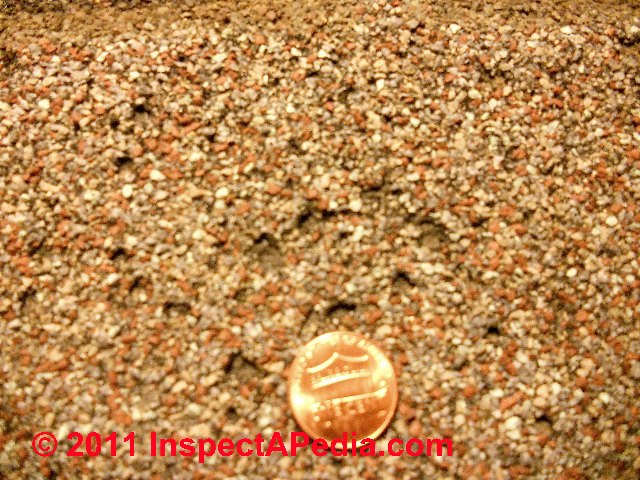 The photo shows open pits on an asphalt roof shingle; without further investigation we don't know if this mineral granule loss is due to foot traffic, hail, or other wear that could have opened the tops of the blisters of a blister-rash type asphalt shingle.
Also see SHINGLE HAIL DAMAGE vs SHINGLE BLISTER RASH where we point out that where hail damage has been caused by large hailstones you may see denting of metal components on or around buildings, such as dented gutters, aluminum chimney caps, roof vent covers, ridge vent covers, or other metal components located around the building such as aluminum siding dented by hail wind-driven at an angle, A/C or heat pump compressor units.
In distinguishing worn roof shingles or shingles damaged by foot traffic or other wear sources, you may find accompanying hail damage to metal building components that we listed earlier.
Worn or weathered asphalt roof shingles
which are losing their mineral granules in the course of normal aging, if inspected early in the wear cycle, already show small areas of granule loss, beginning with bald areas on the shingles which may be just the diameter of a few mineral granules.
As the sun and weather wear will accelerate in these "bald" spots or micro-spots, when the inspector sees a larger bald spot it will be also weathered, having developed over time as opposed to having developed suddenly during a storm.
Also see LIFE / WEAR FACTORS in SHINGLES
and MECHANICAL DAMAGE of SHINGLES.
Confounding this distinction between hail damage and shingle wear as a source of granule loss, is the wear on an older asphalt shingle roof when exposed to a hailstorm. If the roof were worn (and its mineral granules less securely attached to the shingle surface), we posit that roof will lose more granules more quickly in the hail storm than a newer surface.
Reichl also points out that other roofing materials such as metal roofs, fiber cement roofs, wood roofs, built-up roofs and clay or concrete tile roofs can also be damaged by larger hailstones. (Reichl op. cit.)
Role in Roof Damage of Hailstone Size, Mass, Terminal Velocity, Wind Direction, and Roof Slope
The impact of hailstones on a roof depends on at least these factors:
- Size: The size of the hailstone
- Mass: Some assumptions about the typical mass of a hailstone (ice or ice with some water coating)
- Wind: The effect of wind on the object's velocity
- Falling height or distance (we assume the distance is sufficient to reach terminal velocity before considering wind effects)
- Mechanics: The assumption that all of the physical energy is converted to kinetic energy as the object strikes the roof
- The pre-existing condition of the roof surfaces, age, existing damage or wear, fragility
- The roof slope and angle of presentation of the roof slope to the direction of wind-driven hailstones
The hailstones in your photo look as if they averaged roughly 1 cm or larger (you reported 0.88 inches or 2.2 cm).
A 1 cm hailstone has a theoretical terminal velocity of about 20 mph (9 meters/second). Larger hailstones have a much higher terminal velocity. And a ten-gram hailstone falling from 10 km (this distance is probably more than enough) has a terminal velocity of about 15 meters per second. [1]
What the experts cite as hailstone terminal velocity is, in my opinion, misleading because that figure does not consider the role of winds that typically occur in a storm, nor the relationship between the angle of the roof and the angle of movement of the hailstone. Wind direction and changes in wind direction and velocity will surely complicate any straightforward calculation hailstone impact force.
For example, wind-driven hail may be accelerated beyond simple terminal velocity (gravity).
Furthermore, irregularities in the shape of hailstones will create wind resistance that complicates any direct calculation of the hailstone's downwards velocity, mass, and thus the force with which it strikes a shingle.
In LB's "old shingle" shingle photos taken on the roof itself, most of the open pits or craters on shingles where mineral granules have been lost appear to be in relatively flat areas shingles. Mineral granules that have been lost to expose shingle substrate in the center of raised blisters will in at least some instances leave a crater around the pit edges.
Examination of the shingle pits or craters in a stereo microscope such as we use in our lab would be helpful in making this examination.
Variations in Roof shingle damage or wear according to roof slope pitch and weather or sun exposure
Storm damage is likely to affect different roof slopes differently as their weather exposure varies.
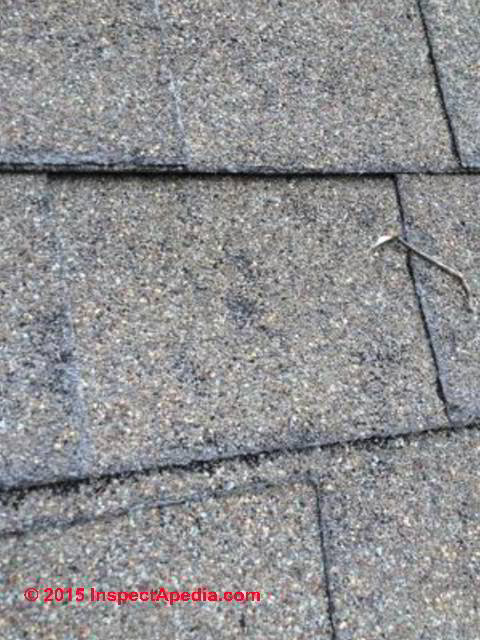
Look closely at the above photo of an asphalt shingle roof after a hailstorm. In the photo sent to me by a reader) we see cracks in some of the shingles.
We would be surprised to learn that the impact of ice pellets on a roof would produce cracking and we pose that the cracks were a preexisting condition on an older shingle roof. (I have seen cracking appear suddenly on asphalt shingles in response to cold weather, in the form
of THERMAL SPLITTING ASPHALT SHINGLES however, a failure for which we have a very different explanation and a different cracking pattern than shown in the photo here--DF.)
Look at the uniformity of roof defects
over the field of a given slope to help understand the probable cause. Blistering of asphalt shingles caused by the product itself might appear uniform over all of the roof on all slopes independent of weather exposure.
In other cases, if only a few bundles of shingles were defective,
say from improper manufacture or storage, asphalt shingle blistering may appear in shingles in a specific pattern on a roof following the application pattern of the shingles themselves as they were nailed to the roof.
Since roof shingles from a single bundle are usually applied over a single area of a roof, this pattern and cause may be self-evident on close inspection of the whole roof.
Roof Inspectors: Whose opinion on roof wear do you trust? Avoid conflicts of interest
While many roof inspectors and home inspectors are expected to be un-biased neutral professionals, we cannot assume that this is always the case. The building owner should consider possible sources of conflicting interests on the part of the person performing the inspection. These conflicting interests can occur in both expected and less obvious ways:
- Who is the roof inspector working for?
Some roof inspectors working for the insurance company may be understandably motivated to focus on shingle wear rather than storm damage. If the insurance company inspector can give specifics of what s/he saw on the roof and what those clues mean (such as evidence of other signs of roof wear: cracks, blisters, tears) that opinion should be considered seriously. - Will the roof inspector gain financially by the inspection outcome?
I the roof inspector is asked to advise on whether or not the roof needs immediate replacement, and if s/he works for a roofing company, the "safe" as well as "profitable" opinion to offer is that replacement is needed. - Experienced roofing contractors who conclude that the roof does not need immediate replacement
but who have seen many roofs in a given geographic area in many conditions, who give specific details of what s/he saw and what those clues mean, and who conclude that the damage is due to hail (or another cause), have offered an opinion that should be taken seriously.
In sum, ask the roof inspector for specific details that support his or her conclusions about the condition of the roof and about what caused its damage or wear. An inspector who offers only the "bottom line conclusion" with no supporting evidence, does not deserve the confidence of the building owner.
For a professional investigation of hail damage to asphalt shingles, see
Hail Damage to Asphalt Roof Shingles [PDF] Timothy P. Marshall, Richard F. Hertzog, Scott J. Morrison, Haag Engineering, Dallas TX.
Hail Damage Identification Examples, Questions & Answers
Reader Comments, Questions & Answers About The Article Above
Below you will find questions and answers previously posted on this page at its page bottom reader comment box.
Reader Q&A - also see RECOMMENDED ARTICLES & FAQs
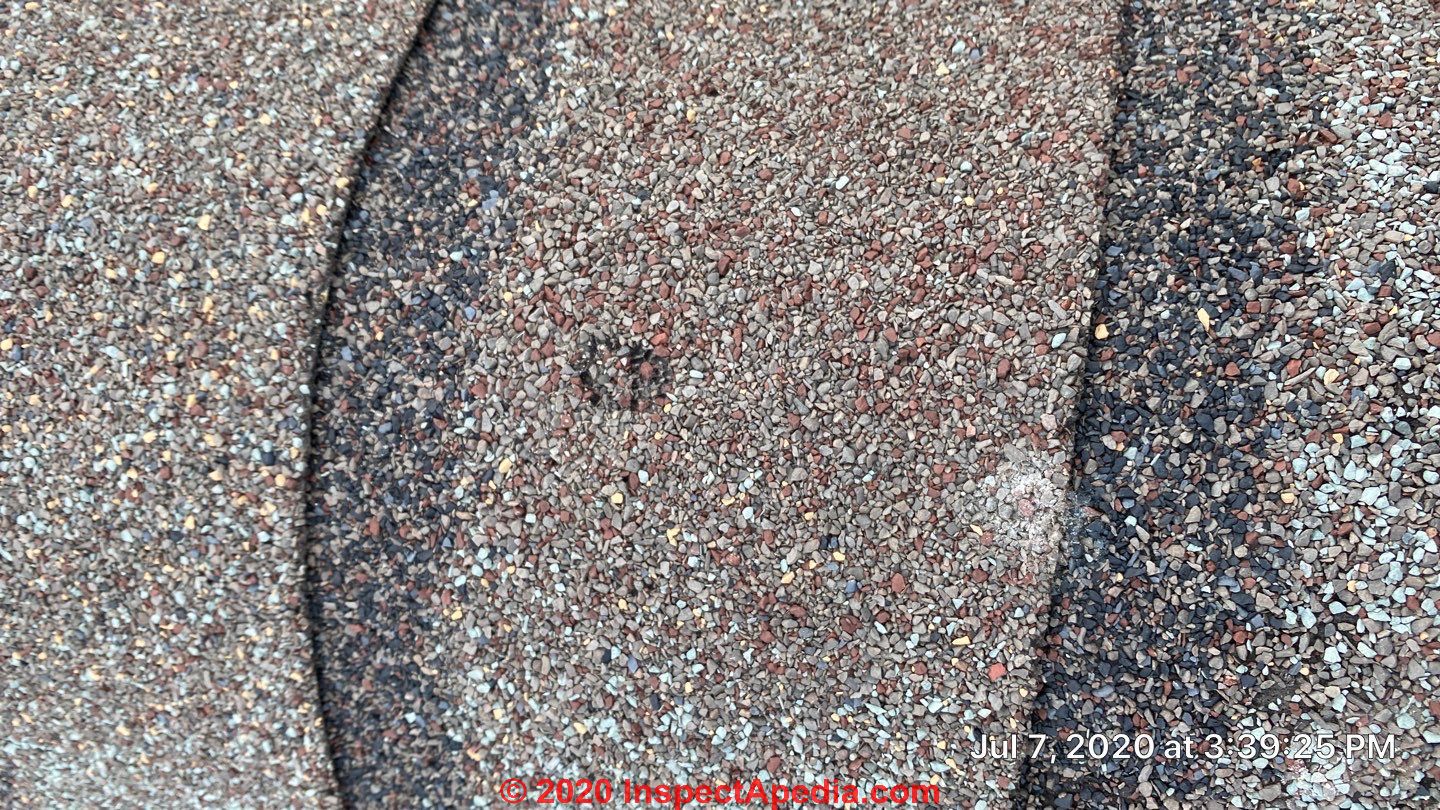
Question: are these small round scoured areas hail damage? 1.5" hailstones fell!
[Click to enlarge any image]
In June 2020 we were struck with a major hailstorm. The siding on our home was shattered in many places. The screens were decimated on windows as well, and gutters and fascia were significantly dented.
In summer of 2019 we had installed a new roof.
When the roof was inspected [after the hailstorm - Ed.] by a third-party hired by the insurance company, he first said no damage.
Then when my contractor joined him on the roof he acknowledged some damage at least.
However, his report to the insurance company seems to have stated no damage (we have not seen this but have been told this and have requested a written copy of the report).
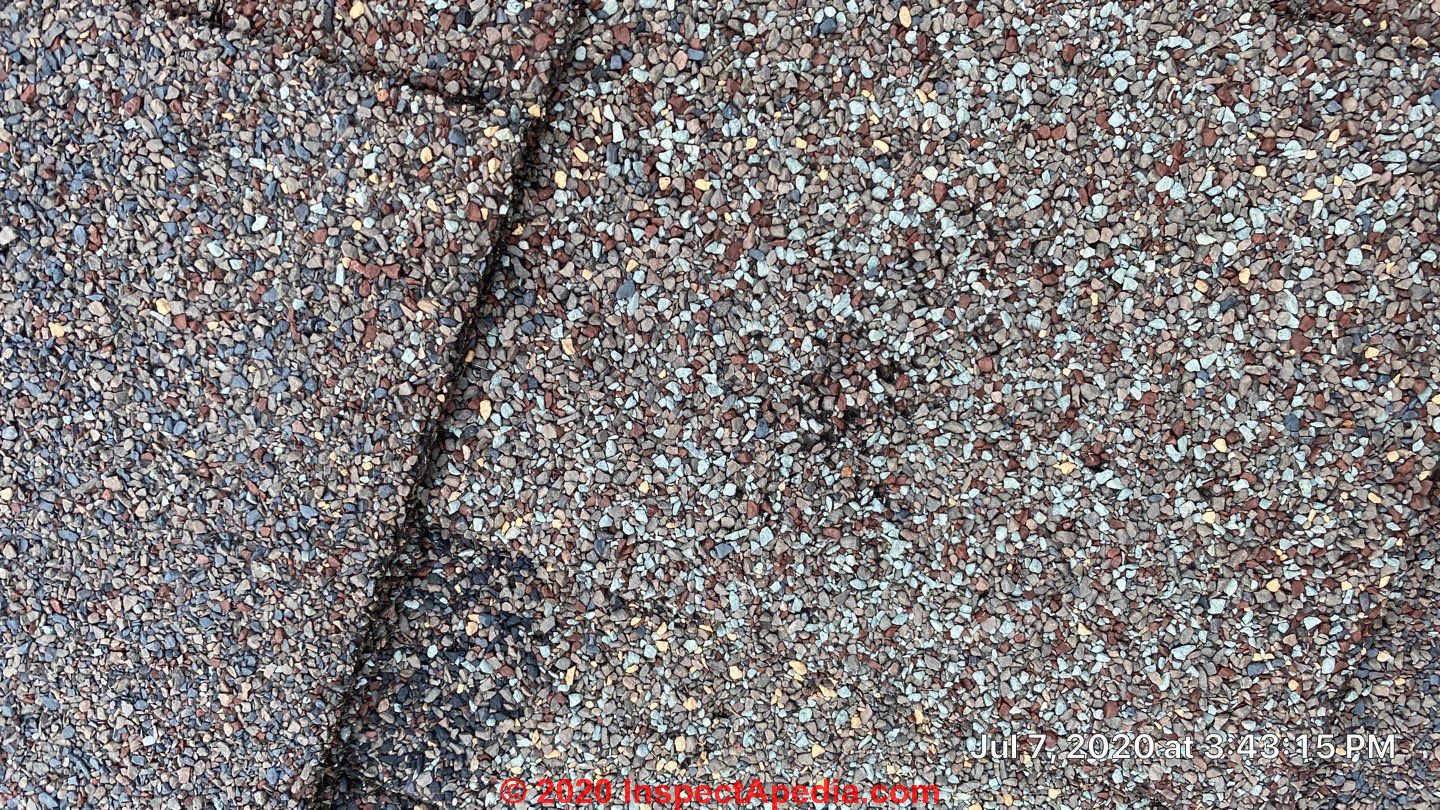
Three different contractors have told us there was hail damage to the shingles, although not as severe since they are knew.
And there is quite a bit of shingle granules in the gutters. I have attached some of the images that have been taken of damaged spots.
The insurance company’s “re-inspector” came back to us after viewing just the images, and said these are all simply shingle defects. He said we could hire a structural engineer on our own dime and pursue this further if we so choose with no guarantees.
Can you provide an assessment of the images attached as being hail damage or shingle defects? The hail storm reported 1.5” sized hail. I was home at the time and noise in the house was a “din” from the impacts of the hail. - 2020/09/24 Anonymous by private email
Moderator reply: roundish and other very localized scour areas of lost mineral granules: typical of hail damage
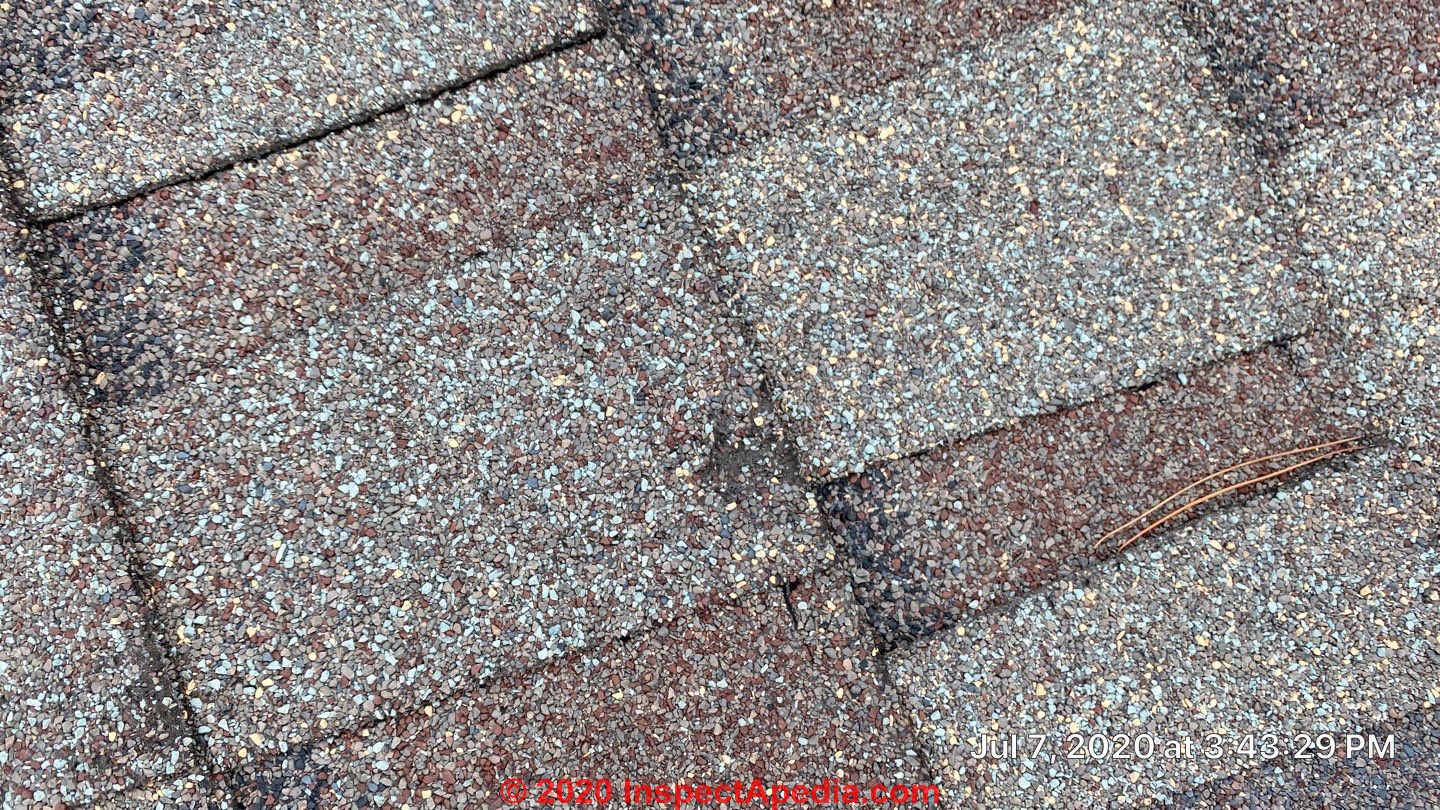
You show what looks like small areas of impact damage that could indeed be caused by hailstones. Those very localized areas of scouring are consistent with impact from large hailstones just as you describe.
There are other causes of localized round areas of granule loss besides impact, such as on a roof with blistering and then foot-traffic but those are much smaller, uniformly over all roof surfaces and are not at all like your photos.
Other causes of roof mineral granule loss such as foot traffic do not appear as small round spots.
Nor does normal roof wear and granule loss with age appear as the spots on your shingles.
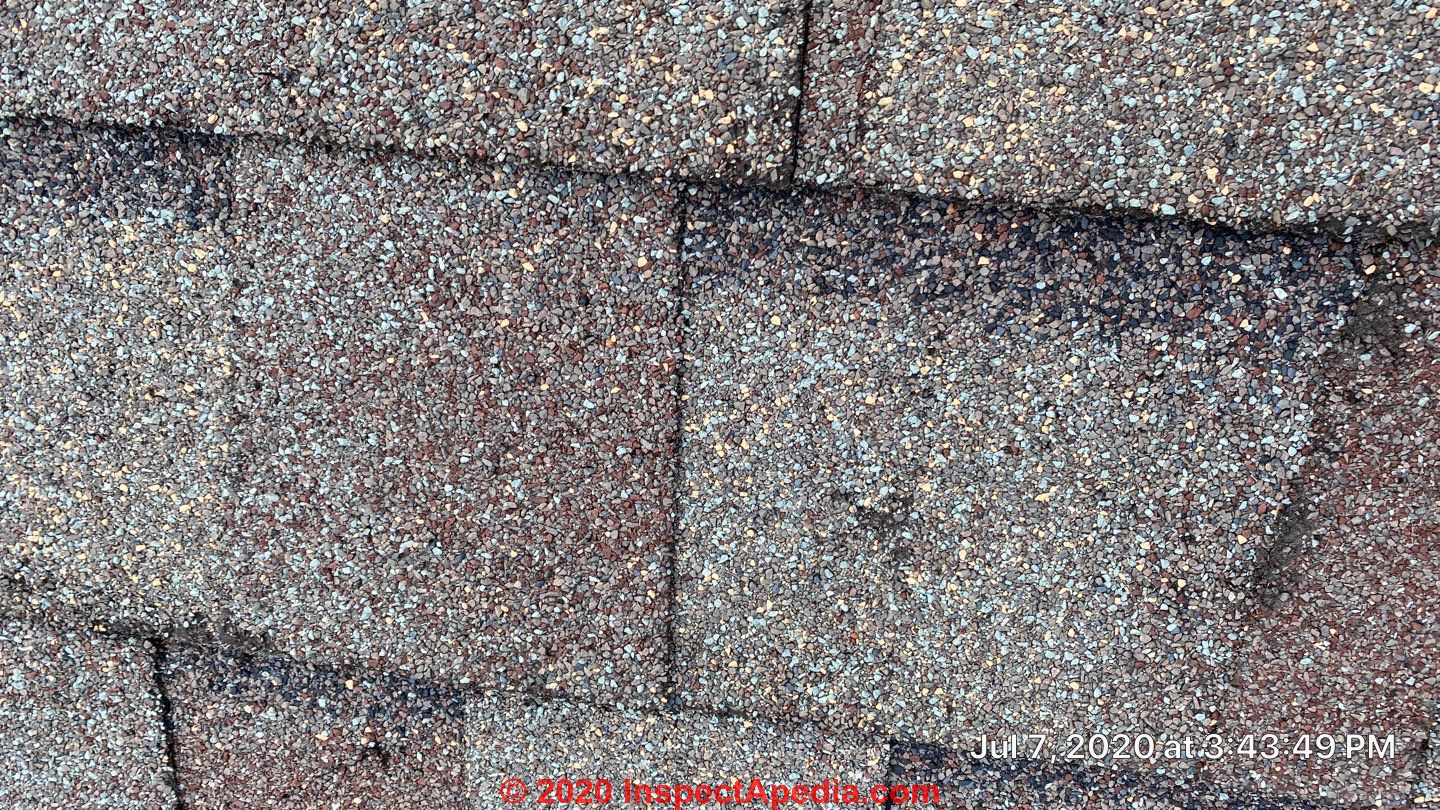
Your insurance inspector's statement that these are "normal roof defects" is incorrect and has no meaning.
And your insurance inspector was mistaken to call this "no damage" - loss of granules is at least some damage.
And your insurance inspector is being specious and silly to suggest hiring a structural engineer to assess the roof condition. The condition of roof shingles is not a structural topic and not within the scope of education and practice of a structural engineer unless she has re-directed her professional practice to become a shingle wear and damage expert: not a building structure engineering education topic and therefore practicing outside the scope of original licensing of the engineer.
Evaluate the actual significance of this hail damage
But it is reasonable to argue about just how much damage has occurred and what will be its effect on remaining roof life.
While some uniform mineral granule loss is normal as asphalt shingle roofs age - a defence of "normal roof wear - that's quite different from spots that expose the bare roof shingle substdrate of asphalt impregnated paper or fiberglass.
Once there are "bald" areas or nearly-bald areas on a roof those become early or more-rapid wear spots that can ultimately become roof leaks and that can precipitate a roof replacement earlier than otherwise.
You should ask your expert roof inspectors for their estimate of the remaining roof life in light of the hail damage, then compare that with the original or warranty life of the roof.
From the photos alone there's not a complete data set to support a roof replacement argument, though I pose that granule loss can shorten the remaining shingle life.
An expert on-site assessment would consider the extent of those, differences in markings on different roof slopes, and other details to confirm that the roof is significantly hail-damaged.
Please compare your photos with those in the article above.
As you agreed, I will post your photos and this discussion here to invite further comment? (Default is to keep you anonymous).
We welcome your further comments, suggestion, criticism, photos.
On 2020-03-24 - by (mod) - insurance adjuster says this is not hail damage
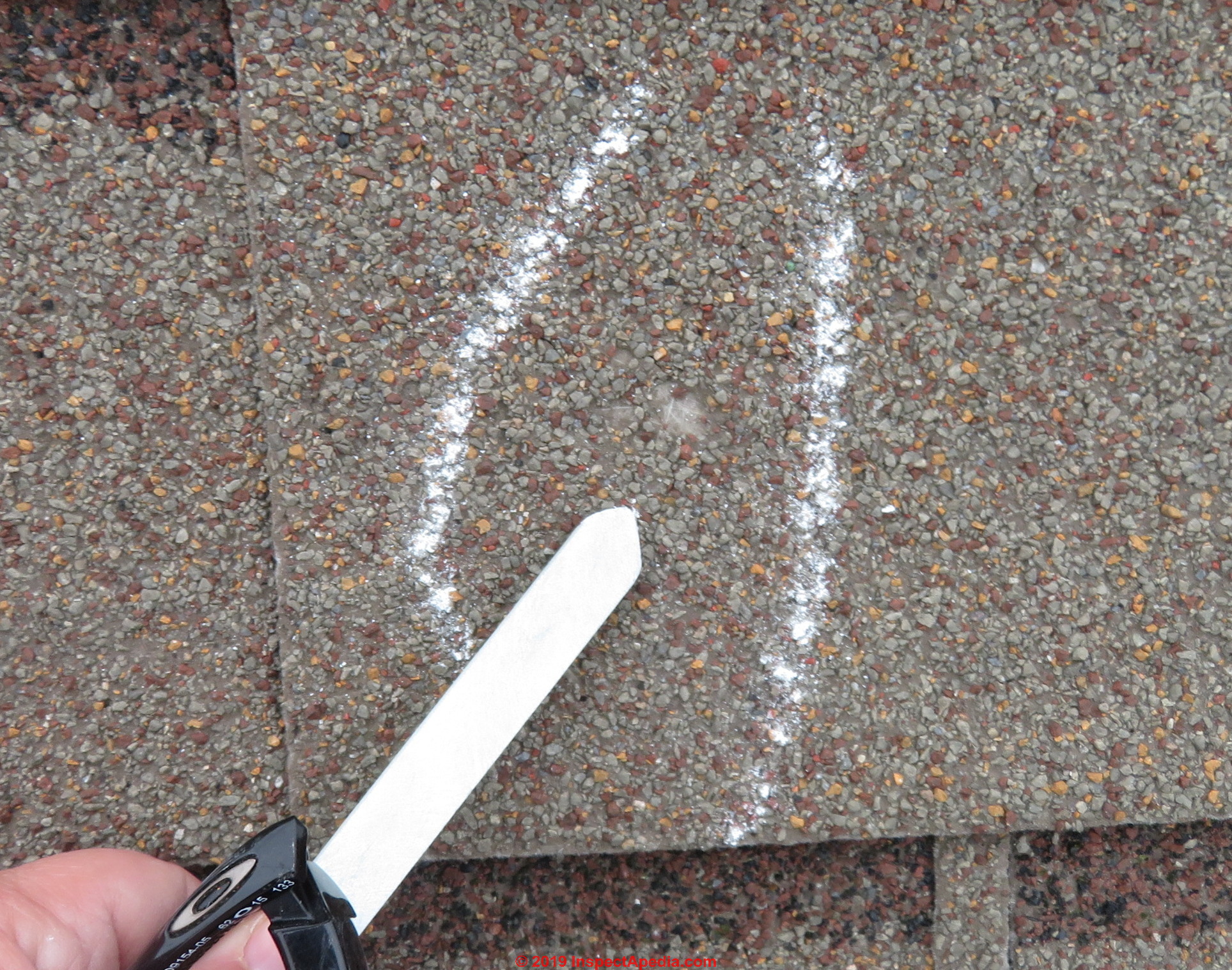 I agree with your analysis Paul.
[Click to enlarge any image]
The size of marks of hail damage vary significantly depending on a number of variables including at least
- the size of the hailstones
- the duration of the hailstorm
- the slope of the roof
- the angle of roof surfaces with respect to the angle of movement of the hailstones
- the age of the roof shingles
- the presence/absence of shingle blisters before the storm
- the shingle brand, style or type, weight, prior condition
In my OPINION It is specious to claim that all hail damage marks have to be a specific size.
However it is true that other forms of roof wear and granule loss can produce small spots of lost granules.
Additional factors distinguish between normal granule loss due to age and exposure vs. hail damage including the factors listed above on this page.
One can but speculate that the adjuster may be viewing her job as finding a way to deny a claim.
There is to my eye a lot more wear and damage on this roof surface than first meets the casual eye.
Regarding your statement "Part of their decision was based on spatter marks not being sufficient enough in size to create the damage", I've taken a closer look at one of your photos and have circled definite impact damage in red and apparent additional impact or similar wear or damage spots in orange.
[Click to enlarge any image] to see added details.
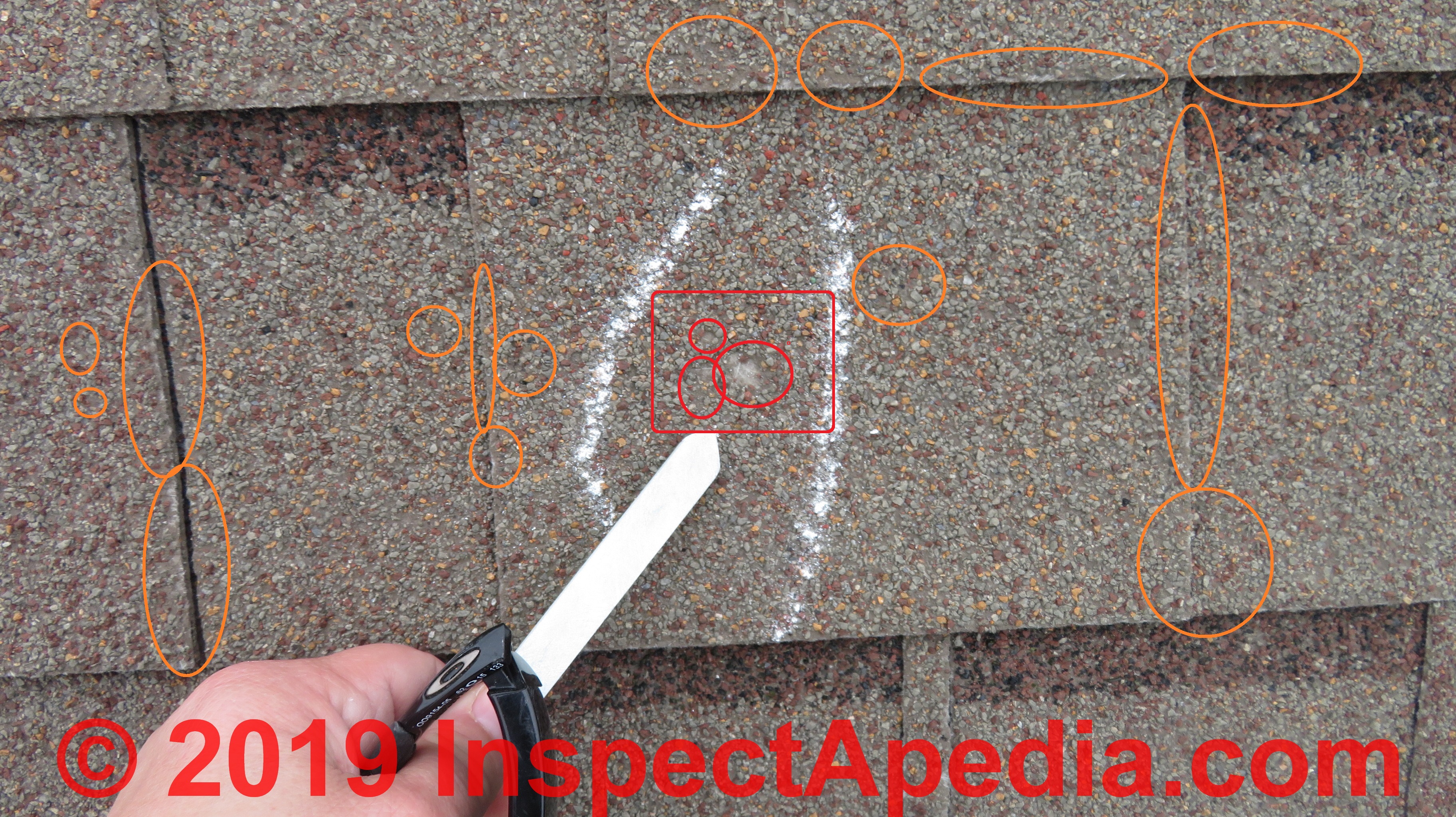
Some hail damage is quite small, only the removal of few granules and possible underlying asphalt leaving behind a small void. But your roof shows larger spots of granule loss and multiple adjacent spots of granule loss characteristic of hail impact.
A careful on-roof inspection may confirm that there are a lot more impact points that can be identified than may have been at-first apparent.
Beware that wear on the raised or exposed edges of shingles that is uniform along the edge is often from foot traffic and is distinct from hail damage.
Take a look and let me know what your adjuster thinks about taking a more-careful look at the entire roof.
Also the term "spatter marks" is perhaps not the best choice of words. "Spatter" usually refers to an over-spray such as paint-spatter when droplets fly through the air and land in a splash on a surface.
What we see on your roof are
- loss of granules in some spots characteristic of impact damage such as from hail. These range from granule loss sufficient to expose the fiberglass-based shingle substrate to other areas of granule loss that are not as severe.
Many of these spots are adjacent or close to one another - arguing for far more damage or granule loss than an occasional isolated area.
Other causes of granule loss such as normal wear, foot traffic, or stepping or weathering of asphalt shingle blisters can look similar but blister rash is easily identified.
See SHINGLE HAIL DAMAGE vs SHINGLE BLISTER RASH
- loss of mineral granules in other spots on your roof that might be from hail but also from foot traffic or even weathering, particularly at shingle edges that are slightly curled
Beyond all that jumping about, whether or not your roof is sufficiently damaged as to warrant a claim needs more data than one photo of one granule loss spot. An overall evaluation of roof condition would be helpful.
On 2020-03-24 by Paul - spatter marks not being sufficient enough in size to create the damage;
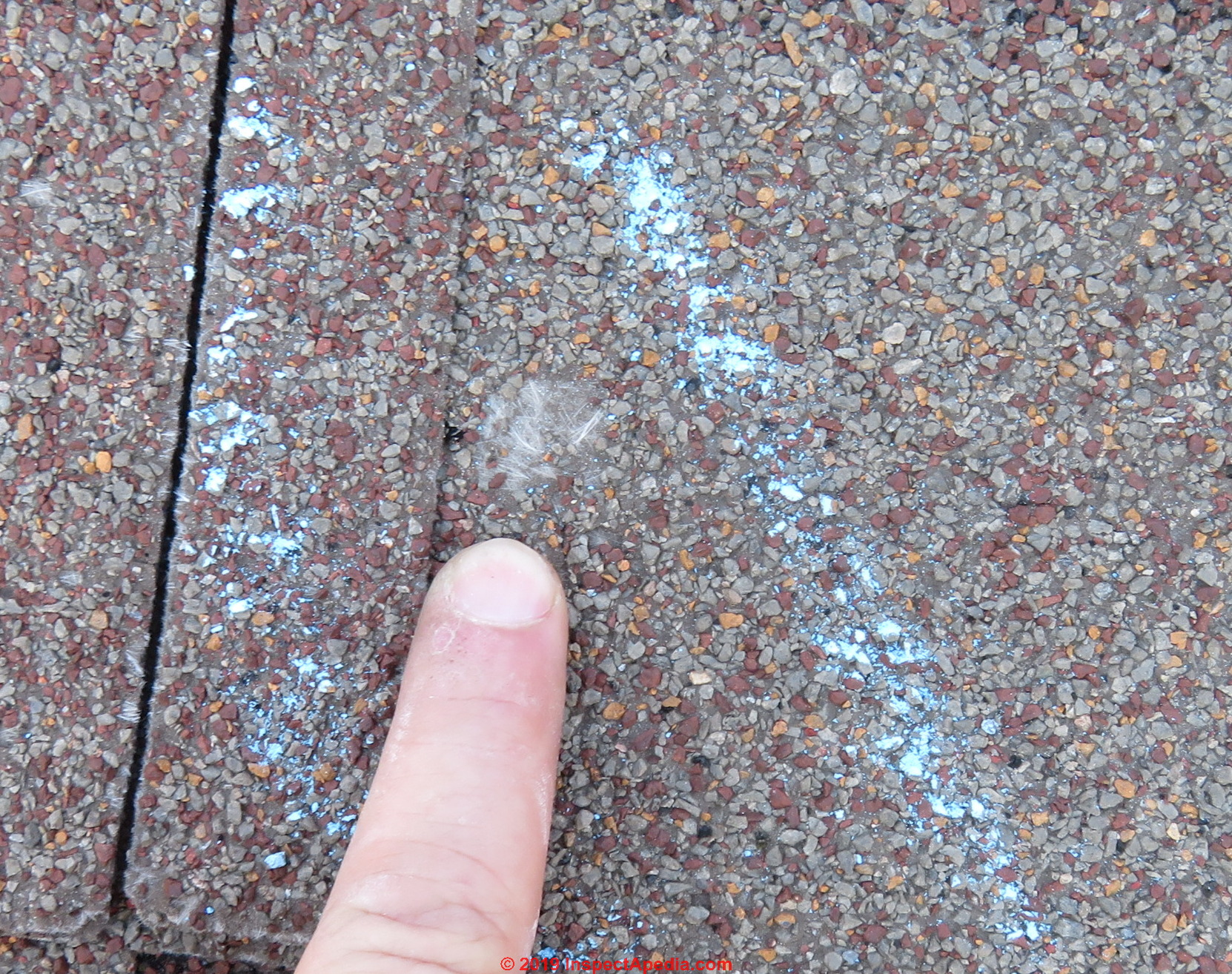 These pictures were taken in March 2020. The damage is based on a storm report indicating 1.5-inch hail at the loss location on April 25, 2017 and an expert has determined that the pictures are not representative of hail damage.
Part of their decision was based on spatter marks not being sufficient enough in size to create the damage; however, a previous storm was reported in October 2019 with 0.8-inch of hail recorded at loss location.
Since spatter marks usually last 1-2 years, it appears they were basing their decision off of spatter marks not initially attributed to the loss.
No protruding nails were observed under the shingles and if a fracture was not observed then it was not accounted for in the test square. Wanted to get your thoughts based on our following stance:
Shingles with old or poor-quality asphalt do not hold granules as well as shingles with newer, high-quality asphalt.
This means that old shingles are more likely to lose granules when struck by hail. As a result, heavy runoff can erode loosened granules; thus, exposing asphalt to UV degradation.
Loss of mineral granules as an immediate or gradual consequence of storm damage can lead to asphalt coating being directly exposed to elements which may lead to accelerated aging of the shingle.
On 2020-02-27 - by (mod) - The insurer cannot deny this claim due to manufacture defect.
Thanks for your comments Adjuster. Your clarification is most helpful - we'll be sure to keep it with the articles.
Apologies if you found some notes on this page "misleading" - certainly we take that complaint seriously and will review the material accordingly. More specific remarks are always very helpful.
Here we report - industry standards, comments from experts, and also building owner experience.
I offer no debate about what the adjuster should do per your remarks, but we have to recognize that what insurance adjusters and insurance companies actually "do" do varies in the field, considerably. Working myself as a consultant for some large insurance companies I found that even within the same company, individual field office practices varied considerably from one town to another.
In order to absolutely assure our readers that we write and report without bias we do not sell any products nor services, nor do we have any business or financial relationships that could create such conflicts of interest.
On 2020-02-26 by Adjuster
This is somewhat misleading information. The insurer cannot deny this claim due to manufacture defect.
It's true that manufacture defect is usually a policy exclusion, however the way the carrier is attempting to interpret the language here is false.
In this scenario; the blisters (defect) is a hazard, which increases the likelihood of a loss, the policy exclusion for defect exists to prevent homeowners from claiming defect as a peril or cause-of-loss.
Once the hail damaged the defective shingles, the carrier was liable because the peril known as hail is covered under the policy.
f this hail would have damaged wood rotted fascia, the carrier would also be liable even though wood rot is almost always excluded from coverage as a peril because the peril in this case is hail and the wood rot just presents a hazard. Important distinction between peril and hazard, don't let the carriers trick you into thinking they're the same.
Now, on the other hand, if an insured attempts to get there roof replaced strictly because they have a defective shingles (no other covered damage present), then the exclusion for defect would apply.
On 2017-12-16 - by (mod) - why do roofs leak after hail damage
V
If a roof leaks immediately after a hail storm and not before, then there is more damage than just lost shingles.
More likely shingles were torn, cracked, or blown off.
Or perhaps you're asking why granule loss leads to leaks? Lost granules - lost sun protection, lost waterproof surface, exposing an asphalt impregnated paper or fiberglass mat that is much less water resistant. Water can penetrate such shingles or if it doesn't immediately it will after sun exposure causes the exposed substrate to crack, pit, or tear.
On 2017-12-15 by v fish
why do roofs leak after hail damage. Understanding the granule loss and over time damage after the hail and it is nearer the end of its product life. B
So why do roofs leak after hail storm? I agree damage exist but the technical reason?
On 2016-05-05 - by (mod) - insurance denied our claim of hail damage.
Laurie,
Unfortunately and depending on the insurance company and their policies, there can be a tendency to hire someone who will report what the insurer wants to hear.
It's usually pretty easy to distinguish between foot traffic (look in specific initial roof access areas) from hail damage (more uniform over the roof slope).
If all that happened to shingles was that algae was removed, you're lucky as there's probably not much loss to the shingles.
Take a look in your gutters and on the ground for mineral granules lost from the shingles: that's another useful indicator of both the timing and extent of granule loss.
"Failure to repair a roof" in my OPINON pertains to improper maintenance (leaving debris on a roof for example) not to granule loss from either normal wear and aging or from a hail storm.
I hesitate to encourage anyone to engage in a long, upsetting, costly dispute, but if you are convinced that the damage is from hail you
1. need unbiased independent, expert inspection and documentation of the conditions
2. an independent insurance adjuster who can help you sort out matters with your company
You can send photos by using the page-bottom or page-top CONTACT link; if they're clear enough I'll post them for comment. But also in my opinion, the on-site expert *always* sees and thus can know more than the remote "expert".
Daniel
On 2016-05-05 by Laurie
Our insurance denied our claim of hail damage. We had two contractors tell us we have significant hail damage. The insurance company hired a structural engineer who made his subjective call on our roof. He stated that hail hit our roof in spots where it cleaned off the algae.
My question was well then what did it do to the rest of the roof where there was no algae as a buffer? He said he just didn't see it but couldn't say if it was hail damage and couldn't say it wasn't. The insurance company denied our claim and is standing behind rather hiding behind the engineers report.
The contractor circled the dents the SE claims is foot traffic.
Nobody was on our roof prior to inspection. Both contractors have stated my roof has the same damage as the rest of the houses surrounding me in the path of that hail storm. Neither one can understand the denial.
And to top it off, after denying we have hail damage, the insurance company is canceling our policy for failure to repair our roof!!! What?? We have filed a complaint with insurance commissioner. If there is a way to post pictures I'd like to see if anyone can determine if it is in fact hail damage. Thanks
Question: Roof inspection procedures: decoding common chalk marks used by roof inspectors to indicate areas of damage or wear
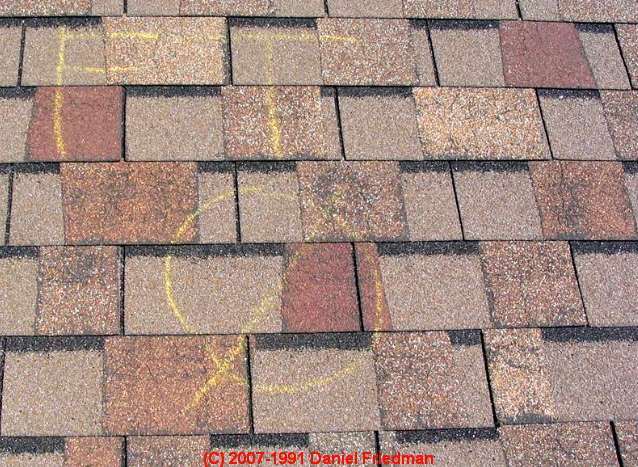
The photo at page top [and shown again at left] in this web article on roof damage inspections shows a circle with a line drawn thru and FT which I figure is meant to indicate "front". What does the circle with the line indicate? Appreciate your help. - R.B.
Reply: Convention for roof damage chalk marking codes
The chalk marks were made on the roof by a local inspector. In our roof damage photo shown at left and above the circle/slash was an area where the roof inspector opined there was no damage, and the "FT" marked above that spot was being used to indicate granule loss due to foot traffic.
Details about chalk codes used to mark on roofs during inspections and to indicate observations are in the article above at Convention for roof damage chalk marking codes.
Question: Expanding the definition of hail damage to include loss of roofing material - not just "dents"
One thing to look at with regards to shingle scouring is if there are any chunks of roofing material (that broke away from the area due to the hail hitting it) left on the surface of the roof after the hail storm. I do not believe that hail damage is only defined as if there was an indentation in the shingle due to the hail.
The impact of the hail, in combination with a rapid temperature drop in the shingle due to the icing effect of the hail can cause the shingle to delaminate and loose parts of the shingle when impacted by a hail stone. - Martin Rizzo 6/21/11
Reply:
Thanks for the helpful comments about hail damage Martin. What you say makes a lot of sense. We agree.
Question: Phoenix hail storm - inspector claims damage due to weather and acid from bird droppings
There was a hail storm in Phoenix, AZ, in October 2010. I was out of the country at the time. I have returned in April 2012. I am in the process of determining if there were hail damage on my roof currently.
The insurance inspector claim there was no hail damage on the roof except on the AC condenser and some of the window screen. The inspector claimed the damages seen on the roof were mainly due to weather and acid from the bird dropping. Is is possible for me to send some photos to you to obtain your opinion? Thank you in advance for your time and help in this matter. - PSF Chan 5/24/12
Reply:
Bird droppings are not likely to produce a shingle scouring / granule loss pattern that would in the slightest be mistaken for hail damage. Even if we buy the "acid damage" claim (which I don't) the birds would have to poop uniformly over an entire roof and the effect would have to be granule loss without remnants of guano.
I'd like to see some sharp photos both of the whole roof, all slopes, and of the slope where the damage seems apparent to you, and sharp close ups of the shingle damage area details. Use the CONTACT US link found on any website page.
Question: Insurance company says shingle defect, GAF says hail damage
We've been told by [our insurance company] that this is the result of manufacturer defect. We filed a warranty claim with GAF and they claim their lab results indicate that the shingles are still up the MFG spec and this is hail damage.
They will not cover this under warranty. I've been told by 3 separate people (contractors and adjuster) that they've never seen shingles this bad before and that this is a serious defect.
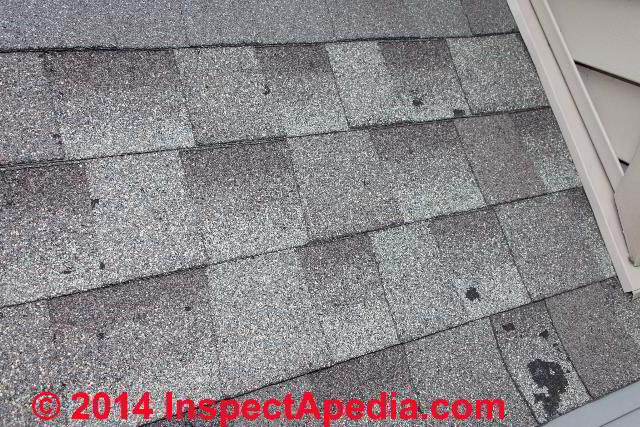
[Click to enlarge any image]

April 12th we had a significant hail storm come through and many in the immediate area (next door neighbors) received full roof replacements and none of them looked like this. These are over a majority of the roof. Are you able to provide any advice or information on what this is and who we could contact to verify GAF's claims? GAF will not supply copies of their lab analysis.
It was brought to my attention by an adjuster that even if this was a defect the hail damage is a subsequent loss and should still be covered under the ensuing loss clause in our policy. - J.F. 8/12/14
Reply: inconclusive photographs of roof shingle granule loss: sorting out hail damage from shingle defect, possible role of shingle blistering
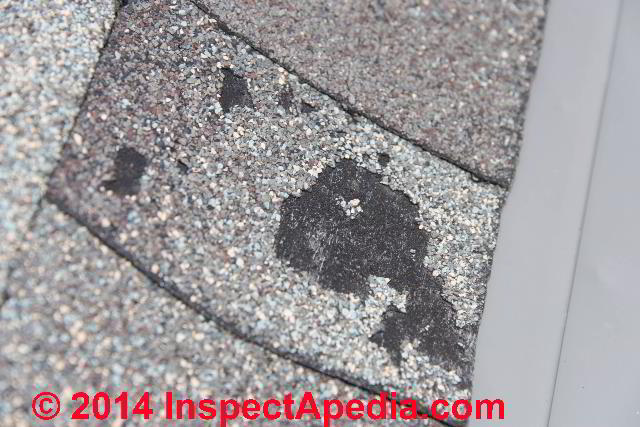
I looked at your photos with interest, though there was not enough information for me to have a confident opinion.
I saw what looked like fragile edges to the bald areas where granules were lost that could indeed suggest recent hail damage and granule loss.
But I also saw weathering [whitening, loss of asphalt] of the exposed shingle substrate black asphalt-filled surface that would have suggested old granule loss. Then I re-read in your note that the hail storm occurred last April.
If your photos of April believed-hail-damage were taken in August, about 4 months later, possibly the whitish weathering I saw occurred on the exposed shingle substrate during that interval.
What I could not see in the shingle photos was good evidence supporting a shingle defect assertion by the insurance company but that doesn't mean they're wrong. For example, if there was surface blistering on the shingles from time of installation, a fabrication artifact that the manufacturers assert is of only cosmetic import, then those shingles would indeed be more vulnerable to impact damage from hail - which breaks the blister tops and leaves substrate exposed.
Unfortunately even if that were the explanation for this case, we're left in a finger-pointing contest. The granule loss will be blamed on hail by the manufacturer who has an arguable position, while the granule loss brought on by hail but really occurring in the exact locations where it did because there was blistering will be mustered as a shingle defect argument by the insurer.
When you said there were lab tests - were shingle samples sent to the manufacturer for testing? And if so, did you point out to GAF that if they refuse to provide test lab results that makes their report to you not only less credible, but puts you in an impossible position with your insurance company? You'd think that if an independent shingle test lab report supports a particular argument made by GAF then they'd be willing to provide the supporting data.
About ensuing loss - that's the value of hiring an expert, independent adjuster who understands insurance policy language - ultimately that may be your best bet.
Also missing from the discussion is a more clear interpretation of the present condition of the shingles and (for you and your adjuster) what that means as a possible basis for insurance claim.
More specifically, roof shingles with bald areas where no protective mineral granules remain are going to wear at an accelerated rate, speeding the time when either leaks occur (risking costly building damage or mold contamination) or when roof replacement is needed to prevent such leaks.
Meaning of "Shingles are Within Specification"
I would like some clarification from GAF on what was meant by shingles being "within specification" since in my opinion, no asphalt roof shingles with notable bald areas can be considered having a long remaining service life.
- Thus if the granule loss occurred due to hail there is a loss (of roof value and remaining life) following the hail storm.
- If the granule loss occurred due to a product defect (or a combination of product defect and subsequent hail) there is still a loss of remaining roof life that could raise a roof warranty claim question.
In sum, sorry but from just your photos I am not confident about a conclusion. I'd need to see more, better images, test reports, or to have on-roof access.
Hail Damage Versus Defective Roof Shingles vs Blistering Damage
As this case report illustrates, multiple signs of wear or damage may be present on on a roof as well as other roof shingle features that may be mistaken for damage. Sorting these out can confound insurance adjustment claims and conflicts of interest may lurk where an inspector doesn't want to upset the insurance company or where he or she stands to profit by performing repair work on the building.
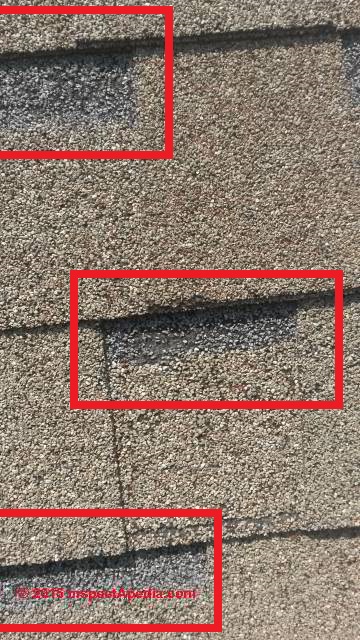
Reader Question: My Denver, CO neighborhood was hit with 2 major hail storms - June 4 and June 24. I called my insurance company June 26 and they sent out a roofer the same day. He went up on the roof for a few minutes. He told me he did not see hail damage.
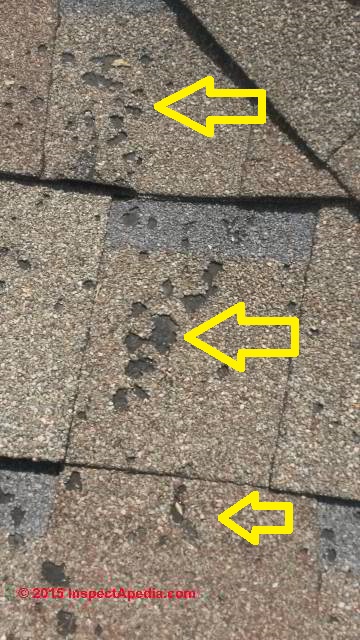
[Editor's note about the damaged shingles above: where bare, bald shingle substrate is exposed these shingles have a shortened remaining life. ]
He said I have a Manufacturing defect.
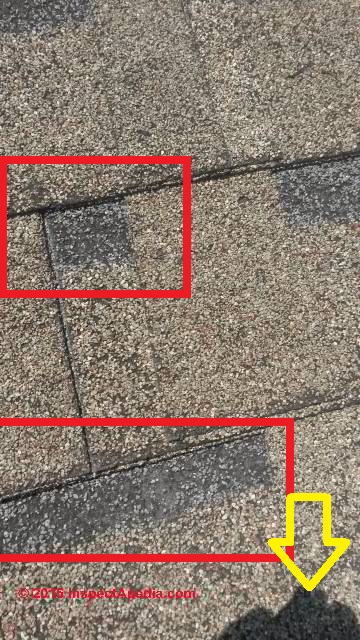
I attach photos he took. I believe they're from a north facing slope with the lowest pitch - east of the gable front. The roof has various pitches some of which are quite steep. In a separate email, I will send you house photos. The roof was installed in 2001 and the shingles are Atlas StormMasterLM with a 40 year warranty.
The stucco front porch was enclosed in 2004 and the roof over that portion has identical shingles installed. In 2008, the addition which has the bay window in the back yard was built and also used the identical shingles.
Please can you give me your assessment.
Thanks for your help. - Name withheld. 28 June 2015
Reply: rectangular shaded areas vs. pitting and granule loss on asphalt shingles
Of your three photos, two show dark rectangular areas of shading on the shingles (marked by red rectangles) - most likely a deliberate manufacturing artifact to give shading and texture to the roof appearance and definitely not hail damage. Hailstones won't leave a regular vertically or horizontally delineated mark on individual roof shingles.
But on two of your photos my yellow arrows point to granule loss that could be due to scouring from hailstones or from breaking opening of roof blistering due to hailstone impact.
See SHINGLE HAIL DAMAGE vs SHINGLE BLISTER RASH
The center photo above shows what could certainly be hail damage and the black bald open shingle in the right-most photo could also certainly be due to hail damage.
Take a look at the hail damage article and the shingle blistering article series at InspectApedia.com. These topics are related. Shingle manufacturers assert that shingle blisters are a harmless manufacturing artifact. But hail impacting shingle blisters can leave exposed shingle substrate such as shown in your ...0613 photo earlier than that would otherwise appear. The result is typically not an immediate roof leak but a reduction in remaining roof life.
To help sort out roof wear (or defective shingle product) from storm damage I would consider the following:
Defective shingle product effects will show up on all roof slopes (unless the roofer did not install the same product on all slopes) with variations in the extent of defect appearance as a function of roof slope, sun exposure and the occasional appearance of individual bundles of shingles that were defective - for example due to improper storage.
(More sun, lower slope = faster shingle wear). Some defective products show up as individual shingle damage amidst a field of shingles that otherwise look OK. Other types of defective shingle product such as cracking are described at InspectApedia.com
Hail damage will also show up on all roof slopes, will be uniform across an individual slope, but is likely to be more severe on lower roof slopes and on slopes that were facing the principal direction of hailstone impact (where wind is a factor).
Inspecting your roof, for example, if we saw shingle blisters on all slopes but open shingle blisters after a hail storm appearing principally on low slopes or slopes facing the primary direction of impact of the hailstones, that would be a compelling argument for a hail-damaged roof.
Reader follow-up: Should I ask for additional roof inspections?
I need to develop a course of action. Should I seek additional inspections by roofers? If they confirm there is hail damage, I can then put in a claim to my insurance company and hope they will not fight me on this? As the main roof is 14 years old, is it worthwhile to make a claim against the manufacturer? (I don't have paperwork on the 2 newer sections.)
I see that I would get maybe only half the cost of the main roof shingles. I assume they make a cash payment and then I could choose new shingles from any manufacturer? Given the dimensions and slope of my roof, do you have any recommendations on which shingles to choose? - Anon.
Reply: Yes, ire an independent roofing expert
You need an unbiased on-site expert. I would not be overly optimistic on collecting on roof warranties unless you've the energy to be a squeaky hinge - ok so that's a poor analogy but you get the idea.
On a 14 year old roof, to make a warranty claim we need to know the roof shingle product and the details of the roof warranty that applies. If your roof is close to end of rated life or warranted life it's not worth spending much on arguing. Same with the insurance company.
See HAIL DAMAGED SHINGLES & OTHER ROOF COVERINGS for more help in recognizing hail damaged shingles, and do keep me posted.
The decision on replacement shingles depends in part on how long you intend to remain in the home.
Reader Follow-up: plan to obtain an independent assessment of roof condition, damage types, cause
Thanks so much for your advice. Perhaps I will get an independent assessment as well as make a claim so an adjuster comes out. The gutters are badly pitted and some screens have small tears so I think it's worth it. The storms were strong enough to break several limbs on my ash trees.
I will let you know how it turns out - Anon, 28 June 2015
Example of Shingle Damage from Hail, Scouring, Granule Loss
Here's my update. I had other roofers take a look. One of their photos of hail damage is below. They all said I had significant hail damage. It was noted there was pitting which could be caused by blisters (defect?) but there was separately lots of hail damage.
I had an insurance adjuster come out and he said I needed a complete new roof, new gutters, replacement of various window screens and cladding, replacement of exterior post lights, re-staining fence, etc.!
So, it seems a bit fishy that the roofer sent out by the agent initially said I had no damage. Do you have any comments?
I do have one question. I have 2 Velux skylights in the vaulted roof. They do not appear to have any damage. The adjuster and the roofer said they would just get new Velux flashing kits for them. Online, the consensus seems to be that the skylights should be replaced when the roof is replaced. What is your opinion? - Anon, 22 July 2015
Reply: conflicts of interest in building or roof inspections
Your photo shows some granule loss of your roof shingles that in my OPINION could fairly be caused "damage" but if we don't see bare, exposed roof shingle substrate (the asphalt-impreganted shingle base or mat) then the damage may be minimal and the impact on remaining roof life may be also minimal.
Regrettably there are often conflicts of interest. A building inspector whose opinions are costing the insurance company more than the company feels is appropriate may find herself or himself out of a job.
Similarly, some real estate agents will not refer home buyers to home inspectors who inspect and report thoroughly because they're afraid that their deal may be hampered - which is too bad since it's rare to find conditions so costly that buying a home is unreasonable.
See CONFLICTS OF INTEREST for details.
The last photo you sent certainly looks like hail damage to me.
The opinion that skylights should be replaced when a roof is replaced makes sense only if the skylights are an older leak-prone type. Modern Velux skylights should be re-usable when flashed with new flashing kits.
Question: resolution of hail damage case?
Is it known whether this man and his situation with blisters vs hail damage mentioned above ever won his case with his insurance co? I too have the same problem. - Tom McLaughlin 8/22/11
Reply:
No Tom, we have not had more feedback, though the case described above was unusually well documented.
Question: What about other roof products that are more resistant to hail damage
Why are there no concrete roof tile products mentioned under hail resistant roofing? Are they not more durable than asphalt shingles? - Robert Joseph 7/10/12
Reply:
Robert, we agree that concrete roof tiles are more hail resistant than thinner softer products such as asphalt shingles. This article is about recognizing hail damage to asphalt shingles and distinguishing hail damage from other types of asphalt roof wear such as granule loss, blistering, foot traffic, cracking, &c.
The issue of distinguishing hail from other wear on concrete roof tiles has not arisen, though I speculate that in extreme cases such as baseball sized hail that occurs in some locales, all roof materials, including concrete, tile, slate and stone can suffer damage as well. See Hail Damage Resistant Roofing Products.
Question: when is entire roof replacement vs just individual shingle repacement justified ? How many hail stone hits per square justify a new roof.
What warrants replacement of entire roof versus repairing only damage shingles from hailstones? How many hail stone hits per square warrant entire roof replacement? Thanks - Anon
When testing for hail stone hits, how do you conclude which area to test? From an adjuster's view, do you choose the best square or most damaged square? - Anon
Reply:
If the roof is worn out and leaking it needs replacement;
If the roof has been hail-scoured but is not leaking and not at immediate end of life in the view of an unbiased expert, then replacing it is not appropriate nor cost justified. If I were an insurance adjuster, in my OPINION, I would consider giving a pro-rated allowance for hail damage on a roof by figuring out
- the roof's remaining life before the hail damage occurred (infer this by examining non-scoured shingles or non-scoured roof slopes as often hail is directional and so damage is not at all uniform)
- the estimated reduction in remaining roof life because of the hail damage
- if some slopes were not hail damaged at all I'd exclude them from the adjustment
I don't think the answer to amount of damage is based on number of stone hits per square, but rather, we should look carefully at the shingles to see the total extent of granule loss over the whole roof, and the DEPTH of granule loss on shingles, and in particular, if there is bald shingle substrate exposed on shingles, those individual shingles have a short remaining life (to be more specific we need to consider slope, age, climate and other factors).
Example:
If I inspect a roof with 10% (or some other TBD %) of the shingles on a given slope having 1/4 to 1/2" absolutely bald spots on the shingles, showing the shingle substrate, for an organic OR fiberglass shingle, in my opinion the safe reliable remaining life of that roof slope is less than 5 years.
As an insurance adjuster (which I am not, though I do advise insurers and adjusters as a neutral professional), in deciding to offer an allowance and to encourage roof replacement within that period, I would be considering also a wish to reducce or even avoid the risk of a future property loss due to a roof leak on a roof that should have been replaced sooner.
I welcome debate on these questions in order to arrive at as consistent and fair an assessment procedure as we can.
Question: I don't see hail damage from the ground but I'm worried
(Dec 15, 2015) Keith Kosmin said:
I have a question. We had a hail storm last May. There was a lot of hail but they were all small diameter. I was most concerned about my vehicles which were parked outside due to a project set up in my garage.
After the storm, I checked the vehicles and none had hail damage. About a week later my neighbor mentioned that he was getting a roof replacement due to hail damage. Many neighbors have now also had roof replacements done.
From the ground, I can see no damage as described in this article. I did see a small amount of roofing granuals on the driveway. My house is several years newer than the surrounding houses and is a two story house with a steeper roof pitch than the neighbors. The roof is about eight years old and a contractor for my neighbor said my roof shingles were much more expensive than typical.
I bought this house five years ago and have no information on the type asphalt shingle installed. I'm worried that I'm passing up an insurance claim, but also have a very high deductible for this type damage. Should I be concerned?
Reply:
Keith,
A close-up inspection of the roof gutters and also of the ground surface at the ends of your downspouts will be a useful quick-test of the problem. If there was notable granule loss you'll see the granules from your shingles in one or both of those locations.
Hail Damage to Roofs, Research Citations
- Also see our research citations atReferences or Citations
- Argonne National Laboratory, Office of Science, U.S. Department of Energy, "Vertically Shot Bullet Landing Speed", Michael R. Rayno (Rev), Argonne National Laboratory, Building DEP/223 9700 S. Cass Ave. Argonne, Illinois 60439-4845 USA
This article provides calculations and examples of the terminal velocity of a hailstone. Web search 03/14/2011, original source: newton.dep.anl.gov/askasci/phy05/phy05051.htm
Quoting:
HAILSTONE:
A spherical hailstone weighing 10 gm has a volume of 10 cm^3 since the density is 1 gm/cm^3. REALITY CHECK: The volume = 10 cm^3 = 4/3 *pi* r^3. So r^3 = 2.4 cm^3 or a radius of r = 1.3 cm or a diameter of 2.6 cm (a fairly nominal hailstone -- about an inch in diameter).
The potential energy of a hailstone weighing 10 gm = 10^-2 kg falling from 10 km is: P.E. = m*g*h = 10^-2 * 9.8 * 10,000 (about 10^-2+1+1 = 10^0 = 1 Joule).
Its velocity assuming complete conversion of the P.E. to K.E. = 1/2*m*(v)^2 gives: 1 = 1/2x10^-2*(v)^2 or v^2 = 200 m^2 or about 15 m / sec - Dieling, Christian, Milton Smith, and Mario Beruvides. REVIEW OF IMPACT FACTORS OF THE VELOCITY OF LARGE HAILSTONES FOR LABORATORY HAIL IMPACT TESTING CONSIDERATION [PDF] Geosciences 10, no. 12 (2020): 500.
Abstract:
The terminal velocity of hailstones is an essential quantity in hail research. It is an important value for the kinetic energy of hailstones and has to be carefully considered when laboratory hail impact testing is being planned. Many standardized hail impact testing procedures require specific impact velocities.
Several empirical models for various hailstone diameter ranges have been developed to calculate the velocity based on the diameter, indicating somewhat inconsistent results.
The velocity is influenced by factors such as their density, drag coefficient, shape or air density, and strong winds. This article takes a closer look into each of these factors and how they influence the velocity of hailstones and the damage potential of hailstorms.
Implications are made for laboratory testing of hail impact testing procedures and how the geographic location of hailstorms might be a considerable factor when designing a test.
Excerpt:
Impact testing for structures usually deals with larger hailstone sizes, as the size is closely connected to the damage inflicted on ground structures [8]. Structural damage results from a sufficiently high kinetic energy.
The threshold size for hailstones to damage structures, especially roofs, is given as 3.81 to 5.08 cm (1.50 to 2.00 Inches) [9,10]. These threshold sizes vary based on the roofing material but seem to be reasonable estimates for a wide range of materials [11].
The kinetic energy of an object is calculated from its movement or velocity and its mass. For a hailstone, this movement originates from gravity, and its final velocity is a combination of the terminal velocity and a wind component, a relationship that will be discussed in this review.
- Haag Research IMPACT TESTING of IMPACT-RESISTANT SHINGLES [PDF] White Paper, Haag Research & Testing, 1410 Lakeside Pkwy., Ste. 100 800.527.0168
Flower Mound, Texas 75028 USA Tel:L 214.614.6500
Web: HaagResearchTesting.com HaagGlobal.com
Excerpt:
An increasing number of asphalt roof shingles are being touted for their hail impact-resistance. Hail resistant shingles are desired because the process of removing and replacing a roof is costly and disruptive.
Furthermore, many property insurance carriers offer significant discounts on insurance premiums when impact-resistant shingles are installed. Haag Research & Testing Co. (HRT) performed a study on impact-resistant asphalt roof shingles to evaluate their performance. - "Products Qualifying for Impact Resistant Roofing Credits", Texas Department of Insurance - see http://www.http://tdi.state.tx.us/home/roofingx.html
- Reichl, Justin, "How to Spot Hail Damage (with pictures)", [web page], Justin Reichl, Roofing Life, Tulsa, Oklahoma, USA, Tel: 918-978-6544, Email: info@roofing.life Website: www.roofing.life, retrieved 2015/12/28, original source: https://www.roofing.life/hail-damage-roof/
- "Roofing: Premium Credits Product Listing, Roofing Products Eligible for Discount", State Farm Insurance 5/1/2010 - Web Search 07/12/2010, original source http://www.statefarm.com/_pdf/nationwide.pdf [copy on file as /roof/State_Farm_Premium.pdf]
- Greenfeld, S.H., 1969: Hail resistance of roofing products, Building Science Series #23, National Bureau of Standards, 9 pp. Koontz, J.D., 1991: The effects of hail on residential roofing products, Proc. of the Third International Symposium on Roofing Technology, NRCA/NIST, 206-215.
- Koontz, Jim D. "The effects of hail on residential roofing products." In Proceedings of the Third International Symposium on Roofing Technology,” NRCA/NIST. 1991.
- Marshall, Timothy P., Richard F. Herzog, and Scott J. Morrison. "Hail Damage to Asphalt Roof Shingles." In 22nd Conference on Severe Local Storms. 2004.
- Marshall, T. P., and R. F. Herzog, 1999: Protocol for Assessment of Hail-Damaged Roofing, Proc. of the North American Conf. on Roofing Technology, Toronto, Canada, p. 40-46.
- Marshall, T.P, R.F. Herzog, S.J. Morrison, and S.R. Smith, 2002. Preprints, 21st Conf. on Severe Local Storms, San Antonio, TX, Amer. Met. Soc., 95-98.
- Marshall, Timothy P., Richard F. Herzog, Scott J. Morrison, and Steven R. Smith. HAIL DAMAGE TO TILE ROOFING [PDF] - retrieved 11/19/2014, original source: https://ams.confex.com/ams/pdfpapers/81093.pdf?referer=www.clickfind.com.au
- Marshall, T.P., Herzog, R.F., Morrison, S.J., HAIL DAMAGE TO ASPHALT ROOF SHINGLES [PDF] Haag Engineering Co., Dallas TX, retrieved 8/8/2014 as republished (with permission ?) at stormstopperroofing.com/faq/roofing-hail-damage-asphalt-shingles/
Introduction excerpt:
Controversies can arise with regard to how asphalt shingles are damaged by hail, and what hail damage actually looks like. More specifically, questions have been raised as to whether granules removed from asphalt shingles during a hailstorm will reduce the expected life or water shedding ability of the roof shingles.
Note: the author's study and opinion is that a small amou0nt of granule loss caused by a hailstorm does not significantly impact the water shedding ability of the roof nor its life because granule loss is expected during shipment, installation, and weathering of a roof and "exposure to hail is built into the design".
The authors report that between 12 and 15 percent of the surface granules had to be removed before the asphalic mat was exposed.
The authors' opinion is that "the small quantities of granules removed from shingles during a hailstorm does [sic] not shorten the life of the roof as long as the impacted areas are anot bruised or punctured and remain covered with granules."
Really? Our [DF] OPINION, is that that conclusion is reasonable but that by no means does it describe the full range of hail damage that occurs to asphalt roof shingles; based also on iour own inspection of hail-damaged and other worn asphalt shingle roofs is that at least some hailstorms do remove enough granules that the asphaltic mat or substrate of the shingle is left exposed to the weather, reduciing the remaining roof life.
An on-roof or at roof-edge inspection following a hailstorm as well as photos of such inspections found in this article series includes some of these more-serious hail damage instances. - Metal Roofing, an Illustrated Guide, R.A. Knowlton , [metal shingle roofs]
- Morrison, S.J., 1999: Long-Term Effects of Hail on Asphalt Composition Shingles Proc. of the North American Conf. on Roofing Technology, Toronto, Canada, 30-39.
- Tile Roofs of Alfred: A Clay Tradition in Alfred NY
Hail Damage Compared to Asphalt Shingle Blister Damage
This topic has moved to SHINGLE HAIL DAMAGE vs SHINGLE BLISTER RASH
Home "Oven Test" Attempts to Replicate Roof Shingle Damage from Hail
Now found at SHINGLE HAIL DAMAGE REPLICATION
Convention for roof damage chalk marking codes
Now moved to SHINGLE HAIL DAMAGE CHALK MARKING CODES
Hail Damage Resistant Roofing Products
This topic is now found at SHINGLE HAIL DAMAGE RESISTANT PRODUCTS
See METAL ROOFING
Also see PLASTIC ROOFING TYPES for examples of impact resistant roof materials.
...
Continue reading at SHINGLE HAIL DAMAGE vs SHINGLE BLISTER RASH or select a topic from the closely-related articles below, or see the complete ARTICLE INDEX.
Or see these
Recommended Articles
- GRANULE LOSS from SHINGLES
- HAIL DAMAGED SHINGLES & OTHER ROOF COVERINGS - home
- MECHANICAL DAMAGE of SHINGLES
- SHINGLE HAIL DAMAGE vs SHINGLE BLISTER RASH
- SHINGLE HAIL DAMAGE REPLICATION
- SHINGLE HAIL DAMAGE CHALK MARKING CODES
- SHINGLE HAIL DAMAGE RESISTANT PRODUCTS
- WARRANTIES for ROOF SHINGLES
Suggested citation for this web page
HAIL DAMAGED SHINGLES & OTHER ROOF COVERINGS at InspectApedia.com - online encyclopedia of building & environmental inspection, testing, diagnosis, repair, & problem prevention advice.
Or see this
INDEX to RELATED ARTICLES: ARTICLE INDEX to BUILDING ROOFING
Or use the SEARCH BOX found below to Ask a Question or Search InspectApedia
Ask a Question or Search InspectApedia
Try the search box just below, or if you prefer, post a question or comment in the Comments box below and we will respond promptly.
Search the InspectApedia website
Note: appearance of your Comment below may be delayed: if your comment contains an image, photograph, web link, or text that looks to the software as if it might be a web link, your posting will appear after it has been approved by a moderator. Apologies for the delay.
Only one image can be added per comment but you can post as many comments, and therefore images, as you like.
You will not receive a notification when a response to your question has been posted.
Please bookmark this page to make it easy for you to check back for our response.
Our Comment Box is provided by Countable Web Productions countable.ca
Citations & References
In addition to any citations in the article above, a full list is available on request.
- "Products Qualifying for Impact Resistant Roofing Credits", Texas Department of Insurance - see tdi.state.tx.us/home/roofingx.html
- [2] "Roofing: Premium Credits Product Listing, Roofing Products Eligible for Discount", State Farm Insurance 5/1/2010 - Web Search 07/12/2010, original source http://www.statefarm.com/_pdf/nationwide.pdf [copy on file as /roof/State_Farm_Premium.pdf]
- [7] Greenfeld, S.H., 1969: Hail resistance of roofing products, Building Science Series #23, NationalBureau of Standards, 9 pp.Koontz, J.D., 1991: The effects of hail on residentialroofing products, Proc. of the Third International Symposium on Roofing Technology, NRCA/NIST,206-215.
- [8] Marshall, T. P., and R. F. Herzog, 1999: Protocol for Assessment of Hail-Damaged Roofing, Proc. of the North American Conf. on Roofing Technology, Toronto, Canada, p. 40-46.
- [9] Marshall, T.P, R.F. Herzog, S.J. Morrison, and S.R.Smith, 2002. Preprints, 21st Conf. on Severe Local Storms, San Antonio, TX, Amer. Met. Soc., 95-98.
- [10] Morrison, S.J., 1999: Long-Term Effects of Hail on Asphalt Composition Shingles Proc. of the North American Conf. on Roofing Technology, Toronto, Canada, 30-39.
- [11] Ribble, R., D. Summers, R. Olson, and J. Goodman: From generation to generation: issues and problems facing the steep-slope roofing industry. Proc. of the 10th Conf. on Roofing Technology, 1-5.
- [12] "Roofing: Premium Credits Product Listing", State Farm Insurance, - Web Search 07/12/2010 original source http://www.statefarm.com/_pdf/nationwide.pdf
- [13] Asphalt Roofing Residential Manual from ARMA the Asphalt Roofing Manufacturers Association Website https://www.asphaltroofing.org/product/residential-asphalt-roofing-manual/
- [14] Building Pathology, Deterioration, Diagnostics, and Intervention, Samuel Y. Harris, P.E., AIA, Esq., ISBN 0-471-33172-4, John Wiley & Sons, 2001 [General building science-DF] ISBN-10: 0471331724 ISBN-13: 978-0471331728
- [15] Building Pathology: Principles and Practice, David Watt, Wiley-Blackwell; 2 edition (March 7, 2008) ISBN-10: 1405161035 ISBN-13: 978-1405161039
- [20] Problems in Roofing Design, B. Harrison McCampbell, Butterworth Heineman, 1991 ISBN 0-7506-9162-X (available used)
- [21] Roofing The Right Way, Steven Bolt, McGraw-Hill Professional; 3rd Ed (1996), ISBN-10: 0070066507, ISBN-13: 978-0070066502
- In addition to citations & references found in this article, see the research citations given at the end of the related articles found at our suggested
CONTINUE READING or RECOMMENDED ARTICLES.
- Carson, Dunlop & Associates Ltd., 120 Carlton Street Suite 407, Toronto ON M5A 4K2. Tel: (416) 964-9415 1-800-268-7070 Email: info@carsondunlop.com. Alan Carson is a past president of ASHI, the American Society of Home Inspectors.
Thanks to Alan Carson and Bob Dunlop, for permission for InspectAPedia to use text excerpts from The HOME REFERENCE BOOK - the Encyclopedia of Homes and to use illustrations from The ILLUSTRATED HOME .
Carson Dunlop Associates provides extensive home inspection education and report writing material. In gratitude we provide links to tsome Carson Dunlop Associates products and services.
 | HOME | ABOUT | ASK a QUESTION | CONTACT | CONTENT USE POLICY | DESCRIPTION | POLICIES | PRIVACY | |
| © 2024 - 1985 Publisher InspectApedia.com - Daniel Friedman | |||||||||