
InspectAPedia® FREE Encyclopedia of Building & Environmental Construction, Diagnosis, Maintenance & Repair |
Question? Just ask us! InspectAPedia
|
 Asphalt Shingle Curling
Causes & Effects of These
Signs of Shingle Wear

- POST a QUESTION or COMMENT about curling asphalt roof shingles: causes & cures
Curling asphalt shingle roofs:
This article describes shingle curling as a sign of wear on asphalt shingle roofs and discusses how to identify & explain the most-common asphalt roof shingle failures. We illustrate different asphalt shingle curling patterns, types & causes, and we discuss how to decide if a curling-shingle roof can be repaired or if it needs replacement.
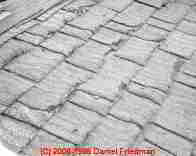
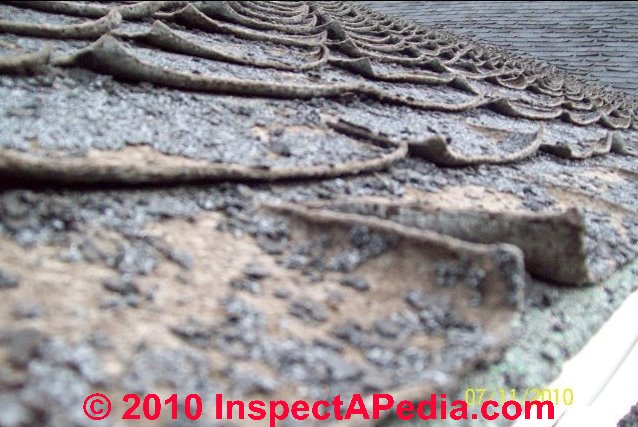
We also illustrate early roof shingle failure on a 6-year old installation. Our page top photo shows shingle edge down-curling. Other photos on this page show shingle corner curling.
InspectAPedia tolerates no conflicts of interest. We have no relationship with advertisers, products, or services discussed at this website.
Curling Asphalt Shingle Explanation & Photos
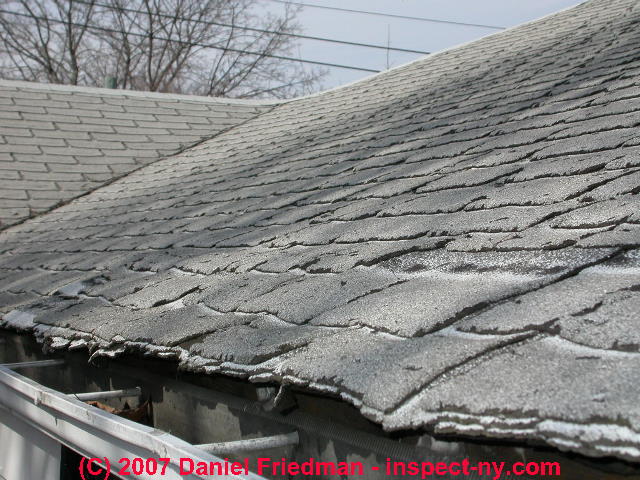
Shingle curling defects occur on both organic-mat or fiberglass-mat asphalt roof shingles, though we see them more often on organic-mat shingles.
Curling roof shingles (as shown here) will show a curling-under at the edges of the shingle tab, first at the lower edge and sometimes also at the two sides of the shingle tab. The page top photograph of curled roof shingles shows a worn-out roof that needs replacement as soon as possible.
[Click to enlarge any image]
Making the distinction between "curled" roof shingles as shown on this page and "cupped" roof shingles as shown on the previous page may be a bit of a nuance of mostly academic interest since both conditions are signs of an older, worn roof.
But we have found that stepping on and breaking the edge of a curled roof shingle might cause less damage than that caused by walking on a cupped shingle roof where larger pieces of shingle break off under the feet of a thoughtless "roof inspector".
In fact we have seen a "failed" roof that was not leaking until the fellow who was asked to inspect it walked across this fragile surface.
From a ladder at the roof edge one could clearly see the virtual footprints of broken shingle edges where the "inspector" had walked. It's best to stay off fragile roof surfaces to avoid converting a "near end of life" condition to a "failed, leaking" condition.
Curling and cupping may occur together on the same roof, or shingles may appear to be curled-only (or fishmouth-curled-only as you'll read next). We don't see cupping without some curling.
As we advised about cupped roof shingles, when inspecting a a curled-shingle roof we would also be careful to stay off of it, particularly in cold weather since as with cupped or fish mouthed shingles they are more likely to break when stiff and cold.
And as we said earlier, if you have to walk on such a roof, move carefully, avoiding stepping on the raised or cupped shingle sections.
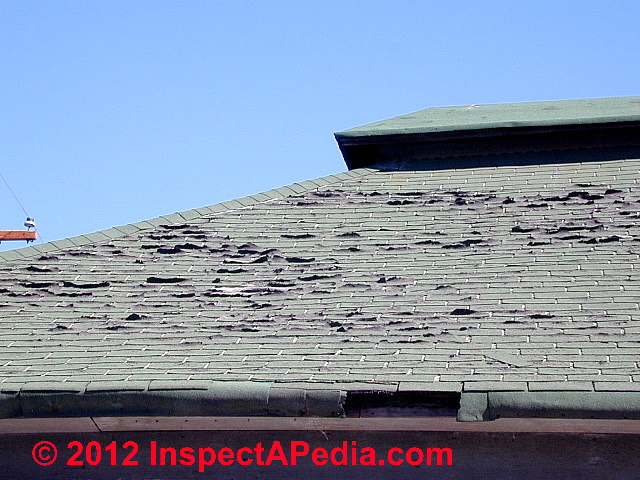
The badly curled, failing asphalt shingle roof shown at left was observed on a home in Arizona - certainly not a freezing climate, but nonetheless, walking on this roof will only cause further damage. These shingles are worn out and need replacement. [Click any InspectApedia image to see an enlarged version.]
It is rare that it's cost justified to repair a badly curled-shingle roof, but if it's absolutely necessary, perhaps as a stopgap measure while waiting for a whole new roof, when making curled shingle roof repairs, either work from adjacent surfaces which are in better condition, work your way down the roof from damaged areas back to the ladder, or prop a ladder up off of the roof surface and work from that scaffold as is sometimes done with slate or other fragile roof surface repairs.
Six Year Old Roof Shingle Curling & Granule Loss Diagnosis & Commentary
Question about early asphalt roof shingle failure:
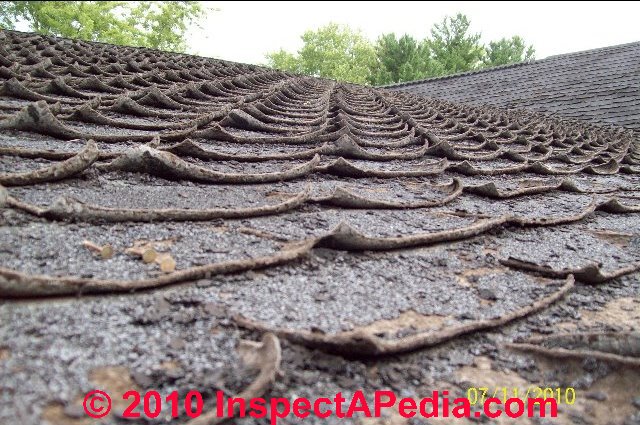
I live in Wisconsin and had my roof replaced (total strip down) about 6 years ago. Now my shingles are curling up or fish mouthing. I do not know what you call it but it looks terrible . Can you help me out? A friend said to check on the internet for something with Owens Corning.
I believe they are 30 yr shingles. I do not have any of the paper work but when they put them on they said they only use premium shingles. Check out the rain gutter. It is 3/4 full of shingle fragments and granules. The rest of the roof shingles still look good. Any help would be great. - Louis Tolley, Adams WI
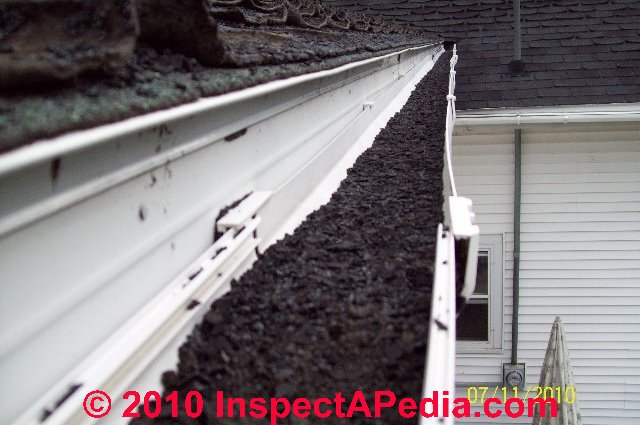
Answer and advice on diagnosing a failing fishmouthed shingle "new roof" job:
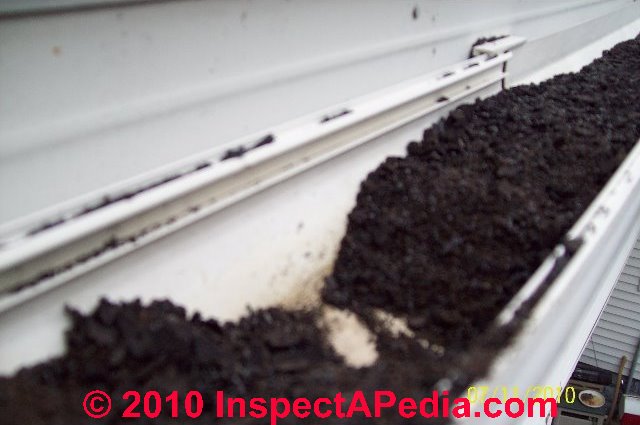
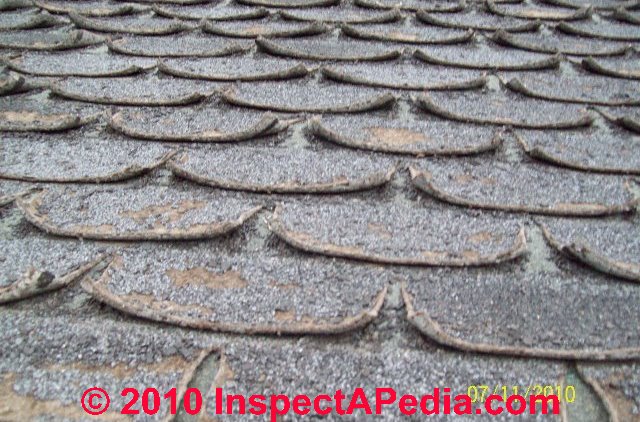
The roof shingle wear pattern in your photos is easily mistaken for "fishmouthing asphalt roof shingle" but what we see in your photos is not "fishmouthing" but rather shingle curling, combined with extreme granule loss.
The definitions of shingle cupping, curling, and fishmouhing are given
at ASPHALT SHINGLE FAILURE TYPES
where we include photos of each of those wear patterns. It's worth getting the terms correct if for no other reason than to waste time arguing about the condition of a roof and its remaining life.
More, while shingle curling and cupping are normal wear patterns on older asphalt shingle roofs, in some patterns, and certainly in the fishmouth pattern, there is a suggestion of an underlying moisture or roof venting problem that needs attention.
Comparing Shingle Fishmouth Patterns with Shingle Curling Patterns
Fishmouthing asphalt shingles appear as an upwards curve in the center of shingle tabs, usually where the center of a fishmouthed shingle tab crosses over the shingle butt joints in the course below. See the fishmouth shingle photos above on this page.
Shingle tab curling, such as shown in your photos, occurs at the corners of shingle tabs, not in the center of the tab.
How old is This Roof Wear-Out?
Regardless, your roof photos show severe wear and curled shingle tabs that we see at the end of roof life - your photos of this worn roof slope show that every single shingle tab is curled up from a corner – that combined with the significant granule loss would be very unusual on a six-year-old roof.
We comment further and provide some roof failure diagnostic questions just below.
From looking at the photographs, and recognizing that we are not looking at the entire roof, some comments and questions arise that should help sort out this "early roof failure" mystery:
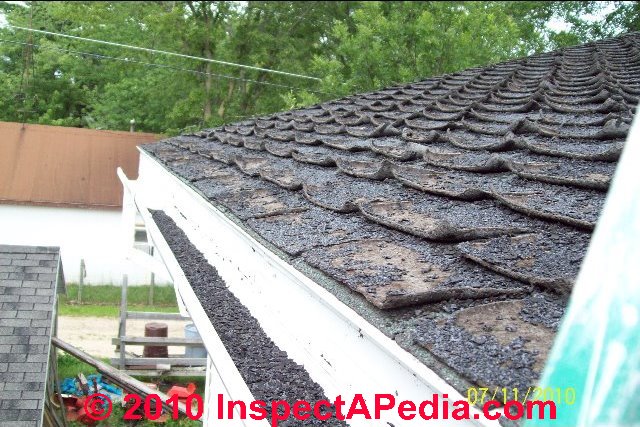
- The roof slopes in your photographs are totally worn out
- This does not look like a six year old roof
- Your comments suggest that other roof slopes are fine.
- Before we assume that the wear difference is due to the building, roof ventilation, weather exposure, or a similar cause, let's consider that the roof is reported to be just six years old - actually we wonder if that's quite right.
Six-Year-Old Roof Shingle Failure Diagnostic Questions
Watch out: First off - don't fall off the roof while you are up there looking around.
Don't walk on these fragile, damaged asphalt shingles - they'll break and leak.
Go back to look at your information on your 6 year old re-roof job with the questions listed below. If you have no records and no documentation of who did the roof, what was the contracted scope of work (all slopes or just some) we can still figure this out by inspection of the whole building.
- What type of shingles were installed in your re-roof job six years ago (your photos of failing shingles look like organic base not fiberglass base)
- Are the same type of shingles present on all roof slopes?
- Were all the roof slopes re-roofed or just some slopes? Sometimes only the worst or actively leaking roof slope is replaced, especially if the homeowner is squeezing for the lowest re-roof price, money is tight, or the roofer feels that there are five or more years remaining on other roof slopes
- Did anyone actually inspect the roof before and after the job, other than the roofer?
- Do all of your roof slopes look the same? That is, is the shingle wear the same on all slopes?
- Are all roof slopes exposed to similar wind and weather conditions ? Usually not - which slope(s) show the most shingle wear?
- Are you sure the roofer actually replaced shingles on all of the slopes?
- Did you actually see that work being done?
- If you remove or lift one of these bad shingles at the roof edge, do you see raw roof deck below or other old shingle layers?
- Other asphalt shingle roof wear indicators and conditions (besides fishmouthing) are discussed beginning
at ASPHALT ROOF SHINGLES.
Usually when we have inspected early roof failure cases like this it turns out that there was a misunderstanding (or less often, dishonesty) - the roofer did not re-shingle all slopes, maybe just one of them, but the owner thought they all were being done.
Also see our shingle curling photos and comparison with shingle fishmouthing shown at EARLY ROOF FAILURE DIAGNOSTIC QUESTIONS [live link given just below].
Reader Q&A - also see RECOMMENDED ARTICLES & FAQs
On 2019-06-06 by (mod) - futile to put roof coating on brittle curled or cupped asphalt roof shingles
If your shingles are curling that usually means they're at or near the end of their life in their quite fragile. Even if you spray them with a sealant they're still fragile.
You may be throwing good money after bad.
On 2019-06-05 by Jeff Shaffer
LaPolla is offering a water based, acrylic, clear sealer to prevent granule loss and retard metal flashing oxidation.
The sealer dries to 5.7 mills and was tested by Dell Labs stating that it will weather 1/10th of a mill a year. This product does not void ant manufactures warranty. OPINION??
On 2018-07-18 by Erik
Good afternoon, could you define the term "Mat-transfer"
On 2016-07-04 by (mod) - water pooling on shingles
Jim
I can't diagnose the problem from an e-text;
But it sounds as if your roof slope vs. covering type raises a fundamental question about use of shingles on a low slope surface.
A 34" rise over 12 feet is 2.8 feet in 12 feet or .23 ft of rise per foot of run or 2.76 " of rise per foot of run. This is too low a slope for an asphalt shingle roof to drain properly.
Low slope roofing is described at https://inspectapedia.com/roof/Low_Slope_Roofing.php
On 2016-07-04 by Jim
I have an asphalt shingle roof. It is about 25 feet wide. It is 12 feet long and the top is 34 inches higher than the bottom. Today it was raining hard and I looked out the window onto the roof and saw water pooling in some of the bottom row shingles
. I saw on another web site that that indicates a particular problem, I believe they said from installation. Only the bottom row, and not all of its shingles, is affected. I have owned the house since 2013 and moved in in May last year
. I do not know the age of the roof. The previous owner appears to have taken good care of the house and had good quality things like new windows installed so I don't think he takes shortcuts to save money. Can you diagnose the problem, let me know if I can fix it or if it needs a pro, and estimate cost?
I normally can follow instructions well and always try to do whatever I'm doing well. I live in a small WV town and don't yet know about the skill levels of the construction workers here. I appreciate any help you can give me.
Question: How do I know if the contractor screwed up or if I got defective shingles?
I have the same problem as the one in this article. When it rains there are tons of black granules and there are lots of curled shingles. I peeled the old shingles off before the contractor came in and replaced my shingles. My contractor told me that the new shingles were 30 year shingles. How do I know if the contractor screwed up or if I got defective shingles. The roof doesn't leak but I want to fix it before anything happens. What should I do next ? - alkelly85@yahoo.com 8/27/11
Reply: you should not see curled shingles on a new roof. Some granule loss on new shingles is normal, due to foot traffic during installation, but not any bald areas.
AlKelly
How old is your roof?
You shouldn't see shingle curling on a new roof - not at all.
You MIGHT see granules washing off on a new roof - they were loosened by foot traffic during installation. As long as it's a new roof and the granule loss is not ongoing, and there are no bald or damaged shingle surfaces, that part of your comment sounds normal to me.
I'd like to see some photos of the curling shingles - use the CONTACT link found on our pages.
Question: The real estate agent on this property said they had the roofer that did their house examine the issue in question and said the roof has "a good 5 more years of life
We are looking at a property in the Northwoods. On the southern sun exposed slope over the garage and shop, the shingles are curling badly. The real estate agent on this property said they had the roofer that did their house examine the issue in question and said the roof has "a good 5 more years of life"
What potential effects could occur by leaving this issue unresolved in the next 5 years? Would it be prudent to insist the current owner "cure or fix up" the problem or allow some credit on the purchase price? - Ned Bandy, Wausau, Wisconsin 9/28/11
Reply: caveat emptor
Ned, it's a legal standard in real estate purchases that a buyer should obtain his/her own independent expert to assess the condition of property including assessing remaining roof life. Like the seller, a real estate agent has a conflict of interest and in court if you were arguing that you'd relied on the realtor, most likely the judge would say that in real estate where conflicting interests are well understood, caveat emptor.
I wouldn't ask a seller to fix anything - because of the risk of a wasteful shortcut that is ineffective. If the seller agrees to give you an allowance that's a solution that leaves you in the drivers' seat.
Question: Our new roof, two weeks old, is curling & warping - could cold weather installation be at fault?
Just got a new roof this year, (less than 2 weeks ago) and it is curling and warping? It is cold here right now and I understand it is better to put a roof on in warmer weather but could this be the culprit? I haven't received the final bill yet and don't want to pay up or accept any excuses without at least understanding if there may be some issue other than the install to blame. - Jules 1/25/12
Reply:
Jules, new shingles certainly should be flat, not curling; weather or temperature independent; Send me some photos if you can and I can comment further - use the contact link found on our pages.
Question: the shingles are curling on our 12-year old home
The [last 2] photos (left) look just like our issue. The home is only 12 years old and in the last two developed this problem. AWFUL!!! We have had an inspection and they are saying it is an organic shingle. a builders special!!
It's only on the south side of the house while the rest looks good. It was indicated that heat is likely the source for this both exterior and interior. We are getting estimates to replace and the numbers aren't pretty!! Can a shingle issue like this allow condensation to the attic area? - Bob 4/29/12
Reply:
Bob,
Curled roof shingles can be a symptom of wear and age, or of an indoor moisture problem that is not being adequately vented out (and of course high indoor moisture sources need to be identified and fixed).
A curled roof shingle, if damaged enough, might let water into an attic - that's a roof leak.
But the shingles do not cause attic condensation.
Curled shingles can suggest a product defect
What is unusual in our curling shingle photo above is that at first glance it looks like fishmouthing but I don't think so. Notice that every shingle corner is curled up - that's not how fishmouthed shingles show curling.
We haven't seen your roof, but for the one illustrated just above, that observation, combined with extensive granule loss on what was reported to be a 6-year-old roof suggests a product defect problem.
See details at FISHMOUTHING ASPHALT SHINGLES
Question: can I just fix the little area of curling shingles on this roof?
Hello,my Mother has home in Mi. I noticed some of the singles-only on the south side of roof(18 yr old house/roof) have started to curl up. Why would this be,and,do I need to replace all singles in this area or is there some other means to deal with this for now? Also what is good defense against bird damage to roof and gutters? Thank you for your assistance and reply! - R.M.K. - 9/17/2013
Reply: probably not. Here's what goes wrong when trying to patch an old, brittle asphalt shingle roof
A competent onsite inspection by an expert usually finds additional clues that would permit a more accurate, complete, and authoritative answer to why your ** particular ** shingles are curling up than we can give by email alone. You will find additional depth and detail in articles at our website.
That said I offer these comments:
An 18-year old asphalt shingle roof is at or near the end of it's life expectancy - in most cases, though some roofs are warranted for longer periods.
Most likely an experienced roofer won't want to bid on just replacing a few curled shingles - s/he knows from field experience that the surrounding roof shingles will be brittle, hard to remove, and fragile, easily damaged, expanding the size of the job and leading to a customer who's mad that the price of the repair has escalated beyond the original estimate.
But on occasion you might find a roof that had a particular bundle of bad shingles that fail early; if in fact the surrounding roof is in good shape - confirmed by up-close roof-level inspection, such a repair might be attempted. Usually I'd expect this better case to occur on a roof that is younger than your roof (and younger than I am, too. At 70, few roofs last as long as I have.)
Watch out: you might find a less experienced (or less honest) local handyman who'll promise to repair "just the bad shingles" on an old, fragile roof. I'd be worried that s/he will run into trouble, damaging the roof by walking on it and thus leading to a whole roof replacement needed right away when you might have gotten a few more years out of the existing covering.
How to and should you squeeze a few more years out of an old roof?
If the roof is not leaking and no shingle parts have actually broken away on your roof, you may be able to squeeze a few more years out of the roof - with the risk of leaks and leak damage at any time, or following an even like a branch falling on the roof or a bad storm.
Speaking of squeezing, a repair person who is squeezed tightly on job price and who runs into trouble is likely to either have to face an irritated client, or to be tempted into taking hidden shortcuts ... I'm just sayin'
...
Continue reading at EARLY ROOF FAILURE DIAGNOSTIC QUESTIONS or select a topic from the closely-related articles below, or see the complete ARTICLE INDEX.
Or see these
Recommended Articles
Suggested citation for this web page
CURLING ASPHALT SHINGLES at InspectApedia.com - online encyclopedia of building & environmental inspection, testing, diagnosis, repair, & problem prevention advice.
Or see this
INDEX to RELATED ARTICLES: ARTICLE INDEX to BUILDING ROOFING
Or use the SEARCH BOX found below to Ask a Question or Search InspectApedia
Ask a Question or Search InspectApedia
Try the search box just below, or if you prefer, post a question or comment in the Comments box below and we will respond promptly.
Search the InspectApedia website
Note: appearance of your Comment below may be delayed: if your comment contains an image, photograph, web link, or text that looks to the software as if it might be a web link, your posting will appear after it has been approved by a moderator. Apologies for the delay.
Only one image can be added per comment but you can post as many comments, and therefore images, as you like.
You will not receive a notification when a response to your question has been posted.
Please bookmark this page to make it easy for you to check back for our response.
Our Comment Box is provided by Countable Web Productions countable.ca
Citations & References
In addition to any citations in the article above, a full list is available on request.
- Asphalt Roofing Residential Manual from ARMA the Asphalt Roofing Manufacturers Association Website https://www.asphaltroofing.org/product/residential-asphalt-roofing-manual/ ,
- Our recommended books about building & mechanical systems design, inspection, problem diagnosis, and repair, and about indoor environment and IAQ testing, diagnosis, and cleanup are at the InspectAPedia Bookstore. Also see our Book Reviews - InspectAPedia.
- In addition to citations & references found in this article, see the research citations given at the end of the related articles found at our suggested
CONTINUE READING or RECOMMENDED ARTICLES.
- Carson, Dunlop & Associates Ltd., 120 Carlton Street Suite 407, Toronto ON M5A 4K2. Tel: (416) 964-9415 1-800-268-7070 Email: info@carsondunlop.com. Alan Carson is a past president of ASHI, the American Society of Home Inspectors.
Thanks to Alan Carson and Bob Dunlop, for permission for InspectAPedia to use text excerpts from The HOME REFERENCE BOOK - the Encyclopedia of Homes and to use illustrations from The ILLUSTRATED HOME .
Carson Dunlop Associates provides extensive home inspection education and report writing material. In gratitude we provide links to tsome Carson Dunlop Associates products and services.
 | HOME | ABOUT | ASK a QUESTION | CONTACT | CONTENT USE POLICY | DESCRIPTION | POLICIES | PRIVACY | |
| © 2024 - 1985 Publisher InspectApedia.com - Daniel Friedman | |||||||||