
InspectAPedia® FREE Encyclopedia of Building & Environmental Construction, Diagnosis, Maintenance & Repair |
Question? Just ask us! InspectAPedia
|
 Asphalt Roof Shingle Wind Damage Causes & Evaluation
- POST a QUESTION or COMMENT about inspecting, diagnosing, & repairing or preventing wind damage to roof shingles, tiles, & other roof coverings
Wind damaged roof shingles:
Guide to assessing, repairing & preventing wind damage to roofing: this document discusses how to evaluate wind damage to asphalt shingle roofs and tells readers how to identify & explain the most-common failure mechanisms such as improper nailing, failure of shingles to seal.
We discuss: Shingle sealant defects as a cause of wind damage. Disaster-resistant roofing shingles. Do we need to remove the protective cellophane strips from the glue strips on asphalt shingles? No. Asphalt roof shingle blow-off, photographs.
This information is useful when considering how to obtain asphalt roofing shingle failure claims assistance. These defects occur on both organic-mat or fiberglass-mat asphalt roof shingles. Readers are also invited contribute roof failure information to the web author for research purposes.
InspectAPedia tolerates no conflicts of interest. We have no relationship with advertisers, products, or services discussed at this website.
Causes, Diagnosis, Cure & Prevention of Wind Damage to Roofing
 Workmanship and Wind Damage Assessment for Asphalt Shingle Roofs
As stated in Best Practices Guide to Residential Construction (Steve Bliss, J Wiley & Sons) :
Most shingles carry a wind resistance rating of 60 miles per hour as tested under ASTM 3161 or UL 997, while specialty shingles may be rated to as much as 130 miles per hour.
While laboratory tests may not predict actual performance in a storm, a higher rated shingle will likely perform better than a lower rated one.
[Click to enlarge any image]
Shingles rated at over 100 mph are often special order items and typically require six rather than the usual four nails per shingle.
Adding two extra nails and extra dabs of plastic roofing cement to a regular shingle can also increase its performance in high-wind conditions.
See FASTENING (NAILING) REQUIREMENTS FOR ASPHALT SHINGLE ROOFS
and MANUAL SEALING REQUIREMENTS FOR ASPHALT SHINGLE ROOFS.
Also see ASPHALT SHINGLE STAPLE vs NAIL where we warn that stapled asphalt shingles may be at extra risk of blowing off in a high wind.
A wind-resistance rating is not the same as a warranty.
Shingles that carry a wind-resistance warranty generally require that the shingle tabs have been adequately sealed to the adhesive strip and most limit wind coverage to five or ten years from installation.
In cold, cloudy weather or on a steep north-facing slope, manual sealing with roofing cement may be necessary.
Roof Installation Workmanship:
Fasteners/Nailing Problems, Wind Damage appeared to have led wind blow-off of these Atlas shingles, though an investigation of whether or not the shingles had self-sealed was also needed.
Weather: Wind damage can happen to any asphalt shingle roof in severe weather conditions. However if shingles are not properly nailed, shingles are far more likely to blow off of the roof in even a modest windstorm.
Proper roof shingle nailing is what keeps shingles on the roof in a high wind
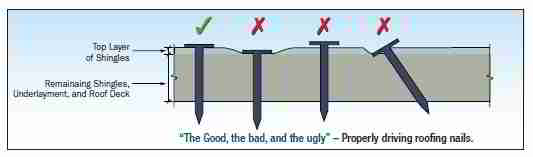
Roofing product manufacturers are careful to specify where shingle nails should be placed in each shingle and the number of nails required.
In addition to the number of nails, how nails are driven is critical to a shingle's ability to stay on the roof.
Sketch (above/left) of common roof shingle nailing errors is a detail from FEMA's , Asphalt Shingle Roofing for High Wind Regions [2].
How Roof Shingle Nailing Errors Occur
Over-driving nails so that they cut into the shingle or driving nails on an angle so that the edge of the nail cuts into its shingle as well as the next overlapping shingle are examples of common errors.
Below Mr. Skees elaborates on the importance of nailing errors in roof shingle blow-offs. First a little background: How or why does this angled or over-driving of roof shingle nails happen? Roofers depend on speed to make a profit. A roofer moving very fast may use excessive air pressure or nailing gun settings so that s/he can drive nails very rapidly.
But improper gun settings over-drive nails, cutting shingles and allowing them to blow off of the roof. And a roofer who reaches out with the nailer (speed again) rather than taking a step is also more likely to drive nails on an angle.
These specifications may vary by shingle type and building location, with more nails specified for high-wind areas such as asphalt shingle roofs applied in coastal areas.
Watch out: cocked shingle fasteners cause trouble regardless of whether they are staples or nails, but in our opinion it's easier to get into trouble with roof shingle staples.
See additional warnings about using roof shingle staples
at ASPHALT SHINGLE STAPLE vs NAIL.
Just How Important is Nailing in Roof Shingle Wind Damage Prevention?
High Nailing Roof Shingles
When Hurricane Ike turned east after landfall in Texas in September 2008 and tracked up the Ohio River Valley, we had thousands of wind damage claims.
I looked at several hundred. All of them I inspected were shingles that were improperly nailed. Most of the missing and torn shingles were nailed above the sealing strips.
Pneumatic Roof Nailer Pressure Settings
Another common nailing issue that leads to unnecessary wind damage is over-driving the nails, most often when pneumatic nailers are used.
Perhaps the most common cause of shingle blow-off in storms is improper or inadequate nailing by the roofing installer.
I don't remember a single wind damage claim where the nails were in the proper location and driven flush with the surface of the shingles. The instructions are usually printed on the packaging, complete with diagrams. In both English and Spanish.
With the compressor set too high, the heads cut through the fabric of the shingle, basically leaving the shingles unattached to the roof.
Another discussion of shingle nailing errors and omissions is at Mr. Skees' comments
about LADDERING vs STAIR STEPPING SHINGLES
Follow the Manufacturer's Shingle Nailing & Placement Instructions
Commentary: D Friedman
On a wood shingle failure where all of the shingles were improperly offset the roofer was trying to bluff his way through, insisting that his work was absolutely to spec and correct and in accordance with the manufacturer's instructions.
A pile of swept-up debris remained in the courtyard (this was a big expensive roof job).
Taking the roofer aside, away from the client (and from unnecessary embarrassment) I reached into the pile and pulled out one of the inserts from the manufacturer that showed the shingle offset pattern they wanted and the nailing pattern - which was totally different from what he had used.
The result was cursing and fist shaking and stomping off the job. The client, however, read and recognized the significance of the manufacturer's instructions.
As Skees points out
The shingle nailing instructions are usually printed on the packaging, complete with diagrams. In both English and Spanish.
Reading the instructions doesn't take but a moment, and it would be a great idea.
Components of roof shingle wind damage resistance
 Asphalt shingle wind resistance and the success of a roofing job in resisting wind damage combines several factors including
- Proper shingle nail type, nail quantity per shingle (specified also by the manufacturer and
at ASPHALT SHINGLE INSTALLATION).
Manufacturers typically require at least four nails in a 3-tab asphalt shingle, six in high wind areas, plus other measures that are required by local building codes in coastal and hurricane-risk zones.
Use of staples rather than roofing nails is still done by some roofers but is not recommended.
See additional warnings about using roof shingle staples
at ASPHALT SHINGLE STAPLE vs NAIL - staples not perfectly-installed can permit easy shingle blow-off in the next wind storm. - Proper shingle nailing patterns - locations of the nail in the shingle as specified by the manufacturer, roofing standards, or in the shingle installation article linked just above
- Sound roof sheathing serving as a nail base for the roof covering.
Nailing asphalt shingles onto rotted roof decking, too-thin roof decking, or using a nailing pattern and shingle course that has the bad luck to place shingle nails for multiple shingles, particularly in long sections of individual shingle courses into gaps in roof decking - Effectiveness of the glue strips on the shingle backs which adhere the shingle courses against wind-uplift .
See ASPHALT SHINGLE CELLOPHANE STRIP REMOVAL - Extra sealant application between shingle courses (under tabs) is required in some circumstances such as areas of high risk of wind damage or where required by local roofing codes
- Roof pitch and the effect of roof angle that meets prevailing wind direction
- Roof orientation with respect to prevailing winds
Not only must nails be properly placed and spaced, improper nailing itself, such as driving a nail through the shingle, leaving a nail sticking up to cut a shingle above, or using a roofing stapler improperly leaving cocked staples or shingle-cutting staples will all encourage shingles to fly away with the wind.
If an new roof has the bad luck to encounter a severe wind storm shortly after asphalt shingles have been installed, it is possible that the shingles will blow off of the roof because their self-sealing tabs have simply not had time (or warm enough weather or enough sun) to adhere.
For FEMA advice on wind damage resistant construction of roofing,
see
- ASPHALT SHINGLE ROOFING FOR HIGH WIND REGIONS, HOME BUILDERS' GUIDE TO COASTAL CONSTRUCTION [PDF], FEMA 499, August 2005, Technical Fact Sheet No. 20.
Roofing Shingle Glue Strip or Glue Tab Adhesion Failure as Contributor to Wind Damage to Asphalt Shingle Roofs
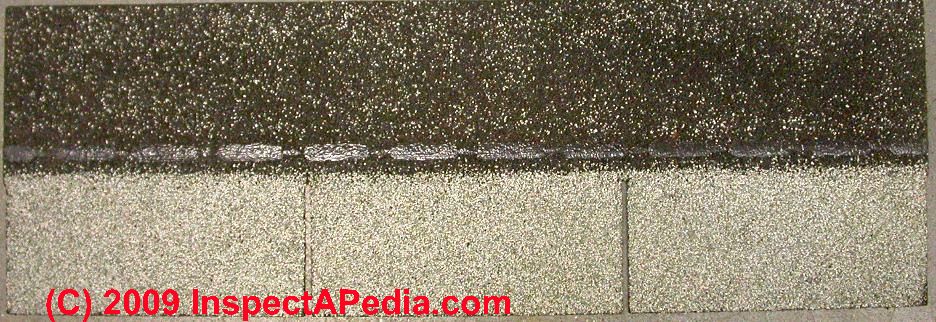
Our photo (left) shows a typical 3-tab asphalt roof shingle (this one is made by GAF™). The shiny black strips form the "glue line" on the shingle. This adhesive is intended to bond to the three tabs of the next shingles nailed atop of this one when the roof is later warmed by sunlight.
On occasions, particularly during high wind conditions such as hurricanes, defective glue strips or adhesive strips on the underside of asphalt shingles may not provide sufficient adhesion, or if the shingles were not properly handled and the glue strip was dirty, an adhesion failure can lead to failure of the shingle tabs to adhere to the nailed-down header of the shingle above.
In this case exposure to high winds can cause shingles to tear or blow off of the roof, increasing the degree of water damage inside the building when such winds are accompanied by rain.
In most climates exposure to even a few weeks of normal sunlight will cause the glue tabs on the under-side of asphalt roof shingles to soften and adhere to the surface below.
We discuss the function of asphalt shingle adhesive strips, handling the protective cellophane strip, and shingle uplift wind damage prevention in more detail below.
Extra Sealant Recommended for Shingle Wind-Damage Resistance
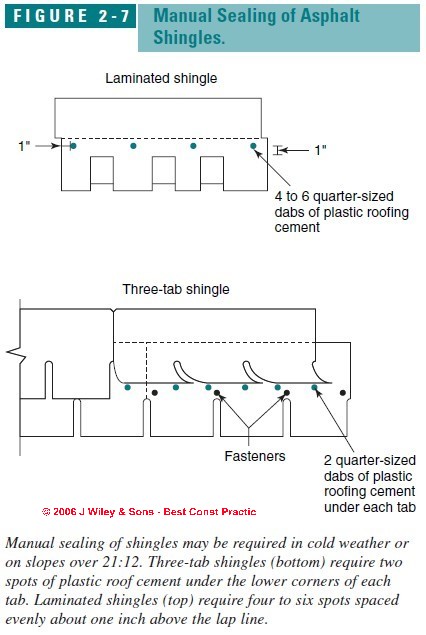
As detailed at ASPHALT SHINGLE INSTALLATION stated in the printed text: Best Practices Guide to Residential Construction (Steve Bliss, J Wiley & Sons) :
In cold climates, the asphalt shingle sealant strip may not set up properly and may require manual sealing.
For three-tab shingles, place two quarter-size spots of plastic roof cement under the lower corners of each tab (as shown in Figure 2-7).
With laminated shingles, place four to six quarter-sized dots, spaced evenly, about one inch above the bottom of the overlapping shingle.
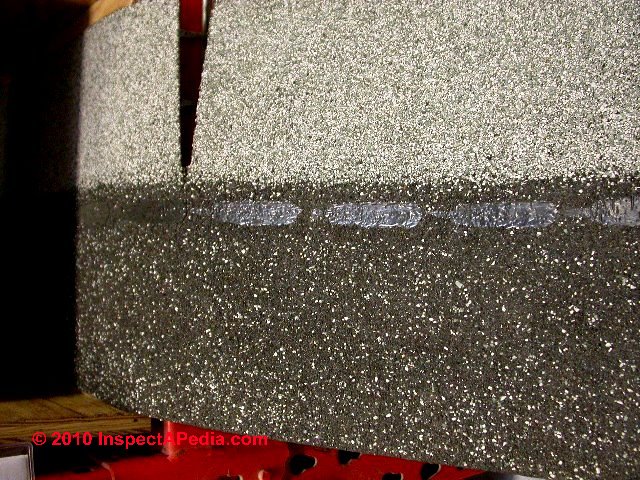
Our page top photo shows the standard sealant strips [photo] found on asphalt shingles, in this case a GAF® product we photographed at a Home Depot® store.
Here is what the GAF Materials Corporation, Grand Timberline™ Premium Architectural Shingle Application Instructions [at Reviewers] say about the glue strips and cellophane. You'll note that we are to leave the cellophane in place, but if site conditions (high wind) require immediate shingle sealing, an extra step, using additional shingle tab adhesive, is permitted.
WIND RESISTANCE/HAND SEALING: These shingles have a special thermal sealant that firmly bonds the shingles together after application when exposed to sun and warm temperatures.
Shingles installed in fall or winter may not seal until the following Spring. If shingles are damaged by winds before sealing or are not exposed to adequate surface temperatures, or if the self sealant gets dirty, the shingles may never seal. Failure to seal under these circumstances results from the nature of self-sealing shingles and is not a manufacturing defect.
To insure immediate sealing, apply 4 quarter-sized dabs of shingle tab adhesive on the back of the shingle 1" (25mm) and 13" (330mm) in from each side and 1" (25mm) up from bottom of the shingle. Press shingle firmly into the adhesive. For maximum wind resistance along rakes, cement shingles to underlayment and each other in a 4" (102mm) width of asphalt plastic roof cement.
NOTE: Excess tab adhesive can cause blistering of the shingle. [The company is referring to the use of additional roof shingle adhesive, not the factory-applied glue strip.
Also see BLISTERS on ASPHALT SHINGLES -- InspectAPedia]. The film strips on the back of each shingle are to prevent sticking together of the shingles while in the bundle and to keep dirt and debris out of the adhesive material so that after installation the adhesive will work. Their removal is NOT required during application.
Should the Cellophane Strip on the Back of Asphalt Shingles be Pulled Off?
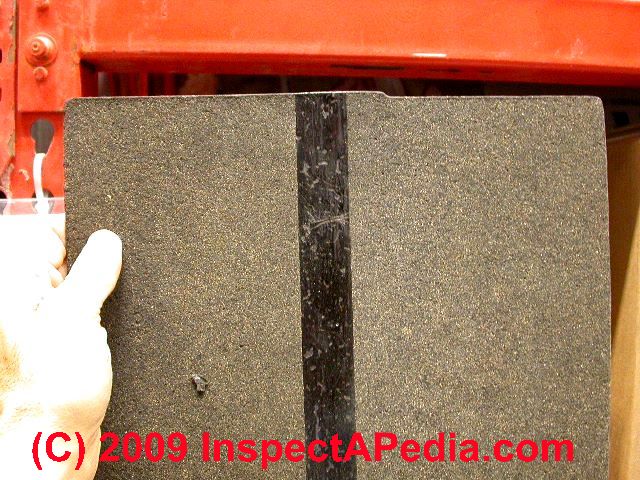 The success with which asphalt shingles bond together as the glue strip is heated by sun exposure is a factor in protecting roof shingles from wind-damage and blow-off.
But the debate about whether or not a protective cellophane strip found atop this glue strip on new asphalt shingles has gone on too long. Do we remove the cellophane or leave it in place?
A detailed article about this question is
at ASPHALT SHINGLE CELLOPHANE STRIP REMOVAL.
Excerpts are just below.
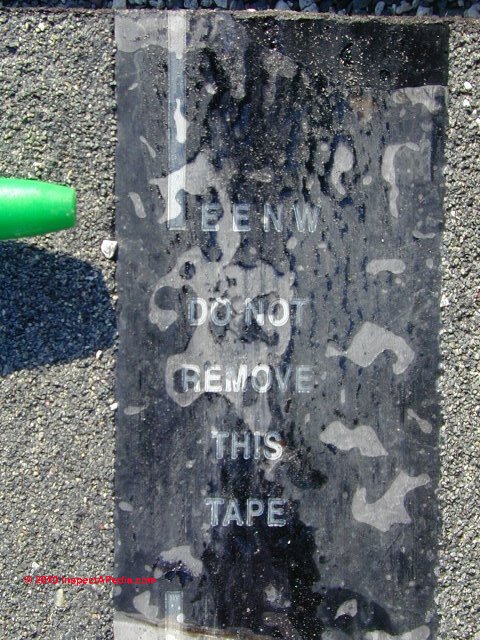
Our photo (left) shows the cellophane strip found on the back or "down"
side of a typical asphalt roof shingle. This one is a GAF™ product.
No: In answer to a common reader question, not normally: according to roofing manufacturers, it is not required to remove the cellophane strip on the back of roof shingles before they are nailed. Below we quote from a major manufacturer's instructions.
Yes: as we discuss in more detail
at ASPHALT SHINGLE CELLOPHANE STRIP REMOVAL,
experts familiar with wind damaged roofs (in coastal areas exposed to hurricanes and in other high-wind areas) previously recommended both the removal of the cellophane strip and the installation of double-sticky-sided roofing adhesive mastic tape or roof cement under shingle tabs at the time of asphalt roof shingle installation.
As Cramer reported in 2009 (see "More on the "yes" answer" just below, currently asphalt shingles sold in high wind areas adhere and cannot be pulled apart by wind (nor hand).
Certainly if you wait to remove the cellophane strip until the moment that the shingle is about to be nailed, taking it off will do no harm, and it may speed the adhesion between shingles that is intended to resist wind blow-off of roof shingles.
We suspect that few professional roofers will add to their roofing time and cost by taking a step that is not recommended by the product manufacturer. causing also extra foot traffic wear.
Other Examples of Wind Damaged Shingle Roofs
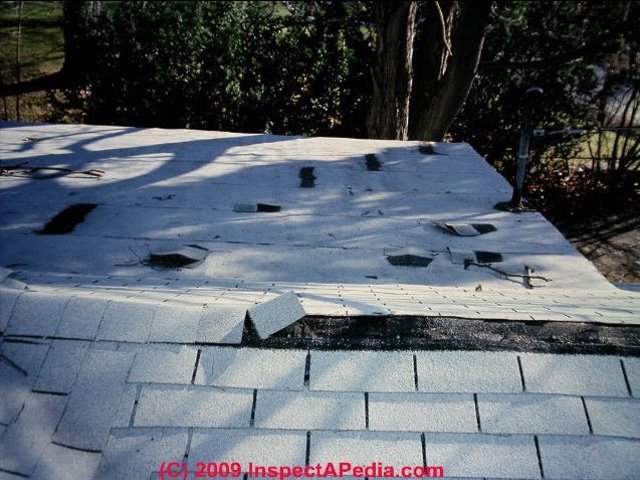
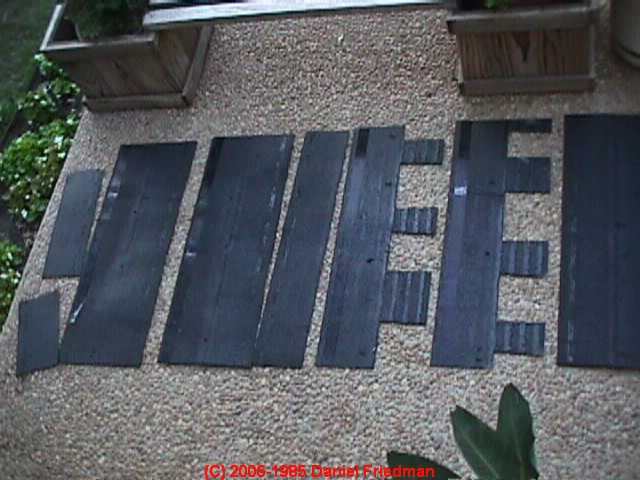
The photographs here include examples of improperly or inadequately-nailed shingles which blew off in modest windstorms of far less than hurricane strength.
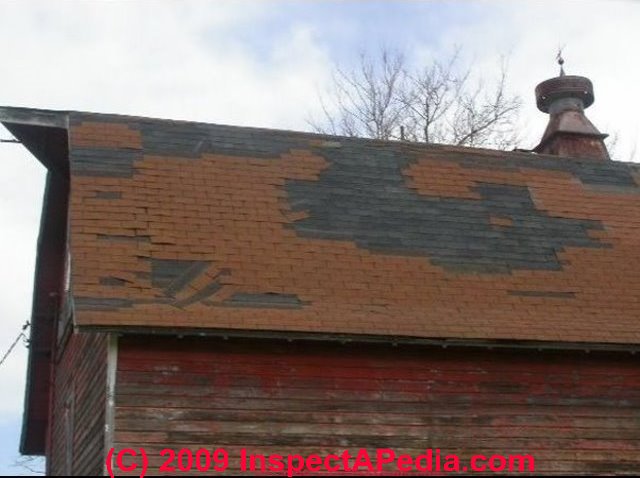
In the first photograph below, our correspondent has laid-out shingles retrieved after the storm, showing the location and pattern of nail holes in each shingle - clear evidence of just how they were nailed.
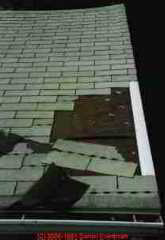
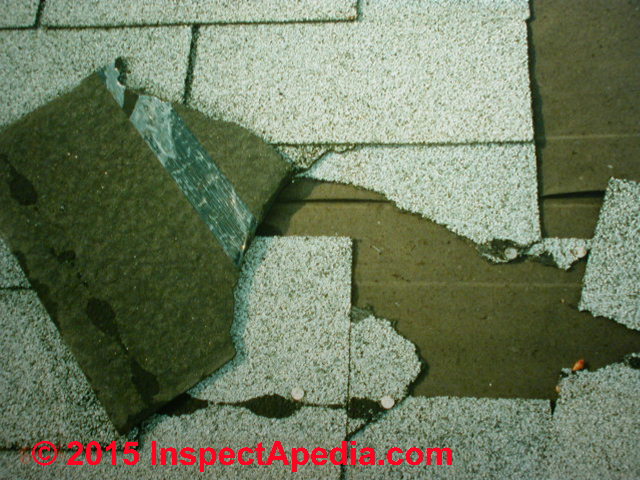
Our ridge cap shingle loss (above left) is plainly due to wind damage and is discussed in detail
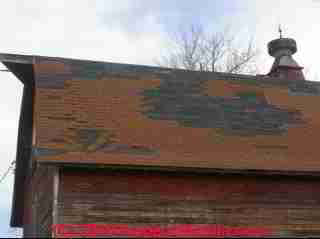
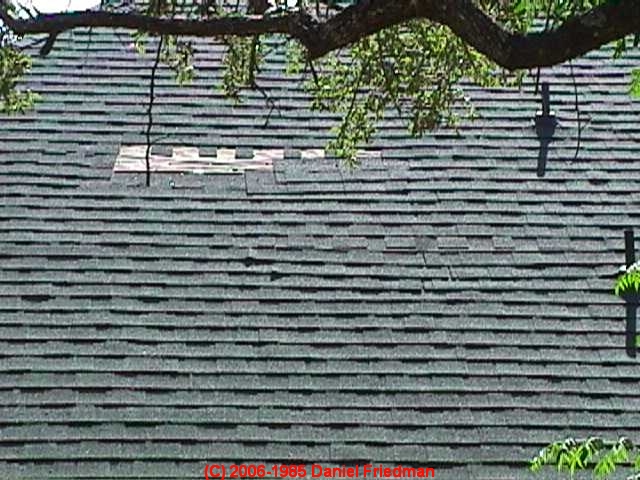
The shingles falling off of the barn roof (above right) appear due to a combination of wind damage and possibly inadequate nailing.
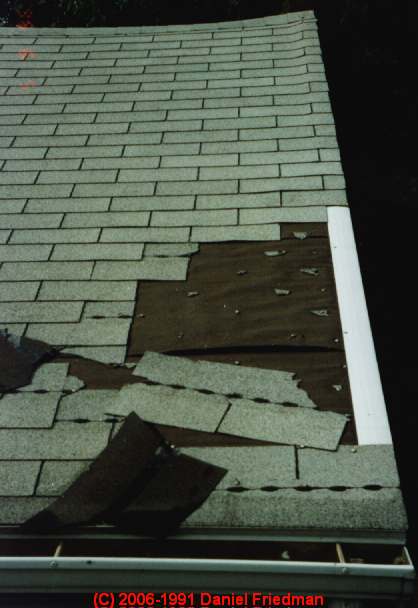
The photos above were taken of a garage roof located at the intersection of Vassar Road and Willowbrook Heights in Poughkeepsie, New York on 7 March 1997 (windy March enters like a lion but exits like a lamb) following a wind storm that was nowhere near hurricane strength. Look closely and you'll see roofing nails, not staples.
I observed the damage, accessed the roof, and ultimately made the repairs.
There were shingles lost at the ridge (cap shingles) as well as at one rake end of the roof where wind got under the shingles. [Click to enlarge any image]
- Workmanship: Fasteners/Nailing Problems lead to holes or wind blow-off. Roofing manufacturers provide recommendations for the type of shingle fastener (nails are recommended), the type of roofing nail, and the length of roofing nail required.
Yes, it is proper for roofing nails to penetrate through the roof decking so that the tips of the nails are visible inside. This is particularly important where 1/2" roofing plywood or OSB decking are used (as opposed to thicker roof decking materials).
Here is a representative example comment on roofing nails from the GAF Materials Corporation Grand Timberline™ Premium Architectural Shingle Application Instructions [at Reviewers]FASTENERS: Use of nails is recommended.
Use only zinc coated steel or aluminum, 10-12 gauge, barbed, deformed or smooth shank roofing nails with heads 3/8" (10mm) to 7/16" (12mm) in diameter. Fasteners should be long enough to penetrate at least 3/4" (19mm) into wood decks or just through the plywood decks.Fasteners must be driven flush with the surface of the shingle. Over driving will damage the shingle. Raised fasteners will interfere with the sealing of the shingles.
Experts discussing measures to reduce asphalt roof shingle blow-off in coastal or other high-wind areas recommend against using roofing staples to install shingles.
- Workmanship: Fasteners/Nailing Problems (above) lead to holes or wind blow-off. Notice that not only has one shingle already fallen or been blown off of the roof, but its neighbors are sliding down.
Diagnosis from a photograph is questionable but there appears to be a nailing problem here.
We need to inspect this roof from the interior to look at the nail pattern and to consider the condition of the roof decking to which the shingles were fastened.
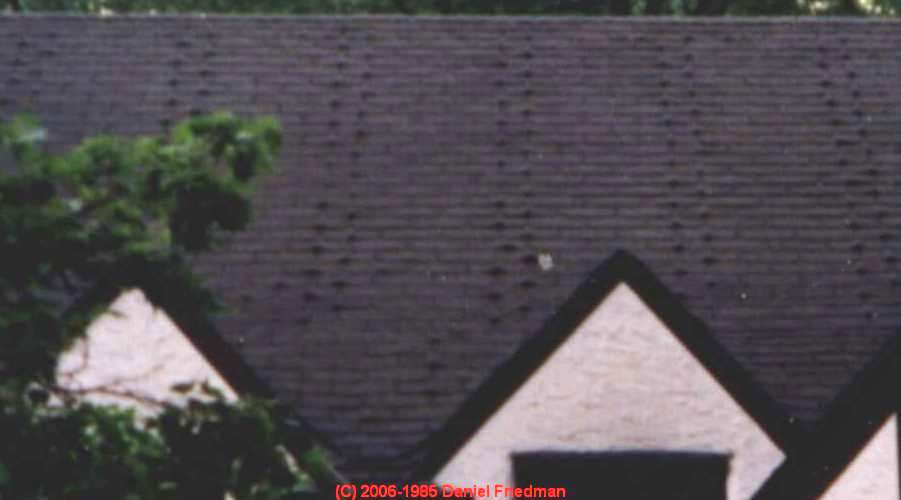
- Workmanship: Installation Pattern Problems: Laddering [Photo above: Carl Gerosa, New Rochelle, NY.]
Details are at LADDERING vs STAIR STEPPING SHINGLES - Workmanship, condition of roof deck, roof flashing, roofing felt underlayment: Flashing and underlayment problems:
Here is a representative example comment on the use of roofing felt underlayment and roof decking condition, from the GAF Materials Corporation Grand Timberline™ Premium Architectural Shingle Application Instructions [at Reviewers]
UNDERLAYMENT: Underlayment beneath shingles has many benefits, including preventing wind driven rain from reaching the interior of the building and preventing sap in some wood decking from reacting with asphalt shingles.
Underlayment is also required by many code bodies. Where an underlayment is to be installed, use a breather-type underlayment such as GAF Shingle-Mate® underlayment.ROOF DECKS: Wood decks must be well-seasoned, supported, and tightly-constructed with maximum 6" (152mm) wide lumber, having adequate nail-holding capacity and a smooth surface.
Plywood decking as recommended by The Engineered Wood Association is acceptable.
Where a Class A rating is required over decks less than 15/32" thick, an underlayment is required.
Do not fasten shingles directly to insulation or insulated deck unless authorized in writing by GAF. Roof decks and existing surfacing material must be dry prior to application of shingles. - Workmanship: Improper materials/roof-slope problems - installing shingles on low-slope roofs, for example.
- Workmanship: improper nail pattern, quantity, nail length, nail type, nail position, or failure to inspect to assure a sound roof deck
- Holes and nail-pops in shingle roofs, mechanically damaged roof shingles.
- Choice of roofing, shingle type, underlayment, and roof decking materials: In a 2005 article Paul Fisette cited Mitrani who, more than a decade earlier, concluded that in areas of coastal high winds and storms, OSB was an inferior roof decking product to plywood. Opinion among Florida consultants currently is that OSB is fine and performs as well as plywood. -- Cramer (personal communication 4/1/09).
In discussing wind damage to roofing with your insurance adjuster or roofing contractor, be sure to review the details of original and replacement shingle installation as this can give evidence about the underlying cause of roof failure as well as informing you of how to avoid roof shingle blow-off in the future.
Roof / Shingle Wind Damage Research & References
- Ayscue, Jon K., "Hurricane Damage to Residential Structures: Risk and Mitigation", Jon K. Ayscue,
The Johns Hopkins University, Baltimore, Maryland, published by the Natural Hazards Research and Applications Information Center, Institute of Behavioral Science, University of Colorado, November 1996. Abstract:
"Property damage and loss from hurricanes have increased with population growth in coastal areas, and climatic factors point to more frequent and intense hurricanes in the future. This paper describes potential hurricane hazards from wind and water.
Damage to residential structures from three recent intense hurricanes - Hugo, Andrew, and Iniki - shows that wind is responsible for greater property loss than water.
The current state-of-the-art building technology is sufficient to reduce damage from hurricanes when properly applied, and this paper discusses those building techniques that can mitigate hurricane damage and recommends measures for mitigating future hurricane damage to homes." - online at www.colorado.edu/hazards/publications/wp/wp94/wp94.html - CLAY TILE WIND & SEISMIC CONNECTORS where we describe special connectors used for roofing tiles in high wind, hurricane, and seismic areas.
Standard clay tile roof connectors are discussed
at CLAY TILE ROOF CONNECTIONS. - Dixon, Craig Robert, THE WIND RESISTANCE OF ASPHALT ROOFING SHINGLES, [PDF] (Dissertation thesis 2013), University of Florida, retrieved 2017/09/27, original source http://ufdc.ufl.edu/UFE0046235/00001,
- Fronapfel, Edward L., P.E., "WINDS of CHANGE in Asphalt Shingle Specification and Application", [PDF] Interface (September 2006 pp. 40-46) retrieved 2017/09/27, original source: http://rci-online.org/wp-content/uploads/2016/04/2006-09-fronapfel.pdf
- Marshall, Timothy P., Scott J. Morrison, Richard F. Herzog, and Jeffrey R. Green. "P 2.17 WIND EFFECTS ON ASPHALT SHINGLES."
- FEMA, ASPHALT SHINGLE ROOFING FOR HIGH WIND REGIONS, HOME BUILDERS' GUIDE TO COASTAL CONSTRUCTION [PDF], FEMA 499, August 2005, Technical Fact Sheet No. 20. [To recommend practices for installing asphalt roof shingles that will enhance wind resistance in high-wind, coastal regions.]
- FEMA, Asphalt Shingle Roofing for High Wind Regions, Home Builder's Guide to Coastal Construction, Technical Guide No. 73, retrieved 3/5/13
- Fisette, Paul, "Evaluating OSB for Coastal Roofs," Paul Fisette, Coastal Contractor, Winter 2005, online at coastalcontractor.net/pdf/2005/0501/0501eval.pdf . Fisette cites: "Jose Mitrani, a civil engineer and professor at Florida. International University in Miami, was ... Florida’s official damage assessment team. ... After Hurricane Andrew, Florida code advisers ruled OSB sheathing inferior to plywood."
- GAF, REPLACEMENT of STORM DAMAGED SHINGLES [PDF] - GAF, Technical Advisory Bulletin TAB-R-126, GAF 1 Campus Drive, Parsippany NJ 07054, Web: gaf.com - retrieved 2023/03/09 retrieved 2023/03/09, original source: https://www.gaf.com/en-us/document-library /documents/documents/ technicalbulletinsdocuments/residentialenglishdocuments /R__126_Replacement_Of_Storm_Damaged_Shingles.pdf
Excerpt:
Extraordinary weather related damages as described above are specifically excluded from coverage*. This damage may be immediately noticeable, or can be latent damage in which case evidence of any damage may not be apparent for years. This latent damage caused by severe weather or flying debris may cause the shingles to deteriorate prematurely.
*Timberline® Shingles with LayerLock™ Technology are eligible for the WindProven™ Limited Wind Warranty with no maximum wind speed limitation when installed with at least 4 qualifying GAF accessories.
¹ For installations of GAF Designer and Timberline shingles not eligible for the WindProven Limited Wind Warranty, Maximum Wind Speed Coverage is 130mph with Special Installation or 110mph without Special Installation.
2 Max wind speed coverage for Marquis WeatherMax Shingles is 80 mph and for Royal Sovereign Shingles is 60 mph.
Latent damage may take on many forms such as:
Granule loss at points of impact or caused by stresses the shingles endure
Cracks in the granule-asphalt surfacing – especially if high winds blew the shingles back
Exposed fiberglass mat – which may or may not be immediately visible
Loosening of the self-seal integrity creating the potential for future shingle blow-off - Marshall, Timothy P., S. J. Morrison, R. F. Herzog, and J. R. Green. WIND EFFECTS on ASPHALT SHINGLES [PDF] (2010) In 29th Conference on Hurricanes and Tropical Meteorology. 2010.
Abstract:
This paper will explore various failure modes of asphalt shingle roofs in windstorms.
Roofs in three subdivisions were analyzed after Hurricane Frances struck Florida in 2004. Wind damage involved unbonding, creasing, flipping, and displacing shingles from the windward slopes where three second wind gusts ranged from 33 to 43 m/s at 10 m. Laminated type shingles significantly outperformed tab type shingles.
We also will discuss why many shingle roofs have little to no bond. Age, installation, and expansion-contraction effects have resulted in straight-up or diagonal patterns where shingles were not bonded on each directional slope.
Such uniform bonding problems have been observed in non-hurricane regions. Thus, it is important for roof inspectors to understand the nature of shingle bonding in order to properly assess wind damage to roof coverings.
Finally, the results of field uplift tests will be presented where bond strength was measured on selected roofs. Once the bond was broken, the tabs were resealed with adhesive then retested to determine the bond strength of the repairs. It was found that resealed shingles had higher bond strengths. - Rabb, William, FLORIDA LAWSUIT CHARGES UNITED P&C WITH RICO VIOLATIONS IN WIDESPREAD CLAIMS DENIALS [PDF] (2022) Insurance Journal, 14 January 2022, - retrieved 2022/06/24, original source: https://www.insurancejournal.com/news/southeast/2022/01/14/649546.htm
Excerpt:
In the ongoing war between restoration companies and insurers in Florida, contractors suing carriers in assignment-of-benefits claims is nothing new. And insurers have long argued that some construction firms are colluding with adjusters and law firms to jack up claims and churn lawsuits.
A Stuart, Florida, roofing and restoration company has now brought in a new weapon: The contractor claims in a federal lawsuit filed Thursday that United Property & Casualty Insurance Co. conspired with adjuster firms to systematically deny and underpay thousands of AOB roof claims after Hurricane Irma hit the state in 2017. - Simpson Strong-tie HIGH WIND GUIDE to SELECT CONNECTIONS in HIGH WIND AREAS [PDF] (2020) Simpson Strong Tie®, retrieved 2020/11/23, original source: https://www2.strongtie.com/catalog_order.asp?site=SST where you can download any of a large collection of reference documents, catalogs, and product guides from Simpson Strong-Tie.
- Simpson Strong-tie STRONG-ROD SYSTEMS SEISMIC & WIND RESTRAINT SYSTEMS GUIDE [PDF] (2020) Simpson Strong Tie®, retrieved 2020/11/23, original source: https://www2.strongtie.com/catalog_order.asp?site=SST where you can download any of a large collection of reference documents, catalogs, and product guides from Simpson Strong-Tie.
- Simpson Strong-Tie STRONG-ROD SYSTEMS SEISMIC & WIND ANCHOR TIEDOWN SYSTEM GUIDE (Canada) [PDF] (2018) Simpson Strong Tie®, retrieved 2020/11/23, original source: https://www2.strongtie.com/catalog_order.asp?site=SST where you can download any of a large collection of reference documents, catalogs, and product guides from Simpson Strong-Tie.
...
Continue reading at WIND RESISTANT ASPHALT SHINGLE STARTER STRIPS or select a topic from the closely-related articles below, or see the complete ARTICLE INDEX.
Or see WIND DAMAGE ROOF FAQs - questions & answers posted originally at the end of this page
Or see these
Recommended Articles
- ASPHALT SHINGLE INSTALLATION - best practices
- CELLOPHANE STRIP ADHESIVE ADEQUACY in HIGH WIND AREAS
- BUILDING DAMAGE ASSESSMENT & REPAIR - home
- HURRICANE DAMAGED BUILDINGS
- MECHANICAL DAMAGE of SHINGLES
- WARRANTIES for ROOF SHINGLES
- WIND DAMAGED BUILDINGS
Suggested citation for this web page
WIND DAMAGE to ROOFS at InspectApedia.com - online encyclopedia of building & environmental inspection, testing, diagnosis, repair, & problem prevention advice.
Or see this
INDEX to RELATED ARTICLES: ARTICLE INDEX to BUILDING ROOFING
Or use the SEARCH BOX found below to Ask a Question or Search InspectApedia
Ask a Question or Search InspectApedia
Questions & answers or comments about how to recognize, diagnose, repair & prevent wind damage to roofs.
Try the search box just below, or if you prefer, post a question or comment in the Comments box below and we will respond promptly.
Search the InspectApedia website
Note: appearance of your Comment below may be delayed: if your comment contains an image, photograph, web link, or text that looks to the software as if it might be a web link, your posting will appear after it has been approved by a moderator. Apologies for the delay.
Only one image can be added per comment but you can post as many comments, and therefore images, as you like.
You will not receive a notification when a response to your question has been posted.
Please bookmark this page to make it easy for you to check back for our response.
Our Comment Box is provided by Countable Web Productions countable.ca
Citations & References
In addition to any citations in the article above, a full list is available on request.
- [6] Thanks to Leonard Wheeler, Retired DCA Disaster Assessment Engineer for Hurricane Andrew, for questions leading to clarification on the proper handling of asphalt shingle glue strip protective cellophane during roof installation 3/29/09.
- [7] Thanks to James A. Skees, PE, President and Sr. Forensic Engineer, OnTheRock Engineering, LLC, 604 W. Jefferson Street, LaGrange, KY 40031
502-225-6203 FAX 225-6204, for commenting on the roof cellophane strip problem, on wind damage to roof shingles, shingle blow off, improper shingle nailing, and roof shingle laddering underlying defects, August 2010. Mr. Skees is a forensic engineer who works for insurance companies. Mr. Skees can also be reached by email at jimskees@ontherockeng.com
The company has published online a sample Tornado Report
"Residential Wind Damage Evaluation", Wind Damage Sample, found at http://www.ontherockeng.com/Sample%20Tornado%20Report.pdf - GAF Materials Corporation, Grand Timberline Premium Architectural Shingle Application Instructions.
http://www.gaf.com/Content/Documents/20573.pdf discusses the requirements for successful asphalt shingle installation including the condition of the roof deck, the use of roofing felt underlayment, the selection of roofing nails by type and length and penetration of the roof decking, and the role of glue strips on the back side of asphalt roof shingles. - Roofing The Right Way, Steven Bolt, McGraw-Hill Professional; 3rd edition (November 1, 1996), ISBN-13: 978-0070066502, p. 350 for one of many citations on this point.
- Best Practices Guide to Residential Construction, by Steven Bliss. John Wiley & Sons, 2006. ISBN-10: 0471648361, ISBN-13: 978-0471648369, Hardcover: 320 pages, available from Amazon.com and also Wiley.com. See our book review of this publication.
- Decks and Porches, the JLC Guide to, Best Practices for Outdoor Spaces, Steve Bliss (Editor), The Journal of Light Construction, Williston VT, 2010 ISBN 10: 1-928580-42-4, ISBN 13: 978-1-928580-42-3, available from Amazon.com
- The Journal of Light Construction has generously given reprint permission to InspectAPedia.com for this article. All rights and contents are ©Journal of Light Construction and may not be reproduced in any form.
- Architectural elements: the technological revolution: Galvanized iron roof plates and corrugated sheets; cast iron facades, columns, door and window caps, ... (American historical catalog collection), Diana S Waite, available used out of Amazon.
- Asphalt Roofing Residential Manual from ARMA the Asphalt Roofing Manufacturers Association Website https://www.asphaltroofing.org/product/residential-asphalt-roofing-manual/ ,
- Building Pathology, Deterioration, Diagnostics, and Intervention, Samuel Y. Harris, P.E., AIA, Esq., ISBN 0-471-33172-4, John Wiley & Sons, 2001 [General building science-DF] ISBN-10: 0471331724 ISBN-13: 978-0471331728
- Building Pathology: Principles and Practice, David Watt, Wiley-Blackwell; 2 edition (March 7, 2008) ISBN-10: 1405161035 ISBN-13: 978-1405161039
- Built-Up Roof Systems, Manual C.W. Griffin, Mcgraw-Hill (Tx); 2nd edition (July 1982), ISBN-10: 0070247838, ISBN-13: 978-0070247833
- Concrete Folded Plate Roofs, C. Wilby PhD BSc CEng FICE FIStructE (Author), Butterworth-Heinemann, 1998, ISBN-10: 0340662662, ISBN-13: 978-0340662663
- Copper Roofing, by CDA
- Corrugated Iron, Building on the Frontier, Simon Holloway
- Metal Roofing, an Illustrated Guide, R.A. Knowlton , [metal shingle roofs],
- Problems in Roofing Design, B. Harrison McCampbell, Butterworth Heineman, 1991 ISBN 0-7506-9162-X (available used)
- Roofing The Right Way, Steven Bolt, McGraw-Hill Professional; 3rd Ed (1996), ISBN-10: 0070066507, ISBN-13: 978-0070066502
- Slate Roofs, National Slate Association, 1926, reprinted 1977 by Vermont Structural Slate Co., Inc., Fair Haven, VT 05743, 802-265-4933/34. (We recommend this book if you can find it. It has gone in and out of print on occasion.)
- Roof Tiling & Slating, a Practical Guide, Kevin Taylor, Crowood Press (2008), ISBN 978-1847970237,
If you have never fixed a roof tile or slate before but have wondered how to go about repairing or replacing them, then this is the book for you. Many of the technical books about roof tiling and slating are rather vague and conveniently ignore some of the trickier problems and how they can be resolved. In Roof Tiling and Slating, the author rejects this cautious approach. Kevin Taylor uses both his extensive knowledge of the trade and his ability to explain the subject in easily understandable terms, to demonstrate how to carry out the work safely to a high standard, using tried and tested methods.
This clay roof tile guide considers the various types of tiles, slates, and roofing materials on the market as well as their uses, how to estimate the required quantities, and where to buy them. It also discusses how to check and assess a roof and how to identify and rectify problems; describes how to efficiently "set out" roofs from small, simple jobs to larger and more complicated projects, thus making the work quicker, simpler, and neater; examines the correct and the incorrect ways of installing background materials such as underlay, battens, and valley liners; explains how to install interlocking tiles, plain tiles, and artificial and natural slates; covers both modern and traditional methods and skills, including cutting materials by hand without the assistance of power tools; and provides invaluable guidance on repairs and maintenance issues, and highlights common mistakes and how they can be avoided. The author, Kevin Taylor, works for the National Federation of Roofing Contractors as a technical manager presenting technical advice and providing education and training for young roofers. - In addition to citations & references found in this article, see the research citations given at the end of the related articles found at our suggested
CONTINUE READING or RECOMMENDED ARTICLES.
- Carson, Dunlop & Associates Ltd., 120 Carlton Street Suite 407, Toronto ON M5A 4K2. Tel: (416) 964-9415 1-800-268-7070 Email: info@carsondunlop.com. Alan Carson is a past president of ASHI, the American Society of Home Inspectors.
Thanks to Alan Carson and Bob Dunlop, for permission for InspectAPedia to use text excerpts from The HOME REFERENCE BOOK - the Encyclopedia of Homes and to use illustrations from The ILLUSTRATED HOME .
Carson Dunlop Associates provides extensive home inspection education and report writing material. In gratitude we provide links to tsome Carson Dunlop Associates products and services.
 | HOME | ABOUT | ASK a QUESTION | CONTACT | CONTENT USE POLICY | DESCRIPTION | POLICIES | PRIVACY | |
| © 2024 - 1985 Publisher InspectApedia.com - Daniel Friedman | |||||||||