
InspectAPedia® FREE Encyclopedia of Building & Environmental Construction, Diagnosis, Maintenance & Repair |
Question? Just ask us! InspectAPedia
|
 How to Inspect and Repair Slate Roofs - The Basics
- POST a QUESTION or COMMENT about slate roof installation, maintenance, repair, inspection, life expectancy, and common problems
How to inspect a slate roof: this article assists readers in evaluating the condition of slate roofs and planning for the maintenance, repair, or replacement of slate roofing as we discuss these concerns. At the same time, careless optimism about a bad slate roof which is at the end of its life risks an angry inspection client.
This article reviews types of slate, common defects, inspection topics, and some repair tips. We also provide slate sources and where to buy slate roofing materials and slate roofing tools and products.
This series of detailed slate roof inspection and repair articles describes procedures for evaluating the condition of slate roofing. How to inspect, identify defects, and estimate remaining life of slate roofs are addressed. The article series also references slate repair procedures, repair slate sources, and slate quarries.
InspectAPedia tolerates no conflicts of interest. We have no relationship with advertisers, products, or services discussed at this website.
How to Inspect & Repair Slate Roofs - Detailed Procedures, Repair Methods, Slate and Replacement Sources
by lan Carson & Dan Friedman
Every slate roof looks terrific when it's wet - unless you're seeing leaks inside. There are, fortunately, some better ways to look at and think about this material. Slate roof failures result from breakdown of the material itself, from poor installation, or from poor maintenance.
Yet too often we see people choosing the abandonment of good slate roofs which should have been repaired is a financial shame and the destruction of a valued asset.
[Click to enlarge any image]
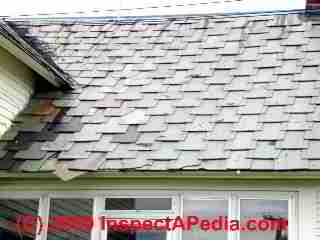
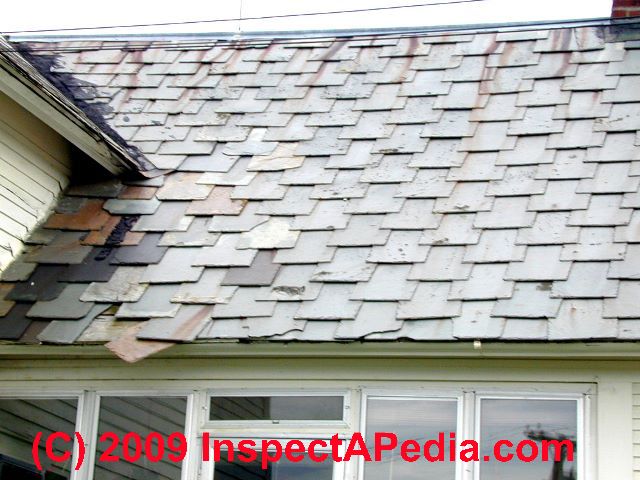
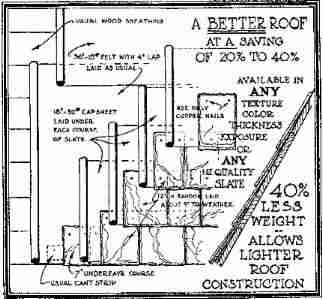
Photographs of an actual slate roof installed using the pattern shown at left are are at the top of this page and included in our slate photo library. This was, in keeping with the spirit of the Dutch, an economical slate roof but not necessarily a better slate roof.
Some slate roof installations such as that sketched at left and installed in a Dutch Lap or Dutch Side Lap slate roofing pattern, relied on the roofing felt underlayment - material much less durable than the slate itself.
Evaluation of the condition of slate roofing, and estimating its remaining life considers at least these factors:
- Type of slate installed on the roof - durability of the slate material itself depends on the quarry from which the slate was cut and even the location within the quarry
- Age and condition of the slates - where are we in the expected life of the material and what damage is visible
- Condition of the roof flashings - rusted leaky roof flashing may require removal of some good slates in order to repair the flashing
- Slate Roof Installation quality, fasteners used to secure the slates to the roof; the slate installation pattern used may determine the resistance of the roof to leaks and wind-blown rain
- The slate roof's repair history, quality of maintenance work - if improper or poor repairs have been done the slate roof may have been damaged or its future life reduced
- Roof Leaks - are a telltale which could point to any or all of the above problem sources
- Roof Structure - on uncommon occasions slate roofing may be installed on a structure not designed to carry its weight
Other very important factors in evaluating the condition of a building roof such as the condition of roof decking or sheathing, and roof structure and framing, and condition of valleys and other flashings. Many of the slate roof defects discussed below are illustrated in our online Slate Roof Photo Library included below in this document.
Advice About Walking on & Inspecting Slate Roofs
Inspectors should be cautious in evaluating any roof condition to avoid failing the roof material itself when leaks are confined to flashing areas.
Watch out: our own experience is that it is absolutely impossible to walk directly on slate roofs without damaging them, particularly if the slates are worn, loose, damaged. And walking on such surfaces is unsafe.
Roof access hazards are discussed
at ROOF INSPECTION SAFETY & LIMITS
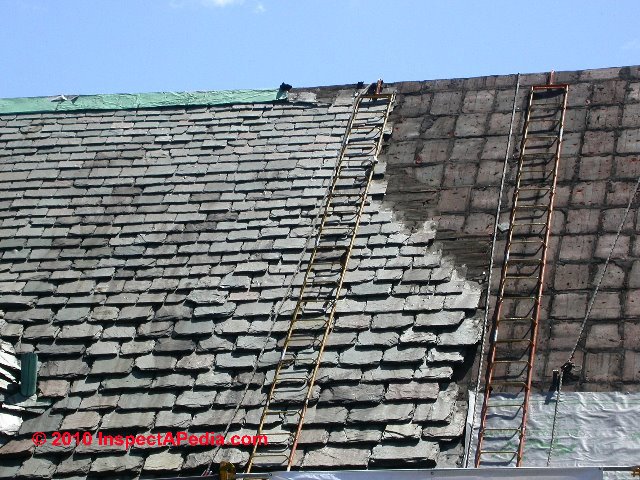
On some other fragile but not totally fragile roofs such as slate roofs, cement tile, cement-asbestos, fiber cement, and hard-fired ceramic clay tile roofs, contractors suspend a ladder over the roof surface, hanging it from the ridge (as shown in our photo of slate roor replacement underway in Duluth, MN), and cushioning it off of the roof surface using foam or insulation padding, or contractors work from scaffolding.
See ROOF INSPECTION SAFETY & LIMITS where we describe roof safety and roof damage issues when inspecting, repairing, or otherwise walking on other roof materials such as asphalt, slate, wood roofs.
As stated in stated in Best Practices Guide to Residential Construction (Steve Bliss, J Wiley & Sons) (printed text), and in our online article
at FLASHING, CLAY TILE ROOFS, to prevent breakage, walk on clay and similarly fragile roof tiles with extreme caution or best, not at all.
We've found good Vermont slate roofs which have been "roofed over" with asphalt (and ruined) when the leaks were located in and only in metal valleys. Metal flashings may be deteriorating from slate particles washing off of the roof.
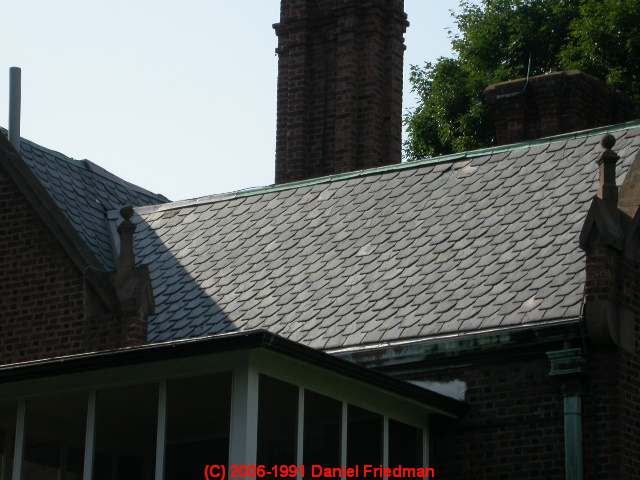 Our photo at left of an open lap slate pattern (a Vassar College slate roof) and at page top of a Dutch Lap slate roof found in Vermont, and the sketch at above left show what was sold as a "better" roof but was actually a leak prone slate installation pattern that
covered as much area as possible with as little slate as possible. The minimal head lap and side lap invite slate roof leaks in windy rainy weather.
Our photo at left of an open lap slate pattern (a Vassar College slate roof) and at page top of a Dutch Lap slate roof found in Vermont, and the sketch at above left show what was sold as a "better" roof but was actually a leak prone slate installation pattern that
covered as much area as possible with as little slate as possible. The minimal head lap and side lap invite slate roof leaks in windy rainy weather.
Don't confuse the open lap pattern (left) with the minimal head and side lap roofing slate pattern in the sketch above.
We read repair suggestions in the Old-House Journal involving use of roofing cement and felt for temporary purposes, as well as the preferable soldered or replacement repairs.
We've found severe corrosion, particularly on copper, when asphalt roof cement has been used for temporary repairs. In our opinion this is a poor short-term repair which causes increased damage.
On an historic restoration project involving slate roofs with copper flashings the worst corrosion we found on the copper was where roof cement had been used to patch leaks. Other patches and materials over similar leaks caused much less apparent damage.> are not considered in this discussion but must indeed be evaluated by the inspector.
What to Do if the Slate Roof Needs Repairs
- At SLATE ROOF REPAIRS we describe common repairs for all sorts of slate roof defects.
- At SLATE ROOF REPAIR, WORN OUT we describe how a roofer will decide to recommend to a building owner that the slate roof is beyond economical repair
- At page bottom ARTICLE INDEX you will find a series of articles that treat roof flashing problems individually
An earlier version of this article appeared in the winter 1991 issue of the ASHI Technical Journal as cited below. In this article series we have made additions and corrections to the original text,and we've added many slate roof photographs and details.
- Carson, Alan & Daniel Friedman, SLATE ROOFS [PDF] (1991) ASHI Technical Journal, Vol. 1. No. 1, January 1991
Reader Comments, Questions & Answers About The Article Above
Below you will find questions and answers previously posted on this page at its page bottom reader comment box.
Reader Q&A - also see RECOMMENDED ARTICLES & FAQs
On 2020-02-25 by (mod) - slate roof installation in Yorkshire
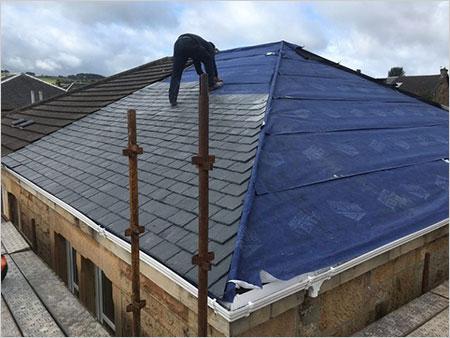 Re-posting without advertisement link
James Lark said:
Hi,
I'm James
I really like your topic this is very informative for me and my company...But i have also some more tips for repairing Slate Roofing in Yorkshire. Safeway Roofing Yorkshire ... can install new roof, repair, or maintenance for your slate roof
Moderator comment:
Thanks for the post and photo, James.
To protect reader trust we do not permit posting of advertising links, but if you are able to contribute technical content, criticism, suggestions, then we are able to cite and provide contact information and links to your company.
DF
Reader Comment: (June 26, 2014) John said:
I like your information,Slate roofing restoration is a technique to procure the roof of the house in such way that, all its damages are repaired, and it is upgraded to work again for more number of years.
...
Continue reading at SLATE ROOF INSPECTION COURSE or select a topic from the closely-related articles below, or see the complete ARTICLE INDEX.
Or see these
Slate Roofing Articles
- SLATE ROOF DEFECTS
- SLATE ROOF INSPECTION & REPAIR - home
- SLATE THERMAL MASS for SOLAR HEAT STORAGE
- SNOW GUARDS & SNOW BRAKES
Suggested citation for this web page
SLATE ROOF INSPECTION BASICS at InspectApedia.com - online encyclopedia of building & environmental inspection, testing, diagnosis, repair, & problem prevention advice.
Or see this
INDEX to RELATED ARTICLES: ARTICLE INDEX to BUILDING ROOFING
Or use the SEARCH BOX found below to Ask a Question or Search InspectApedia
Ask a Question or Search InspectApedia
Try the search box just below, or if you prefer, post a question or comment in the Comments box below and we will respond promptly.
Search the InspectApedia website
Note: appearance of your Comment below may be delayed: if your comment contains an image, photograph, web link, or text that looks to the software as if it might be a web link, your posting will appear after it has been approved by a moderator. Apologies for the delay.
Only one image can be added per comment but you can post as many comments, and therefore images, as you like.
You will not receive a notification when a response to your question has been posted.
Please bookmark this page to make it easy for you to check back for our response.
Our Comment Box is provided by Countable Web Productions countable.ca
Citations & References
In addition to any citations in the article above, a full list is available on request.
- Alan Carson (Carson Dunlop, Associates,) and Dan Friedman are ASHI Members, home inspectors, educators and writers in Toronto and Poughkeepsie respectively. Information in this article is taken from the references shown below, from inspection experience, from opinions shared at ASHI and other education seminars, from the authors' personal, limited experience repairing and rebuilding of slate roofs
- Thanks to helpful Bill Markcrow and Doug Sheldon at Vermont Structural Slate Co.
- we also paraphrased from a presentation to NY Metro ASHI Members by Mr. Steven Trapasso in October, 1990. Mr. Trapasso has 40 years experience in working with slate, and has a clear love affair with the material, particularly when it comes from Vermont.
- Slate Roofs, National Slate Association, 1926, reprinted 1977 by Vermont Structural Slate Co., Inc., Fair Haven, VT 05743, 802-265-4933/34. (We recommend this book if you can find it. It has gone in and out of print on occasion.)
- The Slate Roof Bible, Joseph Jenkins, www.jenkinsslate.com, 143 Forest Lane, PO Box 607, Grove City, PA 16127 - 866-641-7141 (We recommend this book).
- Slate Roofs , Steven Trapasso, presentation to NY Metro ASHI, Inc. chapter seminar, November 1990.
- The Old-House Journal , Special Roof Issue , April 1983, The Old-House Journal, PO Box 50214, Boulder, CO 80321-0214
- National Slate Technology courses for architects, builders, etc.
- Handbook of Building Crafts in Conservation, Jack Bower, Ed., Van Nostrand Reinhold Company, NY 1981 ISBN 0-442-2135-3 Library of Congress Catalog Card Nr. 81-50643.
- Slate Roofing Contractors Association [Website: www.slateroofers.org ] of North America
- National Slate Association includes list of slate testing laboratories
- Vermont Structural Slate Co., PO Box 98 Fair Haven, VT 05743 802/265-4933 802/265-3865 FAX (Green, purple, unfading red, and Spanish imported black.)
- Rising & Nelson Slate Co., West Pawlet, VT 05775; 802/645-0150 (all VT colors plus Buckingham Gray from VA and blacks from PA.)
- Evergreen Slate Co., 68 Potter Ave., Granville, NY 12832; 518/642-2530. Vermont slates in 10 colors.
- Hilltop Slate Co., Middle Granville, NY 12849; 518/642-2270 (all VT colors plus imported Spanish Black)
- Structural Slate Co., Pen Argyl, PA 18072; 215/863-4145 (PA black)
- Buckingham Slate Co., 4110 Fitzhugh Ave., Richmond, VA 23230; 805/355-4351 (VA Buckingham Grey)
- Reinforced-cement shingles which "look like slate but are lighter and one-third the cost" are available from Atlas International Building Products, 5600 Hochelaga St., Montreal, Quebec, Canada H1N 1W1. [$180/square loose or $400./sq. installed, 30-year guarantee.]
- Supra-Slate "looks like slate and is manufactured in colors of real quarry slate." Tegusol is a double interlocking clay roof tile. Available from: Supradur Manufacturing Corporation, PO Box 908, Rye, NY 10580 800/223-1948 or 914/967-8230. or 122 East 42nd St., NY, NY 10168 212/697-1160
- Lifetile(R) Boral Concrete Products, Inc., produces high density extruded concrete roofing tiles meeting Class "A" requirements. Dallas, TX 214/544-2227
- Slate Roofs, National Slate Association, 1926, reprinted 1977 by Vermont Structural Slate Co., Inc., Fair Haven, VT 05743, 802-265-4933/34. (We recommend this book if you can find it. It has gone in and out of print on occasion.)
- The Slate Roof Bible, Joseph Jenkins, www.jenkinsslate.com, 143 Forest Lane, PO Box 607, Grove City, PA 16127 - 866-641-7141 (We recommend this book).
- Slate Roofs , Steven Trapasso, presentation to NY Metro ASHI, Inc. chapter seminar, November 1990.
- The Old-House Journal , Special Roof Issue , April 1983, The Old-House Journal, PO Box 50214, Boulder, CO 80321-0214
- National Slate Technology courses for architects, builders, etc.
- Slate Roofing Contractors Association [Website: www.slateroofers.org ] of North America
- Historic Slate Roofs : With How-to Info and Specifications, Tina Skinner (Ed), Schiffer Publishing, 2008, ISBN-10: 0764330012 , ISBN-13: 978-0764330018
- Slate Roofs, National Slate Association, 1926, reprinted 1977 by Vermont Structural Slate Co., Inc., Fair Haven, VT 05743, 802-265-4933/34. (We recommend this book if you can find it. It has gone in and out of print on occasion.)
- Roof Tiling & Slating, a Practical Guide, Kevin Taylor, Crowood Press (2008), ISBN 978-1847970237,
If you have never fixed a roof tile or slate before but have wondered how to go about repairing or replacing them, then this is the book for you. Many of the technical books about roof tiling and slating are rather vague and conveniently ignore some of the trickier problems and how they can be resolved. In Roof Tiling and Slating, the author rejects this cautious approach. Kevin Taylor uses both his extensive knowledge of the trade and his ability to explain the subject in easily understandable terms, to demonstrate how to carry out the work safely to a high standard, using tried and tested methods.
This clay roof tile guide considers the various types of tiles, slates, and roofing materials on the market as well as their uses, how to estimate the required quantities, and where to buy them. It also discusses how to check and assess a roof and how to identify and rectify problems; describes how to efficiently "set out" roofs from small, simple jobs to larger and more complicated projects, thus making the work quicker, simpler, and neater; examines the correct and the incorrect ways of installing background materials such as underlay, battens, and valley liners; explains how to install interlocking tiles, plain tiles, and artificial and natural slates; covers both modern and traditional methods and skills, including cutting materials by hand without the assistance of power tools; and provides invaluable guidance on repairs and maintenance issues, and highlights common mistakes and how they can be avoided. The author, Kevin Taylor, works for the National Federation of Roofing Contractors as a technical manager presenting technical advice and providing education and training for young roofers. - The Slate Roof Bible, Joseph Jenkins, www.jenkinsslate.com, 143 Forest Lane, PO Box 607, Grove City, PA 16127 - 866-641-7141 (We recommend this book).
- Slate Roofing in Canada (Studies in archaeology, architecture, and history)
- In addition to citations & references found in this article, see the research citations given at the end of the related articles found at our suggested
CONTINUE READING or RECOMMENDED ARTICLES.
- Carson, Dunlop & Associates Ltd., 120 Carlton Street Suite 407, Toronto ON M5A 4K2. Tel: (416) 964-9415 1-800-268-7070 Email: info@carsondunlop.com. Alan Carson is a past president of ASHI, the American Society of Home Inspectors.
Thanks to Alan Carson and Bob Dunlop, for permission for InspectAPedia to use text excerpts from The HOME REFERENCE BOOK - the Encyclopedia of Homes and to use illustrations from The ILLUSTRATED HOME .
Carson Dunlop Associates provides extensive home inspection education and report writing material. In gratitude we provide links to tsome Carson Dunlop Associates products and services.
 | HOME | ABOUT | ASK a QUESTION | CONTACT | CONTENT USE POLICY | DESCRIPTION | POLICIES | PRIVACY | |
| © 2024 - 1985 Publisher InspectApedia.com - Daniel Friedman | |||||||||