
InspectAPedia® FREE Encyclopedia of Building & Environmental Construction, Diagnosis, Maintenance & Repair |
Question? Just ask us! InspectAPedia
|
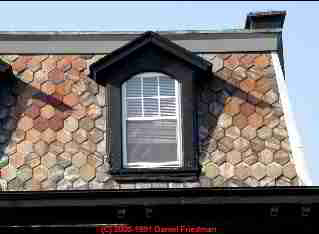 Types of Roofing Slates & Types of Slate Roofing
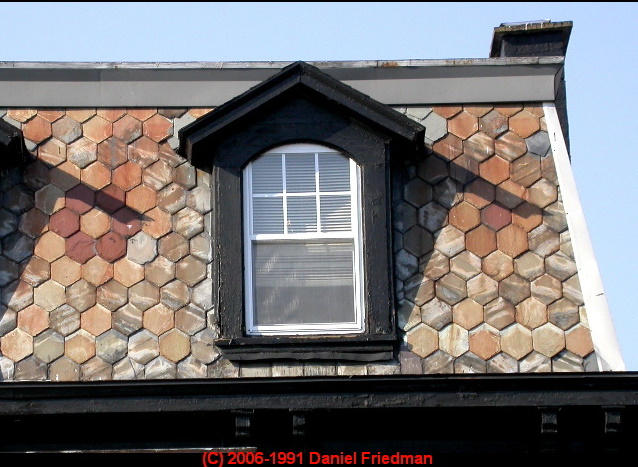
- POST a QUESTION or COMMENT about the different types of roofing slates and slate roofs
Types of slates used on building roofs.
This series of detailed slate roof inspection and repair articles describes procedures for evaluating the condition of slate roofing. How to inspect, identify defects, and estimate remaining life of slate roofs are addressed. The article series also references slate repair procedures, repair slate sources, and slate quarries.
InspectAPedia tolerates no conflicts of interest. We have no relationship with advertisers, products, or services discussed at this website.
Types of Slate used in Roofing
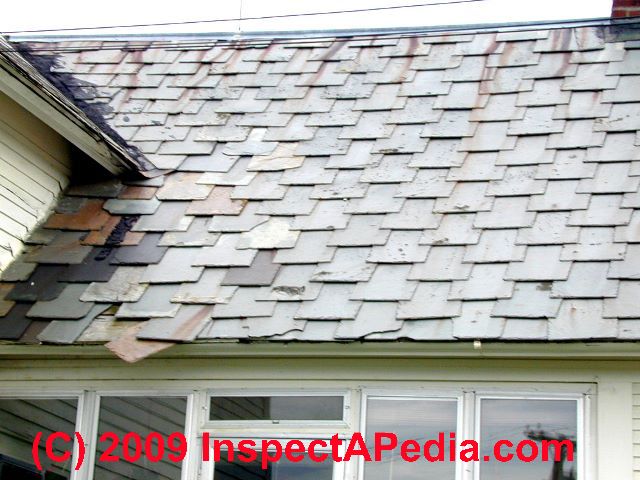
The abandonment of perfectly good slate roofs which should have been repaired is a financial shame and the destruction of a valued asset.
At the same time, careless optimism about a bad slate roof which is at the end of its life risks an angry inspection client. This article reviews types of slate, common defects, inspection topics, and some repair tips. We also provide slate sources and where to buy slate roofing materials and slate roofing tools and products.
Variations occur in color, thickness, surface texture, graduated sizes and varying widths. S
tandard slate roofs use slates 3/16" to 1/4" thick of one uniform length and width with square tails laid to a line in a conventional shingling pattern.
Textural style roofs
use rough-textured slates with uneven butts and varied thickness. Different colors and varying sizes are often used. The resulting roof has a very rustic look.
Graduated slate roofs use slates which vary in size and often in thickness, with larger slates at the eaves, smaller and with less shingle exposure at the ridge. Original work graduated roofs show smooth transition among the sizes from larger to smaller as each course of slates approaches the ridge line. Where lots of repair work was done this effect may have been lost. This roof style makes the roof and building look larger and taller than it actually is.
Shingle exposure is the portion of the shingle which you can see from outside, or the portion left exposed to the weather. In most shingle roofing systems the exposed portion of the shingle is considerably less than the total shingle length.
In addition to color, graduated and textural patterns, slates are placed in a variety of shingling patterns, of which several are illustrated in sketches throughout this paper and in
the Slate Roof Photo Library, such as French, Dutch-lap, and open-lap patterns.
The Dutch lap uses a 3" side overlap and a vertical exposure of all but 3" of the slate. The result is essentially a single layer of roofing with only 3" of overlap at the top and side. The open joints are all on one side or the other along any given row or course of slates. This system is extra vulnerable to wind-driven rain.
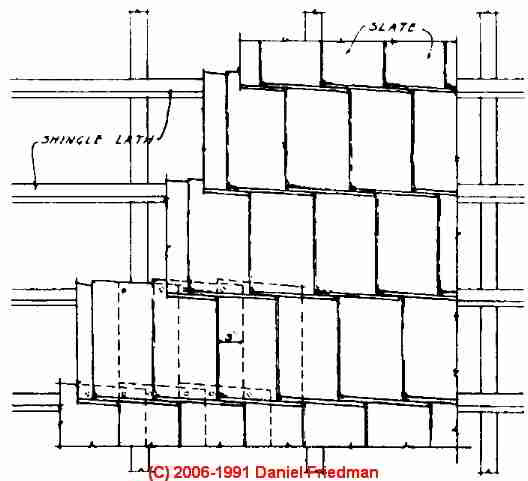
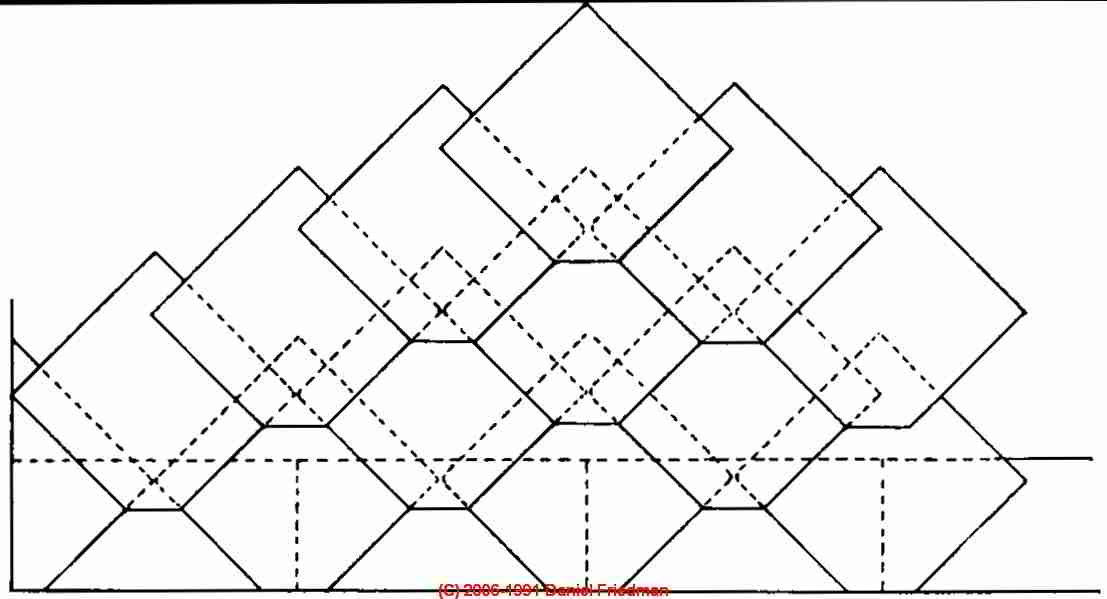
 The French method slate pattern also offers essentially
a single layer of roofing with three inches around the perimeter of
each shingle.
The French method slate pattern also offers essentially
a single layer of roofing with three inches around the perimeter of
each shingle.
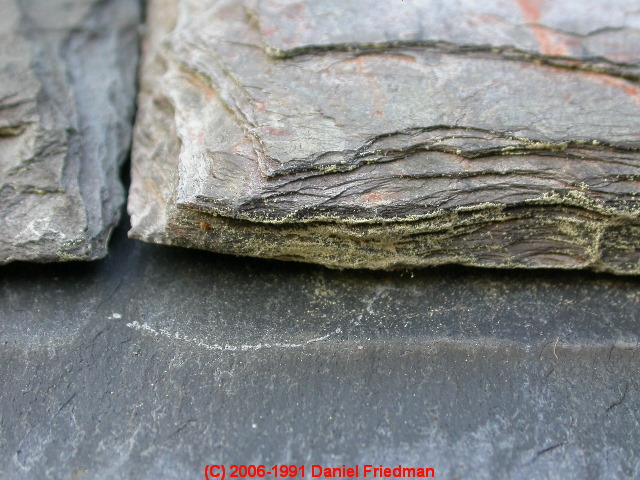
Finally, slates have a natural "grain" in the material. Normally the slates are cut so that the grain runs the length of the slates.
If the slate is quarried improperly, the nail holes create a perforated effect on the slate and it will break in half at the nail holes after the installation. Watch for this interesting defect.
See this slate edge close up, showing the natural layering of mineral deposits in the original stone.
An earlier version of this article appeared in the winter 1991 issue of the ASHI Technical Journal as cited below. That original content has been edited and updated for this online article series - March 2010, December 2023. Copies of the ASHI Technical Journal are no longer available from the American Society of Home Inspectors - ASHI at ashi [dot] com.
In this article series we have made additions and corrections to the original text,and we've added many slate roof photographs and details.
- Carson, Alan & Daniel Friedman, SLATE ROOFS [PDF] (1991) ASHI Technical Journal, Vol. 1. No. 1, January 1991
...
Continue reading at SLATE ROOF TYPES, RIBBON SLATES or select a topic from the closely-related articles below, or see the complete ARTICLE INDEX.
Or see these
Recommended Articles
Suggested citation for this web page
SLATE ROOF TYPES at InspectApedia.com - online encyclopedia of building & environmental inspection, testing, diagnosis, repair, & problem prevention advice.
Or see this
INDEX to RELATED ARTICLES: ARTICLE INDEX to BUILDING ROOFING
Or use the SEARCH BOX found below to Ask a Question or Search InspectApedia
Ask a Question or Search InspectApedia
Questions & answers or comments about different types of roofing slates..
Try the search box just below, or if you prefer, post a question or comment in the Comments box below and we will respond promptly.
Search the InspectApedia website
Note: appearance of your Comment below may be delayed: if your comment contains an image, photograph, web link, or text that looks to the software as if it might be a web link, your posting will appear after it has been approved by a moderator. Apologies for the delay.
Only one image can be added per comment but you can post as many comments, and therefore images, as you like.
You will not receive a notification when a response to your question has been posted.
Please bookmark this page to make it easy for you to check back for our response.
Our Comment Box is provided by Countable Web Productions countable.ca
Citations & References
In addition to any citations in the article above, a full list is available on request.
- Alan Carson and Dan Friedman are ASHI Members, home inspectors, educators and writers in Toronto and Poughkeepsie respectively. Information in this article is taken from the references shown below, from inspection experience, from opinions shared at ASHI and other education seminars, from the authors' personal, limited experience repairing and rebuilding of slate roofs, and from very helpful Bill Markcrow and Doug Sheldon at Vermont Structural Slate Co. we also paraphrased from a presentation to NY Metro ASHI Members by Mr. Steven Trapasso in October, 1990. Mr. Trapasso has 40 years experience in working with slate, and has a clear love affair with the material, particularly when it comes from Vermont.
- Slate Roofs, National Slate Association, 1926, reprinted 1977 by Vermont Structural Slate Co., Inc., Fair Haven, VT 05743, 802-265-4933/34. (We recommend this book if you can find it. It has gone in and out of print on occasion.)
- The Slate Roof Bible, Joseph Jenkins, www.jenkinsslate.com, 143 Forest Lane, PO Box 607, Grove City, PA 16127 - 866-641-7141 (We recommend this book).
- Slate Roofs , Steven Trapasso, presentation to NY Metro ASHI, Inc. chapter seminar, November 1990.
- The Old-House Journal , Special Roof Issue , April 1983, The Old-House Journal, PO Box 50214, Boulder, CO 80321-0214
- National Slate Technology courses for architects, builders, etc.
- Handbook of Building Crafts in Conservation, Jack Bower, Ed., Van Nostrand Reinhold Company, NY 1981 ISBN 0-442-2135-3 Library of Congress Catalog Card Nr. 81-50643.
- Slate Roofing Contractors Association [Website: www.slateroofers.org ] of North America
- National Slate Association includes list of slate testing laboratories
- Vermont Structural Slate Co., PO Box 98 Fair Haven, VT 05743 802/265-4933 802/265-3865 FAX (Green, purple, unfading red, and Spanish imported black.)
- Rising & Nelson Slate Co., West Pawlet, VT 05775; 802/645-0150 (all VT colors plus Buckingham Gray from VA and blacks from PA.)
- Evergreen Slate Co., 68 Potter Ave., Granville, NY 12832; 518/642-2530. Vermont slates in 10 colors.
- Hilltop Slate Co., Middle Granville, NY 12849; 518/642-2270 (all VT colors plus imported Spanish Black)
- Structural Slate Co., Pen Argyl, PA 18072; 215/863-4145 (PA black)
- Buckingham Slate Co., 4110 Fitzhugh Ave., Richmond, VA 23230; 805/355-4351 (VA Buckingham Grey)
- Eternit, Inc., rigid fiber reinforced cement roofing slates (and board products. Village Center Drive, Reading, PA 19607 800/233-3155
- BritSlateTM are made from 100% quarried slate particles combined with an adhesive (epoxy?) and no fillers with no questionable side effects according to the manufacturer. According to the manufacturer, they can be cut, drilled, etc. and come with a 50-year guarantee. They're less prone to breakage than slate, fireproof, and do not absorb water (like natural slate), and do not encourage organic growth (moss and lichens) because they are not porous. BritSlate North America, Inc., 647 West Boylston St., Worcester, MA 01606 508/852-4888 508/852-7224 FAX 2/90.
- Reinforced-cement shingles which "look like slate but are lighter and one-third the cost" are available from Atlas International Building Products, 5600 Hochelaga St., Montreal, Quebec, Canada H1N 1W1. [$180/square loose or $400./sq. installed, 30-year guarantee.]
- Supra-Slate "looks like slate and is manufactured in colors of real quarry slate." Tegusol is a double interlocking clay roof tile. Available from: Supradur Manufacturing Corporation, PO Box 908, Rye, NY 10580 800/223-1948 or 914/967-8230. or 122 East 42nd St., NY, NY 10168 212/697-1160
- Lifetile(R) Boral Concrete Products, Inc., produces high density extruded concrete roofing tiles meeting Class "A" requirements. Dallas, TX 214/544-2227
- Mark Cramer Inspection Services Mark Cramer, Tampa Florida, Mr. Cramer is a past president of ASHI, the American Society of Home Inspectors and is a Florida home inspector and home inspection educator. Mr. Cramer serves on the ASHI Home Inspection Standards. Contact Mark Cramer at: 727-595-4211 mark@BestTampaInspector.com
- John Cranor [Website: /www.house-whisperer.com ] is an ASHI member and a home inspector (The House Whisperer) is located in Glen Allen, VA 23060. He is also a contributor to InspectApedia.com in several technical areas such as plumbing and appliances (dryer vents). Contact Mr. Cranor at 804-873-8534 or by Email: johncranor@verizon.net
- In addition to citations & references found in this article, see the research citations given at the end of the related articles found at our suggested
CONTINUE READING or RECOMMENDED ARTICLES.
- Carson, Dunlop & Associates Ltd., 120 Carlton Street Suite 407, Toronto ON M5A 4K2. Tel: (416) 964-9415 1-800-268-7070 Email: info@carsondunlop.com. Alan Carson is a past president of ASHI, the American Society of Home Inspectors.
Thanks to Alan Carson and Bob Dunlop, for permission for InspectAPedia to use text excerpts from The HOME REFERENCE BOOK - the Encyclopedia of Homes and to use illustrations from The ILLUSTRATED HOME .
Carson Dunlop Associates provides extensive home inspection education and report writing material. In gratitude we provide links to tsome Carson Dunlop Associates products and services.
 | HOME | ABOUT | ASK a QUESTION | CONTACT | CONTENT USE POLICY | DESCRIPTION | POLICIES | PRIVACY | |
| © 2024 - 1985 Publisher InspectApedia.com - Daniel Friedman | |||||||||