
InspectAPedia®FREE Encyclopedia of Building & Environmental Construction, Diagnosis, Maintenance & Repair |
Question? Just ask us! InspectAPedia
|
 Slate Roof Wear, Slate Rot, Slate Roof Life
Durability of slate roofs - how to inspect slate roof condition
- POST a QUESTION or COMMENT about slate rot, soft, mushy roofing slate, slate that is "shot" even if slate doesn't really "rot"
Signs of slate roof wear & deterioration from close-up inspection allows one to assess remaining roof life: the abandonment of good slate roofs which should have been repaired is a financial shame and the destruction of a valued asset.
At the same time, careless optimism about a bad slate roof which is at the end of its life risks an angry inspection client.
This article describes various indicators of wear and aging found on slate roofs as an aid to assessing the overall roof condition, its risk of extensive leak points, and its probable remaining life.
InspectAPedia tolerates no conflicts of interest. We have no relationship with advertisers, products, or services discussed at this website.
- Daniel Friedman, Publisher/Editor/Author - See WHO ARE WE?
Aging and Durability of Slate Roofing - How Long Will a Slate Roof Last?
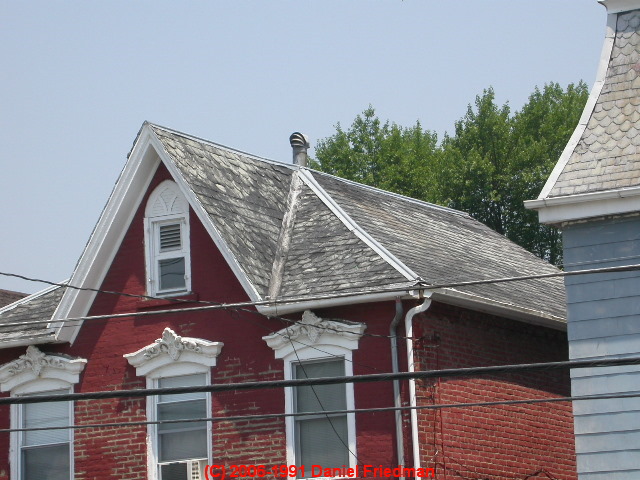
The slate roof in our photo at left was coated over all of its surface with roofing tar that later began to wash away.
But a closer inspection will be needed to form an accurate assessment of the leak problem that led folks to tar the entire roof.
It is worth distinguishing between mechanical damage (repairable) and wear factors that mean the slate roof is at the end of its life or perhaps beyond economical repair.
[Click to enlarge any image]
Close-up Inspection of Slate Roofs is Necessary to Evaluate Their Condition
Does slate "rot"?
No. Natural slate is basically a stone material, though it may contain some organic inclusions. Stone, being inorganic, does not truly "rot". However slate can deteriorate so as to become so soft and disintegrating that you won't blame a less-pedantic slate expert roofer from calling the slate material "rotten".
We were warned by an experienced slate roofer and we have confirmed by field inspections of slate roofs that determination of slate condition other than by direct up-close inspection is highly unreliable.
Slates may look fine from the ground, but be found soft and at end of life on close inspection.
Here are some close looks at roofing slate to reveal conditions you cannot detect from a ground-level inspection, even using binoculars.
Example of Very Soft Roofing Slates Past End of Life
By direct inspection we mean looking at slates from a few inches, either from a ladder or some other point of view such as an attic window.
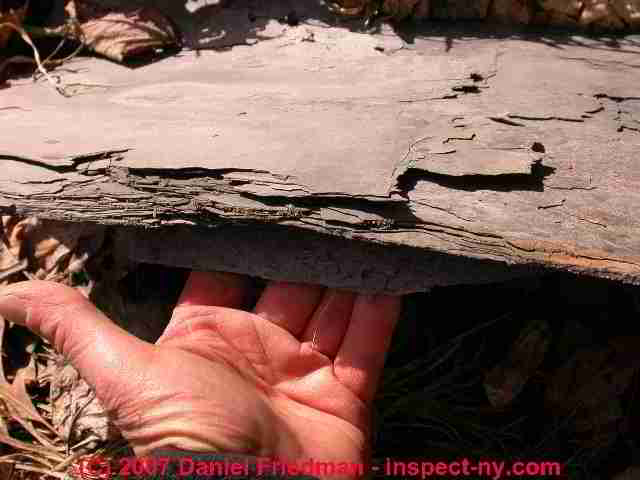
The slate above looks pretty good from a distance, though in the first photo as I've begun to push it up you can see some delamination.
In my second "rotted slate" photo below, I'm demonstrating that my weak puny thumb and forefinger are engough to smush this red slate into mud.
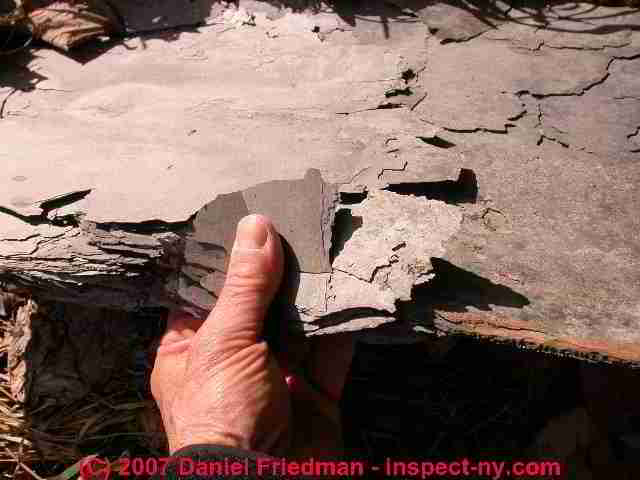
My third end-of-life slate photo shows the result: the slate is a handful of fragile chips and slivers.
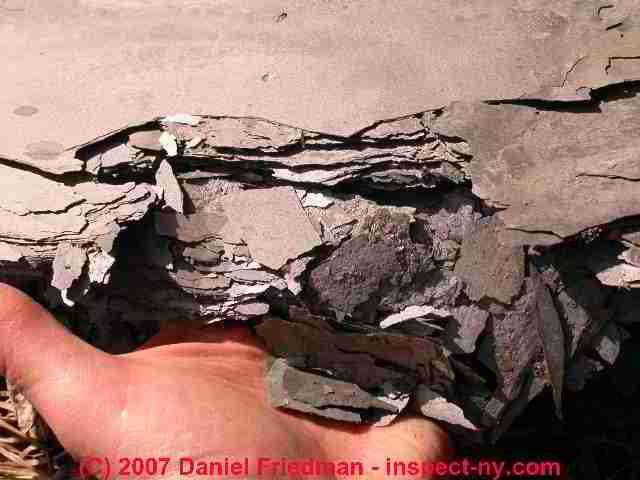
This red slate, probably from the Granville NY quarry, was also wet through to the touch. A few of these slates were on the ground along a barn on the FDR estate, the rest were still on the roof.
We strongly advise inspectors not to walk on slate roofs. Risks include falling - very slippery, and extensive damage to the slates. [Trapasso, personal communication.]
Example of Surface Delamination on a Roofing Slate
 The photographs provided here show how soft roofing slates can become. These slates might, from a distance, look pretty good, but
we were easily able to crush the slates with my fingers.
The photographs provided here show how soft roofing slates can become. These slates might, from a distance, look pretty good, but
we were easily able to crush the slates with my fingers.
We do not agree that we should call this "rotted roofing slate" as did Mr. Trapasso, but on seeing how soft and delaminated this slate can become, we can understand his loose use of that term.
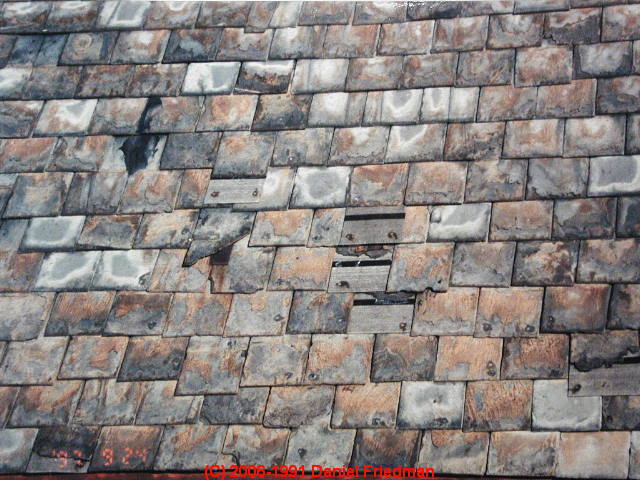
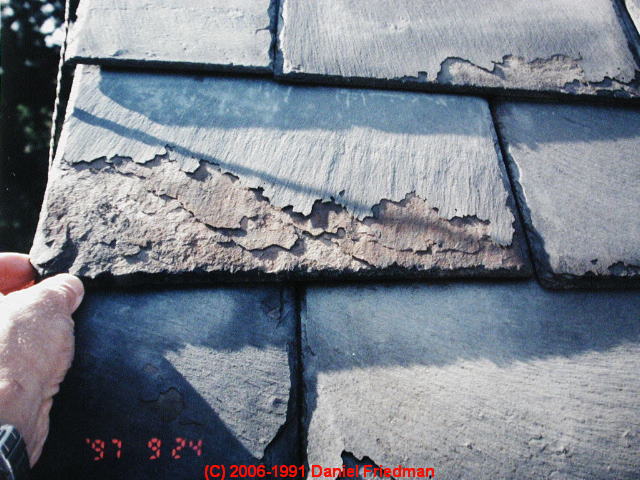
It is useful to contrast the above "soft crumbling roofing slate" with the surface delamination of the roofing slates shown at left.
The slates in our photo (left) may look questionable from the ground but a closeup inspection may show, as this one did, that the slate body is still thick and hard, and it is surface delamination of the slate that was visible from the ground.
These slates are not yet at end of life.
These photographs make clear that it can be tough to accurately evaluate the condition of some slate roofs from ground level - a close-up inspection is needed to distinguish between the slate roofs in our photos shown here.
The first is or really past end of roof life and the second slate roof has good life remaining.
Life Expectancy / Durability of Different Roofing Slates
Roofing Slate Life Depends on From Where Slates were Quarried, as we desribe below.
Life expectancy of Virginia Buckingham roofing slate
Darker gray "Buckingham" slates from Virginia are considered a durable high-quality material which, properly maintained, can have a near indefinite life. Average life of these slates is 175 years.
The Old House Journal, April, 1983 p. 57
Life expectancy of Vermont roofing slate
Vermont slate roofs, with proper maintenance, can last indefinitely.
 The Old House Journal, April 1983, p.58, and Slate Roofs,
National Slate Association, p. 71.
The Old House Journal, April 1983, p.58, and Slate Roofs,
National Slate Association, p. 71.
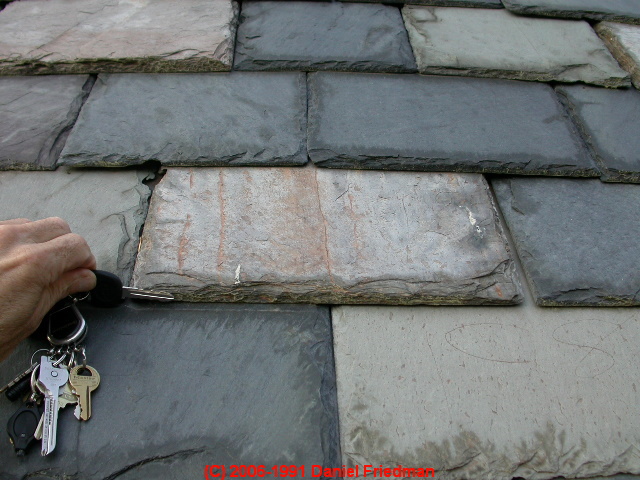
By other sources, Vermont slates have life expectancy of 100-200 years. Our photo at left shows a slate roof in good condition at Vassar College in Poughkeepsie, NY. We do not know the origin of this particular slate, but it's wear condition and age indicate a durable roof.
Steven Trapasso, personal communication. Also the Old House Journal April 1983 rates Vermont slates as having a 175 year life.
Such roofs should be maintained, not replaced.
With proper maintenance such an asset may be continued for an indefinite period. Inspectors who do not know the composition and source of slates would not want to condemn, except in the worst of circumstances, a Vermont slate roof.
Life expectancy of Pennsylvania roofing slate
Typical life for Pennsylvania slate roofs is 40-50 years. These life expectancies are general experience with the material and do not consider installation or environmental factors which vary from one building to the next.
Life Expectancy of Ribbon Slates
As you can read in more detail at RIBBON SLATE, there are two different sorts of ribbon slates, definitely from different quarries.
Some ribbon slates whose ribbons or lines of color through the slate demonstrate color lines comprised of soft minerals, sometimes even with small voids, often of a red or rust-brown color. In our experience, in the Northeastern U.S. where these slates were found, often these were a low-priced and short-lived roofing slate.
But other ribbon slates, also found in the Northeastern U.S. as well as in other areas, prove to be as durable as other high quality roofing slates, with lifetimes from 20 to 80 years, perhaps even longer.
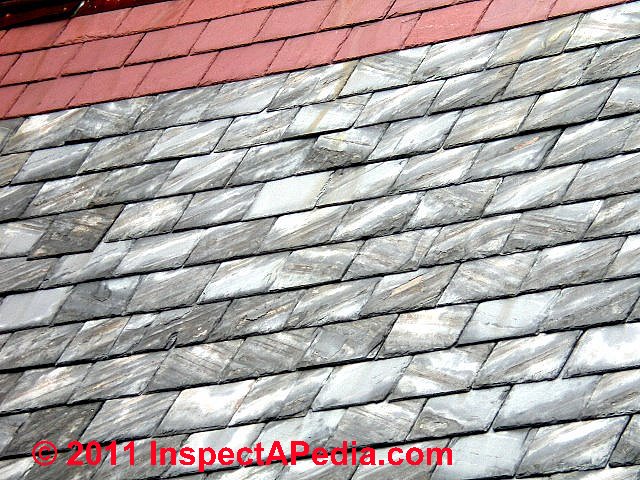
Above, the ribbon-slate roof in Poughkeepsie, New York was about eighty years old when we took the photo in the 1980s.
It remains in good condition and was still on the home in 2018.
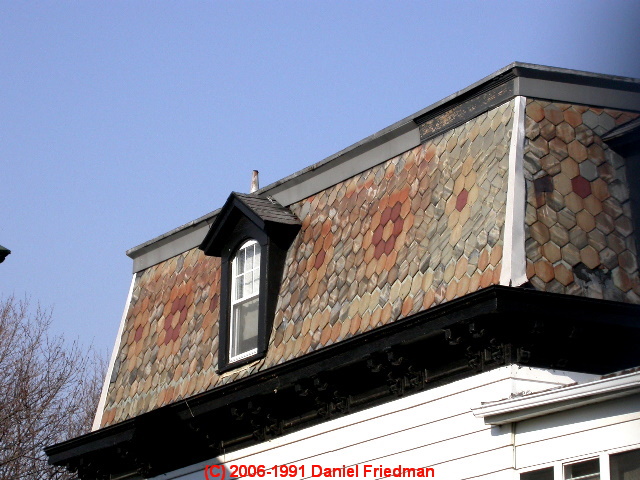
On a different home in the same city, the mansard style slate roof shown below right employs a mix of ribbon slates, some of which were quite worn and appeared to be at the end of their life.
Life expectancy of British and Welsh roofing slate
Earlier British experimentation on slate durability and composition emphasized that variations in the tendency of slates to absorb water may be the principal cause of deterioration seen by modern inspectors. Slates which are soft, delaminating, and thus are at or near end of their useful life may have been damaged by frost.
"That sort of slate", said Dr. Watson, the bishop of Llandaff, "other circumstances being the same, is esteemed the best, which imbibes the least water; for the imbibed water not only increases the weight of the covering, but, in frosty weather, being converted into ice, it swells and shivers the slate."
Watson continued to suggest that slates, being less porous than clay roofing tiles of the day, were more durable.
The New Practical Builder and Workman's Companion
Watson's opinion that slates are more durable than clay tiles is arguable as both materials are found with considerable variation in composition. Indeed unglazed clay absorbs more water (up to 10%) than slate (usually 1%) but tiles are not necessarily damaged by these freeze-thaw conditions. Watson's comments pertain to use of slate in Britain.
The extent of color change in Pennsylvania [and possibly other] slates often indicates the extent of deterioration. More white, more efflorescence probably means more deteriorated.
Reader Question: comparing the properties of Canadian Slate & Welsh Slate for Roofs
5/5/2014 john owen
hi, what is the difference between canadian roofing slates and welsh slates .
Reply:
John you must know that the names refer to where the roofing slates originate.
Canadian roofing slates are made from slate quarried in Quebec or possibly Newfoundland, and sold by a variety of companies. According to the National Slate Association, (quoting)
Overlooking the ocean at Burgoynes Cove, Newfoundland, is a deposit of smooth to medium-texture, unfading Cambrian slate with deep purple, green and variegated green and purple slate colors. The purple slate is very similar in color to Welsh Purple from England. Production of roofing slate from this quarry has been intermittent since the early 1900s.
The Glendyne Quarry in St. Mark du Lac Long, Quebec, Canada, is the largest roofing-slate producing facility in North America and one of the largest in the world. Their unfading black slate is currently produced for the European and North American market and is marketed in North America as North Country Unfading Black.
The first production from this vein of slate occurred in the early 1900s. This smooth-textured slate is easy to cut and has a consistent black color with subtle vertical shade markings. - slateassociation.org
For Edco roofing slates sold in Canada the product includes a 50 year warranty.
Welsh roofing slate is described by welshslate.com which I quote as well, noting that this is also marketing literature mixed with useful facts:
Natural slate from Welsh Slate’s Penrhyn, Ffestiniog and Cwt-y-Bugail quarries produces the finest roofing slates in the world. Its durability, which sets it apart from other slates, is derived from its density and the geological formation found in that part of North Wales.
Welsh Slate roofing is commonly removed from roofs after 100 years not because they have failed but because the roof timbers holding them up have failed. The Welsh slates may then be re-used. Penrhyn slate, for example, was removed from St Asaph Cathedral after 400 years in use and reused and this practice also applies to civic buildings as far away as Australia.
This blend of quality and aesthetics, as well as the large format sizes available, makes Welsh Slate roofing slate much desired for heritage and prestigious projects including Buckingham Palace, Number 10 Downing Street and St Pancras and King’s Cross Stations. - welshslate.com
Finally, when comparing slate properties it is worth remembering the location of the slate quarry and considering the shipping costs of alternative slates. Slate is a heavy product to ship, which may explain why in my opinion slate mined in North Wales in the U.K. is not likely to be found on many buildings in the U.S. or Canada.
Contact information for these companies and slates can be found at SLATE ROOF SOURCES & TOOLS
What is the normal rate of deterioration of roofing slates?
 The rate of slate deterioration on roofs depends on the source quarry and the depth
from which the slates were cut. These determine the density and composition
of the slate. Site conditions, such as the roof pitch, exposure to
sun, building moisture and ventilation and exposure to mechanical
damage also affect slate life.
The rate of slate deterioration on roofs depends on the source quarry and the depth
from which the slates were cut. These determine the density and composition
of the slate. Site conditions, such as the roof pitch, exposure to
sun, building moisture and ventilation and exposure to mechanical
damage also affect slate life.
It is interesting to note that several references indicate that slates actually harden after being quarried and exposed.
We'd presume that observation pertains to the early or initial state of use of the slates, and we found no reference which claimed some chemical or molecular process of permanent or continuing hardening over life.
Signs of deteriorating roofing slate
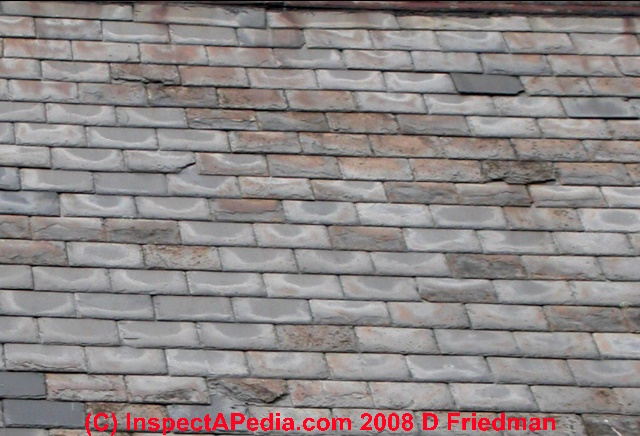
Deteriorating Pennsylvania slate shows a mottled appearance, with white faded patches resulting from exposure to sunlight and moisture.
The white areas generally begin at the three exposed sides of a slate, growing towards the center of the slate as a function of time and exposure.
The white visible in Pennsylvania slate is evidence of efflorescence - lime deposited on the slate surface. If the whole slate is white in color and scaling you should consider the slate to be at the end of its life.
However as long as the slates are physically intact the roof is serviceable. If a roofer recommends tearing off the whole roof you should ask to be shown examples of failed slates.
Also see EFFLORESCENCE SALTS & WHITE DEPOSITS
Roofing slate fading versus mottling
Fading versus mottling: It is important for an inspector to distinguish between the mottled edges-in whitening (efflorescence) and fading. By contrast to the efflorescence process, fading slates generally fade monotonically across the slate rather than from edges in.
Faded slates will not show an obvious whitish powder of surface deposited mineral salts as thick as that left by efflorescence. All slates will fade from weather exposure. Those which have only minimal color change are classed as "permanent" or "unfading". Those which change more markedly are classed as "weathering".
Monotonically means that the color change is even across the material rather than showing up as a splotch, or a ring of white around darker color, or in other variations. It's a nice word, not recommended for inspection reports.
We've heard several explanations for the mechanism by which Pennsylvania slates deteriorate, of which the most interesting was the opinion that lime in the slates in the presence of moisture reacts to break down organic components in the slate. For slates higher in carbon or carbonaceous materials this may be indeed the most accurate explanation.
Pennsylvania "Black Bed" quarried slates were high in carbonaceous impurities and were recommended by the Slate Association only for temporary buildings or for chalkboards. By the 1920's this slate was recognized as not as durable; you'd not expect to find it surviving on a building in 1991.
The National Slate Association reference does not detail the mechanism of slate deterioration. It does point out that the slate roof on the Saxon Chapel at Stratford-on-Avon was built 1100 years ago - still in good condition.
By Mr. Trapasso's account the decomposition of Pennsylvania slate may be understood as a process similar to decomposition of wood. The lime which was in the slate, when the slate was mined, had not caused deterioration because the slates were protected from sunlight.
When the slate is split, cut, punched for use, the lime is in an inactive or dormant state. Following application on a roof surface the slate material is exposed to ultraviolet rays (sunlight) and moisture. These components cause the lime to break down the organic materials in the slate (shale), making the slate increasingly porous and causing the white efflorescence. Lime and other mineral salts are dissolved and deposited on the surface of the slate when moisture evaporates.
Slate Roofs, National Slate Association, p.71-76.
Calcium Oxide - Sources of white minerals and oxides in roofing slates
Examining quantitative analysis of slates from nineteen quarries we observe that while oxides of silica (SIO2) and aluminum oxide (AL2O3) are the dominant components of slates, almost all have measurable levels of calcium oxide (CaO) and other carbonates and oxides. There are dramatically higher levels of these materials in Pennsylvania slates (3%) than in slates from Vermont (.3%-.7%). Clearly there is more material available to form calcium carbonates and efflorescence in the shorter lived materials.
Slate Roofs p. 73
Carbon, which would be broken down in the process described by Trapasso, occurs in slates from only a few quarries, and then in usually small amounts of less than 1%. This would seem to argue against the "slate rots" explanation of deterioration.
Brown staining in roofing slate: iron inclusions
 The brown color of some slate may be from oxidizing
iron content in the slate which is following a similar reactive path.
we did not find references to brown in Virginia slates.
The brown color of some slate may be from oxidizing
iron content in the slate which is following a similar reactive path.
we did not find references to brown in Virginia slates.
The known chronological age of slates may be available from an owner or other documentation. As with all materials, experienced inspectors rate the apparent wear age of the roof, not the actual age.
This article series reviews types of slate, common defects, inspection topics, and some repair tips. We also provide slate sources and where to buy slate roofing materials and slate roofing tools and products.
This series of detailed slate roof inspection and repair articles describes procedures for evaluating the condition of slate roofing. How to inspect, identify defects, and estimate remaining life of slate roofs are addressed.
The article series also references slate repair procedures, repair slate sources, and slate quarries.
Information in this article is taken from the references shown below, from inspection experience, from opinions shared at ASHI and other education seminars, from the authors' personal, limited experience repairing and rebuilding of slate roofs, and from very helpful Bill Markcrow and Doug Sheldon at Vermont Structural Slate Co.
We also paraphrased from a presentation to NY Metro ASHI Members by Mr. Steven Trapasso in October, 1990. Mr. Trapasso has 40 years experience in working with slate, and has a clear love affair with the material, particularly when it comes from Vermont.
...
Reader Comments, Questions & Answers About The Article Above
Below you will find questions and answers previously posted on this page at its page bottom reader comment box.
Reader Q&A - also see RECOMMENDED ARTICLES & FAQs
On 2021-08-09 - by (mod) - - typical life of Pennsylvania Slate Roofs
Pennsylvania slate is an excellent product, though higher in Lime than slates from Vermont.
Those details are at SLATE ROOF COLORS & SLATE CHEMISTRY
I dob't know for sure which Pennsylvania slate is on your roof; At our onlien
we note that
- Blue-gray - Pennsylvania slate is the best known among varities of PA slate.
- "Pennsylvania black" slate - less durable - 40-50 yrs,or 60 years in some tects. White efflorescence forms rings on 3 exposed sides of slates and the size of those effloresence rings can be an indicator of remaining slate life.
- Unfading Pennsylvania gray slate is soft-gray, longer-lived;
- Unfading Pennsylvania black slate is rougher, longer-lived;
- Blue-black "hard-vein" Pennsylvania roofing slates darken with age.
- Pennsylvania "Peach Bottom" slate, first quarried by Welsh miners, is reported to have a150- 200-year lifespan
You need to have specifics: which kind of slate is on your roof, what damage is present, how much, and what % of total roof area;
Do take a look at the other slate roof condition articles I suggested as those offer more complete and better detail than I recreate typing off-the-cuff anew.
On 2021-08-09 by Cathy
 Both roofers are experienced in working with slate roofing.
I do not know if I mentioned that the slate was Pennsylvania slate and original to the 83 yr. old house.
The cost to do either is fairly expensive, with the replacement cost almost twice as much as the repair.
On 2021-07-31 by inspectapedia.com.moderator (mod) - one roofer says repair a few slates, another roofer says tear off this slate roof; which is right?
@Cathy,
Mak, thanks, I agree we can't say anything definitive when we don't understand the question.
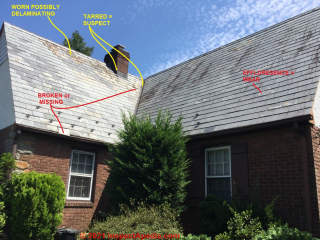
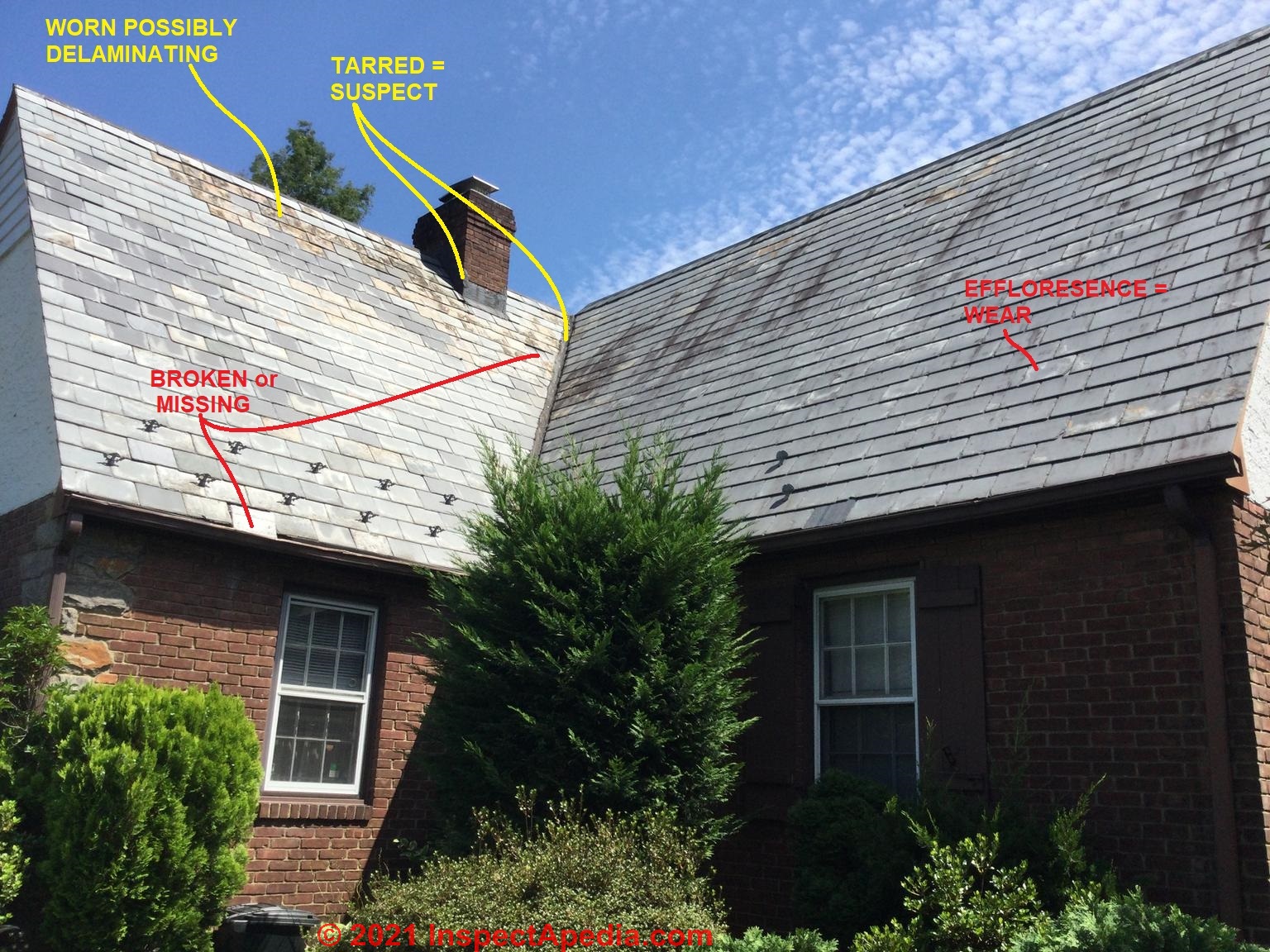
I'm posting an annotated copy of Cathy's photo;
[Click to enlarge any image]
We can see that a valley and also chimney flashing are tarred - a patch -approach that of course also further erodes the tarred-over metal flashing - suspect leak points that ought to be easily confirmed if there is an attic with view of the roof decking, valley, chimney areas;
Other things obvious in your photo are annotated below.
Bottom line:
On you roof I see questionable slates at the upper left slope, but a lot of good slates - from just the photo and considering that we can see less than half of the total roof area, no one should draw a conclusion; but considering the costs involved in maintaining a slate roof and its considerable value in its usual long life as well as other considerations (aesthetic, property value) we'd prefer to keep the roof and repair it until the repair costs approach the cost of a new roof.
A close-up inspection by an experienced slate roofer will always be far more thorough than looking at a photo;
But to compare two roofing bids in any case, insist on specifics: what do you see, why do you recommend what you do, how much damage, where - point it out to me.
In the Recommended Articles above see
SLATE ROOF REPAIR, WORN OUT inspectapedia.com/roof/Worn_Out_Slate_Roofs.p
where we discuss the decision of repair versus replace;
The articles recommended on this page, include
SLATE ROOF DEFECTS https://inspectapedia.com/roof/Slate_Roof_Defects.php
describe visual clues about slate condition and slate roof condition, including those white effloresence spots, delaminating, etc. Be sure to take a look. That will prep you for talking with your slate roofers.
Also see
SLATE ROOF CONDITION, OTHER FACTORS https://inspectapedia.com/roof/Slate_Roof_Condition_Factors.php - How to Evaluate Slate Roof Condition - other factors
Watch out: But beware of a roof tear-off recommendation by a roofer who might not be a true slate expert; I've seen a 100 year life roof torn off and replace by 20-year asphalt shingles because the proposer was an asphalt shingle person who wasn't up to and didn 't know how to repair
On 2021-07-31 by mak.church (mod)
@Cathy,
Are you asking between the two options of repairing the roof where needed vs. replacing the entire roof?
On 2021-07-31 by Cathy
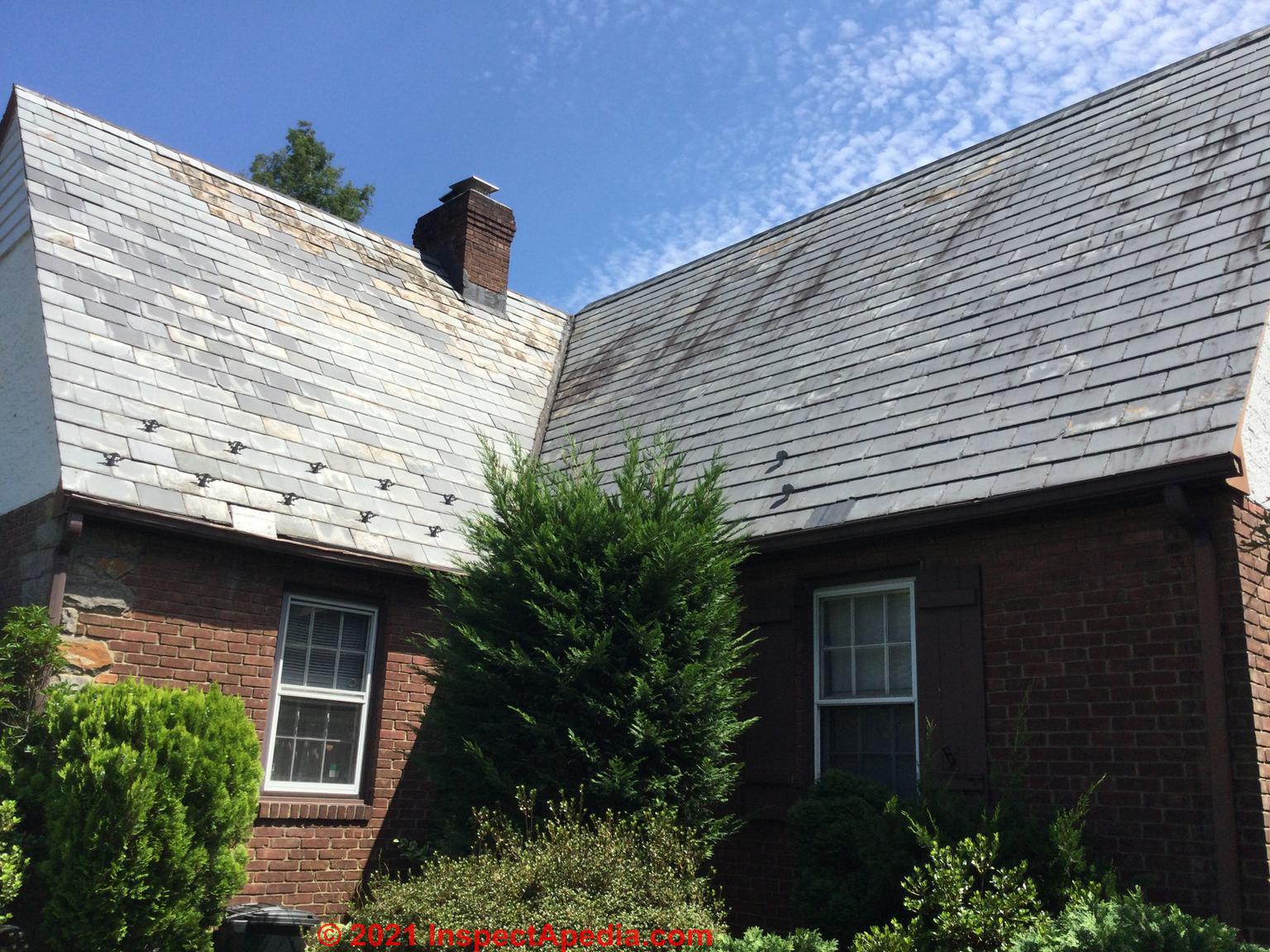
Slate roof on 83 year old house recently, there has been cracks, stains and peeling in upstairs bedrooms. Every year, Ireplace about 5or 6 slates.
One roofer says to repair and another to replace at twice the cost. See the picture below. Please advise.
On 2021-03-24 by (mod)
@Sarah,
In your second photo I think I see one broken-off slate that could risk a leak, some broken edges that might be OK, but the photo is blurry and lacks detail.
As you can read in our slate roof inspection articles recommended above, and in our description of each of the types of damage or defects found in slate roofs,
many of these are simply not visible from the ground at all, blurry picture notwithstanding, and need to be seen by up-close inspection by ladder at roof edge or from a similar close inspection point.
For example cracked slates or failing fasteners may not be obvious from the ground, and though its' not common, slates that have become soft and are at end of life may also not be visible from ground.
Watch out: don't let some idiot stop all over the roof breaking slates and causing worse damage, or you may find that what was a minor repair has been stomped into a major one.
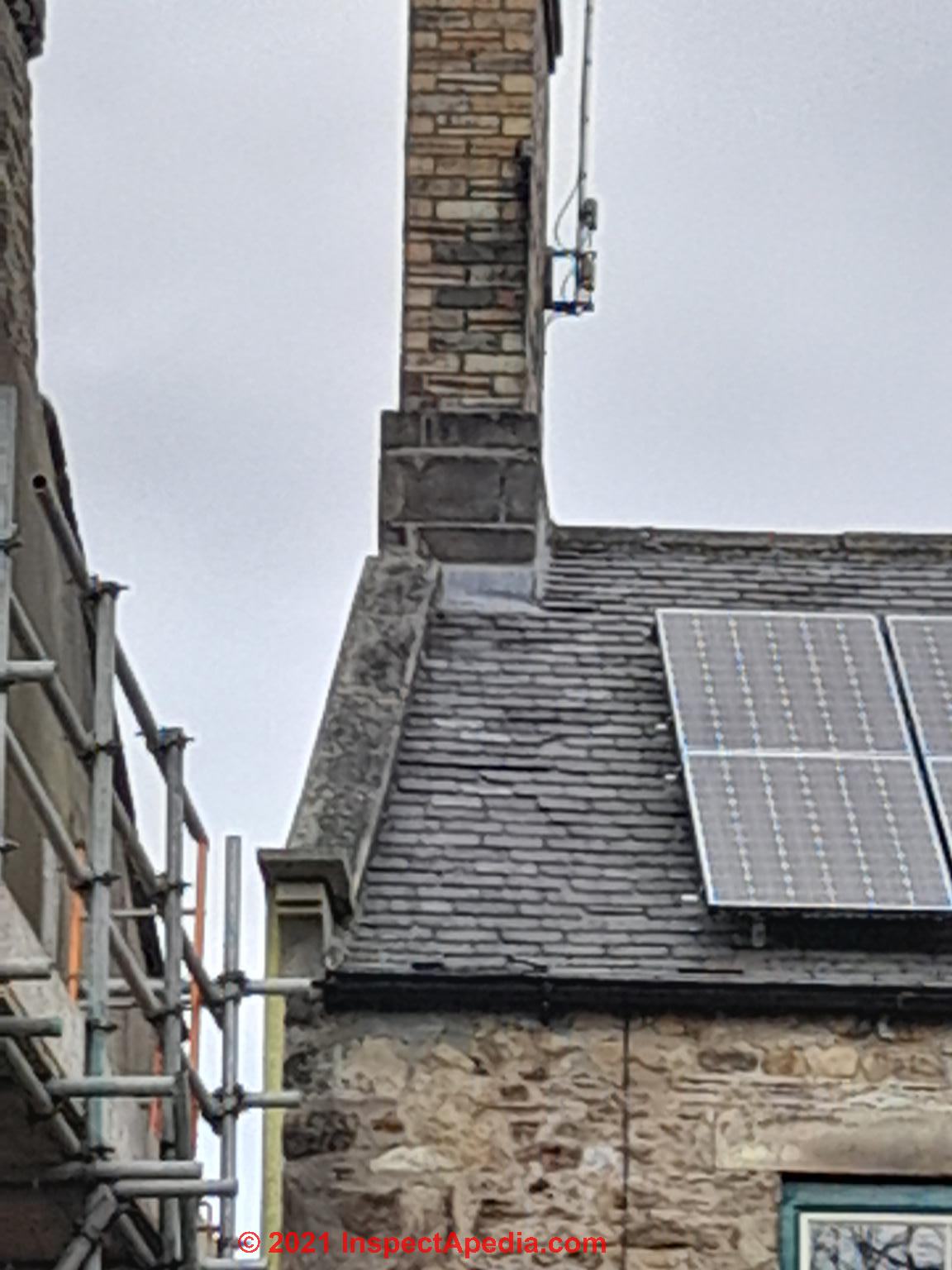 Here I re-post your image rotated right-way up. You are probably asking about the slates to the left of those solar panels, as that's pretty much all that's depicted in the photo. Don't worry about minor typos or errors in posted questions.
In your first photo I can't see enough in your photo to be certain, but in general you should beware of opting for a total replacement of a slate roof when all that's needed is to repair a few broken slates or to fix some flashing.
Watch out: repair bids from or actual work by someone who is not a slate roof expert risks tossing out material that could have a very long remaining life (sometimes hundreds of years depending on slate quality) and replacing it with 20-year material instead. I hope you won't do that.
In very general terms, if less than 30% of slates need repair, it's economically sensible to repair the roof.
Take a look at SLATE ROOF REPAIR, WORN OUT inspectapedia.com/roof/Worn_Out_Slate_Roofs.php for descriptions of slate roofs that are beyond repair.
On 2021-03-24 by Sarah
Thank you very much for your comment. I am only concerned with the state of the roof from about satellite dish to the left, towards solar panel, as my neighbour seems to have a newer cover on his part. What happens, when the house is divided and one part is of the sound quality and other worse?
I have posted the other part toward the chimney later on, which seems to be worse
. I still hope repair is possible. rather than taking all the slates, as I was advised. I certainly will bear in mind, what you have said about discarding good old material and replacing with newer, not so good quality.
On 2021-03-24 by Sarah
This is a comment to my previous photo: I am only concerned with the state of the roof from the solar panels to the left of a cable, as the rest is my neighbour and seems in a better condition. Attached picture of another part, from the other side.
On 2021-03-23 by Sarah - does this slate roof need replacement?
Would you be able to say, if the state of this roof warrants total replacement?!

On 2017-01-22 by (mod)
If the slates are extremely soft I doubt that coating them with a polyurethane would be enough - you'd have to glue the underside of the slate to a supporting piece of wood or metal.
On 2017-01-22 by Yvonne Gabel
I have obtained several old slate roof tiles from a family barn. They are soft and will crumble if not handled carefully. I am looking to preserve some pieces for family heirlooms. Is there anything I can do to help strengthen them? Thanks for your assistance! Please reply to ymgabel21@gmail.com.
...
Continue reading at SLATE ROOF PATTERNS or select a topic from the closely-related articles below, or see the complete ARTICLE INDEX.
Or see these
Recommended Articles
- SLATE ROOF INSPECTION & REPAIR - home
- SLATE ROOF COLORS
- SLATE ROOF COLORS & SLATE CHEMISTRY
- SLATE ROOF DEFECTS - problems and leak points on slate roofs that are not necessarily a function of the age or wear condition of the roof.
- SLATE ROOF INSPECTION BASICS
- SLATE ROOF INSPECTION COURSE
- SLATE ROOF LIFE EXPECTANCY
- SLATE ROOF PATTERNS
- SLATE ROOF PHOTO LIBRARY
- SLATE ROOF REPAIRS
- SLATE ROOFS, STEEP SLOPE
- SLATE ROOF TYPES
- SLATE THERMAL MASS for SOLAR HEAT STORAGE
- SNOW GUARDS & SNOW BRAKES
...
Suggested citation for this web page
SLATE ROOF LIFE EXPECTANCY at InspectApedia.com - online encyclopedia of building & environmental inspection, testing, diagnosis, repair, & problem prevention advice.
Or see this
INDEX to RELATED ARTICLES: ARTICLE INDEX to BUILDING ROOFING
Or use the SEARCH BOX found below to Ask a Question or Search InspectApedia
Ask a Question or Search InspectApedia
Try the search box just below, or if you prefer, post a question or comment in the Comments box below and we will respond promptly.
Search the InspectApedia website
Note: appearance of your Comment below may be delayed: if your comment contains an image, photograph, web link, or text that looks to the software as if it might be a web link, your posting will appear after it has been approved by a moderator. Apologies for the delay.
Only one image can be added per comment but you can post as many comments, and therefore images, as you like.
You will not receive a notification when a response to your question has been posted.
Please bookmark this page to make it easy for you to check back for our response.
IF above you see "Comment Form is loading comments..." then COMMENT BOX - countable.ca / bawkbox.com IS NOT WORKING.
In any case you are welcome to send an email directly to us at InspectApedia.com at editor@inspectApedia.com
We'll reply to you directly. Please help us help you by noting, in your email, the URL of the InspectApedia page where you wanted to comment.
Citations & References
In addition to any citations in the article above, a full list is available on request.
- Mark Cramer Inspection Services Mark Cramer, Tampa Florida, Mr. Cramer is a past president of ASHI, the American Society of Home Inspectors and is a Florida home inspector and home inspection educator. Mr. Cramer serves on the ASHI Home Inspection Standards. Contact Mark Cramer at: 727-595-4211 mark@BestTampaInspector.com
- John Cranor [Website: /www.house-whisperer.com ] is an ASHI member and a home inspector (The House Whisperer) is located in Glen Allen, VA 23060. He is also a contributor to InspectApedia.com in several technical areas such as plumbing and appliances (dryer vents). Contact Mr. Cranor at 804-873-8534 or by Email: johncranor@verizon.net
- Building Pathology, Deterioration, Diagnostics, and Intervention, Samuel Y. Harris, P.E., AIA, Esq., ISBN 0-471-33172-4, John Wiley & Sons, 2001 [General building science-DF] ISBN-10: 0471331724 ISBN-13: 978-0471331728
- Building Pathology: Principles and Practice, David Watt, Wiley-Blackwell; 2 edition (March 7, 2008) ISBN-10: 1405161035 ISBN-13: 978-1405161039
- Built-Up Roof Systems, Manual, C.W. Griffin, Mcgraw-Hill (Tx); 2nd edition (July 1982), ISBN-10: 0070247838, ISBN-13: 978-0070247833
- Handbook of Building Crafts in Conservation, Jack Bower, Ed., Van Nostrand Reinhold Company, NY 1981 ISBN 0-442-2135-3 Library of Congress Catalog Card Nr. 81-50643.
- Historic Preservation Technology: A Primer, Robert A. Young, Wiley (March 21, 2008) ISBN-10: 0471788368 ISBN-13: 978-0471788362
- Historic Slate Roofs : With How-to Info and Specifications, Tina Skinner (Ed), Schiffer Publishing, 2008, ISBN-10: 0764330012 , ISBN-13: 978-0764330018
- Problems in Roofing Design, B. Harrison McCampbell, Butterworth Heineman, 1991 ISBN 0-7506-9162-X (available used)
- Roofing The Right Way, Steven Bolt, McGraw-Hill Professional; 3rd Ed (1996), ISBN-10: 0070066507, ISBN-13: 978-0070066502
- Slate Roofs, National Slate Association, 1926, reprinted 1977 by Vermont Structural Slate Co., Inc., Fair Haven, VT 05743, 802-265-4933/34. (We recommend this book if you can find it. It has gone in and out of print on occasion.)
- Roof Tiling & Slating, a Practical Guide, Kevin Taylor, Crowood Press (2008), ISBN 978-1847970237,
If you have never fixed a roof tile or slate before but have wondered how to go about repairing or replacing them, then this is the book for you. Many of the technical books about roof tiling and slating are rather vague and conveniently ignore some of the trickier problems and how they can be resolved. In Roof Tiling and Slating, the author rejects this cautious approach. Kevin Taylor uses both his extensive knowledge of the trade and his ability to explain the subject in easily understandable terms, to demonstrate how to carry out the work safely to a high standard, using tried and tested methods.
This clay roof tile guide considers the various types of tiles, slates, and roofing materials on the market as well as their uses, how to estimate the required quantities, and where to buy them. It also discusses how to check and assess a roof and how to identify and rectify problems; describes how to efficiently "set out" roofs from small, simple jobs to larger and more complicated projects, thus making the work quicker, simpler, and neater; examines the correct and the incorrect ways of installing background materials such as underlay, battens, and valley liners; explains how to install interlocking tiles, plain tiles, and artificial and natural slates; covers both modern and traditional methods and skills, including cutting materials by hand without the assistance of power tools; and provides invaluable guidance on repairs and maintenance issues, and highlights common mistakes and how they can be avoided. The author, Kevin Taylor, works for the National Federation of Roofing Contractors as a technical manager presenting technical advice and providing education and training for young roofers. - The Slate Roof Bible, Joseph Jenkins, www.jenkinsslate.com, 143 Forest Lane, PO Box 607, Grove City, PA 16127 - 866-641-7141 (We recommend this book).
- Slate Roofing in Canada (Studies in archaeology, architecture, and history)
- In addition to citations & references found in this article, see the research citations given at the end of the related articles found at our suggested
CONTINUE READING or RECOMMENDED ARTICLES.
- Carson, Dunlop & Associates Ltd., 120 Carlton Street Suite 407, Toronto ON M5A 4K2. Tel: (416) 964-9415 1-800-268-7070 Email: info@carsondunlop.com. Alan Carson is a past president of ASHI, the American Society of Home Inspectors.
Thanks to Alan Carson and Bob Dunlop, for permission for InspectAPedia to use text excerpts from The HOME REFERENCE BOOK - the Encyclopedia of Homes and to use illustrations from The ILLUSTRATED HOME .
Carson Dunlop Associates provides extensive home inspection education and report writing material. In gratitude we provide links to tsome Carson Dunlop Associates products and services.
 |
HOME | ABOUT | ASK a QUESTION | CONTACT | CONTENT USE POLICY | DESCRIPTION | POLICIES | PRIVACY | |
| © 2026 - 1985 Publisher InspectApedia.com - Daniel Friedman | |||||||||