
InspectAPedia® FREE Encyclopedia of Building & Environmental Construction, Diagnosis, Maintenance & Repair |
Question? Just ask us! InspectAPedia
|
 Ribbon Slates on Slate Roofs
Types, life, sources, effect on slate roof life
- POST a QUESTION or COMMENT about ribbon slate roofs: appearance, durability, life expectancy
Ribbon slate roofing:
What are ribbon slates, and do they wear out faster than other slate roofs? Slates with diagonal or striped inclusions of varying colors, or ribbon slates, include products with a very long life expectancy and other ribbon slates that are or were a low-priced slate with soft inclusions, short life, and leaks.
Here we illustrate different types of ribbon slates used in roofing and we describe how to distinguish the low-priced short-lived ribbon slate from the longer-lived very durable ribbon slate on a roof.
InspectAPedia tolerates no conflicts of interest. We have no relationship with advertisers, products, or services discussed at this website.
Ribbon Slates & Ribbon Slate Roofs: appearance, life expectancy, leak risks
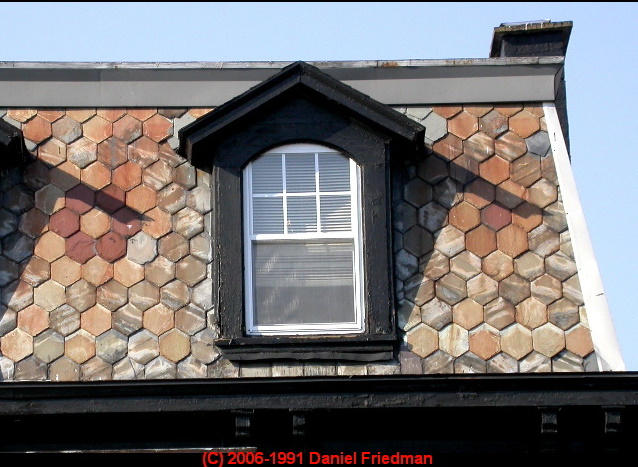
The ribbon slate on this mansard roof slope may have been chosen for appearance, though it was not installed so as to use the ribbon diagonals to form any particular pattern.
[Click to enlarge any image]
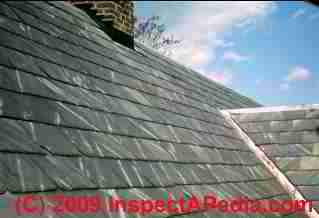
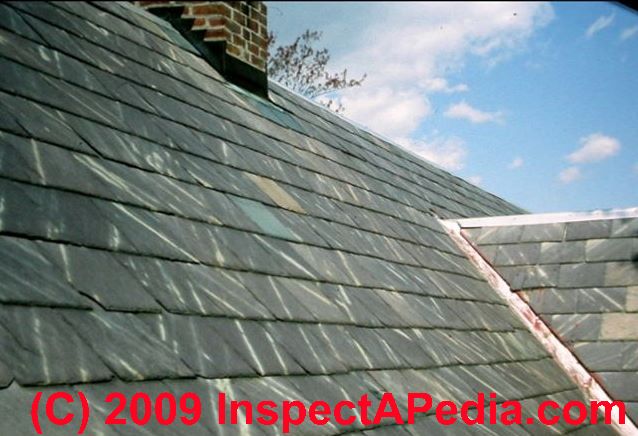
In the first two photos shown here the slates have diagonal colored stripes of mineral inclusion, but they do not show the characteristic delamination and wear we see on classic ribbon slates.
Some ribbon slates were a cheaper and shorter-lived product because the mineral inclusions that formed the "ribbons" of color in the roofing slates were a softer material that weathered out of the slate rapidly.
However as numerous slate roofers and other readers have pointed out, ribbon slates were also selected and installed on some buildings for their aesthetic appeal and included ribbon slates from other quarries whose mineral inclusions were quite durable.
So the answer to the question of "are ribbon slates more or less durable than other roofing slates?" is "it depends" on which quarry was the source of the slate and on some more technical details that we'll describe just below.
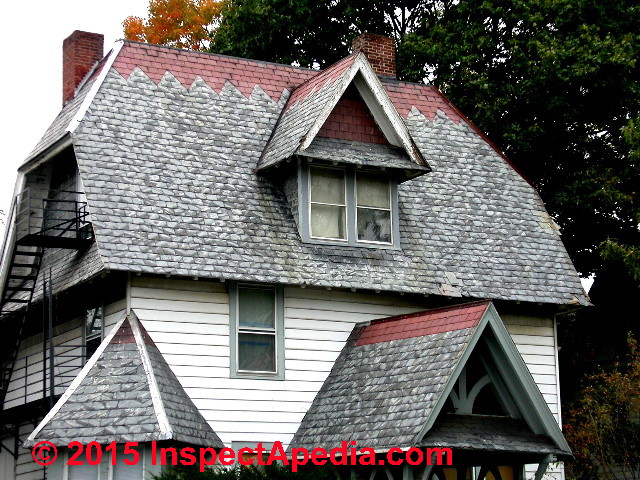
Below: more ribbon slate with diagonal mineral inclusions is shown mixed with solid reds on other slopes of the same home.
"Slate is of medium hardness, very fine grained of low porosity, great strength and consists essentially of insoluble and stable minerals that will withstand weathering for hundreds of years. Some slate in Pennsylvania contains ribbons which consist of narrow original beds usually containing carbon, and darker in color than in the body.
There is tendency for some ribbons to contain an excessive amount of the less resistant minerals, and they should not appear on exposed surfaces." -- Dr. Oliver Bowles, Mineral Technologist of the US Bureau of Mines, in "The Characteristics of Slate" , June 1923 paper delivered to the American Society for Testing Materials. ASTM. Bowles was a mineral technologist employed by the U.S. Bureau of Mines.
By "appear," Bowles meant that inferior ribbon slates which contain fast-weathering mineral inclusions should not be used where exposed to the weather.
Ribbon slates are easily identified from the ground. The stripes are accentuated because the ribbon portion absorbs more water than the rest of the slate. Usually the ribbons are darker, often multi-colored browns and reds.
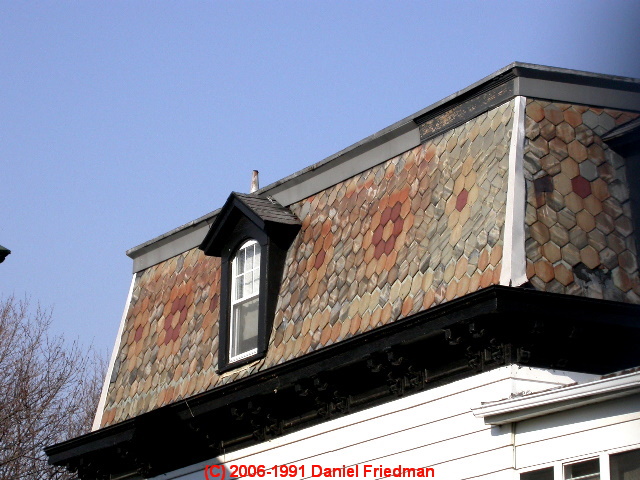
Ribbons of color in ribbon slates on roofs may be in the entire shingle or in some applications, may be in the upper or covered portion of the slates
White Inclusions in Chapman Slate
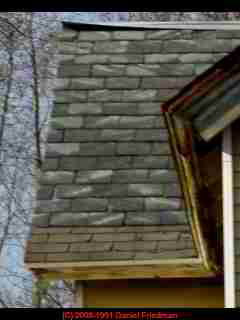 In the this photo , we see a mix of "ribbon slates" that have light colored or even white diagonal colored stripes of mineral inclusion, but they do not show the characteristic delamination and wear we see
on classic ribbon slates.
In the this photo , we see a mix of "ribbon slates" that have light colored or even white diagonal colored stripes of mineral inclusion, but they do not show the characteristic delamination and wear we see
on classic ribbon slates.
What's different about this roof, and why are these "ribbon slates" in apparently good shape.
At a 1990 Metro ASHI class on slate roofs, an Albany NY slate roofer suggested that ribbons were desirable for a pattern effect, and that they were equally durable with other slates from Pennsylvania. -- Capital Region ASHI chapter education seminar, fall 1990
Some roofers consider ribbon slates as less durable material.
There is no doubt that In at least some cases, ribbon slates are less durable than other Pennsylvania slates. -- Trapasso, personal communication.
I [DF] agreed with Trapasso, having both worked-on and inspected quite a few slate roofs in the Northeastern U.S. We found many ribbon slate roofs in which the ribbons were red or tan and where those slates to be wearing faster than expected - noting that the durability of ribbon slates depends on the particular minerals which make up the visual diagonals.
The ribbons proved to be a softer material than the surrounding slate.
More than two decades after we first compiled this material on slate roofs, Tim Underhill (Underhill 2015) explains that the slates in our photo, with light or white diagonal stripes, are probably Chapman slate, a Vermont slate product that is also called "ribbon slate" by many of us, but is morphologically different.
In Chapman slates the white inclusions are not soft stripes of calcium or magnesium but rather quartz inclusions that are in fact harder than the slate itself. These slates are from a different quarry or at the very least, a different slate vein even when mined in the same state as the more colorful and often shorter-lived ribbon slates.
Watch out: don't call out white-striped Chapman slates as defective ribbon slate of questionable life - at least not based on these hard white inclusions.
If the diagonals are comprised of minerals softer than the surrounding slate, early wear is likely.
 If some ribbon slates were actually shorter-lived than clear cut materials,
why were they used? In the 1940's one square (100 sq. ft.) of Pennsylvania
slate cost about $6.00, or about $15.00 installed. Because of these
attractively low prices and low anticipated replacement cost [boy
were they wrong!] ribbon slates were very popular and were
used extensively.
If some ribbon slates were actually shorter-lived than clear cut materials,
why were they used? In the 1940's one square (100 sq. ft.) of Pennsylvania
slate cost about $6.00, or about $15.00 installed. Because of these
attractively low prices and low anticipated replacement cost [boy
were they wrong!] ribbon slates were very popular and were
used extensively.
As slate and roofing costs rose and as ribbon slates were less expensive than clear slates, some clever roofers used slates which were cut so that the ribbons were only in the upper half of the slate. As the ribbons were covered by the next course, these roofs were more durable.
What's the bottom line on ribbon slates? Good or bad?
Really, as Florida home inspection expert Mark Cramer loves to intone, "... it depends." Some ribbon slates include mineral inclusions that weather out and lead to a short slate roof life. But plenty of ribbon slate roofs like the Poughkeepsie home shown at left are very durable, lasting many decades.
So the life of a ribbon slate roof depends on the particular ribbon slates installed and thus on the quarry where they originated, and on the minerals that make up the stripes in the slate, and also in where in the slate the ribbons are located - exactly where ribbon bands of softer slate, comprised of bands of greater percentages of magnesium (Mg) and calcium (Ca) occur within the slate body. In other ribbon slates inclusions of higher-carbon material may produce a dark, almost black line in the slate.
Some slates are cut so that the ribbon inclusions of Mg and Ca are placed in the head of the slate where they will be covered by succeeding courses of slate as it's laid up the roof.
If the ribbon occurs right at the nailing location in the slate, then softening and loss of material in this area eventually leads to movement of the slate down-roof and ultimately to loss of the slate. (Underhill 2015).
An inspector may spot this interesting material from attic view or from outside if a slate has fallen out of position, exposing the upper half of its predecessor course. The cost of installing a modern slate roof makes the choice of poor materials illogical.
Attic view means inspecting the underside of the roof surface from inside the building. If open or spaced sheathing was used as nailing base for the slates you'll be able to see the backs of the slate material, or in some cases, you'll see roofing felt, usually damaged or soft, which may provide openings to see the slates. Where closely-spaced board sheathing was used you'll not see slates except perhaps through a knot hole or damaged board.
More ribbon slate photos are in our SLATE ROOF COLORS article
Research on Ribbon Slate Properties & Life
- Jenkins, Joseph, The Slate Roof Bible, Joseph Jenkins, www.jenkinsslate.com, 143 Forest Lane, PO Box 607, Grove City, PA 16127 - 866-641-7141 (We recommend this book).
- Skinner, Tina, Historic Slate Roofs : With How-to Info and Specifications, Tina Skinner (Ed), Schiffer Publishing, 2008, ISBN-10: 0764330012 , ISBN-13: 978-0764330018
- Stearns, brian, Alan Stearns, & Jon Myer, SLATE ROOFING & GRADING in the NEW MILLENIUM [PDF] Interface, January 200, pp. 14-16, retrieved 2021/08/09 original source: https://iibec.org/wp-content/uploads/2016/03/2000-01-iface-Stearns-Meyer.pdf
- Stearns, brian, Alan Stearns, & Jon Myer, The Slate Book, [complete citation needed] The Slate Book, available from RCI, 205 pages; $69.95 (members), $79.95 (nonmembers), plus S & H.
- Underhill, Tim, RIBBON SLATE [PDF] (2015) U.S. National Slate Association. 65 East Main Street, Falconer, NY 14733 USA, Website: https://www.slateassociation.org/ Tel: 866-477-1409retrieved 2021/08/09, original source: https://www.slateassociation.org/wp-content/uploads/2016/03/ribbon-slate.pdf
- Cullen, Mary, SLATE ROOFING in CANADA [PDF] (1990) (Studies in archaeology, architecture and history, ISSN 0821-1027) Environment Canada, Parks service, National Historic Parks and Sites Parks Service Environment Canada
Introduction
Excerpt:
As a roofing material slate has historically been unparalleled in its combined attributes of permanence and appearance. A natural building stone, this metamorphic rock, characterized by an excellent parallel cleavage, possesses the essential mineral constituents white mica and quartz that are highly resistant to water absorption and weathering or abrasion.
The varying presence of accessory constituents, such as hematite and chlorite, has produced slate in a variety of desirable colours. Yet, as this study indicates, being a natural building stone also limited the use of slate as a roofing material. Even with the most efficient quarrying methods serviceable slate has always represented as little as 10 to 40 percent of material quarried.
Slate is not only expensive to produce, it is heavy. The weight of slate increases freight charges and renders installation difficult in comparison to factory-made materials. For these reasons, in this century slate ultimately failed to compete with manufactured roofing products. - Taylor, Kevin, Roof Tiling & Slating, a Practical Guide, Kevin Taylor, Crowood Press (2008), ISBN 978-1847970237,
If you have never fixed a roof tile or slate before but have wondered how to go about repairing or replacing them, then this is the book for you. Many of the technical books about roof tiling and slating are rather vague and conveniently ignore some of the trickier problems and how they can be resolved. In Roof Tiling and Slating, the author rejects this cautious approach.
- US Preservation Briefs, Historic Slate Roofs ISSN ISSN 008857016https://bookstore.gpo.gov/catalog/preservation-briefs
Also you can search the U.S. Government Bookstore for Historic Preservation Briefs on various subjects at
https://bookstore.gpo.gov/search/products?keywords= - U.S. NPS, From Asbestos to Zinc, Roofing for Historic Buildings, [PDF] National Park Service
- Vermont Structural Slate Company, Slate Roofs, The National Slate Association, 1928, available from Vermont Structural Slate Company, Fair Haven, VT
...
Continue reading at SLATE ROOF COLORS & SLATE CHEMISTRY or select a topic from the closely-related articles below, or see the complete ARTICLE INDEX.
Or see these
Recommended Articles
Suggested citation for this web page
SLATE ROOF TYPES, RIBBON SLATES at InspectApedia.com - online encyclopedia of building & environmental inspection, testing, diagnosis, repair, & problem prevention advice.
Or see this
INDEX to RELATED ARTICLES: ARTICLE INDEX to BUILDING ROOFING
Or use the SEARCH BOX found below to Ask a Question or Search InspectApedia
Ask a Question or Search InspectApedia
Questions & answers or comments about ribbon slate roofs: appearance, durability, life expectancy.
Try the search box just below, or if you prefer, post a question or comment in the Comments box below and we will respond promptly.
Search the InspectApedia website
Note: appearance of your Comment below may be delayed: if your comment contains an image, photograph, web link, or text that looks to the software as if it might be a web link, your posting will appear after it has been approved by a moderator. Apologies for the delay.
Only one image can be added per comment but you can post as many comments, and therefore images, as you like.
You will not receive a notification when a response to your question has been posted.
Please bookmark this page to make it easy for you to check back for our response.
Our Comment Box is provided by Countable Web Productions countable.ca
Citations & References
In addition to any citations in the article above, a full list is available on request.
- Building Pathology, Deterioration, Diagnostics, and Intervention, Samuel Y. Harris, P.E., AIA, Esq., ISBN 0-471-33172-4, John Wiley & Sons, 2001 [General building science-DF] ISBN-10: 0471331724 ISBN-13: 978-0471331728
- Building Pathology: Principles and Practice, David Watt, Wiley-Blackwell; 2 edition (March 7, 2008) ISBN-10: 1405161035 ISBN-13: 978-1405161039
- Handbook of Building Crafts in Conservation, Jack Bower, Ed., Van Nostrand Reinhold Company, NY 1981 ISBN 0-442-2135-3 Library of Congress Catalog Card Nr. 81-50643.
- Historic Preservation Technology: A Primer, Robert A. Young, Wiley (March 21, 2008) ISBN-10: 0471788368 ISBN-13: 978-0471788362
- Roof Tiling & Slating, a Practical Guide, Kevin Taylor, Crowood Press (2008), ISBN 978-1847970237,
If you have never fixed a roof tile or slate before but have wondered how to go about repairing or replacing them, then this is the book for you. Many of the technical books about roof tiling and slating are rather vague and conveniently ignore some of the trickier problems and how they can be resolved. In Roof Tiling and Slating, the author rejects this cautious approach. Kevin Taylor uses both his extensive knowledge of the trade and his ability to explain the subject in easily understandable terms, to demonstrate how to carry out the work safely to a high standard, using tried and tested methods.
This clay roof tile guide considers the various types of tiles, slates, and roofing materials on the market as well as their uses, how to estimate the required quantities, and where to buy them. It also discusses how to check and assess a roof and how to identify and rectify problems; describes how to efficiently "set out" roofs from small, simple jobs to larger and more complicated projects, thus making the work quicker, simpler, and neater; examines the correct and the incorrect ways of installing background materials such as underlay, battens, and valley liners; explains how to install interlocking tiles, plain tiles, and artificial and natural slates; covers both modern and traditional methods and skills, including cutting materials by hand without the assistance of power tools; and provides invaluable guidance on repairs and maintenance issues, and highlights common mistakes and how they can be avoided. The author, Kevin Taylor, works for the National Federation of Roofing Contractors as a technical manager presenting technical advice and providing education and training for young roofers. - Tile Roofs of Alfred: A Clay Tradition in Alfred NY
- In addition to citations & references found in this article, see the research citations given at the end of the related articles found at our suggested
CONTINUE READING or RECOMMENDED ARTICLES.
- Carson, Dunlop & Associates Ltd., 120 Carlton Street Suite 407, Toronto ON M5A 4K2. Tel: (416) 964-9415 1-800-268-7070 Email: info@carsondunlop.com. Alan Carson is a past president of ASHI, the American Society of Home Inspectors.
Thanks to Alan Carson and Bob Dunlop, for permission for InspectAPedia to use text excerpts from The HOME REFERENCE BOOK - the Encyclopedia of Homes and to use illustrations from The ILLUSTRATED HOME .
Carson Dunlop Associates provides extensive home inspection education and report writing material. In gratitude we provide links to tsome Carson Dunlop Associates products and services.
 | HOME | ABOUT | ASK a QUESTION | CONTACT | CONTENT USE POLICY | DESCRIPTION | POLICIES | PRIVACY | |
| © 2024 - 1985 Publisher InspectApedia.com - Daniel Friedman | |||||||||