
InspectAPedia® FREE Encyclopedia of Building & Environmental Construction, Diagnosis, Maintenance & Repair |
Question? Just ask us! InspectAPedia
|
 Slate Roof Installation Procedures & Slate Roofing Job Quality
- POST a QUESTION or COMMENT about how to assess the quality of workmanship on a slate roof installation job
Slate roof installation workmanship:
This article explains various factors that help determine the quality and thus life expectancy of a slate roof.
This series of detailed slate roof inspection and repair articles describes procedures for evaluating the condition of slate roofing. How to inspect, identify defects, and estimate remaining life of slate roofs are addressed.
The article series also references slate repair procedures, repair slate sources, and slate quarries.
InspectAPedia tolerates no conflicts of interest. We have no relationship with advertisers, products, or services discussed at this website.
Slate Roof Installation quality, Fasteners Used & Slate Pattern
 The following may all be indications that the roof is failing from
the condition of the slate nails:
The following may all be indications that the roof is failing from
the condition of the slate nails:
[Click to enlarge any image]
- many loose slates sliding down and often, pieces of slate on the ground around the building
- numerous repairs showing old slates re-secured in place (could also indicate other problems)
- improper tar and flashing materials used to secure loose slates
In our opinion, galvanized flashings (or too-thin thin copper or painted steel) are a mistake on slate roofs. The flashing is very likely to wear, rust, and fail before the slates. While replacing flashings is quite possible and appropriate, it's often expensive and if not done by an experienced slate roofer, there is risk of costly damage to the roof.
We had a client this year whose slate roof was damaged by the mason working on the chimney. He accepted a low-bidder for roof repairs. We found asphalt shingles nailed over and around the area of damaged slates. To say that the roof leaked was the least aggravating observation concerning this work.
Inspecting from the attic interior may also give clues to fastener age, type, and condition if some nails are visible. You may see tips of nails, depending on the length of fasteners used.
Slate Roof Installation Pattern as a Factor in Slate Roof Life
[See sketch above]
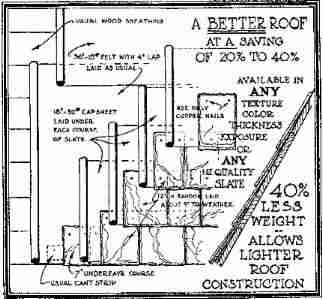
Some slate companies advertised A slate roof that cannot leak, yet [was] inexpensive, easy to apply, beautiful..., durable as time," using a design which was soon found to be a disaster: 12" slates were placed with 9" exposure, leaving 3" for headlap and 6" which was backed only by a cap sheet of 32# felt interlaced with the slates.
Roofs were also installed following this poor design, using 14" slates with 10"-11" exposure. Felt is not functional as a permanent roofing material: even where it is not exposed directly to sunlight, as the organics dry out the felt cracks, disintegrates, and leaks.
We have reports that inspectors have been the subject of legal actions following their failure to identify this defect in slate roofs. See the illustrations above. -- Personal communication, Doug Sheldon, Vermont Structural Slate, December 1990.
 ...
...
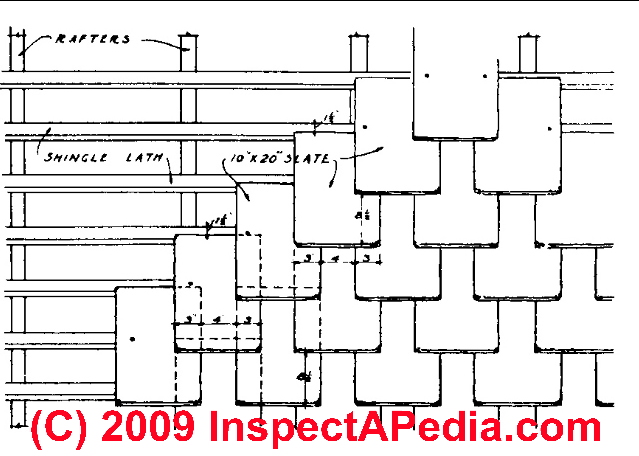
Slate installation pattern: as we introduced at SLATE ROOF INSPECTION PROCEDURE, some slate roof installation patterns "stretched" the material by installing slates with minimum head lap or side lap.
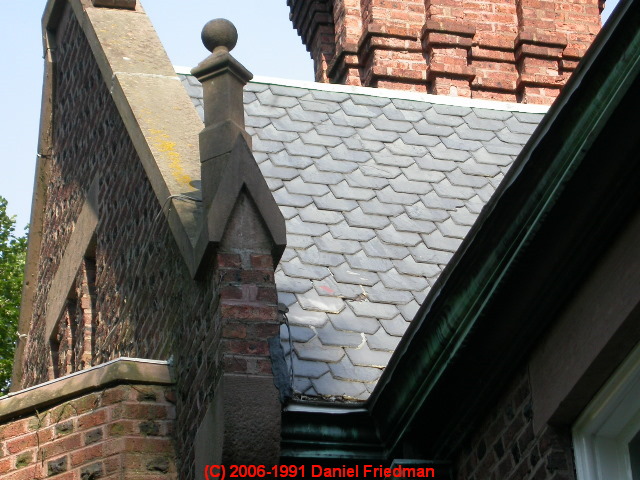
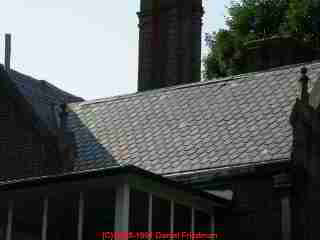
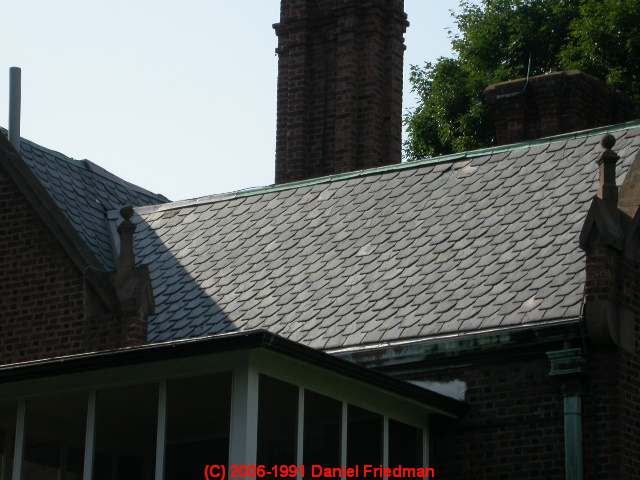
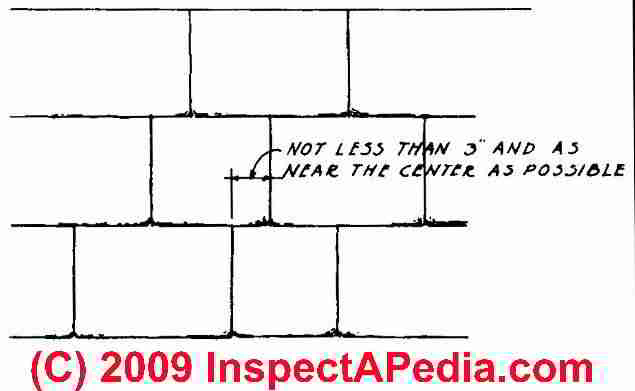
The proper minimum side lap for roofing slates is shown in our sketch at above left. An "open lap" slate roof is shown at page top (Vassar College Campus, Poughkeepsie, NY) and in our sketch at above right.
In some climates (blowing rain) this may lead to a leaky roof that was fine on a barn but not so nice on a house, in particular if the side lap of the slates is less than 3". Notice that 3" is called for in the right hand sketch and that a 50% head lap is also shown.
The side-lap pattern of the Vassar College campus slate roof at left shows that the slates are overlapped 50% - this slate roof pattern should be fine provided that there is also adequate head lap (which we cannot see). .
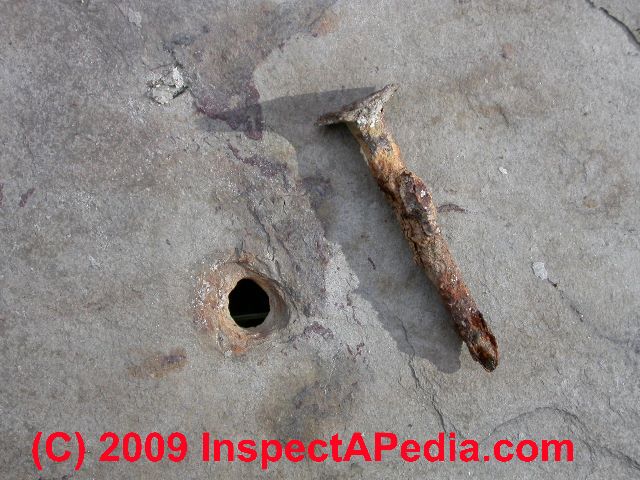
Slate nails: Proper installations use copper, stainless, or hot-dipped galvanized
nails for fastening slates. Very early slate roofs were secured using
wood pegs.
Later ones used tie-wires in some applications. Slaters' nails have a thinner head than conventional roofing nails, avoiding damage to the covering slates.
We've found many slate roofs installed with steel nails in the Northeast.
We've also found lots of roofs in that area which are losing good slates from nail failures.
Slate nail holes: When a slate is punched (usually at the quarry) the hole is driven from the back of the slate, leaving a ragged pit at the front (exposed) surface of the slate so that the nail head can be countersunk flush with the top of the slate. This avoids damage to the next course of slates which overlay the nail heads and which may crack under load.
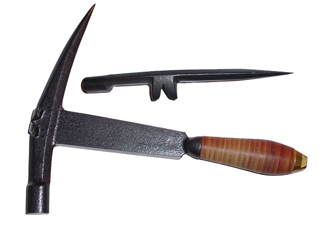 Hand punching of nail holes in slates:
Because most roofs have at least some custom slate fitting (for example
at valleys), some slates are hand-punched and may be fractured around
the nail hole.
Hand punching of nail holes in slates:
Because most roofs have at least some custom slate fitting (for example
at valleys), some slates are hand-punched and may be fractured around
the nail hole.
Usually only two holes are punched, 1.25" to 2" from either side and about a quarter of the length of the slate down from the top.
More holes and more nails may be used to hang thicker heavier slates. Where battens or spaced roof sheathing are used the spacing of the battens will affect where the holes are punched in the slates.
Slates punched too close to their centers or too low in the slate are more likely to leak when water seeps down in a fan-shaped pattern from the vertical abutment of the sides of the slates in the next course up the roof.
If you are inspecting a roof which frequently leaks following prolonged rains, and if the slates and flashings look pretty good, and if leaks are everywhere, you might look for improper punching or nailing errors. Don't rush to condemn the roof - how often and how badly does it leak? Under what conditions? What is being damaged? Where is water going?
Reader Question: how tight should you lay the roofing slates?
(Oct 23, 2011) mike said:
how tight should you lay the slate ?
Nail tightness: Slates should hang loosely on the nail. Nails too tight may break the slate as they're pulled through it as wood shrinks. Nails not driven fully are likely to break the slate above.
Other signs of poor installation include inadequate side laps. Side Lapped slate pattern.
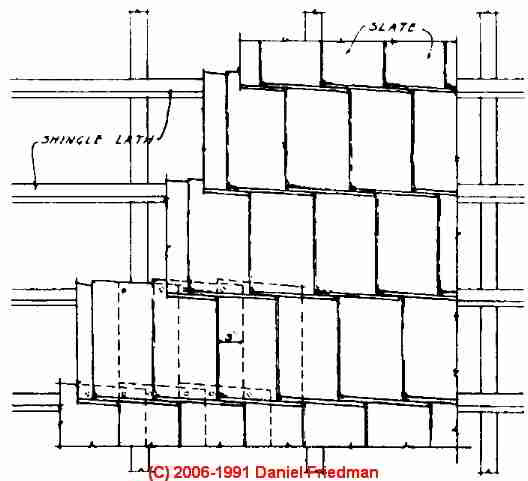
Side laps on slate roofs should be not less than 3" and each side-joint should be as near as possible to the center of the slate below. Particularly where improper repairs have been done you may find violations of this rule. Inadequate side laps risk leaks as a result of wind-driven rain.
Inadequate side laps might be suspected on roofs which use varying-width or graduated width shingles. However some experienced roofers and inspectors commented that graduated, random-width, graduated width slate roofs were more costly than other slate systems and were often installed by more skilled roofers.
Do not mistake graduated or random slate sizes for necessarily improper application.
An earlier version of this article appeared in the winter 1991 issue of the ASHI Technical Journal - the content has been edited and updated for this online version - March 2010, April 2014.
Recommended Articles
- SLATE ROOF INSPECTION & REPAIR - home
- SLATE THERMAL MASS for SOLAR HEAT STORAGE
- SNOW GUARDS & SNOW BRAKES
...
Continue reading at SLATE ROOF LEAKS or select a topic from the closely-related articles below, or see the complete ARTICLE INDEX.
Suggested citation for this web page
SLATE ROOF INSTALLATION QUALITY at InspectApedia.com - online encyclopedia of building & environmental inspection, testing, diagnosis, repair, & problem prevention advice.
Or see this
INDEX to RELATED ARTICLES: ARTICLE INDEX to BUILDING ROOFING
Or use the SEARCH BOX found below to Ask a Question or Search InspectApedia
Ask a Question or Search InspectApedia
Questions & answers or comments about how to assess the quality of workmanship on a slate roof installation job.
Try the search box just below, or if you prefer, post a question or comment in the Comments box below and we will respond promptly.
Search the InspectApedia website
Note: appearance of your Comment below may be delayed: if your comment contains an image, photograph, web link, or text that looks to the software as if it might be a web link, your posting will appear after it has been approved by a moderator. Apologies for the delay.
Only one image can be added per comment but you can post as many comments, and therefore images, as you like.
You will not receive a notification when a response to your question has been posted.
Please bookmark this page to make it easy for you to check back for our response.
Our Comment Box is provided by Countable Web Productions countable.ca
Citations & References
In addition to any citations in the article above, a full list is available on request.
- Mark Cramer Inspection Services Mark Cramer, Tampa Florida, Mr. Cramer is a past president of ASHI, the American Society of Home Inspectors and is a Florida home inspector and home inspection educator. Mr. Cramer serves on the ASHI Home Inspection Standards. Contact Mark Cramer at: 727-595-4211 mark@BestTampaInspector.com
- John Cranor [Website: /www.house-whisperer.com ] is an ASHI member and a home inspector (The House Whisperer) is located in Glen Allen, VA 23060. He is also a contributor to InspectApedia.com in several technical areas such as plumbing and appliances (dryer vents). Contact Mr. Cranor at 804-873-8534 or by Email: johncranor@verizon.net
- How to Inspect & Repair Slate Roofs a detailed article about evaluating the condition of slate roofing and repairing worn or damaged slate roofs.
- Slate Roof Photo Library photographs of colors, types, patterns of slate roofs, slate roof wear, slate roof conditions.
- Slate References page from the ASHI Technical Journal
- Slate Sources, Repairs page from the ASHI Technical Journal
- Roofing: Defect Recognition, Repair, Prevention for Roofing & Flashing main web page
- Inspecting and Evaluating Slate Roofs Hudson Valley ASHI seminar content
- Choosing a Roofing Contractor How to find and select a roofing contractor - (thanks to Jessie Schrader)
- Slate Roofs, National Slate Association, 1926, reprinted 1977 by Vermont Structural Slate Co., Inc., Fair Haven, VT 05743, 802-265-4933/34. (We recommend this book if you can find it. It has gone in and out of print on occasion.)
- The Slate Roof Bible, Joseph Jenkins, www.jenkinsslate.com, 143 Forest Lane, PO Box 607, Grove City, PA 16127 - 866-641-7141 (We recommend this book).
- Slate Roofs , Steven Trapasso, presentation to NY Metro ASHI, Inc. chapter seminar, November 1990.
- The Old-House Journal , Special Roof Issue , April 1983, The Old-House Journal, PO Box 50214, Boulder, CO 80321-0214
- National Slate Technology courses for architects, builders, etc.
- Slate Roofing Contractors Association [Website: www.slateroofers.org ] of North America
- National Slate Association includes list of slate testing laboratories
- Our recommended books about building & mechanical systems design, inspection, problem diagnosis, and repair, and about indoor environment and IAQ testing, diagnosis, and cleanup are at the InspectAPedia Bookstore. Also see our Book Reviews - InspectAPedia.
- Building Pathology, Deterioration, Diagnostics, and Intervention, Samuel Y. Harris, P.E., AIA, Esq., ISBN 0-471-33172-4, John Wiley & Sons, 2001 [General building science-DF] ISBN-10: 0471331724 ISBN-13: 978-0471331728
- Building Pathology: Principles and Practice, David Watt, Wiley-Blackwell; 2 edition (March 7, 2008) ISBN-10: 1405161035 ISBN-13: 978-1405161039
- Green Roof Construction and Maintenance, Kelley Luckett, McGraw-Hill Professional, 2009, ISBN-10: 007160880X, ISBN-13: 978-0071608800, quoting: Key questions to ask at each stage of the green building process Tested tips and techniques for successful structural design Construction methods for new and existing buildings Information on insulation, drainage, detailing, irrigation, and plant selection Details on optimal soil formulation Illustrations featuring various stages of construction Best practices for green roof maintenance A survey of environmental benefits, including evapo-transpiration, storm-water management, habitat restoration, and improvement of air quality Tips on the LEED design and certification process Considerations for assessing return on investment Color photographs of successfully installed green roofs Useful checklists, tables, and charts
- Handbook of Building Crafts in Conservation, Jack Bower, Ed., Van Nostrand Reinhold Company, NY 1981 ISBN 0-442-2135-3 Library of Congress Catalog Card Nr. 81-50643.
- Historic Preservation Technology: A Primer, Robert A. Young, Wiley (March 21, 2008) ISBN-10: 0471788368 ISBN-13: 978-0471788362
- Historic Slate Roofs : With How-to Info and Specifications, Tina Skinner (Ed), Schiffer Publishing, 2008, ISBN-10: 0764330012 , ISBN-13: 978-0764330018
- Problems in Roofing Design, B. Harrison McCampbell, Butterworth Heineman, 1991 ISBN 0-7506-9162-X (available used)
- Roofing The Right Way, Steven Bolt, McGraw-Hill Professional; 3rd Ed (1996), ISBN-10: 0070066507, ISBN-13: 978-0070066502
- Slate Roofs, National Slate Association, 1926, reprinted 1977 by Vermont Structural Slate Co., Inc., Fair Haven, VT 05743, 802-265-4933/34. (We recommend this book if you can find it. It has gone in and out of print on occasion.)
- Roof Tiling & Slating, a Practical Guide, Kevin Taylor, Crowood Press (2008), ISBN 978-1847970237,
If you have never fixed a roof tile or slate before but have wondered how to go about repairing or replacing them, then this is the book for you. Many of the technical books about roof tiling and slating are rather vague and conveniently ignore some of the trickier problems and how they can be resolved. In Roof Tiling and Slating, the author rejects this cautious approach. Kevin Taylor uses both his extensive knowledge of the trade and his ability to explain the subject in easily understandable terms, to demonstrate how to carry out the work safely to a high standard, using tried and tested methods.
This clay roof tile guide considers the various types of tiles, slates, and roofing materials on the market as well as their uses, how to estimate the required quantities, and where to buy them. It also discusses how to check and assess a roof and how to identify and rectify problems; describes how to efficiently "set out" roofs from small, simple jobs to larger and more complicated projects, thus making the work quicker, simpler, and neater; examines the correct and the incorrect ways of installing background materials such as underlay, battens, and valley liners; explains how to install interlocking tiles, plain tiles, and artificial and natural slates; covers both modern and traditional methods and skills, including cutting materials by hand without the assistance of power tools; and provides invaluable guidance on repairs and maintenance issues, and highlights common mistakes and how they can be avoided. The author, Kevin Taylor, works for the National Federation of Roofing Contractors as a technical manager presenting technical advice and providing education and training for young roofers. - The Slate Roof Bible, Joseph Jenkins, www.jenkinsslate.com, 143 Forest Lane, PO Box 607, Grove City, PA 16127 - 866-641-7141 (We recommend this book).
- In addition to citations & references found in this article, see the research citations given at the end of the related articles found at our suggested
CONTINUE READING or RECOMMENDED ARTICLES.
- Carson, Dunlop & Associates Ltd., 120 Carlton Street Suite 407, Toronto ON M5A 4K2. Tel: (416) 964-9415 1-800-268-7070 Email: info@carsondunlop.com. Alan Carson is a past president of ASHI, the American Society of Home Inspectors.
Thanks to Alan Carson and Bob Dunlop, for permission for InspectAPedia to use text excerpts from The HOME REFERENCE BOOK - the Encyclopedia of Homes and to use illustrations from The ILLUSTRATED HOME .
Carson Dunlop Associates provides extensive home inspection education and report writing material. In gratitude we provide links to tsome Carson Dunlop Associates products and services.
 | HOME | ABOUT | ASK a QUESTION | CONTACT | CONTENT USE POLICY | DESCRIPTION | POLICIES | PRIVACY | |
| © 2024 - 1985 Publisher InspectApedia.com - Daniel Friedman | |||||||||