
InspectAPedia® FREE Encyclopedia of Building & Environmental Construction, Diagnosis, Maintenance & Repair |
Question? Just ask us! InspectAPedia
|
 How to Evaluate Slate Roof Condition - other factors
- POST a QUESTION or COMMENT about factors that affect the life and leak-resistance of a slate roof.
Slate roof life and leak factors:
Besides the obvious problems you may see at a slate roof such as broken or missing slates or leak stains in the interior, there are other critical slate roof factors that affect its durability, remaining life, and leakiness - here we describe them.
This series of detailed slate roof inspection and repair articles describes procedures for evaluating the condition of slate roofing. How to inspect, identify defects, and estimate remaining life of slate roofs are addressed. The article series also references slate repair procedures, repair slate sources, and slate quarries.
InspectAPedia tolerates no conflicts of interest. We have no relationship with advertisers, products, or services discussed at this website.
Other Slate Roof Factors that affect the slate roof life or slate roof leak risk
Roof slope,
as with all roof systems, is a big factor in shingle wear. The steeper the slope, the more durable the roof. Slates have been used even on flat roofs, as ballast, and slates were used to line the reflecting pool at the US Capitol in Washington DC.
Condensation in attic interiors
can be a problem. All slate roofs need ventilation to equalize the temperature between inside and outside the roof surface. Elimination of unwanted moisture in winter and heat in summer will both extend roof life. Serious damage from interior moisture is likely to be to roof sheathing and framing, but high interior moisture will shorten the life of most roof coverings as well.
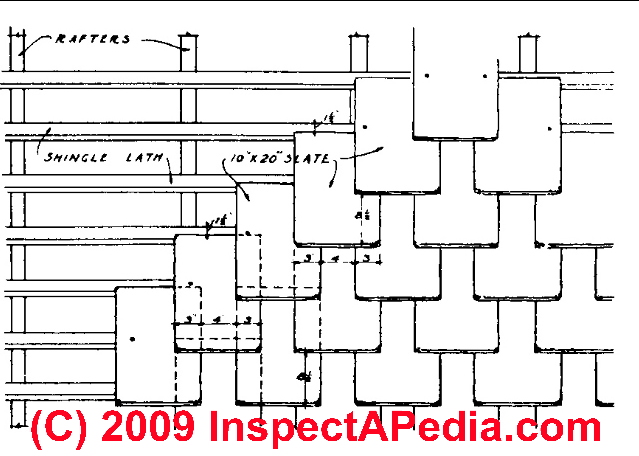
The open lap slate pattern (above left) was probably intended for use on buildings with high interior moisture - perhaps a cow barn.
Most normal slate roof installations, as originally built, may have had adequate ventilation. I
n our opinion, serious moisture problems may begin when modern renovations insulate between rafters and add interior finishes in attics. For those designs special provisions may be needed to cool and dry the roof cavity.
Mineral deposits
found on the interior surface (attic view) of slates, when none are visible outside, are a sign of possible attic moisture problems. Where no outside staining or efflorescence match inside findings, the inspector may suspect that sun exposure is drying the outer surface leaving longer moist conditions inside. If
these conditions are not consistent on all roof surfaces you may find the most mineral deposits on the north or shaded roof surfaces.
Moss on slates
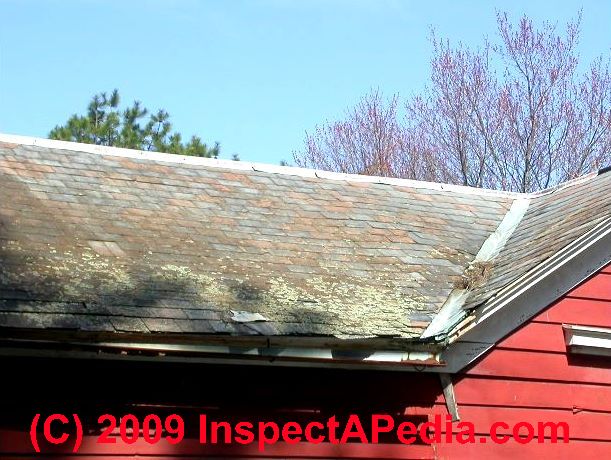
(see our photo at page top) should be considered as damaging as on any other type of shingle. The moss retains moisture against the slate and its roots may actually penetrate and damage the material. On older roofs with heavy moss the growth can actually lift and separate the shingles. C
hemical treatments may help with moss as it does on wood roofs. Extreme care should be used in working with chemicals.
Our photo at page top shows a mossy and lichens covered slate roof on Phillips Road in Poughkeepsie, NY - this slate barn roof is at the end of its life and is leaking.
Roof framing for slate roofs
is often stronger than similar framing for houses of the same age for which lighter roof materials were used. A slate roof can weigh as little as 700 pounds per square up to 8000 pounds where 2" thick slates were used on a graduated slate roof.
On a residential building the maximum weight per square you'd probably find would be 2500 pounds. The addition of slate to a house not framed for this purpose will require an analysis of the roof framing system.
(One roofing square is 100 sq. ft.)
Clues about the quality of a slater's work
may be found in hip and ridge design. This topic is not discussed here. Flashing details, valley flashing methods, weather exposure, mechanical damage from falling limbs, foot traffic or improper workmanship, are examples of other factors which affect roof life. They are not discussed here. -- See Alan Carson's "Slate Roof" presentation notes used at several ASHI Seminars.
An earlier version of this article appeared in the winter 1991 issue of the ASHI Technical Journal as cited below. That original content has been edited and updated for this online article series - March 2010, December 2023. Copies of the ASHI Technical Journal are no longer available from the American Society of Home Inspectors - ASHI at ashi [dot] com.
- Carson, Alan & Daniel Friedman, SLATE ROOFS [PDF] (1991) ASHI Technical Journal, Vol. 1. No. 1, January 1991
Excerpt: Slate roofing is considered a high-quality, durable, and aesthetically pleasing material which receives considerable focus in both the sale of properties and in the evaluation of building condition.
Like many building topics, opinions run heavier than actual data. The abandonment of good slate roofs which should have been repaired is a financial shame and the destruction of a valuable asset.
At the same time, careless optimism about a bad slate roof which is at the end of its life risks an angry inspection client [and costly building leak damage]. This article reviews types of slate, common defects, inspection topics, and some repair tips.
...
Continue reading at SLATE ROOF INSTALLATION QUALITY or select a topic from the closely-related articles below, or see the complete ARTICLE INDEX.
Or see these
Recommended Articles
- SLATE ROOF DEFECTS
- SLATE ROOF INSPECTION & REPAIR - home
- SLATE ROOF REPAIRS
- SLATE ROOF TYPES
- SLATE ROOF TYPES, RIBBON SLATES
- SLATE THERMAL MASS for SOLAR HEAT STORAGE
- SNOW GUARDS & SNOW BRAKES
Suggested citation for this web page
SLATE ROOF CONDITION, OTHER FACTORS at InspectApedia.com - online encyclopedia of building & environmental inspection, testing, diagnosis, repair, & problem prevention advice.
Or see this
INDEX to RELATED ARTICLES: ARTICLE INDEX to BUILDING ROOFING
Or use the SEARCH BOX found below to Ask a Question or Search InspectApedia
Ask a Question or Search InspectApedia
Questions & answers or comments about factors that affect the life and leak-resistance of a slate roof.
Try the search box just below, or if you prefer, post a question or comment in the Comments box below and we will respond promptly.
Search the InspectApedia website
Note: appearance of your Comment below may be delayed: if your comment contains an image, photograph, web link, or text that looks to the software as if it might be a web link, your posting will appear after it has been approved by a moderator. Apologies for the delay.
Only one image can be added per comment but you can post as many comments, and therefore images, as you like.
You will not receive a notification when a response to your question has been posted.
Please bookmark this page to make it easy for you to check back for our response.
Our Comment Box is provided by Countable Web Productions countable.ca
Citations & References
In addition to any citations in the article above, a full list is available on request.
- Mark Cramer Inspection Services Mark Cramer, Tampa Florida, Mr. Cramer is a past president of ASHI, the American Society of Home Inspectors and is a Florida home inspector and home inspection educator. Mr. Cramer serves on the ASHI Home Inspection Standards. Contact Mark Cramer at: 727-595-4211 mark@BestTampaInspector.com
- John Cranor [Website: /www.house-whisperer.com ] is an ASHI member and a home inspector (The House Whisperer) is located in Glen Allen, VA 23060. He is also a contributor to InspectApedia.com in several technical areas such as plumbing and appliances (dryer vents). Contact Mr. Cranor at 804-873-8534 or by Email: johncranor@verizon.net
- Slate Roofs, National Slate Association, 1926, reprinted 1977 by Vermont Structural Slate Co., Inc., Fair Haven, VT 05743, 802-265-4933/34. (We recommend this book if you can find it. It has gone in and out of print on occasion.)
- The Slate Roof Bible, Joseph Jenkins, www.jenkinsslate.com, 143 Forest Lane, PO Box 607, Grove City, PA 16127 - 866-641-7141 (We recommend this book).
- Slate Roofs , Steven Trapasso, presentation to NY Metro ASHI, Inc. chapter seminar, November 1990.
- The Old-House Journal , Special Roof Issue , April 1983, The Old-House Journal, PO Box 50214, Boulder, CO 80321-0214
- National Slate Technology courses for architects, builders, etc.
- Slate Roofing Contractors Association [Website: www.slateroofers.org ] of North America
- National Slate Association includes list of slate testing laboratories
- Building Pathology, Deterioration, Diagnostics, and Intervention, Samuel Y. Harris, P.E., AIA, Esq., ISBN 0-471-33172-4, John Wiley & Sons, 2001 [General building science-DF] ISBN-10: 0471331724 ISBN-13: 978-0471331728
- Building Pathology: Principles and Practice, David Watt, Wiley-Blackwell; 2 edition (March 7, 2008) ISBN-10: 1405161035 ISBN-13: 978-1405161039
- Handbook of Building Crafts in Conservation, Jack Bower, Ed., Van Nostrand Reinhold Company, NY 1981 ISBN 0-442-2135-3 Library of Congress Catalog Card Nr. 81-50643.
- Historic Preservation Technology: A Primer, Robert A. Young, Wiley (March 21, 2008) ISBN-10: 0471788368 ISBN-13: 978-0471788362
- Historic Slate Roofs : With How-to Info and Specifications, Tina Skinner (Ed), Schiffer Publishing, 2008, ISBN-10: 0764330012 , ISBN-13: 978-0764330018
- Slate Roofing in Canada (Studies in archaeology, architecture, and history)
- In addition to citations & references found in this article, see the research citations given at the end of the related articles found at our suggested
CONTINUE READING or RECOMMENDED ARTICLES.
- Carson, Dunlop & Associates Ltd., 120 Carlton Street Suite 407, Toronto ON M5A 4K2. Tel: (416) 964-9415 1-800-268-7070 Email: info@carsondunlop.com. Alan Carson is a past president of ASHI, the American Society of Home Inspectors.
Thanks to Alan Carson and Bob Dunlop, for permission for InspectAPedia to use text excerpts from The HOME REFERENCE BOOK - the Encyclopedia of Homes and to use illustrations from The ILLUSTRATED HOME .
Carson Dunlop Associates provides extensive home inspection education and report writing material. In gratitude we provide links to tsome Carson Dunlop Associates products and services.
 | HOME | ABOUT | ASK a QUESTION | CONTACT | CONTENT USE POLICY | DESCRIPTION | POLICIES | PRIVACY | |
| © 2024 - 1985 Publisher InspectApedia.com - Daniel Friedman | |||||||||