
InspectAPedia® FREE Encyclopedia of Building & Environmental Construction, Diagnosis, Maintenance & Repair |
Question? Just ask us! InspectAPedia
|
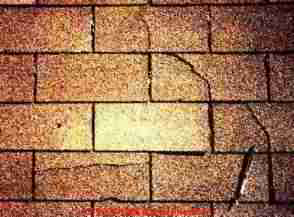 Causes of Thermal Splitting or Cracking Asphalt Roof Shingles
- POST a QUESTION or COMMENT about asphalt roof shingle splits, cracks, and thermal splitting: effects on roof life, leaks, warranty coverage, cause, history of product problems
Asphalt shingle cracks due to thermal splitting & defective product: this document tells readers how to identify & explain asphalt shingle cracking or thermal splitting, what causes shingle cracks or splits, and how to distinguish this product failure (which may be entitled to a warranty or class action claim) from other roofing product failures or defects.
InspectAPedia tolerates no conflicts of interest. We have no relationship with advertisers, products, or services discussed at this website.
Fiberglass Shingle Cracks: Thermal Splitting Asphalt Shingle Crack & Tear Failures Described & Explained
Fiberglass-based Asphalt Roof Shingle Cracking/Tearing/Splitting Failures
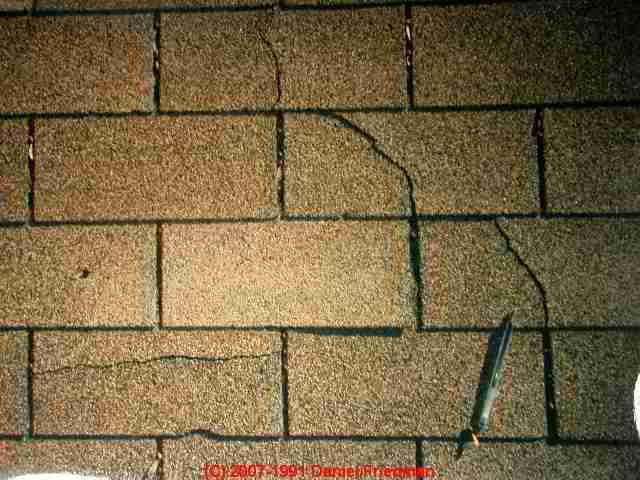
"Thermal splitting," or "cracking" which in fact is in most cases actually a tearing of the shingles is considered by experts to be the principal current problem with fiberglass-based shingles. We prefer the term tearing as a most accurate description of what's probably happening. Originally observed on the lightest-weight (15-year life) shingles this problem has now been found across all shingle styles, weights (life ratings), and we suspect, probably across most or all manufacturers of this type of product.
The thermal expansion of defective asphalt shingle product (common in the U.S. across many manufacturers in the early 1990's) followed by thermal contraction when cool weather approached, explained the tear shown in the shingle in our photograph just above.
See THERMAL EXPANSION of MATERIALS for a table of the coefficient of expansion of common building materials. We have not found a source defining the coefficient of thermal expansion of asphalt roof shingles - Contact Us if you can provide that information.
Does Thermal Splitting or Shingle Cracking Tearing Occur only in 3-Tab Asphalt Shingle Roofs?
No. Thermal splitting or tears occur in both conventional 3-tab shingles (photo above) and also in laminated asphalt shingle roofs.
Our photo (below-left) of thermal split/tear damage to a laminated asphalt shingle roof was provided by ASHI Home inspector Steve Mauer.
This unfortunate roof, inspected by Mr. Mauer in 2009, also suffered from granule loss (below-right) that in our OPINION looked like a defective product.
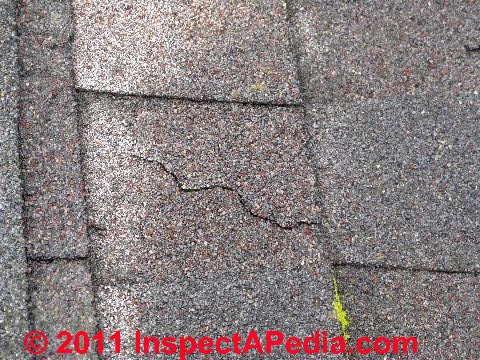
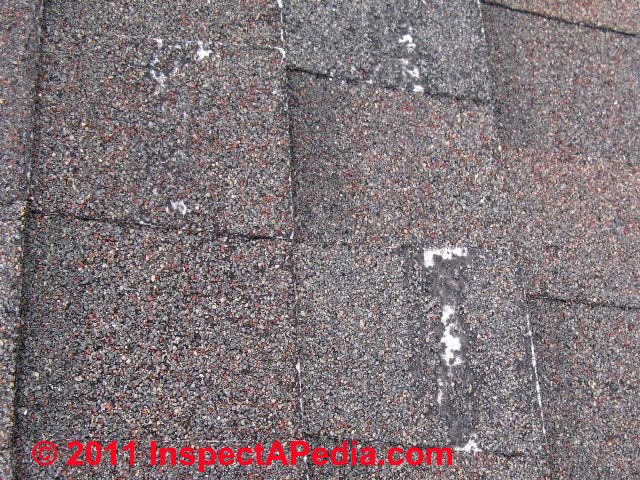
The same roof also included a damaged shingle that looked like a cracking and granule loss problem combined, but we think this was a shingle splice created at the factory during production - a bad individual shingle that is sometimes created when ends of shingle production substrate are spliced together.
See SPLICE DEFECTS on ASPHALT SHINGLES
What Does Shingle Cracking or Shingle Splitting Look like?
Watch out: : as we warn at ASPHALT SHINGLE FAILURE TYPES if conditions prevented the home inspector from direct access onto the roof or at least a look from a ladder set against the roof edge, shingle damage, cracks, and splits such as that shown in own photo (at left) could have been difficult or even impossible to spot. Inspecting the roof from the ground, even with good binoculars, can't show all roof damage types and conditions.
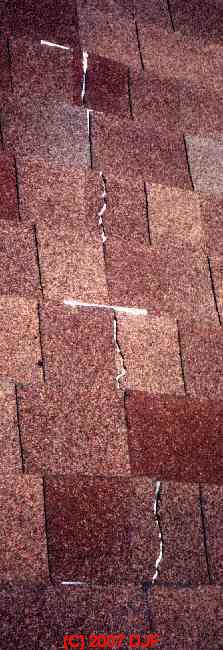
We have observed a variety of torn or split asphalt roof shingles, illustrated by our photographs below. (Click to enlarge any image.)
 Horizontal or vertical tears across multiple 3-tab shingles
 Horizontal, vertical, and diagonal tears across multiple strip-type shingles
 Horizontal, vertical, diagonal, and corner tears across multiple laminate-type shingles
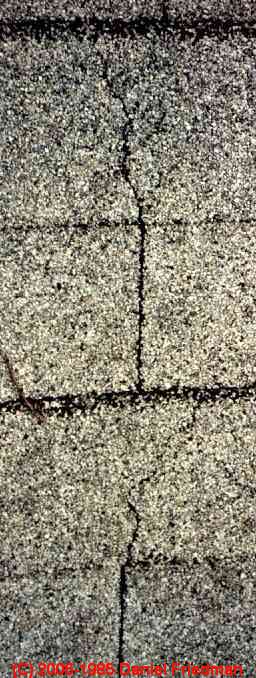 Horizontal, vertical, and diagonal tears across multiple strip-type shingles
 Horizontal, vertical, diagonal, and corner tears across multiple laminate-type shingles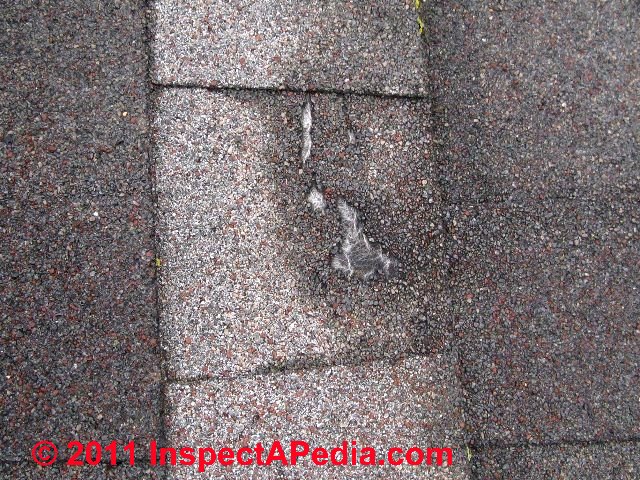
Horizontal Cracks & Splits in Asphalt Shingles
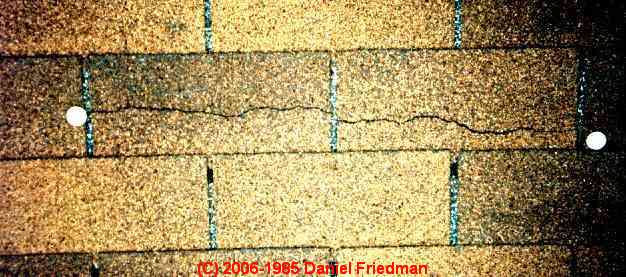
Both thermal splitting and other shingle cracks and splits can also occur in a horizontal pattern as we illustrate in our photographs below.
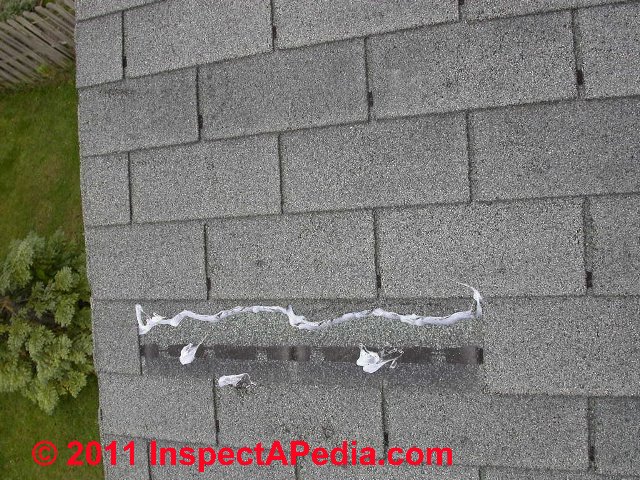
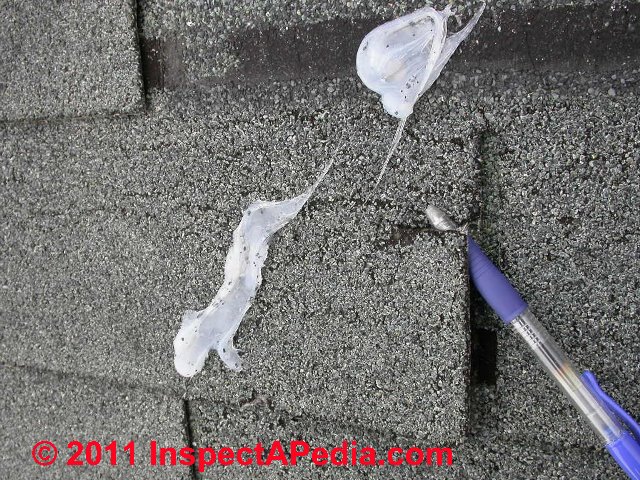
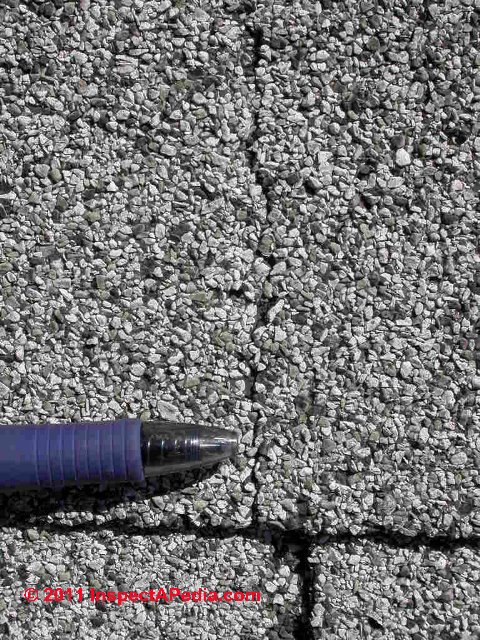
The horizontal cracking occurring in these fiberglass-based asphalt shingles resulted in complete loss of some of the shingles from the roof surface. The silicone caulk was placed by the owner during an attempt to "re-glue" the lost shingle tabs. But using our pen we pointed out additional horizontal cracks and tears developing in the next course of shingles just below. From a the ground the lost shingles looked like an isolated problem. An on-roof inspection told a different story.
 Both horizontal and diagonal or vertical tearing may occur in the same roof as we illustrate in our photo at left (Click to enlarge).
What is the Cause of Thermal Splitting Cracks in Fiberglass-based Asphalt Roof Shingles?
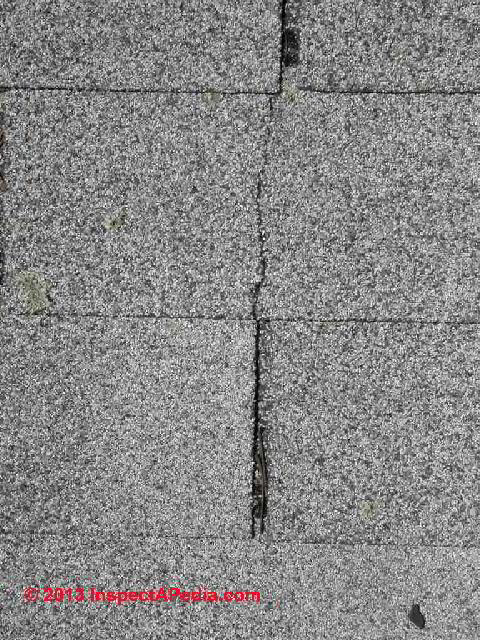
Our photos above demonstrate two classic thermal split patterns in fiberglass based asphalt shingles: vertical splits running straight up the roof (above left) and diagnoal splits following butt joints (below).
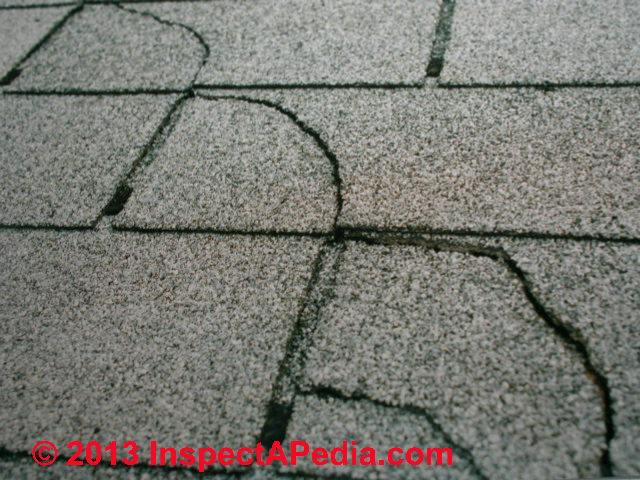
- It's possible that shingles made by some manufacturers do not meet the ASTM Standards for tear resistance.
- Even where shingles meet the Standards, it's possible that the standards themselves were defective. In particular, for a time the asphalt roof shingle standards combined these concerns:
- A thin fiberglass mat was permitted as the shingle substrate, lacking adequate tear resistance
- The wind uplift prevention bonding adhesive was too strong, causing the shingles to bond into nearly a single continuous surface that lacked adequate movement to respond to significant changes in temperature without tearing the bound surface
- In any case, Fiberglass mat may lack adequate tear resistance
- Self-sealing tabs on shingle backs may glue shingles together with too much strength, causing the roof covering to form a single large membrane which cannot accommodate large temperature changes. This explanation was discovered across the asphalt shingle industry.
- Reduced total amount of asphalt in thin fiberglass mats might become brittle after exposure to heat and sunlight
- Temperature swings probably contribute to the onset and extent of tearing, and we'd expect worse tearing where temperature swings are more extreme such as in Northern climates.
- Nailing or placement pattern of shingles: "laddering" vs.
"staggered." On laminate and strip type shingles we have inspected roofs on which damage is found occurring at the corners of shingles rather than in
the middle of the shingle material. It appears that as temperatures dropped and the glued-together-roof-membrane cools and contracts, the natural point at
which movement occurs is where shingles are end-butted together.
When the pattern of end-butts is laddered rather than staggered up the roof we have found corners tearing off of shingles following the laddering pattern exactly. (Laddering is not a recommended installation pattern according to NRCA and ARMA publications nor according to instructions from some manufacturers.)
Laddering alone cannot be blamed for this failure however, as we have seen similar shingle tearing following a staggered end-butt pattern up other roofs. However laddering may indeed create a more localized natural point of separation on a roof, causing most of the movement to occur in a smaller area when the roof material contracts with cooling.
Splits or Cracking in Organic Asphalt Shingles
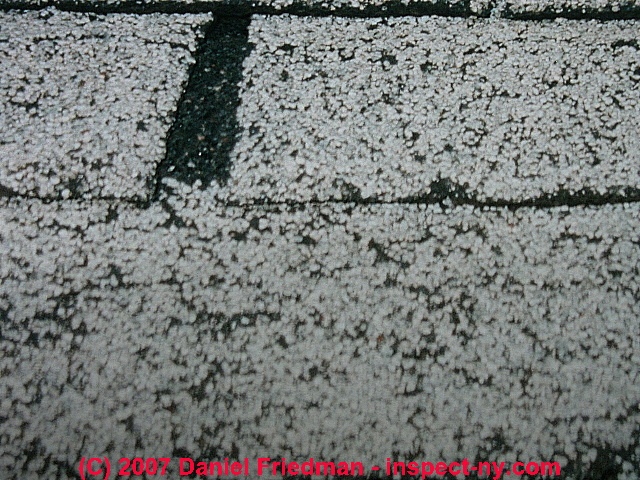
Organic mat asphalt shingles also may show cracking and accompanying granule loss. Defective asphalt shingle products of either organic or fiberglass based shingles may experience several failures including cracking, tearing, granule loss, blistering, etc. So, splits or cracks can occur in both organic-mat based and fiberglass-mat based asphalt roof shingles.
See ORGANIC FELT SHINGLE NORMAL WEAR for details about normal wear splits or cracks and granule loss in organic roof shingles.
Also see ORGANIC FELT SHINGLE DEFECTS for other wear signs on organic mat asphalt shingles.
But thermal splitting is particularly a problem with fiberglass mat based asphalt roof shingles. The catastrophic early shingle splitting failures like the ones illustrated earlier in this article were principally a problem of lightweight, fiberglass-mat based asphalt roof shingles made during the period discussed above. Roughly, from 1992 - 1997.
Nevertheless, fine cracks through roof shingles, regardless of cause, mean accelerating wear rate and on a roof like the one shown at left, the roof needs replacement.
Cracking due to cold weather installation & bending ridge or hip cap shingles:
see RIDGE & HIP CAP SHINGLES for additional discussion of distinguishing cracking wear failures from other types of shingle failures.
Also see ASPHALT SHINGLE PROPERTIES and
see
- CHOOSING AN ASPHALT SHINGLE: ORGANIC VS. FIBERGLASS, [PDF] Ted Cushman, The Journal of Light Construction, May 1993 for more about the debate around the advantages and disadvantages of organic mat asphalt shingles vs. fiberglass mat-based asphalt roof shingles.
Readers are also invited contribute roof failure information to the web author for research purposes. web author for research purposes.
Reader Comments, Questions & Answers About The Article Above
Below you will find questions and answers previously posted on this page at its page bottom reader comment box.
Reader Q&A - also see RECOMMENDED ARTICLES & FAQs
On 2020-11-20 - by (mod) -
That sounds like a product failure, perhaps not covered by your homeowners policy
On 2020-11-20 by Kathy Limanen
Just sent a ton of pictures of my roof to insurance company. Shingles are cracked all over the place. Insurance company won’t cover saying it’s from heat and cold. Roof is only 6 years old. Like everyone else, why would you put shingles on a house that can’t withstand the weather. Minnesota
On 2018-08-25 by Ken Martin
Wow, want a great article. I live in Idaho and have a 10 year roof that is suppose to be a 50year roof according to the manufacture. We had a hail storm and I had a roofer inspect it for damage. I had no hail damage but I have cracks all over. Some are 6 feet going up the roof at a 45 degree angle and others much shorter. My builder looked at it and was floored. Now I need to convince the mfg and distributed that this was defective material. This article really helps.
Wow, want a great article. I live in Idaho and have a 10 year roof that is suppose to be a 50year roof according to the manufacture. We had a hail storm and I had a roofer inspect it for damage. I had no hail damage but I have cracks all over. Some are 6 feet going up the roof at a 45 degree angle and others much shorter. My builder looked at it and was floored. Now I need to convince the mfg and distributed that this was defective material. This article really helps. Sound I hirer a building inspector?
On 2018-08-25 by Ken Martin
Wow, want a great article. I live in Idaho and have a 10 year roof that is suppose to be a 50year roof according to the manufacture. We had a hail storm and I had a roofer inspect it for damage. I had no hail damage but I have cracks all over. Some are 6 feet going up the roof at a 45 degree angle and others much shorter. My builder looked at it and was floored. Now I need to convince the mfg and distributed that this was defective material. This article really helps. Sound I hirer a building inspector?
On 2016-12-19 by Del Gonzales
This problem started on my good about 20 years ago and is probably past the warranty period. I filed a insurance claim when it first occurred. I was told it wasn't covered. Is there any recourse?
On 2016-07-25 - by (mod) -
I'm surprised to hear about thermal splitting on a 2009 roof, but I guess it's possible. Use the page top or bottom CONTACT link to send me some sharp photos of the damage and we can comment further.
On 2016-07-25 by Derek Hoyle
Looks just like the problem I am having with my 7-year old roof built using 35 yr. asphalt/fiberglass shingles.
Now how to get the shingle manufacturer to admit they have a shingle quality problem .
If their shingles can not stand Alberta's climate , why are they selling them here.
I was in business for 35 years and if I sold defective product I was on the hook for old product removal , new product
and new product instalation so why not them ?
...
Continue reading at SPLICE DEFECTS on ASPHALT SHINGLES or select a topic from the closely-related articles below, or see the complete ARTICLE INDEX.
Or see these
Recommended Articles
- EARLY ASPHALT SHINGLE FAILURE
- ASPHALT SHINGLE FAILURE TYPES
- ASPHALT SHINGLE LIFE / WEAR FACTORS
- ASPHALT SHINGLES on LOW SLOPE ROOFS
- ASPHALT ROOF SHINGLES - topic home, for all articles about asphalt roof shingles
Suggested citation for this web page
CRACKS & THERMAL SPLITTING in FIBERGLASS SHINGLES at InspectApedia.com - online encyclopedia of building & environmental inspection, testing, diagnosis, repair, & problem prevention advice.
Or see this
INDEX to RELATED ARTICLES: ARTICLE INDEX to BUILDING ROOFING
Or use the SEARCH BOX found below to Ask a Question or Search InspectApedia
Ask a Question or Search InspectApedia
Questions & answers about cracked or broken roof shingles & thermal splitting: cause, effects, remedy, warranty.
Try the search box just below, or if you prefer, post a question or comment in the Comments box below and we will respond promptly.
Search the InspectApedia website
Note: appearance of your Comment below may be delayed: if your comment contains an image, photograph, web link, or text that looks to the software as if it might be a web link, your posting will appear after it has been approved by a moderator. Apologies for the delay.
Only one image can be added per comment but you can post as many comments, and therefore images, as you like.
You will not receive a notification when a response to your question has been posted.
Please bookmark this page to make it easy for you to check back for our response.
Our Comment Box is provided by Countable Web Productions countable.ca
Citations & References
In addition to any citations in the article above, a full list is available on request.
- Steve Mauer is an ASHI certified home inspector in Doylestown, PA. Mr. Mauer can be reached by email to steve@maurerinspections.com or by telephone at 287-884-4047.
- "Choosing an Asphalt Shingle: Organic vs. Fiberglass", Ted Cushman, The Journal of Light Construction, May 1993, pp. 11-14. Used with Permission from the Journal of Light Construction.
- The Journal of Light Construction has generously given reprint permission to InspectAPedia.com for adaptations, quotations, or reproductions used at this website. All rights and contents of the JLC material are ©Journal of Light Construction and may not be reproduced in any form.
- Our recommended books about building & mechanical systems design, inspection, problem diagnosis, and repair, and about indoor environment and IAQ testing, diagnosis, and cleanup are at the InspectAPedia Bookstore. Also see our Book Reviews - InspectAPedia.
- Best Practices Guide to Residential Construction, by Steven Bliss. John Wiley & Sons, 2006. ISBN-10: 0471648361, ISBN-13: 978-0471648369, Hardcover: 320 pages, available from Amazon.com and also Wiley.com. See our book review of this publication.
- Decks and Porches, the JLC Guide to, Best Practices for Outdoor Spaces, Steve Bliss (Editor), The Journal of Light Construction, Williston VT, 2010 ISBN 10: 1-928580-42-4, ISBN 13: 978-1-928580-42-3, available from Amazon.com
- The Journal of Light Construction has generously given reprint permission to InspectAPedia.com for this article. All rights and contents are ©Journal of Light Construction and may not be reproduced in any form.
- Architectural elements: the technological revolution: Galvanized iron roof plates and corrugated sheets; cast iron facades, columns, door and window caps, ... (American historical catalog collection), Diana S Waite, available used out of Amazon.
- Asphalt Roofing Residential Manual from ARMA the Asphalt Roofing Manufacturers Association Website https://www.asphaltroofing.org/product/residential-asphalt-roofing-manual/ ,
- Building Pathology, Deterioration, Diagnostics, and Intervention, Samuel Y. Harris, P.E., AIA, Esq., ISBN 0-471-33172-4, John Wiley & Sons, 2001 [General building science-DF] ISBN-10: 0471331724 ISBN-13: 978-0471331728
- Building Pathology: Principles and Practice, David Watt, Wiley-Blackwell; 2 edition (March 7, 2008) ISBN-10: 1405161035 ISBN-13: 978-1405161039
- Roof failure causes in depth (and specific methods for avoiding them)
- Roof design fundamentals and flourishes, based on voluminous industry research and experience
- New technologies and materials -- using them safely and correctly
- Problems in Roofing Design, B. Harrison McCampbell, Butterworth Heineman, 1991 ISBN 0-7506-9162-X (available used)
- Roofing The Right Way, Steven Bolt, McGraw-Hill Professional; 3rd Ed (1996), ISBN-10: 0070066507, ISBN-13: 978-0070066502
- Smart Guide: Roofing: Step-by-Step Projects, Creative Homeowner (Ed), 2004, ISBN-10: 1580111491, ISBN-13: 978-1580111492
- In addition to citations & references found in this article, see the research citations given at the end of the related articles found at our suggested
CONTINUE READING or RECOMMENDED ARTICLES.
- Carson, Dunlop & Associates Ltd., 120 Carlton Street Suite 407, Toronto ON M5A 4K2. Tel: (416) 964-9415 1-800-268-7070 Email: info@carsondunlop.com. Alan Carson is a past president of ASHI, the American Society of Home Inspectors.
Thanks to Alan Carson and Bob Dunlop, for permission for InspectAPedia to use text excerpts from The HOME REFERENCE BOOK - the Encyclopedia of Homes and to use illustrations from The ILLUSTRATED HOME .
Carson Dunlop Associates provides extensive home inspection education and report writing material. In gratitude we provide links to tsome Carson Dunlop Associates products and services.
 | HOME | ABOUT | ASK a QUESTION | CONTACT | CONTENT USE POLICY | DESCRIPTION | POLICIES | PRIVACY | |
| © 2024 - 1985 Publisher InspectApedia.com - Daniel Friedman | |||||||||