
InspectAPedia® FREE Encyclopedia of Building & Environmental Construction, Diagnosis, Maintenance & Repair |
Question? Just ask us! InspectAPedia
|
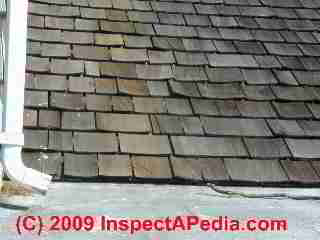 Wood Shingle & Wood Shake Roof Fire Ratings
Can Coatings or Component System Increase Wood Roof Fire Rating From Class B or C to Class A?
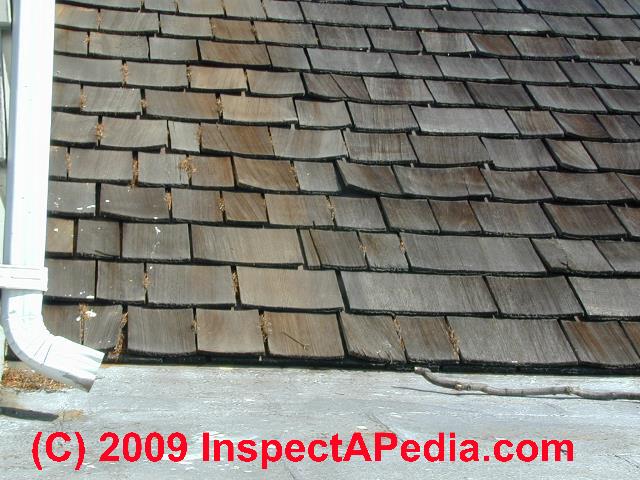
- POST a QUESTION or COMMENT about preservative coatings & fire resistive coatings used on wood shingle roofs
Coatings for wood shingles or wood shake roofs - wood roof preservatives, wood roof fire resistive coatings:
This article explains fire resistant treatments and preservative treatments for wood shingle or wood shake roofing in historic and contemporary use.
InspectAPedia tolerates no conflicts of interest. We have no relationship with advertisers, products, or services discussed at this website.
Class A Wood Shake or Shingle Roofs
 How to Convert a Class-C to B or Class B wood shingle roof to Class A Fire Rating
Watch out: without more-complete information, don't assume that your roof has been properly classified & approved as Class-A fire rated.
Class A fire-rated wood shingle or shake roofs are can be achieved through a component roofing system, so no individual shakes or shingles can achieve a Class A rating. The components involve FRT treated wood shakes or shingles, a Class A cap sheet, and (probably) a layer of fire-resistant gypsum board over the wood deck (possibly also requiring FRT plywood decking)
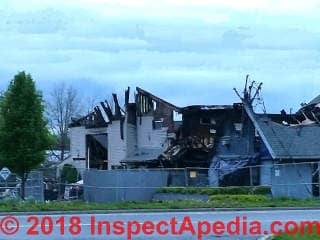
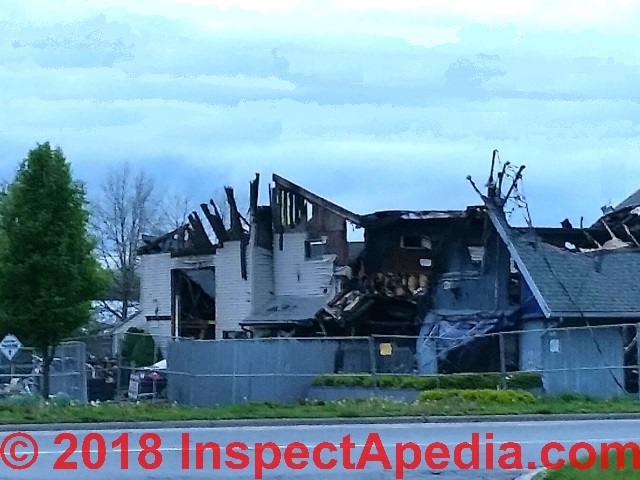
Photo: building damaged by fire in Redhook, New York. [This was not a wildfire event but illustrates the catastrophic destruction of a building fire including the building's roof - Ed.]
[Click to enlarge any image]
Class A Cap Sheet + Panelized Fireproof Sheathing Under Wood Shakes or Shingles
Wood shakes or shingles that have been treated wth a fire-retardant chemical (FRT) can meet a Class-B fire rating, and these roofs can achieve a Class A fire rating if additional materials such as FRT plywood base and a Class A cap sheet, Type 72 roll roofing and panelized gypsum-fiberglass system such as DensDeck are installed.
In sum, Class B shakes or shingles can form part of a Class-A Fire Rate roof provided they aer installed over sheathing (spaced or solid) that in turn has been covered with one layer of 1/4 in. (6.4 mm) thick noncombustible roof board, or with one layer of minimum 72-lb. fiber-glass-based mineral surfaced cap sheet, or with another, equivalent and fire-rated specialty roofing sheet product in order to obtain the Class A fire rating.
Watch out: do not go ahead and try to build your class roof using wood shingles or shakes interpretation before checking with your local building code and fire officials: local codes and roof structures that are permitted vary by jurisdiction. In some jurisdictions where wildfires are a concern wood shingle or shake roofs may not be permitted, period.
Research on Construction of a Component-system Class A Wood Shingle or Shake Roof
- Edlich, Richard, Kathryne L. Winters, William B. Long III, and L. D. Britt. "Prevention of residential roof fires by use of a class" A" fire rated roof system." Journal of long-term effects of medical implants 14, no. 2 (2004). - https://pubmed.ncbi.nlm.nih.gov/15099189/
Abstract Excerpt:
- Fortunately, the Class A fire rating is available for certain wood shingle products that incorporate a factory-applied, fire resistant treatment.
However, in this circumstance, wood products labeled as Class B shakes or shingles must be installed over spaced or solid sheathing that have been covered either with one layer of 1/4 in. (6.4 mm) thick noncombustible roof board, or with one layer of minimum 72-lb. fiber-glass-based mineral surfaced cap sheet, or with another specialty roofing sheet to obtain the Class A fire rating. - Hopper, Howard, CLASS A, B, AND C ROOF RATINGS [PDF] (2015) UL, Underwriters Laboratories, Code Authorities, retrieved 2022/05/28 original source: https://code-authorities.ul.com/wp-content/uploads/sites/40/2015/02/tca_issue_1_2014.pdf
- PIMA, CLASS 1 AND CLASS A ROOF ASSEMBLIES ARE NOT THE SAME [PDF] PIMA Technical Bulletin #111 [PDF] (2017)
Polyisocyanurate Insulation Manufacturers Association, www.polyiso.org • pima@pima.org 1220 North Fillmore Street, Suite 400 Arlington, VA 22201 Phone: 703.258.0093 - retrieved 2022/05/28, original source: https://cdn.ymaws.com/www.polyiso.org/resource/resmgr/Tech_Bulletins/tb111_Feb2017.pdf
- Smith, Edwin G., John Christopherson, Gerry L. Adams, and North Lake Tahoe Fire Protection District. THE WOOD SHAKE AND SHINGLE ROOF HAZARD [PDF] University of Nevada Cooperative Extension Fact Sheet (2008 - 1992): 94-26. - retrieved 2022/05/28 original source: http://tahoefire.poweractivesite.com/docs/LWF_roofing_factsheet.pdf
Introduction excerpts:
Today, there are a number of roofing products from which the homeowner, builder, and architect can choose. Wood shakes and shingles are frequently selected because of their aesthetic appeal, ability to blend a structure into a forest background, good insulation properties, and durability (if properly maintained).
Although the advantages are noteworthy, wood shake and shingle roofs possess a highly undesirable characteristic:
WOOD SHAKE AND SHINGLE ROOFS INCREASE THE RISK OF STRUCTURE LOSS DUE TO WILDFIRE.
The risk has been considered so great, that their use has been banned in some communities. This publication discusses the wood shake and shingle roof hazard in the Lake Tahoe Basin.
Protective Coatings & Treatments for Fire Rating for Wood Shingle & Wood Shake Roofs - Getting from No-Rating to B-Rating to Class A Fire Rating
Types of Wood Shingle/Shake Roof Treatments Available
As we mention in our outline of roofing materials and their properties found at ROOFING INSPECTION & REPAIR, wood shingle roofs, if treated with a fire retardant, are fire rated B.
Un-treated wood roof shingles have no fire rating and are not permitted by code in some areas. A class A fire rated wood shingle roof can be installed using special procedures and materials that include plywood and gypsum board.
NRCA's David Flickinger explained in 1999 in Professional Roofing, that treatments are available for wood shingles and wood shakes on building roofs to preserve the wood from rot and to increase its fire resistance. For new wood shingles, a pressure treatment impregnates the shingles with a wood preservative (in the 1990's CCA or chromated copper arsenate) or a fire retardant.
[Click to enlarge any image]
When shingles are treated with a fire retardant they are then heated to complete that treatment procedure.
Typical spray or brush-on wood roof treatments are also available to treat wood shingles or shakes that have already been installed on a building.
According to Flickinger, the Cedar Shake & Shingle Bureau (CSSB) recommends that cedar roofing products used in locations with high decay potential should be treated with a preservative.
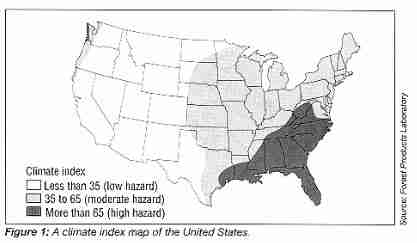
A U.S. map provided by the Forest Products Laboratory (above-left) indicates that the southeastern quadrant of the U.S., but extending north into West Virgina and parts of eastern Kentucky and Tennessee make up this area of high decay hazard (the dark colored area on the map) based on the FPL climate index.
Questions About the Durability of Fire Retardants & Preservatives for Wood Roofs
According to the NRCA both of the wood roof processes described above, when wood roofing shingles or shakes are treated under pressure, before installation on the roof, are considered "permanent", that is, the treatment should last for the life of the wood shingle.
For existing wood shingle roofs, treatment might be applied using a topical spray or brush-on of preservatives. These treatments are not permanent and need to be performed periodically depending on the geographic locale of the roof
According to Best Practices Guide to Residential Construction (Steve Bliss, J Wiley & Sons) and discussed in BEST ROOFING PRACTICES,
Where premium red or white cedar is too expensive for a particular roofing job, wood roof buyers should consider pressure-treated southern yellow pine shakes and shingles. In its favor, yellow pine is a tougher and stronger wood, and although not as pretty as red cedar when new, over time they will both weather to a similar silver gray.
Because penetration of the treatment on pine roofing shingles is nearly 100%, pressure-treated pine shingles carry guarantees against decay for up to 50 years, making them well suited to high-moisture environments, shallow slopes, and shady wooded sites where organic matter may collect on the roof. The preservatives should not leach out over time.
One drawback to yellow pine shingles and shakes is that many are flat-grained, so most come pretreated with a water repellent to help them resist cupping and splitting. However, retreatment with a water repellent at some point may be required for optimal performance. Western red cedar shingles are also available pressure-treated for severe applications where standard cedar shingles are prone to decay.
A bit before Flickinger's 1999 article, in 1995 in his article on Choosing Roofing, Jefferson Kolle questioned the durability of wood shingle fire retardant treatments. Kolle suggested that rain tends to draw the fire retardant to the shingle surface where it is washed away over time.
The same article however, quoted Don Meucci from the Cedar Single & Shake Bureau who said that tests performed on fire-retardant-treated wood shingles from a 16-year old roof passed the current fire resistance tests of that time. Nonetheless, some communities where fire risk is particularly high (Los Angeles California, Newcastle, New Hampshire) have banned the use of wood roofs regardless of their treatment.
For added details about proper wood shingle or wood shake roof installation, perhaps the most authoritative source of wood shingle and wood shake information is from the Western Red Cedar Shingle & Shake Bureau (now the Cedar and Shake Shingle Bureau, since not only western red cedar is used for roof shingles).
Research on Use of Fire-Retardant Paint & Paint Sources to Protect Buildings
- See also the research cited
at WILDFIRE DAMAGE PREVENTION for HOMES - Arruda, M. R. T., T. Tenreiro, and F. Branco. "Rethinking How to Protect Dwellings against Wildfires." Journal of Performance of Constructed Facilities 35, no. 6 (2021): 06021004.
Abstract:
This paper presents research concerning new fireproof construction guidelines for protection of dwellings against wildfires. The main subject of this study are newly-built houses, using current building materials and methods to maintain the integrity of the overall structure for an extended time during an ongoing fire exposure.
This study also presents possibilities for use of these new construction techniques to rehabilitate existing houses located in highly endangered wildland fire areas. The scope of this study are traditional dwellings situated mainly in the south of Europe, such as Portugal, Spain, France, Italy, and Greece, located in high risk wildfire zones in the wildland-urban interface
. In recent years, wildfires have had a major impact on the forest areas in Portugal, mostly due to the high combustibility of the wildland and to climate change, causing severe lasting damage to, or even the destruction of, dwellings.
The dwellings have often been rebuilt with similar characteristics to the original ones, disregarding interventions with new techniques that would make them fire protected, thus making them likely to burn again. As a result of these analyses, this study provides new fireproof construction guidelines for new and old dwellings, using traditional materials found in the construction industry of Europe.
Finally, as a future reference, the situation of isolated villages surrounded by forests is also investigated and solutions are proposed to protect the inhabitants. - Busch, Andrew, Michael Denning, Rosario Grasso, and Jason Zhuang. WILDFIRE PREVENTION USING AN RDP-APP-BASED FIRE RETARDANT [PDF] Journal of Undergraduate Chemical Engineering Research, Volume X May 2021 (2021): 72. [ Department of Materials Science and Chemical Engineering, Stony Brook University, Stony Brook, NY 11794, US]
Abstract:
The abundance of recent wildfires has caused a great need for fire retardants to prevent such disasters. Many fire-retardant mixtures exist, but a broad category of them are too toxic for the environment or are not applicable to our range of use to have wildfire-preventive practicalities.
Halogenated flame retardants, usually containing bromine as the halogen, is one of such categories with great potency in preventing fires. It is usually not chemically bound to the coated material, which can lead to leakage to the environment and the potential to bioaccumulate within organisms and ultimately known to have adverse health effects in literature.
As such, many studies have turned to safer alternatives such as phosphorus-based flame retardants. These compounds can act in the solid phase, causing the coated material to char to inhibit fueling of the flame or act in the gas phase, producing radicals that cool down the system.
This paper highlights a phosphorus-based mixture that acts in the solid and gas phase along with results of several proposed mixtures that performed poorly in flameproofing the samples.
The first mixture contained resorcinol (bis)-diphenyl phosphate (RDP), starch, xanthan gum (XG), and water. This produces a thick solution that was difficult to spray and had poor longevity as the samples were partially consumed when burnt after drying. The final mixture contained RDP, ammonium polyphosphate (APP), and (3S)- cis-3,6-dimethyl-1,4-dioxane-2,5-dione lactide monomer (LM). This solution has low viscosity, exhibiting strong flame retardant performance even when dried.
Pine branches and bushes were the primary samples for this experiment, and both control samples and coated samples were burned. The samples were additionally analyzed with Fourier-transform infrared spectroscopy (FTIR) to deduce the potential wettability of the mixture onto the surfaces after drying and burnt.
Keywords: flame retardant, resorcinol (bis)-diphenyl phosphate (RDP), ammonium polyphosphate, lactide monomer, charring, gas-phase inhibition, cellulose. - Carboline Fire Protective Coatings, Carboline Company 2150 Schuetz Road St. Louis, MO 63146 Phone: 1-314-644-1000, Tel: 800-848-4645 website: www.carboline.com
- Fire Retardants Inc., 123 Columbia Court North, Suite 201, Chaska MN 55318, Tel: 800-913-9385, email: info@fireretardantsinc.com, Website: www.fireretardantsinc.com
The company produces Burn Barrier No. 10 Shingle Treatment, Clear, Fire Retardant solvent-based wood roof coating, fire hazard hazard classifcation Class "B" - Flame Safe Wood Products, Flame Safe Chemical Corporation and Flame Safe Wood Products, Inc. 2653 Warfield Avenue, Fort Worth, Texas 76107 Phone: 817-740-9197 Toll Free: 1-800-333-9197, website: www.flame-safe.com/
- Glenn, Gregory M., Gokhan Bingol, Bor-Sen Chiou, Artur P. Klamczynski, and Zhongli Pan. "Sodium bentonite-based coatings containing starch for protecting structures in wildfire emergency situations." Fire safety journal 51 (2012): 85-92.
Abstract:
Coating materials were developed as a means of protecting structures from fires in emergency situations. Sodium bentonite (SB) gel and foam coatings were evaluated in burn tests for their ability to protect a sample of commercial lap siding from intense heat (42 kW/m2). Starch was added to some treatments to determine whether it stabilized the coating and prevented vertical slumping.
A commercial fire protection gel coating was included in the study for comparison. Coatings containing starch and the SB gel sample had negligible slumping during burn tests while the commercial gel and the SB foam slumped severely during the test. In rheology studies, samples containing starch had higher G′ (elastic modulus), G″ (viscous modulus), and higher yield stress than the commercial gel or SB samples without starch.
Surprisingly, the samples containing starch heated more slowly than samples without starch. This could be explained, in part, by the continuous boundary layer (crust) that formed during the burn test that shielded the substrate surface from direct heat exposure, minimized the exposed surface area, and, initially, lowered water vapor flux. Drying tests were performed at 44 °C to determine how long the coatings could remain hydrated under severe conditions. The SB gel coatings remained hydrated longer than the SB foam samples. Starch prolonged the drying time (reduced evaporation rate) for both the SB foam and gel samples. - Kasymov, Denis, and Mikhail Agafontsev. STUDYING THE EFFECT OF FIRE RETARDANT COATING ON THE FIRE HAZARD CHARACTERISTICS OF WOOD USING INFRARED THERMOGRAPHY [PDF] In EPJ Web of Conferences, vol. 159, p. 00018. EDP Sciences, 2017.
- Kalabokidis, Kostas D. "Effects of wildfire suppression chemicals on people and the environment—a review." Global Nest: The International Journal 2, no. 2 (2000): 129-137.
Abstract:
The different wood samples (flat and cylinder samples) were exposed to combustion modeled by forest fuels to study the effect of combustion under the laboratory conditions, using infrared diagnostics. The temperature profiles were obtained on the surface of wood samples, and the heat-stressed areas were found during the model combustion representing a ground fire of weak intensity.
Also the effect of fire front on the surface of wood samples (pine, aspen and larch) was studied to estimate the effect of fire retardant treatment "FUKAM". Infrared thermography was used as a diagnostic method.
The surface temperature distribution was obtained for the test wood samples after exposure to a fire front that was modeled using pine needles.
The fire hazard characteristics of wood after fire retardant treatment showed a significant reduction in the surface temperature and the resistance to fire for the chosen parameters of the experiment compared to the same untreated samples. - Ye, Qing. "Super-Absorbent Polymer Based Fire Retardant." PhD diss., Johns Hopkins University, 2021.
Abstract:
In this project, we develop a SAP based wildfire home protection strategy. The strategy is design to increase the odd for house to survive in a wildfire and is made up of two parts: the preparation of SAP suspension and the design of a sprinkling system.
We will also introduce the channels for a normal houseowners to purchase all the supply and the way to assemble and use the whole system. A cost accounting is also included in this project to help the houseowners to manage their budgets. - Zielnik, Allen. WHERE THERE’S SMOKE, THERE MAY BE WILDFIRE [PDF] Journal of Architectural 67 (2008).
Excerpt:
The use of specialty protective coatings, however, can significantly reduce the likelihood or severity of the effects of fire on vulnerable buildings. In addition, these coating materials could gain additional prominence in protecting buildings and properties in the line of wildfires that annually destroy thousands or millions of acres of parched woodlands and brushlands in California, other western states, and Florida.
Reader Comments, Questions & Answers About The Article Above
Below you will find questions and answers previously posted on this page at its page bottom reader comment box.
Reader Q&A - also see RECOMMENDED ARTICLES & FAQs
On 2020-08-08 - by (mod) -
fire-retardant wood roof coating Re-posting pending approval of included links:
Sean Harrison said:
A new, innovative, 100% eco-friendly wood coating that is shocking the world: once impregnated, your wood is protected for over 50 years, it is fire retardant, preventing bending, mold, worms, termites, UV damage and most important, water damage.
info@pd-18usa.com
On 2016-05-08 - by (mod) -
Sandra:
Yes there are spray-on fire retardant treastments for wood shingle roofs. I can't say what you need to do on a new roof, as some shingles may already have had fire retardant pre-applied. Some wood shingle roof products are pressure-treated with fire retardant when they are manufactured. That would probably be more effective than a spray-on retardant. What you should look at closely are the manufacturer's information about how long the fire retardant treatment lasts and when re-treatment is recommended.
According to x,
"Class B or C fire resistance ratings can be achieved for pressure treated wood shakes and shingles depending upon the amount of chemicals injected and/or the type of roof deck and underlayment used. "
- Smith Edwin G., et als, "The Wood Shake and Shingle Roof Hazard", University of Nevada Cooperative Extension, Fact Sheet 94-26, University of Nevada at Reno [PDF]
On 2016-05-07 by sandra
can you buy a fire treatment to put on an existing cedar shingle roof do new roofs have to be fire treated
Question: how to see if wood shingles are fire resistant
(Mar 25, 2012) Ona Hester said:
I need to know how to see if wood shingles are fire resistant
Reply:
Ona, if you do not have a record of who installed the roof, what product was used, nor a copy of documents describing the product, what's left is to send a sample to a shingle testing lab, asking for the appropriate ASTM test to be performed. The code requirement for treated shingles varies by geographic area, so you might start there.
Question: Is there a wood shingle treatment that provides both fire retardant and preservative?
(July 20, 2012) Bill Schubert said:
Is there a wood shingle treatment that provides both fire retardant and preservative?
Reply:
Bill, thanks, you ask an important question.
Wood shingle fire retardants (e.g. see FireRetardantsinc [dot] com Tel: 800-913-9385) are expected to be applied over new, un-treated wood shingles or shakes, and to be re-applied every few years to preserve their protection. I infer that if someone has already treated a wood roof with a preservative that imparts any water resistance to the wood shingle surface, the fire retardant treatment won't be effective as it won't soak into the wood as expected.
I pose that the fire retardant is also preservative, but I agree that the chemistry will vary. I've asked the experts to take a look at this Q&A and to comment further
Question:
(Oct 22, 2014) Joel said:
I have a 35 year-old wood shake roof, which was put over a now 55 year-old wood shingle roof.
Is there any (liquid) waterproofing material that can be sprayed (or brushed) over the outer wood-shake roof, to make it more leak proof? Is there any other way to make this roof more leak-resistent? (How the roof "looks" after this additional waterproofing is done is not important. I am located in Southern California.
Reply:
There are companies selling elastomeric roof coatings purporting to seal roof leaks. I would not attempt that repair on a wood shingle roof without discussing the process with the coating manufacturer.
...
Continue reading at WOOD ROOF INSPECTION GUIDE or select a topic from the closely-related articles below, or see the complete ARTICLE INDEX.
Or see these
Recommended Articles
- FIRE RATINGS for ROOF SURFACES
- WOOD ROOF COATINGS & FIRE RATINGS
- WOOD ROOF FLASHING DETAILS
- WOOD ROOF INSPECTION GUIDE
- WOOD ROOF INSTALLATION SPECS
- WOOD ROOF MAINTENANCE
- WOOD SHAKE & SHINGLE ROOFING - home
- WOOD ROOF SHAKES INSTALLATION
- WOOD ROOF SHEATHING, UNDERLAYMENT
- WOOD ROOF SHINGLE PROPERTIES
- WILDFIRE DAMAGE PREVENTION for HOMES
Suggested citation for this web page
WOOD ROOF COATINGS & FIRE RATINGS at InspectApedia.com - online encyclopedia of building & environmental inspection, testing, diagnosis, repair, & problem prevention advice.
Or see this
INDEX to RELATED ARTICLES: ARTICLE INDEX to BUILDING ROOFING
Or use the SEARCH BOX found below to Ask a Question or Search InspectApedia
Or see
INDEX to RELATED ARTICLES: ARTICLE INDEX to BUILDING DAMAGE, DISASTER, REPAIRS
Or use the SEARCH BOX found below to Ask a Question or Search InspectApedia
Or see
INDEX to RELATED ARTICLES: ARTICLE INDEX to BUILDING FIRE SAFETY
Or use the SEARCH BOX found below to Ask a Question or Search InspectApedia
Ask a Question or Search InspectApedia
Try the search box just below, or if you prefer, post a question or comment in the Comments box below and we will respond promptly.
Search the InspectApedia website
Note: appearance of your Comment below may be delayed: if your comment contains an image, photograph, web link, or text that looks to the software as if it might be a web link, your posting will appear after it has been approved by a moderator. Apologies for the delay.
Only one image can be added per comment but you can post as many comments, and therefore images, as you like.
You will not receive a notification when a response to your question has been posted.
Please bookmark this page to make it easy for you to check back for our response.
Our Comment Box is provided by Countable Web Productions countable.ca
Citations & References
In addition to any citations in the article above, a full list is available on request.
- Best Practices Guide to Residential Construction, by Steven Bliss. John Wiley & Sons, 2006. ISBN-10: 0471648361, ISBN-13: 978-0471648369, Hardcover: 320 pages, available from Amazon.com and also Wiley.com. See our book review of this publication.
- [7] Fire Retardants Inc., 123 Columbia Court North, Suite 201, Chaska MN 55318, Tel: 800-913-9385, email: info@fireretardantsinc.com, Website: www.fireretardantsinc.com
The company produces Burn Barrier No. 10 Shingle Treatment, Clear, Fire Retardant solvent-based wood roof coating, fire hazard hazard classifcation Class "B" - [8] Historic Preservation Technology: A Primer, Robert A. Young, Wiley (March 21, 2008) ISBN-10: 0471788368 ISBN-13: 978-0471788362
- Problems in Roofing Design, B. Harrison McCampbell, Butterworth Heineman, 1991 ISBN 0-7506-9162-X (available used)
- [9] The Cedar Shake and Shingle Bureau in the U.S.: Cedar Shake and Shingle Bureau, P.O. Box 1178
Sumas, WA 98295-1178, or in Canada: Cedar Shake and Shingle Bureau, #2 - 7101 Horne Street
Mission, BC V2V 7A2, 604-820-7700 E-mail: info@cedarbureau.com. The association can also be contacted by their website, cedarbureau.org where CCSB offers wood shingle installation instructions in the form of a manual - cedarbureau.org/installation/wall_manual/introduction.htm - [10] "Treatment of Cedar Shakes and Shingles," David Flickinger, RRO, p. 74, Professional Roofing, NRCA, October 1999, Rosemont IL.
- [11] Cedar Shake & Shingle Bureau, CSSB, U.S.: Sumas, WA 98295-1178, Tel: 604-820-7700, In Canada:
Cedar Shake and Shingle Bureau #2 - 7101 Horne Street, Mission, BC V2V 7A2 Tel: (604) 820-7700, E-mail: info@cedarbureau.com , website: http://www.cedarbureau.org/
CCSB offers wood shingle installation instructions in the form of a manual - cedarbureau.org/installation/wall_manual/introduction.htm - [12] U.S. Forest Products Laboratory, US FPL, One Gifford Pinchot Drive, Madison, WI 53726, Tel: (608) 231-9200, Email: mailroom_forest_products_laboratory@fs.fed.us608-231-9200, website: http://www.fpl.fs.fed.us/
- [13]NRCA - National Roofing Contractors Association - Website: www.nrca.net 10255 W. Higgins Road, Suite 600, Rose mont, IL 60018-5607, Tel: (847) 299-9070
- [14] Fire Safety Standard/Classification: ASTM E 84- Class " A " UL 723, Type 1, NFPA 255, UBC 42-1 ASTM E 2898, AWPA C-20, AWPA C-27
- [15] Fire Safety Standard/Classification: ASTM E 84 - Class " A " UL 723, Type 1, CAN4-S102-M83 NFPA 255, UBC 42-1
- [16] Fire Safety Standard/Classification: International Maritime Organization Resolution A.753 (18) AND ASTM F1173-85 section A5 Wet Condition Classification of " Waterfilled Plastic Pipe"
- [17] Fire Safety Standard/Classification: ASTM E 84 - Class "B" UL 723, Type 2, CAN4-S102-M83 NFPA 255, UBC 42-1
- [18] Fire Safety Standard/Classification: ASTM E 108 Fire Tests for Roof Coverings-Flying Brand, Burning |Brand, Spread of Flame and Intermittent Flame Exposure ASTM E 2898
- [19] Fire Safety Standard/Classification: NFPA 701
- [20] Fire Safety Standard/Classification: California Administrative Code Section 1237.1 of Title 19
- [21] Fire Safety Standard/Classification: Federal Standard 16CFR 1632 (FF 4-72) California Administrative Code, Title 4, Chapter 3 Section 1371- mattress/mattress ticking
- [22] Fire Safety Standard/Classification: Cal Tech 117-F
- [23] Fire Safety Standard/Classification: ASTM E 162
- [24] Fire Safety Standard/Classification: ASTM E662
- Our recommended books about building & mechanical systems design, inspection, problem diagnosis, and repair, and about indoor environment and IAQ testing, diagnosis, and cleanup are at the InspectAPedia Bookstore. Also see our Book Reviews - InspectAPedia.
- Wood Shingle Roofs, Care and Maintenance of wood shingle and shake roofs, (EC), Stanley S. Niemiec (out of print)
- In addition to citations & references found in this article, see the research citations given at the end of the related articles found at our suggested
CONTINUE READING or RECOMMENDED ARTICLES.
- Carson, Dunlop & Associates Ltd., 120 Carlton Street Suite 407, Toronto ON M5A 4K2. Tel: (416) 964-9415 1-800-268-7070 Email: info@carsondunlop.com. Alan Carson is a past president of ASHI, the American Society of Home Inspectors.
Thanks to Alan Carson and Bob Dunlop, for permission for InspectAPedia to use text excerpts from The HOME REFERENCE BOOK - the Encyclopedia of Homes and to use illustrations from The ILLUSTRATED HOME .
Carson Dunlop Associates provides extensive home inspection education and report writing material. In gratitude we provide links to tsome Carson Dunlop Associates products and services.
 | HOME | ABOUT | ASK a QUESTION | CONTACT | CONTENT USE POLICY | DESCRIPTION | POLICIES | PRIVACY | |
| © 2024 - 1985 Publisher InspectApedia.com - Daniel Friedman | |||||||||