
InspectAPedia® FREE Encyclopedia of Building & Environmental Construction, Diagnosis, Maintenance & Repair |
Question? Just ask us! InspectAPedia
|
 Inspecting Slate Roofs - Class on how to inspect slate roofing for condition, damage, leaks
- POST a QUESTION or COMMENT about free online education for slate roof inspection, diagnosis, & evaluation
Slate roof inspection class, free, online: this is a classroom presentation on the inspection, diagnosis, and estimate of remaining life of slate roofs. It was made to home inspectors in New York and has been used in other states in the U.S.
InspectAPedia tolerates no conflicts of interest. We have no relationship with advertisers, products, or services discussed at this website.
ASHI home inspection education class notes on how to inspect slate roofs
by Daniel Friedman
Hudson Valley ASHI - HVASHI Seminar - Kingston, New York
9 September 2003 class for home inspectors
This course outline reviews key considerations in evaluating slate roofing on historic or other buildings. Its presentation is intended to be accompanied by a collection of photographs and drawings. As time permits the author will place in this document links to representative samples of those illustrations.
Readers of this page should
see SLATE ROOF INSPECTION & REPAIR by Alan Carson and Daniel Friedman, for a detailed description of slate roof inspection procedures, slate roof materials, slate roof defects, slate and slate replacement sources.
Key Questions to ask about slate roofs
- Is it slate?
- How is it inspected?
- How much life remains? Stratford-on Avon Saxon chapel, 1100 years +!
- What repairs are needed?
- What will it cost to repair or maintain?
Identifying Slate Roofs
- Standard style, one or many colors
- Textured style, varying thickness & texture
- Graduated Slate, varying size, smaller, thinner at ridge
- Not-Slate
- asbestos-cement shingles
- slate look-alikes and replacement materials
Inspecting Slate
- Safety of the inspector comes first - Do not walk-on it
- From ground - unreliable
- Ladder at edge - reliable
- From nearby windows/surfaces - good
- Binoculars - useful, incomplete
- Document inspection limitations & implications (hidden slopes often differ in materials, condition, and may not even be slate!)
Slate Roof Life
- Quality of Slate (Vermont-NY, Pennsylvania, Virginia Buckingham)
- Level of maintenance (repair history, competence)
- Material failures (quality, age, condition, leaks)
- Fasteners & fastener failures (common)
- Flashing failures (most common)
- Installation patterns (uncommon)
Quality of Slate
Slate is stone, unique to quarry where mined
Color and appearance are clues but not sure
- Black
- Blue-black
- Purple
- Mottled-purple & green
- Red
- "unfading" vs. "weathering" for each of above, not a durability factor
Slate Colors (continued)
- Green, purple, black, red also avail - Vermont, most common, lower in lime than PA = 100-200 yrs.
- Gray, gray-black - Vermont & New York lighter than PA slate, may include purple, green.
- Blue-gray - Pennsylvania - best known, "Pennsylvania black" - less durable - 40-50 yrs. White efflorescence forms rings on 3 exposed sides. Unfading PA gray is soft-gray, longer-lived; Unfading PA black is rougher, longer-lived; Blue-black "hard-vein" PA slates darken with age.
- Blue-gray - Virginia - tough, >100-200 yrs.
- Red un-fading - Washington County NY
Quality of Slate
- Variations in thickness - more is better
- Variations in stone chemistry - quarry-unique
- Imperfections and inclusions - iron & calcite
- Ribbon slate - impurities in bands, shorter life, may vary depending on what minerals make up the color bands
Slate Maintenance
- replacement slates - how many?
- replacement fastening methods -hooks, tabs
- temporary patches - with metal or other
- tar or roof mastic - "the bigger the blob the better the job?"
- loose or missing slates - how many?
- valleys or ridge caps worn, rusted, leaky
Material Failures
Weathering:
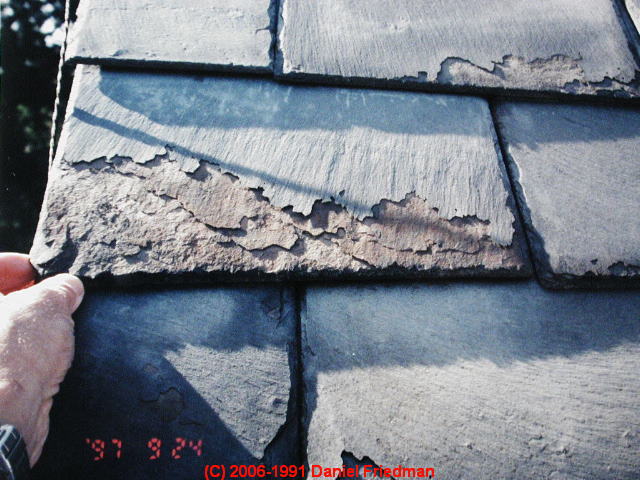
- delaminating
- scaling along cleavage planes
- science: slate becomes thin or soft and spongy: mineral impurities (calcite, iron sulfides) + alternating wet/dry cold/hot form gypsum which expands and delaminates the slate. Slate is stone, it does not "rot" but it does get soft.
- white mineral salt rings may telltale degree of aging, some slaters opine that the area of the un-stained center defines the % remaining life - no science given
Fastener Failures
- Many missing slates, many patches
- Nail pops - vibration, high nails -> holes
- Over-nailing - too tight -> cracks
- Iron vs. copper/stainless nails - fastener failures - many slates may be about to fall
Flashing Failures
- Mineral roll roofing valley liners
- Copper
or steel valley liners
- corroded
- tarred
- leaky
- Chimney flashings - usually tarred
- Inspect leak history in attic - flashings & ice dams
Installation Patterns
- "Cheap" patterns more likely to leak
- Dutch Lap (smaller slates 10x6"?)
- French Method
- Open Lap - good for barns
- Standard
lap patterns, solid or mixed
- sizes up to 24x14", square ends, uniform color & exposure
- Textured Slate - look for on Tudor's, rough surface, varied thickness
- Graduated Slate - graduated size & exposure
Sketches of Slate Patterns
- Dutch Lap
- French method
- Open Lap
- Standard Pattern
Slate Inspection Mistakes
Don't "Pass" a Worn Out Slate Roof: Criteria
- more than 25% of slates are sliding down - fastener failure
- more than 25% of slates are worn out - big replacement cost
Don't "Fail" or Replace a Good Slate Roof
- many repairs, few current loose/bad slates
- bad flashings, good slates
- asphalt-shingle roofer sells owner on avoiding maintenance cost, removes 300-year material, installs 30-year material
An earlier version of this material appeared in the winter 1991 issue of the ASHI Technical Journal as cited below. In this article series we have made additions and corrections to the original text,and we've added many slate roof photographs and details.
- Carson, Alan & Daniel Friedman, SLATE ROOFS [PDF] (1991) ASHI Technical Journal, Vol. 1. No. 1, January 1991
...
Continue reading at SLATE ROOF LIFE EXPECTANCY or select a topic from the closely-related articles below, or see the complete ARTICLE INDEX.
Or see these
Recommended Articles
- SLATE ROOF DEFECTS
- SLATE ROOF INSPECTION & REPAIR - home
- SLATE ROOF REPAIRS
- SLATE ROOF TYPES
- SLATE THERMAL MASS for SOLAR HEAT STORAGE
- SNOW GUARDS & SNOW BRAKES
Suggested citation for this web page
SLATE ROOF INSPECTION COURSE at InspectApedia.com - online encyclopedia of building & environmental inspection, testing, diagnosis, repair, & problem prevention advice.
Or see this
INDEX to RELATED ARTICLES: ARTICLE INDEX to BUILDING ROOFING
Or use the SEARCH BOX found below to Ask a Question or Search InspectApedia
Ask a Question or Search InspectApedia
Questions & answers or comments about slate roof inspection, diagnosis, & evaluation.
Try the search box just below, or if you prefer, post a question or comment in the Comments box below and we will respond promptly.
Search the InspectApedia website
Note: appearance of your Comment below may be delayed: if your comment contains an image, photograph, web link, or text that looks to the software as if it might be a web link, your posting will appear after it has been approved by a moderator. Apologies for the delay.
Only one image can be added per comment but you can post as many comments, and therefore images, as you like.
You will not receive a notification when a response to your question has been posted.
Please bookmark this page to make it easy for you to check back for our response.
Our Comment Box is provided by Countable Web Productions countable.ca
Citations & References
In addition to any citations in the article above, a full list is available on request.
- The Slate Roof Bible, Joseph Jenkins, www.jenkinspublishing.com
- "Slate roofing: an old-world tradition," Professional Roofing, February 1993
- "Special Roof Issue", Old House Journal, April 1983
- Handbook of Building Crafts in Conservation, Jack Bower, 1981
- Vermont Structural Slate Co., Fair Haven VT, 802-265-4933
- Evergreen Slate Co., & Hilltop Slate Co., both in Granville, NY
- Buckingham Slate Co., Richmond, VA.
- Building Pathology, Deterioration, Diagnostics, and Intervention, Samuel Y. Harris, P.E., AIA, Esq., ISBN 0-471-33172-4, John Wiley & Sons, 2001 [General building science-DF] ISBN-10: 0471331724 ISBN-13: 978-0471331728
- Building Pathology: Principles and Practice, David Watt, Wiley-Blackwell; 2 edition (March 7, 2008) ISBN-10: 1405161035 ISBN-13: 978-1405161039
- Handbook of Building Crafts in Conservation, Jack Bower, Ed., Van Nostrand Reinhold Company, NY 1981 ISBN 0-442-2135-3 Library of Congress Catalog Card Nr. 81-50643.
- Historic Preservation Technology: A Primer, Robert A. Young, Wiley (March 21, 2008) ISBN-10: 0471788368 ISBN-13: 978-0471788362
- Historic Slate Roofs : With How-to Info and Specifications, Tina Skinner (Ed), Schiffer Publishing, 2008, ISBN-10: 0764330012 , ISBN-13: 978-0764330018
- The Slate Roof Bible, Joseph Jenkins, www.jenkinsslate.com, 143 Forest Lane, PO Box 607, Grove City, PA 16127 - 866-641-7141 (We recommend this book).
- Slate Roofing in Canada (Studies in archaeology, architecture, and history)
- In addition to citations & references found in this article, see the research citations given at the end of the related articles found at our suggested
CONTINUE READING or RECOMMENDED ARTICLES.
- Carson, Dunlop & Associates Ltd., 120 Carlton Street Suite 407, Toronto ON M5A 4K2. Tel: (416) 964-9415 1-800-268-7070 Email: info@carsondunlop.com. Alan Carson is a past president of ASHI, the American Society of Home Inspectors.
Thanks to Alan Carson and Bob Dunlop, for permission for InspectAPedia to use text excerpts from The HOME REFERENCE BOOK - the Encyclopedia of Homes and to use illustrations from The ILLUSTRATED HOME .
Carson Dunlop Associates provides extensive home inspection education and report writing material. In gratitude we provide links to tsome Carson Dunlop Associates products and services.
 | HOME | ABOUT | ASK a QUESTION | CONTACT | CONTENT USE POLICY | DESCRIPTION | POLICIES | PRIVACY | |
| © 2024 - 1985 Publisher InspectApedia.com - Daniel Friedman | |||||||||