
InspectAPedia® FREE Encyclopedia of Building & Environmental Construction, Diagnosis, Maintenance & Repair |
Question? Just ask us! InspectAPedia
|
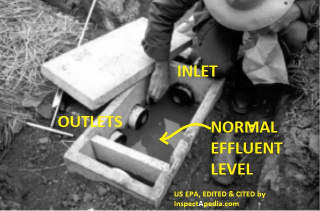 Septic System D-Box
5 Ways to find the drop box
Install, Inspect, Test & Fix Septic System Distribution Box
- POST a QUESTION or COMMENT about septic system D-box installation, inspection, troubleshooting, and repair or replacement
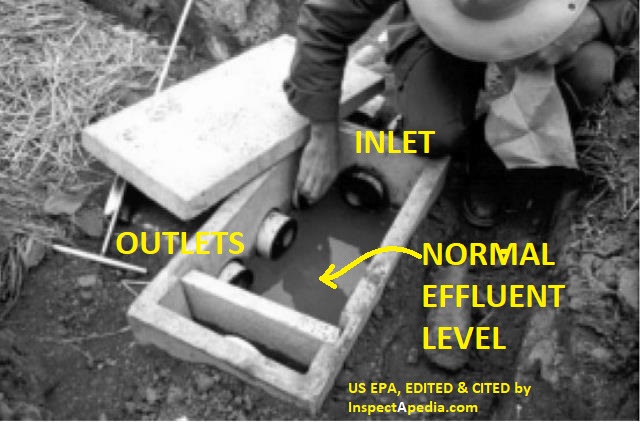
A septic D-box or "Distribution Box" is a small container that connects septic effluent pipes: an incoming wastewater pipe coming from the septic tank enters the D-box and the sewage liquid is then routed to one, or usually several outgoing effluent dispersal pipes that form the septic drainfield or soakaway bed. In sum the D-box is a "junction box" for routing septic effluent into a drainfield.
Here we give eptic system D box installation, specifications, inspection, diagnosis, and repair, and we explain how to find the septic distribution box, drop box, or D-box by any of several methods.
We also provide links to additional details about how to inspect and repair the D-box if that's needed.
In this article series about septic system drop boxes we describe the best procedures for locating and inspecting, repairing or replacing the septic drainfield distribution box, or the "D-box" or "Splitter box".
If the D-box or septic diversion box is leaking, smells, or is tipped, clogged, or otherwise not working this article describes how to diagnose & fix the trouble.
This series of septic system installation, maintenance & repair articles discusses the Inspection and Reporting the Condition of Private Residential Waste Disposal Systems - or - Where Does it Go When I Flush? and ... Will We Meet Again?
InspectAPedia tolerates no conflicts of interest. We have no relationship with advertisers, products, or services discussed at this website.
Septic System Effluent Distribution Boxes: the D-Box Home Page
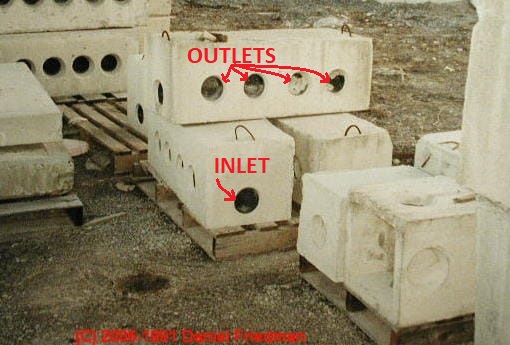
Definition of a Septic D-Box: a septic distribution box is a container used to receive septic system effluent from a septic tank and to re-distribute the effluent into a network of attached drain-field or soakaway bed absorption trenches & pipes.
The D-box works by gravity, flowing effluent into the drainfield (or leachfield) piping network.
Our photo shows a stack of concrete drop boxes or distribution boxes at a local septic system supplier.
[Click to enlarge any image]
How to Find the Septic System D-Box
Question: distance from the septic tank to the D-box?
How far away from the septic tank is the dbox? - Kristin Clary
How far from the main tank is the D box located on average? - Fishass
 [Click to enlarge any image]
Reply: Distance from the Septic tank to the D-Box gives a clue to the D-box location
Kristin & Fishass:
There is not a fixed distance from the septic tank to the distribution box; rather, its location depends on the space for and layout of the septic drainfield.
But you can often get a fair idea where the D-box is likely to be by any of several means:
- Look for a depression
in the ground a couple of feet in diameter and located between the septic tank and the drainfield.
The D-box is normally not very deep, often between 6" and two feet to the top of the box.
You may also see a pattern of parallel depressions, typically about 5 feet apart, that mark the individual drainfield leach lines. The D-box will at or near end of the drainfield area that is closest to the septic tank.
More details about how to find the drainfield itself are in this
Separate article: SEPTIC DRAINFIELD LOCATION
Also at SEPTIC VIDEOS we walk a site showing you how to rule-in or rule-out various locations that would or would-not be expected to contain a drainfield, septic tank, or D-box
- Look at the site layout
for where the D-box could possibly be located.
For example, if the drainfield site is level and rectangular, the D-box would typically be at or near the edge of the drainfield closest to the septic tank. - See if you can find a site plan
or septic drawing that would have been filed when your septic system was approved by your local health or building department
See SEPTIC DRAWINGS for some sketches that give an idea where the distribution box is typically found - Measure the distance to D-box:
Run a plumbing snake or probe or sewer line camera from the septic tank outlet until it stops will give the distance to the D-box (probably)
Once you know the distance to the D-box you have an arc along which the D-box will be found.
The arc has its origin at the point where you inserted the plumbing snake into the effluent line, such as at the septic tank outlet baffle or tee, and the distance is what you measured when you withdrew the snake from the line after it was stopped by hitting the D-box.
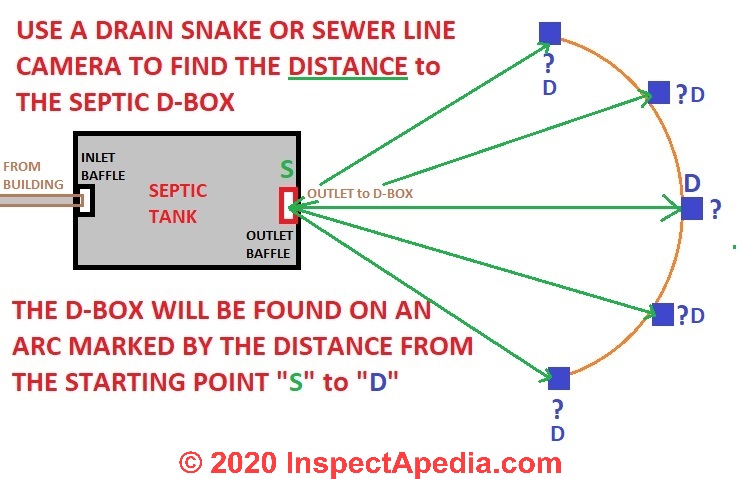
Above: by inserting a sewer line camera or plumbing snake into the effluent line at the septic tank outlet baffle or tee you can measure the distance from that point to the D-box. The snake or camera will stop when it hits the D-box interior.
Then you can first inspect (for a depression) or if necessary, use the same snake, camera, or simply a tape measure to mark out the ground surface the arc along which the Drop box or D-box must lie. Some careful exploratory digging along that arc will find the distribution box.
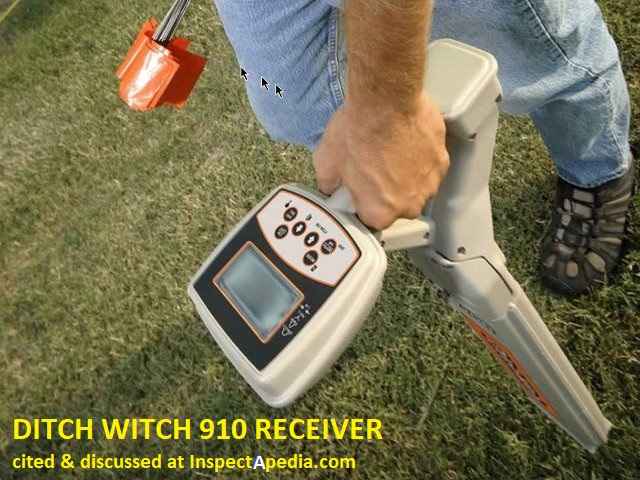
- Use an electronic buried drain line locator to find the D-box
A combination of a metal snake inserted into any buried pipe or drain line and special locating equipment (basically a metal detector) can find the exact route and location of the buried effluent line between the septic tank and the D-box.
Just follow the buried line, using your locating device (and metal snake inserted into the buried effluent line) to its end and there you'll find the D-box.
Details are at DRAINFIELD PIPE LOCATION, PRECISE where we also give sources of buried drain locating equipment.
Not All Septic Systems have a Drop Box
Above we describe finding the D-box for a septic system by several means. But is a Distribution box always even present?
Usually.
Really? Well not always. Most septic systems using a drainfield or absorption field or soakaway bed will have a D-box but not all of them. Some septic systems, particularly smaller capacity ones may use just one effluent distribution line. There will be no d-box or drop box on a single line effluent dispersal system.
What about mound septics and peat septics and aerobic septic systems? All of those systems that disperse effluent through more than a single dispersal pipe or line will use a form of drop box or D-box.
D-Box or Drop Box Specifications & Code Requirements
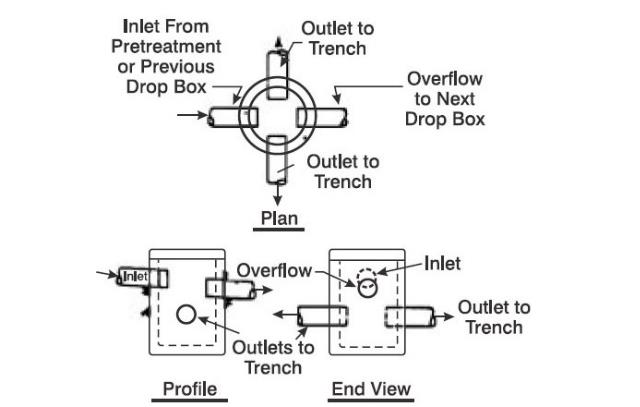
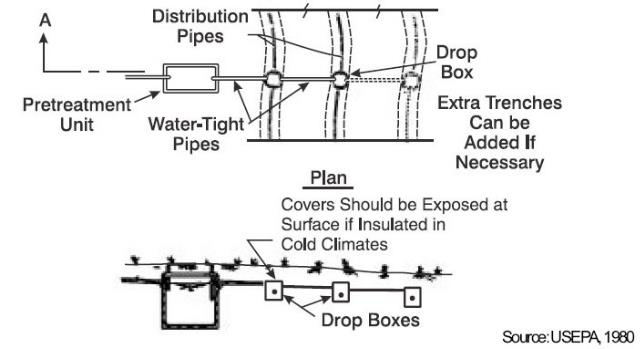 Watch out: as you'll note in our drawing, there may be multiple Distribution Boxes in some septic system designs.
The following building code example specification for septic system distribution boxes is excerpted from SEPTIC DISTRIBUTION LINES, BOXES, TYPES, NYS-A.7 Effective Date: 12/01/90 Title: Appendix 75-A.7 - Distribution devices
[Click to enlarge any image]
(1) Distribution Box Design Specifications - the D-Box Specs
(i) For accessibility, it is necessary that the distribution box be located and have a removable cover not more than 12 inches below grade. Where, due to site conditions, a distribution box must be greater than 12 inches below the surface, an extension collar shall be installed to within 12 inches of the surface.
(ii) All outlets from the distribution box shall be at the same level to insure the even distribution of flow.
(iii) To minimize frost action and reduce the possibility of movement once installed, distribution boxes must be set on a bed of sand or pea gravel at least 12 inches thick.
(iv) The drop between inlet and outlet inverts shall be at least two inches. A baffle is required at the inlet side of the box when the slope from the septic tank to the box exceeds 1/2 inch per foot or when siphon dosing is used.
(v) There shall be a minimum two inch clearance between the inverts of the outlets and the bottom of the box to prevent short-circuiting and reduce solids carry-over.
(vi) Distribution boxes may be constructed in place or purchased prefabricated. When concrete is used to construct boxes, it shall have a minimum compressive strength of 2,500 psi at 28 day set.
(vii) Prefabricated boxes may be constructed of concrete, fiberglass, or
plastic. The boxes shall be installed in conformance with the
manufacturer's instructions in addition to the requirements above.
Inspecting the Septic System Distribution Box
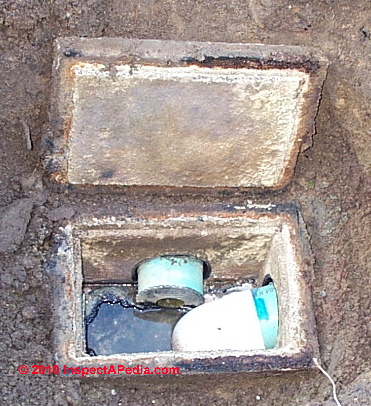 The distribution box (more than one may be in use) connects a single effluent line from the septic tank to a network of absorption system components such as drainfield leach lines or to a network of seepage pits or galleys.
Details are now found
Septic D-Box Piping
Question: are the pipes from the D-box solid or perforated?
Reply: It depends on septic drainfield layout.
Details have been moved to
Signs of D-Box Trouble, Advice on D-Box Repairs
Reader question: I am being told that my D box is bad. When no levelers are in place all effluent runs into only one port.
Reply: Details about thorough inspection and diagnosis of Drop box problems are now
at SEPTIC D-BOX TROUBLESHOOTING
Distribution Box Clogs, Flooding Leaks & Odors: troubleshooting & repair
Details about flooding, leaks and odors at the drop box are now
Distribution Box Cover Troubleshooting & Repair
Details about septic drop box covers have been moved
Temporary D-Box Repairs - eliminate the D-box?
Details are now at SEPTIC D-BOX TEMPORARY REPAIR
Septic System D-Box Splitters - Drainfield Resting
For details about drop box splitters and drainfield resting and recovery or Drainfield R&R approaches
Reader Comments, Questions & Answers About The Article Above
Below you will find questions and answers previously posted on this page at its page bottom reader comment box.
Reader Q&A - also see RECOMMENDED ARTICLES & FAQs
On 2022-10-02 by Martin
My distribution box is (was) concrete and 12"x36", and only the bottom remains. It has 1 inlet and 3 out. I cannot find a similar distribution box anywhere online. Does it have to have the same dimensions or can I use any size as long as it has at least 1 inlets and 3 outlets?
On 2022-10-02 by InspectApedia (Editor) - replacement D-box must have correct number of inlets and outlets
@Martin,
It's perfectly fine and functional to replace your old D-box with one that is larger or even a bit smaller as long as it has the correct number of inlets and outlets, but if you can find one whose dimensions make connecting to the existing sewage inlet and outlet ports easiest, with minimum additional digging and re-piping, the D-box replacement job will be easier, faster, and much less costly.
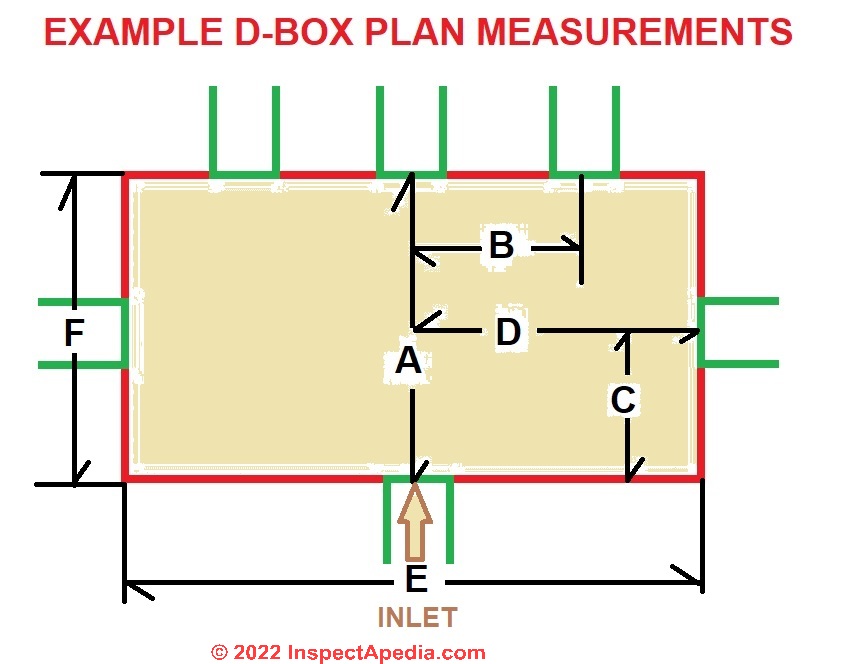
So make a plan-drawing giving the dimensions and arrangement of piping and take that to D-box suppliers to see what fits best.
On our example sketch below you'll notice that dimensions A, B, C, and D are more-important when replacing a D-box than dimensions E and F **if** we don't want to have to make lateral relocation adjustments of the incoming and outgoing septic effluent lines.
On 2022-06-11 by Big John
My septic system was installed in 2007. It includes a distribution box and two drain fields approximately 80 ' in length. All went well until recently. The toilets, shower and sinks began to drain slowly and after a few days began to back up.
I had the tank pumped and was told there were roots present inside the tank that needed to be treated as well as the drain fields and copper sulfate was recommended. Since the initial problem was resolved I was in no hurry to follow up on the recommendations. ( bad decision )
About 7 weeks water was discovered over and about the distribution box. I poured 2.5 - 3 lbs of copper sulfate down an access pipe into the distribution box hoping this would eliminate any invading roots and hopefully cleanse the media below the drain field permitting it to function properly again.
Well, this hasn't solved the problem as yet. Yesterday while mowing grass I noticed sewer water bubbling out of the ground again.
My question, after 14 years of neglect is it reasonable to expect a treatment poured into the lines to restore its ability to function again? Your answer and suggestion will be greatly appreciated. Big John.
On 2022-06-11 by InspectApedia (mod) - invading roots in septic field
@Big John,
Thank you for the helpful question.
In five decades of experience on this topic I've never found a single instance in which pouring anything down a drain will fix a failed septic system.
Even if you use mechanical cleaning to route out the drain lines, the area around them is filled with invading roots, and quite possibly the soil is clogging your drain field.
Before launching into an extensive replacement of the fields, it might be worth sending a sewer line camera down each of the septic field drain lines to see their condition.
On 2022-05-07 by Tom
Hello,
Is it dangerous for my septic system if a small amount of sand enters my distribution box while it is being buried? My system will be completed in a few days, and the concrete lid has a little bit of play side to side. I'm the homeowner and just curious if this is grounds for concern. Thank you
On 2022-05-09 by Inspectapedia Com Moderator (mod) - sand in septic system
@Tom,
If by "small amount of sand" you mean a sprinkling then it's harmless.
If so much sand enters the d-box that it could clog or block one of the lines, that would be a concern.
On 2022-01-27 by Gary Phillips
can an inspector fail your septic, because there are watermarks above the outlet but no actual water at the time of the inspection.
On 2022-01-27 by Inspectapedia Com Moderator (mod) - signs of a flooded D-box
@Gary Phillips,
Certainly signs of a flooded D-box are at the very least a warning that there has been a failure in the past. Additional clues that an inspector might find may permit her to form the opinion that the signs of prior drainfield failure are accompanied by no evidence that a prior problem has been corrected, thus that the condition is still there.
Keep in mind that a septic drainfield may flood or be in failure mode episodically rather than continuously, as weather and usage and other conditions vary. The fact that we "only sometimes " send our sewage into the environment, into nearby waterways, or potentially into people's drinking water wells is still a septic failure that needs to be addressed.
In my OPINON, an inspector who failed to issue a septic failure warning if there are signs of septic system flooding would not be doing her job.
On 2021-05-07 by William
Are there plastic D box manufactured
On 2021-05-07 by danjoefriedman (mod) - plastic and fiberglass septic D-boxes available
@William,
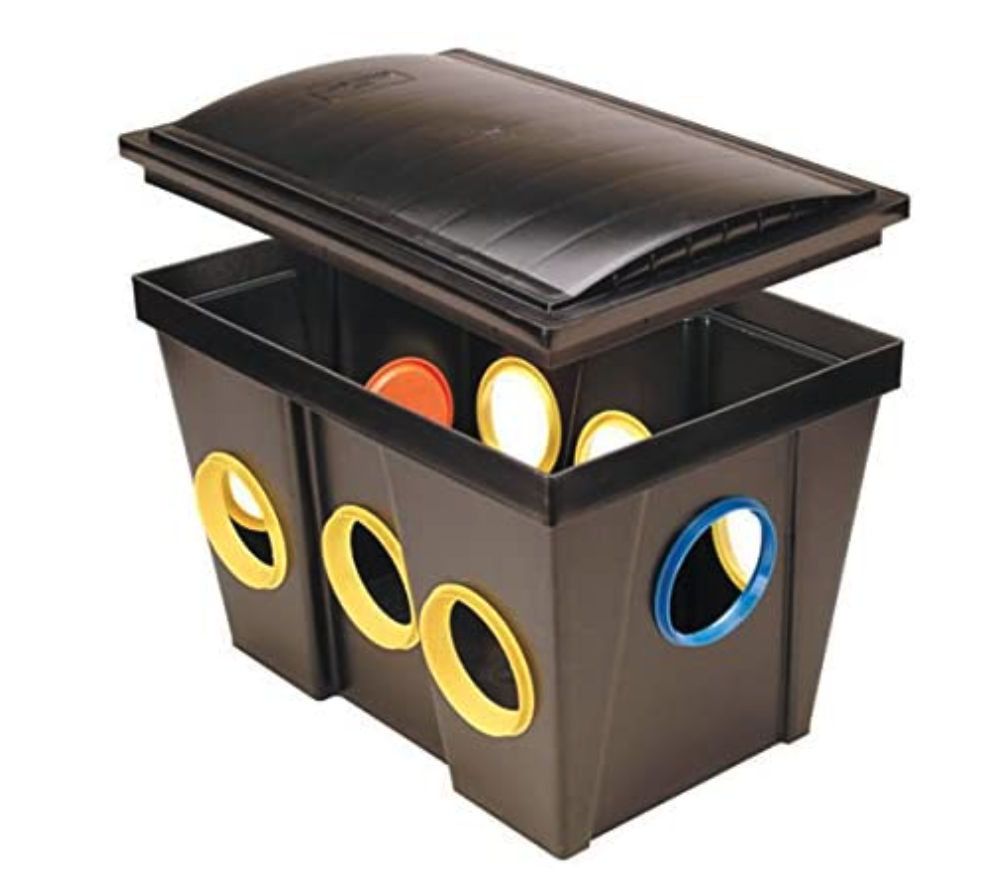
Yes there are plastic, fiberglass as well as pre-cast concrete Septic D-boxes widely sold.
Below is an example, the Tuf-Tite 9-hole Septic D-box that sells for about $75. U.S. (in a size for 4-inch effluent lines)
On 2020-05-21 by Anonymous
My septic system's 4-hole distribution box has levelers on all 3 outlets and the inlet. Should the inlet have a leveler on it? All pipes are 4" but the leveler's hole is only about 1.5", effectively reducing the input line from 4" to 1.5". Is this normal?
On 2020-05-21 - by (mod) -Anon
Thanks for an interesting question. I don't normally see a leveler on the inlet to a D-box. If we consider what's supposed to be going-on, effluent should flow freely from the septic tank into the D-box and then flow out of the D-box to the fields, with distribution to individual field leach lines being balanced as needed among your 3 outlet openings.
Installing a leveler on the inlet to the D-box, in my OPINION, does nothing useful and could cause harm by restricting effluent inflow into the D-box and onwards to the soakaway beds. The risks are clogs at the inlet side or even a septic tank backup.
On 2020-04-27 by Nancy mc laughlin
Need to know following est to replace d box, $2115.00., permit, jetting. Plus disc $151.00 total $ 2,584.00. Is this reasonable? I am retired senior. Not familiar with standard costs. Thank u
On 2020-04-28 - by (mod) -
Can you get a second estimate from another company?
On 2020-03-04 by David - what's the maximum distance from septic tank to D-Box?
What is maximum length of line between septic tank and diverter box ?
On 2020-03-04 by (mod) -
David
There's not a code-specified maximum distance between septic tank and the D-box, but there will be a technical or practical distance limitation since the main effluent line from tank to D_box and from D-box to absorption trenches has to slope (typically 1/8" to 1/4" per foot).
A very long run that pushes drainfield lines too deep will have you building a system that lacks soil oxygen and thus doesn't treat the effluent adequately (not enough bacterial action) so then contaminates the environment, groundwater, wells.
On 2019-06-16 by Joyce I. Keay
I had some water in my basement while doing a load of laundry and called a sewage pumpout company who came in and emptied the septic tank.
It had not been pumped out since 2010. I live alone in the house. He thinks there could be a problem with the distribution box and wants to come back to locate it and inspect and, I assume, replace it.
I'm assuming the box is the original from when the house was built in either 1983 or 1986 and I've been here since 1993.
What is the usual life of a distribution box and how much should it cost to locate, inspect and replace? Thank you.
On 2019-06-16 - by (mod) - What is the usual life of a distribution box ?
Joyce:
On 2019-05-06 by Carol - tenant poured grease down my kitchen sink and put baby wipes and female products down the toilet
If the Distribution Box is blocked or clogged you will have constant sewage backup into your home, coming up through the lowest drains in the house whenever you use a plumbing fixture.
Keep in mind that pumping a septic tank, while critical for septic drainfield life, will never ever fix a clogged drain nor a failed drainfield.
I having a problem with my leach field not draining properly. I installed a leach field 5 yes ago.
Someone said it might be the d box does that sound like it could be that,?
I had a backup last year in my waste pipe my tenant poured grease down my kitchen sink and put baby wipes and female products down the toilet
I had the pipe snaked and everything was fine until now
My home is in milton NH.can u call me 941 221 1970 tks carol
On 2019-05-08 - by (mod) - clogged D-box or effluent line
Carol
From your description it's possible that there's a clog that needs to be cleared.That's not something we could discuss usefully by telephone you need an on-site plumber to perhaps use a sewer line camera to inspect your lines.
If the leach field is in failure or you'll know because you'll see that it's flooded.
On 2014-07-05 by Katie
We've lived in this house for more than 20 years and for most of those years we've had trouble getting grass to grow at and just down hill from the D-box.
Many years ago we had a swampy area there and when we had the tank vacuumed out we asked about that problem. They came back and pumped styrofoam pellets into the ground (I don't remember what the process was called and it may not have been styrofoam, but small white pellets similar to perlite).
That helped the whole system quite a bit for some years, but now, as I stated we have problems getting grass to grow in a larger spot than the soggy area (the previous owners had also put an above ground pool over 2 lines of the leach field and we were told at the time of putting the pellets into the ground that we also should remove the pool which we did).
Do you have any ideas why the ground near the d-box won't grow grass well? Last year we even dug up the area, removed some soil, replaced it with fresh soil and resodded the area.
On 2014-07-06 - by (mod) -
Katie,
If the soil depth over a concrete cover of a septic tank or distribution box is too thin it may lack sufficient moisture to support grass growth.
On 2014-05-30 by sc
having trouble locating my distribution box, my county didn't require site plans when this place was built in the 80's, and now suspect I am failing to dig far enough down. Is there an average or maximum depth below the outlet pipe on the septic that the Dbox will be installed in?
On 2014-06-01 - by (mod) -
SC
The depth of the D-box will be somewhere between the elevation of the outlet of the septic tank and the top of the drain field pipes to which it connects. That's site dependent.
YOu might go to the tank, insert a snake into the outlet pipe until it hits an obstruction, then pull it out and measure that length. Presuming it hit the D-Box that'll give you the distance along an arc extending from the septic tank outlet.
Or use a pipe locating tool to follow the waste line.
On 2014-05-26 by Barbra
Our leach field seems to be clogged. It's across the fence with heavy woods and undergrowth. Digging anywhere seems a monumental task. Seems like the whole woods will have to be removed! This system may have been installed in the 70s.
On 2014-05-27 - by (mod) -
Barbra
It does sound monumental, and expensive.
On the other hand, if your leach field is overgrown with woods and undergrowth chances are that its pipe system is quite invaded with roots, not working and thus needs replacement. Modest exploratory digging is not a big deal but if you need to replace the fields you could not do so successfully amidst woodlands and heavy undergrowth anyway.
I'd review the site to see if there is a more suitable location. If not, $orry for the bad new$.
- Moderator
On 2014-03-24 by Anonymous
B.Ayers I have just noticed standing water on a small portion of my drainfield.Should I be worried? System is 15 years old.
On 2014-03-24 - by (mod) -
Unfortunately Anon, that suggests you should indeed be worried. Either the drainfield is failing or surface runoff is flooding the field.
...
Continue reading at SEPTIC D-BOX INSPECTION or select a topic from the closely-related articles below, or see the complete ARTICLE INDEX.
Or see SEPTIC D-BOX INSTALL REPAIR FAQs - questions & answers posted originally on this page
Or see these
Recommended Articles
- ALTERNATING BED SEPTIC SYSTEMS
- DRAINFIELD PIPE LOCATION, PRECISE - using electronic equipment to find buried pipes
- SEPTIC COMPONENT LOCATIONS
- SEPTIC D-BOX INSTALL, LOCATE, REPAIR - home for septic distribution box, drop box, D-box
- SEPTIC D-BOX COVERS - cover leaks, cover sealing, cover safety at the septic system distribution box
- SEPTIC D-BOX FLOODING - causes & cures for flooding & leaks at the septic system distribution box or Drop Box
- SEPTIC D-BOX INSPECTION - How to inspect the septic system distribution box for clues of septic drainfield condition
- SEPTIC D-BOX LOCATION - how to find the D-box
- SEPTIC D-BOX PIPING - solid vs. perforated piping
- SEPTIC D-BOX SPECIFICATIONS - sanitary code examples of D-box requirements
- SEPTIC D-BOX SPLITTERS - Using a D-box control or a Splitter Valve / Diverter Valve for drainfield resting & restoration
- SEPTIC D-BOX TEMPORARY REPAIR - temporary repair bypassing the Drop Box may work in a few cases
- SEPTIC D-BOX TROUBLESHOOTING - simple repairs at the D-Box can improve septic drainfield performance and may eliminate a Tipped D-box, Distribution -Box Leaks, Drop Box Odor
- SEPTIC DRAINFIELD LOCATION
- SEPTIC TANK, HOW TO FIND
- SEPTIC TANK LOCATING EQUIPMENT
Suggested citation for this web page
SEPTIC D-BOX INSTALL, LOCATE, REPAIR at InspectApedia.com - online encyclopedia of building & environmental inspection, testing, diagnosis, repair, & problem prevention advice.
Or see this
INDEX to RELATED ARTICLES: ARTICLE INDEX to SEPTIC DRAINFIELDS & D-BOXES
Or use the SEARCH BOX found below to Ask a Question or Search InspectApedia
Ask a Question or Search InspectApedia
Try the search box just below, or if you prefer, post a question or comment in the Comments box below and we will respond promptly.
Search the InspectApedia website
Note: appearance of your Comment below may be delayed: if your comment contains an image, photograph, web link, or text that looks to the software as if it might be a web link, your posting will appear after it has been approved by a moderator. Apologies for the delay.
Only one image can be added per comment but you can post as many comments, and therefore images, as you like.
You will not receive a notification when a response to your question has been posted.
Please bookmark this page to make it easy for you to check back for our response.
Our Comment Box is provided by Countable Web Productions countable.ca
Citations & References
In addition to any citations in the article above, a full list is available on request.
- New York State Department of Health, APPENDIX 75-A WASTEWATER TREATMENT STANDARDS - INDIVIDUAL HOUSEHOLD SYSTEMS , [PDF] New York State Department of Health, 3 February 2010, retrieved 3/1/2010, original source: https://www.health.ny.gov/regulations/nycrr/title_10/part_75/appendix_75-a.htm
- [1] Readers of this page should also see System Design Regulations 75-A.7 Distribution lines, distribution boxes, gravity flow, pressure distribution, dosing, siphons design specifications for septic systems.
- [2] Thanks to reader Nicholas Day for discussing D-box troubles and repairs, September 2010
- [3] Zoeller Pump Company, 3649 Cane Run Rd., Louisville, KY 40211, Phone: 1-800-928-7867, 502-778-2731
Fax: 502-774-3624. Technical support and/or quote related emails: zcotechnical@zoeller.com. Zoeller produces just about every kind of septic, sewage, effluent, grinder, and sump pump. Homeowners who need a sewage pump are asked to contact their local representative or retail sales outlet. Zoeller classes their pumps into these categories:
- Grinder pumps, such as Zoeller's 810/815 Turnkey Grinder Systems, 800-series Grinder Pumps, Cold-Climate grinder pumps, Simplex prepackaged grinder pump systems, and Simplex and Duplex (two pumps) grinder systems including four outdoor use.
- Utility, pedestal, & gas engine pumps. These are portable gas-engine powered pumps used typically in construction, service, or emergencies
- Sewage & Dewatering pumps, such as certain Aqua-Mate Models and Waste-Mate models, and Sewage-Waste 600-series pumps
- Splitter for septic effluent distribution. Web search 5/1/12, original source
https://app.qleapahead.com/rtp/LibraryGet.aspx?asset=85356,63 [copy on file as septic/D-boxes/Zoeller_D-BOx_Splittert.pdf ] Website: www.zoeller.com - Sump, Effluent, Dewatering pumps, such as Water Ridd'r , Mighty-Mate, Aqua-Mate, Flow-Mate, and High Head Flow-Mate pumps - of certain models - be sure to read the manufacturer's intended use for a pump model before purchasing it
- [4] "Drainfield Rehabilitation", Pipeline, Winter 2005, Vol. 16, No. 1, NESC, National Environmental Services Center, 800-624-8301 [copy on file as [/septic/D-boxes/NESC_2005-16_1.pdf
- [5] Advanced Onsite Wastewater Systems Technologies, Anish R. Jantrania, Mark A. Gross. Anish Jantrania, Ph.D., P.E., M.B.A., is a Consulting Engineer, in Mechanicsville VA, 804-550-0389 (2006). Outstanding technical reference especially on alternative septic system design alternatives. Written for designers and engineers, this book is not at all easy going for homeowners but is a text I recommend for professionals--DF.
- [9] Onsite Wastewater Treatment Systems, Bennette D. Burks, Mary Margaret Minnis, Hogarth House 1994 - one of the best septic system books around, suffering a bit from small fonts and a weak index. (DF volunteers to serve as indexer if Burks/Minnis re-publish this very useful volume.)While it contains some material more technical than needed by homeowners, Burks/Minnis book on onsite wastewater treatment systems a very useful reference for both property owners and septic system designers. We refer to it often.
- [10] Septic Tank/Soil-Absorption Systems: How to Operate & Maintain [ copy on file as /septic/Septic_Operation_USDA.pdf ] - , Equipment Tips, U.S. Department of Agriculture, 8271 1302, 7100 Engineering, 2300 Recreation, September 1982, web search 08/28/2010, original source: http://www.fs.fed.us/t-d/pubs/pdfimage/82711302.pdf
- [11] Percolation Testing Manual, CNMI Division of Environmental Quality, PO Box 501304, Saipan, MP 96950
- [12] Septic System Owner's Manual, Lloyd Kahn, Blair Allen, Julie Jones, Shelter Publications, 2000 $14.95 U.S. - easy to understand, well illustrated, one of the best practical references around on septic design basics including some advanced systems; a little short on safety and maintenance. Both new and used (low priced copies are available, and we think the authors are working on an updated edition--DF. Quoting from one of several Amazon reviews: The basics of septic systems, from underground systems and failures to what the owner can do to promote and maintain a healthy system, is revealed in an excellent guide essential for any who reside on a septic system. Rural residents receive a primer on not only the basics; but how to conduct period inspections and what to do when things go wrong. History also figures into the fine coverage.
- [17] Wells and Septic System, Alth, Max and Charlet, Rev. by S. Blackwell Duncan, $ 18.95; Tab Books 1992. We have found this text very useful for conventional well and septic systems design and maintenance --DF. Quoting an Amazon description:Here's all the information you need to build a well or septic system yourself - and save a lot of time, money, and frustration. S. Blackwell Duncan has thoroughly revised and updated this second edition of Wells and Septic Systems to conform to current codes and requirements. He also has expanded this national bestseller to include new material on well and septic installation, water storage and distribution, water treatment, ecological considerations, and septic systems for problem building sites.
- [18] The NSFC Products List has an excellent list of design manuals/modules National Small Flows Clearinghouse (NSFC) now (2019/12/13) hosted at http://www.nesc.wvu.edu/ Tel: 304-293-4191 e-mail info@mail.nesc.wvu.edu.
The National Small Flows Clearinghouse (NSFC) was funded by the U.S. Environmental Protection Agency (EPA) to help America's small communities and individuals solve their wastewater problems through objective information about onsite wastewater collection and treatment systems. NSFC products and information are the only national resource of its type, dealing with small community wastewater infrastructure. or by telephone 800-624-8301 - Our recommended books about building & mechanical systems design, inspection, problem diagnosis, and repair, and about indoor environment and IAQ testing, diagnosis, and cleanup are at the InspectAPedia Bookstore. Also see our Book Reviews - InspectAPedia.
- In addition to citations & references found in this article, see the research citations given at the end of the related articles found at our suggested
CONTINUE READING or RECOMMENDED ARTICLES.
- Carson, Dunlop & Associates Ltd., 120 Carlton Street Suite 407, Toronto ON M5A 4K2. Tel: (416) 964-9415 1-800-268-7070 Email: info@carsondunlop.com. Alan Carson is a past president of ASHI, the American Society of Home Inspectors.
Thanks to Alan Carson and Bob Dunlop, for permission for InspectAPedia to use text excerpts from The HOME REFERENCE BOOK - the Encyclopedia of Homes and to use illustrations from The ILLUSTRATED HOME .
Carson Dunlop Associates provides extensive home inspection education and report writing material. In gratitude we provide links to tsome Carson Dunlop Associates products and services.
 | HOME | ABOUT | ASK a QUESTION | CONTACT | CONTENT USE POLICY | DESCRIPTION | POLICIES | PRIVACY | |
| © 2024 - 1985 Publisher InspectApedia.com - Daniel Friedman | |||||||||