
InspectAPedia® FREE Encyclopedia of Building & Environmental Construction, Diagnosis, Maintenance & Repair |
Question? Just ask us! InspectAPedia
|
 Chemical, Waterless & Low Water Toilets
for Elderly or Disabled People or for Home Care Use
- POST a QUESTION or COMMENT about specifications for using portable or chemical toilets for the elderly or for people with physical disabilities
Toilets for elderly & disabled users:
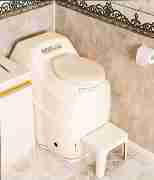
This article provides information about using tall height toilets or chemical toilets or composting toilets for elderly or disabled people for convenience (close access) or to avoid the effects of medication on septic tank bacteria. Our page top photo shows a fully automatic composting toilet.
Below we describe chemical and composting toilets for disabled, sick, or elderly people's use. Using a chemical toilet or a composting toilet to avoid the effects of medication on septic tank bacteria. Building a secure chemical toilet base to elevate the toilet above the floor. Composting toilets for elderly or disabled use. Camping toilets for elderly or disabled use.
Waterless toilets, low-water toilets, and other alternative toilet designs may solve practical problems in providing convenient, sanitary facilities for temporary or even longer term care of elderly, disabled, sick, or injured people. Special care needs to be taken to provide proper toilet height, grab rails, and maintenance.
InspectAPedia tolerates no conflicts of interest. We have no relationship with advertisers, products, or services discussed at this website.
How to Select & Use a Chemical or Waterless Toilet for the Elderly, Disabled, or Home Care
Question about using a chemical toilet because medications are killing septic tank bacteria:
My uncle is on some medication that has killed all the bacteria in our septic system. We were told the only way to get the bacteria back was to stop having my uncle use the septic system and we needed to get him a chemical toilet.
What do you suggest we get. We have to be able to use it in the house because he is disabled. We have to solved the problem of the stinky septic ASAP. - K.H.
Answer:
Toilets for the disabled or elderly that are connected to building plumbing and municipal sewer or private septic systems are different from other models principally in their height above the floor.
But if you need to use a separate toilet that is not connected to plumbing, either for physical convenience or to avoid placing excreted medications into a septic system, alternatives are available.
The most simple solution to your problem would be using a portable camping toilet as we describe below
Alternatively, the chemical and waterless toilets we describe here may be suitable, depending on how far you'll have to travel to empty the toilet into a municipal sewer or an RV dumping station.
Chemical Toilets for disabled or home care use
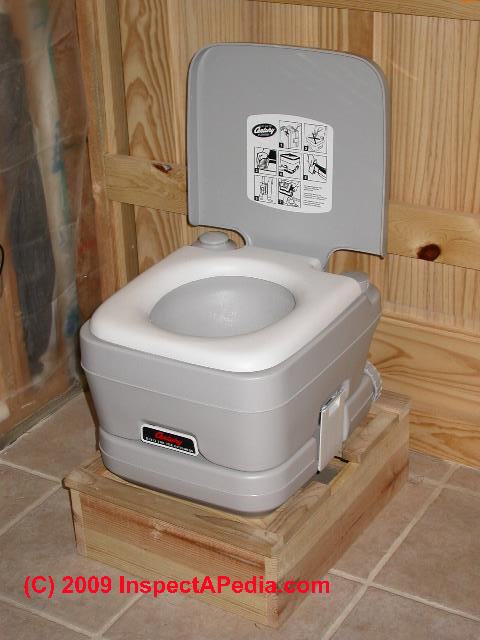 Use a chemical toilet: A very simple, inexpensive chemical toilet is something you can purchase immediately, for example at camping or RV suppliers, or online even at Amazon.com where we purchased the very inexpensive Century (cited atReferences or Citations ) portable chemical toilet shown at left.
Possible use of a composting toilet: Alternatively, you may find that some composting toilet manufacturers produce a completely self-contained unit that is also suitable. Some composting toilets are already taller than the simple chemical toilet we show here, avoiding the need to elevate the toilet for comfortable use.
Elevating the chemical toilet above the floor:
The photograph at above left is of the Century 6205 2.6-Gallon Portable Toilet by Century Tool, a portable toilet which uses chemicals to deodorize and disinfect toilet waste.
We built the wooden platform shown underneath this toilet in order to raise the seat height to a more comfortable position, but in normal use this toilet works just fine placed directly on a floor or on the ground outdoors.
Version I of our wooden chemical toilet height platform is shown at the top of this page.
Version II of our chemical toilet height increase platform that added railings and a wider platform for greater stability is shown just below - we call this version, constructed in 2014 the Throne.
The ADA Accessibility Guidelines (ADA 4.16) & ADA Fig. 29b [Image] specify that the height of water closets (toilets) shall be 17 inches to 19 inches, measured to the top of the toilet seat.
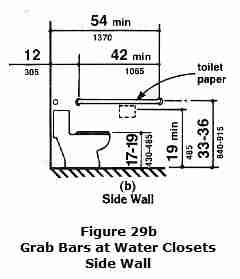
You will probably need to build a stable, secure wooden base to elevate the toilet so that the top of the seat is 18" or 19" above the floor - otherwise an elderly or disabled person may have5trouble getting up and down from the toilet.
In our photograph (left) and at CHEMICAL TOILETS you can see an example of a wooden base that we built for this purpose.
And you'll want nearby grab rails consistent with ADA 4.26 & ADA Fig. 29b [Image]. These aids are missing in our photograph (above-left).
Our wooden base included 1" x 1" rails around its perimeter and spaced to assure that the toilet would not slide around or move off of the base.
For an elderly or disabled person you may also need to secure the base to the floor. Don't secure or glue the toilet itself to the wooden base as you'll need to be able to lift it away for emptying or cleaning.
Accessible Chemical Toilet Improvements: height increase + side railings
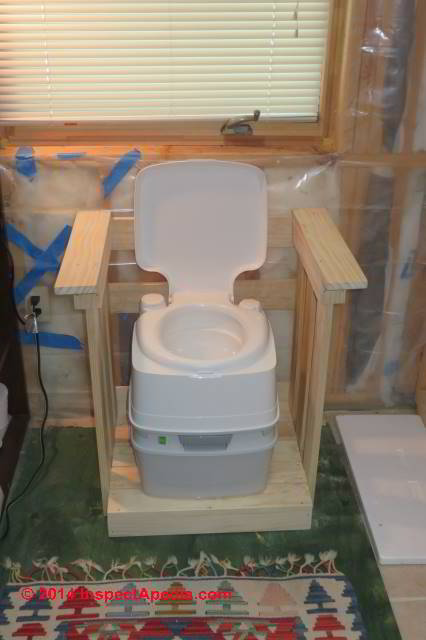 The Throne uses a Thetford® Porta Potty replacing the slightly smaller original Coleman® unit and converting the accordian flush valve to a pump style flush valve.
Designed by Jennifer Church and constructed by the author, the Throne added a 3-inch bottom platform that raised the seat height of the porta-potty to about 19" from the floor. That's the maximum height recommended by the ADA though some users may prefer 20".
We added very strong side-railings and a back rail both to keep the toilet from tipping off of its platform and to make its use easier for those who like a grab railing to ease sitting and standing.
Because there are rails on two sides of this toilet it's not necessarily wheelchair accessible as for some users we'd need the 60" open side clearance.
For example, for wheelchair access I'd suggest that the toilet would need to be open on one side, provided with more grab rails, and would need to be secured against tipping.
We might also need to extend the length of the side rails.
We made the side-to-side width of the platform about 22" and its height 3".
This arrangement feels quite secure but if we needed to add still more sideways stability we'd affix a horizontal board at floor level and attached to the back of the platform to provide outriggers. To date that hasn't been needed.
If you need to provide seat height and grabrails that meet ADA specifications for accessible designs see
- BATHROOM DESIGN, ACCESSIBLE - best practices guide to accessible bathroom designs.
- "2010 ADA Standards for Accessible Design", U.S. DOJ, online version, original source: http://www.ada.gov/regs2010/2010ADAStandards/2010ADAstandards.htm#Toilet
- "2010 ADA Standards
for Accessible Design", document version, U.S. Department of Justice, at the ADA website (www.ADA.gov) or call the ADA at
800-514-0301 (voice) 800-514-0383 (TTY)
September 15, 2010. Retrieved 4/24/14,
original source: - www.ada.gov/regs2010/2010ADAStandards/2010ADAStandards_prt.pdf - If your access requirements include wheelchair ramps to building entrances, also see RAMPS, ACCESS.
- See CHEMICAL TOILETS for more about using chemical toilets for temporary or even more permanent applications.
Other common portable toilets include models from Thetford®, Sears®, the Coleman®, and Reliance® toilets who provide a hassock model portable chemical toilet.
Composting Toilets for disabled or home care use
See COMPOSTING TOILETS for possible models that may also be suitable for elderly or disabled use.
Watch out: before using a composting toilet to receive waste from people whose medications include lots of antibiotics or other medicines that may kill bacteria, discuss the question with the composting toilet manufacturer.
If the medications kill bacteria in a septic tank, the same drugs will certainly kill bacteria necessary for a composting toilet system to work properly.
At ALTERNATIVE & WATERLESS TOILETS you'll see we list other more sophisticated (and much more costly) types of waterless toilets - most of these will require installation by an expert as they include vent piping and in some cases an external reservoir tank.
These are more permanent installations, but the result is a more "normal" looking toilet that is bolted to the floor.
Camping Toilets: Portable no-flush toilet systems for disabled or home care use
For short term use a camping toilet can be as easy as a chemical toilet to place close to bedside or in an otherwise accessible location for disabled, sick, or elderly person use.
Watch out: a free-standing portable toilet may be tippy or a bit short; you may need to provide grab rails or personal assistance to make using a portable toilet easy and safe for people who are disabled.
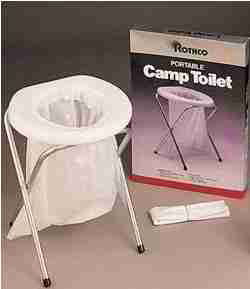
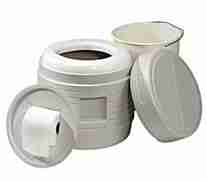
Camping toilets are among the most simple and rudimentary facilities to provide and operate.
Please see our detailed article about camping and emergency use toilets found at CAMPING & EMERGENCY TOILETS. Two types of portable camp toilets are produced:
Toilet seat with legs: a folding frame supports a toilet seat that in turn holds a suspended plastic bag used to collect waste. After use the plastic bag is sealed for disposal. Our photo (far left) shows a typical portable camping toilet. This portable camp toilet, model 560, produced by Rothco (cited atReferences or Citations ) , uses a folding steel frame to support a molded plastic toilet seat and plastic bag.
Plastic bucket type portable toilet: shown in our photo (close left) a pail and drum type portable toilet uses a plastic bucket that collects waste for later disposal. These toilets are also quite inexpensive, often less than $40. U.S.
Two bucket type portable toilet producers are Coleman (non-flush portable toilet) and the Reliance Hassock Portable Toilet.
In an emergency, you can fabricate a bucket type portable toilet using a five-gallon joint compound bucket and heavy plastic bags to collect the waste.
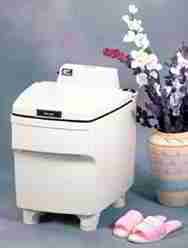
Thetford Corporation lists ten of their portable chemical toilet products as suitable for home or bedside use and for the physically challenged.
For some circumstances, a more sophisticated toilet may be suitable for home health care. Our photo (left) shows the Thetford ElectraMagic Model 80 RV recirculating 100% self-contained toilet that is intended for more permanent installation.
This toilet can be battery operated, and can be connected to an external tank for increased capacity. This toilet was designed for use in RVs and boats and uses very little water. It requires a 12V or 24V D.C. electrical hookup. (It can be powered by a car battery, for example.) Thetford's
Aqua-Kem liquid holding tank deodorant is used with these products. We discuss chemical toilet products and deodorants
Unlike some of the chemical toilets we discuss here, the Thetford Electra Magic seat height is roughly 18" above the floor and may be easier to get on and off-of for the disabled.
Portable toilets include these brands: Thetford Porta Potti, SeaLand’s SaniPottie, Coleman Portable Toilet, Fiamma Bi-Pots, Century Portable Toilet, Dometic Sani Porti, Visa Potty, Companion Eziloo and Primus Deluxe Portable Loo.
Please see our detailed article about camping and emergency use toilets found
at CAMPING & EMERGENCY USE TOILETS
Elderly or Disabled Assistance with Maintenance of Chemical or Composting Toilets
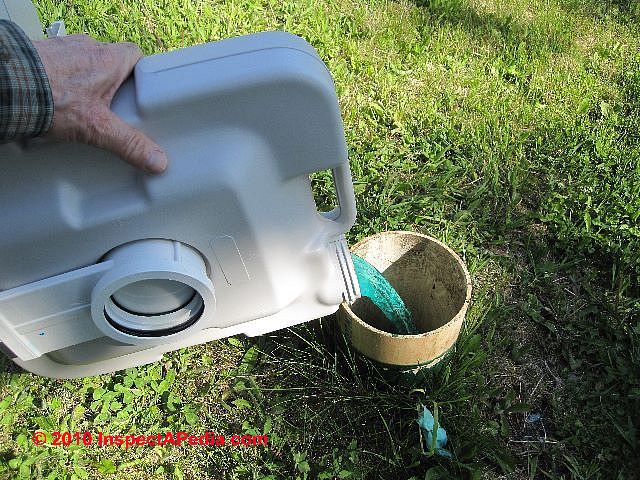 Simple chemical toilets require that the user, or an aide, open the flush valve after use so that waste can spill into the bottom reservoir, then push a plunger to wash the bowl with fresh water, then close the valve.
Where to Empty the Chemical Toilet:
When the bottom reservoir is getting full it is separated from the top half of the toilet by two clips and emptied into a plumbed toilet or septic tank.
But if your purpose was to avoid placing excreted medications into a private septic system or tank, you will need to empty the toilet reservoir into a toilet that is served by a municipal sewer or perhaps an RV dumping station.
RV HOLDING TANK DUMP INTO SEPTIC TANK? discusses this topic.
This is an easy, simple system, but requires assistance from someone besides the user if an elderly or disabled person is involved - at least to empty the tank on occasion. A chemical deodorant placed in the base is inexpensive and keeps things pleasant and sanitary.
See CHEMICAL TOILETS for more about this option.
Also see our detailed article about camping and emergency use toilets found at Camping & Emergency Toilets.
Product submissions are welcome Contact Us. No conflicts of interest: We have no financial business relationship nor any other economic relationship with any product or service discussed at this website.
At TOILET TYPES, CONTROLS, PARTS we discuss various heights of toilets and recommend taller toilets for people who may have difficulty sitting down on or rising up from other toilet models.
See ALTERNATIVE & WATERLESS TOILETS for a discussion of various types of chemical toilets, waterless toilets, graywater systems, composting toilets, home health care toilets, incinerating toilets, outhouses, and latrines.
Question: odor free chemical toilet to convert a cloak room to a downstairs toilet
I am considering the possiblility of looking after my aged brother who has lost his mobility at my home in lieu of commiting him to a care-home, but do not have a down-stairs toilet.
What I do have is a cloak-room which could house a chemical toilet, provided of course it was of a type and design which would be odor-free.
Can you advise or recommend a suitable product from your range?
Thanking you for your services, - Anonymous by private email 2017/09/18
Reply:
InspectAPedia is an independent publisher of building, environmental, and forensic inspection, diagnosis, and repair information provided free to the public - we have no business nor financial connection with any manufacturer or service provider discussed at our website. We do not sell products nor services.
But we have published articles that describe several simple portable toilets that could work for a person with limited mobility -
See DISABLED or ELDERLY-USE TOILETS and in that article take a look at what I built for a relative who has limited mobility - basically a base that raises the toilet seat to the required height and very sturdy armrails to help the user get up and down, in this section of that article: Accessible Chemical Toilet Improvements: height increase + side railings
Let me know what further questions you have. - Editor
...
Continue reading at CHEMICAL TOILETS or select a topic from the closely-related articles below, or see the complete ARTICLE INDEX.
Or see these
Recommended Articles
- ACCESSIBLE DESIGN
- ADA STAIR & RAIL SPECIFICATIONS
- BATHROOM DESIGN, ACCESSIBLE
- CUSTOM TOILETS
- DISABLED or ELDERLY-USE TOILETS
- ELDERLY & VETERANS HOME SAFETY
- KITCHEN DESIGN, ACCESSIBLE
- RAMPS, ACCESS - home
- RAMP CODES & STANDARDS
- RAMP LANDING CODES
- RAMP RAILING CODES
- RAMP SLOPE or PITCH
- RAMP SLIP TRIP FALL HAZARDS
- RAMP SLIP TRIP FALL REDUCTION
- STAIR DESIGN for SENIORS
- STAIRWAY CHAIR LIFTS
Suggested citation for this web page
DISABLED or ELDERLY-USE TOILETS at InspectApedia.com - online encyclopedia of building & environmental inspection, testing, diagnosis, repair, & problem prevention advice.
Or see this
INDEX to RELATED ARTICLES: ARTICLE INDEX to TOILET INFORMATION
Or use the SEARCH BOX found below to Ask a Question or Search InspectApedia
Ask a Question or Search InspectApedia
Try the search box just below, or if you prefer, post a question or comment in the Comments box below and we will respond promptly.
Search the InspectApedia website
Note: appearance of your Comment below may be delayed: if your comment contains an image, photograph, web link, or text that looks to the software as if it might be a web link, your posting will appear after it has been approved by a moderator. Apologies for the delay.
Only one image can be added per comment but you can post as many comments, and therefore images, as you like.
You will not receive a notification when a response to your question has been posted.
Please bookmark this page to make it easy for you to check back for our response.
Our Comment Box is provided by Countable Web Productions countable.ca
Citations & References
In addition to any citations in the article above, a full list is available on request.
- Americans with Disabilities Act, ADA, web search 07/08/210 - original source http://www.access-board.gov/adaag/html/adaag.htm#4.16
- The Century 6205 2.6-Gallon Portable Toilet by Century Tool shown in the photograph at page top was purchased at Amazon.com and costs less than $100. Other Century Tool camping products can be seen at centurycamping.com/
- Coleman Corporation, 3600 North Hydrauli, Wichita, KS 67219, Tel: 1-800-835-3278, is a producer of camping equipment and gear, including chemical and portable toilets including both non-flush portable toilets and a large portable flush-toilet. Coleman has offices in many countries.
- Reliance Products, 1093 Sherwin Road, Winnipeg, MB, Canada R3H 1A4, Toll Free: 1-800-665-0258, Telephone: (204) 633-4403, produces the Reliance Hassock Portable Toilet #00984421. Quoting from the company's website:
Whether you’re on the road, in a campground, out on the water, or at the cabin, the Hassock is one of best portable toilets around. This lightweight, self-contained toilet has a comfortable contoured seat, a removable inner bucket for easy waste disposal and clean-up, an inner splash cover, and toilet paper holder.
In addition, the Hassock is compatible with our standard Double Doodie bag, which means virtually no clean-up and waste disposal is a snap when used together. - Rothco Corporation, 3015 Veterans Memorial Highway, Ronkonkoma, New York 11779-0512, Telephone: 631-585-9446, Toll Free: 800-645-5195
Domestic Fax: 631-585-9447, International Fax: 631-585-9442,
Email: info@rothco.comTel. 800-645-5195; Rothco, founded in 1953, is a wholesale supplier of military and outdoor products including camping toilets. Quoting:
ROTHCO is America’s foremost wholesale supplier of military and outdoor products. We carry an extensive line of apparel and gear available for domestic and overseas sale to resellers of all types: retail, wholesale, military, police, security, outdoor products, screen printers, uniform dealers, fashion retailers, and sportswear shops. For nearly 50 years we’ve primarily serviced independently-owned Army/Navy surplus stores across America, but in recent years ROTHCO has expanded our customer and product range to include new lines of sportswear and over 25% of our sales are now to overseas customers. - Thetford Corporation 7101 Jackson Road, Ann Arbor, MI 48103, Phone: 1-800-543-1219, 734-769-6000, Fax: 734-769-2023; Thetford produces a wide range of permanent and portable alternative toilet designs. Quoting:
Our [toilet] products are easy to use at bedside and indispensable for the physically challenged, the aged, and small children.
Thetford's list of toilet products suitable for home or bedside health care are listed at
http://www.thetford.com/Thetford/HOME/ApplicationHome/BedsideApplications/tabid/94/Default.aspx - Thanks to reader K.H. for discussing the question of antibiotics emptied into a septic tank and chemical toilet alternatives for the elderly - July 2010
- In addition to citations & references found in this article, see the research citations given at the end of the related articles found at our suggested
CONTINUE READING or RECOMMENDED ARTICLES.
- Carson, Dunlop & Associates Ltd., 120 Carlton Street Suite 407, Toronto ON M5A 4K2. Tel: (416) 964-9415 1-800-268-7070 Email: info@carsondunlop.com. Alan Carson is a past president of ASHI, the American Society of Home Inspectors.
Thanks to Alan Carson and Bob Dunlop, for permission for InspectAPedia to use text excerpts from The HOME REFERENCE BOOK - the Encyclopedia of Homes and to use illustrations from The ILLUSTRATED HOME .
Carson Dunlop Associates provides extensive home inspection education and report writing material. In gratitude we provide links to tsome Carson Dunlop Associates products and services.
 | HOME | ABOUT | ASK a QUESTION | CONTACT | CONTENT USE POLICY | DESCRIPTION | POLICIES | PRIVACY | |
| © 2024 - 1985 Publisher InspectApedia.com - Daniel Friedman | |||||||||