
InspectAPedia® FREE Encyclopedia of Building & Environmental Construction, Diagnosis, Maintenance & Repair |
Question? Just ask us! InspectAPedia
|
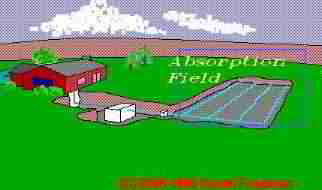 Septic Drainfield Location - Video 2
Walk a site to find possible leachfield locations
- POST a QUESTION or COMMENT about septic drainfield location methods & approaches
How to find the septic system drainfield, soakaway bed, leach field, absorption bed. This article series and video explains how to find the septic drainfield or leach field or soakaway bed.
InspectAPedia tolerates no conflicts of interest. We have no relationship with advertisers, products, or services discussed at this website.
Find the Septic System Drainfield
Septic System Component Location Video #2 - Possible Locations for a Drainfield at a site
This septic system video#2 describes walking a homesite by a lake in order to reason that the drainfield must be not only uphill from the lake but in this case uphill from the septic tank too.
Click the image above, or use this YouTube URL https://youtu.be/Q2bb-zO6fDc to see the video above in a larger window.
A septic pumping system will be needed. More videos on septic system location & maintenance are
at SEPTIC VIDEOS.
Citation of this article by reference to this website and brief quotation for the sole purpose of review are permitted. Use of this information at other websites, in books or pamphlets for sale is reserved to the author. Technical reviewers and content suggestions are welcome and are credited at "References."
This is a chapter
of SEPTIC SYSTEM INSPECTION & MAINTENANCE COURSE an online book on septic systems.
Reader Comments, Questions & Answers About The Article Above
Below you will find questions and answers previously posted on this page at its page bottom reader comment box.
Reader Q&A - also see RECOMMENDED ARTICLES & FAQs
On 2020-04-02 - by (mod) -
Campbell
At CLEARANCE DISTANCES, SEPTIC SYSTEM inspectapedia.com/septic/Septic_Clearance_Distances.php
and also at
WELL CLEARANCE DISTANCES https://inspectapedia.com/water/Well_Clearance_Distances.php
for required distances between wells and septic systems and other site features
we give clearance distances that you need.
On 2020-04-02 by Campbell
How far away from my well does the septic system need to be?
On 2019-09-01 by (mod) - allowable distance, septic drainfield to new garage
 Stephen
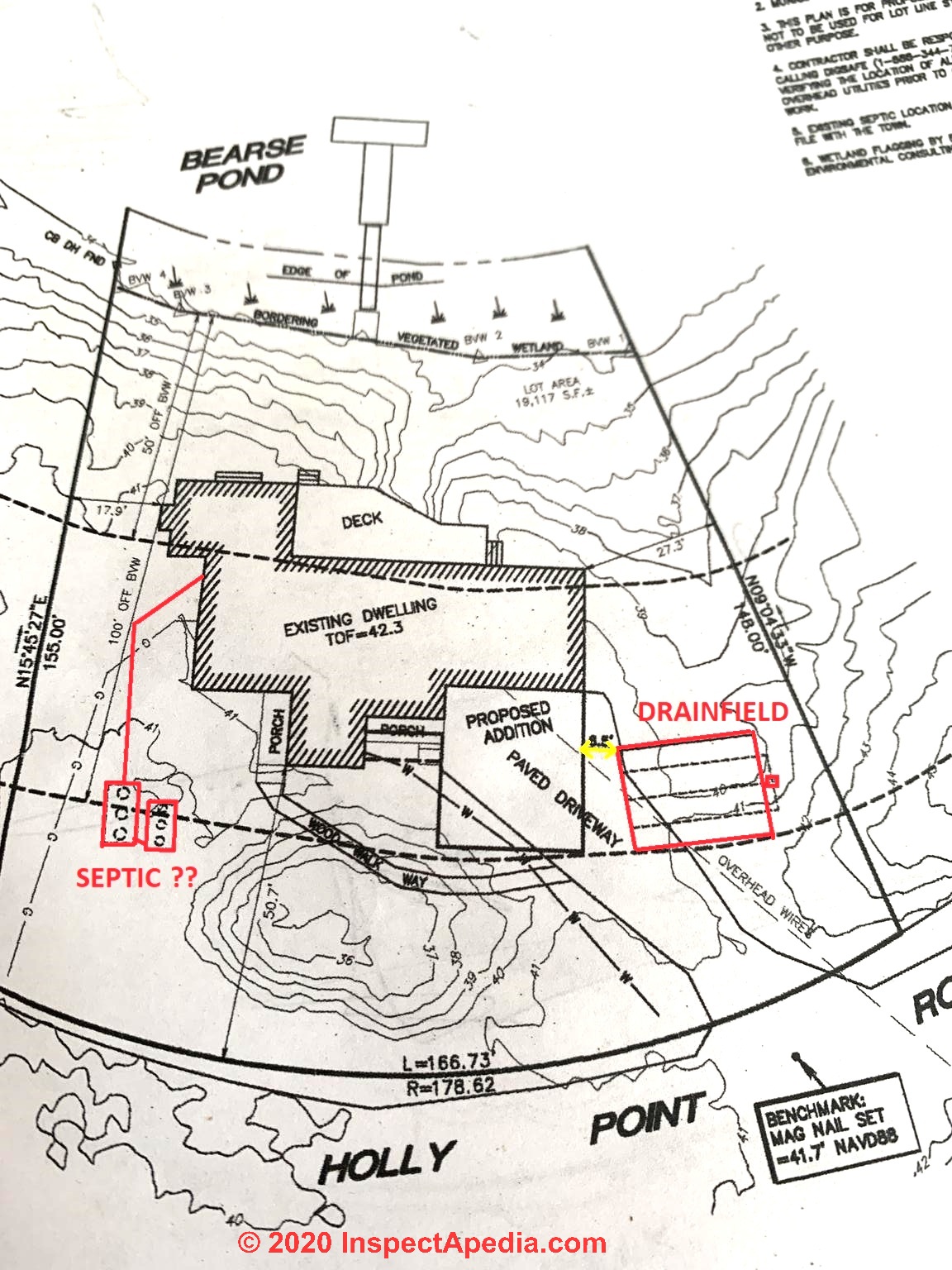
at CLEARANCE DISTANCES, SEPTIC SYSTEM we show that the distance from drainfield to structure varies by state code from 20' to 5'.
In Massachusetts I'd expect that the local building department or plumbing inspector may be willing to grant an exception for the case you describe;
in my OPINION your argument is bolstered by the illustration that it's a corner of the field that's less than 10 feet away and that that distance increases for the rest of the structure. Would it help to show the distance from the other drainfield corner to the garage? Is that going to be 10 ft or more?
Also important: in constructing the garage be sure to prevent heavy equipment from driving over the drainfield lest it be damaged by soil compression or pipes actually crushed by vehicle weight.
Let me know what the local inspector says.
On 2019-09-01 by Stephen Duff
My customer wants to build a garage but it’s only
6 1/2 ft from leachfield (new leachfield). Since there is no basement, can the 10’ rule be negotiable? In Massachusetts
[Click to enlarge any image]
On 2012-10-17 - by (mod) -
K Bader,
Watch out: You could be making a costly mistake. First check with your local building and zoning department to assure that you can put a house on this lot.
I would not buy property before those basic questions are answered.
On 2012-10-17 by KBader
I am looking at buying the property of which we currently live. It's a .3 acre lot with a single wide mobile home on the lot. Our intention is to tear down the trailer, and put up a modular home on a basement foundation. Before we offer on the property we're trying to locate the septic elements.
It's dark now, but I have a feeling the tank and leach field are in the front yard. What are the requirements for digging a basement next to a leach field? We're trying to find all our options... and finding it difficult... Any help is appreciated!
On 2011-12-16 by JW
In Pennsylvania, contact your local sewer officer. Each County has one. Realize though, that the failure of your neighbor to correct the problem, if they can't afford it, could result in them being told to leave their home until a new system can be installed. I agree that it sounds like a system failure, but often, it could be rectified by pumping the septic tank out, since it may be overflowing into the leach field with solids and causing failure.
But the sewer gas you are smelling is dangerous, deadly in a confined space and potentially explosive, aside from the obvious odor issues (not really the sewr gas you are smelling but associated hydrogen sulfide, in all likelihood.
On 2011-08-26 by Anonymous
Im the last one to ever start a dispute but they know its bad. She has even made comments before about the odor and telling her husband to throw lime on it. Thats just plain rude and neglect. I thank you for your suggestions and comments. I think I know what I have to do and the ball needs to start rolling. Thanks again
On 2011-08-26 - by (mod) -
Anon I am always reluctant to fan the flames of a dispute among neighbors.
But if you are faced with a genuine health and sanitation issue and a property owner flat refuses to address it, local health laws doubtless apply and you may have no choice but to take the matter to your health officials and ask for assistance.
I've seen such cases before; typically a health department official visits the property, confirms the presence of a health issue and orders the property owner to repair the trouble following approved methods. If the owner refuses the property can be condemned or fines levied, as public health could be at risk.
On 2011-08-26 by Anonymous
They know it's bad already or they wouldn't be throwing sand and lime on it. He's on disability, cheating the system, and he's a tight wad but they can buy a 'vette, new car, and new zero turn mower. which was aquired by insurance. I believe homeowners.
On 2011-08-25 - by (mod) -
Anon if you are going to pursue the matter you would first
- speak to the neighbor, let him know there is an unsavory and unsanitary problem thea affects you, and give him/her a chance to respond.
- if you need to obtain outside help you'd need to call your local health department or building department.
Anon your neighbor will need to call a septic repair contractor; some large plumbing companies offer that service, or in other areas you'll find septic repair listed under excavators. Be sure the person called actually has expertise in septic systems.
On 2011-08-25 by Anonymous
Thanks for the reply. In Pa., what do I do about it and who do I call?
On 2011-08-24 - by (mod) -
Anon:
You are describing a septic system failure. If there is effluent or sewage coming to the ground surface there is a problem with the waste system piping or drainfield that needs diagnosis and repair. In just about all North American, European, Austrailian, etc. communities, local health regulations specifically prohibit discharge of wastewater on the ground surface.
Unfortunately just sprinking some sand around the pipe has only the appeal of a low-cost cover-up. It's not an effective repair for a failed septic system.
On 2011-08-24 by Anonymous
My neighbor has a plastic pipe sticking out of the ground in his yard. The odor at night is terrible and seems to fresh , what looks to be sewage, around this pipe. He keeps covering it with sand and lime. Is this legal? I have smelled this for ten years and I'm tired of it. What can be done?
...
Continue reading at DRAINFIELD PIPE LOCATION, PRECISE or select a topic from the closely-related articles below, or see the complete ARTICLE INDEX.
Or see SEPTIC DRAINFIELD LOCATION FAQs - questions & answers posted originally at the end of this page
Or see these
Septic Drainfield Location Articles
- CLEARANCE DISTANCES, SEPTIC SYSTEM
- SEPTIC TANK, HOW TO FIND for details about finding the septic tank or chamber or drywell or seepage pit.
- SEPTIC COMPONENT LOCATIONS
- SEPTIC DRAINFIELD INSPECTION & TEST - home
- SEPTIC DRAINFIELD LOCATION
- DRAINFIELD PIPE LOCATION, PRECISE
- EXCAVATE to LOCATE DRAINFIELD
- REASONS to FIND THE DRAINFIELD
- RECORDS to LOCATE the DRAINFIELD
- SURPRISING DRAINFIELD LOCATIONS
- UNLIKELY DRAINFIELD LOCATIONS
- VISUAL CLUES LOCATE the DRAINFIELD
- VISUAL CLUES LOCATE the SEPTIC TANK
- SEPTIC DRAINFIELD SIZE
- SEPTIC DRAINFIELD SHAPE
- SEPTIC VIDEOS - home, showing how to find the septic system, septic tank, & septic drainfield
Suggested citation for this web page
SEPTIC DRAINFIELD LOCATION at InspectApedia.com - online encyclopedia of building & environmental inspection, testing, diagnosis, repair, & problem prevention advice.
Or see this
INDEX to RELATED ARTICLES: ARTICLE INDEX to SEPTIC SYSTEMS
Or use the SEARCH BOX found below to Ask a Question or Search InspectApedia
Ask a Question or Search InspectApedia
Try the search box just below, or if you prefer, post a question or comment in the Comments box below and we will respond promptly.
Search the InspectApedia website
Note: appearance of your Comment below may be delayed: if your comment contains an image, photograph, web link, or text that looks to the software as if it might be a web link, your posting will appear after it has been approved by a moderator. Apologies for the delay.
Only one image can be added per comment but you can post as many comments, and therefore images, as you like.
You will not receive a notification when a response to your question has been posted.
Please bookmark this page to make it easy for you to check back for our response.
Our Comment Box is provided by Countable Web Productions countable.ca
Citations & References
In addition to any citations in the article above, a full list is available on request.
- New York State Department of Health, APPENDIX 75-A WASTEWATER TREATMENT STANDARDS - INDIVIDUAL HOUSEHOLD SYSTEMS , [PDF] New York State Department of Health, 3 February 2010, retrieved 3/1/2010, original source: https://www.health.ny.gov/regulations/nycrr/title_10/part_75/appendix_75-a.htm
- Aero Stream ® , LLC W300 N7706 Christine Lane Hartland, WI 53029 Phone: (262) 538-4000 or (877)-254-7093 Fax: (262) 538-4093
- Kazunori, Hanyu, Hirohisa Kishino, Hidetoshi Yamashita and Chikio Hayashi. "Linkage between recycling and consumption: a case of toilet paper in Japan." Resources, Conservation and Recycling, Volume 30, Issue 3 (1 September, 2000): 177-199.
- Recycled Content in toilet paper (US EPA definition): When reporting recycled content, some toilet paper (and other product) manufacturers report total recycled content (combining pre- and post-consumer waste re-use) while others report post-consumer only. Both pre-consumer and post-consumer recycled materials provide the environmental benefits of displacing virgin feedstocks such as toilet paper using a high percentage of paper made from trees. Using post-consumer content has the added benefit of providing markets for materials separated for recycling by consumers, such as newspapers and magazines.
- Recovered materials: Waste materials and byproducts that have been recovered or diverted from solid waste, but does not include materials and byproducts generated from, and commonly reused within, an original manufacturing process.
- Thanks to reader Ernie Zinter for requesting clarification on the value of adding yeast to a septic tank. 02/17/2010. Don't do it - yeast in the septic is a suburban legend or an old wives tale that is not helpful and may be harmful to the septic system.
- Original citation for EPA article: http://www.epa.gov/nrmrl/pubs/625r00008/html/fs1.htm
- Andress, S.; Jordan, C. 1998. Onsite Sewage Systems. Virginia Polytechnic Institute and State University, Civil Engineering Department, Blacksburg, VA.
- Angoli, T. 2000. Hydrogen peroxide not recommended to unclog failed drainfields. Small Flows Quarterly Vol. 1 No. 2, p. 42-44.
- Clark, G.H. 1999. The Effect of Bacterial Additives on Septic Tank Performance. Master's thesis, North Carolina State University, Department of Soil Science, Raleigh, NC.
- Dow, D., and G. Loomis. 1999. Septic Tank Additives. University of Rhode Island Cooperative Extension Service Onsite Wastewater Training Center, Kingston, RI.
- Hairston, J.E., G. Speakman, and L. Stribling. 1995. Protecting Water Quality: Understanding Your Septic System and Water Quality. Alabama Cooperative Extension Publication wq-125.al, June 1995. Developed with support from Auburn University, Auburn, AL.
- Olson, K., D. Gustafson; B. Liukkonen; and V. Cook. 1977. SEPTIC SYSTEM OWNERS GUIDE [PDF]. University of Minnesota Extension Services Publication PC-6583-GO. University of Minnesota, College of Agricultural, Food, and Environmental Sciences, St.Paul, MN.
- Rupp, G. 1996. Questions and Answers About Septic System Additives. Montana State University Extension Service, Bozeman, MT.
- Virginia Polytechnic Institute and State University (Virginia Tech). 1996. Septic System Maintenance. VTU publication no. 440-400, October 1996. Water Quality Program Committee, Virginia Polytechnic Institute and State University, Blacksburg, VA.
- Pennsylvania State Fact Sheets relating to domestic wastewater treatment systems include
- Our recommended books about building & mechanical systems design, inspection, problem diagnosis, and repair, and about indoor environment and IAQ testing, diagnosis, and cleanup are at the InspectAPedia Bookstore. Also see our Book Reviews - InspectAPedia.
- Advanced Onsite Wastewater Systems Technologies, Anish R. Jantrania, Mark A. Gross. Anish Jantrania, Ph.D., P.E., M.B.A., is a Consulting Engineer, in Mechanicsville VA, 804-550-0389 (2006). Outstanding technical reference especially on alternative septic system design alternatives. Written for designers and engineers, this book is not at all easy going for homeowners but is a text I recommend for professionals--DF.
Design Manuals for Septic Systems
- US EPA ONSITE WASTEWATER TREATMENT SYSTEMS MANUAL [online copy, free] Top Reference: US EPA's Design Manual for Onsite Wastewater Treatment and Disposal, 1980, available from the US EPA, the US GPO Superintendent of Documents (Pueblo CO), and from the National Small Flows Clearinghouse. Original source http://www.epa.gov/ORD/NRMRL/Pubs/625R00008/625R00008.htm Onsite wastewater treatment and disposal systems, Richard J Otis, published by the US EPA. Although it's more than 20 years old, this book remains a useful reference for septic system designers. U.S. Environmental Protection Agency, Office of Water Program Operations; Office of Research and Development, Municipal Environmental Research Laboratory; (1980)
- Eco John® Innovative Toilet Solutions, Global Inventive Industries, Fountain Valley CA, PDF, product brochure
- "International Private Sewage Disposal Code," 1995, BOCA-708-799-2300, ICBO-310-699-0541, SBCCI 205-591-1853, available from those code associations.
- "Manual of Policy, Procedures, and Guidelines for Onsite Sewage Systems," Ontario Reg. 374/81, Part VII of the Environmental Protection Act (Canada), ISBN 0-7743-7303-2, Ministry of the Environment,135 St. Clair Ave. West, Toronto Ontario M4V 1P5 Canada $24. CDN.
- Manual of Septic Tank Practice, US Public Health Service's 1959.
- In addition to citations & references found in this article, see the research citations given at the end of the related articles found at our suggested
CONTINUE READING or RECOMMENDED ARTICLES.
- Carson, Dunlop & Associates Ltd., 120 Carlton Street Suite 407, Toronto ON M5A 4K2. Tel: (416) 964-9415 1-800-268-7070 Email: info@carsondunlop.com. Alan Carson is a past president of ASHI, the American Society of Home Inspectors.
Thanks to Alan Carson and Bob Dunlop, for permission for InspectAPedia to use text excerpts from The HOME REFERENCE BOOK - the Encyclopedia of Homes and to use illustrations from The ILLUSTRATED HOME .
Carson Dunlop Associates provides extensive home inspection education and report writing material. In gratitude we provide links to tsome Carson Dunlop Associates products and services.
 | HOME | ABOUT | ASK a QUESTION | CONTACT | CONTENT USE POLICY | DESCRIPTION | POLICIES | PRIVACY | |
| © 2024 - 1985 Publisher InspectApedia.com - Daniel Friedman | |||||||||