
InspectAPedia® FREE Encyclopedia of Building & Environmental Construction, Diagnosis, Maintenance & Repair |
Question? Just ask us! InspectAPedia
|
 Guide to Septic Drainfield Rejuvenation - "Un-Clogging," or "Repair"
Products & Procedures
Guide to Septic Drainfield Rejuvenation - "Un-Clogging," or "Repair"
Products & Procedures
- POST a QUESTION or COMMENT & reader comment about septic tank aeration add-on products & about drainfield rejuvenation treatments
Guide to septic system drainfield restoration methods:
This article discusses the use of various septic drainfield restoration methods and explores their effectiveness. Are there some septic drainfield restoration systems that work without replacing the drainfield? Perhaps. Why don't we see expert, independent peer-reviewed research confirming their efficacy?
This article series discusses the use of various septic drainfield restoration methods including the use of drainfield restorer treatments, add-on aerobic systems, soil aeration, porox methods, jetting, chemical treatments and also septic tank or drainfield aeration or septic aerobic system add-on systems and special septic bacteria for failed septic system rejuvenation.
InspectAPedia tolerates no conflicts of interest. We have no relationship with advertisers, products, or services discussed at this website.
Failed or Clogged Septic Field Rejuvenation or Restoration Products & Methods: Alternative Onsite Waste Disposal (Septic System) Materials & Products
Should you add septic treatment chemicals, nutrients, cleaners, bacteria, yeast, root killers, septic drainfield decloggers to septic systems? Generally, no. Why not? What causes septic system failures? What do experts say about septic chemicals and septic treatments? Why do people use them?
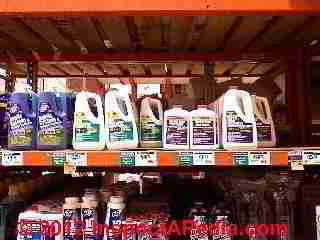
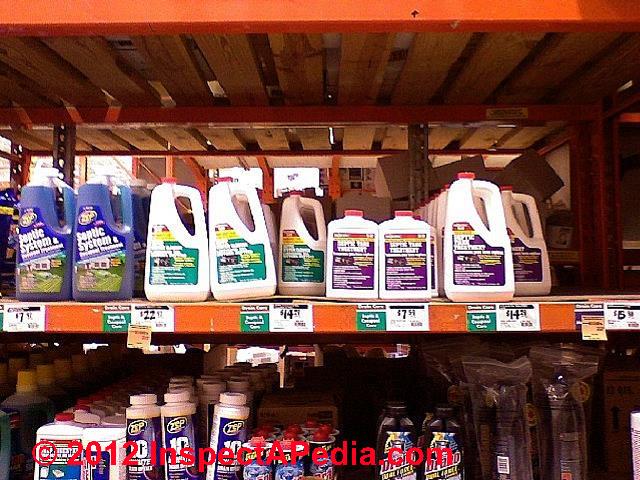
These questions are addressed here. Our page top photograph shows a collection of septic system additives, chemicals, cleaners, root killers, etc. for sale at a building supply store. We do not have specific information about these individual products and we make no specific representation about the efficacy of any individual product shown.
OPINION: the following comments describe the results of a search for information about two approaches to "failed septic system rejuvenation" and comment on the level of independent technical study and research supporting the types of product under examination.
Types of Septic Rejuvenator or Septic Drainfield Restoration Systems
3 March 2015, Anonymous said:
Have you tested or heard of the XXX (name deleted) . It is inserted into the clean side of a septic tank and air is pumped into it to aerate the water? Does it work? Thanks for your help. -- Dave Massetti
Answer: Let's look at two septic system rejuvenator approaches - one that you asked about inserts an aerator into the septic tank, and a second approach that is a bit more sophisticated
Add-on Aerobics for Conventional Septic Tanks - an Interesting Septic Rejuvenation System Approach with Some Questions Remaining
We took a preliminary look at the XYZ Drainfield Savior system about which you inquired, but emphasize that we are expert on it nor its efficacy - what follows are some simple research and tentative conclusions based on study, reader comments about septic system repair attempts, and septic failure inspection & testing experience:
This XYZ Drainfield Savior system is comprised of a small do-it-yourself conversion kit to "convert" a conventional septic tank to a sort of aerobic septic system - though the design of a conventional non-areobic-septic-system tank and drainfield almost certainly were not originally made with an aerobic system in mind. Although you referred to the "clean side" of the septic tank, many conventional septic systems use a single chamber tank where this device would have to work if no other (costly) modifications to the system were made.
At AEROBIC SEPTIC SYSTEMS, ATUs you'll see that an aerobic septic system has tank and a number of other design features designed specifically for that approach.
It is certainly true that aerobic type septic systems are able to treat waste to a higher level.. But a confirmation that treating current and future effluent to a higher level rejuvenates a failed drainfield despite any other conditions in the system would seem to deserve independent expert research and documentation beyond testimonials and the enthusiasm of the inventor.
The claims at the website are certainly enthusiastic: System XXX returns drain fields to proper functioning and keeps them from failing in the future [we have paraphrased to respect the identity of specific septic restorer products and systems].
- System XYZ Drainfield Savior system Will Restore Your Existing Septic System - no matter what.
- Whatever type of septic tank you have, in whatever condition.
- Whatever type of septic leachfield or drain field you have, in whatever condition
- Whatever septic system age is installed: even 60 years old.
- Whatever condition the septic system is in
- Our system will restore your septic system to good working order for a fraction of the cost of a new drainfield.
Comments and Questions about XYZ Drainfield Savior system
1. There are surely plenty of septic system failure cases that cannot and should not be "restored" by adding anything to the system whatsoever - such as collapsing septic tanks, broken baffles, crushed D-boxes, improperly located and designed fields, collapsed drainfield trenches or piping. All of these conditions need diagnosis and physical repairs.
For that matter, without diagnosis we don't know that the septic "failure" isn't due to a broken pipe rather than a failed drainfield. So rushing to Septic Genie might be in some cases a mistake.
See the septic system inspection and diagnosis advice
at SEPTIC SYSTEM INSPECTION & TEST GUIDE
and at SEPTIC SYSTEM INSPECTION LEVELS
2. The XYZ Drainfield Savior system and marketing includes a special septic bacteria along with a plastic aerator, tubing, and an air pump to be mounted in the septic tank.
A septic tank aerator will almost certainly improve the level of treatment in the septic tank, reducing the workload on the drainfield, though retrofit aerators in non-aerobic-designed septic systems need some research and testing
The air volume, flow rate, distribution, and septic tank shape, as well as maintenance are all designed with care for a true aerobic septic system.
Bacterial additives are something that experts in the field have told us time and again are inappropriate and unnecessary. We didn't find any independent assessment of this bacterial additive.
3. How does XYZ work? By sending less-loaded higher-treated effluent and special bacteria into the drainfield the clogged biomat around the drainfield trench sides and bottom is repaired.
This may be partly accurate. For example, if we totally stop using a drainfield trench for some period of time to allow it to rest (alternating drainfields) the biomat may recover some function. I'm not sure what happens when effluent load continues on a trench with higher-treated effluent. The inventors state that bacteria produced in the septic tank (their special strain) migrate to and improve the field biomat.
The inventors explain that "we have used the wrong bacteria for more than a century - although really the same bacteria, naturally occurring in wastewater and developing in septic tanks has served in septic and waste disposal facilities for longer than that.
4.Watch out: other than testimonials, and a patent for an earlier device, we could not find actual technical data, nor any independent research on effectiveness of this design, even though it is appealing.
Here is what one inventor explained about an XYZ product:
We decided to stop selling our original invention directly to homeowners because there were installation, maintenance, and performance issues with that design. So we shrunk the size and production cost of the original design but we didn't reduce its effectiveness.
Then we re-packaged and began marketing our simplified design only to do-it-yourself owners. No septic contractors, engineers, or design consultants are involved.
None of this describes the theory, nor any independent corroborating testing of XYZ, though the inventors are enthusiastic and are confident in its success.
Certainly increasing the level of treatment in an otherwise un-damaged septic tank is likely to be a good idea in any case; and a system that does not use toxic chemicals is not likely to be harming the environment.
In sum - we often find XYZ drainfield rejuvenation products sold with strong claims from the inventor/vendor, and supported testimonials, but with little or no reliable third-party research.
Drainfield Restorers:
Can an Add-On Aerobic Treatment System or Septic Tank Aerator Rejuvenate a Septic Drainfield?
[Notice: the following comments provided by a reader are provided for study and thought about drainfield rejuvenation using a septic tank add-on aerator system. We have conducted no study nor found other independent studies concerning the questions raised by the writer cited. - ED.]
Question: Can Septic Genie [or other septic tank add-on aeration system] rejuvenate, restore, or fix a failed drainfield?
Do you have a file on dissatisfied customer emails concerning this [Septic Genie] product? Of course, the product website has glowing endorsements for customers in the short run...it creates clear fluid and eliminates odors rapidly; however, after 18 months, my septic tank level rises after one-half inch of measured yard rain.
I had been in contact with Jerry Fife after a soil scientist evaluated my property for septic compatibility ...finding a 1 inch per 10 minute drainage rate (somehow). I provided Jerry with his number so he could speak directly to my source and eliminate any layman's confusion or errors. To my knowledge, he has never contacted the soil scientist. Further, he appears extremely busy and has not taken or returned my calls yesterday and today; excluding his immediate desire to contact the soil scientist over 10 days ago, and promptly report back to me.
After a year, my septic should have been re-mediated or rejuvenated, according to the theory. Modest rainfall causes my septic tank level to rise. After 1.3 inches of rain this Monday (2 days ago), my tank overflows...as indicated by the bubbling fluid. - S.S.
Additional details: evidence of drainfield failure
Our house was placed into service in 1995 as the initial model home. It is unknown if the sales staff used it solely throughout the two-three year subdivision generation or if the staff moved from new house to new house. In any event, the house has been occupied since 1995...25.5 years of septic system use.
We purchased the house in late September 2000 and have resided here for 10.5 years. Reportedly, the residence had been vacant for nine months when we began our residency. Within six months of laundry use, the septic prohibited the toilet function closest to the septic drain entry...the guest bathroom.
We ceased discharging laundry drains into the septic system, never used the garbage disposal, and observed the water softener drain never appeared to have been connected to house piping (was externally discharged). Several years later, we took additional steps.
Approximately two and one half years ago, we had the leach field pipes water jetted and inspected after pumping the tank itself. Eighteen months ago, we had the septic tank pumped, cleaned, and inspected for leaks and built a new laundry room and removed the (previously electrically disconnected) garbage disposal.
Personnel cleaning leach piping found no deficiencies and reported no tree roots inside our piping. Septic personnel reported no cracks or leaks inside our septic tank. The same septic personnel installed my septic genie for three reasons; soil determination capability, familiarity with aerobic systems, and technical knowledge.
The septic genie's instructions indicate homeowner installers may elect to have septic personnel install the plastic tank adapter and riser pieces to ensure a good fit.
My septic personnel had the regional representative verify my leach field soil was acceptable for aerobic system installation, a descendant and offshoot of the piranha corporation, in competition with genie and piranha parent company. I elected the genie because it was the only homeowner installation and at a reduced cost, vice their competition, after getting verification and installation acknowledgments.
My septic personnel completely installed my genie.
Within three days, leach field odors from installation inspection test holes ceased and clear effluent existed in my septic tank.
Within one week, the plastic lid had popped off my tank due to back-pressure; dismissing the ideal where using trained septic personnel ensures a snug fit when adapting to plastic tanks pieces. Septic technicians had forgotten to remove the eighty pound concrete lid and pushed the plastic riser back onto the concrete lip of the tank and then placed the concrete lid atop the plastic closure lid.
Within another week, back-pressure had cocked the lid and bubbling clear effluent was visible and audible.
Septic personnel returned and seated the lid for a third time, without applying new sealant excepting the original installation.
The riser remains cocked and the concrete lid remains in-place, and the air pump continues to produce a bubbling brook effect after one-half inch of residential rainfall, via a plastic rain collecting gauge.
A month ago we hired a soil scientist to perform sampling along our leach field and identify potential future mound installation sites.
The soil under the bottom of the trench inspected was relatively dry. Having been in a drought for three years, excepting medium rains around genie installation time period, twenty inches of dry soil exists under our leach field before finding clay at fifty inches depth. Thus, our leach field bottom was correctly installed at thirty inches below the surface.
The soil examiner reported our soil composition as having between 80 and 85 percent sand; I did not inquire where he obtained this information. He assigned a 1 inch per 10 minute drain rate. He directed me to redirect existing backyard gutter drains and install a gutter on the wall adjacent to the leach field.
He considered the leach field does not get dried out. I countered with the fact we had received virtually no rains for three months and soil near the leach field was completely dry with 50 inches of good soil to soak.
I disagreed with the notion area rain was inhibiting leach field function, after 18 months of genie use and one-half inch of rainfall causing my septic tank level to rise...as evidenced by the audible bubbling inside the septic tank. In essence, my tank level should remain near the bottom of the exit piping inside the septic tank.
In short, if the genie eliminated dysfunctional bio-mat then soil under my leach fields must be wet as the system gets daily use.
I must believe the indications and accept the bio-mat continues to seal the sides and bottom of the leach field, explaining how minimal rainfall causes septic tank level rises.
Assuming no cracks into the tank exist.
Due to financial hardships in my area gutter installation requires going long distance to obtain installers. I have obtained landscaping plastic with a one-inch tubular lip to redirect rain away from the leach field. I am designing a 4-inch underground piping system to redirect gutter drains into a swell we had created alongside one leach line two years ago.
The manufacturer of the genie recommended I install a leach field monitoring well and remove the plastic lid on the septic and record how fluid levels react during rainfall, but also to determine resting tank level. I am replacing the bacteria bag in the genie and adding the five shot treatment (flush one bag every two days) for exponentiation of aerobic bacteria ability ...perhaps pushing through the bio-mat barrier.
Simultaneously, my septic personnel will reseal the plastic adapter, might pump and inspect my tank for cracks, and will install an additional safety pan below my riser lid. I want the new safety pan to have a 22-inch diameter (one-inch thick) Plexiglas viewing window sealed with marine goop sealant.
Six screws are required to remove the plastic cover lid for viewing tank level.
My plumber is the regional Terra-lift (or their competitors brand) franchisee. He recommends I take the money he would charge, drive down the road, and toss it out the car window. As such, many could benefit from my largess. In lieu of a full treatment, Genie personnel want me to see if he would do a partial shock of the system.
Since this plumber has repeatedly made it clear (including last weeks above remarks) anything beyond installing a mound system is a waste of effort and money, I do not believe he will do a partial treatment. In his mind, I may get two weeks of effect and then the system will return to normal.
He believes the type of limestone gravel installed in the 1980's was not the correct type for longevity. Since the house has met the federal timetable (20-25 years) for a system, he and others believe I should bite the bullet. However, if the Genie re-mediates bio-mat as advertised, the soil scientist believes we have good soil under the leach field, then I prefer to give it another six months at least.
Please realize, excluding the bio-mat issue, no one has given me a scientific reason for soil failure. If the plumber is correct, improper gravel was used, then I suspect the system should have failed within five years, not fifteen. I have not done soil compaction testing yet.
Visually, little compaction was reported by the soil examiner. The plumber believes the limestone has formed a congealed impenetrable mass, as there good varieties of limestone and less desirable types. Rules in my State and County have changed over the life of my system, any repair is replacement with a mound system.
For sheer aesthetics, I believe my septic tank and Genie are the perfect pre-stage for the Elgen chamber above-ground system.
My premise - injecting clear fluid into an above ground system enhances the operation of that system. Elgen also builds piranha, genie, and other royalty driven aerobic systems, in addition to mound system manufacture.
The Genie is smaller in composition and diameter than the piranha and piranha offshoots, but the manufacturer considers size to have minimal impact. The same bacteria and air pump is used for both piranha and genie.
Hopefully, my Plexiglas view window will arrive before this weekend so I can seal it into the safety pan and if the rains cease I can begin to reseal plastic riser pieces and replace the bacteria colony in my Genie, and inspect the tank for leaks next week.
The above information may be used as good faith information. - S.S.
Reply: Septic Tank Flooding After Rainfall Indicates One or More System Failures
The rise in liquid level in a septic tank following rainfall is strongly suggestive of surface or subsurface runoff invading the septic tank or drainfield and in either case is an indication of failure in that a flooded drainfield will not adequately treat septic effluent. You'll want to investigate and cure the source of extra water in the system.
A separate question: the ability of an aerobic or any other septic tank action "improver" to rejuvenate a septic drainfield should be supported by independent expert studies. Advertisements and testimonials do not adequately substitute for impartial expert evaluation.
Also see the preceding discussion about drainfield rejuvenation or restoration beginning
at SEPTIC DRAINFIELD RESTORERS?.
Reliability of White Papers & Technical Journal Articles
Tips for Evaluating Any Technical Journal Article
- Who publishes the journal?
- Who accepts and edits articles in the journal?
- Who are the article authors, what are their education, experience, and professional affiliations?
- Is the article peer-reviewed? Does it include references to related expert research?
Are there conflicts of interest between the article authors and the study or product reviewed?
For example do any of the authors have a financial interest in the product. Readers may recall the brouhaha that ensued a decade ago when a study proving that cotton balls treated with an insecticide would be carried by mice into their burrows where the chemical would kill off deer ticks?
The authors, it developed, held a patent on the approach recommended in their journal article.
- Consumer complaints about other septic restoration products [we have not received consumer comments about the system discussed here]: over the past 30 years of field investigation work and more than 10 years of publishing, we have had a recurrent reports from homeowners who tried a septic rejuvenation system or product. The most common complaint has been that while the process appeared to work at first, the solution was not lasting - often relief was less than a year.
- Peer review would be helpful: The publishing journal is an established one, with experts on staff, but the article is not a peer-reviewed work - meaning we don't have the benefit of criticism by other experts in the field. Peer review can make a significant difference in the acceptance of any research, as other neutral party experts in the field will know better how to interpret and question the methodology and conclusions of any study than a lay reader.
For this study, George W. Loomis who commented (apparently privately) to the authors on the manuscript is a respected expert in the field of onsite waste disposal. We don't know what he said. - What does a journal article really say? Does the article actually test the restoration of a failed drainfield or does it handle the less confounded task of comparing conventional septic tank wastewater processing with a retrofit aerobic and effluent filter system?
- We watch out for conflicts of interest in all technical studies. The inventor of the Aero-Stream® Aerobic System is Karl Holt - he is not listed among the article's authors.
The study above does not mention [and the authors may not have considered it pertinent] that the first author, David A. Potts, from Killingworth CT, holds a patent on several wastewater treatment methods see http://www.faqs.org/patents/inv/15893 and these three patents:
- http://www.faqs.org/patents/app/20090071884
- http://www.faqs.org/patents/app/20080203002
- http://www.faqs.org/patents/app/20080202999
The second author, Gorres is at U. Rhode Island - see http://www.wrc.uri.edu/pubs/reports.html - and is also an active professional in the field. Cf: "Acid Phosphatase Activity As An Indicator Of Phosphorus Status In Riparian Forest Soils:, José A. Amador and Josef H. Gorres. http://www.wrc.uri.edu/pubs/reports/1999/Amador_1999.pdf
The patents indicate someone with great interest in the topic of effluent disposal, experience, and some inventions. As with our deer tick example above, it is always important for readers of journal articles that endorse products or systems for sale to remain alert for undisclosed, serious conflicts of interest in the study.
Aero-Stream: Another & Different Septic Rejuvenation System with Promise & Some Questions
This discussion has moved to AERO-STREAM SEPTIC REJUVENATION
Our search for XYZ Septic Drainfield Rejuvenators also turned up the system marketed by Aero-Stream® This is not the same aerobic septic tank system product described by the XYZ system we discussed above, though this approach uses similar principles to improve the level of wastewater treatment in the septic tank and intended to restore effluent flow through the drainfield.
Other Drainfield Repair or Restoration Approaches: Arcan, BioCycle, Hydrogen Peroxide, Hydrojetting, Porox, TerraLift
This topic has moved to OTHER DRAINFIELD RESTORE APPROACHES - separate article: Septic field restoration projects and products: Porox™, BioCycle® , hydrogen peroxide, acids, enzymes, pressurized aeration, TerraLift®, resting the drainfield, as attempts to rejuvenate a drainfield: do they work? are they legal?
Other Septic Rejuvenation Systems are discussed
at SEPTIC TREATMENTS & CHEMICALS
Trenchless Pipe Technology Proposed for Septic Drainfield Soakaway Bed Leachfield Pipe Repair or Replacement
Please see TRENCHLESS SEWER REPLACEMENT
Reader Comments, Questions & Answers About The Article Above
Below you will find questions and answers previously posted on this page at its page bottom reader comment box.
Reader Q&A - also see RECOMMENDED ARTICLES & FAQs
On 2020-11-22 - by (mod) -
AlbertIn my opinon there is no useful nor safe nor legal product that you can pour over a filled-up 15 foot deep cavity that would digest whatever is left in it, and further, it doesn't seem like a good explanation: you removed the drywell and then filled the cavity with fresh materials that are presumably not sewage contaminated. Sure there may be some sewage effluent in the surrounding soil but underground.
There is, however a troubling problem here: water from the filled-in pit, you say, is entering the basement sump system; that's totally unacceptable - and suggests that the abandonment was not performed properly or that someone missed a pipe connection between house and cesspit.
Some further diagnosis and more-careful investigation is in order before we start throwing money at this without useful effect.
On 2020-11-18 by Albert
Our new house is connected to the City sewer. Our sewer pipe was broken underground adjacent to an old abandoned cesspit for 5 years. The ground near and under our home is always saturated. We had cesspit/drywell removed leaving a 10 foot diameter by 15 foot deep cavity. Water and solids were pumped.
A truck load of sand followed by a truckload of 2inch blues stone, followed by a truck of crushed stone, followed by a truck of fresh top soil was placed in the cavity. If filled with water quickly. We still smell and feel something irritating our tongues, noses, eyes, and stomachs at times. Can I add something to the ground to help this go away quickly? This foul water is making its way into our sump pump in the basement.
On 2020-10-01 - by (mod) -
Probably not, Gerald. If you are cleanout access is to a drain line connecting the septic tank to the D box that line should only have liquid in it when water is being run in the building and that the septic tank and thus exiting the septic tank towards the D box and drainfieldOn 2020-10-01 by Gerald
should there be standing water in the cleanout between my septic tank and D box? I just brought this 20yr old home where the former owner had used a garbage disposal in her kitchen. This gave me worries about the state of the septic system.
I just moved in for 3 months and I decided to check the cleanout between my septic tank and the D box and I notice the pipe had about 3" of standing water in it. This seems worrisome to me, but would like some opinion on this; thanks.
On 2018-10-28 - by (mod) -
GloriaThere may be an "as-filed" (obtaining a permit to build) and less often as "as-built" plan for your septic system including location of tank and drainfield on file with your local building or health department. That's a good place to start as it's inexpensive and simple.
IF there is nothing on file at all it is still possible to locate a drainfield exactly with a bit of work - basically by a combination of visual inspection, common sense, and if necessary, sending cables down drainfield lines and detecting those cables from above ground using electronic equipment.
Details are at SEPTIC DRAINFIELD LOCATION
On 2018-10-27 by Gloria Baysinger
I am a 85 year old woman and I have a 1,500 gallon septic tank. We purchased our home in 1971 and have used the septic tank ever since without any problems other than having it pumped out every 2 to 3 years. We have an individual that owns a lot next to our home and he has alleged that my drain field is on his property.
How can I prove where my drain field is? I have read most of your articles above, but I am not completely sure of what to do. We have 4 bedrooms in our home and at one time had 9 individuals living in our home (son and his 2 and a daughter with her 3,my husband and myself) and didn't have any problems. Now it is only my daughter , her son and myself. My husband passed in 2016.
On 2017-01-23 by Peter
We have a 3 yr old septic system. During rainy season the leach field fails and we have to pump the septic tank. Sometimes every three or four weeks. Is there a system we can retrofit that can help with this dilemma, some kind of machine/pump/treatment system that can help us out? And what does it cost?
Thank you.
...
Continue reading at AERO-STREAM SEPTIC REJUVENATION or select a topic from the closely-related articles below, or see the complete ARTICLE INDEX.
Also see these
Drainfield Repair Articles
- AERO-STREAM SEPTIC REJUVENATION
- BLOCKED DRAIN REPAIR METHODS
- CHEMICALS & TREATMENTS for SEPTICS
- CLOGGED DRAIN DIAGNOSIS & REPAIR
- DRAIN DRAINFIELD DIAGNOSTIC TABLE
- SEWER BACKUP PREVENTION
- SEPTIC BIOMATS
Suggested citation for this web page
DRAINFIELD RESTORATION APPROACHES at InspectApedia.com - online encyclopedia of building & environmental inspection, testing, diagnosis, repair, & problem prevention advice.
Or see this
INDEX to RELATED ARTICLES: ARTICLE INDEX to SEPTIC SYSTEMS
Or use the SEARCH BOX found below to Ask a Question or Search InspectApedia
Ask a Question or Search InspectApedia
Try the search box just below, or if you prefer, post a question or comment in the Comments box below and we will respond promptly.
Search the InspectApedia website
Note: appearance of your Comment below may be delayed: if your comment contains an image, photograph, web link, or text that looks to the software as if it might be a web link, your posting will appear after it has been approved by a moderator. Apologies for the delay.
Only one image can be added per comment but you can post as many comments, and therefore images, as you like.
You will not receive a notification when a response to your question has been posted.
Please bookmark this page to make it easy for you to check back for our response.
Our Comment Box is provided by Countable Web Productions countable.ca
Citations & References
In addition to any citations in the article above, a full list is available on request.
- Aero Stream ® , LLC W300 N7706 Christine Lane Hartland, WI 53029 Phone: (262) 538-4000 or (877)-254-7093 Fax: (262) 538-4093
- David A. Potts, Josef H. Görres, Erika L. Nicosia, and José A. Amador,
"Effects of Aeration on Water Quality from Septic System Leachfields", JEQ: Journal of Environmental Quality 2004 33: 1828-1838. [September issue]
Copy also provided in HTML at the Journal's website http://jeq.scijournals.org/cgi/content/full/33/5/1828
[http://jeq.scijournals.org/] [or see the Journal's archives at http://jeq.scijournals.org/contents-by-date.0.shtml]
ASA-CSSA-SSSA Headquarters at (608)273-8080.
(JEQ http://jeq.scijournals.org/ ) is published by ASA [American Society of Agronomy https://www.agronomy.org/ ], CSSA [possibly the Crop Science Society of American https://www.crops.org/] , and SSSA [The Soil Science Society of America https://www.soils.org/] . Since 1994 it has been published bimonthly; before that (1972-1993) it was published quarterly. The JEQ editorial board consists of the editor; associate editors; the managing editor; the Headquarters associate or assistant editor or editors working on the journal; the editors-in-chief of ASA, CSSA, and SSSA; the executive vice president; and the director of publications. - José A. Amador and Josef H. Gorres, "Acid Phosphatase Activity As An Indicator Of Phosphorus Status In Riparian Forest Soils", José A. Amador and Josef H. Görres, Dept. of Natural Resources Science, University of Rhode Island, Kingston, RI 02881, (401) 874-2902, E-mail: jam7740u@postoffice.uri.edu
- XYZ septic drainfield restoration system specific product information is not printed here.
- Kazunori, Hanyu, Hirohisa Kishino, Hidetoshi Yamashita and Chikio Hayashi. "Linkage between recycling and consumption: a case of toilet paper in Japan." Resources, Conservation and Recycling, Volume 30, Issue 3 (1 September, 2000): 177-199.
- Recycled Content in toilet paper (US EPA definition): When reporting recycled content, some toilet paper (and other product) manufacturers report total recycled content (combining pre- and post-consumer waste re-use) while others report post-consumer only. Both pre-consumer and post-consumer recycled materials provide the environmental benefits of displacing virgin feedstocks such as toilet paper using a high percentage of paper made from trees. Using post-consumer content has the added benefit of providing markets for materials separated for recycling by consumers, such as newspapers and magazines.
- Postconsumer Materials (US EPA definition): A material or finished product that has served its intended use and has been diverted or recovered from waste destined for disposal, having completed its life as a consumer item. Postconsumer materials are part of the broader category of recovered materials.
- Recovered materials: Waste materials and byproducts that have been recovered or diverted from solid waste, but does not include materials and byproducts generated from, and commonly reused within, an original manufacturing process.
- Thanks to reader Ernie Zinter for requesting clarification on the value of adding yeast to a septic tank. 02/17/2010. Don't do it - yeast in the septic is a suburban legend or an old wives tale that is not helpful and may be harmful to the septic system.
- Original citation for EPA article: http://www.epa.gov/nrmrl/pubs/625r00008/html/fs1.htm
- Andress, S.; Jordan, C. 1998. Onsite Sewage Systems. Virginia Polytechnic Institute and State University, Civil Engineering Department, Blacksburg, VA.
- Angoli, T. 2000. Hydrogen peroxide not recommended to unclog failed drainfields. Small Flows Quarterly Vol. 1 No. 2, p. 42-44.
- Clark, G.H. 1999. The Effect of Bacterial Additives on Septic Tank Performance. Master's thesis, North Carolina State University, Department of Soil Science, Raleigh, NC.
- Dow, D., and G. Loomis. 1999. Septic Tank Additives. University of Rhode Island Cooperative Extension Service Onsite Wastewater Training Center, Kingston, RI.
- Hairston, J.E., G. Speakman, and L. Stribling. 1995. Protecting Water Quality: Understanding Your Septic System and Water Quality. Alabama Cooperative Extension Publication wq-125.al, June 1995. Developed with support from Auburn University, Auburn, AL.
- Olson, K., D. Gustafson; B. Liukkonen; and V. Cook. 1977. SEPTIC SYSTEM OWNERS GUIDE [PDF]. University of Minnesota Extension Services Publication PC-6583-GO. University of Minnesota, College of Agricultural, Food, and Environmental Sciences, St.Paul, MN.
- Rupp, G. 1996. Questions and Answers About Septic System Additives. Montana State University Extension Service, Bozeman, MT.
- Virginia Polytechnic Institute and State University (Virginia Tech). 1996. Septic System Maintenance. VTU publication no. 440-400, October 1996. Water Quality Program Committee, Virginia Polytechnic Institute and State University, Blacksburg, VA.
- Percolation Testing Manual, CNMI Division of Environmental Quality, Gualo Rai, Saipan provides an excellent English Language manual guide for soil percolation testing. Original source: www.deq.gov.mp/artdoc/Sec6art108ID255.pdf
- Soil Test Pit Preparation, fact sheet, Oregon DEQ Department of Environmental Quality, original source www.deq.state.or.us/wq/pubs/factsheets/onsite/testpitprep.pdf The Oregon DEQ onsite water quality program can be contacted at 811 South Ave, Portland OR 97204, 800-452-4011 or see http://www.oregon.gov/DEQ/
- Thanks to reader Michael Roth for technical link editing 6/29/09.
- Pennsylvania State Fact Sheets relating to domestic wastewater treatment systems include
- Our recommended books about building & mechanical systems design, inspection, problem diagnosis, and repair, and about indoor environment and IAQ testing, diagnosis, and cleanup are at the InspectAPedia Bookstore. Also see our Book Reviews - InspectAPedia.
- Advanced Onsite Wastewater Systems Technologies, Anish R. Jantrania, Mark A. Gross. Anish Jantrania, Ph.D., P.E., M.B.A., is a Consulting Engineer, in Mechanicsville VA, 804-550-0389 (2006). Outstanding technical reference especially on alternative septic system design alternatives. Written for designers and engineers, this book is not at all easy going for homeowners but is a text I recommend for professionals--DF.
- In addition to citations & references found in this article, see the research citations given at the end of the related articles found at our suggested
CONTINUE READING or RECOMMENDED ARTICLES.
- Carson, Dunlop & Associates Ltd., 120 Carlton Street Suite 407, Toronto ON M5A 4K2. Tel: (416) 964-9415 1-800-268-7070 Email: info@carsondunlop.com. Alan Carson is a past president of ASHI, the American Society of Home Inspectors.
Thanks to Alan Carson and Bob Dunlop, for permission for InspectAPedia to use text excerpts from The HOME REFERENCE BOOK - the Encyclopedia of Homes and to use illustrations from The ILLUSTRATED HOME .
Carson Dunlop Associates provides extensive home inspection education and report writing material. In gratitude we provide links to tsome Carson Dunlop Associates products and services.
 | HOME | ABOUT | ASK a QUESTION | CONTACT | CONTENT USE POLICY | DESCRIPTION | POLICIES | PRIVACY | |
| © 2024 - 1985 Publisher InspectApedia.com - Daniel Friedman | |||||||||