
InspectAPedia® FREE Encyclopedia of Building & Environmental Construction, Diagnosis, Maintenance & Repair |
Question? Just ask us! InspectAPedia
|
 Duplex Septic, & Sewage Pump Installations
Types, features, instructions
- POST a QUESTION or COMMENT about duplexing or doubling septic and sewage ejector pumps
Duplex septic pumps or sump pumps:
For critical systems such as a sewage system that depends on pumps for operation or a building that depends on sump pumps to keep water out of a low area, duplexing the pumps along with appropriate controls and periodic testing is an important step.
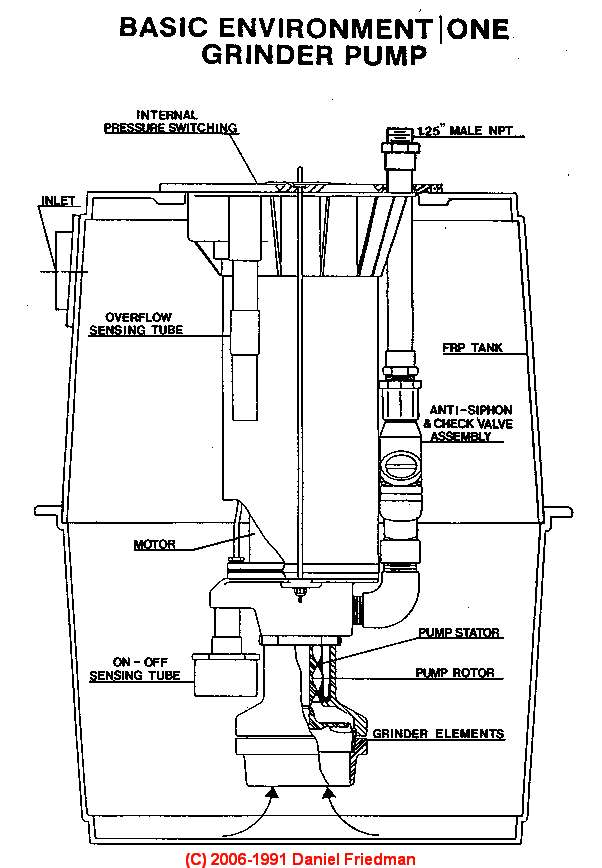
This article describes the reasons & methods for installing duplex versions of septic pumps, septic sump pumps, sewage ejector Pumps, septic grinder pumps, & pumps in sewage pumping stations.
Advice is given for septic tank effluent or sewage pump selection and use.
InspectAPedia tolerates no conflicts of interest. We have no relationship with advertisers, products, or services discussed at this website.
Duplex Sump & Septic Pump System Designs
 To avoid confusion note that duplex and backup pump systems may be used for either
- Sump pump installations - for water removal or prevent water entry - details are
at SUMP PUMPS - Septic & sewage pumps - for pumping sewage or wastewater, including solids, out to a sewer main or to a septic tank located at a higher elevation. We include effluent pumps used in septic mounds and raised-bed septics in this second wastewater-handling group bu tnote that effluent pumps are not intended to pump solids. - details are
at SEWAGE EJECTOR / GRINDER PUMPS
Shown here, our illustration, adapted from Glentronics sump pump instructions cited below, describes details of a typical battery-backup dual-sump pump installation.
[Click to enlarge any image]
Septic pumps used for pumping air in aeration systems and septic pumps used to move effluent in a drip dispersion system are discussed under the appropriate septic system type which are outlined
at SEPTIC SYSTEM DESIGN ALTERNATIVES.
There are two common pump-pair or duplex sump or septic grinder pump system setups. Either of these is found at municipal lift stations and similar installations and also in buildings where a backup or extra capacity is needed for water removal.
1. Alternating septic pumps: two septic pumps alternate, taking turns running - I prefer this method as you are spreading the wear over two pumps and you'll know when one fails and have a chance to repair it.
The two sewage grinder pumps are installed at the same location but are wired so that the pumps take turns, first one, and next cycle the other pump is turned on by the float switch.
However this system lacks the ability to handle surges in wastewater load unless additional controls and wiring are installed to make the pump also come on in response to high waste levels such as in the reserve septic backup design discussed next.
2. Reserve septic backup design: the backup septic pump never runs unless the primary septic pump has failed or is overloaded.
A simple installation provides a pump control float switch that turns on the backup pump only when effluent or sewage in the pumping chamber reaches a level above that normally handled by the primary septic pump.
This approach provides both pump backup and the ability to handle surges in sewage loads on the system.
Handling surge loads on the septic system: A duplex septic pump system in which the second pump can come on as effluent level rises in the pumping chamber handles either unusual flows into the system (uncommon) or the case where the 1st pump is broken. I don't like this setup as much as we're never testing pump #2 until the very day it's absolutely needed.
Septic Pump controls for two-pump duplexed septic systems are produced by several manufacturers including Anchor Scientific, Aquawarx (control panels), B/W Controls, Orenco, Rhombus, SJ Electro, and CSI.
Reliability requirements define when a duplex sewage grinder pump or septic pump system is appropriate
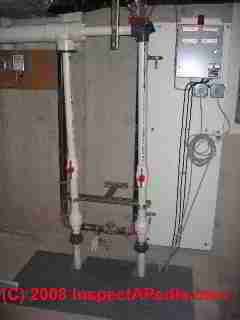
Wile single grinder pump systems are often installed to support an extra basement bathroom, where a sewage pump is handling an entire home or larger facility, duplex septic pumping systems (shown in the photo at the top of this page) are preferable for their greater reliability. There are two principal advantages of a two-pump septic system:
- Septic system reliability: If either sewage pump fails the second unit can keep the building's plumbing system operating while the failed pump is repaired.
- Handling surge loads in a septic system: If the building is one which experiences surges in wastewater loading, the duplex sewage pump design option #2 described below can handle this extra wastewater load without a system backup.
(Remember that in a power outage your pump system will not work unless you've provided backup power.)
Inspecting Duplex Septic Pump Systems
Additional details about the installation of sewage grinder or septic pumps and how to inspect them can be found at SEWAGE EJECTOR / GRINDER PUMPS
Beyond those suggestions, when inspecting a duplex septic pump system, remember to assure that both pumps are in working condition and that the switch between them is functioning. Simply turn off power to one pump to confirm that the second one will operate, and vice versa.
Duplex Septic Pump or Sump Pump System Alarms
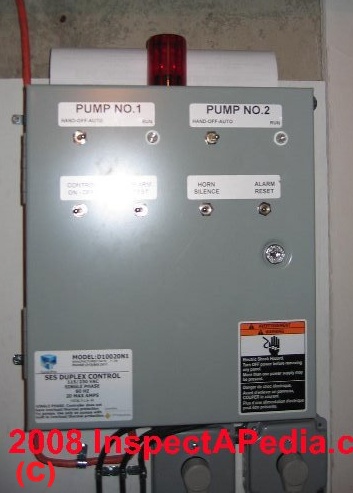
A duplex septic pump system is installed where septic and plumbing system reliability are very important. That same requirement makes it important for the building occupants or maintenance staff to know if one of the pumps has failed, so that a repair can be ordered before both pumps stop working.
A duplex septic pump alarm system accomplishes this function and can also diagnose the system by indicating which pump has stopped operating.
Here is a photo of a typical alarm system for a duplex sewage grinder pump installation.
We discuss septic system alarms in more detail at SEPTIC PUMP ALARM SYSTEMS
This duplex septic pump article is part of our series: SEPTIC SYSTEM INSPECTION & MAINTENANCE COURSE an online book on septic systems
Also see FLOOD ALARMS
...
Continue reading at SEPTIC PUMP INSPECTION & MAINTENANCE or select a topic from the closely-related articles below, or see the complete ARTICLE INDEX.
Or see these
Recommended Articles
- FLOOD ALARMS - detect water on floors or in basements or crawl spaces
- ODORS, SEPTIC or SEWER
- SEWAGE EJECTOR / GRINDER PUMPS - home
- DISPOSABLE WET WIPE CLOGS
- FREE-STANDING GRINDER PUMPS
- SEWAGE TREATMENT PLANTS, RESIDENTIAL
- SEPTIC SYSTEM PUMPS
- SEPTIC PUMP ALARM SYSTEMS
- SEPTIC PUMP BUYERS GUIDE & MANUALS
- SEPTIC PUMP DUPLEX DESIGNS
- SEPTIC PUMP INSPECTION & MAINTENANCE
- SEPTIC PUMP INSTALLATION
- SEWAGE ODOR SOURCE LOCATION
- SEWAGE PUMP BUYERS GUIDE & MANUALS
- SEWAGE PUMP DAMAGE & REPAIR
- SEWAGE PUMP INTERMITTENT CYCLING
- SEWAGE PUMP ODORS
- SEWAGE PUMPING STATIONS
- SEWAGE ODOR SOURCE LOCATION
- SEWAGE PUMPING STATIONS
- WAXY BIOFILM SLIME CLOGS in DRAINS & PUMPS
- SEPTIC TANK PUMPING PROCEDURE
- SEPTIC TANK PUMPING SCHEDULE
- SUMP PUMPS - home
- BATTERY BACKUP SUMP PUMPS
- CROSS CONNECTIONS, PLUMBING
- MERCURY HAZARDS in SUMP PUMP CONTROLS
- PEDESTAL SUMP PUMP GUIDE
- SUMP PUMP DISCHARGE
- SUMP PUMP INSPECTION
- SUMP PUMP MANUALS
- SUMP PUMP RELIABILITY
- SUMP PUMP TYPES
- SUBMERSIBLE SUMP PUMP GUIDE
- SUMP PUMP SINGLE vs DUPLEX
- SEPTIC PUMP DUPLEX DESIGNS
- WATER POWERED SUMP PUMPS
- WATER ENTRY in BUILDINGS for the diagnosis & cure of wet basements or crawl spaces.
Suggested citation for this web page
SEPTIC PUMP DUPLEX DESIGNS at InspectApedia.com - online encyclopedia of building & environmental inspection, testing, diagnosis, repair, & problem prevention advice.
Or see this
INDEX to RELATED ARTICLES: ARTICLE INDEX to SEPTIC SYSTEMS
Or use the SEARCH BOX found below to Ask a Question or Search InspectApedia
Ask a Question or Search InspectApedia
Questions & answers or comments about duplexing or doubling septic and sewage ejector pumps
Try the search box just below, or if you prefer, post a question or comment in the Comments box below and we will respond promptly.
Search the InspectApedia website
Note: appearance of your Comment below may be delayed: if your comment contains an image, photograph, web link, or text that looks to the software as if it might be a web link, your posting will appear after it has been approved by a moderator. Apologies for the delay.
Only one image can be added per comment but you can post as many comments, and therefore images, as you like.
You will not receive a notification when a response to your question has been posted.
Please bookmark this page to make it easy for you to check back for our response.
Our Comment Box is provided by Countable Web Productions countable.ca
Citations & References
In addition to any citations in the article above, a full list is available on request.
- Glentronics PRO-SERIES SUMP PUMP INSTALLATION MANUAL [PDF] Models ST1033 & ST1050, (2015) Glentronics, Inc., 645 Heathrow Drive, Lincolnshire, IL 60069 USA Tel: 800-991-0466 retrieved 2021/06/04, original source: https://www.stopflooding.com/assets/2/6/Manual_ST1033-ST1050_6-2015.pdf
- New York State Department of Health, APPENDIX 75-A WASTEWATER TREATMENT STANDARDS - INDIVIDUAL HOUSEHOLD SYSTEMS , [PDF] New York State Department of Health, 3 February 2010, retrieved 3/1/2010, original source: https://www.health.ny.gov/regulations/nycrr/title_10/part_75/appendix_75-a.htm
- In addition to citations & references found in this article, see the research citations given at the end of the related articles found at our suggested
CONTINUE READING or RECOMMENDED ARTICLES.
- Carson, Dunlop & Associates Ltd., 120 Carlton Street Suite 407, Toronto ON M5A 4K2. Tel: (416) 964-9415 1-800-268-7070 Email: info@carsondunlop.com. Alan Carson is a past president of ASHI, the American Society of Home Inspectors.
Thanks to Alan Carson and Bob Dunlop, for permission for InspectAPedia to use text excerpts from The HOME REFERENCE BOOK - the Encyclopedia of Homes and to use illustrations from The ILLUSTRATED HOME .
Carson Dunlop Associates provides extensive home inspection education and report writing material. In gratitude we provide links to tsome Carson Dunlop Associates products and services.
 | HOME | ABOUT | ASK a QUESTION | CONTACT | CONTENT USE POLICY | DESCRIPTION | POLICIES | PRIVACY | |
| © 2024 - 1985 Publisher InspectApedia.com - Daniel Friedman | |||||||||