
InspectAPedia® FREE Encyclopedia of Building & Environmental Construction, Diagnosis, Maintenance & Repair |
Question? Just ask us! InspectAPedia
|
 How to Measure the Hardness of Water
Water hardness test procedures & water mineral content tests
- POST a QUESTION or COMMENT about how to measure the hardness or mineral content of water
How to test water hardness & how to measure it using test strips, a water hardness soap test solution and other methods.
This article explains how to measure water hardness or grains of hardness: a measure of water mineral content. We provide a table of water hardness measurements and we discuss different methods for measuring water hardness including a simple soap test.
Electronic instruments can also measure water hardness but are a cost that most homeowners can eschew given the very low, even free costs of other water hardness test methods.
We give references on where to buy water low-cost but quite effective water hardness tests and we describe how various water hardness test kits are used and how to choose among them.
InspectAPedia tolerates no conflicts of interest. We have no relationship with advertisers, products, or services discussed at this website.
How to Measure Water Hardness: how many grains of hardness is found in your water?
 Definition of hard water
As we explain in more detail at WATER SOFTENERS & CONDITIONERS, Water "hardness" refers to the level of unwanted minerals, principally calcium and magnesium, found in your water supply.
Hard water is an aesthetic issue (poor lathering, spots on dishes) and a mechanical issue (clogged pipes, expensive repairs, poor washing machine performance) but it is not a health concern.
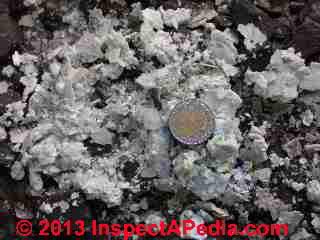
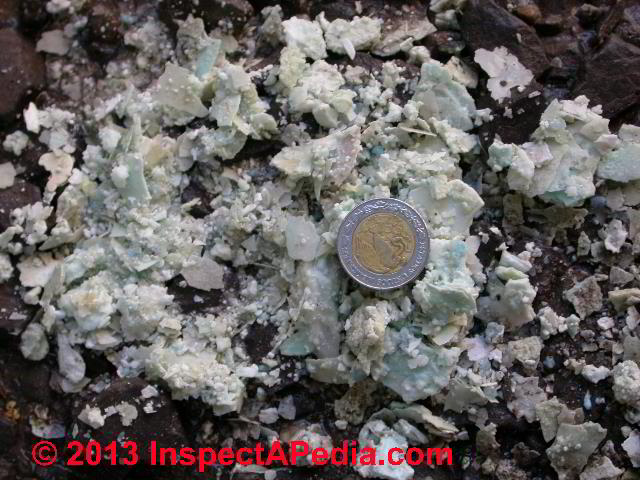
Photo at left: lime scale fragments collected from a water heater. [Click to enlarge any image]
Hard water is found only in certain neighborhoods and usually only on private water supplies from a local well or wells.
At DETECT HARD WATER we describe how to visually detect that your water is high in mineral content or "hard".
How is water hardness measured?
Water hardness is measured in "grains" per gallon, in milligrams of calcium (Ca) per liter, or water hardness may be expressed in ppm - parts per million, and also in German Degrees of Hardness (dH) [which we drop here as this is for fish tanks].
You can take a water sample to a water test lab to have its hardness measured, but it is also trivially easy to measure the hardness of water yourself, as we explain here.
Readers whose water is acidic or corrosive rather than "hard" and readers needing to know about the Langelier Saturation Index or LSI should
see CORROSIVITY or ACIDITY of WATER.
How to convert among different water hardness measures:
- Water with hardness of 25 ppm = 25 mg. of hardness-causing minerals per liter of water.
- Grains of Hardness per Gallon GPG x 17.1 = Water Hardness in PPM
- Total Water Hardness in mg/L / 17.1 = GPG
- Total Water Hardness in PPM / 17.1 = GPG
- Water Hardness in mg/L = Water Hardness in PPM
Water Hardness Measurements
- mg/L = milligrams (of minerals) per liter of water = a hardness measurement where 1 mg/L = 1 PPM of minerals in the water source.
- PPM = parts per million, in this case "parts" refers to parts of hard water mineral substances
- 1 ppm = 1 part in a million
- GPG = grains [of hard water minerals) per gallon where one grain is a unit of weight measurement first defined in Egypt as equivalent to one grain of wheat or roughly 1/7000 of a pound .
- 1 Grain = 0.0001428571 pounds
Table of Degrees of Water Hardness |
|||
| Water Hardness | mg/L = PPM | Grains
of Hardness |
Action / Effect |
| Soft water | 0-17.1 mg/L of minerals | 0-1 | None |
| Slightly hard water | 17.1-60 mg/L of minerals | 1.1 - 3.5 | |
| Moderately hard water | 61-120 mg/L of minerals | 3.6 - 7 | Spotty dishes Dry skin |
| Hard water | 121-180 mg/L of minerals | 7.1 - 10.5 |
Clogged pipes |
| Very hard water | 180 - 250 mg/L of minerals | 10.6-15 | Above |
| Extremely-hard water |
Above 250 mg/L | > 15 gpg | Above + hard-to |
Notes to the table above
- adapted from web search Wikipedia 01/31/2011
You can compare the water hardness range above with the water hardness test sensitivity of the various water hardness tests listed later in this article.
We repeat this table with more details, below where we show other measures of water hardness..
How to Use A Simple Soap Test to Measure the Grains of Hardness of the Water Supply
You will need:
- a small glass bottle with a tight cap, or a water hardness test kit bottle that is of an ideal size and has a water level line mark on it.
- dish soap
- any measuring device such as a measuring cup marked in ml, cc's or ounces, or a 12-oz drinking glass
Water hardness can be easily measured using a simple soap test kit that will measure in "grains of hardness" (a little bottle with a line marked on it which you fill to the line with water, add a drop of soap, and shake to look for suds. More drops of soap - more degrees of hardness).
The very crude do-it-yourself water hardness test method that some folks try is just adding dish soap to 12-oz of tap water (the left two columns in our table below).
In our OPINION this is a very crude test and you'd be better off obtaining a free or low-cost but more accurate water hardness test from one of the sources listed below at Water Test Kits & Guide
Water Hardness Measurements - How to Use the Home Soap Test Method for Water Hardness |
|||||
| Test Water Volume - crude test | Soap drops - crude test | Grains/gallon GPG of Water Hardness | ppm mg/L Water hardness in parts per million in milligrams per liter |
Softness of the Water | |
| 12 oz | 10 | 0 - 1 | 0-17.1 | Very Soft | |
| 20 | 1 - 3.5 | 17.1 - 60 | Slightly Hard | ||
| 30 | 3.5 07/13/2010 - 07.0 | 60 - 120 | Medium Hard | ||
| 40 | 7.0 - 10.5 | 120 - 180 | Hard | ||
| 50 | 10.5 & higher | 180 & over | Very Hard | ||
Notes to the table above
NOTE: 1 German degree of hardness dH = 17.5 ppm. For fish tanks, 200-300 ppm is considered "hard", 300-500 ppm "very hard" and over 500 ppm "extremely hard" water.
Compensated Water Hardness
PureWater, cited below, gives this definition of "compensated water hardness" or "CH":
A measure of water condition used for determining water softener capacity. It takes into account the amount of iron present in water as well as hardness. To determine compensated hardness, add twice the iron content to the actual hardness.
Why is compensated water hardness an important calculation when planning for water treatment?
Hard water, characterized by containing higher levels of calcium (Ca) and magnesium (Mg) form salts of those minerals that in turn affect both the softness and the acidity (pH) of the water. Hard water forms scale in water that ranges from a nuisance (spots on dishes) to very expensive trouble (clogged pipes, ruined water heaters) or even unsafe conditions (clogged temperature/pressure relief valve).
Iron is generally a problem in water treatment because it interferes with water softener operation.
So making an accurate assessment of water hardness, to include the effects of iron in the water by computing CH is useful when planning, choosing, or adjusting water softening or for other water treatment equipment. In some installations a separate iron removal step may also be needed.
More scholarly sources suggest considering both iron an manganese, but of the two, iron is the more-significant. Below we give the most-common methods of calculating CH or Compensated Hardness of a water supply. Keep in mind that various water treatment companies may use calculations that produce somewhat different results.
Compensated Hardness CH = (2 x Iron Content) + (Measured Hardness)
CH = (2 x 3) + 20 = 26
DWC, also cited below, offers a different approach to computing "compensated water hardness."
The following table is excerpted from information provided by DWC, cited below.
Using DWC's CH calculation we'd obtain
CH = (measured Hardness gpg) x (data from table)
CH = 20 x 1.1 = 22
Note that the DWC approach gives a lower CH number than does PureWater.
Quoting the company's advice:
When sizing water conditioning equipment, the hardness should be based on compensated hardness. Compensated hardness takes into consideration minerals and other factors that will reduce the softening capacity of a softener. These items cannot be picked up in a standard hardness test. To arrive at compensated hardness, multiply the figure on the right by the hardness in grains per gallon by your test that fit into the hardness category on the left.
Calculate Compensated Water Hardness |
|
Water Test |
Compensated |
| 1-20 | 1.1 |
| 21-40 | 1.2 |
| 41-70 | 1.3 |
| 71-100 | 1.4 |
| 101 & above | 1.5 |
Notes to the table above
Other Calculations of CH - Compensated Hardness of Water
Example: (Purewater's calculation)
Actual hardness = 20 gpg
Iron content = 3ppm.
Compensated Hardness CH = 20 + (2 x3) = 26 - this would agree with the DWC compensated harness table given just above.
Other sources (filterwaterdirect.com) suggest a more-aggressive calculation of compensated water hardness, adding 3 x the iron content to the actual hardness measurement to determine "compensated hardness" of your water supply.
Example using same data as above: Compensated Hardness CH = 20 + (3 x 3) = 29 - this would give a greater CH number.
Sources:
- Abeliotis, Konstadinos, Cevza Candan, Caroline Amberg, Ada Ferri, Miguel Osset, Jeremy Owens, and Rainer Stamminger. IMPACT OF WATER HARDNESS ON CONSUMERS’ PERCEPTION OF LAUNDRY WASHING RESULT IN FIVE EUROPEAN COUNTRIES [PDF] International Journal of Consumer Studies 39, no. 1 (2015): 60-66.
Excerpt from Introduction:
Washing clothes, laundry and other home textiles is one of the most widespread housework in the world (Pakula and Stamminger, 2010). The washing performance depends on the following four factors, depicted by the Sinner circle, namely: chemical action, mechanical action, temperature effect and time (Sinner, 1960; AISE, 2013).
If the role of one factor is reduced, the loss must be compensated for by increasing one or more of the other factors to maintain the same level of washing performance. On the other hand, water has always been the most important commodity in any type or size of laundry. Thus, water has been introduced by Stamminger (2010) as a fifth factor to show the importance of water as essential element in wet cleaning.
Excerpt from Conclusions:
Water hardness is a key factor in the successful outcome of the washing process. For the first time, a research was conducted in five European countries aiming at identifying the perception of the consumers on the effect of the water hardness in the washing cleaning performance. - Büker, Oliver, Krister Stolt, Corinna Kroner, Miroslava Benkova, Jan Pavlas, and Veit Seypka. INVESTIGATIONS ON THE INFLUENCE OF TOTAL WATER HARDNESS AND PH VALUE ON THE MEASUREMENT ACCURACY OF DOMESTIC COLD WATER METERS [PDF] Water 13, no. 19 (2021): 2701.
Abstract
In the framework of the ongoing EMPIR Joint Research Project (JRP) 17IND13 Metrology for real-world domestic water metering (Metrowamet), a main task is to investigate the influence of realistic operation conditions, that is, typical water qualities (suspended particles, degree of hardness, and pH value), on the measurement accuracy. For this purpose, two representative types of cold water meters were investigated in more detail. Initially, the cold water meters were calibrated and then subjected to an accelerated wear test with water of different pH values and degrees of hardness.
The accelerated wear tests were designed to reproduce the realistic use and service life of a cold water meter. Subsequently, the cold water meters were re-calibrated to assess the influence of the different water qualities on the measurement accuracy. One of the results was that the measurement accuracy of the water meters investigated was not strongly affected by the water quality. The practical realisation and the measurement results are reported in this paper. - Downes, Virginia. "Compensated hardness (computed from actual." JAMA. 1959;170(1):137-142. doi:10.1001/jama.1959.03010010139037 Q&A
- DWC, WATER TREATMENT CATALOG [PDF] Duff, Co. Tel: 610-275-4453
- FWD, "Glossary of Common Terms Used in Water Treatment", Filter Water Direct LLC PO Box 194 Lakeview AR 72642 USA, retrieved 2021/12/28 original source: https://www.filterwaterdirect.com/information/free-water-test
- Kozisek, Frantisek. HEALTH RISKS FROM DRINKING DEMINERALISED WATER [PDF] Nutrients in drinking water 1, no. 1 (2005): 148-163.
- Mestre, Ana S., André Nabiço, Patrick L. Figueiredo, Moisés L. Pinto, M. Soledade CS Santos, and Isabel M. Fonseca. "Enhanced clofibric acid removal by activated carbons: Water hardness as a key parameter." Chemical Engineering Journal 286 (2016): 538-548.
- PureWater, "Water Treatment Glossary", PureWater, LLC 9768 Maumelle Blvd. North Little Rock, AR 72113 Phone: (501) 812-5300 Toll Free: (800) 324-1744 Email: Mike@purewater2000.com - retrieved 2021/12/28 original source: http://www.purewater2000.com/glossary.html
Water Hardness Test Kit - Test Strips
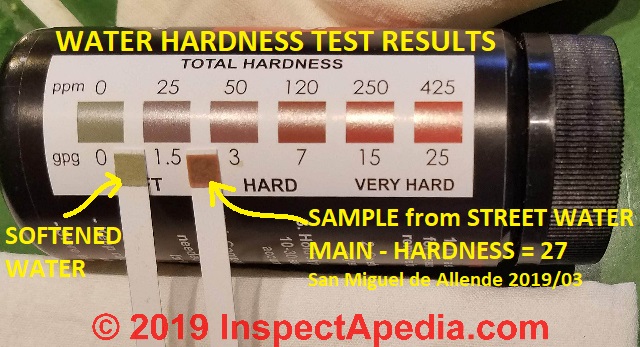 Using simple plastic test strips that carry a chemically-treated pad is an easy and quick way to measure water hardness and / or to confirm that a water softener is working correctly.
LaMotte [cited in detail below] provides a helpful comparison between water hardness measurement using instruments and water hardness measurement using test strips:
Instrument Measurement of Water Hardness: A colorimeter passes a white light beam through an optical filter which transmits only one particular color or band of wavelengths of light to the photodetector, where it is measured.
The difference in the amount of colored light transmitted by a colorless sample (blank), and the amount of colored light transmitted by a colored sample, is a measurement of the amount of colored light absorbed by the sample. In most colorimetric tests, including hardness, the amount of colored light absorbed is directly proportional to the concentration and is reported by the meter.
Test Strip Measurement of Water Hardness:Test strips are typically produced from plastic, with chemically impregnated pads on the end. These pads are designed to react with specific ions and produce a specific color change.
Once a test strip is reacted and a color is developed, the strip is then compared to a printed color chart. The color chart is specifically designed to represent color reactions at various concentrations. Matching the strip to the closest color match produces a concentration reading. - retrieved 12/11/2014, original source: http://www.lamotte.com/en/blog/test-factors/75-measuring-water-hardness
A step-by-step water hardness test procedure using these test strips and hardness test results are given in detail
at WATER HARDNESS TEST San Miguel de Allende
where we illustrate using the JNW Direct water hardness test kit strips (Amazon.com) to test the hardness level of the water supply in San Miguel de Allende, Guanajuato Mexico (Col. San Antonio) in March of 2019.
What's the difference between using a total water hardness test strip kit and using the "true calcium" liquid reagent drop count titration method?
Water hardness or other water test kits are used in a very wide variety of applications beyond simply checking a drinking water supply.
Some other uses include balancing the water hardness of pools and spas, testing the condensate in a steam boiler system or in water operated cooling towers, and checking the proper operation of water softeners.
A difference between this calcium test using the dropcount titration method and total hardness test kits that use a test strip is that the test strips only measure total water hardness - which is perfectly fine for examining a residential water supply.
But for measuring water hardness when maintaining a pool or spa, you need to measure calcium hardness specifically. That measurement requires the drop count titration method described next. Quoting from Taylor who explains the difference in exquisite detail:
... whereas test strips for total hardness have just four or five color blocks to cover a tremendously wide range—from 0 to 1,000 parts per million (ppm) with color blocks for 0, 100, 250, 500, 1,000, for instance—a drop test will allow you to approach the true concentration of calcium hardness in 10-ppm increments.
This means if you're faced with wanting to balance water in a spa by increasing the calcium hardness from 60 ppm to 150 ppm, the strip can't help but the drop test can.9]
Sources of Water Test Kits & Guide to Using a Water Hardness Test Kit
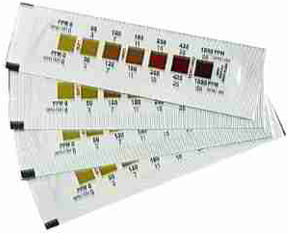 Water hardness test kits may use water hardness test tablets or paper test strips (see below).
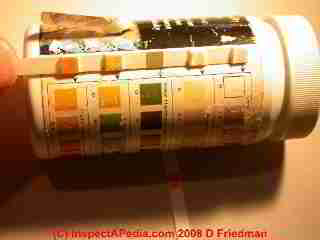
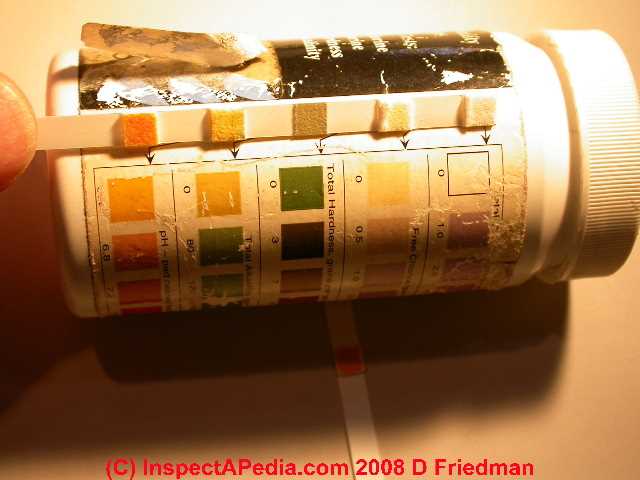
When mixed with (a test tablet) or wet by (a test strip such as those shown at left) water of a specified volume (fill the test bottle with the specified amount dictated by the test kit instructions or to the line marked on the test bottle), the water in the bottle plus test tablet changes color (green or red, for example) or the test strip changes color (on a scale, for example) that is compared to a standard provided with the kit.
Other simple test kits provide a small glass bottle with a line marked on it and intended for use with dishwasher soap. One drop dish soap at a time. More soap drops = harder water.
We bought our Total Water Hardness Test Kit at Sears where water softeners were sold. Or the hardness of your water may be measured at no charge if you ask the local water treatment company to take a look.
A typical water hardness test kit that uses water strips provides with each strip a color chart. Match the color on the strip (after you wet it with your test water) against the color chart to see the hardness of your water sample, measured in ppm or gains.
A typical water hardness test kit strip measures hardness from 0-1000 ppm or from 0-59 grains of hardness.
Potable Water Hardness Test Kits: sources, features, costs: soap, strips, electronic hardness testers are listed here.
 Here we describe different methods & prices for building water supply hardness testing and we include description of the different tests, their technology, and their application.
[These water tests are available at Amazon.com through links given here, from the companies and producers listed here, and from other suppliers]
Watch out: a general search for "water test kit" or "water hardness test kit" will list kits and tests that may not match your application. Don't order an aquarium test kit or a swimming pool test kit if your need is to test building drinking water or potable water supply. The test criteria, methods, and standards may be quite different.
[Disclosure: you can buy these test kits from many online sources including Amazon.com. Amazon pays us a pittance per item if purchased via these links.
Here are our WEBSITE VISITOR PRIVACY POLICY (we do not collect any information about individual website visitors)
and our ADVERTISING POLICY.]
- Aquamerck® Mercks total hardness & oxygen content "rapid tests" using the titrimetric method with dropping bottle or titration pipettes for accuracy. Contact Merck or EMD Chemicals in the U.S. or other countries. Merck & Co., Inc. Global Headquarters, One Merck Drive, P.O. Box 100, Whitehouse Station, NJ 08889-0100 USA, Phone: 908-423-1000 - http://www.merck.com/
- Culligan TK-2 Water Test Kit (less than $10. U.S.), includes test bottle, tablets, test strips, instructions. 15-minutes to complete the water analysis testing and determine the chlorine, chloramine, iron, nitrates, hardness, and ph levels.
- Diamond Crystal Water Softening Products: free water hardness test kit: Tel: 800-428-4244. Website: http://www.diamondcrystalsalt.com/. Note: The free test kit distributed by Diamond C.W.S.contains one Hach SofChek test strip which we describe immediately below.
- Hach SofChek Dip-and-Read Water Quality Test Strips: Total Hardness 0-425 ppm, Easy to use test strips - dip and read against a scale on the bottle label. OPINION: Suitable for checking water softener operation - Ed.
- Hach AquaChek Dip-and-Read Water Quality Test Strips, Multiparameter, 50 tests ($20. U.S.) bottle of 50 single-use water test strips, Easy to use.
Measures well water or potable water hardness in range of 0-425 ppm. Each test strip measures 5 parameters and gives results in a color- change that is matched to references on the bottle label: Free Chlorine (0-4 ppm), Total Chlorine (0-10 ppm), Total Hardness (0-425 ppm - 0-25 grains per gallon of water), Total Alkalinity (CaCO3 0-240 ppm), and pH (6.4 - 8.8). OPINION: Hach is a long-established, reputable water test kit manufacturer; we use this kit - Ed. - HM Digital TDS-EZ TDS "Water Quality" Tester with Auto-off Function TDS-EZ, HM Digital or Serv-A-Pure Co., (less than $20. U.S.), "water quality" test parameter specifics were not provided.
HM Digital produces a wide range of testing equipment and monitoring equipment. HM Digital, Inc. 5819 Uplander Way Culver City, CA 90230 U.S.A., Website: http://www.tdsmeter.com
Watch out: "Water purity" expressed in parts per million of particulates does not measure water safety, hardness, bacterial nor chemical contaminants. - Home Water Quality Test Kit, ($41. U.S.), Industrial Test Systems, Inc., ITS produces water test kits & test equipment, Email: its@sensafe.com, Website: http://www.sensafe.com/home.php,
most expensive test kit in this list, measures for Bacteria, Nitrates, Nitrites, Hydrogen Sulfide, Total Hardness, Total Alkalinity, Total Chlorine, Free Chlorine, Chloride, Copper, Sulfate, Iron, & pH. Industrial Test Systems, Inc., 1875 Langston Street, Rock Hill, SC, 29730 | Toll Free: (800) 861-9712.
Watch out: independent of the actual test reliability, some state health departments (e.g. New York) may not accept as valid the type of bacteria test provided - Industrial Test Systems, Inc. ITS480008 Total Hardness Water Test Kit, Industrial Test Systems, Inc., ($10.) bottle of 50 water hardness single-use test strips
- Intellitec WPT1000 Digital Water Purity Tester, Intellitec, ($13.), measures "water purity", readings in ppm of particulates in water.
Watch out: "Water purity" expressed in parts per million of particulates does not measure water safety, hardness, bacterial nor chemical contaminants. Website: http://www.intellitecproducts.com/

- JNW Direct Hardness Test Strips, Website: jnwdirect.com sold at Amazon at amazon.com/jnwdirect, email: support@jnwdirect.com
See WATER HARDNESS TEST San Miguel de Allende for an example of the use of this the water hardness test strips provided by JNW.
- Jungle Labs Hardness / Alkalinity Quik-Dip Test Strips for Aquariums & fish care. Website http://www.junglelabs.com/.
Watch out: this is an example of a special use product that is not intended for potable water testing. - PurTest 8-in-1 Iron Hardness Water Test Kit, PurTest, ($16. U.S.), Quoting "PurTest 8-in-1 Iron Hardness Water PLUS Test Kit includes: 3 different foil packet with 2 strips on each packet Test pads Test vial Press on cap",
tests for Alkalinity, Copper, Hardness, Iron, Nitrates, Nitrites, pH. American Water Service, LLC, Matthews NC, U.S.A., Tel: 800-788-4825, Website: http://www.purtest.com/ Email: water@purtest.com - Sears, Roebuck & Co., (Kenmore) Free water test. Sears offers free water testing to its customers, testing for hardness, acidity, and clarity.
Website: http://www.kenmorewater.com/ Kenmore Water Telephone: 1-800-426-9345. Most Sears stores will provide a sterile water sampling bottle at no charge.
Fill the bottle with tap water from your building and return it to Sears for a free "in-store" analysis. Or use your own sterile (clean) glass jar with a secure lid, collecting 4 ounces of tap water for this test. Sears will report Hardness in grains per gallon or GPG, clarity (iron or color or sediment), and acidity of your water sample. - Total Water Hardness Water Test Kit m#480008 [bottle of 50 test strips, available at Amazon.com], produced by Industrial Test Systems, Inc.
A reader comments were critical of a lack of precision in this test with an uncertainty of at least 200 ppm [Jan 2011]; others complained that test strip colors did not resemble the color chart. Easy to use. - Water Hardness Test Kit, Taylor K-0432, Reagent Pack, Buret, Hardness (calcium/magnesium/total), EDTA, 1 mL = 1 mg CaCO₃
This very thoroughly supplied test kit contains ten components and is designed for expert-level testing of the hardness level of potable water. Like the test reagent discussed next, this kit uses drop count titration for a very accurate hardness measurement. We discuss this kit in more detail below. [9] - Water Hardness Test Reagent, Taylor R-0012 - 0.75 oz bottle (least expensive test kit in this list but this product contains only the reagent. You'll need instructions and a 3/4 oz test bottle).
Note that this test kit, sold online at Amazon for "water testing" may be designed to measure calcium levels as necessary for maintaining pools and spas. [9] Discussed in more detail below. - Micro Essential Lab WHT-050 Hydrion Double Roll Water Hardness Test Paper Rolls, 0 to 20 gr/gal and 0 to 50 gr/gal Ranges, Micro Essential Lab, Inc. ($10.) Quoting: Micro Essential Hydrion Water Hardness Tester provides a simple, easy to read test to determine the hardness of water.
This test allows determination of the need to treat the water to prevent calcium carbonate build up and to monitor the ongoing efficacy of the treatment used.
The Tester consists of a roll of Lo Range test paper with a color match chart reading in increments of 0, 5, 10 and 20 gr/gal as calcium carbonate and a wider range roll of test paper with a color match chart reading in 10, 20, 30, 40 and 50 gr/gal of water hardness.
Roll Length: 180 inches. Total Range: 0-50 gr/gal. Micro Essential Labs #: WHT-050. " - Micro Essential Lab SWT-125 Hydrion Low Water Hardness Test Paper, 0 to 20 gr/gal Range, ($15), Micro Essential Lab,
Quoting: "Micro Essential Hydrion Low Range Water Hardness Tester provides a simple, easy to read test to determine the hardness of water.
This test allows determination of the need to treat the water to prevent calcium carbonate build up and to monitor the ongoing efficacy of the treatment used.
The Tester consists of a roll of test paper sufficient for approximately 180 tests and a color match chart reading in increments of 0, 5, 10 and 20 gr/gal as calcium carbonate. Total Range: 0-20 gr/gal. 1 Roll/Dispenser; 10 /Carton. Micro Essential Labs #: SWT-125." - Watersafe WS425B Drinking Water Test Kit, Watersafe (less than $20. U.S.), tests for Chlorine, Bacteria (?? methodology not stated), Lead, Hardness, Nitrates/Nitrites (fertilizers, animal waste, potentially sewage effluent), pesticides, ten minutes, Quoting: "This WaterSafe kit identifies harmful levels of bacteria and lead in your water.
Watersafe test kits are easy-to-use and produce results on the spot. Tests bring the accuracy of laboratory procedures into any home or business.
Contains one-step water testing kits: Lead kit can detect dissolved lead at levels below the EPA Action level of 15 parts per billion (ppb); bacteria kit can detect the presence of Coliform Bacteria in your water.
Get results in only 10 minutes with easy to follow directions and no mixing or measuring."
Producer: Discover Testing.com, Silver Lake Research Corporation, P.O. Box 686, Monrovia, CA 91017 Tel: 888-438-1942, Website: http://www.discovertesting.com/, - Watersafe WS425W Well Water Test Kit, Watersafe, ($25.), Quoting: a single-use kit made for testing well water that will detect coliform bacteria, pesticides, nitrates, lead, iron, chlorine, copper and hardness. Includes an instruction manual and EPA drinking water standards.
Easy to use, with results on the spot."
Watch out: "bacteria test" may include non-coliform bacteria as well as coliform bacteria, so it is a general indicator, not a comprehensive test. - Watts Premier 173006 All-In-One Water Test Kit, Watts Premier, ($32. U.S.), color coded test strips, 2 tests for most items, 1 test for some - see this quote: "This test also contains the only available EPA-approved free chlorine test strip on the market! This Water Quality Test Kit includes: * Free Chlorine - 2 tests * Total Chlorine - 2 tests * Chloride - 2 tests * pH - 2 tests * Total Alkalinity - 2 tests * Total Hardness - 2 tests * Nitrate - 2 tests * Nitrite - 2 tests * Iron - 2 tests * Sulfate - 2 tests * Hydrogen Sulfide - 2 tests * Copper - 2 tests * Lead - 1 test * Pesticide - 1 test * Bacteria - 1 test",
Watts Premier produces a large range of water testing systems, water filtration, water treatment, reverse osmosis, etc.
Watts Premier, Inc. 8716 W Ludlow Dr Ste 1 Peoria, AZ 85381, Tel: 800-752-5582, Website: https://www.wattspremier.com/
Watch out: "bacteria test" may include non-coliform bacteria as well as coliform bacteria, so it is a general indicator, not a comprehensive test. - Well Water Test Kit, WellSafe, ($25. U.S.), Quoting, "... test quickly and easily for the most common contaminants found in private well water, including: iron, copper, lead, bacteria, pesticides, nitrates, nitrites, chlorine, pH and hardness."
Note: We were unable to identify the producing company for this product.
- Water Hardness Test Kit, Taylor K-0432, Reagent Pack, Buret, Hardness (calcium/magnesium/total), EDTA, 1 mL = 1 mg CaCO₃This very thoroughly supplied test kit contains ten components and is designed for expert-level testing of the hardness level of potable water. Like the test reagent discussed next, this kit uses drop count titration for a very accurate hardness measurement. Quoting from Taylor[9]:
Hardness in water was originally defined as a measure of the water's ability to precipitate soap. In current practice it is considered to be the sum of the calcium and magnesium ions in water, expressed as milligrams per liter (mg/L) or parts per million (ppm) as calcium carbonate.
The modern way to test for hardness is by titration with EDTA (ethylenediaminetetraacetic acid), an organic chelating agent which reacts with both calcium and magnesium ions. When all calcium and magnesium ions are complexed, the excess EDTA reacts with an indicator to give a characteristic blue color, which is the endpoint.[9]
For potable water testing Taylor also provides tests for water alkalinity, water pH, Nitrites, Nitrite, Permanganate (testing water treatment equipment that removes sulphur odors), Sulfites, Iron, Copper, Chlorine, Bromine, Acidity, and a nearly endless catalog of additional water tests and water test methods.
- Water Hardness Test Reagent, Taylor R-0012 - 0.75 oz bottle (least expensive test kit in this list but this product contains only the reagent. You'll need instructions and a 3/4 oz test bottle). Note that this test kit, sold online at Amazon for "water testing" may be designed to measure calcium levels as necessary for maintaining pools and spas.
How to use the Taylor R-0012 water hardness test kit - drop count titration method
This water hardness test method uses a water hardness reagent, an organic chelant solution whose principal ingredient is Ethylenediaminetetra- 60-00-4 <5 Irritant acetic acid. The reagent is added drop by drop to a quantity of test water and the user looks for a permanent color change in the water test sample.
By using the Taylor R-0012 0.75 oz test bottle and filling the bottle to a mark provided on that container you can be assured that you are using the proper test volume. In discussing water hardness testing (calcium level) in a discussion of pools and spas, Taylor adds these details:
The color progression in a hardness test is from red, to a mixture of red and blue, to blue. To be certain the color change is permanent, indicating you have reached the true endpoint, add one more drop of titrant. If the blue color remains unchanged, do not count this drop.[9]
Taylor also warns about water hardness tests (using a reagent and drop count titration) that produce a "fading endpoint" - the color ends at purple rather than blue due to contamination of the test water by metal ions. The company provides a procedure for adjusting the process if this happens during your test.
Store your reagent between 36-85 degF., keep it out of direct sunlight, and avoid abrupt temperature changes that can cause reagent deterioration. Handle appropriately. Like many acid reagents the liquid can be a skin or eye irritation. Taylor's website provides an MSDS if you need it. More information is available from the manufacturer, Taylor Technologies [9] whose contact information is at our references section below.
Measuring Water Hardness to Test Water Softener / Water Conditioner Operation using Water Hardness Test Tablets
If you need to confirm that your water softener equipment is working properly you will want to measure the hardness or mineral content of your water supply taken at a plumbing tap (sink faucet) located after or "downstream from" the water softener. The following procedure is adapted from IBC [using "water hardness tablets" and other water conditioner installation manuals.[8]
There are three conceptual data points you might want to test:
- incoming water hardness - take a water sample from a tap that bypasses or is before the water softener
- water hardness after a water softener regeneration or "backwash" cycle
- water hardness a day or more after a backwash cycle, or each day of normal water usage in the building between one backwash cycle and the next one - this can confirm that the settings on the water conditioner controls, including regeneration or backwash cycle frequency are adequate.
- Collect a water sample to be tested from a tap after the water softener if you are performing test #2 or 3 above.
- Place 10 ml of water into a clean plastic bottle - choose a plastic bottle of about 30 ml capacity so that your water sample will fill the bottle to 1/3 full.
- If working with an IBC water conditioner test kit, add one "Yes/No" tablet to the water sample and shake the sample until the tablet has dissolved completely.
- Watch out: do not touch the Yes/No tablet with your fingers, or if you accidentally have done so, stop and wash your hands thoroughly. And don't put your finger in your eye or mouth.
- Check the color of the water sample. If it is green (of any shade) the water is below 20 mg/L of hardness. If the water sample is red the hardness is 20 ppm or above.
- Note: if your incoming water is very high in hardness, the water softener may not be able to drop the hardness level to below 20 mg/L - consult your water softener company for advice. [8]
Electronic Instruments for Testing Water Hardness: Colorimeter, Ion Detector, other
Electronic instruments can also measure water hardness but are a cost that most homeowners can eschew given the very low, even free costs of other water hardness test methods. But since some fellows complained about feeling left out:
- Dwyer Test Intstruments: Website; http://www.dwyer-inst.com
- Hach, whom we cite for a wide range of water testing equpment & methods includintg the original Hach Test Kit, Website: http://www.hach.com/hardnessguide The company can provider a colorimeter that can measure very low hardness levels in very soft water and they provider an Ion-selective electrode such as their ISE25Ca Calcium electrode
- HM Digital: provides handheld hardness testers. Website: http://www.tdsmeter.com
- LaMotte Company, 802 Washington Ave [PO Box 329], Chestertown, MD 21620, USA, Tel: 410-778-3100. Website: http://www.lamotte.com
LaMotte provides water hardnerss measurement equipment: Website: http://www.lamotte.com.
Watch out: there are some low cost but poor-functioning meters & test instruments we see for sale at auction and stores offering devices that may "work" but may not be suitable if accuracy is important.
Reader Comments, Questions & Answers About The Article Above
Below you will find questions and answers previously posted on this page at its page bottom reader comment box.
Reader Q&A - also see RECOMMENDED ARTICLES & FAQs
On 2019-10-11 - by (mod) -
Samuel
I'll be glad to assist you by answering any particular questions that you have. You've come to the right place. Start by reading the article on the page above and let me know if that leaves you with any questions.
On 2019-10-11 by Samuel
I am in a science fair this year in school and i need help in knowing how to measure hardness of water in my project.
On 2017-12-04 - by (mod) -
Rajesh
If you are talking about an industrial process it's quite possible that the acidity or alkalinity of your dye bath will be able to be measured by the methods discussed in the article above. However if you need to discriminate at the extreme ends of the range of alkalinity or acidity then the conventional test strips described above may not be sufficient and you would need to use a test from an industrial supplier.
On 2017-12-04 by Rajesh Sharma
How i can measure hardness of dye bath using reactive dye with alkali and electrolyte in the dye bath
On 2017-11-26 - by (mod) -
Since all you need is a few ounces of water, a clear four-ounce glass bottle with a plastic screw top would be fine and would permit repeated use. Less costly clear plastic bottles can work but are less durable.
On 2017-11-26 by Kris
What is ideal size of bottle for simple soap test?
On 2016-06-17 - by (mod) -
Virender, there are several large water testing equipment suppliers in india including
Acumen Labware, Water & Soil Analysis Kit Suppliers, Water Testing Kits Manufacturers, Water & Soil Testing Kits Exporters in India.
Web: http://acumenlabware.com/
Acumen Labware
85 H.B.C
Ambala Cantt-133001
Haryana(India)
Tel: +91 98127-00785, +91 99922-00785
Email: acumenlabware@gmail.com
Indiamart an online marketer not specifically focused only on water testing +91-96-9696-9696 web: http://dir.indiamart.com/impcat/water-testing-kits.html
OrlabIndia a manufacturer of water testing equipment Tel 040-67216354 E-mail : orlab@orlabindia.com Web: http://www.orlabindia.com/
PanoMex in New Delhi
Panomex Inc.
301, 3rd Floor,
Vardhman Capital Mall, LSC-10,
Sindhora Kalan, Nr. Shakti Nagar,
New Delhi - 110052 (India)
Company Email :
sales@panomex.com
Landline:
+91-11-23644143
Mobile:
+91-981 805 4319- http://www.panomex.com/water-quality-meters/water-hardness-meter.html
On 2016-06-17 by Virender Kumar Tandon
Who are suppliers of plastic dropping bottles used for drop delivery in water testing kits in India. pl email to info5584@gmail.com
On 2014-12-12 - by (mod) -
Good point, anon, I'll add some citations, however
Electronic instruments can also measure water hardness but are a cost that most homeowners can eschew given the very low, even free costs of other water hardness test methods.
Anon: there are countless water hardness tests including free ones offered by water treatment companies, or DIY tests using soap. But we'll add some instruments to the list above.
On 2014-10-27 by Anonymous
i want the instrument to test hardness where it is available?
Question: how to use the Taylor R-0012 water hardness test kit
How do I test for water hardness using Taylor R-0012 - 0.75 oz bottle? - Jim 7/27/2012
Reply:
Jim the Taylor R-0012 -0.75oz bottle method for testing water hardness uses a combination of a bottle with a fill-level marking (0.75 oz) and a bottle of liquid reagent. The reagent is added to the test bottle and you watch for a color change. The number of drops to obtain the final color change translates into degree of hardness according to instructions packed with the reagent and kit.
In the article above on testing water hardness we have added more water test details from Taylor. Taylor explains that each test kit comes with detailed instructions.
Unfortunately the Taylor company's website when we last visited (July 2012) was challenging: we found it impossible to access the documents that were listed in some drop down menus. Better to contact the company directly 800-TEST KIT (837-8548), with your questions.
...
Continue reading at SCALE PREVENTION, WATER HEATER or select a topic from the closely-related articles below, or see the complete ARTICLE INDEX.
Or see these
Recommended Articles
- CLOGGED TANKLESS COIL or PIPES, LIME SCALE
- LANGLIER SATURATION INDEX LSI
- WATER HARDNESS: HOW TO DETECT
- WATER HARDNESS TEST San Miguel de Allende
- WATER SOFTENERS & CONDITIONERS - home
Suggested citation for this web page
WATER HARDNESS: HOW TO MEASURE at InspectApedia.com - online encyclopedia of building & environmental inspection, testing, diagnosis, repair, & problem prevention advice.
Or see this
INDEX to RELATED ARTICLES: ARTICLE INDEX to WATER TREATMENT SYSTEMS
Or use the SEARCH BOX found below to Ask a Question or Search InspectApedia
Ask a Question or Search InspectApedia
Questions & answers or comments about how to measure the hardness or mineral content of water
Try the search box just below, or if you prefer, post a question or comment in the Comments box below and we will respond promptly.
Search the InspectApedia website
Note: appearance of your Comment below may be delayed: if your comment contains an image, photograph, web link, or text that looks to the software as if it might be a web link, your posting will appear after it has been approved by a moderator. Apologies for the delay.
Only one image can be added per comment but you can post as many comments, and therefore images, as you like.
You will not receive a notification when a response to your question has been posted.
Please bookmark this page to make it easy for you to check back for our response.
Our Comment Box is provided by Countable Web Productions countable.ca
Citations & References
In addition to any citations in the article above, a full list is available on request.
- [1] North Dakota Standards for Water Softeners, North Dakota General Authority Law, Chapter 62-04-08, Water Softener Units http://www.legis.nd.gov/information/acdata/pdf/62-04-08.pdf. "The objective of this chapter is to provide a standard of quality, capacity, and performance for water softener units. Water softener performance is to be based upon referee tests procedures described in section 62-04-08-09."
- [2] Culligan Mark 10 Water Softener 1994-1998 Installation and Operating Instructions (covering models manufactured after 1995) (1-96) 01881948.pdf available from www.culligan.com
- [3] Water Softeners, CMHC, Canadian Mortgage and Housing Corporation, cmhc-schl.gc.ca/en/co/maho/wawa/wawa_005.cfm - October 2008. Canada Mortgage and Housing Corporation acknowledges the contribution of Health Canada to the development of this document. For further questions regarding water treatment and water quality, contact Health Canada at watereau@hc-sc.gc.ca or call 613-957-2991 or 1-866-225-0709.
- [4] "Commercial Water Softener Installation and Operating Instructions", IBC Filtration & Water Treatment Products (Australia) for commercial, industrial and residential application www.ibcwater.com.au (07) 3219 2233
- [5] "Non electric water softener, Installation and Operating Instructions", IBC Filtration & Water Treatment Products (Australia), op.cit.
- [6] "Water Softener Twin Tank Installation and Operating Instructions", IBC Filtration & Water Treatment Products (Australia), op.cit.
- [8] Water Softener with Microprocessor: Installation & Operating Instructions, IBC Filtration & Water Treatment Products (Australia), IBC Water, Ltd., 18 Dividend Street, Mansfield Qld 4122, Postal Address: PO Box 2247, Mansfield BC, Qld 4122 Australia, Tel: Sales/Service: 1-300-166-253; Tel: (07) 3347 1600 Int. +61 7 3347 1600, Facsimile: (07) 3219 2266 Int. +61 7 3219 2266, Email: sales@ibcwater.com.au , web search 01/31/2011, original source: http://www.ibcwater.com.au/zone_files/PDF/as0922mp-cl.pdf
- [9] Taylor Technologies, Inc., 31 Loveton Circle, Sparks, MD 21152-9206. Tel: 800-TEST KIT (837-8548), Taylor Technologies distributes an extensive range of water testing chemicals, methods, technologies. Web search 7/27/2012, Website: http://www.taylortechnologies.com
-
More Details About Drinking Water Testing
- ARSENIC in WATER - arsenic contaminants in water may occur naturally in some soils
- BACTERIA TEST GUIDE - tests the level of microbial contaminants in water. The basic "present/absent" or "P/A" test is the minimum water potability test required by many home mortgage lenders. Also see HPC Heterotrophic Plate Count and be sure to see these articles
- CHEMICAL CONTAMINANTS in WATER
- CORROSIVITY or ACIDITY of WATER - corrosive water risks leaky copper water pipes; the Langelier Saturation Index..
- General Classes of Water Contaminants for Comprehensive Water Testing
- HARDNESS of WATER - water high in minerals, typically calcium or manganese, risk clogged pipes & water heaters
- HERBICIDE CONTAMINATION in WATER - water test parameters
- LEAD CONTAMINATION in WATER, HOW to TEST - also see Lead Contamination in Drinking Water: how to test & correction lead in drinking water
- Nitrate level in water, identifies contamination from septic system effluent or possibly from nearby animal or livestock facilities or barns. See Nitrate/Nitrite Toxicity ATSDR: [Big, Slow-Loading File] U.S. Government ATSDR Science Corner - 2.5MB PDF
- Turbidity test for drinking water - can indicate whether the water supply is contaminated with groundwater or flood waters
- Standard VA FHA - water test parameters - how to check for pesticide contaminants in drinking water
- Title 5 - water test parameters - how to check for pesticide contaminants in drinking water
- Total dissolved solids in water (also measures conductivity or a "conductivity test") identifies the mineral content of water. Water with high levels of salts or minerals may be a health hazard, and high mineral content or "hard water" risks problems with clogged plumbing equipment, pipes, water heaters. Also See WATER SOFTENERS & CONDITIONERS.
- 1-Bromo-3-chloro-5,5-dimethylhydantoin (C5H6BrClN2O2) is produced world-wide and is also used in cleaners and bathroom disinfectants and deodorizers. Here is an example MSDS for this product, provided by Leisure Time
- "Bacteria in Drinking Water" - "Chlorine," Karen Mancl, water quality specialist, Agricultural Engineering, Ohio State University Extension. Mancl explains factors affecting the effectiveness of chlorine in water as a means to destroy bacteria and other microorganisms. OSU reports as follows:
- Chlorine kills bacteria, including disease-causing organisms and the nuisance organism, iron bacteria. However, low levels of chlorine, normally used to disinfect water, are not an effective treatment for giardia cysts. A chlorine level of over 10 mg/1 must be maintained for at least 30 minutes to kill giardia cysts. -- http://ohioline.osu.edu/b795/index.html is the front page of this bulletin
- Crystal Clear Supply provides portable ceramic water filter purifiers and portable reverse osmosis water treatment equipment - see http://www.crystalclearsupply.com/category_s/7.htm
- Drinking Water Contaminant Levels - Maximum Allowed
- Drinking Water Contamination and Pollution How to Detect, Test, Correct, and Prevent Well Water Contamination - US EPA - Groundwater
- "Drinking Water Safety in Emergencies", University of Minnesota extension, extension.umn.edu/info-u/nutrition/BJ646.html
- National Primary Drinking Water Regulations - The complete regulations regarding these contaminants available from the Code of Federal Regulations Website -(United States)
- Ohio State University article on the concentration of chlorine necessary to act as an effective disinfectant, and the effects of the water's pH and temperature: See http://ohioline.osu.edu/b795/b795_7.html for details.
- Water Requirements, Home & Outdoor Living - how much water do people use, how much water do people need?
- In addition to citations & references found in this article, see the research citations given at the end of the related articles found at our suggested
CONTINUE READING or RECOMMENDED ARTICLES.
- Carson, Dunlop & Associates Ltd., 120 Carlton Street Suite 407, Toronto ON M5A 4K2. Tel: (416) 964-9415 1-800-268-7070 Email: info@carsondunlop.com. Alan Carson is a past president of ASHI, the American Society of Home Inspectors.
Thanks to Alan Carson and Bob Dunlop, for permission for InspectAPedia to use text excerpts from The HOME REFERENCE BOOK - the Encyclopedia of Homes and to use illustrations from The ILLUSTRATED HOME .
Carson Dunlop Associates provides extensive home inspection education and report writing material. In gratitude we provide links to tsome Carson Dunlop Associates products and services.
 | HOME | ABOUT | ASK a QUESTION | CONTACT | CONTENT USE POLICY | DESCRIPTION | POLICIES | PRIVACY | |
| © 2024 - 1985 Publisher InspectApedia.com - Daniel Friedman | |||||||||