
InspectAPedia® FREE Encyclopedia of Building & Environmental Construction, Diagnosis, Maintenance & Repair |
Question? Just ask us! InspectAPedia
|
 Septic Systems: Introduction, Definitions - New York State Septic System Design Regulations 75-A.1 -
- POST a QUESTION or COMMENT about definitions of common septic system and wastewater treatment system terms.
Definitions of common septic and wastewater treatment system terms: section 1 of the model septic design regulations, provided here, includes definitions of common septic system terms.
This document uses the New York State wastewater treatment standard for individual household septic systems (Appendix 75-A) to provide an example of state regulated design and installation of both conventional tank and leach field septic systems and alternative septic system designs, including raised septic systems, septic mound systems, intermittent sand filter septic systems, and evaportion-transpiration septic systems.
InspectAPedia tolerates no conflicts of interest. We have no relationship with advertisers, products, or services discussed at this website.
Septic System Terms and Definitions
Title: Appendix 75-A.1 - Introduction - Effective Date: 12/01/90
For a more complete list of septic system terms and definitions than that provided immediately below by the State, see our Dictionary of Septic System and Onsite Wastewater Terms. What follows below are specific definitions suggested for model septic system regulations such as those used by New York State's septic guidelines. These definitions are a proper
(a) This appendix applies to on-site wastewater treatment systems serving residential properties and receiving sewage without the admixture of industrial wastes or other wastes, as defined in Environmental Conservation Law, Section 17-0701, in quantities of less than 1,000 gallons per day (gpd).
(b) Definitions - As used in this Appendix, the following words and terms shall have the indicated meaning:
(1) Absorption Area - an area to which wastewater is distributed for infiltration to the soil.
(2) Absorption Field - the area to which sewage is distributed for infiltration to the soil by means of a network of pipes.
(3) Absorption Trench - a long narrow area which includes a pipe for the distribution of septic tank effluent.
(4) Aerobic Treatment Unit - a system that provides for the biological decomposition of the organic portion of the wastewater by mechanical aeration of the wastewater.
(5) Aggregate - washed gravel or crushed stone 3/4 - 1 1/2 inches in diameter.
(6) Application Rate - the rate at which septic tank effluent is applied to a subsurface absorption area, for design purposes, expressed in gallons per day per square foot (gpd/sq. ft.).
(7) Baffle - a flow deflecting device used in septic tanks and distribution boxes to inhibit the discharge of floating solids, reduce the amount of settleable solids that exit, and reduce the exit velocity of the wastewater.
(8) Building Sewer - that part of the drainage system which extends from the end of the building drain and conveys wastewater to the sewage system or sewer.
(9) Cleanout - an opening providing access to part of the sewage system.
(10) Commissioner - the State Commissioner of Health.
(11) Curtain Drain - a subsurface drain designed and constructed to control groundwater and surface water intrusion into the area of the sewage system. Curtain drains or intercept drains can protect septic drainfields in areas of wet soils or surface and subsurface groundwater
(12) Design Professional - a person licensed or registered in the State of New York and authorized by the State Education Law to design the systems described in the standards.
(13) Distribution Device - a device used to uniformly distribute sewage to the absorption area.
(14) Distribution Line - the perforated pipe used to distribute wastewater to the absorption area.
(15) Drinking Water - water whose physical, chemical and biological quality is or is intended to be satisfactory for human consumption, food preparation or culinary purposes.
(16) Effective Grain Size - a measure of the diameter of soil particles, when compared to a theoretical material having an equal transmission constant. It is the dimensions of that mesh screen which will permit 10 percent of the sample to pass and will retain 90 percent.
(17) Gas Baffle - a device on the outlet of a septic tank which deflects gas bubbles away from the outlet and reduces the carry over of solid particles from the septic tank.
(18) Groundwater - subsurface water occupying the saturation zone from which wells and springs are fed.
(19) Heavy Equipment - all equipment which would result in the compaction of the design absorption area at a depth equivalent to the design depth of the distribution lines.
(20) Infiltration - the flow or movement of water into the interstices or pores of a soil through the soil interface.
(21) Invert - the floor, bottom, or lowest point of the inside cross section of a pipe.
(22) Local Health Department - a city, county, or part-county department of health or a State Department of Health District Office.
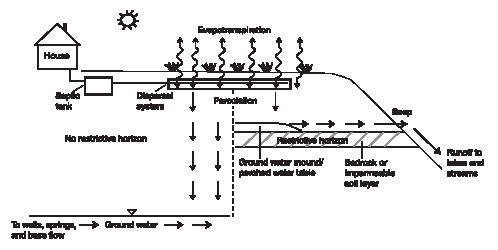
(23) Percolation - the movement of water through the pores of a soil or other porous medium following infiltration through the soil interface.
(24) Permeability - a measure of the rate of movement of liquid through soil.
(25) Scum - the wastewater material which is less dense than water and floats on top of the water.
(26) Sewage - the combination of human and household waste with water which is discharged to the home plumbing system including the waste from a flush toilet, bath, sink, lavatory, dishwashing or laundry machine, or the water-carried waste from any other fixture, equipment or machine.
(27) Stabilized Rate of Percolation - the rate corresponding to two consecutive equal or near equal percolation test results.
(28) usable Soil - unless otherwise stated a soil with a percolation rate of faster than 60 min/in with a compatible soil classification.
(29) Wastewater - any water discharged from a house through a plumbing fixture to include, but not limited to, sewage and any water or waste from a device (e.g., water softener brine) which is produced in the house or property.
(30) Watercourse - a visible path through which surface water travels on a regular basis. Drainage areas which contain water only during and immediately after a rainstorm shall not be considered a watercourse. (31) Watershed - an area of drainage for a body of water that serves as a source of drinking water and for which watershed rules and regulations have been adopted by the commissioner.
(32) Well head area - the area surrounding a well which includes the cone of influence (where the drawdown of groundwater causes groundwater flow).
(33) Wetland - an area(s) of marshes or swamps which have been designated as such by the State Department of Environmental Conservation or other agency having jurisdiction. Marshes or swamps that have not been classified by an agency as a wetland shall not be treated for design purposes as a wetland.
See SEPTIC SYSTEM DESIGN BASICS for a description of the specifications and properties of most common septic systems such as tank and drainfield, soil & perc tests, septic tank pumping table, septic system treatment chemicals, and steep slope system designs.
Also see SEPTIC CODES & REFERENCES and SEPTIC CONSULTANTS, DESIGNERS, ENGINEERS.
See SEPTIC SYSTEM DESIGN ALTERNATIVES for a description of alternative septic system designers, products, and design specifications such as cesspools, disinfection systems, evaporation/transpiration, filters, fixed film gravelless, greywater, holding tanks, lagoons, media filters, mound septic designs, outhouses, peat filters, pressure dosing, raised beds, sequencing batch, steep slope, toilet alternatives, vegetated submerged beds, and wetland septic designs.
...
Continue reading at SEWAGE FLOW & DESIGN FLOW ESTIMATES or select a topic from the closely-related articles below, or see the complete ARTICLE INDEX.
Or see these
Recommended Articles
- DICTIONARY of SEPTIC SYSTEM & WASTEWATER TERMS for a more complete dictionary of septic system and wastewater terminology
- SEPTIC SYSTEM DESIGN ALTERNATIVES - home
- SEPTIC SYSTEM DESIGN BASICS - home
- SEPTIC CODES & REFERENCES
- SEPTIC & SEWAGE TREATMENT CODES & REFERENCES - home
- U.S. SEPTIC AUTHORITIES & DESIGN SPECIFICATIONS - start of this series
Suggested citation for this web page
SEPTIC SYSTEM DESIGN: INTRO at InspectApedia.com - online encyclopedia of building & environmental inspection, testing, diagnosis, repair, & problem prevention advice.
Or see this
INDEX to RELATED ARTICLES: ARTICLE INDEX to SEPTIC SYSTEMS
Or use the SEARCH BOX found below to Ask a Question or Search InspectApedia
Ask a Question or Search InspectApedia
Questions & answers or comments about definitions of common septic system and wastewater treatment system terms..
Try the search box just below, or if you prefer, post a question or comment in the Comments box below and we will respond promptly.
Search the InspectApedia website
Note: appearance of your Comment below may be delayed: if your comment contains an image, photograph, web link, or text that looks to the software as if it might be a web link, your posting will appear after it has been approved by a moderator. Apologies for the delay.
Only one image can be added per comment but you can post as many comments, and therefore images, as you like.
You will not receive a notification when a response to your question has been posted.
Please bookmark this page to make it easy for you to check back for our response.
Our Comment Box is provided by Countable Web Productions countable.ca
Citations & References
In addition to any citations in the article above, a full list is available on request.
- New York State Department of Health, APPENDIX 75-A WASTEWATER TREATMENT STANDARDS - INDIVIDUAL HOUSEHOLD SYSTEMS , [PDF] New York State Department of Health, 3 February 2010, retrieved 3/1/2010, original source: https://www.health.ny.gov/regulations/nycrr/title_10/part_75/appendix_75-a.htm
- For a more complete list of septic system terms and definitions than that provided above by the State, see our DICTIONARY of SEPTIC SYSTEM & WASTEWATER TERMS
- Advanced Onsite Wastewater Systems Technologies, Anish R. Jantrania, Mark A. Gross. Anish Jantrania, Ph.D., P.E., M.B.A., is a Consulting Engineer, in Mechanicsville VA, 804-550-0389 (2006), Advanced Onsite Wastewater Systems Technologies. Outstanding technical reference especially on alternative septic system design alternatives. Written for designers and engineers, this book is not at all easy going for homeowners but is a text we recommend for professionals--DF.
CONTINUE READING or RECOMMENDED ARTICLES.
- Carson, Dunlop & Associates Ltd., 120 Carlton Street Suite 407, Toronto ON M5A 4K2. Tel: (416) 964-9415 1-800-268-7070 Email: info@carsondunlop.com. Alan Carson is a past president of ASHI, the American Society of Home Inspectors.
Thanks to Alan Carson and Bob Dunlop, for permission for InspectAPedia to use text excerpts from The HOME REFERENCE BOOK - the Encyclopedia of Homes and to use illustrations from The ILLUSTRATED HOME .
Carson Dunlop Associates provides extensive home inspection education and report writing material. In gratitude we provide links to tsome Carson Dunlop Associates products and services.
 | HOME | ABOUT | ASK a QUESTION | CONTACT | CONTENT USE POLICY | DESCRIPTION | POLICIES | PRIVACY | |
| © 2024 - 1985 Publisher InspectApedia.com - Daniel Friedman | |||||||||