
InspectAPedia® FREE Encyclopedia of Building & Environmental Construction, Diagnosis, Maintenance & Repair |
Question? Just ask us! InspectAPedia
|
 Septic System Alternatives: septic holding tanks, waterless
septic systems, chemical toilets, electrical and gas toilets
Septic System Alternatives: septic holding tanks, waterless
septic systems, chemical toilets, electrical and gas toilets

- POST a QUESTION or COMMENT about regulation and approval of septic system alternatives such as septic holding tanks, waterless toilets, chemical, recirculating or incinerator toilets, and engineered septics
Septic system alternatives: holding tanks, waterless toilets.
This article discusses example procedures for evaluating, installing, approving other septic system types besides those already discussed. These include (by example) septic holding tanks, waterless septic systems, chemical toilets, electrical and gas toilets.
InspectAPedia tolerates no conflicts of interest. We have no relationship with advertisers, products, or services discussed at this website.
Regulations for the Design of Other Septic System Alternatives: septic holding tanks, waterless septic systems, chemical toilets, electrical and gas toilets
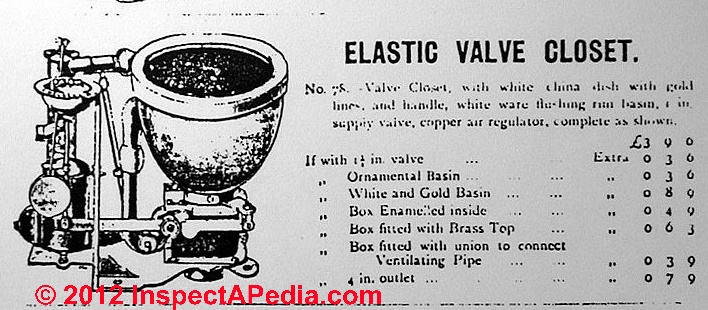
Details about early toilet designs such as the elastic valve closet shown above are at ANTIQUE FLUSH TOILETS
NOTE: This section of NYS regulations discusses "alternatives" to onsite wastewater disposal systems. None of the systems discussed here dispose of septic effluent on the primary site, and some avoid effluent production completely, other than human excreta.
New York regulations (effective in 1990) do not discuss other septic and onsite wastewater handling methods such as aerobic septic systems.
[Click to enlarge any image]
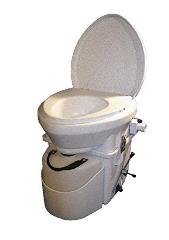
The composting toilet shown at page top (Nature's Head) is discussed in more detail at ALTERNATIVE & WATERLESS TOILETS.
Readers should therefore also be sure to see SEPTIC SYSTEM DESIGN ALTERNATIVES.- Ed. NYS Title: Appendix 75-A.10
(a) Holding Tank Septic Systems
The use of holding tanks shall not be permitted for new home construction except where occupancy of a home is permitted while the sewage treatment system is under construction. Tank size shall be based upon five days design flow or 1,000 gallons, whichever is greater and meet the same construction as a septic tank except that the holding tank shall not have an outlet. Holding tanks are not acceptable for long term use on year-round residences.
See HOLDING TANK SEPTIC SYSTEMS for details
Also for RV holding tank issues
see RV HOLDING TANK DUMP INTO SEPTIC TANK?
(b) Non-Waterborne Septic Systems
(1) Waterless Toilets - General
In certain areas of the State where running water is not available or is too scarce to economically support flush toilets, or where there is a need or desire to conserve water, the installation of non-waterborne sewage systems may be considered however, the treatment of wastewater from sinks, showers, and other facilities must be provided when non-flush toilets are installed. Household wastewater without toilet wastes is known as greywater.
See ALTERNATIVE & WATERLESS TOILETS for detals and a complete list. And for a special circumstances requiring waterless toilet facilities see the following:
Also see CAMPING & EMERGENCY USE TOILETS
Also see DISASTER ZONE TOILET GUIDE for makeshift or temporary toilet designs & products
Also see LATRINE TYPES & CONSTRUCTION
Also see OUTHOUSES & LATRINES
Also see SQUAT TOILETS
Also see WATERLESS URINALS
(2) Composters [Composting Toilets].
These units shall be installed in accordance with the manufacturers instructions. The units shall have a label indicating compliance with the requirements of National Sanitation Foundation (NSF) Standard 41 or equivalent. Only units with a warranty of five years or more shall be installed.
(3) Chemical and Recirculating Toilets
(i) Chemical toilets provide a toilet seat located directly above a vault containing a chemical to disinfect and remove odors from the wastewater. Recirculating toilets use chemicals as the toilet flush fluid. The wastes are separated from the fluid, wastes discharged to an internal holding tank, and the fluid reused.
(ii) The liquids used in these types of toilets do not completely disinfect the wastes; therefore, waste products from these units shall not be discharged to surface waters or to the ground surface.
(iii) The reduced volume wastewater from recirculating toilets may be discharged to a larger holding tank but not to a subsurface absorption system.
See CHEMICAL TOILETS
(4) Incinerator Toilets [Gas, Electric Toilets]
These units accept human waste into a chamber where the wastes are burned. They have a very limited capacity and require a source of electricity or gas. The ash remains must be periodically removed. They must be installed according to the manufacturer's instructions.
See INCINERATOR TOILET SYSTEMS
(5) Greywater Systems
Greywater [grey water, gray water] systems shall be designed upon a flow of 75 gpd/bedroom and meet all the criteria previously discussed for treatment of household wastewater.
[DF NOTE: Grey water is water that does not include sewage, including water from sinks, showers, and laundry facilities.]
Also see GREYWATER TOILETS & SEPTICS
(C) Engineered Septic Systems
(1) A treatment system of a type not discussed in this document may be allowed only through the issuance of a Specific Waiver by the health unit having jurisdiction as provided for in Part 75, of this Title.
(2) Special Conditions.
(i) The system shall be designed by a design professional.
(ii) An environmental assessment determines that the development of the site with this system is consistent with the overall development of the area and will cause no adverse environmental impacts. The homeowner/purchaser shall be informed of the expected reliability or problems with the design.
(iii) The design professional supervises the installation of the system and certifies that the system was built in accordance with the approved plan and/or submits as-built plans of the system.
See SEPTIC CONSULTANTS, DESIGNERS, ENGINEERS and also
See SEPTIC SYSTEM DESIGN ALTERNATIVES - home
Also see these low water toilet designs and economical toilet designs
- LOW COST TOILETS - separate article
- LOW WATER USAGE / POWER FLUSH TOILETS
...
Continue reading at DESIGN APPROVAL for NEW or INTERIM SEPTIC SYSTEMS & PRODUCTS or select a topic from the closely-related articles below, or see the complete ARTICLE INDEX.
Or see these
Recommended Articles
- HOLDING TANK SEPTIC SYSTEMS
- TOILET DESIGN CHOICES
- TOILET TYPES, CONTROLS, PARTS TOILET DESIGN CHOICES - complete list of standard, economical, and alternative toilet products & designs
- SEPTIC SYSTEM DESIGN ALTERNATIVES - home
- SEPTIC CODES & REFERENCES
- SEPTIC & SEWAGE TREATMENT CODES & REFERENCES - home
- U.S. SEPTIC AUTHORITIES & DESIGN SPECIFICATIONS - start of this series
Suggested citation for this web page
DESIGN SPECS HOLDING TANKS, WATERLESS TOILETS at InspectApedia.com - online encyclopedia of building & environmental inspection, testing, diagnosis, repair, & problem prevention advice.
Or see this
INDEX to RELATED ARTICLES: ARTICLE INDEX to SEPTIC SYSTEMS
Or use the SEARCH BOX found below to Ask a Question or Search InspectApedia
Ask a Question or Search InspectApedia
Questions & answers or comments about regulation and approval of septic system alternatives such as septic holding tanks, waterless toilets, chemical, recirculating or incinerator toilets, and engineered septics.
Try the search box just below, or if you prefer, post a question or comment in the Comments box below and we will respond promptly.
Search the InspectApedia website
Note: appearance of your Comment below may be delayed: if your comment contains an image, photograph, web link, or text that looks to the software as if it might be a web link, your posting will appear after it has been approved by a moderator. Apologies for the delay.
Only one image can be added per comment but you can post as many comments, and therefore images, as you like.
You will not receive a notification when a response to your question has been posted.
Please bookmark this page to make it easy for you to check back for our response.
Our Comment Box is provided by Countable Web Productions countable.ca
Citations & References
In addition to any citations in the article above, a full list is available on request.
- New York State Department of Health, APPENDIX 75-A WASTEWATER TREATMENT STANDARDS - INDIVIDUAL HOUSEHOLD SYSTEMS , [PDF] New York State Department of Health, 3 February 2010, retrieved 3/1/2010, original source: https://www.health.ny.gov/regulations/nycrr/title_10/part_75/appendix_75-a.htm
- US EPA ONSITE WASTEWATER TREATMENT SYSTEMS MANUAL [online copy, free] Top Reference: US EPA's Design Manual for Onsite Wastewater Treatment and Disposal, 1980, available from the US EPA, the US GPO Superintendent of Documents (Pueblo CO), and from the National Small Flows Clearinghouse. Original source http://www.epa.gov/ORD/NRMRL/Pubs/625R00008/625R00008.htm Onsite wastewater treatment and disposal systems, Richard J Otis, published by the US EPA. Although it's more than 20 years old, this book remains a useful reference for septic system designers. U.S. Environmental Protection Agency, Office of Water Program Operations; Office of Research and Development, Municipal Environmental Research Laboratory; (1980)
- Advanced Onsite Wastewater Systems Technologies, Anish R. Jantrania, Mark A. Gross. Anish Jantrania, Ph.D., P.E., M.B.A., is a Consulting Engineer, in Mechanicsville VA, 804-550-0389 (2006), Advanced Onsite Wastewater Systems Technologies. Outstanding technical reference especially on alternative septic system design alternatives. Written for designers and engineers, this book is not at all easy going for homeowners but is a text we recommend for professionals--DF.
CONTINUE READING or RECOMMENDED ARTICLES.
- Carson, Dunlop & Associates Ltd., 120 Carlton Street Suite 407, Toronto ON M5A 4K2. Tel: (416) 964-9415 1-800-268-7070 Email: info@carsondunlop.com. Alan Carson is a past president of ASHI, the American Society of Home Inspectors.
Thanks to Alan Carson and Bob Dunlop, for permission for InspectAPedia to use text excerpts from The HOME REFERENCE BOOK - the Encyclopedia of Homes and to use illustrations from The ILLUSTRATED HOME .
Carson Dunlop Associates provides extensive home inspection education and report writing material. In gratitude we provide links to tsome Carson Dunlop Associates products and services.
 | HOME | ABOUT | ASK a QUESTION | CONTACT | CONTENT USE POLICY | DESCRIPTION | POLICIES | PRIVACY | |
| © 2024 - 1985 Publisher InspectApedia.com - Daniel Friedman | |||||||||