
InspectAPedia® FREE Encyclopedia of Building & Environmental Construction, Diagnosis, Maintenance & Repair |
Question? Just ask us! InspectAPedia
|
 Soil & Site Evaluation Procedures for Septic System Design
- POST a QUESTION or COMMENT about this article topic.
Soil Percolation Tests or Perc Test Specifications:
Section 4 of these model septic design regulations discusses the procedure for evaluating site and soil conditions in preparation for the design of a private septic system to handle onsite wastewater disposal.
For the installation of a conventional septic tank and leach field, minimum usable soil depth, percolation rates, leach field clearance distances, and the requirement for a future repair or expansion area are reviewed, and a table of separation distances from septic components to other site and building features is provided.
InspectAPedia tolerates no conflicts of interest. We have no relationship with advertisers, products, or services discussed at this website.
Soil and site appraisal for off-grid or onsite wastewater treatment systems: septic drainfields, soakaway beds, percolation beds
As we explain at SEPTIC SOIL & PERC TESTS, a standard soil percolation test to evaluate a site's suitability for onsite wastwater disposal is basically the excavation of one or more holes in the disposal area into which water is poured. The observation of the length of time required for that water to seep into the ground below is measured as the soil's "percolation rate".
But other factors such as weather, seasonal groundwater level variations, slope, and variations in soil properties mean that even where the septic design and approval rely on a soil perc test, additional site inspection and evaluation steps are necessary.
This document uses the Maine, New York State, and other wastewater treatment standards for individual household septic systems (Appendix 75-A) to provide an example of state regulated design and installation of both conventional tank and leach field septic systems and alternative septic system designs, including raised septic systems, septic mound systems, intermittent sand filter septic systems, and evaportion-transpiration septic systems. Effective Date: 12/01/90 Title: Appendix 75-A.4.
Article Contents
Numerical Classification Systems for Site Evaluation for Septic System Designs
Rather than rely on a compartively simple soil percolation test, some U.S. states, Canadian Provinces, and different jurisdictions in the U.K., Australia, New Zealand, India and other countries may specify different procedures for soil and site evaluation that in turn guides the design of an acceptable and functional onsite wastewater disposal system.
Where soil characteristics make it difficult to use a simple soil percolation test to design a suitable onsite septic system that disposes of wastewater in the soil, some jursidictions such as the State of Maine in the U.S. use a numerical classification system that combines multiple site evaluation factors.
The site inspection and evaluation must be performed by a qualified, licensed professional. Using Maine's 2009 DEH standards as a model, here are examples of factors that are considered in designing an onsite wastewater disposal system:
- Waterbody Setback: 100 feet/200 feet/300 feet (engineered)
- Well / Water Supply Setback: 100 feet/200 feet/300 feet (engineered & public supply)
- Soil Test: Site Evaluation (described below)
- Septic Tank Sizing: Bedroom/Specific use
- Disposal Area Sizing: Soil Profile & Drainage
- Type of Disposal Area: Chamber, Pit Privy, Leach Field, Engineered Peat System, Gravel-less Tubes and Beds, Drip Irrigation
- Authorized first time systems outside of the SLZ if there is 9 inches of suitable soil.
Note: The Subsurface Wastewater Team, within the MECDC's Division of Environmental Health, Drinking Water Program is charged under 42 MRS § 42 (3, 3-A, 3-B) to adopt rules which regulate subsurface sewage disposal systems, licensing of persons to evaluate soils for subsurface wastewater disposal systems, and inspection of plumbing and subsurface waste water disposal systems. - Maine DEHS, retrieved 8 June 2015, original source: http://www.maine.gov/dhhs/mecdc/environmental-health/plumb/index.htm
Maine provides several forms used to guide site inspections, variance requests, pluming permit applications, and septic system product registrations as well as a Voluntary septic inspection form [PDF], all available from the site link given just above.
Reader Question: Standards for a Soil Percolatin Test in Maine?
8 June 2015 Anonymous said:
What are the standards for a Percolation test in Biddeford Maine?
Reply: Maine's Numerical Classification System To Determine Overall Site Suitability For Subsurface Wastewater Disposal
Anon:
Our reply to your question draws on several different documents from the Maine Subsurface Wastewater Unit.
According to the Maine Subsurface Wastewater Unit of Maine's Division of Environmental Health, since 1974 soil perc tests must be performed by a Licensed Site Evaluator. Our reply draws on several different documents from that organization.
The Subsurface Wastewater Team, within the MECDC's Division of Environmental Health, Drinking Water Program is charged under 42 MRS § 42 (3, 3-A, 3-B) to adopt rules which regulate subsurface sewage disposal systems, licensing of persons to evaluate soils for subsurface wastewater disposal systems, and inspection of plumbing and subsurface waste water disposal systems."
"The general rule of thumb is that a soil test (site evaluation) is needed any time sewage, wastewater, or human waste is being placed beneath the ground in a location where there was none before. This includes all first time development, all replacement systems, and expansions of existing systems. This also includes pit privies, greywater disposal areas, and full septic systems."
Key is this quote from a 1987 Main document:
The State of Maine abandoned the traditional percolation test in 1974 and replaced it with a system of site evaluation to determine suitability for subsurface wastewater disposal. These evaluations are performed by individuals licensed by the Department of Human Services.
Because of the diminishing number of sites with “suitable soils” and the belief that other site characteristics should be taken into consideration the Department developed the New System Variance procedure. This procedure assigns points to various site and system design characteristics and sets a minimum passing score of 50 points, with 65 points required for properties in Shoreland Zoning areas, and 75 points for lots in proposed subdivisions.
Properties not meeting the requirement of original soil over limiting factor are judged by this system. - Maine DEH, "Numerical Classification System To Determine Overall Site Suitability For Subsurface Wastewater Disposal, October, 1987 ", retrieved 8 June 2015, original source: www.maine.gov/dhhs/mecdc/environmental-health/plumb/documents/numerical-classification.rtf - 2011-11-10
Since Maine's numerical classification system used to determine the suitability of a site for subsurface wastewater disposal can be a bit difficult to find (we give the original link above) we've included a link to that document
To learn details about traditional soil percolation tests and exactly how they are performed, or to see other examples of soil perc test specifications
See SEPTIC SYSTEM DESIGN BASICS for a description of the specifications and properties of most common septic systems such as tank and drainfield, soil & perc tests, septic tank pumping table, septic system treatment chemicals, and steep slope system designs.
See SEPTIC SYSTEM DESIGN ALTERNATIVES for a description of alternative septic system designers, products, and design specifications such as cesspools, disinfection systems, evaporation/transpiration, filters, fixed film gravelless, greywater, holding tanks, lagoons, media filters, mound septic designs, outhouses, peat filters, pressure dosing, raised beds, sequencing batch, steep slope, toilet alternatives, vegetated submerged beds, and wetland septic designs.
(a) Site Investigation for Onsite Wastewater Displsal System Design
(1) Areas lower than the 10 year flood level
are unacceptable for on-site systems. Slopes greater than 15% are also unacceptable.
(2) There must be at least four feet of usable soil
available above rock, unsuitable soil, and high seasonal groundwater for the installation of a conventional absorption field system (75-A.8(b)).
(3) Soils with very rapid percolation rates
(faster than one minute per inch) are not suitable for subsurface absorption systems unless the site is modified by blending with a less permeable soil to reduce the infiltration rate throughout the area to be used.
(4) Subsurface treatment systems and components of the sewage system shall be separated from
buildings, property lines, utilities and wells, to maintain system performance, permit repairs and reduce undesirable effects of underground sewage flow and dispersion.
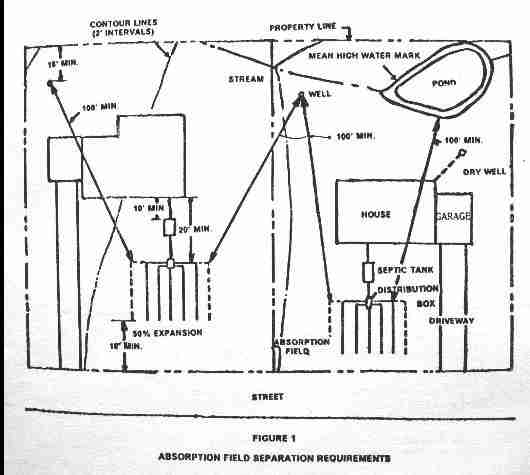
The minimum separation distances are shown in Figures 1 and 2. Reduced separation distances may be approved upon request when the site evaluation by a design professional or soil scientist clearly establishes there will be no adverse environmental impact and will not interfere with the satisfactory operation and maintenance of the system.
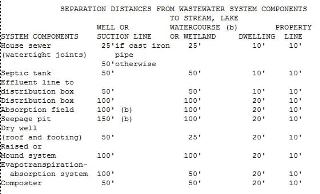
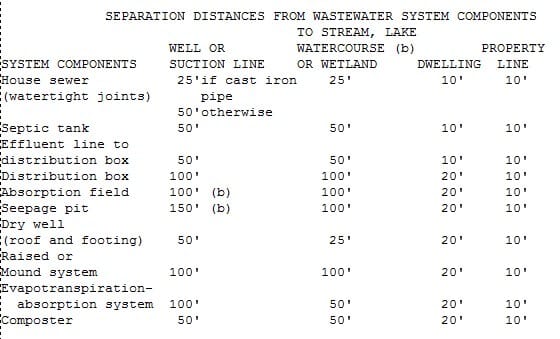
Table 2 shows the acceptable minimum separation distances from the various components of treatment systems.
(5) Once the required infiltration area is determined by daily flow, percolation tests and soil evaluation, the required usable area of the property for subsurface treatment can be found. An additional usable area of 50 percent shall be set aside for future expansion or replacement whenever possible.
(b) Separation Requirements for septic system components from buildings and other site features:
[Click to enlarge any image]
FIGURE 1 - ABSORPTION FIELD SEPARATION REQUIREMENTS
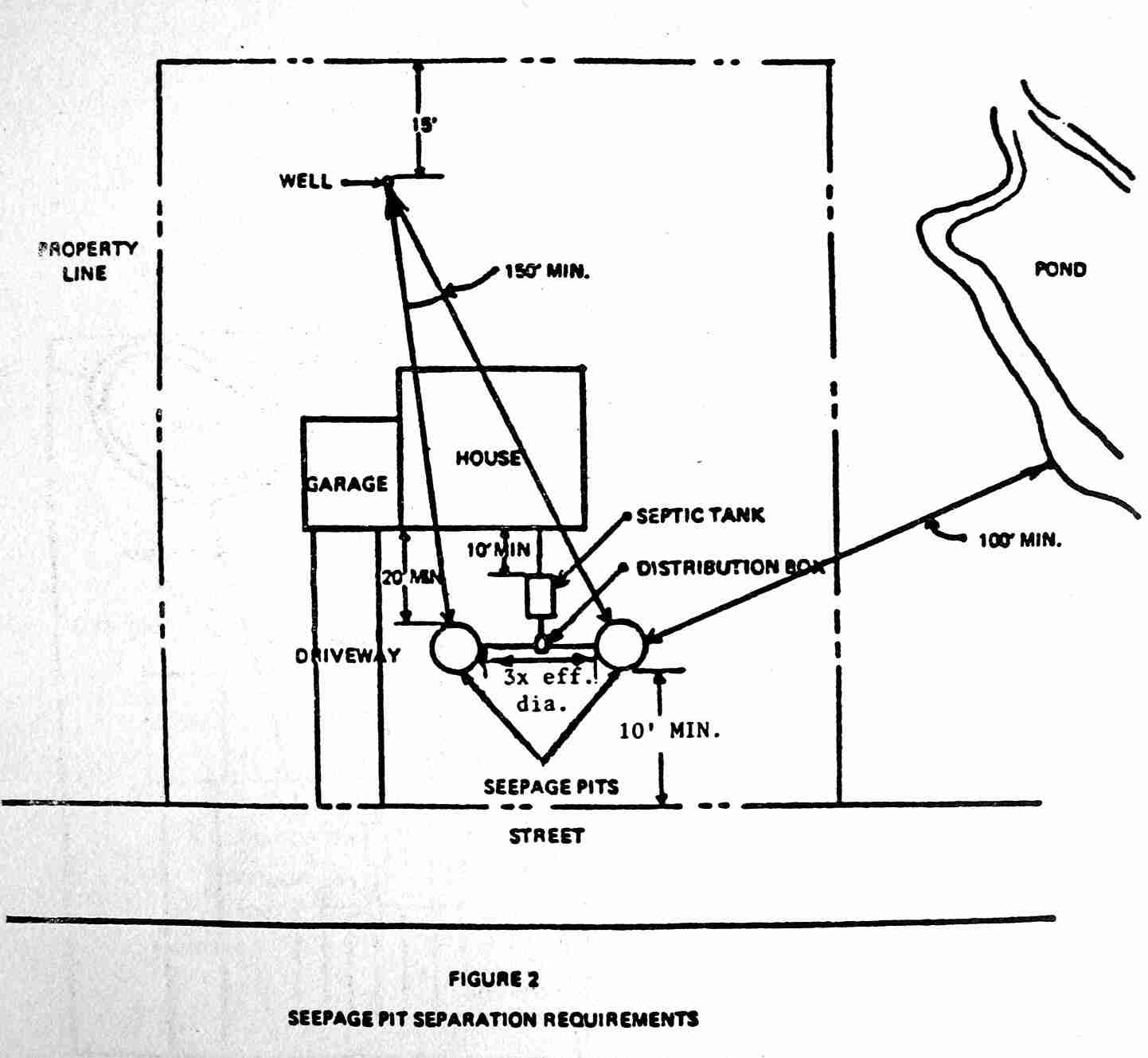
FIGURE 2 - SEEPAGE PIT SEPARATION REQUIREMENTS
TABLE 2 - Separation Distances (in feet) From Wastewater System Component to Well, Stream, Lake, Watercourse or Other Components |
||||
| System Component | Well or Well Water Suction Line | Distance to Lake, Watercourse (b) or Wetland | Distance to Dwelling | Distance to Property Line |
| House Sewer Piping (water-tight joints) | 25 if cast iron sewer pipe 50 otherwise |
25 | 3 | 10 |
| Septic tank or watertight ETU | 50 | 50 | 10 | 10 |
| Effluent line to distribution box | 50 | 50 | 10 | 10 |
| Distribution Box | 100 | 100 | 20 | 10 |
| Absorption Field (c)(d) | 100 (a) | 100 | 20 | 10 |
| Seepage Pit (d) | 100 (a) | 100 | 20 | 10 |
| Raised or Mound Septic Absorption Bed (c)(d) | 100 (a) | 100 | 20 | 10 |
| Intermittent Sand Filter (d) | 100 (a)(f) | 100 (f) | 20 | 10 |
| Non-Waterborne Systems with offsite residual disposal | 50 | 50 | 20 | 10 |
| Non-Waterborne Systems with onsite discharge | 100 | 50 | 20 | 10 |
NOTES to the table on Septic Separation Distances
See SEPTIC CLEARANCE DISTANCES for a more extensive table of recommended clearances and distances between septic system or well components and other site features
Also see SEPTIC COMPONENT LOCATION and see SEPTIC DRAINFIELD LOCATION
(a) When sewage treatment systems are located in coarse gravel or upgrade and in the general path of drainage to a well, the closest part of the treatment system shall be at least 200 feet away from the well.
(b) Mean high water mark.
(c) For all systems involving the placement of fill material, separation distances are measured from the toe of the slope of the fill.
(d) Separation distances shall also be measured from the edge of the designated additional usable area as described in Section 75-A.4 (a)(5).
(e) The closest part of the wastewater treatment system shall be located at least 10 feet from any water service line (e.g. public water supply main, public water service line or residential well water service line).
(f) When sand filters are designed to be watertight and collect all effluent, the separation distance can be reduced to 50 feet.
(g) The listed water well separation distances from contaminant sources shall be increased by 50% whenever aquifer water enters the water well at less than 50-feet below grade. If a 50% increase can not be achieved, then the greatest possible increase in separation distance shall be provided with such additional measures as needed to prevent contamination.
(c) Soil Investigation for Septic System Design & Installation Approval
Details are at SEPTIC SOIL & PERC TESTS
(1) The highest groundwater level shall be determined
and shall include the depth to the seasonal high groundwater level and the type of water table -- perched, apparent, or artesian.
(2) If a subsurface treatment unit such as an absorption field is planned,
at least four feet of usable soil shall be available over impermeable deposits (i.e., clay or bedrock). Highest groundwater level shall be at least two feet below the proposed trench bottom. Where systems are to be installed above drinking water aquifers, a greater separation distance to bedrock may be required by the local health department having jurisdiction.
At least one test hole at least six feet deep shall be dug within or immediately adjacent to the proposed leaching area to insure that uniform soil and site conditions prevail. If observations reveal differing soil profiles, additional holes shall be dug and tested. These additional holes shall be spaced to indicate whether there is a sufficient area of usable soil to install the system.
Treatment systems shall be designed to reflect the most severe conditions encountered. If the percolation tests results are inconsistent with field determined soil conditions, additional percolation tests must be conducted and the more restrictive tests must be the factor used for the system design.
(3) Specifications for soil percolation septic test holes:
Test holes for seepage pits shall extend to at least mid-depth and full depth of the proposed pit bottom. At least three feet of usable soil shall exist between the pit bottom and rock or other impermeable soil layer and the highest groundwater level.
This shall be confirmed by extending at least one deep test hole three feet below the deepest proposed pit.
(4) Alternatives to soil percolation tests:
A local health department may accept or require other soil tests in lieu of the percolation test when such tests are conducted or observed by local health department personnel.
(d) Soil Percolation Test Detailed Specifications
(1) At least two percolation tests shall be made at the site of each proposed sewage treatment system.
(2) For seepage pits, one test shall be conducted at the bottom depth, and the other at half the pit depth.
If different soil layers are encountered when digging the test pit, a percolation test shall be performed in each layer with the overall percolation rate being the weighted average of each test based upon the depth of each layer.
The local health department having jurisdiction may adopt an alternative procedure for determining the permeability of soil for the installation of seepage pits.
(3) A percolation test is only an indicator of soil permeability and must be consistent with the soil classification of the site as determined from the test holes.
...
Continue reading at SEPTIC SOIL & PERC TESTS for details about how soils are tested when designing or specifying a septic system or soakaway bed, or select a topic from the closely-related articles below, or see the complete ARTICLE INDEX.
Or see these
Recommended Articles
- U.S. SEPTIC AUTHORITIES & DESIGN SPECIFICATIONS
- SEPTIC & SEWAGE TREATMENT CODES & REFERENCES
- SEPTIC SOIL & PERC TESTS
- PERC HOLE SPECIFICATIONS
- PERC TEST STANDARDS
- SOAKBED SOIL CONDITIONS
- SOIL & SITE EVALUATION for SEPTIC SYSTEMS
- SEPTIC SYSTEM DESIGN BASICS - home
Suggested citation for this web page
SOIL & SITE EVALUATION for SEPTIC SYSTEMS at InspectApedia.com - online encyclopedia of building & environmental inspection, testing, diagnosis, repair, & problem prevention advice.
Or see this
INDEX to RELATED ARTICLES: ARTICLE INDEX to SEPTIC SYSTEMS
Or use the SEARCH BOX found below to Ask a Question or Search InspectApedia
Ask a Question or Search InspectApedia
Questions & answers or comments about soil percolation test regulations & procedures - testing soil suitability for installation of a septic effluent disposal system, drainfield, leach field, soakaway bed.
Try the search box just below, or if you prefer, post a question or comment in the Comments box below and we will respond promptly.
Search the InspectApedia website
Note: appearance of your Comment below may be delayed: if your comment contains an image, photograph, web link, or text that looks to the software as if it might be a web link, your posting will appear after it has been approved by a moderator. Apologies for the delay.
Only one image can be added per comment but you can post as many comments, and therefore images, as you like.
You will not receive a notification when a response to your question has been posted.
Please bookmark this page to make it easy for you to check back for our response.
Our Comment Box is provided by Countable Web Productions countable.ca
Citations & References
In addition to any citations in the article above, a full list is available on request.
- New York State Department of Health, APPENDIX 75-A WASTEWATER TREATMENT STANDARDS - INDIVIDUAL HOUSEHOLD SYSTEMS , [PDF] New York State Department of Health, 3 February 2010, retrieved 3/1/2010, original source: https://www.health.ny.gov/regulations/nycrr/title_10/part_75/appendix_75-a.htm
- US EPA ONSITE WASTEWATER TREATMENT SYSTEMS MANUAL [online copy, free] Top Reference: US EPA's Design Manual for Onsite Wastewater Treatment and Disposal, 1980, available from the US EPA, the US GPO Superintendent of Documents (Pueblo CO), and from the National Small Flows Clearinghouse. Original source http://www.epa.gov/ORD/NRMRL/Pubs/625R00008/625R00008.htm Onsite wastewater treatment and disposal systems, Richard J Otis, published by the US EPA. Although it's more than 20 years old, this book remains a useful reference for septic system designers. U.S. Environmental Protection Agency, Office of Water Program Operations; Office of Research and Development, Municipal Environmental Research Laboratory; (1980)
- Eco John® Innovative Toilet Solutions, Global Inventive Industries, Fountain Valley CA, PDF, product brochure
- "International Private Sewage Disposal Code," 1995, BOCA-708-799-2300, ICBO-310-699-0541, SBCCI 205-591-1853, available from those code associations.
- "Manual of Policy, Procedures, and Guidelines for Onsite Sewage Systems," Ontario Reg. 374/81, Part VII of the Environmental Protection Act (Canada), ISBN 0-7743-7303-2, Ministry of the Environment,135 St. Clair Ave. West, Toronto Ontario M4V 1P5 Canada $24. CDN.
- Manual of Septic Tank Practice, US Public Health Service's 1959.
- Onsite Wastewater Disposal, R. J. Perkins; Quoting from Amazon: This practical book, co-published with the National Environmental Health Association, describes the step-by-step procedures needed to avoid common pitfalls in septic system technology. Valuable in matching the septic system to the site-specific conditions, this useful book will help you install a reliable system in both suitable and difficult environments. Septic tank installers, planners, state and local regulators, civil and sanitary engineers, consulting engineers, architects, homeowners, academics, and land developers will find this publication valuable.
- Onsite Wastewater Treatment Systems, Bennette D. Burks, Mary Margaret Minnis, Hogarth House 1994 - one of the best septic system books around, suffering a bit from small fonts and a weak index. (DF volunteers to serve as indexer if Burks/Minnis re-publish this very useful volume.)While it contains some material more technical than needed by homeowners, Burks/Minnis book on onsite wastewater treatment systems a very useful reference for both property owners and septic system designers. We refer to it often.
- Septic Tank/Soil-Absorption Systems: How to Operate & Maintain, Equipment Tips, U.S. Department of Agriculture, 8271 1302, 7100 Engineering, 2300 Recreation, September 1982, web search 08/28/2010, original source: http://www.fs.fed.us/t-d/pubs/pdfimage/82711302.pdf
- Septic System Owner's Manual, Lloyd Kahn, Blair Allen, Julie Jones, Shelter Publications, 2000 $14.95 U.S. - easy to understand, well illustrated, one of the best practical references around on septic design basics including some advanced systems; a little short on safety and maintenance. Both new and used (low priced copies are available, and we think the authors are working on an updated edition--DF. Quoting from one of several Amazon reviews: The basics of septic systems, from underground systems and failures to what the owner can do to promote and maintain a healthy system, is revealed in an excellent guide essential for any who reside on a septic system. Rural residents receive a primer on not only the basics; but how to conduct period inspections and what to do when things go wrong. History also figures into the fine coverage.
- Septic System Owner's Manual, Lloyd Kahn, Blair Allen, Julie Jones, Shelter Publications, 2000 $14.95 U.S. - easy to understand, well illustrated, one of the best practical references around on septic design basics including some advanced systems; a little short on safety and maintenance. Both new and used (low priced copies are available, and we think the authors are working on an updated edition--DF. Quoting from one of several Amazon reviews: The basics of septic systems, from underground systems and failures to what the owner can do to promote and maintain a healthy system, is revealed in an excellent guide essential for any who reside on a septic system. Rural residents receive a primer on not only the basics; but how to conduct period inspections and what to do when things go wrong. History also figures into the fine coverage.
- Grass is Always Greener Over the Septic Tank, Bombeck, Erma: $ 5.99; FAWCETT; MM; This septic system classic whose title helps avoid intimidating readers new to septic systems, is available new or used at very low prices. It's more entertainment than a serious "how to" book on septic systems design, maintenance, or repair. Not recommended -- DF.
- US EPA ONSITE WASTEWATER TREATMENT SYSTEMS MANUAL Top Reference: US EPA's Design Manual for Onsite Wastewater Treatment and Disposal, 1980, available from the US EPA, the US GPO Superintendent of Documents (Pueblo CO), and from the National Small Flows Clearinghouse. Original source http://www.epa.gov/ORD/NRMRL/Pubs/625R00008/625R00008.htm
- Water Wells and Septic Systems Handbook, R. Dodge Woodson. This book is in the upper price range, but is worth the cost for serious septic installers and designers.
Quoting Amazon: Each year, thousands upon thousands of Americans install water wells and septic systems on their properties. But with a maze of codes governing their use along with a host of design requirements that ensure their functionality where can someone turn for comprehensive, one-stop guidance? Enter the Water Wells and Septic Systems Handbook from McGraw-Hill.
Written in language any property owner can understand yet detailed enough for professionals and technical students this easy-to-use volume delivers the latest techniques and code requirements for designing, building, rehabilitating, and maintaining private water wells and septic systems. Bolstered by a wealth of informative charts, tables, and illustrations, this book delivers:
* Current construction, maintenance, and repair methods
* New International Private Sewage Disposal Code
* Up-to-date standards from the American Water Works Association
- Wells and Septic System, Alth, Max and Charlet, Rev. by S. Blackwell Duncan, $ 18.95; Tab Books 1992. We have found this text very useful for conventional well and septic systems design and maintenance --DF. Quoting an Amazon description:Here's all the information you need to build a well or septic system yourself - and save a lot of time, money, and frustration. S. Blackwell Duncan has thoroughly revised and updated this second edition of Wells and Septic Systems to conform to current codes and requirements. He also has expanded this national bestseller to include new material on well and septic installation, water storage and distribution, water treatment, ecological considerations, and septic systems for problem building sites.
- The NSFC Products List has an excellent list of design manuals/modules National Small Flows Clearinghouse (NSFC) now (2019/12/13) hosted at http://www.nesc.wvu.edu/ Tel: 304-293-4191 e-mail info@mail.nesc.wvu.edu.
The National Small Flows Clearinghouse (NSFC) was funded by the U.S. Environmental Protection Agency (EPA) to help America's small communities and individuals solve their wastewater problems through objective information about onsite wastewater collection and treatment systems. NSFC products and information are the only national resource of its type, dealing with small community wastewater infrastructure. or by telephone 800-624-8301 - Advanced Onsite Wastewater Systems Technologies, Anish R. Jantrania, Mark A. Gross. Anish Jantrania, Ph.D., P.E., M.B.A., is a Consulting Engineer, in Mechanicsville VA, 804-550-0389 (2006), Advanced Onsite Wastewater Systems Technologies. Outstanding technical reference especially on alternative septic system design alternatives. Written for designers and engineers, this book is not at all easy going for homeowners but is a text we recommend for professionals--DF.
CONTINUE READING or RECOMMENDED ARTICLES.
- Carson, Dunlop & Associates Ltd., 120 Carlton Street Suite 407, Toronto ON M5A 4K2. Tel: (416) 964-9415 1-800-268-7070 Email: info@carsondunlop.com. Alan Carson is a past president of ASHI, the American Society of Home Inspectors.
Thanks to Alan Carson and Bob Dunlop, for permission for InspectAPedia to use text excerpts from The HOME REFERENCE BOOK - the Encyclopedia of Homes and to use illustrations from The ILLUSTRATED HOME .
Carson Dunlop Associates provides extensive home inspection education and report writing material. In gratitude we provide links to tsome Carson Dunlop Associates products and services.
 | HOME | ABOUT | ASK a QUESTION | CONTACT | CONTENT USE POLICY | DESCRIPTION | POLICIES | PRIVACY | |
| © 2024 - 1985 Publisher InspectApedia.com - Daniel Friedman | |||||||||