
InspectAPedia® FREE Encyclopedia of Building & Environmental Construction, Diagnosis, Maintenance & Repair |
Question? Just ask us! InspectAPedia
|
 Raised Bed Septic System Design & Model Regulations
- POST a QUESTION or COMMENT about raised bed septic design specifications, construction, maintenance, or repair
Raised bed septic design regulations:
This document uses the New York State wastewater treatment standard for individual household septic systems (Appendix 75-A) to provide an example of state regulated design and installation of alternative septic system designs, including raised septic systems, septic mound systems, intermittent sand filter septic systems, and evaportion-transpiration septic systems.
InspectAPedia tolerates no conflicts of interest. We have no relationship with advertisers, products, or services discussed at this website.
Regulations for the Design of Raised Septic Systems Design Criteria
Source for this model septic design and regulation guide is Title: Appendix 75-A.9 - Alternative Septic Systems [Regulation and System Design Criteria for Raised Septic Systems, Septic Mound Systems, Intermittent Sand Filter Bed Systems, Evaporation-Transpiration Septic Systems, Evaporation-Transpiration Absorption Septic Systems, and Other Alternative Septic Systems] Effective Date: 12/01/1990
See details also at RAISED BED SEPTIC SYSTEMS
(1) General: Raised Septic Systems
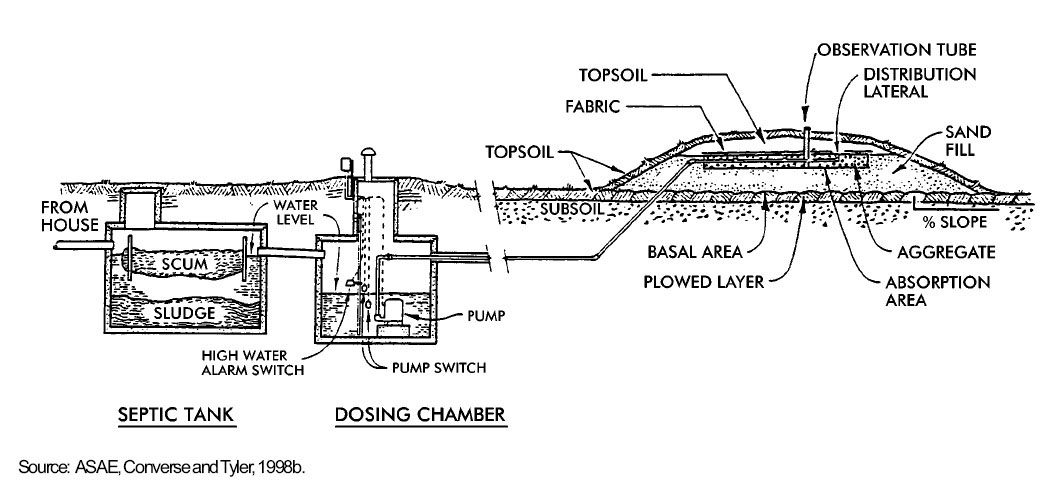
A raised septic system [or raised bed septic system] is an absorption trench system constructed in fill material with acceptable permeability placed above the natural soil on a building lot.
[DF: Note: while they are similar in design "raised septic systems" discussed here are not identical to "mound septic systems" discussed at SEPTIC MOUND DESIGN SPECIFICATIONS which have different site requirements]
(2) Site Requirements for Raised Septic Systems
A raised system may be used where all the following conditions are found:
(i) There is at least one foot of original soil with a faster than 60 minutes percolation rate, above any impermeable soil layer or bedrock, but not more than two feet.
(ii) The maximum high groundwater level must be at least one foot below the original ground surface.
(iii) Slopes shall not exceed 15%.
(iv) All minimum vertical and horizontal separation distances can be maintained as described in Table 2.
(3) Design Criteria for Raised Bed Septic Systems
(i) Percolation tests shall be conducted in the fill material at the borrow pit and after placement and settling at the construction site. The slower percolation rate of these tests shall be used for design purposes.
(ii) The total area beneath the absorption trenches, extending 2.5 feet in all directions from the outer edge of all trenches, is defined as the basal area. The minimum size of the basal area of the raised bed shall be calculated based upon 0.2 gpd/sq.ft.
(iii) An absorption trench system as described in Section 75-A.8(b) is designed using the percolation rate of the fill material. The use of slowly permeable soils for the fill material will result in a trench system that will have a basal area larger than the minimum area calculated in (ii) above.
(iv) Sufficient soil with a percolation rate of between 5 - 30 min/in is required to maintain at least two feet separation between the proposed bottom of the trenches and any boundary condition such as groundwater, bedrock, clay or other relatively impermeable soil or formation.
(v) The edge of the fill material shall be tapered at a slope of no greater than one vertical to three horizontal with a minimum 20 foot taper.
(vi) Horizontal separation distances shall be measured from the outside edge of the taper.
(vii) The system shall incorporate siphon dosing or pressure distribution except where the following conditions are met:
(aa) The local health department has a program incorporating site evaluation, system design approval, and construction inspection/certification.
(bb) A minimum of two feet of fill material with a percolation rate of 5 - 30 min/in shall be placed between the bottom of the trenches and the existing ground.
(viii) Curtain drains may be used to intercept and carry underground water away where high groundwater levels exist. Curtain drains shall be upslope from the system and at least 20 feet from the toe of slope of the fill material.
[See: Curtain drains or intercept drains can protect septic drainfields in areas of wet soils or surface and subsurface groundwater]
(4) Construction details for raised bed septic systems
(i) Heavy construction equipment shall not be allowed within the area of the system. The underlying soil shall be undisturbed although the surface may be plowed with at least a double bottomed blade/furrow plow and the furrow turned upslope.
(ii) A system shall not be built in un-stabilized fill material. The fill material shall be allowed to settle naturally for a period of at least six months to include one freeze-thaw cycle.
(iii) The absorption trenches shall be constructed in the fill material.
(iv) The entire surface of the system including the tapers shall be covered with a minimum of six inches of topsoil, mounded to enhance the runoff of rainwater from the system and seeded to grass.
(v) On sloping sites a diversion ditch or curtain drain shall be installed uphill to prevent surface water runoff from reaching the bed area.
...
Continue reading at RAISED BED SEPTIC SYSTEMS for design details for raised bed septic or soakaway systems, or select a topic from the closely-related articles below, or see the complete ARTICLE INDEX.
Or see these
Recommended Articles
- SEPTIC MOUND DESIGN SPECIFICATIONS
- SEPTIC SYSTEM DESIGN ALTERNATIVES - home
- SEPTIC SYSTEM DESIGN BASICS - home
- DICTIONARY of SEPTIC SYSTEM & WASTEWATER TERMS for a more complete dictionary of septic system and wastewater terminology
- SEPTIC CODES & REFERENCES
- SEPTIC & SEWAGE TREATMENT CODES & REFERENCES - home
- U.S. SEPTIC AUTHORITIES & DESIGN SPECIFICATIONS - start of this series
Suggested citation for this web page
RAISED BED SEPTIC DESIGN SPECIFICATIONS at InspectApedia.com - online encyclopedia of building & environmental inspection, testing, diagnosis, repair, & problem prevention advice.
Or see this
INDEX to RELATED ARTICLES: ARTICLE INDEX to SEPTIC SYSTEMS
Or use the SEARCH BOX found below to Ask a Question or Search InspectApedia
Ask a Question or Search InspectApedia
Questions & answers or comments about raised bed septic design specifications, construction, maintenance, or repair.
Try the search box just below, or if you prefer, post a question or comment in the Comments box below and we will respond promptly.
Search the InspectApedia website
Note: appearance of your Comment below may be delayed: if your comment contains an image, photograph, web link, or text that looks to the software as if it might be a web link, your posting will appear after it has been approved by a moderator. Apologies for the delay.
Only one image can be added per comment but you can post as many comments, and therefore images, as you like.
You will not receive a notification when a response to your question has been posted.
Please bookmark this page to make it easy for you to check back for our response.
Our Comment Box is provided by Countable Web Productions countable.ca
Citations & References
In addition to any citations in the article above, a full list is available on request.
- New York State Department of Health, APPENDIX 75-A WASTEWATER TREATMENT STANDARDS - INDIVIDUAL HOUSEHOLD SYSTEMS , [PDF] New York State Department of Health, 3 February 2010, retrieved 3/1/2010, original source: https://www.health.ny.gov/regulations/nycrr/title_10/part_75/appendix_75-a.htm
- US EPA ONSITE WASTEWATER TREATMENT SYSTEMS MANUAL [online copy, free] Top Reference: US EPA's Design Manual for Onsite Wastewater Treatment and Disposal, 1980, available from the US EPA, the US GPO Superintendent of Documents (Pueblo CO), and from the National Small Flows Clearinghouse. Original source http://www.epa.gov/ORD/NRMRL/Pubs/625R00008/625R00008.htm Onsite wastewater treatment and disposal systems, Richard J Otis, published by the US EPA. Although it's more than 20 years old, this book remains a useful reference for septic system designers. U.S. Environmental Protection Agency, Office of Water Program Operations; Office of Research and Development, Municipal Environmental Research Laboratory; (1980)
- Advanced Onsite Wastewater Systems Technologies, Anish R. Jantrania, Mark A. Gross. Anish Jantrania, Ph.D., P.E., M.B.A., is a Consulting Engineer, in Mechanicsville VA, 804-550-0389 (2006), Advanced Onsite Wastewater Systems Technologies. Outstanding technical reference especially on alternative septic system design alternatives. Written for designers and engineers, this book is not at all easy going for homeowners but is a text we recommend for professionals--DF.
CONTINUE READING or RECOMMENDED ARTICLES.
- Carson, Dunlop & Associates Ltd., 120 Carlton Street Suite 407, Toronto ON M5A 4K2. Tel: (416) 964-9415 1-800-268-7070 Email: info@carsondunlop.com. Alan Carson is a past president of ASHI, the American Society of Home Inspectors.
Thanks to Alan Carson and Bob Dunlop, for permission for InspectAPedia to use text excerpts from The HOME REFERENCE BOOK - the Encyclopedia of Homes and to use illustrations from The ILLUSTRATED HOME .
Carson Dunlop Associates provides extensive home inspection education and report writing material. In gratitude we provide links to tsome Carson Dunlop Associates products and services.
 | HOME | ABOUT | ASK a QUESTION | CONTACT | CONTENT USE POLICY | DESCRIPTION | POLICIES | PRIVACY | |
| © 2024 - 1985 Publisher InspectApedia.com - Daniel Friedman | |||||||||