
InspectAPedia® FREE Encyclopedia of Building & Environmental Construction, Diagnosis, Maintenance & Repair |
Question? Just ask us! InspectAPedia
|
 Chemical Toilets - when can we empty a chemical toilet or RV holding tank into a Septic Tank?
- POST a QUESTION or COMMENT about how to dispose of waste from chemical toilets & RV holding tanks
Chemical & RV Toilet or Holding Tank Dumping Locations:
This RV and chemical toilet article describes acceptable ways to empty a chemical toilet, porta-potty, or RV waste holding tank, and answers the question of when these can be emptied into a residential septic tank. Chemical toilets with larger waste reservoirs are used in RV's and campers as well as for full-sized portable toilets or Porta-Johns used at construction sites and at outdoor festivals.
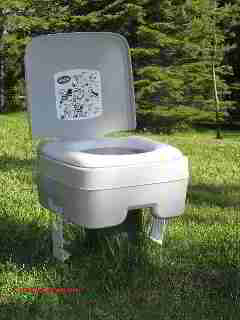
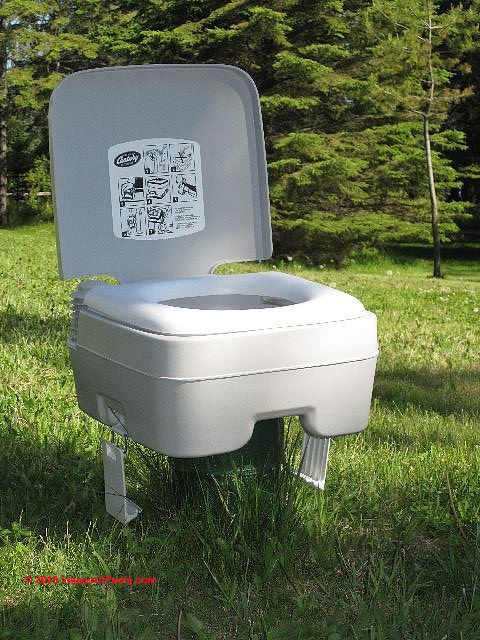
Other common portable toilets include models from Sears, the Coleman, and Reliance toilets who provide a hassock model portable chemical toilet. Our page top photo shows a chemical toilet set atop a septic tank service riser. The chemical toilet's holding tank has been removed so that the toilet empties directly into the septic tank - a perfectly functional emergency toilet setup, but unstable and of course lacking in privacy.
InspectAPedia tolerates no conflicts of interest. We have no relationship with advertisers, products, or services discussed at this website.
Is it Acceptable to Ever Dump an RV Holding Tank or Toilet into a Home Septic System Tank?
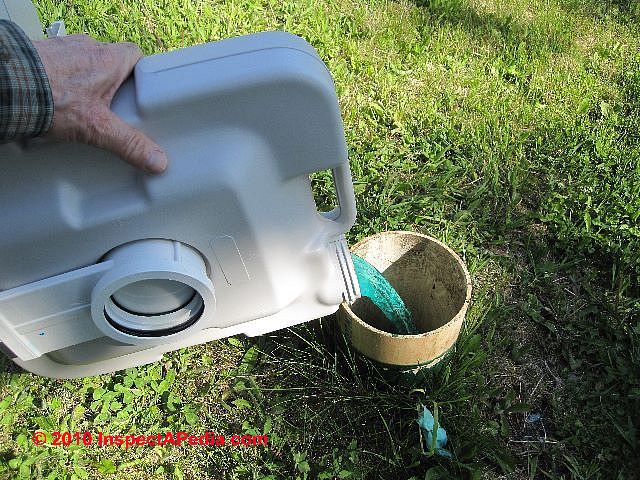 We would not hesitate to occasionally dump a portajohn or small, portable, chemical toilet
into a home septic tank - the volumes are so low, typically
two gallons or so total, that the
deodorants or disinfectants in that small container would be so dilute as not to harm the tank bacteria.
We would not hesitate to occasionally dump a portajohn or small, portable, chemical toilet
into a home septic tank - the volumes are so low, typically
two gallons or so total, that the
deodorants or disinfectants in that small container would be so dilute as not to harm the tank bacteria.
[Click to enlarge any image]
But not only in view of the typical state standard on dumping chemical toilets into the environment, but further and more serious, an RV is a different matter as the holding tank is much bigger. It depends on what chemicals you're using in your RV holding tank.
I'd contact the manufacturer and ask for their literature on this point - if you get something from the manufacturer of your product, pass it on to me.
Here's one example of one manufacturer's comment about dumping RV chemicals into a septic
"Yes [you can empty your RV holding tank into your septic system], as long as your septic system is fully functioning, adequately sized and properly maintained.
If you do, it's important to use only the recommended amount of deodorant in your holding tank and only empty when the tank is full.
Also, because holding tank waste is very concentrated and breakdown takes longer, we recommend you dump only one RV holding tank in a home septic system per week." --Copyright © 2010 Thetford Corporation.
How Much Holding Tank Deodorant Chemical to Use
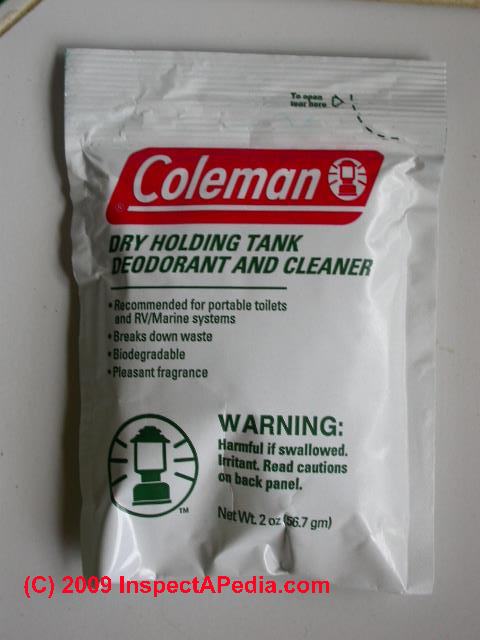
Watch out: don't overdose a small portapotty or chemical toilet with too much RV toilet or RV holding tank deodorant or disinfectant. A typical Coleman™ chemical toilet packet contains enough dry powder to treat a 40-gallon chemical toilet holding tank, such as that found on an RV.
Coleman's PORTABLE TOILET INSTRUCTION MANUAL [PDF] includes advice on using a holding tank deodorant.
The toilet instruction manual suggests adding one 2-oz dry powder packet with one pint of water. But that's to treat 40 gallons of waste. If your portapotty only holds a few gallons, perhaps 4 gallons, you can use much less.
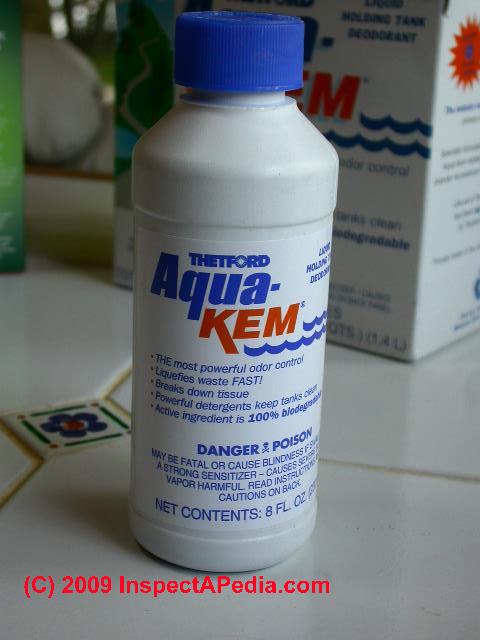
A Thetford Aqua Kem™ liquid [photo] bottle also contains treatment sufficient for an RV tank.
But the little chemical toilet holding tank we show above holds just about two to three gallons of waste. You would want to use about one tenth of the package or container of holding tank deodorant in a little tank like this one.
If you use too much disinfectant it won't damage the toilet, but if you intend to empty your little toilet into a residential septic tank, you don't want to insert more disinfectant or deodorant into the septic tank than is necessary.
These products and their package sizes are intended for RV or marine (boat) septic holding tank use.
Watch out: dumping a chemical toilet or RV waste holding tank into a septic tank might create a problem if users of the chemical or RV toilet are taking antibiotics or other bacteria-killing medicines.
See DISABLED or ELDERLY-USE TOILETS for details.
Biodegradable RV Toilet & Holding Tank Fluids?
The product literature for some septic holding tank additive and toilet cleaner manufacturers such as Elsan's Organic Toilet Fluid - UK informs us that their products are harmless, biodegradable, and acceptable to empty into septic tanks, drainfields, reed beds, etc. We are researching the topic and will report here.
Thetford Corporation's product literature informs us that their Aqua-Kem products are "100% biodegradable liquid and environmentally safe when disposed of properly." We are researching the topic and will report here.
Note that Thetford also informs us that
WARNING: This product contains a chemical known to the State of California to cause cancer.
Marykate Heads Up MKT-4532 is another RV holding tank deodorant with a detergent base and intended for use in marine or RV holding tanks, recirculating and portable toilets. The company specifes that the pproduct has a
"Non-toxic and non-formaldehyde formulation"
Note that the Marykate Heads Up RV & Marine holding tank deodorant label includes some safety warnings that we could not quite read
"Caution: may be harmful if swallowed, may cause eye irritation"
and other text that we could not read
- readers who have one of these bottles and can send us the text are welcome to CONTACT us with that information. Marykate products appear to be produced by CRC Industries, Inc.
Also see Septic & Holding/RV Tank/Toilet Chemicals MSDS
Calculations and Data to Evaluate the Effect of Dumping RV Holding Tanks Into a Septic Tank
 Comment-DF:
What's missing from this is a more scholarly explanation that includes real data such as:
Comment-DF:
What's missing from this is a more scholarly explanation that includes real data such as:
- the size of the RV tank in gallons
- the concentration of and chemistry of the disinfectant/deodorant agent used in the RV tank
- the size of the septic tank in gallons
- the daily wastewater flow other than from the RV dumping that will be available to dilute the RV chemicals
- the concentration of the RV disinfectant chemicals in the septic tank
- the type of septic system - some systems, mound, recirculating sand bed, aerobic, or onsite wastewater treatment mini plants, may have widely varying vulnerabilities to extra chemicals and disinfectants
Photo above: RV dumping station sign near Whangamata, New Zealand.
What are the problems if we empty an RV or other waste holding tank into the septic system?
The concern with dumping RV disinfectants or any chemical into a septic system is that high concentrations of a disinfectant may not only harm the natural bacterial and other actions that occur in the septic tank, worse, it could harm the biomat which forms under and is essential for proper functioning of the drainfield.
With some chemicals there is also the risk that the chemical itself is an environmental contaminant. You can understand why New York State and perhaps other states have taken the position quoted just above.
Considering that the chemical manufacturer says they are confident that their chemical won't harm the system if we follow their instructions, then if you want to develop some real test data, after checking with your local health department to discuss doing a mini-study of this kind:
Go ahead and empty your RV tank into the septic system, Once only, making a note of the volume dumped and the other information listed above. If you don't already have one, install a riser port at the septic tank pumping opening so that you can use the same riser port as a dumping station. You'll just pull the cap off of the riser pipe and connect your RV dumping hose to it.
What else should we do to avoid Damaging the Septic System with our RV?
- DO NOT drive your RV over the septic fields or tank - you can damage or even ruin them
- CHECK your septic tank pumping schedule. I provide a
pumping schedule
at SEPTIC TANK PUMPING SCHEDULE which shows when to clean out the septic tank, and I describe the septic tank pumping procedure
at SEPTIC TANK PUMPING PROCEDURE - A Detailed Guide to Pumping and Cleaning Septic Tanks.
NOW: since you're putting sewage along with deodorant (which probably retards sewage breakdown) into the septic tank, and since we don't have any quantitative data from the manufacturer about how many RV gallons can go how often into a septic tank of any given size (I doubt they know), I would respond by moving up my septic tank pumping schedule to an earlier date.
A Proposed Septic Tank Pumping Schedules if We Empty an Recreational Vehicle Holding Tank into the Septic Tank
The below is ARBITRARY to use as a starting point -
RV gallons put into   Next septic tank Move your tank
tank in one year   pumpout was due  up sooner by

250 gals  1 year  2 months
500 gals  1 year  4 months

250 gals  2 years 0 months
500 gals  2 years 2 months

250 gals  3 years 0 months
500 gals  3 years 0 months
1000 gals 3 years 4 months
FOLLOWUP: IF, when you pump the septic tank+RV-waste and your pumper says that there was no unusually thick floating scum or settled sludge or suspended solid waste, you can begin to push the septic tank pumping schedule back out to the frequency given in my table.
If I can get some more accurate data I will amend this current table (which is completely made-up and speculative) and post it online.
Reader Comments, Questions & Answers About The Article Above
Below you will find questions and answers previously posted on this page at its page bottom reader comment box.
Reader Q&A - also see RECOMMENDED ARTICLES & FAQs
On 2021-06-02 by inspectapedia.com.moderator (mod)
@Victoria, Thank you so much for your very nice note. It means a lot that you took the time and trouble to comment as you did, and of course I'm very happy that our information proved helpful to you.
Indeed we have worked hard for over twenty years to make information at InspectAPedia.com accurate, in-depth, and without bias, so we are of course very grateful when a reader reports that our website has been useful.
To that end, we would much appreciate hearing any comments, critique, suggestions, or further questions that you may have about any of our diagnosis/repair articles.
On 2021-06-02 by Victoria
Thanks for this helpful information!
On 2018-05-07 - by (mod) -
Call local septic pumping companies.On 2018-05-04 by need to find some one to empty my setic tank cant move
how to find a company to empty my tanks on 5 wheel
On 2018-04-10 - by (mod) -
LeslieCall your local septic pumping companies and discuss with them bringing along an appropriate adapter or connections to be able to empty your RV sewage holding tank.
On 2018-04-10 by Leslie Ramirez
I'm trying to find someone who will come out and empty my tank it's set up on blocks so I have no way to move it in Spartanburg South Carolina
On 2017-03-21 - by (mod) -
Connie Coen, if you have a question or comment you're welcome to post it here. The Comments Box software blocks, for security reasons, empty comments and links.On 2015-11-10 - by (mod) -
Jason in Brisbane call Mesa Waste at 1-877-279-5725On 2015-10-12 by jason
I just want to find somewhere in Brisbane to dump my porta potti.it should not be this hard.
...
Continue reading at CHEMICAL TOILETS or select a topic from the closely-related articles below, or see the complete ARTICLE INDEX.
Or see these
Recommended Articles
- CAMPING & EMERGENCY USE TOILETS
- MARINE TOILETS
- PORTABLE TOILET INSTRUCTION MANUAL [PDF]
- SEPTIC SYSTEM & PRODUCT SUPPLIERS - aerobic system pumps, media filters, gravelless systems, other advanced wastewater treatment products including waterless, low water, chemical, and incinerating toilets.
Suggested citation for this web page
RV HOLDING TANK DUMP INTO SEPTIC TANK? at InspectApedia.com - online encyclopedia of building & environmental inspection, testing, diagnosis, repair, & problem prevention advice.
Or see this
INDEX to RELATED ARTICLES: ARTICLE INDEX to TOILET INFORMATION
Or use the SEARCH BOX found below to Ask a Question or Search InspectApedia
Ask a Question or Search InspectApedia
Questions & answers or comments about problems with the operation of aerobic septic systems
Try the search box just below, or if you prefer, post a question or comment in the Comments box below and we will respond promptly.
Search the InspectApedia website
Note: appearance of your Comment below may be delayed: if your comment contains an image, photograph, web link, or text that looks to the software as if it might be a web link, your posting will appear after it has been approved by a moderator. Apologies for the delay.
Only one image can be added per comment but you can post as many comments, and therefore images, as you like.
You will not receive a notification when a response to your question has been posted.
Please bookmark this page to make it easy for you to check back for our response.
Our Comment Box is provided by Countable Web Productions countable.ca
Citations & References
In addition to any citations in the article above, a full list is available on request.
- Elsan Limited, Bellbrook Park, Uckfield, East Sussex TN22 1QF, England. Telephone: +44 (0) 1825 748200. The company produces chemical toilet sanitation and hygiene products for caravanning, camping and boating. Quoting from the company's website: web search 08/27/2010, original source http://www.elsan.co.uk/about-elsan.html
While Elsan Blue toilet fluid exceeds British and European Standards BS:EN 2893:2005, no other brand even claims to comply with them.
... because it is biodegradable and free from harsh chemicals, [Elsan organic toilet fluid] can be safely emptied into a septic tank.
Technical data requested by email to Elsan: 8/27/2010 - DF - Marykate Heads Up holding tank deodorant [MSDS], web search 08/27/2010, original source for the Marykate Heads Up deodorant MSDS
http://www.crcindustries.com/marine/content/prod_detail_print.aspx?PN=MK4532
Marykate products appear to be produced by CRC Industries, - Thetford Corporation, 7101 Jackson Road, Ann Arbor, MI 48103, Tel: 1-800-543-1219, Mailing Address:
P.O. Box 1285, Ann Arbor, MI 48106 web search 08/27/2010, original source: http://www.thetford.com/Home/Products/ChemicalsCleanersHome
/AquaKemLiquidTossInsandDri/tabid/122/Default.aspx Quoting from the company's website:
[Aqua-Kem Products are] 100% biodegradable liquid and environmentally safe when disposed of properly - Also see Septic & Holding/RV Tank/Toilet Chemicals MSDS
- Our recommended books about building & mechanical systems design, inspection, problem diagnosis, and repair, and about indoor environment and IAQ testing, diagnosis, and cleanup are at the InspectAPedia Bookstore. Also see our Book Reviews - InspectAPedia.
- In addition to citations & references found in this article, see the research citations given at the end of the related articles found at our suggested
CONTINUE READING or RECOMMENDED ARTICLES.
- Carson, Dunlop & Associates Ltd., 120 Carlton Street Suite 407, Toronto ON M5A 4K2. Tel: (416) 964-9415 1-800-268-7070 Email: info@carsondunlop.com. Alan Carson is a past president of ASHI, the American Society of Home Inspectors.
Thanks to Alan Carson and Bob Dunlop, for permission for InspectAPedia to use text excerpts from The HOME REFERENCE BOOK - the Encyclopedia of Homes and to use illustrations from The ILLUSTRATED HOME .
Carson Dunlop Associates provides extensive home inspection education and report writing material. In gratitude we provide links to tsome Carson Dunlop Associates products and services.
 | HOME | ABOUT | ASK a QUESTION | CONTACT | CONTENT USE POLICY | DESCRIPTION | POLICIES | PRIVACY | |
| © 2024 - 1985 Publisher InspectApedia.com - Daniel Friedman | |||||||||